
IRS Notices
IRS CP08 Notice: The Additional Child Tax Credit You May Be Owed (2026)
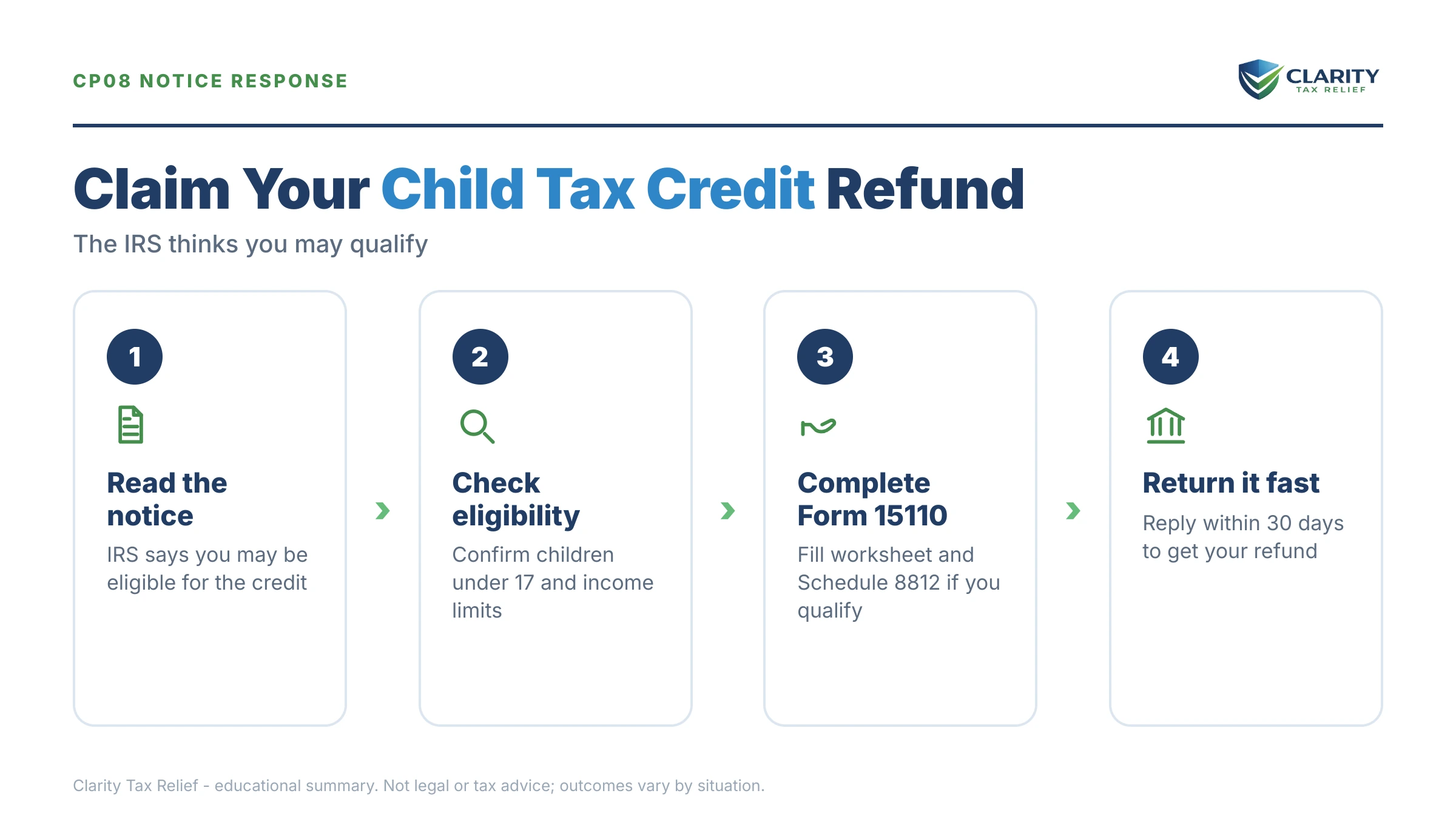
The short answer: a CP08 notice means the IRS believes you may qualify for the Additional Child Tax Credit — worth up to $1,700 per qualifying child — but didn't claim it on your return. Complete the enclosed Form 15110 worksheet; if it shows you qualify, mail it back with Schedule 8812 and the IRS sends your refund.
You braced yourself when you saw the IRS return address — and then the letter said the opposite of what you feared: the government may owe you money. Now you're wondering whether it's a trick, why your own tax software missed a credit, and what this Form 15110 in the envelope actually does. All three questions have clean answers, and none of them involves owing anything.
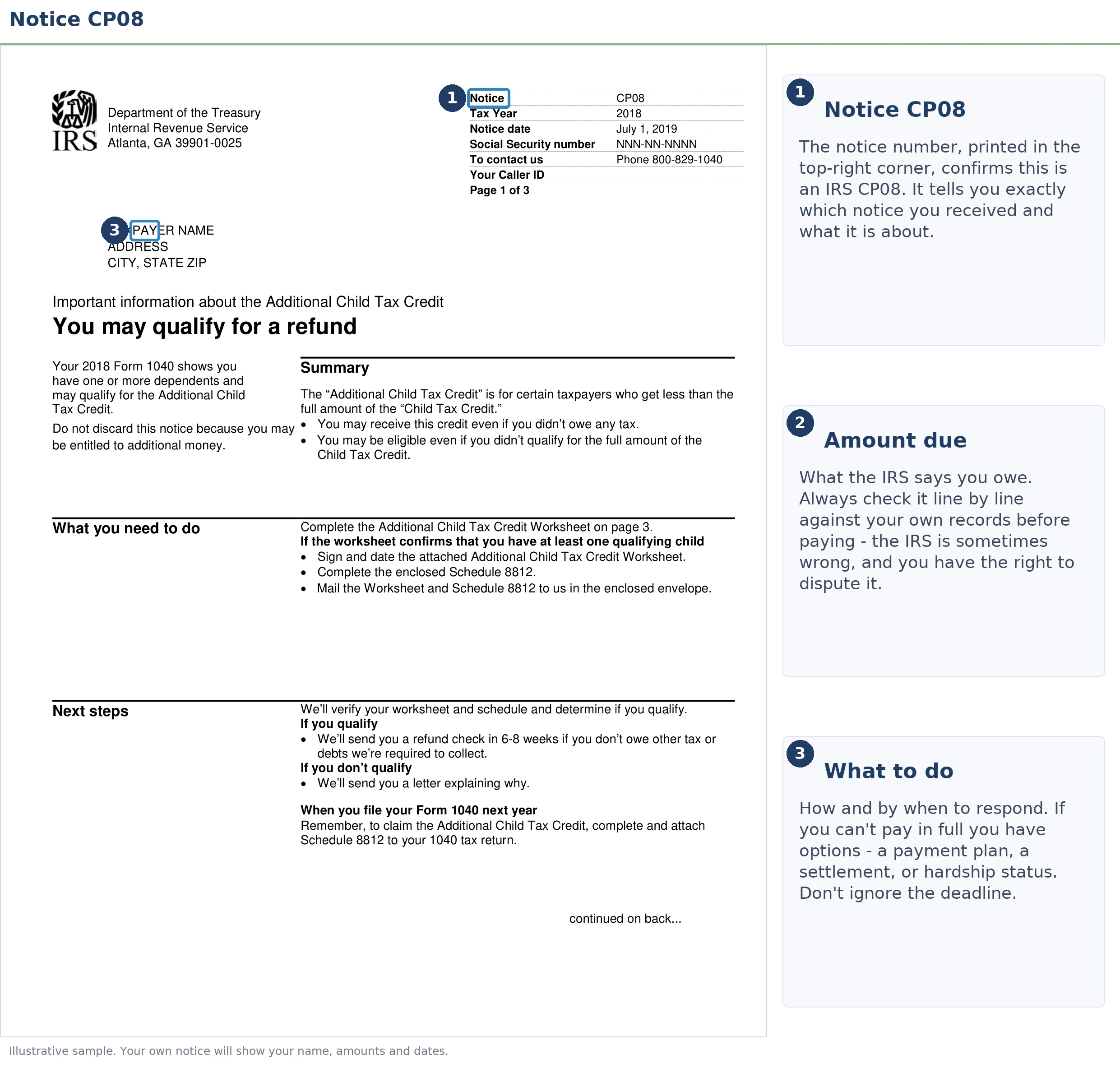
A CP08 is one of a small family of "you may be due money" letters the IRS mails after processing season — this one specifically about the refundable portion of the Child Tax Credit. The image below shows exactly what a genuine CP08 looks like and where to find the tax year, the worksheet reference, and the response address, so you can orient yourself before filling anything out. (For the bigger picture of why any IRS letter arrives, see why did I get a letter from the IRS.)
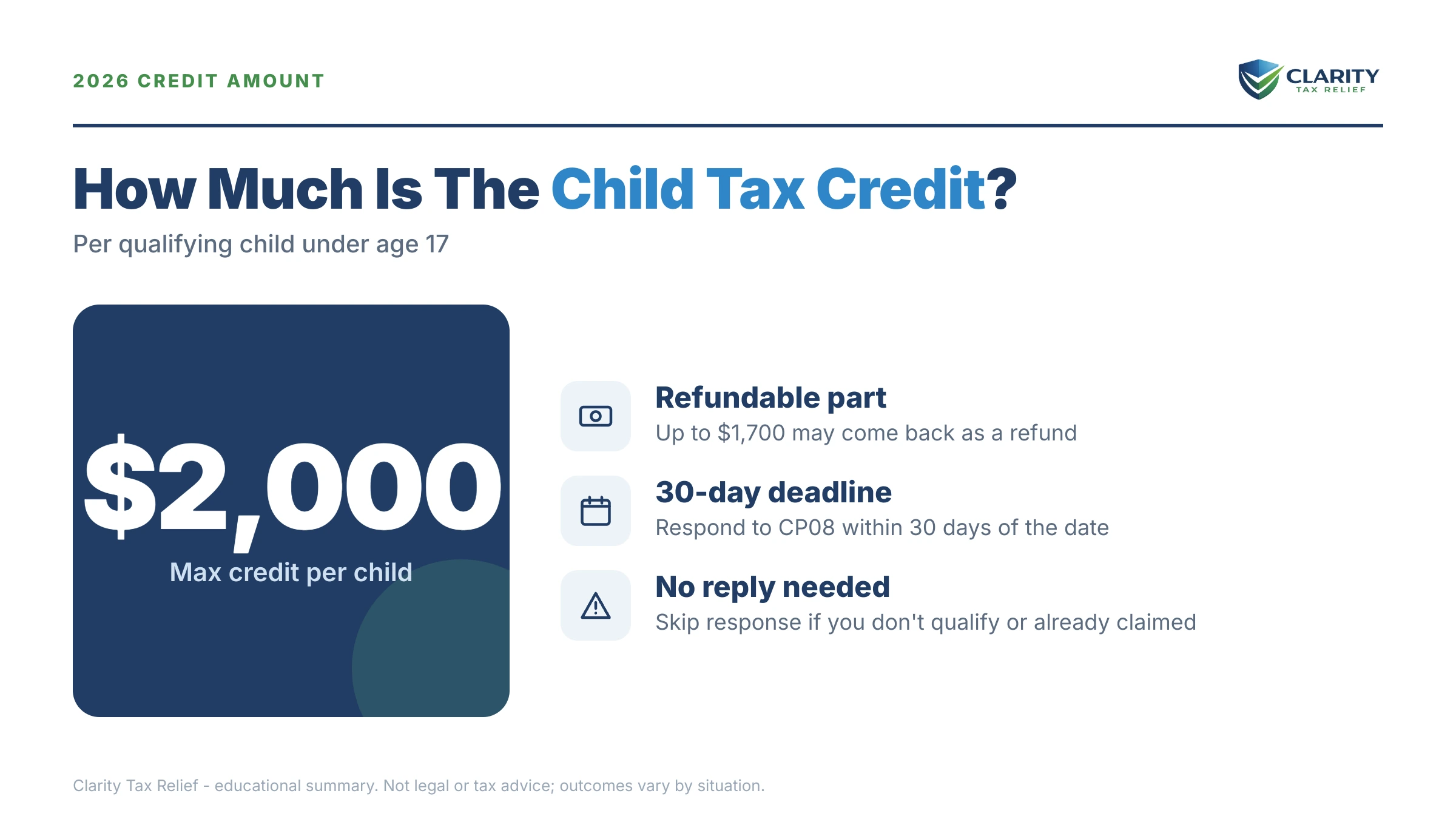
⏱ Your real clock: a CP08 has no short response deadline printed on it — but refunds expire. You generally have three years from the return's original due date to claim this money. Once that refund statute closes, the credit is forfeited permanently, no matter how clearly you qualified.
Why you got a CP08 notice
The IRS sends a CP08 when its computers see dependents and earned income on your return that suggest you may qualify for the Additional Child Tax Credit — but no claim for it. The Additional Child Tax Credit (ACTC) is the refundable piece of the Child Tax Credit: the part the IRS pays out in cash even when you owe zero tax.
That last detail explains most CP08s. If your income was modest enough that your tax before credits was already $0, the ordinary Child Tax Credit had nothing to offset — so your return showed a $0 credit and looked finished. The refundable portion, claimed on Schedule 8812, is a separate calculation, and it's the step that gets skipped: a paper return without the schedule, software that never generated it because a dependent question was answered wrong, or a missing Social Security number that knocked the child out of the computation.
The notice covers one specific tax year — printed near the top, next to the notice date. A CP08 arriving in 2026 usually relates to your 2025 return, but not always; if you filed late or amended, it can reference an older year. Everything you send back must use that year's numbers, not this year's.
First, confirm the CP08 is real
A genuine CP08 arrives only by postal mail and never asks for your bank account number, a processing fee, or gift cards. Refund-bait scams are common precisely because good news makes people click; a fake "you're owed money" text or email is one of the oldest hooks there is.
Two quick checks settle it. First, match your letter against the CP08 image in this guide — the layout, the tax year placement, and the Form 15110 reference are consistent on real notices. Second, log in to (or set up) your IRS online account and confirm the notice appears in your records for that year. If something still feels off, our guide to how to tell if an IRS letter is real covers the remaining tells. The IRS never initiates contact about a refund by email, text, or social media.
Do your children qualify for the Additional Child Tax Credit?
A child qualifies for the credit only by passing every one of the IRS's tests for the year on the notice — and Form 15110 walks you through them as yes/no questions. The table below is the same set of tests in plain English, so you can pre-check before you put pen to paper.
| Test | What the IRS requires for the tax year on the notice |
|---|---|
| Age | The child was under 17 at the end of that tax year. A child who turned 17 during the year does not qualify. |
| Relationship | Your son, daughter, stepchild, eligible foster child, sibling, half-sibling, step-sibling — or a descendant of any of them, such as a grandchild, niece, or nephew. |
| Residency | The child lived with you more than half the year. Temporary absences for school, medical care, or vacation count as time at home. |
| Support | The child provided less than half of their own financial support. |
| Dependent | You claimed the child as a dependent on that year's return. |
| Social Security number | The child has an SSN valid for employment, issued before that return's due date. An ITIN or ATIN does not qualify for this credit. |
| Citizenship | The child was a U.S. citizen, U.S. national, or U.S. resident alien. |
| Joint return | The child didn't file a joint return for the year, except solely to claim a refund of withheld tax. |
Two more requirements sit on your side of the table. The credit begins phasing out at higher incomes — $400,000 of modified AGI for a joint return, $200,000 for others — though if you received a CP08, your income is almost certainly nowhere near that line. And under recent law changes, the taxpayer claiming the credit needs a work-eligible SSN as well; on a joint return, at least one spouse must have one.
If the sticking point is that another household claimed the same child — an ex-spouse, a grandparent — the residency test decides it, and the IRS will ask both sides for proof. Our guide to what happens when both parents claimed the same child walks through how that gets resolved.
How much a CP08 refund is worth: the math
The Additional Child Tax Credit pays 15% of your earned income above $2,500, capped at $1,700 per qualifying child for the 2025 tax year. That formula is the entire calculation, so you can estimate your refund before the worksheet ever leaves the envelope.
Say you and your spouse filed jointly with $27,500 of earned income and two children, ages 6 and 9, who pass every test above. The math runs like this:
- Earned income above the floor: $27,500 − $2,500 = $25,000
- 15% of that amount: $25,000 × 0.15 = $3,750
- Per-child cap: 2 children × $1,700 = $3,400
- Refundable credit: the smaller of the two — $3,400
At $27,500 of joint income, the standard deduction wipes out taxable income, so this couple's tax before credits was already $0 — which is exactly why their return showed no Child Tax Credit and why the CP08 arrived. The entire $3,400 comes to them as a refund. With one qualifying child instead of two, the same income would produce $1,700 (the formula's $3,750 gets capped at one child's limit). This is a hypothetical to show the arithmetic; Schedule 8812 produces your actual figure from your actual return.
What happens if you ignore a CP08 notice
Nothing bad happens if you ignore a CP08 — except that you quietly forfeit money that is legally yours. This is the mirror image of a collection notice: the IRS escalates relentlessly when you owe it, but when it owes you, the sequence is short and ends in silence.
- The credit is never applied. The CP08 proposes the credit; it doesn't grant it. Unlike a math-error correction, the IRS will not add the Additional Child Tax Credit to your account without your signed worksheet.
- The follow-up is minimal. There is no chain of reminder letters for money flowing your direction. For many filers, the CP08 is the only nudge the system ever sends.
- The refund window keeps closing. Refund claims run on a statute — generally three years from the return's original due date. Every season you wait spends down that window, and the same clock governs any earlier years you also missed (see the 3-year refund deadline for old returns).
- The refund statute expires. Once the window closes, the money is gone by law. The IRS cannot pay an expired refund even when its own notice said you appeared to qualify.
For the couple in the example above, doing nothing costs $3,400 — not through any penalty, just through a deadline passing unnoticed.
Holding a CP08 and not sure the worksheet comes out right?
Whether it's a residency question, a child another household also claimed, or back taxes that might swallow the refund — send us the notice. An experienced tax professional will review your CP08 free and tell you exactly what to send back and what to expect.
Your options with a CP08, by situation
The right response to a CP08 depends less on the notice than on your situation — whether the worksheet comes out positive, whether you owe other debts, and whether anyone else claimed the same child. Here's the full map:
| Your situation | What to do | What to expect |
|---|---|---|
| The worksheet shows your children qualify | Complete Form 15110 and Schedule 8812; mail both back in the envelope provided | A refund, typically six to eight weeks after the IRS receives your response |
| The worksheet shows you don't qualify | Don't return the forms; file the notice with that year's records | No refund and no penalty — the CP08 was an invitation, not a demand |
| You already claimed the ACTC on that return | Check your IRS online account before responding — the notice may have crossed with a correction | Compare against any CP12 notice adjustment for the same year first |
| You owe back taxes or other offset-eligible debts | Respond anyway — the credit is still yours to claim | The refund pays your IRS balance first; other government debts may take the rest through the Treasury Offset Program |
| Someone else claimed the same child | Respond only if the child genuinely met the residency test with you | Expect the IRS to ask both households for school, medical, or lease records before paying anyone |
One situation deserves emphasis for married couples: on a joint return, the CP08 belongs to both of you. Check both spouses' SSNs on the original return — a transposed digit on either one can be the entire reason the credit didn't compute, and the worksheet response is your chance to fix it.
CP08 vs. CP09, CP27, and CP12: which credit notice do you have?
The IRS mails several near-identical "you may be due a credit" notices, and each one pairs with a different worksheet. Sending back the wrong form is the most common self-inflicted delay, so confirm which letter you're actually holding:
| Notice | What it says | How you respond |
|---|---|---|
| CP08 | You may qualify for the Additional Child Tax Credit | Return Form 15110, plus Schedule 8812 if the worksheet shows you qualify |
| CP09 notice | You may qualify for the Earned Income Tax Credit with a qualifying child | Return Form 15111 — a different worksheet with different tests |
| CP27 notice | You may qualify for the EITC with no qualifying child | Return Form 15112 |
| CP12 notice | The IRS already corrected your return and computed a refund | Nothing, unless you disagree — you generally have 60 days to dispute the change |
It's common to receive a CP08 and a CP09 for the same year — the ACTC and the EITC have overlapping but different tests, and low-to-moderate earned income can trigger both. Each one requires its own worksheet response; answering one does not claim the other.
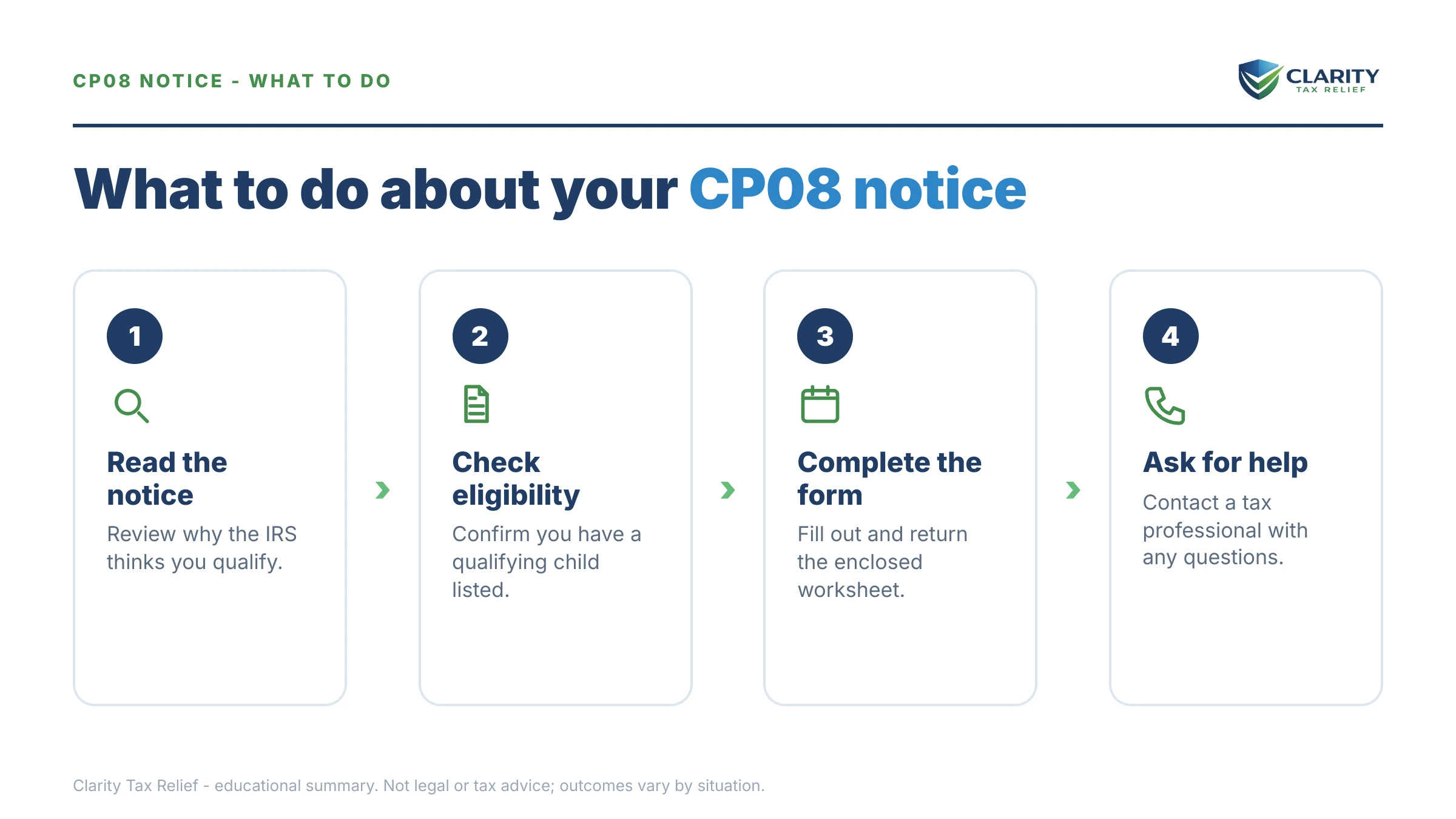
How to respond to a CP08 notice, step by step
- Verify the notice. Log in to your IRS online account and confirm the CP08 matches its records — same tax year, same name, same dependents you listed on that return.
- Complete Form 15110. Answer the qualifying-child questions for the tax year printed on the notice — not the current year. If the worksheet is missing from the envelope, download Form 15110 from IRS.gov.
- Complete Schedule 8812 if the worksheet shows the children qualify. This form computes the actual dollar amount of the credit for that year, using your earned income from that return.
- Mail both forms back. Use the envelope and address printed on the notice, and keep copies of everything you send, including the notice itself.
- Track the refund. Allow typically six to eight weeks from IRS receipt. If you owe back taxes or other offset-eligible debts, expect a notice explaining where the money went instead of a full check.
Notice what's not on the list: an amended return. The CP08 process replaces Form 1040-X for the year on the notice — filing one anyway creates two open claims for the same credit and slows both down.
What happens after you mail Form 15110 back
Once the IRS receives your worksheet, it recalculates that year's return with the Additional Child Tax Credit included and issues the difference as a refund — typically within six to eight weeks. Paper responses are processed by people, not software, and IRS staffing fell sharply in 2025, so build patience into that estimate during peak season.
Three outcomes are possible. Most commonly, the check or deposit simply arrives. Second, the refund arrives smaller or not at all because it was offset: if you owe the IRS for another year, the credit pays that balance first — you'd see something like a CP49 — refund taken for back taxes explaining where it went — and other government debts can intercept the remainder. Even then, claiming the credit was worth it: it retired debt that was growing with interest every month.
Third, and least common, the IRS asks for proof before paying — usually when another return claimed the same child or the residency answer looks thin. If your refund instead goes quiet under a general review, that's the territory of a CP05 notice, and the response rules change. Whatever arrives next, respond to it rather than re-mailing the worksheet; duplicate submissions restart nothing and confuse the file.
One more move worth making while the file is open: if you qualified for the year on the notice, check whether you missed the same credit in adjacent years. The IRS only flags the year it flagged. Earlier years still inside the three-year window can be claimed with Form 1040-X — that one does require an amended return, because no CP08 worksheet exists for it.
When you can handle a CP08 yourself — and when help changes the outcome
Most people can and should handle a CP08 alone. The worksheet is free, the questions are yes/no, the envelope is pre-addressed, and there is no penalty for getting it wrong in either direction — the IRS simply won't pay a credit the facts don't support. If your children clearly pass the tests and you owe nothing else, mail it and move on.
Experienced help earns its cost in a handful of specific situations: a dependent another household also claimed, where the proof package you assemble decides who gets paid; back taxes or unfiled years sitting behind the refund, where the order you fix things determines how much of the credit you actually keep; multiple years of missed credits, where amended returns need to beat the three-year clock; and self-employment income, where "earned income" for the 15% formula isn't always what your bank deposits suggest. In those cases, the CP08 is the visible corner of a larger picture worth mapping before you respond.
Terms on your CP08, decoded
- Additional Child Tax Credit (ACTC): the refundable portion of the Child Tax Credit — the part the IRS pays you in cash even when you owe no tax.
- Form 15110: the worksheet enclosed with your CP08 — a series of yes/no questions that determines whether your children qualify for the credit.
- Schedule 8812: the form that calculates the credit's dollar amount for the year; it attaches to your CP08 response and to future tax returns.
- Qualifying child: a child who passes all of the IRS's tests — age, relationship, residency, support, dependency, citizenship, and SSN — for the year on the notice.
- Refund statute (RSED): the deadline, generally three years from the return's due date, after which an unclaimed refund is forfeited by law.
- Refund offset: the government applying your refund to back taxes or other federal and state debts before paying you whatever remains.
CP08 questions, answered
Is the CP08 notice real or a scam?
A genuine CP08 arrives by postal mail and never asks for bank details, gift cards, or a fee to "release" your refund. The safest check takes five minutes: log in to your IRS online account and confirm the notice matches its records for that tax year. Scammers do imitate refund letters because good news lowers your guard — so verify independently through IRS.gov rather than any contact information in a letter you doubt.
How much is the Additional Child Tax Credit on a CP08?
Up to $1,700 per qualifying child for the 2025 tax year. The refundable amount is calculated as 15% of your earned income above $2,500, capped at $1,700 per child, so the exact figure depends on your income and number of children. Form 15110 walks you through the qualifying questions, and Schedule 8812 computes the dollar amount for the year printed on your notice.
Do I need to file an amended return to respond to a CP08?
No. The CP08 process is designed to skip Form 1040-X entirely — you complete Form 15110, attach Schedule 8812 if the worksheet shows you qualify, and mail both back in the envelope provided. Filing an amended return on top of the worksheet can actually slow things down by creating two open claims for the same credit. Save the 1040-X for earlier years the CP08 doesn't cover.
How long does the CP08 refund take?
Typically six to eight weeks after the IRS receives your completed worksheet, assuming nothing needs manual review. Processing can run longer during heavy backlogs — IRS staffing fell sharply in 2025, and paper responses are handled by people, not software. If part or all of the refund is applied to back taxes or other debts, you'll get a notice explaining the offset instead of the full check.
Will I still get the CP08 refund if I owe back taxes?
Respond anyway, but expect the money to pay your oldest IRS balance first. Whatever remains can also be taken for other federal or state debts — past-due child support, defaulted federal student loans, state income tax — through the Treasury Offset Program. Even when the refund is fully absorbed, claiming it still helps you: it reduces a balance that is otherwise growing with interest every month.
What if the Form 15110 worksheet shows I don't qualify?
Don't return the forms — simply keep the CP08 with that year's tax records. There is no penalty for not responding, because the notice is an invitation, not a demand. The most common reasons the worksheet comes out negative: the child turned 17 during the tax year, lived with you half the year or less, or has an ITIN instead of a work-eligible Social Security number.
Is there a deadline to respond to a CP08 notice?
There's no short response window printed on the notice, but the money itself expires. You generally have three years from the return's original due date to claim a refund; once that refund statute closes, the IRS legally cannot pay you even if you clearly qualified. Respond as soon as you can regardless — your six-to-eight-week refund clock doesn't start until the IRS receives your worksheet.
Why didn't my tax software claim the Additional Child Tax Credit automatically?
Usually because Schedule 8812 never got generated — a skipped dependent question, a missing Social Security number, or a checkbox answered wrong will do it. Paper returns and returns with zero tax liability are the most common CP08 triggers, because with no tax to offset, the ordinary Child Tax Credit shows as $0 and the refundable piece gets overlooked. The IRS's computers cross-check your dependents and income and flag the gap.
Your next 24 hours
- Find the tax year and Form 15110. The tax year and notice date sit near the top right of the letter; the worksheet should be in the same envelope. If it's missing, download Form 15110 directly from IRS.gov — never from a link someone sends you.
- Gather three things: your tax return for that year, each child's Social Security card, and your W-2s or other proof of that year's earned income. That's everything the worksheet and Schedule 8812 need.
- Get a free second look before you mail it. If back taxes, a dependent dispute, or possible missed credits in other years complicate the picture, have an experienced tax professional review the whole file first — the 2-minute form or (888) 825-7779. Interest keeps compounding on any balance the refund could be paying down, so sooner beats later.
Official references: the IRS's own explainer at Understanding your CP08 notice, the credit-calculation form at About Schedule 8812, and — if your response goes unanswered for months — the Taxpayer Advocate Service.
This guide is general information, not tax or legal advice for your specific situation. Eligibility for IRS programs depends on individual facts and circumstances; no outcome is guaranteed.