
IRS Notices
IRS CP501 Notice: What It Means, Your Deadline, and What to Do (2026)
The short answer: a CP501 notice is the IRS's first reminder that you still owe a tax balance — it means the earlier CP14 bill got no response. No levy can happen at this stage, but penalties and interest are compounding, and you typically have about 21 days from the notice date to pay or start a payment plan.
You handled the first IRS letter by not handling it — life got busy, the amount felt impossible, or maybe that first bill never reached you at all. Now a CP501 is sitting on the counter with the word "reminder" printed near the top, and it's clear the balance didn't quietly go away. Here's the honest picture: at the CP501 stage, nothing has been taken from you, and every fix is still cheap, quiet, and on the table.
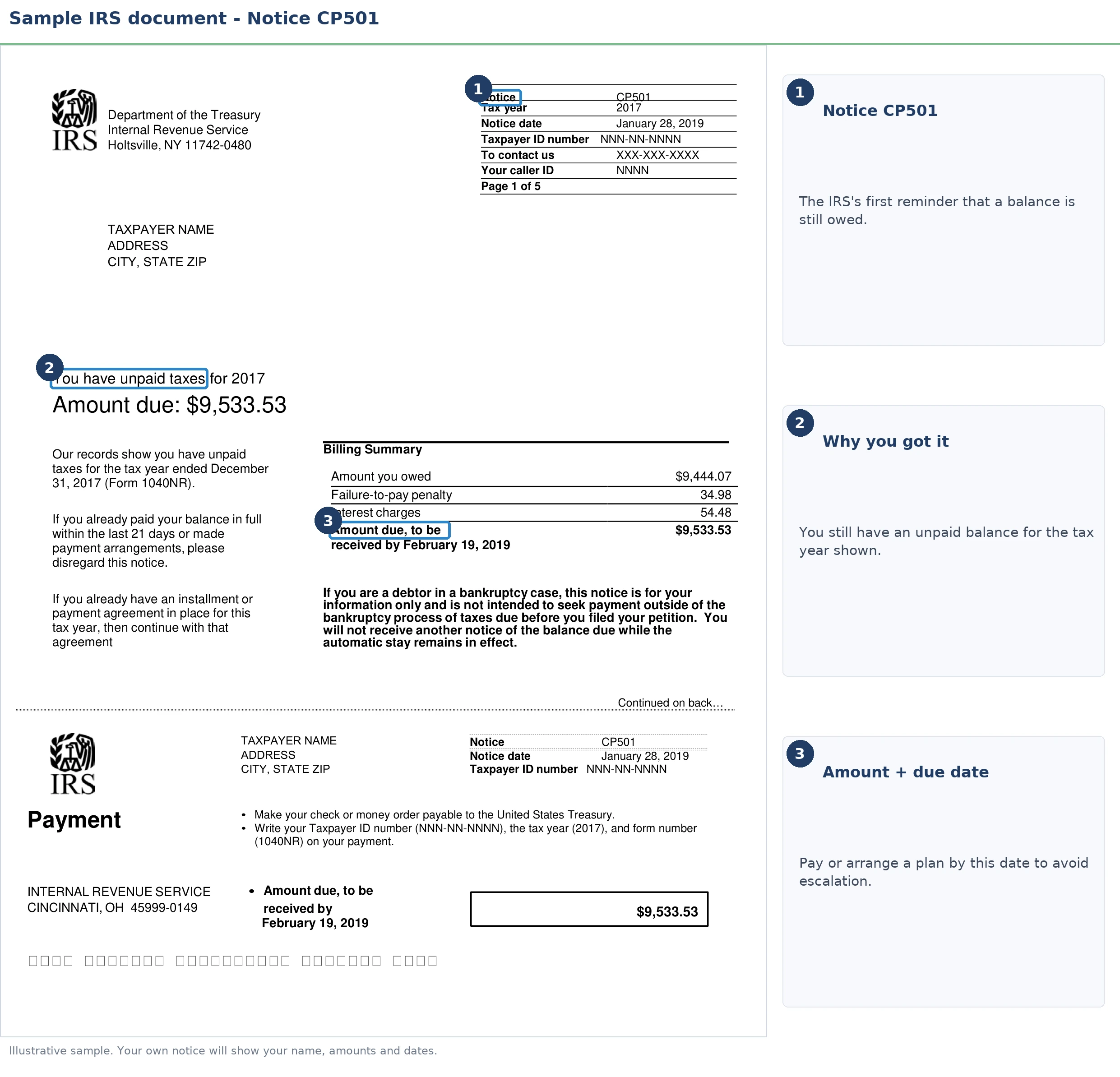
If you're not sure which lines on the page actually matter, the image below shows exactly what a CP501 notice looks like and where to look — the pay-by date and the penalty-and-interest breakdown are the two pieces that control your next move.
⏱ Your deadline: the pay-by date printed on your CP501 — typically about 21 days from the notice date. Interest and the 0.5% monthly failure-to-pay penalty keep accruing past that date, and the IRS's automated system queues the next notice, a CP503, on its own schedule.
Why you got a CP501 notice
A CP501 notice exists for one reason: the IRS billed you once already — usually on a CP14 notice — and its records show no payment and no payment arrangement since. The reminder typically lands about five weeks after the first bill, generated automatically the moment the CP14's window closed with no activity on your account.
The balance printed on the CP501 is bigger than the one on the CP14. That's not a mistake — it now includes another month or more of failure-to-pay penalty and daily-compounding interest. The notice shows the tax year, the original tax, and the penalty and interest lines separately.
How the balance got there usually falls into one of three buckets: you filed and couldn't pay in full; a payment you made posted to the wrong year or the wrong spouse's Social Security number; or the IRS changed your return and created a balance — if that's your situation, the change likely arrived first on a CP11 notice. For the wider map of what any IRS letter means, see why did I get a letter from the IRS.
One note for couples: if the balance comes from a joint return, both spouses owe the entire amount. The IRS can collect the full balance from either of you, no matter whose income created it — and either of you can set up the fix.
What a CP501 is not: an audit, a levy, or a lien. It's a bill on its second lap. Nobody is examining your deductions, and nothing is being seized. Yet.
What happens if you ignore a CP501
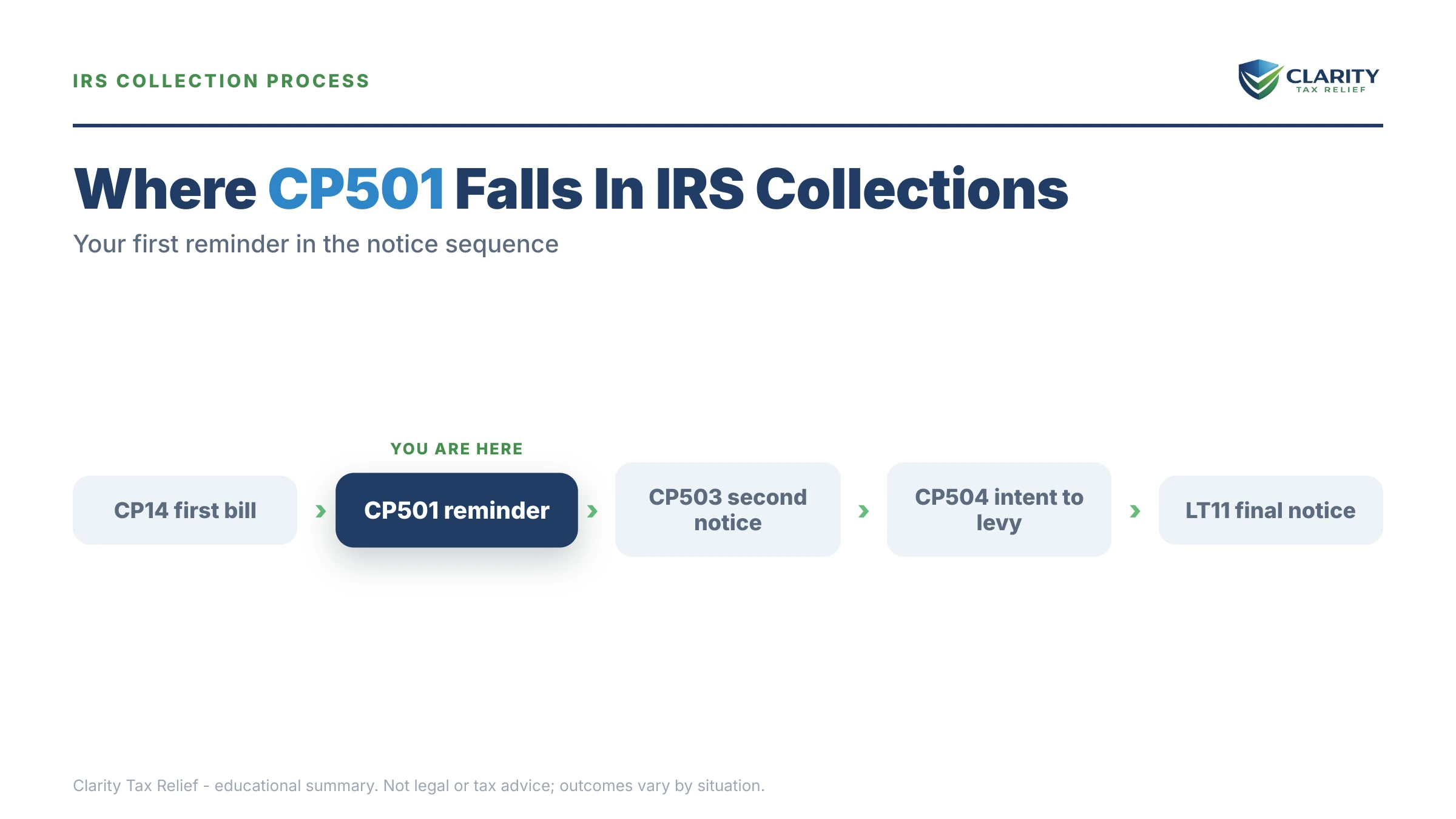
Ignoring a CP501 moves you two notices closer to the IRS taking money: the CP504 that follows can seize your state tax refund, and the LT11 after that authorizes wage and bank levies. The sequence is automated — each unanswered notice triggers the next, typically several weeks apart, with more interest attached and more enforcement power behind it:
- CP14 — the first bill. It gave you roughly 21 days to pay. That window has already closed.
- CP501 — first reminder. You are here. Still no enforcement power — the cheapest remaining moment to act.
- CP503 — second reminder. The tone sharpens, the balance grows, and a federal tax lien becomes a realistic next step.
- CP504 — Notice of Intent to Levy under IRC §6331(d). The IRS can now take your state tax refund, and a lien filing is squarely on the table.
- LT11 / Letter 1058 — the final notice. It starts a 30-day clock and your Collection Due Process rights; once it runs, the IRS can garnish wages and levy bank accounts.
| Notice | Where it falls | What the IRS can do at this stage |
|---|---|---|
| CP14 | First bill (~21 days to pay) | Nothing yet — billing only |
| CP501 | First reminder — you are here | No enforcement; penalties and interest accrue monthly |
| CP503 | Second reminder | Still no levy power; lien filing becomes likelier |
| CP504 | Notice of intent to levy | Can seize your state tax refund; lien filing possible |
| LT11 / Letter 1058 | Final notice | After 30 days: wage and bank levies; CDP appeal rights attach |
One 2026 reality makes this timeline less forgiving than it looks: the IRS workforce was cut roughly 27% in 2025, so reaching a human to sort out a problem is harder than ever — but the notices, liens, and levies come from automated systems that never stopped running. The machine escalates whether or not anyone ever reads your file.
Holding a CP501 right now?
Get it reviewed free before the pay-by date on it passes. An experienced tax professional will confirm whether the balance is even right, and map the option that costs you the least — no pressure, no obligation.
Your options if you can't pay the CP501 balance
Every IRS resolution program is still available at the CP501 stage — nothing has escalated far enough to close a door. The notice presents two choices, pay or else; in reality there are at least six, and which one fits depends on the size of the balance and your finances:
- Pay in full. Ends the penalty clock and the notice sequence immediately. Direct Pay from a bank account is free.
- Short-term payment plan. Up to 180 days with no setup fee. Interest and penalties continue, but the escalation stops.
- Guaranteed installment agreement. For individuals with an income-tax balance of $10,000 or less (excluding penalties and interest) — the official program name is exactly that — the IRS must accept a monthly plan that pays the debt in full within three years, as long as all your returns are filed, you've filed and paid on time for the past five years, and you haven't had an installment agreement during that period. See the guaranteed installment agreement rules.
- Long-term installment agreement. Balances up to $50,000 can be set up online and spread over as long as 72 months. Setup fees vary — lowest for online applications with direct debit, and reduced or waived for low-income taxpayers.
- Currently Not Collectible status. If any payment would leave you unable to cover basic living expenses, collection can be paused entirely. The debt remains and refunds get applied to it, but levies stop. Details in our guide to Currently Not Collectible status.
- Offer in Compromise. Settling for less than the full balance is real but strictly means-tested — the IRS accepted roughly 1 in 5 offers in FY2024, and it runs the math on your assets and income, not your hopes. Here's how an offer in compromise actually works.
- Penalty relief. If your prior three years are clean, first-time penalty abatement can remove the failure-to-pay penalty. Starting summer 2026, the new Automatic Exemption from Penalty (AEP) begins applying qualifying relief automatically, with no request needed.
| Option | Setup cost | Timeline | Best fit |
|---|---|---|---|
| Pay in full | $0 (Direct Pay) | Immediate | You have the funds; stops all accrual |
| Short-term plan | $0 | Up to 180 days | Balance you can clear within six months |
| Guaranteed installment agreement | Fee varies (lowest online, direct debit) | Up to 36 months | Balances of $10,000 or less, returns filed |
| Long-term installment agreement | Fee varies; reduced or waived for low-income | Up to 72 months | Balances up to $50,000, set up online |
| Currently Not Collectible | $0 | Until finances improve; reviewed periodically | Genuine hardship — paying would break the budget |
| Offer in Compromise | $205 fee + 20% down on lump-sum offers (both waived with low-income certification) | Months to two years | Assets and income truly can't cover the debt |
| Penalty abatement (FTA / reasonable cause) | $0 | Weeks | Clean prior 3 years, or events beyond your control |
What an $8,900 CP501 actually costs: a worked example
On an $8,900 balance, the failure-to-pay penalty alone adds $44.50 every month — 0.5% of the unpaid tax — plus daily-compounding interest on top, up to a 25% penalty cap. Say a married couple filing jointly owes $8,900 from last year's return and lets the CP501 sit. Six months of drift means roughly $267 in added penalty ($44.50 × 6) plus interest, pushing the balance toward $9,300 by the time a CP504 arrives — and by then their state refund is exposed too.
Now run the same $8,900 through a plan. At $10,000 or less, the couple fits a guaranteed installment agreement: $8,900 ÷ 36 months ≈ $247 a month before accruals — call it around $260 to finish on schedule. Stretching it across a 72-month long-term agreement drops the base payment to about $124 a month, but roughly doubles the time interest gets to compound, so the total cost is meaningfully higher.
Two details tilt the math further toward acting now. First, the failure-to-pay rate drops to 0.25% per month while an approved installment agreement is in effect — half the drift rate. Second, if the couple's prior three years are clean, first-time abatement can strip the penalty already baked into the notice. You can estimate your own accrual with our Penalty & Interest Calculator. (This is a hypothetical illustration, not a promised result — your figures depend on your rates and dates.)
One more joint-filer note: until the balance is resolved, the IRS will keep the couple's future refunds and apply them to the debt — often the fastest involuntary "payment" people don't see coming.
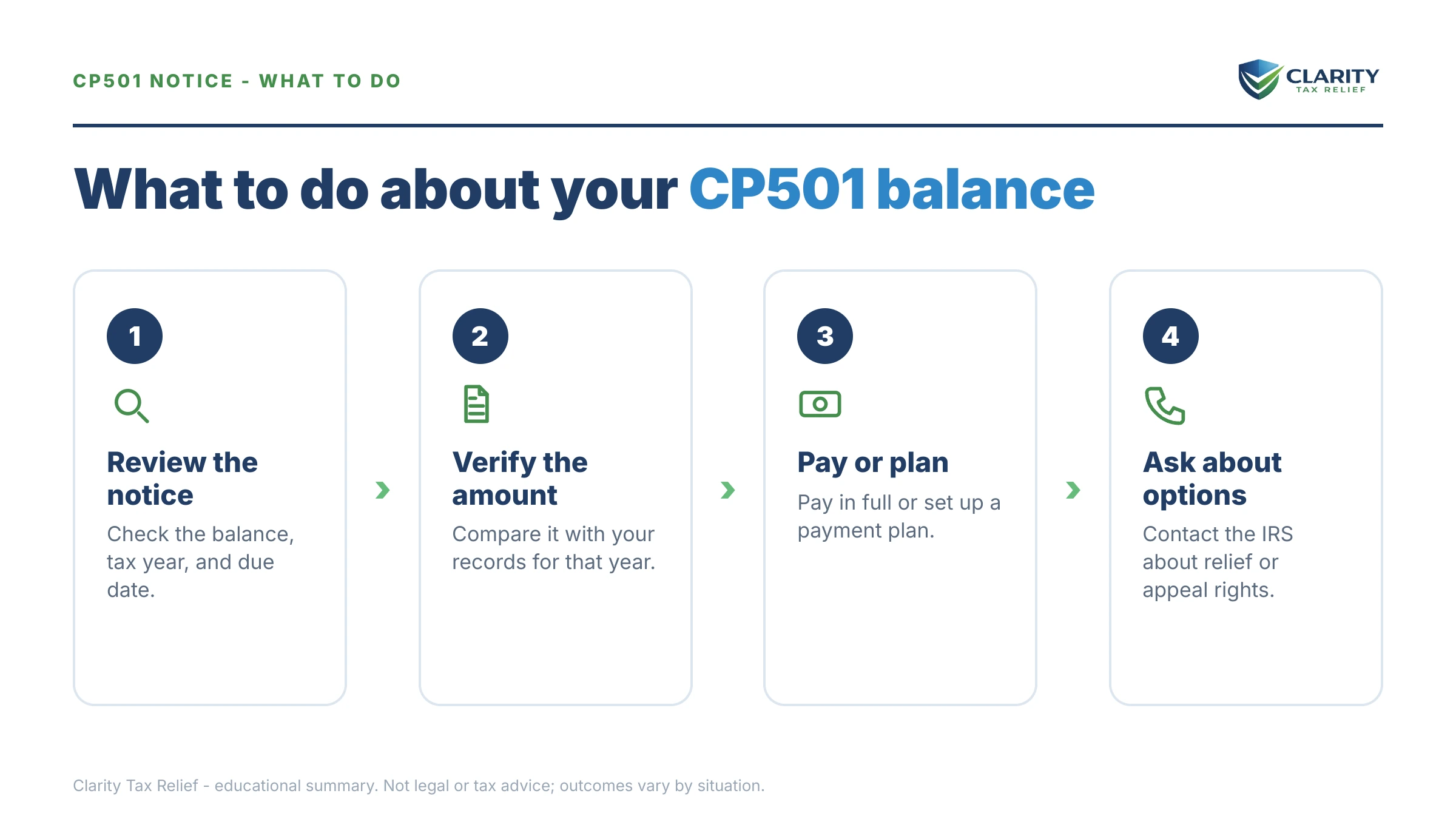
How to respond to a CP501, step by step
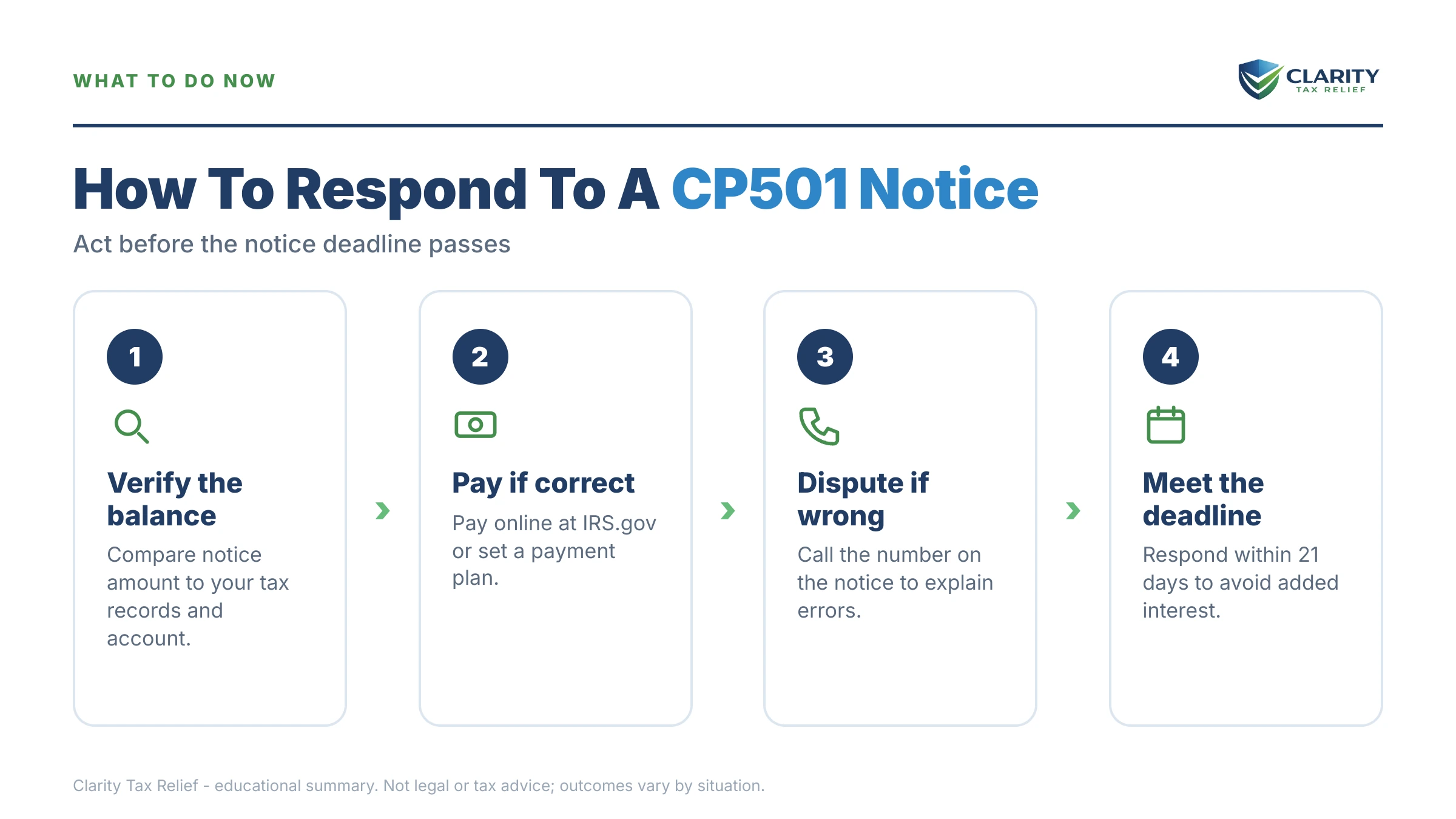
- Verify the balance. Log into your IRS online account and match the CP501's tax year and amount against what actually posted, including every payment you've made.
- Pay in full if you can. Pay by the notice's pay-by date at IRS.gov/payments — Direct Pay from a bank account is free and stops both the penalty clock and the notice sequence.
- Set up a payment plan if you can't. Apply online or file Form 9465; balances under $10,000 generally fit a guaranteed installment agreement, and balances up to $50,000 can be spread over as long as 72 months.
- Request penalty relief. If your prior three years are clean, ask for first-time penalty abatement on the failure-to-pay penalty — it costs nothing to request.
- Dispute in writing if the notice is wrong. Send proof of payment or corrected figures to the address on the notice and keep copies of everything.
- Get a professional review for complications. If you owe for multiple years, have unfiled returns, or genuinely can't afford any payment, have an experienced tax professional map the order of fixes before you commit to a plan.
When you can handle a CP501 yourself
Most people holding a single-year CP501 they agree with do not need professional help. If the balance matches your records, it's under $50,000, and you can either pay within 180 days or afford the monthly payment on an online agreement, the IRS's self-service tools handle it in under an hour — no firm required, including ours.
Experienced help changes outcomes in a narrower set of situations: the balance spans multiple tax years or includes unfiled returns (the order you fix them in changes what you ultimately pay); you dispute the amount and the IRS isn't responding to your letters; the honest math says you can't afford any payment, which puts hardship status or an Offer in Compromise in play; or the debt is tangled with a business or payroll issue. In those cases, the review is about sequencing and eligibility math — not paperwork you couldn't do yourself.
Terms on your CP501, decoded
- Notice date vs. pay-by date: the notice date starts the clock; the pay-by date printed lower on the page is your actual deadline before the next notice queues.
- Failure-to-pay penalty: 0.5% of the unpaid tax per month (part of a month counts), capped at 25% of the tax — and cut in half while an approved payment plan is active.
- Statutory interest: interest set by law, compounding daily on tax and penalties alike; it generally can't be removed except when caused by IRS error or delay.
- Joint and several liability: on a joint return, each spouse owes the entire balance — the IRS can collect all of it from either of you.
- Lien vs. levy: a lien is a legal claim against your property that protects the government's interest; a levy is the actual taking of money or assets. A CP501 involves neither — yet.
- Collection Due Process (CDP) rights: formal appeal rights that attach later, at the LT11/Letter 1058 stage, requested with Form 12153 within 30 days.
The IRS's own summary of this notice is at Understanding your CP501 notice, and payment-plan specifics live on the IRS payment plans page.
CP501 questions, answered
Is a CP501 notice serious?
A CP501 is a mid-level warning: no one can levy your wages or bank account from this notice alone, but you are now two notices away from the CP504 that lets the IRS take your state tax refund. The real cost of ignoring it is compounding — a 0.5% monthly failure-to-pay penalty plus daily interest — and an automated escalation that never forgets your balance.
How long do I have to respond to a CP501 notice?
Your deadline is the pay-by date printed on the notice, typically about 21 days from the notice date. Paying or starting a payment plan by that date stops the escalation to a CP503. Miss it and nothing dramatic happens immediately — but penalties and interest keep accruing, and the next notice is already queued in the IRS's automated system.
What is the difference between a CP501 and a CP503?
They bill the same balance at different stages. A CP501 is the first reminder after the CP14; a CP503 means the IRS has now billed you at least twice with no response, and the next notice is the CP504 intent-to-levy. Neither a CP501 nor a CP503 carries levy power by itself, but each one you ignore shortens the runway before enforcement starts.
Can the IRS levy my bank account after a CP501?
No — a CP501 carries no levy authority. Before the IRS can touch wages or bank accounts, it must send a final notice of intent to levy (LT11 or Letter 1058) and give you 30 days to request a Collection Due Process hearing. The exception coming sooner is your state tax refund, which the IRS can seize once a CP504 is issued.
I already paid — why did I get a CP501?
Usually because a payment crossed in the mail or posted to the wrong place — a wrong tax year, or the wrong spouse's Social Security number on a joint account. Log into your IRS online account and check where the payment landed. If the notice is wrong, respond with proof of payment rather than paying twice; the IRS will not automatically catch its own posting error.
Does a CP501 mean the IRS filed a tax lien?
No. A CP501 warns that a federal tax lien could be filed if the balance stays unpaid — but the filing itself comes later, announced by Letter 3172. The IRS typically does not file liens on smaller balances that get resolved through a payment plan, which is one more reason acting at the CP501 stage keeps the problem quiet and off public records.
We filed jointly — which spouse owes the CP501 balance?
Both of you, in full. A joint return creates joint and several liability, meaning the IRS can collect the entire balance from either spouse regardless of who earned the income. Either spouse can set up the payment plan or make payments. Different rules apply only when the debt belongs to one spouse alone — a pre-marriage year or a separate return — which is an injured- or innocent-spouse question, not a CP501 question.
What if I can't pay anything at all right now?
Ask about Currently Not Collectible status. If paying the IRS would leave you unable to cover basic living expenses, collection can be paused — no levies, no forced payments — while the debt sits. Interest still accrues and future refunds will be applied to the balance, but CNC buys breathing room, and the 10-year collection statute keeps running in the background.
Your next 24 hours
- Find two things on the notice: the pay-by date (your real deadline) and the penalty-and-interest breakdown — those lines tell you how fast the balance is growing and how long you have.
- Gather three things: the CP501 itself, last year's tax return, and your IRS online account login (or create one) so you can see exactly what posted.
- Get a free case review before the pay-by date passes: use the 2-minute form or call (888) 825-7779 — we'll confirm the balance is right and match you to the cheapest fix while every option is still open.
This guide is general information, not tax or legal advice for your specific situation. Eligibility for IRS programs depends on individual facts and circumstances; no outcome is guaranteed.