
IRS Letters
IRS Letter 5447C: How to Verify Your Identity in 2026
The short answer: Letter 5447C means the IRS stopped a tax return filed under your Social Security number and won't process it — or release any refund — until you verify your identity. It's the version sent to filers with foreign addresses or no online option; you respond by phone or mail using the contacts printed on the letter.
You filed months ago, the refund never came, and now an envelope — maybe forwarded halfway around the world — says the IRS needs to confirm you're really you before your return counts. Meanwhile the letters about the balance you already owe haven't stopped. Both problems are fixable, and they're fixed on separate tracks — this page maps both.
The 5447C is unusual in one specific way: unlike the 5071C identity verification letter, it does not send you to the online tool. Your two response paths — a phone number that works from outside the U.S. and a mailing address for a paper response — are printed right on the letter. The image below shows exactly what Letter 5447C looks like and where to find the phone number, the mailing address, and the tax year it's holding hostage.
⏱ The real clock: Letter 5447C has no enforcement deadline — but your return sits unprocessed and any refund stays frozen until you verify. If you're claiming a refund, the three-year refund window keeps running. If you owe on other years, penalties and interest keep accruing while the return waits.
Why did you get Letter 5447C?
Letter 5447C comes from the IRS Taxpayer Protection Program, which pulled a return filed under your SSN out of processing because its filters flagged possible identity theft. Nobody audited you and nobody accused you of anything — an automated screen decided the return looked unusual enough that a human needs you to confirm you filed it.
What makes it a 5447C rather than one of its siblings is your address or access: this version goes out when the account shows an address outside the United States, or when the standard online and domestic toll-free channels aren't available for you. Common triggers include filing with a foreign address for the first time, a first return after years of not filing, a large swing in income, or new bank details for direct deposit. (If you're wondering why the IRS sends letters instead of calling or emailing, our guide to why did I get a letter from the IRS covers how notices work generally.)
If you've been watching your transcript, this letter usually explains the freeze you're seeing there — the 810 freeze verify identity path is the transcript-side view of the same hold.
| Letter | How you verify | Who typically gets it |
|---|---|---|
| 5447C (you are here) | Phone or mail, using the contacts printed on the letter | Filers with foreign addresses, or no access to the online/domestic toll-free channels |
| 5071C | Online tool or phone | Domestic filers whose return tripped identity filters |
| 4883C | Phone only | Returns the IRS wants cleared through a live interview |
| 5747C | In person at a Taxpayer Assistance Center | Highest-risk flags that require face-to-face ID |
| Letter 6330C | Phone verification, per the letter's instructions | A variant used for certain flagged returns |
| Letter 4310C | Follow the letter's specific instructions | Accounts showing signs of possible identity-theft activity |
What happens if you ignore Letter 5447C
Ignoring Letter 5447C doesn't trigger a levy — it quietly guarantees the return you filed never counts. There's no dramatic escalation, which is exactly what makes this letter dangerous: the cost of doing nothing is invisible until it's large. Here's the sequence:
- Your return stays unprocessed. No refund is issued, no payments from the return are credited the way you expect, and Where's My Refund stays stuck.
- The freeze shows on your transcript. The account often carries a refund-freeze marker while the return sits in the Taxpayer Protection Program queue.
- Nobody chases you. With the IRS workforce cut roughly 27% in 2025, no human calls to remind you — the hold is automated and simply persists until you act.
- A frozen refund can expire. Refund claims generally die three years after the return's due date — if the return never processes, that clock can run out. See can I still get a refund from 3 years ago.
- A balance-due return turns you into a non-filer. If your real return showed tax owed and it's never verified, the IRS can treat that year as unfiled — and the failure-to-file penalty runs at 5% per month, ten times the 0.5% failure-to-pay rate (in any month both penalties apply, the failure-to-file portion drops to 4.5%, for 5% combined).
- Collection on other years rolls on regardless. The identity hold applies to one return. Any existing balance keeps accruing penalties and interest, and the levy track keeps moving — more on that below.
Holding a Letter 5447C — and other IRS mail too?
Send us photos of everything you've received. An experienced tax professional will decode where the identity hold stands, what's happening on the collection side, and the exact order to fix things in — free and confidential, with penalties and interest accruing on any balance until it's resolved.
Your options for responding to Letter 5447C
Every 5447C gives you two ways to verify — phone or mail — plus a third path if the return isn't yours, and all three cost nothing. The right one depends mostly on where you are and whether you can reach the IRS during U.S. business hours.
| Response path | What you need | Cost | Typical timeline |
|---|---|---|---|
| Verify by phone | The letter, the flagged return, a prior-year return, W-2s/1099s, photo ID for reference | $0 — though international call charges may apply | One call (expect a hold); the IRS says up to 9 weeks of processing after |
| Verify by mail | Copies of everything on the letter's checklist — never originals | Postage only — use tracked mail | Transit and intake time, then up to 9 weeks of processing |
| Report "not my return" | The letter itself; your own genuine return if you still need to file | $0 | Suspicious return removed; file your real return separately |
The phone path is fastest when it works. The number on a 5447C is reachable from outside the U.S. — the domestic toll-free lines generally aren't — but it isn't toll-free, so plan for hold time and time-zone math. The agent will quiz you on details from both the flagged return and a prior-year return; if you filed jointly, have your spouse available in case the agent needs to speak with both of you. If you keep striking out by phone, or you tried the online tool first and hit a wall, our guide to idverify irs gov not working covers the workarounds.
The mail path is slower but reliable from anywhere. Follow the checklist printed on your letter exactly, send copies rather than originals, and use a tracked service so you can prove delivery. Keep a complete copy of the package you send.
The "I didn't file this" path matters just as much. If the return in the letter isn't yours, say so through the same phone or mail channel — the IRS removes it from your account. Because the IRS already caught the return before processing, you generally don't need the Form 14039 identity theft affidavit for this one — but you should lock down your account with an IP PIN, and our guide to someone filed taxes in my name walks through the full cleanup.
How to respond to Letter 5447C, step by step
- Confirm the letter is real. A genuine 5447C arrives by postal mail and never asks for payment — cross-check its tone against your IRS online account before you respond.
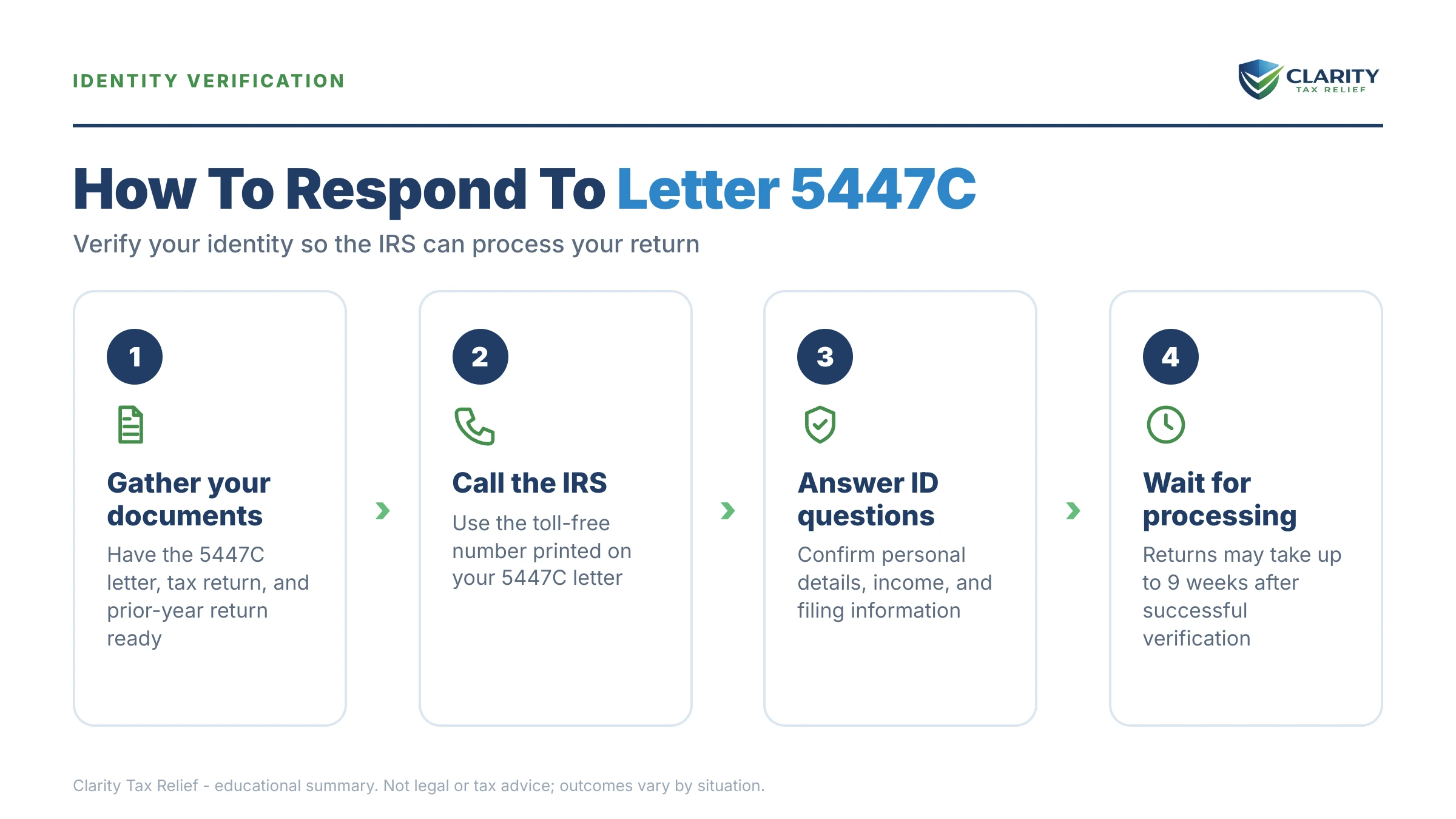
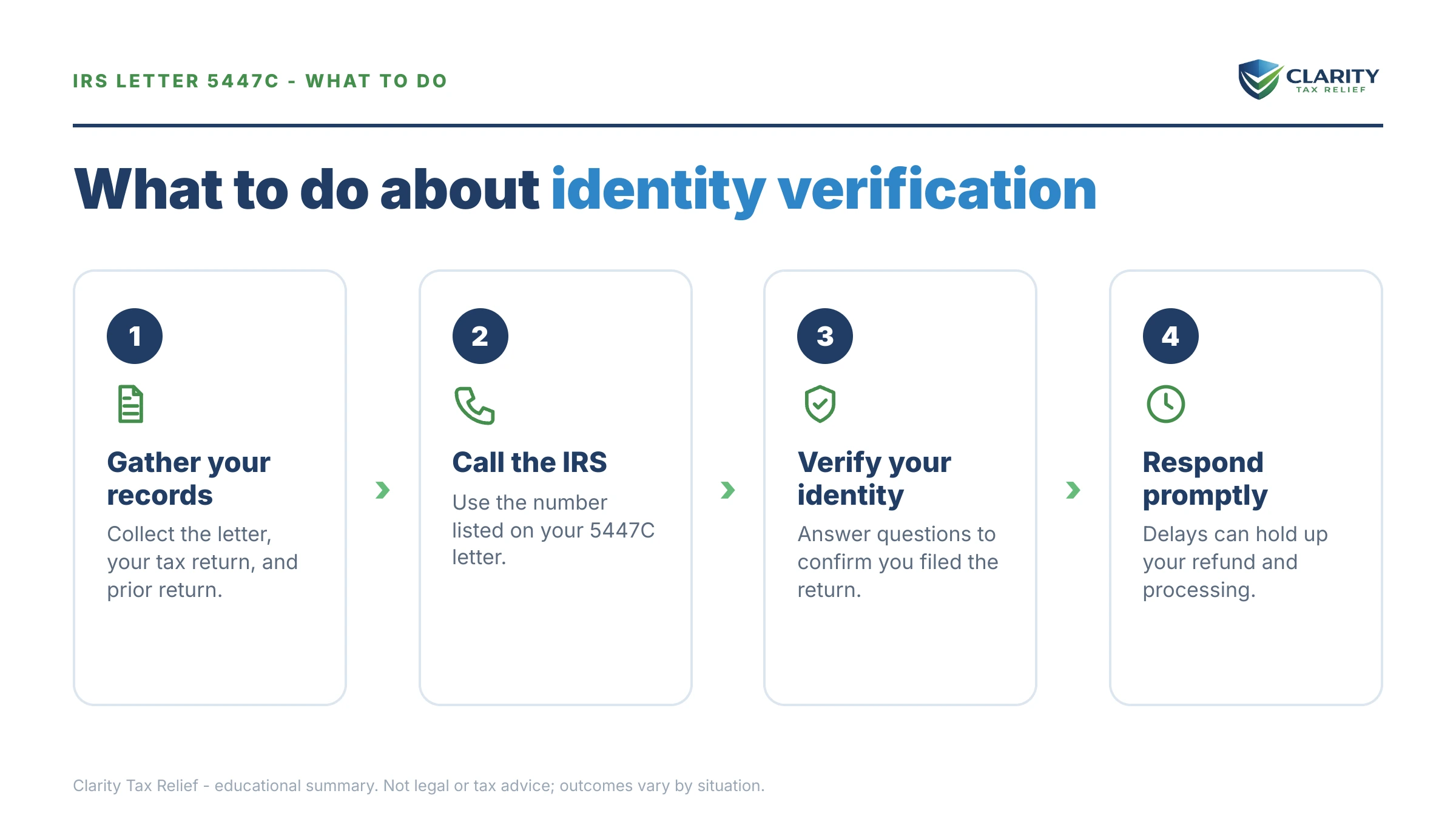
- Gather your documents. You'll need the 5447C letter itself, the tax return it references, a prior-year return if you filed one, and supporting forms like W-2s and 1099s.
- Call the number printed on your letter. The listed number works from outside the U.S. — plan the call around U.S. business hours and expect the agent to walk through both returns line by line.
- Mail your response if you can't get through. Follow the checklist printed on the letter and send copies — never originals — by tracked mail to the exact address it lists.
- Tell the IRS if the return isn't yours. Use the same call or mailed response to report that you didn't file it, so the return is removed from your account.
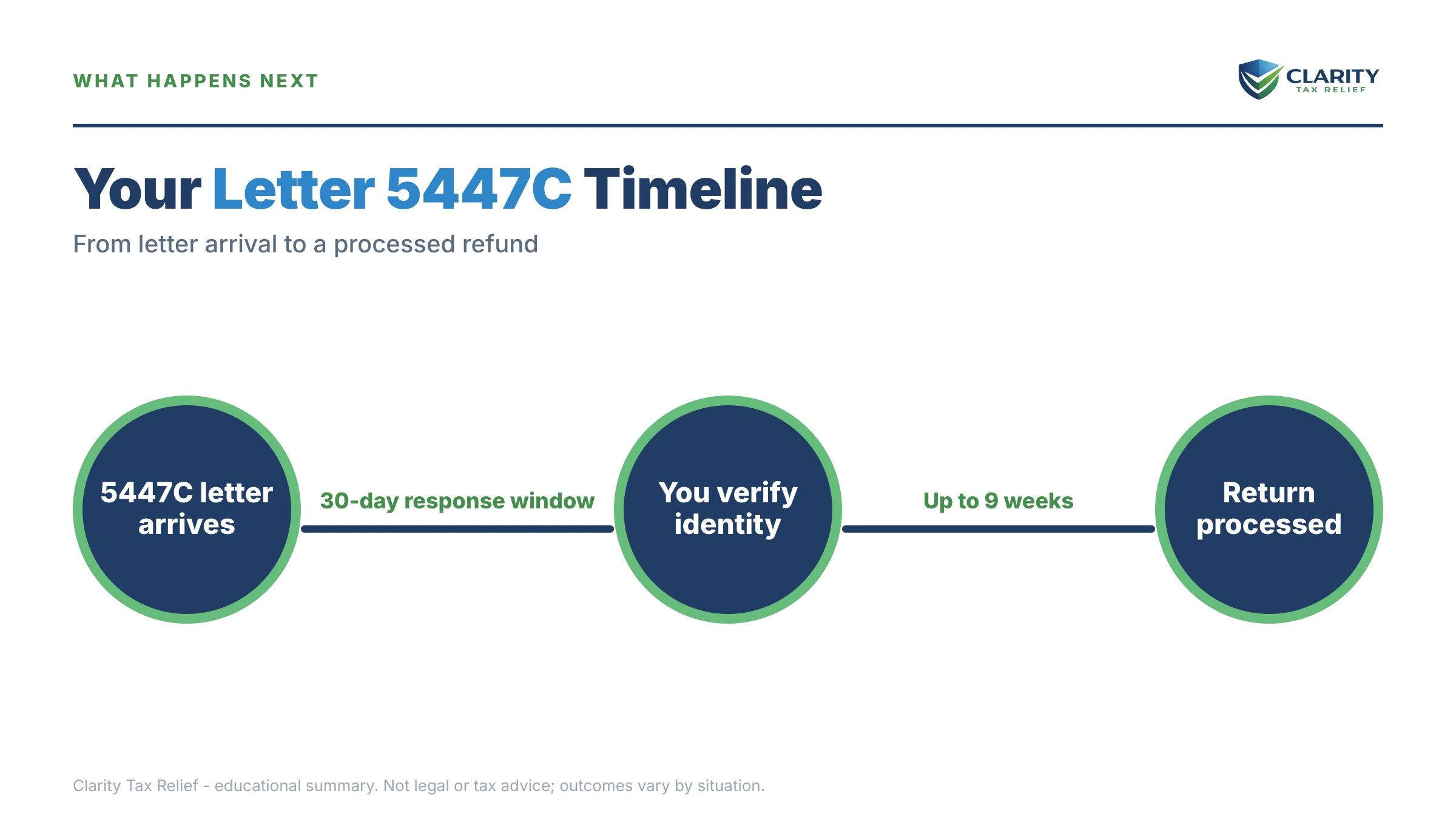
- Track processing afterward. The IRS says processing can take up to nine weeks after verification — watch your account transcript for the return to post.
If you already owe the IRS: the 5447C won't pause collection
Verifying your identity releases the frozen return — it does not pause IRS collection on balances from other years. The Taxpayer Protection Program and the collection machine run on separate rails, and only one of them is waiting on you.
Say you owe $11,300 on your 2023 return, you rent (so there's no house for a lien to bite, but a bank or wage levy is exactly where the collection track leads), and your 2025 return claims a $2,400 refund — the refund the 5447C is now freezing. Here's the hypothetical math:
- The failure-to-pay penalty alone runs 0.5% per month: 0.5% × $11,300 = $56.50 a month, roughly $339 over six months of waiting — plus interest compounding on top.
- The frozen refund can't help you. Once verified and processed, that $2,400 would be offset against the debt, cutting it to about $8,900. Until you verify, the offset never posts and the full $11,300 keeps accruing charges.
- The levy clock doesn't wait. If the IRS issues a final notice of intent to levy — see our letter 1058 IRS guide — you get 30 days to request a Collection Due Process hearing, and that window runs whether or not your identity case is resolved.
The practical takeaway: verify fast, but never treat the 5447C as your only IRS problem. Handle the final-notice deadline first if you have one — it's the only clock in this scenario you can permanently miss.
When you can handle this yourself — and when help changes the outcome
Most people can resolve a Letter 5447C on their own, because verification is free and the IRS is only asking you to prove something you know. Handle it yourself if you filed the return, you have the flagged return and a prior-year return in hand, and your only obstacle is patience with hold times or time zones.
Experienced help earns its cost in a few specific situations: a levy is already in motion on other years and the 30-day appeal window is running; you have multiple unfiled years tangled up with the frozen return, so the order of filing and verifying changes what you end up owing; you're overseas and physically can't reach the IRS after repeated attempts (a representative with a Form 2848 power of attorney can work the case from the U.S. on your behalf); or the return isn't yours and the fraud extends beyond one filing. If the IRS itself is unreachable and the freeze is causing genuine financial harm, the Taxpayer Advocate Service is a free escalation path built for exactly that.
Terms on your letter, decoded
- Taxpayer Protection Program (TPP): the IRS unit that screens returns for identity theft before processing — it's the sender of the 5447C.
- Refund freeze (TC 810): the transcript code that often marks a return held for review, including identity holds.
- Identity and Tax Return Verification Service: the IRS's online verification tool — used by other letters in this family, but usually not an option for 5447C recipients.
- IP PIN: a six-digit Identity Protection PIN that blocks anyone else from e-filing under your SSN in future years.
- Form 14039: the identity-theft affidavit — needed when fraud wasn't already caught; usually unnecessary when you're holding a 5447C.
- Refund statute: the rule that generally kills a refund claim three years after the return's due date — the quiet deadline behind a frozen refund.
For the IRS's own instructions, see the Identity and Tax Return Verification Service page and Identity Theft Central at IRS.gov.
Letter 5447C questions, answered
Why did I get Letter 5447C instead of a 5071C?
The 5447C is the version of the IRS identity-verification letter sent when your account shows an address outside the United States or the standard online and toll-free channels aren't available for you. The verification goal is identical — confirm you actually filed the return — but your response paths are phone and mail instead of the online tool. If you filed with a foreign address or recently moved abroad, that is almost certainly the trigger.
Can I verify Letter 5447C online?
Usually not. The IRS's online Identity and Tax Return Verification Service is built around other letters in this family, and registering through ID.me typically requires a U.S. phone number and documents many overseas filers don't have — often the very reason the IRS routed you to a 5447C. Use the phone number or mailing address printed on your letter; both complete exactly the same verification.
How long after verifying Letter 5447C will I get my refund?
The IRS says it can take up to nine weeks after successful verification for the return to finish processing and any refund to be released. Mail responses take longer because transit and intake time run before that clock starts. Watch your account transcript: the return posting, and eventually a refund-issued code 846, will show there before anything updates on Where's My Refund.
What happens if I ignore Letter 5447C?
The return you filed simply never processes — no refund is released, and the IRS ultimately treats it as unverified. If a refund is at stake, the claim can eventually die when the three-year refund window closes. If your real return showed a balance due, you can end up treated as a non-filer for that year, which stacks the failure-to-file penalty of 5% per month on top of what you already owe.
What if I didn't file the return in my Letter 5447C?
Tell the IRS exactly that, using the same phone number or mailing address on the letter, and the return will be removed from your account. You generally do not need Form 14039 in this situation — the letter itself means the IRS already flagged the return before processing it. Do request an Identity Protection PIN afterward so no one can e-file under your SSN again, and file your own legitimate return if you still need to.
Is Letter 5447C a scam?
A real 5447C arrives by postal mail and asks for exactly zero dollars — identity-verification letters never demand payment, gift cards, or bank details. Anyone contacting you by phone, email, or text claiming you must pay to 'unlock' your refund is a criminal, not the IRS. If you want independent confirmation, log into your IRS online account or call the IRS using a number you find yourself on IRS.gov, not one someone gave you.
What documents do I need to verify my identity for Letter 5447C?
Have the 5447C letter itself, a copy of the tax return it references, a prior-year return if you filed one, and supporting documents such as W-2s, 1099s, and schedules. Keep government-issued photo ID handy for reference during the call. If you respond by mail, send copies only — never original documents — and use tracked mail so you can prove delivery.
Does Letter 5447C mean someone stole my identity?
Not necessarily — many 5447C letters are false positives triggered by a foreign address, a first return in several years, or a big change in income or banking details. It means the IRS's filters flagged the return as unusual, not that fraud is confirmed. If you verify that you filed it, the case closes; if you didn't file it, then someone did use your SSN, and reporting it through the letter starts the cleanup.
Your next 24 hours
- Find three things on your letter: the phone number, the mailing address, and the tax year of the return being held — they control everything about your response.
- Pull your paperwork together: the flagged return, a prior-year return, your W-2s and 1099s, and photo ID — one folder, ready before you dial.
- Get a free case review if the 5447C landed on top of collection notices or unfiled years — an experienced tax professional can work the identity hold and the balance side at the same time, while penalties and interest keep accruing on anything unpaid. Use the 2-minute form or call (888) 825-7779.
This guide is general information, not tax or legal advice for your specific situation. Eligibility for IRS programs depends on individual facts and circumstances; no outcome is guaranteed.