
IRS Transcript Codes
Code 196 Transcript Meaning: IRS Interest Charged to Your Account (2026)
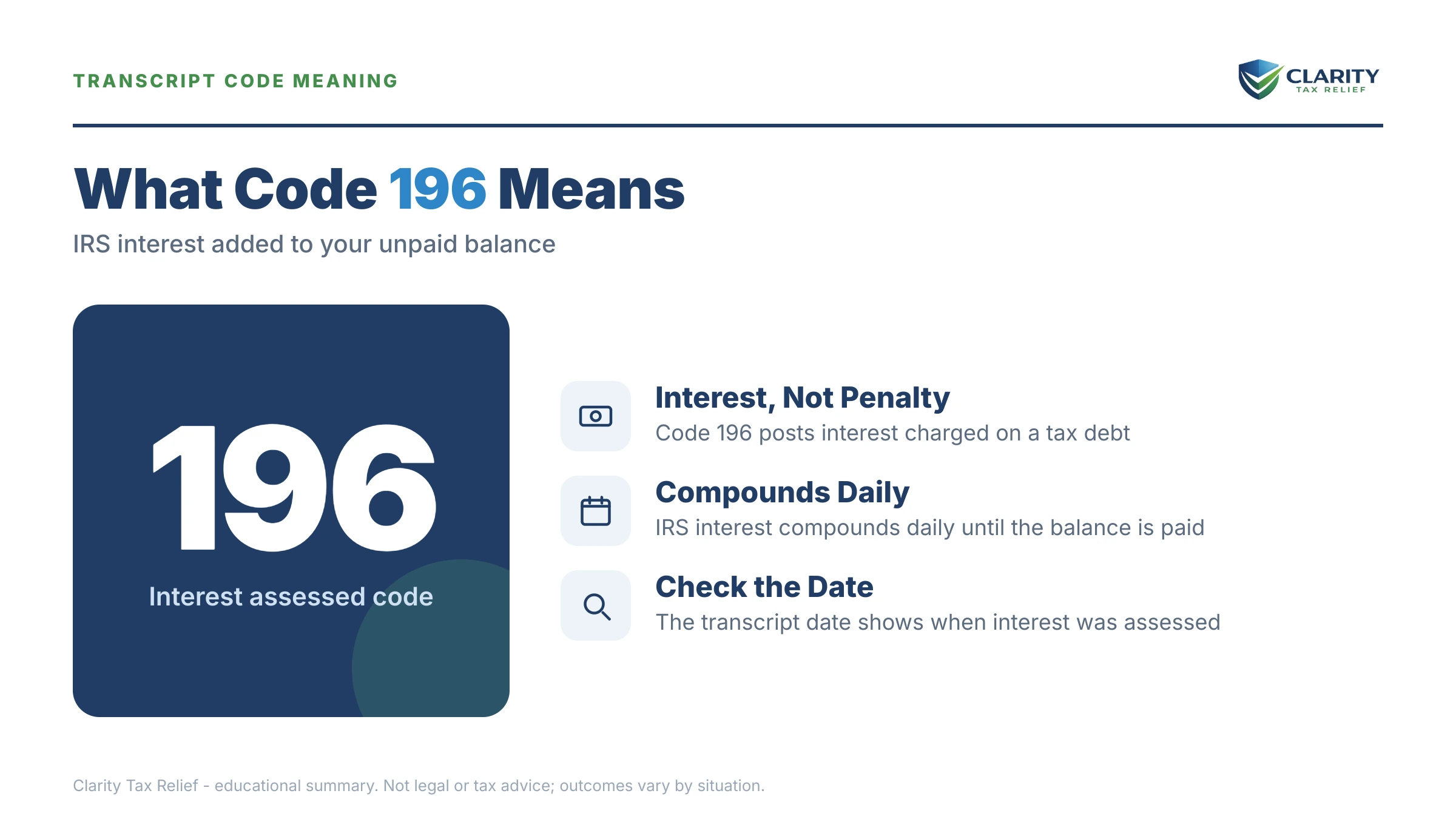
The short answer: a code 196 transcript entry means the IRS charged interest to your account under IRC §6601. It is not a penalty and not an audit — it's the daily-compounding cost of an unpaid balance, calculated from your return's original due date, and it will keep posting until the balance is resolved.
You pulled your account transcript to check on a balance you already knew about — and found code 196 quietly adding money you didn't agree to. If a levy warning has already landed in your mailbox on top of it, watching the number climb line by line feels like losing ground on two fronts at once. Here's the good news: 196 is the most predictable code on your transcript, its math can be checked, and there are specific levers that stop it or shrink it — this page walks through all of them.
The image below shows you exactly where code 196 sits in the transactions section of a real account transcript and how to read the amount and date printed beside it.
⏱ The real clock: there is no response deadline printed next to code 196 — but the interest behind it compounds every single day, and the rate can reset each quarter. Every billing cycle you wait, a new 196 posts with a bigger number, computed on a balance that now includes the previous interest. The only thing that stops the meter is shrinking the balance it runs on.
Code 196 transcript meaning: why it's on your account
Transaction code 196 is the IRS computer charging interest for late payment on an assessed balance. It's generated automatically — no employee decided to add it — and it always attaches to something else on the transcript. Trace upward from your 196 and you'll find one of three triggers:
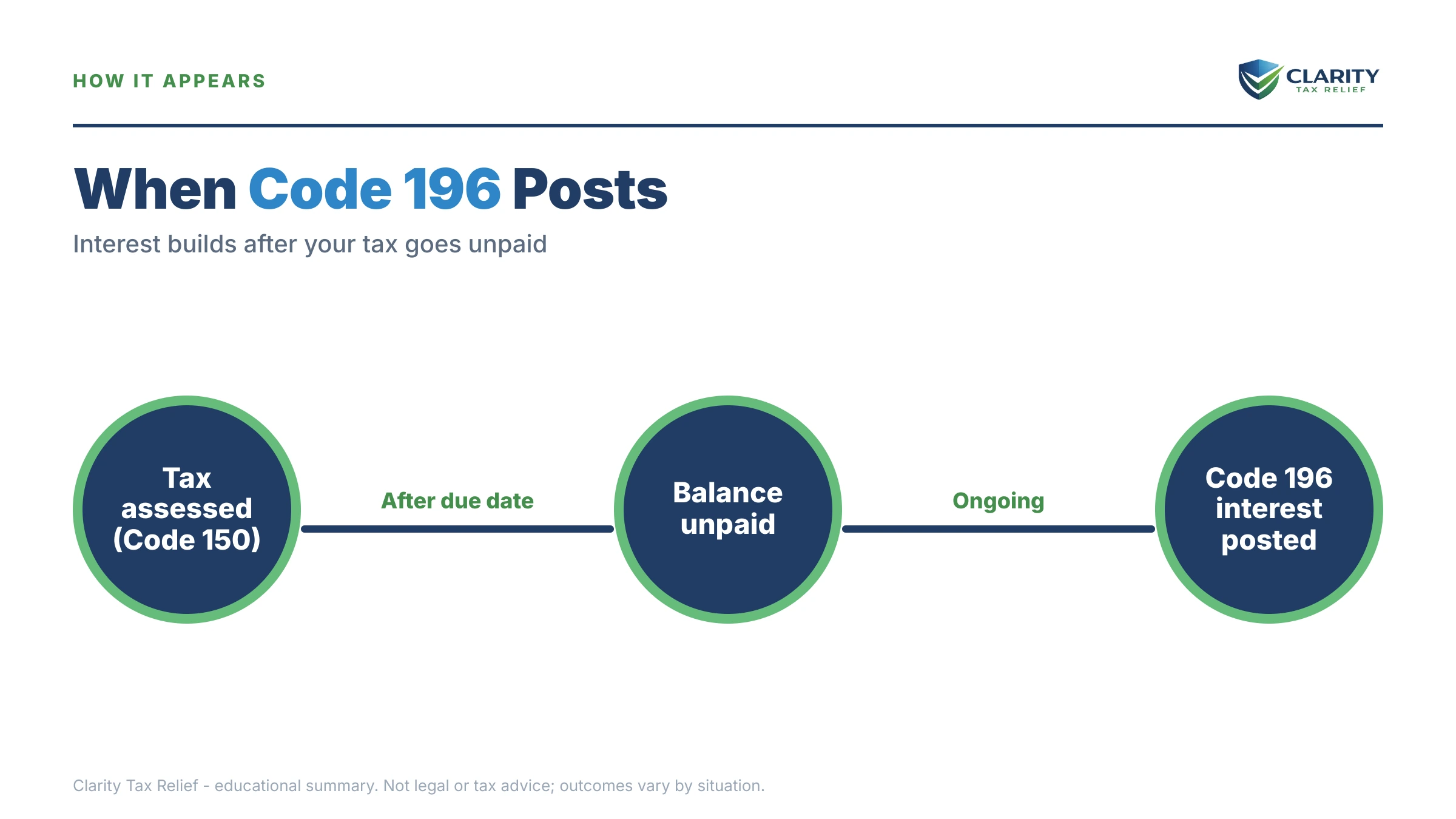
- You filed with a balance due. Interest started running on the amount from your code 150 irs transcript assessment the day after the original filing deadline — even if you had an extension, because an extension moves the filing date, not the payment date.
- The IRS added tax later. If a code 290 irs transcript entry posted above your 196 — from a CP2000 match, an exam, or a math correction — the interest is back-dated to the original return due date, not the adjustment date. That's why interest on a two-year-old adjustment can look shockingly large.
- Interest on penalties. Interest also runs on assessed penalties, such as the failure-to-pay penalty that posts as code 276 transcript entries — usually in the same cycle as the 196.
One thing 196 never means: examination. Audit activity carries its own codes (420 and 424) and its own letters. A 196 is bookkeeping on a debt the IRS already assessed. (For how the whole transactions section fits together — codes, cycle dates, and running balance — see our guide on how to read irs account transcript.)
Code 196 and the codes around it
| Code | What it means | What to do |
|---|---|---|
| 150 | Return filed; original tax assessed | Confirm it matches the return you filed |
| 196 | Interest charged (computer-generated) | Verify what it's running on; act to stop accrual |
| 190 | Interest assessed manually by an employee | Same math as 196 — often follows an exam or adjustment |
| 197 | Interest abated (reduced or removed) | Good news — confirm the amount matches any relief granted |
| 276 | Failure-to-pay penalty assessed | Screen for first-time abatement or reasonable cause |
| 290 | Additional tax assessed | Find out why — this is what re-triggers big 196 entries |
| 291 | Tax reduced | Interest tied to the reduced tax should come down too |
| 971 | Notice issued | Match it to the letter in your mailbox — often the bill for the 196 |
Two cousins worth knowing: if your interest entry says 190 instead of 196, a human assessed it manually — common after audits. And 197 is the code you're working toward: interest coming off. If tax later comes off your account through a code 291 irs transcript adjustment, the interest attached to that tax should be recalculated downward as well — check that it actually was.
How the interest behind code 196 is calculated
IRS underpayment interest is the federal short-term rate plus 3 percentage points, reset quarterly, compounding daily. Daily compounding is the detail that surprises people: each day's interest is computed on a balance that includes every previous day's interest. That's also why several 196 entries can stack on one tax year — each one captures the accrual through a specific posting date, usually the date a notice went out or a payment posted. You can see the current quarterly figures in our guide to irs interest rates 2026 quarterly.
One more trap: the transcript understates today's payoff. The figures are only accurate through the document's "as of" date — our as of date irs transcript guide explains that line — so interest accrued since then exists but hasn't posted yet.
A worked example: what code 196 does to a $61,200 balance
Say you owe $61,200 — $54,000 in tax plus $7,200 in penalties already assessed — and, purely for illustration, assume the underpayment rate is 7%. Here's the hypothetical math:
- Daily interest: $61,200 × 7% ÷ 365 ≈ $11.74 per day — roughly $357 a month posting as new 196 entries.
- Failure-to-pay penalty on top: 0.5% per month on the $54,000 unpaid tax ≈ $270 a month, posting as code 276.
- Combined bleed: about $627 a month, or roughly $7,500 a year — before compounding makes year two worse.
- The hidden threshold: at that pace, the balance crosses $66,000 in about eight months — the 2026 line where the IRS can certify you as seriously delinquent and the State Department can deny or revoke your passport. See passport revoked tax debt for how that works.
Want to run your own numbers instead of a hypothetical? You can estimate your accruals with our Penalty & Interest Calculator.
What happens if you ignore the balance behind code 196
Code 196 itself takes nothing from you — but the balance it measures drives an automated collection sequence that eventually can. Each stage posts to your transcript (usually as a 971 alongside a fresh 196) and each one carries more enforcement power than the last:
- Billing notices post. A 971 pairs with your 196 and a CP14 or annual CP71 arrives showing tax, penalty, and interest broken out.
- Reminders — and bigger 196s. CP501 and CP503 follow. Every cycle, interest is recalculated and a new 196 stacks on the year.
- CP504 — intent to levy. The IRS can now seize your state tax refund, and a federal tax lien becomes a live possibility.
- LT11 / Letter 1058 — final notice. This starts a 30-day clock and your Collection Due Process rights (Form 12153). After it runs, levies can begin.
- Levy. A bank levy freezes funds for a 21-day hold before they leave; a wage levy is continuous until released. As a renter, there's no home equity for a lien to sit on quietly — collection pressure lands directly on what you do have: your paycheck and your bank account.
In 2026 this sequence is more automated than ever. IRS staffing fell roughly 27% in 2025, but the computers that post 196s and issue levy notices never stopped — the balance keeps compounding and the machine keeps escalating whether or not a human ever opens your file.
Watching code 196 grow — or already holding a levy notice?
Interest is compounding on your balance every day, and if a final notice has arrived, the clock printed on that letter is the one that matters. Send us your transcript and any notices — an experienced tax professional will map exactly where you stand and the fastest way to stop the accrual. Free and confidential.
Your options: stopping code 196 interest from growing
Interest never stops accruing on an unpaid balance — even inside a payment plan — so every option below is really about shrinking the base it runs on. Which one fits depends on your balance and your finances:
| Option | Who it fits / threshold | Effect on the interest |
|---|---|---|
| Pay in full | Anyone who can raise the funds | Accrual stops on the payoff date; no more 196s post |
| Short-term plan (up to 180 days) | Balances you can clear within six months; $0 setup fee | Interest continues, but enforcement stops while you pay |
| Streamlined installment agreement | Assessed balance ≤ $50,000; up to 72 months online | Interest continues; failure-to-pay penalty drops to 0.25%/month while the agreement is in effect |
| Installment agreement over $50,000 | A $61,200 balance — expect Form 433-F financials, or pay below $50k to go streamlined | Same as above once approved; the pay-down itself shrinks the interest base |
| §6404 interest abatement | Interest caused by IRS unreasonable error or delay only | The specific interest is removed (posts as code 197) |
| Penalty abatement (FTA / AEP) | Clean compliance history for the prior 3 years; AEP becomes automatic starting summer 2026 | Interest charged on the abated penalty comes off with it |
| Offer in Compromise | Assets + future income genuinely can't cover the debt; means-tested | An accepted offer resolves the interest along with the tax |
| Currently Not Collectible | Paying anything would create genuine hardship | Levies pause; interest keeps accruing in the background |
At the $61,200 level from our example, the threshold detail matters most: you're above the $50,000 streamlined line, so the fastest route to an online agreement is often paying the balance under $50,000 first. Our guide to an irs payment plan over 50000 walks through the financial-disclosure route if that's not possible.
Can code 196 interest be removed?
Interest cannot be abated for reasonable cause the way penalties can — the law only allows it when the IRS itself caused the delay. Under IRC §6404, interest attributable to an unreasonable IRS ministerial or managerial error or delay can be abated, requested on Form 843. That's a real path when, for example, the IRS sat on your case or misapplied a payment for months — see irs interest abatement and our form 843 walkthrough for how to build that request. Interest that accrued simply because money was tight does not qualify, no matter how sympathetic the reason.
The bigger win for most people is indirect: when a penalty is abated, the interest charged on that penalty is removed automatically. Knock out a $7,200 penalty stack through first-time abatement (or, starting summer 2026, the new Automatic Exemption from Penalty, which applies without a request) and the 196 interest that accrued on those penalties comes off too. The honest full picture of what can and can't be waived is in can irs interest be waived.
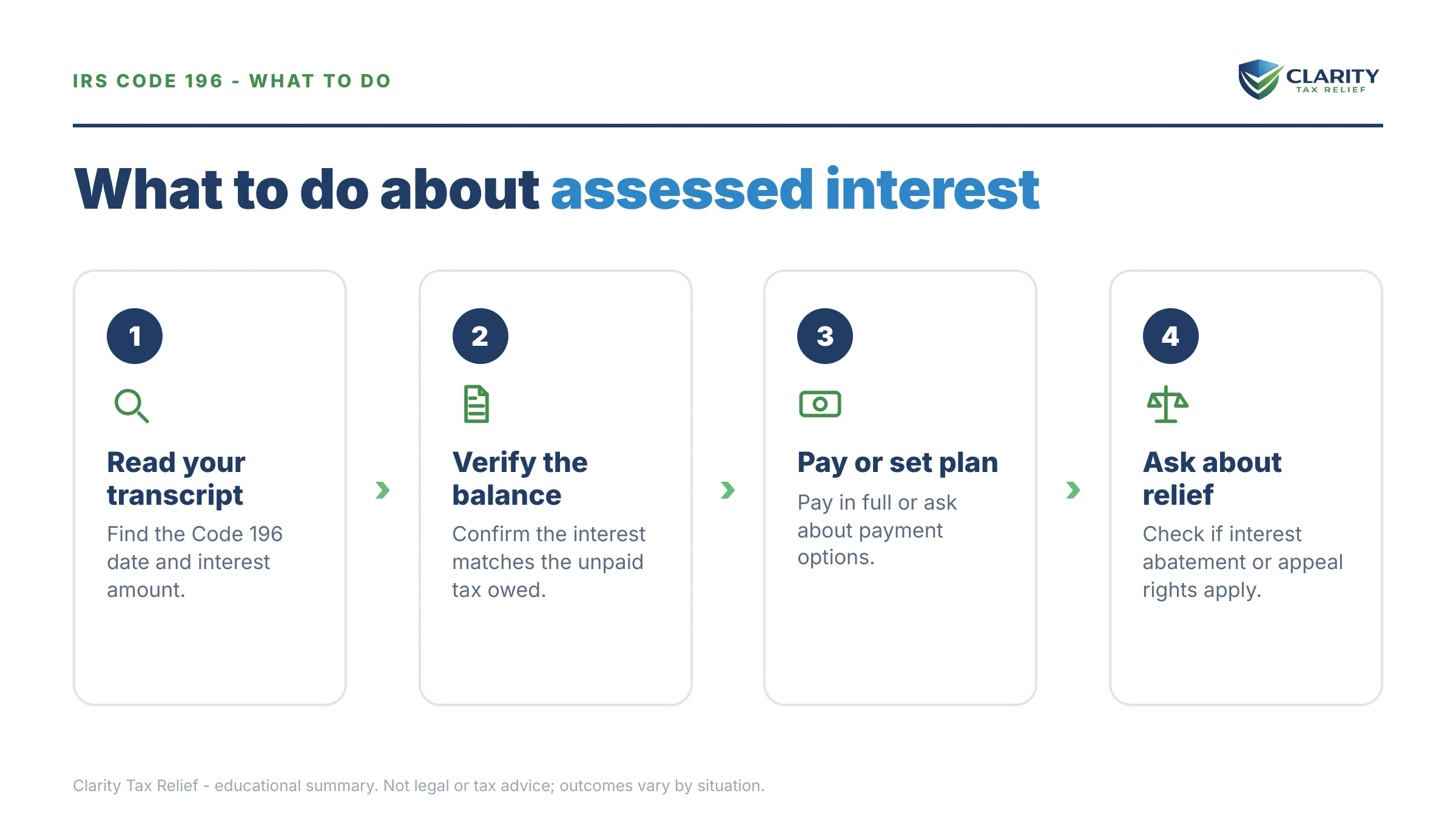
How to respond to code 196, step by step
- Pull the full account transcript for every balance-due year. Download each year's account transcript from your IRS online account so you can see every 196 entry, its date, and the assessment it attaches to.
- Trace what each 196 is attached to. Match each 196 to the assessment above it — a code 150 original balance, a code 290 adjustment, or a code 276 penalty — so you know exactly what the interest is running on.
- Get a current payoff figure. Check the transcript's "as of" date, then pull today's exact balance from your IRS online account — interest accrued since that date will not appear on the transcript.
- Stop the accrual. Pay in full at IRS.gov/payments if you can, or set up a payment arrangement — above $50,000, expect to submit financial information or pay the balance down first.
- Screen for interest and penalty relief. Check whether any interest was caused by IRS error or delay (Form 843 under §6404), and whether penalty abatement could remove the interest charged on those penalties.
When you can handle this yourself
Most single-year 196 situations under $25,000 need no professional help at all. If the underlying tax is correct, you agree with the balance, and you can pay within 180 days or afford a straightforward monthly plan, set it up yourself online and you're done — the interest math will take care of itself as the balance falls.
Experienced help changes outcomes in a narrower set of situations: a levy already in motion or a final notice with the 30-day clock running, a balance over $50,000 where the financial disclosure determines your payment, multiple years of stacked 290s and 196s that need to be resolved in the right order, or a genuine §6404 claim — which requires proving the IRS's own timeline caused the interest, a technical argument that's easy to lose on paperwork. In those cases, what you pay is decided by how the case is presented, not just what you owe.
Terms on your transcript, decoded
- Assessed vs. accrued interest: assessed interest has posted as a 196; accrued interest is growing right now but won't appear until the next posting cycle.
- Underpayment rate: the interest rate the IRS charges on unpaid tax — the federal short-term rate plus 3 points, reset every quarter.
- Daily compounding: each day's interest is calculated on a balance that includes all prior interest — interest on interest.
- Ministerial or managerial error: the IRS's own processing mistake or unreasonable delay — the only basis for abating interest under §6404.
- "As of" date: the date through which the transcript's penalty and interest figures are computed; anything after it hasn't posted yet.
- CSED: the Collection Statute Expiration Date — the IRS generally has 10 years from assessment to collect, though certain events pause that clock.
Code 196 transcript FAQs
What does code 196 on an IRS transcript mean?
Code 196 means the IRS charged interest to your account for that tax year — it is a billing entry, not an audit flag. The amount next to it is interest computed under IRC §6601 from your return's original due date through the posting date. It usually appears alongside code 276, the failure-to-pay penalty, on the same cycle.
Is code 196 a penalty?
No — code 196 is interest, which is legally separate from penalties. Penalties post under their own codes, like 276 for failure-to-pay, and can often be removed through first-time abatement or reasonable cause. Interest is different: it exists to charge you for the time value of the money and can almost never be waived for hardship or good behavior.
Can the interest behind code 196 be removed?
Only in narrow situations. Under IRC §6404, the IRS can abate interest caused by its own unreasonable errors or delays — requested on Form 843 — but not interest that accrued simply because you couldn't pay. The practical side door: if a penalty is abated, the interest charged on that penalty comes off with it, which often removes hundreds or thousands of dollars.
Why do I have more than one code 196 on the same year?
Each 196 captures the interest that accrued up to a specific posting date, so the IRS adds a new one every time it recalculates — typically when a notice goes out or a payment posts. Multiple 196 entries don't mean you're being charged twice. Add them together and you see the total interest assessed so far, not counting what has accrued since the last posting.
Why is the date next to code 196 in the future?
The date is the IRS posting-cycle date, usually matched to the date on the notice being mailed, so it can sit a week or two ahead of the day you pull the transcript. The interest amount is computed through that date. It is not a deadline and not the day something bad happens — it's an accounting date.
Does code 196 mean I'm being audited?
No. Code 196 is a routine billing entry that posts on millions of accounts with balances due. Audit activity shows up under different codes — 420 or 424 for examination — and comes with its own letters. If your 196 followed a code 290, the extra tax came from an adjustment such as a CP2000, which is a document-matching review, not a full audit.
Is the balance on my transcript the amount I need to pay today?
Usually not — the transcript is only accurate through its 'as of' date, and interest keeps compounding daily after that. If you pay the transcript figure on an older balance, a small residual of accrued interest can survive and trigger another bill. Get an exact payoff amount from your IRS online account or by phone before sending a final payment.
Your next 24 hours
- Total your 196s and check the "as of" date. Add every 196 amount on each year's transcript and note the "as of" date at the top — that tells you the interest already assessed and how stale the figure is.
- Gather three things: the transcript for each balance-due year, your most recent tax return, and any IRS notices you've received — especially anything mentioning intent to levy.
- Get a free case review. Interest compounds daily until the balance shrinks, so the cheapest version of this problem is the one you fix now — use the 2-minute form at our free consultation page or call (888) 825-7779.
Primary sources if you want to verify anything yourself: get your transcripts directly at IRS.gov Get Transcript, pay or check balances at IRS.gov/payments, review plan terms at the IRS payment plans page, and if IRS delay is hurting your case, the Taxpayer Advocate Service is an independent, free resource.
This guide is general information, not tax or legal advice for your specific situation. Eligibility for IRS programs depends on individual facts and circumstances; no outcome is guaranteed.