
Penalty & Interest Relief
IRS Interest Abatement in 2026: When the IRS Must Remove Interest Its Own Delay Caused
The short answer: IRS interest abatement is allowed only when the interest itself is wrong: the IRS caused an unreasonable error or delay (Section 6404(e)), miscalculated the charge, or took more than 36 months to notify you of additional tax. You request it on Form 843. Unlike penalties, interest is never removed for hardship or reasonable cause.
You answered every IRS letter within days, mailed the same documents twice, and then heard nothing for over a year — and when the bill finally arrived, it charged you interest for every month the IRS sat on your file. That specific unfairness is the one situation where the law actually forces the IRS to give interest back.
The entire request runs through a single form, Form 843 — the image below shows exactly what it looks like and where an interest-abatement request goes, so you can follow along with the steps later in this guide.
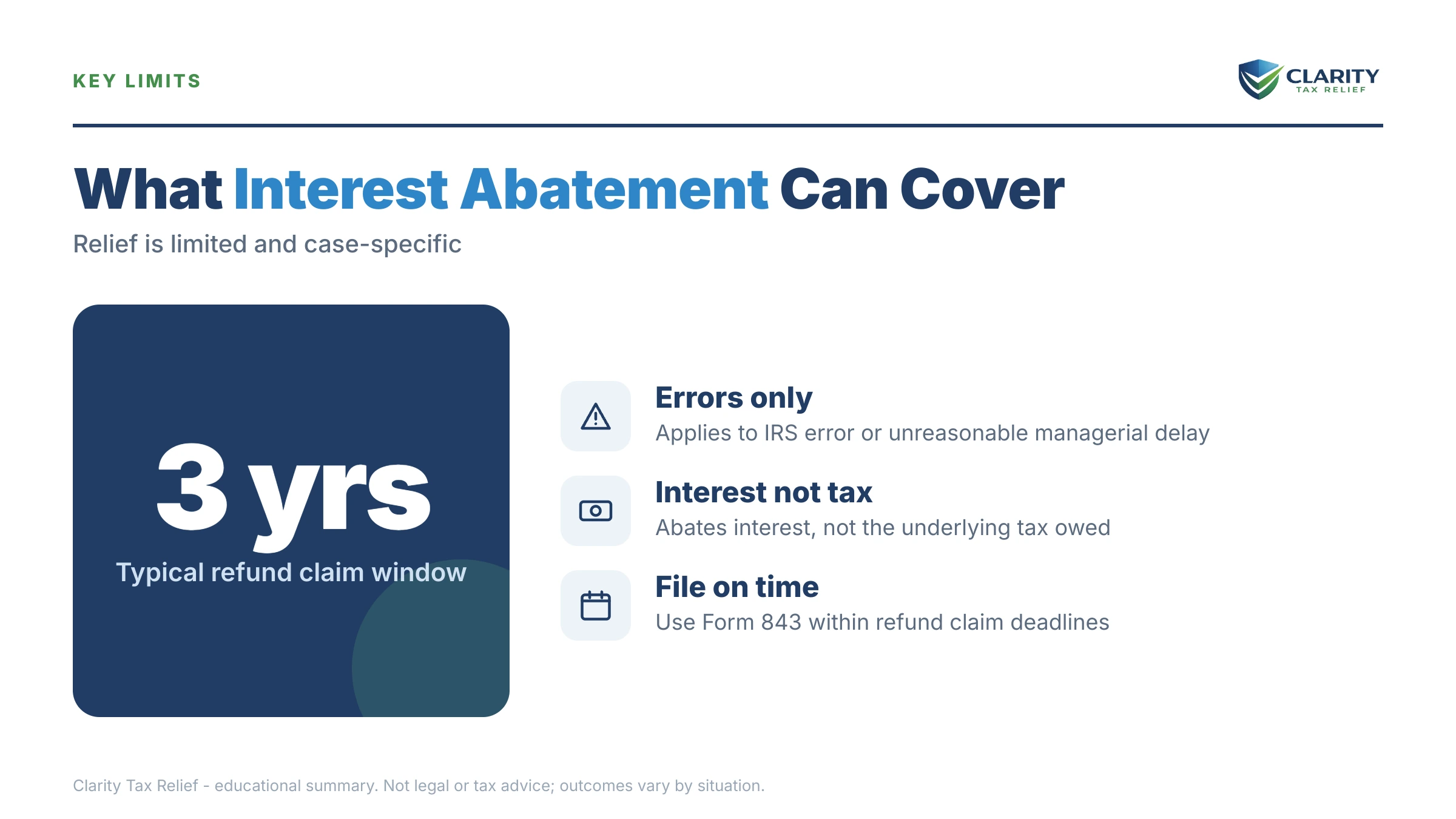
⏱ Your clock: there is no fixed deadline to request abatement of unpaid interest — but interest compounds daily until the balance is resolved, so every week of waiting costs money. If you already paid the interest and want it refunded, a Form 843 claim must generally be filed within 3 years of filing the return or 2 years of the payment, whichever is later.
Why IRS interest is almost never waived — and the narrow cases where it must be
The IRS has no legal authority to waive interest for hardship, illness, or good faith — Section 6601 of the tax code makes interest mandatory, and Section 6404 lists the only exceptions. That's the single most misunderstood fact in this corner of tax law, and it's why so many well-written hardship letters come back denied.
Penalties and interest follow completely different rules. Penalties can be removed for reasonable cause, a clean compliance history, or — starting summer 2026 — the new Automatic Exemption from Penalty, which applies qualifying relief with no request at all. Interest can't. If someone promises to get your interest "waived" because you've been through a hard year, they're describing a program that doesn't exist. Our guide to can IRS interest be waived covers that myth head-on.
Interest compounds daily and the rate resets every quarter — see the current figures in our guide to IRS interest rates for 2026. For how the penalty side of your balance grows (a separate calculation with its own relief paths), the math lives in our guide to how much IRS penalties on back taxes really cost.
What Section 6404 does give you is narrow but real: when the interest exists because the IRS made a mistake or sat on your case, the law says that slice of interest can — and in some cases must — come off.
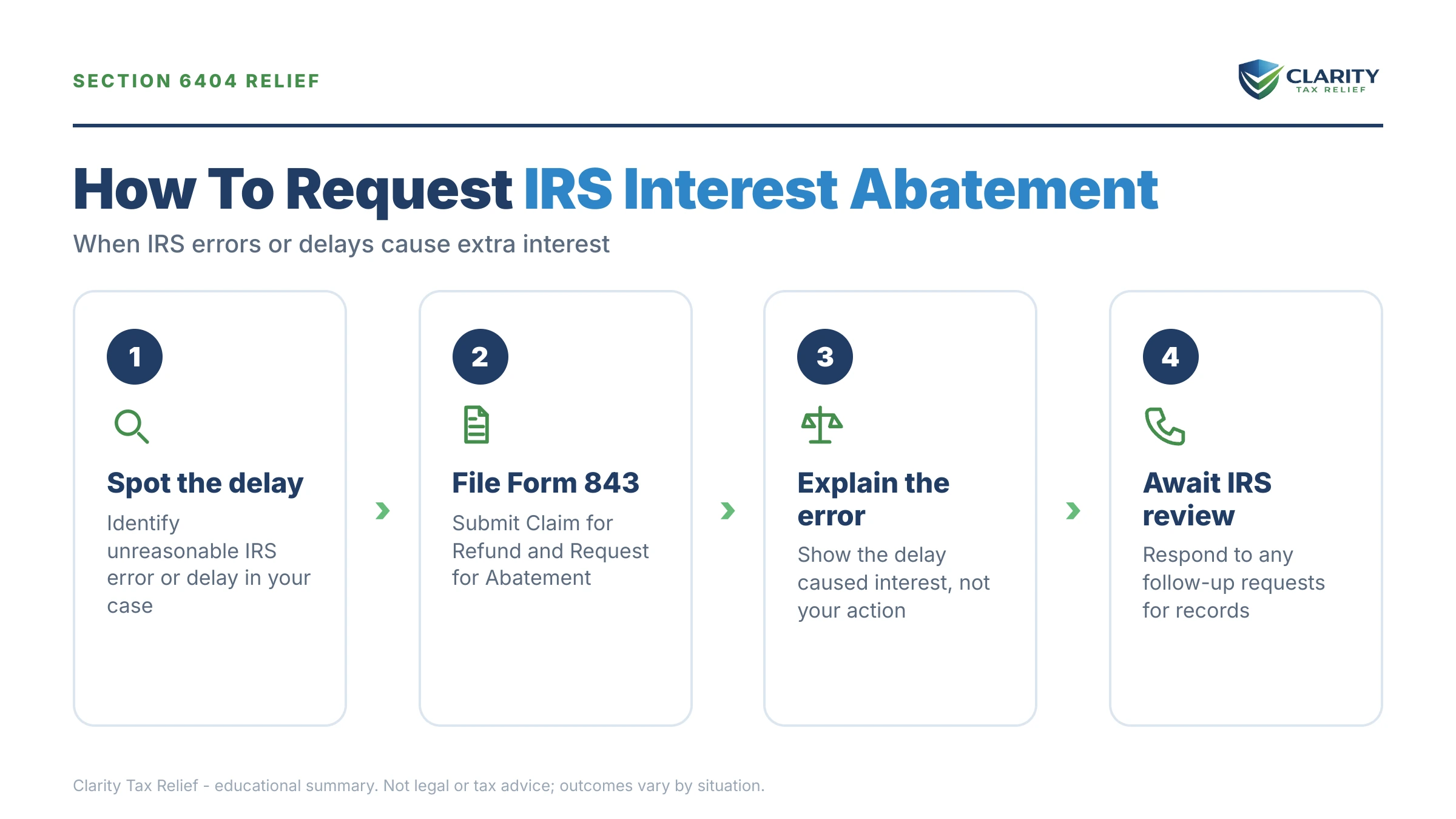
The five legal paths to abate IRS interest under Section 6404
Every legitimate interest-relief request falls into one of five categories, each with its own legal basis and its own trigger. Here's the full map:
| Path | When it applies | How to request it |
|---|---|---|
| Section 6404(e) — IRS error or delay | A ministerial or managerial act by the IRS (lost file, unassigned case, delayed notice) caused interest to accrue after the IRS contacted you in writing, and you didn't significantly cause the delay | Form 843, citing Section 6404(e), with a dated timeline |
| Section 6404(a) — excessive or erroneous interest | The interest itself is miscalculated: wrong start date, a misapplied payment, or interest assessed after the statute expired | Call or write the number on your notice; Form 843 if it isn't corrected |
| Section 6404(g) — 36-month suspension | You filed an individual return on time and the IRS took more than 36 months to notify you of additional tax due | Usually applied automatically; raise it on Form 843 if it wasn't |
| Penalty-abatement flow-through | Any penalty is removed — the interest that was charged on that penalty comes off automatically with it | Request the penalty relief itself; no separate interest form needed |
| Disaster postponement | A federally declared disaster postponed your deadline; interest doesn't accrue during the postponement window | Automatic by address; write to the address on your notice if charged anyway |
Path 1: Section 6404(e) — the IRS delayed or erred, and you paid interest for it
Section 6404(e) requires three things to line up, and the IRS reads all three strictly. First, the delay or error must involve a ministerial or managerial act — a mechanical step (issuing a notice after the decision was already made, transferring your file) or a case-management failure (records lost, case left unassigned after an employee transfer). Second, the interest must have accrued after the IRS first contacted you in writing about the tax. Third, no significant part of the delay can be your fault — unanswered IRS letters on your side will sink the claim.
What doesn't qualify matters just as much: time the IRS spent legitimately deciding your case — weighing evidence, applying the law — is an exercise of judgment, not a ministerial act, and interest that accrued during honest deliberation stays. The claim targets dead air, not slow thinking.
One coverage gap to know: Section 6404(e) applies to income, estate, and gift taxes — not employment taxes. If your interest sits on a payroll balance, the leverage is on the penalty side instead; see 941 penalty abatement.
Path 2: Section 6404(a) — the interest is simply computed wrong
Miscomputed interest is more common than most people expect, because interest is recalculated every time anything on the account changes. A payment applied to the wrong year, an assessment dated wrong, or a prior abatement that never flowed through the interest math all inflate the charge. Every interest posting appears on your transcript as Transaction Code 196 — if the dates or amounts don't reconcile with your payment history, you may be looking at a correction, not a discretionary request.
Path 3: Section 6404(g) — the IRS took more than 36 months to tell you
If you filed your individual return on time and the IRS waited over 36 months to send a notice proposing additional tax, interest must be suspended from the end of that window until 21 days after the notice arrives. This one is supposed to happen automatically, but "supposed to" is doing heavy lifting in 2026 — with the IRS workforce cut roughly 27% in 2025, suspensions that should post automatically are worth verifying on your transcript.
Path 4: kill the penalty, and its interest dies with it
When a penalty is abated, every dollar of interest charged on that penalty is removed automatically — no separate request. This is often the biggest interest reduction available, because it doesn't require proving anything about IRS conduct. If your history is clean, start with first-time penalty abatement; if the balance spans several tax years, see how first time abatement for multiple years stacks with reasonable cause. Even the 20% accuracy-related penalty carries its own interest that disappears if the penalty is successfully challenged. Note the limit, though: interest on the underlying tax survives, because that money was genuinely owed.
Path 5: disaster postponements
When a federal disaster declaration postpones your filing or payment deadline, interest legally doesn't accrue during the postponed period. If your account was charged anyway — it happens when addresses and disaster ZIP codes don't sync — a short letter to the address on your notice, citing the declaration, gets it corrected.
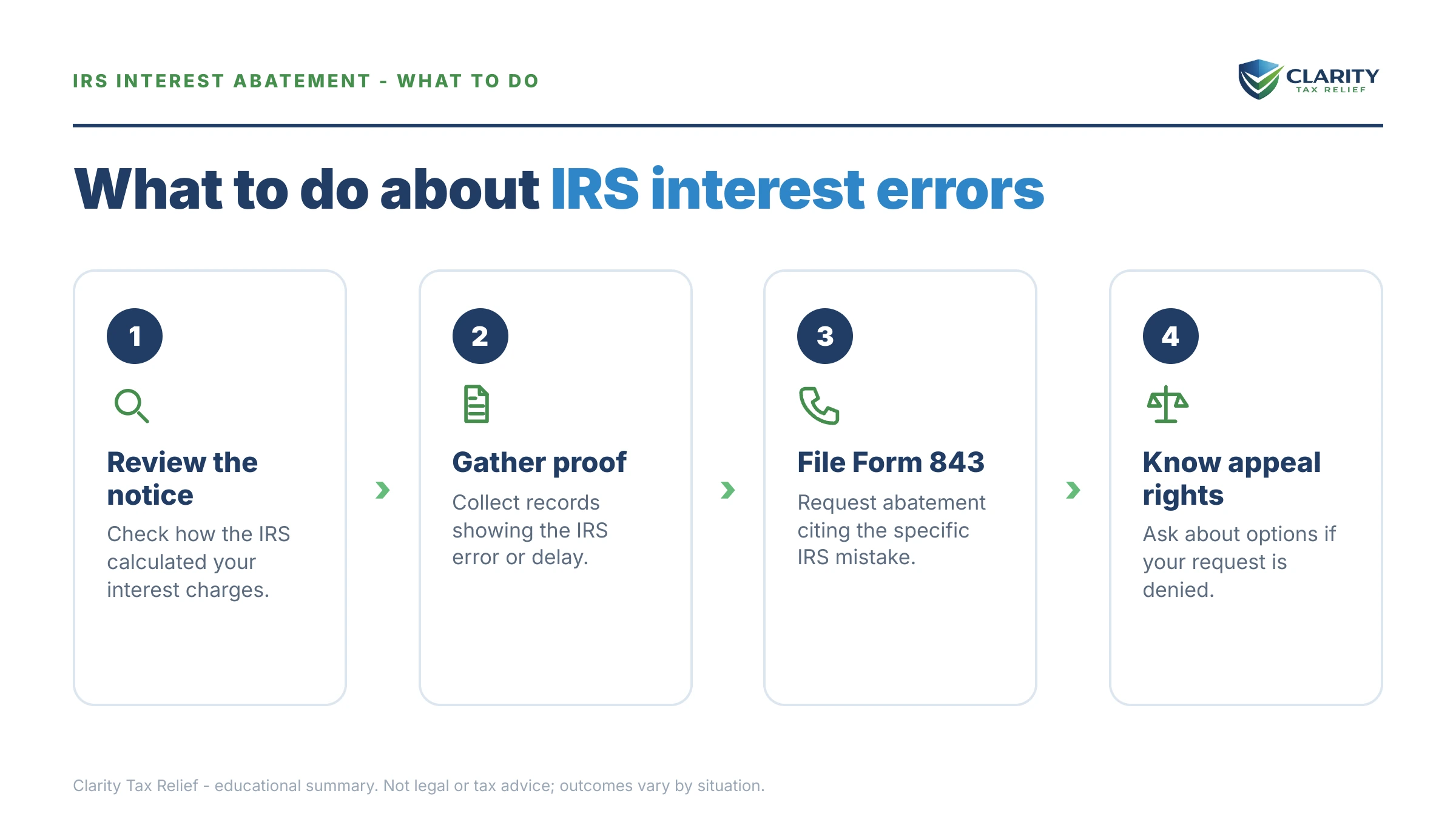
What happens if you ignore the interest on your balance
Unpaid IRS interest compounds every single day — it is the one charge on your account that never pauses, caps out, or waits for a human to act. Left alone, the sequence looks like this:
- Daily compounding continues. New Transaction Code 196 charges post to your account period after period, and each charge itself starts earning interest.
- The failure-to-pay penalty stacks alongside at 0.5% per month — a separate charge, and yes, interest accrues on the penalty too.
- Collection notices keep arriving in sequence — CP14, then CP501/CP503 reminders, then CP504, then the LT11 final notice. A pending Form 843 does not pause any of them.
- At the final-notice stage, the IRS can levy wages and bank accounts for the entire balance — tax, penalties, and every dollar of disputed interest included.
That last point is why the smart move is usually to resolve the balance and pursue the abatement in parallel: a granted claim comes back to you as a refund, with the IRS paying interest on it, while an ungranted claim never protected you from collection in the first place.
Think IRS delay inflated your interest?
Every day you wait, the balance compounds again. An experienced tax professional will review your transcript, map the delay window, and tell you whether a Section 6404 claim is worth filing — free, confidential, no pressure.
What each interest-relief step costs and how long it takes
Every stage of an interest-abatement request is free to file except the courthouse — the real cost is time, and in 2026 that time runs long because fewer IRS employees are processing more claims.
| Stage | Cost | Typical timeline |
|---|---|---|
| Interest recomputation for a math or posting error | $0 | Often a phone call plus a few weeks to a few months for the correction to post |
| Form 843 request under Section 6404(e) | $0 | Typically several months to a written determination; longer with 2026 staffing cuts |
| IRS Appeals review of a denial | $0 | Commonly several months to a year |
| Tax Court review under Section 6404(h) | $60 filing fee | Petition due within 180 days of the final determination; litigation can run a year or more |
If your Form 843 is denied, you don't go straight to court — you request review by the IRS Independent Office of Appeals first, where most of these disputes actually get resolved. The protest mechanics mirror the penalty side; our guide to a penalty abatement appeal walks through the process. Only after a formal final determination does the 180-day Tax Court window open, and the court asks a narrow question: did the IRS abuse its discretion?
What IRS interest abatement is worth: a worked $8,900 example
A successful Section 6404(e) claim removes only the interest attributable to the IRS's delay window — not all interest on the account. Here's what that looks like in real numbers. This is a hypothetical, not a client story.
Say you're a single W-2 employee and a CP2000 adjustment added $8,900 in tax after a brokerage 1099-B never made it onto your return. You responded to every letter within two weeks. Then the IRS transferred your file between offices and went silent for 14 months before finalizing the very adjustment it had already proposed.
At a hypothetical 8% annual rate, the math on that silence:
- $8,900 × 8% = $712 of interest per year
- $712 × 14⁄12 ≈ $831 over the 14-month delay
- Daily compounding pushes the real figure to roughly $860
A granted claim removes that ~$860 — the slice that accrued while the file sat unassigned — but not the interest that accrued before the IRS's first written contact, or after work on your case resumed. Notice what else it doesn't touch: the 0.5%-per-month failure-to-pay penalty that ran during the same window is a separate charge needing its own request, typically first-time abatement or reasonable cause. You can estimate both sides of your own bill with our penalty and interest calculator — it estimates, it doesn't promise.
Is $860 worth a free form and an afternoon of paperwork? Almost always. Is it worth paying someone $2,000 to chase? Almost never on its own — which is why interest claims usually ride along with a larger resolution strategy rather than standing alone.
How to request IRS interest abatement, step by step
- Pull your account transcript. Order your account transcript for the year and find every Transaction Code 196 interest charge and the dates it posted. (New to transcripts? Start with how to read an IRS account transcript.)
- Build the delay timeline. List every IRS letter, the date you responded, and every gap where the IRS went silent, lost your file, or made an error.
- Complete Form 843. File one Form 843 per tax year, state that you are requesting interest abatement under Section 6404(e), and identify the exact delay window. Our Form 843 walkthrough covers each line.
- Attach your evidence. Include copies of the notices, proof of your response dates, and a one-page chronology, then mail everything to the address in the Form 843 instructions.
- Keep the balance from growing. Pay what you can or set up a payment plan, because interest keeps compounding daily while your request is pending. Payment options are at IRS.gov/payments.
- Appeal a denial. Request IRS Appeals review, and if the IRS issues a final determination, petition the Tax Court within 180 days.
When you can handle this yourself — and when help changes the outcome
Plenty of interest problems don't need a professional. If the issue is a plain computation error — a payment posted to the wrong year, interest that started on the wrong date — a phone call and a follow-up letter usually fix it for free. A single-year Section 6404(e) claim with a clean, well-documented timeline is also very manageable on your own: the form is short, and your evidence is your own mail.
Experienced help changes outcomes in four situations: when the interest spans multiple years and the delay windows overlap with audits or appeals (attributing each month of interest to a cause is where claims win or die); when the dollars are large enough that a denial is worth appealing; when the account is already deep in the collection sequence, so the abatement has to be sequenced alongside a payment plan or hardship request; and when the balance is payroll tax, where Section 6404(e) doesn't apply and the strategy shifts entirely to the penalty side. If a claim is stuck in processing limbo with no response for many months, the Taxpayer Advocate Service can also break the logjam at no cost.
Terms on your notice and transcript, decoded
- Abatement — the IRS reducing or removing a charge it already assessed; the opposite of an assessment.
- Ministerial act — a mechanical, procedural IRS step involving no judgment, like mailing a notice after the decision is made.
- Managerial act — a case-management action like assigning, transferring, or losing your file; delay here can also qualify under Section 6404(e).
- Transaction Code 196 — the transcript entry showing interest charged to your account for a period.
- Daily compounding — interest calculated on the balance every day, including on yesterday's interest and on unpaid penalties.
- Final determination — the IRS letter formally denying a Section 6404 claim; it starts the 180-day Tax Court clock.
IRS interest abatement questions, answered
Can the IRS remove interest for reasonable cause?
No. Reasonable cause can remove penalties, but never interest. Interest is set by statute under Section 6601, and the IRS has no discretion to waive it for hardship, illness, or good faith. The only routes are the ones in Section 6404: IRS error or delay, a computation mistake, the 36-month notice suspension, or getting the underlying tax or penalty reduced so the interest charged on it falls away automatically.
What counts as a ministerial or managerial act by the IRS?
A ministerial act is a mechanical, procedural step that involves no judgment — like transferring your file or issuing a notice after a decision has already been made. A managerial act involves personnel or case management, such as losing your records or leaving a case unassigned when an employee transfers. Unreasonable delay in either can support abatement under Section 6404(e), but only for interest that accrued after the IRS first contacted you in writing.
What form do I use to request IRS interest abatement?
Form 843, Claim for Refund and Request for Abatement — one form per tax year. State that you are requesting interest abatement under Section 6404(e) (or 6404(a) for a computation error), attach a dated timeline with copies of every IRS letter and your responses, and mail it to the address in the form's instructions. There is no filing fee.
If my penalties are abated, does the interest go away too?
Partly. When a penalty is abated, the interest that was charged on that penalty is removed automatically — you don't file anything extra. But the interest on the underlying tax survives, because it was charged on money you actually owed. That's why pairing a penalty request with an interest review often saves more than either request alone.
Does interest stop accruing while my abatement request is pending?
No. Interest keeps compounding daily on any unpaid balance while the IRS considers your Form 843, and collection notices keep coming. If you can pay the disputed amount, paying it stops further accrual — and if your claim is later granted, the IRS refunds the abated interest with interest of its own added on top.
Can I go to court if the IRS denies my interest abatement request?
Yes, within limits. If the IRS issues a final determination denying your Section 6404 claim, you can petition the Tax Court within 180 days, and the court reviews whether the IRS abused its discretion. Net-worth caps apply — generally $2 million for individuals — and the Tax Court filing fee is $60. Most disputes resolve earlier, at IRS Appeals, without ever reaching a judge.
What is the 36-month interest suspension rule?
Under Section 6404(g), if you filed an individual return on time and the IRS waited more than 36 months to send a notice saying you owe additional tax, interest and certain penalties must be suspended from the end of that 36-month window until 21 days after the notice finally arrives. It doesn't apply to fraud, or to tax you reported on the return but simply didn't pay.
How far back can I claim a refund of interest I already paid?
Generally three years from when you filed the return or two years from when you paid the interest, whichever is later. Past that window, even a valid claim is barred, so paid-interest refunds are time-sensitive in a way unpaid-balance requests aren't. If you paid in installments, each payment starts its own two-year clock.
Your next 24 hours
- Find the interest on paper. Pull your account transcript (or the breakdown box on your latest notice) and mark every interest charge and the date it posted.
- Gather your timeline evidence. Collect every IRS letter for the year in question, your responses with their dates, and any mailing receipts — the gaps between those dates are your claim.
- Get the delay window reviewed free. Interest compounded on your balance again today and will again tomorrow — send us your timeline through the 2-minute form or call (888) 825-7779, and an experienced tax professional will tell you whether a Section 6404 claim is worth filing.
This guide is general information, not tax or legal advice for your specific situation. Eligibility for IRS programs depends on individual facts and circumstances; no outcome is guaranteed.