
Penalty Relief
First Time Abatement Multiple Years: How to Clear IRS Penalties Across Several Tax Years (2026)
The short answer: first-time abatement clears penalties for only one tax year — the earliest in your penalty run, because every later year fails the three-year clean-compliance test. To clear the remaining years, pair FTA with reasonable-cause abatement. That stack — FTA on year one, reasonable cause on the rest — is how multi-year relief works.
You pulled your transcripts and there they are: penalty lines on not one bad year, but three. Search "first time abatement multiple years" and most guides quietly dodge the question you're actually asking — can "first time" cover all of them at once? It can't. But the later years aren't stuck, either; they just need a different key.
This guide gives you the honest map: exactly which year FTA can save, why the others get blocked, and how the two-part stack clears them. The image below shows how the clean-compliance test plays out across a run of penalty years — where relief starts and where the block begins.
⏱ The clock that's actually running: there's no application deadline for abatement itself, but the failure-to-pay penalty adds 0.5% of the unpaid tax every month, per year, until each year caps at 25% — and interest compounds on tax and penalties alike. Every month you wait to request relief and resolve the balance costs real dollars.
Why you have penalties on multiple tax years
Multi-year penalty runs almost always start with one bad year that nobody fixed. A retiree starts IRA withdrawals with no withholding, a contractor misses quarterlies, or one late return creates a balance — and the same gap repeats the next April, and the next. Each year adds its own failure-to-file or failure-to-pay penalty, and each penalty accrues its own interest. The full penalty math — rates, caps, and how the numbers compound — lives in our guide to how much IRS penalties on back taxes really grow.
What matters for this page is which penalties FTA can touch. First-time abatement covers only the failure-to-file, failure-to-pay, and failure-to-deposit penalties. It does not remove the accuracy-related penalty, the estimated-tax penalty, or fraud penalties — those need different arguments no matter how clean your history is.
That's usually fine for multi-year cases, because failure-to-file and failure-to-pay are exactly what stacks up when several returns go unpaid. The problem isn't the penalty type. It's the eligibility test.
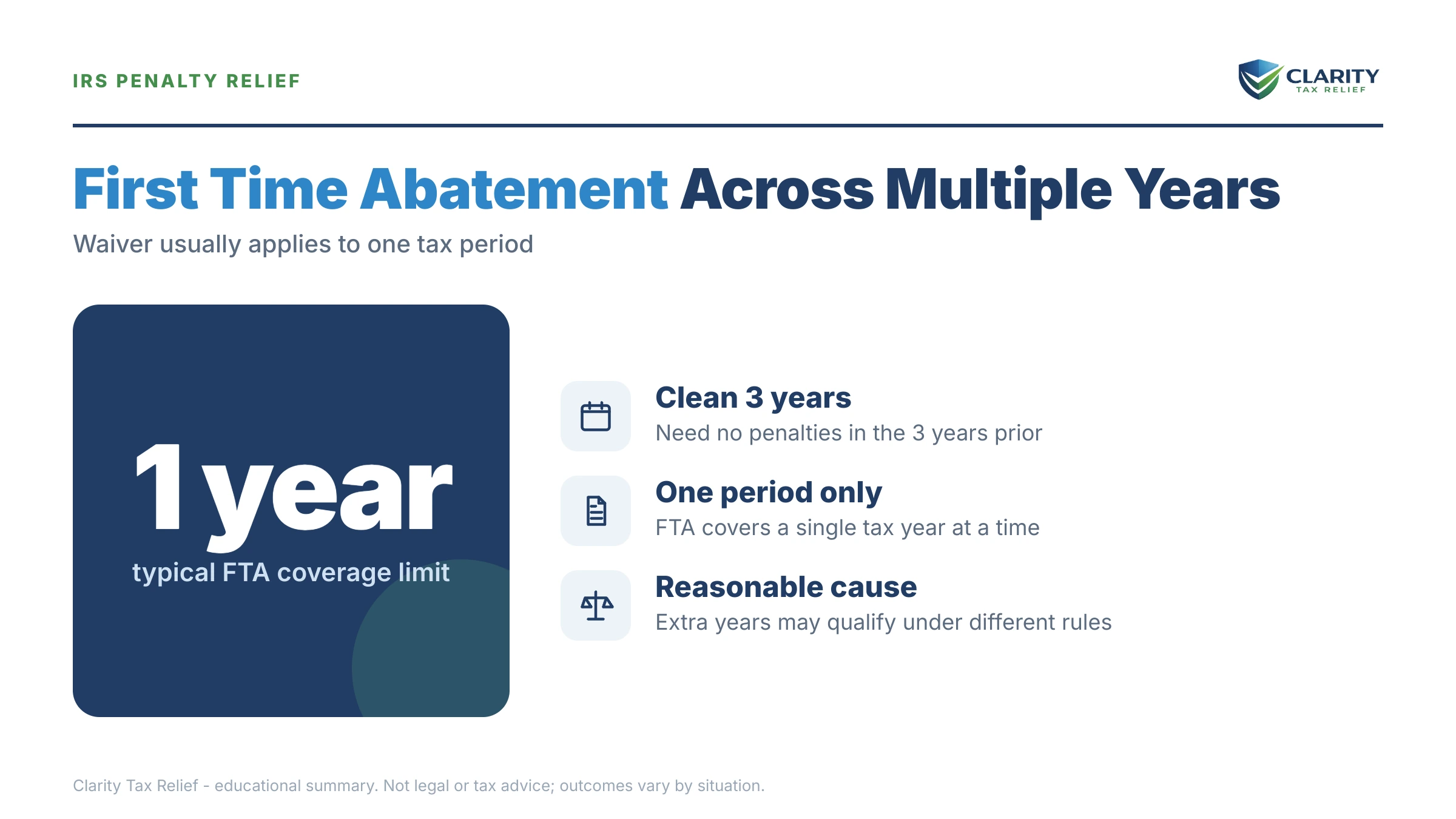
First time abatement multiple years: why FTA only clears one of them
FTA requires no penalties in the three tax years before the year you're requesting — so in a consecutive penalty run, only the earliest year can qualify. Request FTA for 2023 when 2022 has a penalty, and the 2022 penalty itself disqualifies you. The rule creates a domino effect: every year after the first in a run automatically fails the clean-history test.
Three details change the answer for real cases:
- The earliest year is the only door in a consecutive run. If 2022, 2023, and 2024 all carry penalties and 2019–2021 were clean, 2022 qualifies. 2023 and 2024 never will, no matter how you word the request.
- Gaps reset the clock. FTA isn't once per lifetime. Penalty years separated by three or more clean years can each get their own FTA — a 2019 penalty and a 2024 penalty can both be abated.
- A prior estimated-tax penalty generally doesn't break clean history. If your only blemish in the lookback years is an underpayment penalty on quarterlies, you may still qualify — check the transcripts before assuming you're out.
The single-year mechanics — who qualifies, what to say, how the IRS's automated tool decides — are covered in our complete first time penalty abatement guide. This page stays on the multi-year problem: what to do with the years FTA blocks.
| Your penalty years | What FTA can clear | Path for the rest |
|---|---|---|
| 2024 only (2021–2023 clean) | 2024 — the whole problem | None needed |
| 2022, 2023, 2024 (consecutive) | 2022 only | Reasonable cause for 2023 and 2024 |
| 2019 and 2024 (3+ clean years between) | Both years — each has its own clean lookback | None needed if both are granted |
| 2021 through 2024 (four straight years) | 2021 only | Reasonable cause for 2022–2024; AEP as a possible backstop |
What happens if you do nothing
An unaddressed failure-to-pay penalty grows by 0.5% of the unpaid tax every month, on every open year, until each caps at 25%. Multi-year balances don't sit still while you decide — three separate meters run at once, and the collection machine escalates on its own schedule:
- Penalties keep accruing on every unpaid year — each year's failure-to-pay penalty climbs monthly toward its own 25% cap.
- Interest compounds on both the tax and the penalties — including penalty amounts you could have had removed today.
- Collection notices escalate regardless of your abatement eligibility — the sequence runs from a balance-due bill through intent-to-levy notices toward levy authority. Being a good FTA candidate does not pause it.
- Refunds get intercepted — every future refund is applied to the oldest balance until everything, penalties included, is paid.
- Refund rights on paid penalties expire — money that gets applied to penalties can generally only be claimed back within a limited window. Wait long enough and abatement of those amounts stops being possible.
The quiet cost is the second item. Interest charged on a penalty comes off automatically when the penalty is abated — but only the interest accrued on that penalty, and only if you actually get it abated. Every month of delay grows both numbers.
Staring at penalties on three or four different years?
Multi-year abatement is a sequencing problem — request the wrong year first, or send one weak blanket letter, and you can burn relief you were entitled to. An experienced tax professional will map which years qualify for what, free and confidential.
Your options: stacking FTA with reasonable cause and AEP
Multi-year penalty relief is a stack, not a single request: FTA on the earliest year, reasonable cause on the years it blocks, and a refund claim for anything already paid. Here's each layer:
- FTA on the earliest penalty year. Free, no explanation of "why" required — it's an administrative waiver based purely on your clean lookback. Small penalties are often removed on a single phone call; larger amounts usually get routed for written review.
- Reasonable cause penalty abatement for the blocked years. Also free, but here you must prove circumstances beyond your control — illness, a death in the family, disaster, unobtainable records — with dates that match each year's failure. Our list of reasonable cause examples shows what the IRS has actually accepted. One critical drafting rule: argue each year separately. A vague letter saying "the last three years were hard" gets denied; a documented timeline tied to each year's specific missed deadline gets read.
- The Automatic Exemption from Penalty (AEP). Beginning summer 2026, the IRS is replacing FTA with automatic relief that requires no request at all. Treat it as a backstop, not a plan — it doesn't stop the failure-to-pay meter on your existing years while you wait, and you shouldn't assume it reaches every year in your run.
- Form 843 penalty abatement request for penalties you already paid. If refunds were offset or payments were applied to penalties, the same FTA and reasonable-cause arguments can support a refund claim — but only within the statute window. See penalty abatement after paying for the mechanics.
- Interest relief, honestly framed. Interest on abated penalties comes off automatically. Interest on the tax itself generally cannot be waived — the narrow exception is IRS interest abatement under §6404 when IRS error or delay caused it.
One timing point professionals use: the failure-to-pay penalty keeps accruing until the tax is paid, so an abatement granted today removes only what has accrued so far. If you request early, plan to request again once the balance is resolved — or resolve the balance first so the full accrued amount comes off in one shot. You can estimate what's accruing on each year with our Penalty & Interest Calculator.
| Relief route | Cost | Typical timeline | Best for |
|---|---|---|---|
| FTA by phone | Free | Often decided on the call; larger amounts routed to written review | The earliest penalty year, smaller penalty amounts |
| Written FTA / Form 843 | Free | Typically weeks to a few months | Larger penalties; creating a record the IRS must answer |
| Reasonable-cause request (per year) | Free | Typically a few months per request | The later years FTA blocks |
| AEP (rolling out from summer 2026) | Free — automatic, no request | On the IRS's schedule, not yours | A backstop for years the IRS applies it to |
| Appeal of a denial | Free | Typically several months | Denied reasonable-cause requests worth fighting |
One boundary worth naming: FTA is a federal program. States run their own penalty relief with their own rules — California's FTB, for instance, has a separate one-time abatement covered in our FTB penalty abatement guide. Never assume an IRS approval transfers to a state balance.
Worked example: $31,200 across three years, and what the stack removes
Say you're a retiree on Social Security who started IRA withdrawals in 2022 with no withholding, and you now owe $31,200 across tax years 2022, 2023, and 2024. Here's a hypothetical breakdown:
- Tax: $9,000 (2022) + $8,000 (2023) + $7,500 (2024) = $24,500
- 2022 penalties: filed five months late → failure-to-file of roughly 22.5% = $2,025, plus failure-to-pay at 0.5% × 30 months = $1,350
- 2023 penalty: failure-to-pay at 0.5% × 20 months = $800
- 2024 penalty: failure-to-pay at 0.5% × 8 months = $300
- Interest on everything: roughly $2,225 → total $31,200
Now run the stack. With 2019–2021 clean, 2022 qualifies for FTA: that removes $2,025 + $1,350 = $3,375 in penalties, plus roughly $300 of interest that accrued on those penalties — about $3,675 off with one request and zero explanation needed. 2023 and 2024 are blocked from FTA by the 2022 penalty. But say your spouse was hospitalized for much of 2023, documented with medical records: a reasonable-cause request could remove that year's $800 penalty plus its interest, roughly $860 more.
Result: the balance drops from $31,200 to about $26,700 before you've paid a dollar toward the tax. At that level, a streamlined installment agreement (available online for balances under $50,000, up to 72 months) would run roughly $445/month over 60 months — while remembering that interest, and failure-to-pay on the still-open years, continue until paid. For the bigger picture on fixed-income cases like this, see retired and owe back taxes.
This is hypothetical math, not a promise — reasonable cause turns on your documentation, and the IRS decides each year on its facts. But the structure is exactly how multi-year cases get worked.
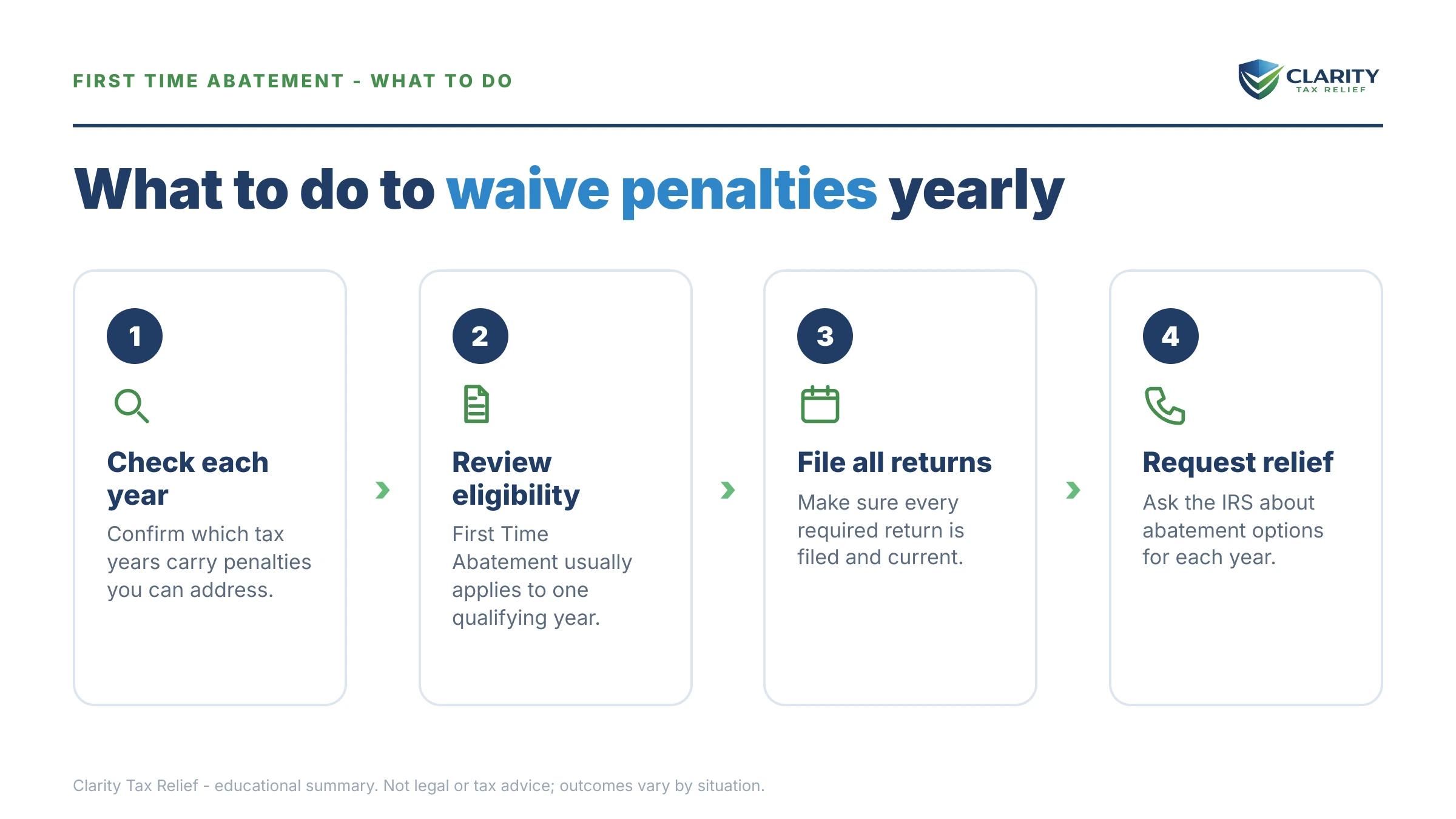
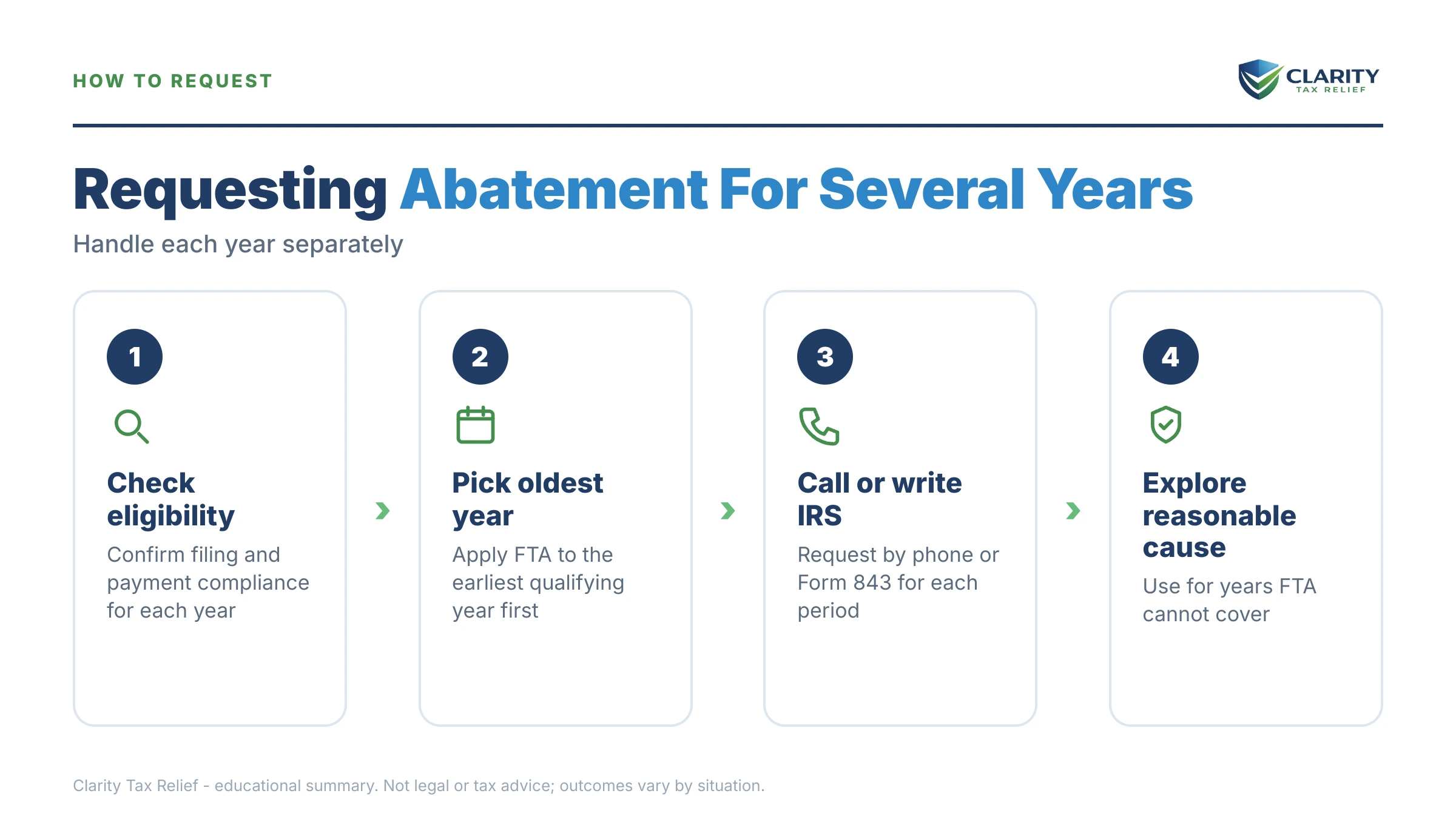
How to request first time abatement across multiple years, step by step
- Pull your account transcripts for every penalty year. Get the account transcript for each year with a balance so you can see exactly which penalties posted, their amounts, and whether the three years before your earliest penalty year are clean.
- Get compliant before you ask. File any missing returns, fix this year's withholding or estimated payments, and get the balance paid or onto a payment arrangement — the IRS checks current compliance before granting any abatement.
- Request first-time abatement on the earliest penalty year. Call the number on your most recent notice or send a written request; for larger penalty amounts, put it in writing so there is a record the IRS must respond to. Our first time penalty abatement letter sample gives you the wording.
- Submit reasonable-cause requests for the blocked years. Send a separate, documented reasonable-cause request for each later year, tying dated evidence — medical records, disaster declarations, death certificates — to each year's specific failure.
- Confirm the result and appeal any denial. Watch your transcripts for the penalty reversals, and if a request is denied, appeal within the window stated in the denial letter rather than accepting the first answer. Our penalty abatement appeal guide covers that route.
The IRS's own framework for all of this is on its penalty relief overview at IRS.gov, and the official form for written requests is at the About Form 843 page.
When you can handle this yourself — and when help changes the outcome
A single penalty year with a clean prior history is a do-it-yourself phone call. If your run is short, the penalties are modest, your lookback years are clearly clean, and the balance is on a payment plan, call the number on your notice, ask for first-time abatement on the earliest year, and you may well be done in twenty minutes at zero cost.
Experienced help earns its keep in the harder patterns: three or more penalty years needing separate, documented reasonable-cause narratives; penalties already paid where a refund claim's statute window is about to close; failure-to-file penalties large enough that a denial costs thousands; active collection escalating while abatement requests sit in a queue; or business and payroll penalties, which run on different rules entirely. The failure risk isn't the phone call — it's a weak blanket letter that gets all the blocked years denied at once, then having to win them back on appeal. If you're low-income, the Taxpayer Advocate Service is another legitimate resource when the IRS process itself stalls.
Terms on your penalty notices, decoded
- First-time abatement (FTA): an administrative waiver that removes failure-to-file, failure-to-pay, or failure-to-deposit penalties for one year based on a clean prior record — no excuse required.
- Clean compliance history: the three tax years before the request year, with no penalties (a prior estimated-tax penalty generally excepted), all returns filed, and payments current or arranged.
- Reasonable cause: the "life happened" standard — documented circumstances beyond your control that explain a specific year's failure to file or pay.
- RCA (Reasonable Cause Assistant): the automated tool IRS phone assistors run your request through; a "no" from the software is not the final word.
- AEP (Automatic Exemption from Penalty): the automatic replacement for FTA rolling out from summer 2026 — relief applied by the IRS with no request needed.
- Form 843: the written request form for penalty abatement or a refund of penalties you already paid.
First time abatement for multiple years: your questions, answered
Can the IRS give first-time abatement for more than one tax year?
No — first-time abatement applies to one tax year per qualifying period, because eligibility requires no penalties in the three years before the year you request. In a consecutive run of penalty years, only the earliest year can pass that test. The exception: penalty years separated by three or more clean years can each qualify for their own FTA.
Which year should I use first-time abatement on?
The earliest penalty year in the run — it is typically the only year with a clean three-year lookback, so the choice usually makes itself. It also tends to be the year with the largest accrued penalties, since failure-to-file and failure-to-pay have had the longest time to build. Confirm the lookback on your account transcripts before you call.
Can you get first-time abatement twice?
Yes, if your penalty years are far enough apart. FTA is not once per lifetime — it requires a clean history for the three years before the specific year you request. Penalties in 2019 and 2024, for example, can each qualify because three clean years sit in between. Back-to-back years never can, which is why stacking with reasonable cause matters.
Does first-time abatement remove interest?
Only the interest that accrued on the abated penalty — that portion comes off automatically when the penalty is removed. Interest on the underlying tax stays, and the IRS generally cannot waive it except when its own error or delay caused the interest under IRC §6404. Paying the tax is the only way to stop that clock.
What counts as a clean compliance history for FTA?
No penalties in the three tax years before the year you are requesting (a prior estimated-tax penalty generally does not disqualify you), all currently required returns filed or on a valid extension, and any balance due either paid or covered by an arrangement such as an installment agreement. Even a small prior-year penalty breaks the clean history.
What qualifies as reasonable cause for the years FTA can't reach?
Circumstances outside your control that line up in time with the noncompliance: serious illness or hospitalization, a death in the immediate family, a natural disaster, or records you could not obtain despite trying. The IRS wants documentation — medical records, death certificates, insurance claims — with dates that match the filing and payment failures for each specific year.
Is first-time abatement going away in 2026?
It is being folded into something more automatic. Starting in summer 2026, the IRS began rolling out the Automatic Exemption from Penalty (AEP), which applies first-time-style relief without a request. Do not wait on it for an existing multi-year balance — the failure-to-pay penalty keeps accruing monthly while you wait. Request relief now and treat AEP as a backstop.
Can I get back penalties I already paid?
Yes, through a refund claim on Form 843, applying the same FTA and reasonable-cause standards. The window is limited: generally the later of three years from when the return was filed or two years from when you paid the penalty. If a payment two years ago cleared old penalties, check that date before assuming the money is gone.
Your next 24 hours
- List your penalty years. Pull the account transcript (or your most recent notice) for each year with a balance and write down the penalty amount per year — that list tells you where FTA fits and which years need reasonable cause.
- Gather the "why" documents. For the years FTA can't reach, collect dated proof of what went wrong — hospital records, a death certificate, disaster paperwork — before you write a single letter.
- Get the sequence reviewed free. Send your year-by-year list through the 2-minute form at claritytaxrelief.com/#consult or call (888) 825-7779. The failure-to-pay penalty adds 0.5% every month on every open year — the stack is cheapest to run today.
This guide is general information, not tax or legal advice for your specific situation. Eligibility for IRS programs depends on individual facts and circumstances; no outcome is guaranteed.