
Penalty Relief
Penalty Abatement After Paying: How to Get IRS Penalties Refunded in 2026
The short answer: penalty abatement after paying still works. Paying an IRS penalty does not forfeit your right to relief — it turns your request into a refund claim. File Form 843 within 2 years of the payment (or 3 years of filing the return, whichever is later) and the IRS refunds the abated penalty plus the interest charged on it.
You paid the penalty because you wanted the letters to stop. The balance reads zero, the account is closed — and only afterward did someone mention the penalty might have been removable all along. That money isn't necessarily gone. The IRS abates and refunds paid penalties every year through a specific claim process, and your case is judged by exactly the same standards as if you'd never paid.
The catch isn't eligibility. It's the clock. A refund claim has a hard statutory expiration date, and every month you wait after paying burns time off it. Everything below — the deadline math, the grounds that work, the $13,600 worked example, and the step-by-step filing — is built around getting your claim in before that date.
⏱ Your deadline: You have 2 years from the date you paid the penalty — or 3 years from the date you filed the return, whichever is later — to file your refund claim. This is the Refund Statute Expiration Date (RSED). Once it passes, the IRS legally cannot refund the penalty, even if your abatement case is airtight.
How penalty abatement after paying actually works
The IRS treats a paid penalty as an overpayment you can reclaim: an abatement request filed after payment becomes a refund claim under the same statute that governs any tax refund. When the IRS grants the abatement, the penalty comes off your account, the payment you made against it becomes an overpayment, and a refund check follows.
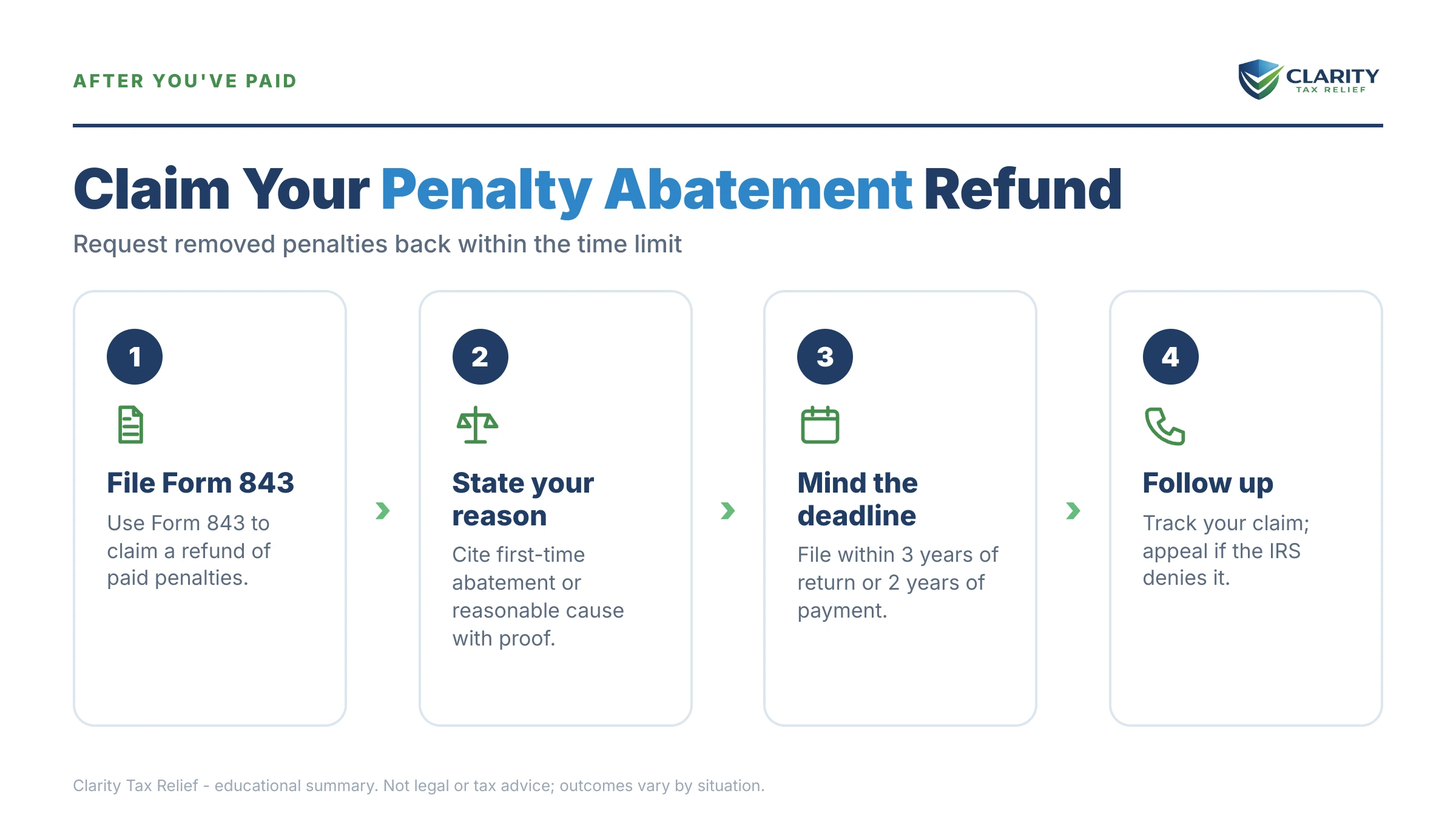
The vehicle is Form 843, Claim for Refund and Request for Abatement — one form per penalty type, per tax period. Our Form 843 penalty abatement request walkthrough covers the form line by line; the image below shows exactly what Form 843 looks like and where the entries that decide your claim go.
Here's what surprises most readers: the grounds don't get weaker after payment. First-time penalty abatement and reasonable cause apply identically to paid and unpaid penalties. Paying first can even work in your favor — it stops the failure-to-pay penalty and interest from compounding, it reads as good faith, and it preserves your right to take a denied claim to federal court (which requires full payment first anyway).
The refund deadline that controls everything (RSED)
A penalty refund claim must be filed within 3 years of filing the return or 2 years of paying the penalty — whichever gives you more time. That "later of" rule matters. If you filed late and paid soon after, the 3-year filing clock usually runs longest. If penalties were assessed years after filing and you paid them recently, the 2-year payment clock is the one keeping your claim alive.
There's a second layer most guides skip: the lookback. Even with a timely claim, you can only recover amounts you actually paid inside the applicable window. If you chipped away at penalties through an installment agreement, each monthly payment carries its own 2-year clock — your oldest payments expire first, one by one.
| How you paid the penalty | Your refund deadline |
|---|---|
| Paid with a late-filed return | 3 years from the filing date (usually the later, controlling date) |
| Paid in one lump sum after a notice | Later of 2 years from that payment or 3 years from filing the return |
| Paid gradually through an installment agreement | Each payment has its own 2-year clock — only payments made inside the window are recoverable |
| Paid by refund offset (the IRS kept a later refund) | 2 years from the offset date — an offset counts as a payment on the day it's applied |
| Penalty still partly unpaid | Abating the unpaid portion has no refund-deadline issue; the paid portion follows the rules above |
Find your exact payment dates before doing anything else. They're listed, transaction by transaction, on your account transcript — see how to read an IRS account transcript if the codes look like alphabet soup.
What you lose by waiting
A penalty refund claim dies permanently when the Refund Statute Expiration Date passes — there is no appeal, extension, or hardship exception. Here is the sequence, stage by stage:
- Today: every penalty dollar you paid within the window is claimable — plus the interest the IRS charged on those penalties.
- As months pass: if you paid in installments, your earliest payments fall outside their 2-year lookback first. The refundable amount shrinks payment by payment, even while your claim rights technically remain open.
- The RSED passes: the claim is barred for good. The IRS has no legal authority to refund a penalty after the statute closes — even when you clearly qualified.
- After a denial: a separate 2-year clock to file a refund suit runs from the disallowance notice. Miss that one and the courthouse door closes too.
Unlike a collection notice, nothing here escalates at you — no levy, no lien. The pressure runs the other direction: your rights quietly expire while nothing happens. That makes this one of the easiest refunds to lose to simple delay.
Paid a penalty you think was removable?
Send us the notice or your transcript. An experienced tax professional will check your compliance history, map your exact refund deadline, and tell you whether a Form 843 claim is worth filing — free, before your 2-year window from payment closes.
Every ground that gets a paid penalty refunded
Four grounds can get a paid penalty back: first-time abatement, reasonable cause, a statutory exception, and — for interest caused by IRS delay — Section 6404 abatement. Each has its own eligibility test:
| Refund ground | Who may qualify | What it can refund |
|---|---|---|
| First-time abatement (FTA) | Clean penalty history in the 3 prior years; all required returns filed | Failure-to-file, failure-to-pay, and failure-to-deposit penalties for one period — plus the interest on them |
| Reasonable cause | Circumstances beyond your control — serious illness, disaster, records you couldn't obtain — with documentation | Most penalty types, across multiple periods, plus their interest |
| Statutory exception | You relied on incorrect written IRS advice, or a federal disaster declaration covered your deadline | The specific penalty the error or advice caused |
| Automatic Exemption from Penalty (AEP) | Applies automatically starting summer 2026 — no request needed | Relief going forward as penalties are assessed; already-paid penalties still need Form 843 |
| Section 6404 interest abatement | Interest caused by IRS error or unreasonable delay in handling your account | Interest only — not the penalty itself |
First-time abatement is the fastest ground when it fits: it's administrative, not judgmental — the IRS checks your prior 3 years, and if they're penalty-free, the relief follows. It works on a fully paid penalty exactly as it would on an open one. If your penalties span several years, FTA typically clears only the first period; the rest need reasonable cause — the stacking strategy is covered in first time abatement multiple years.
Reasonable cause is the workhorse for everything FTA can't reach. The standard doesn't soften or harden because you paid — you still need to show what happened, when it happened, and why it prevented compliance. See reasonable cause penalty abatement for the framework and reasonable cause examples for what the IRS has actually accepted. One paid-penalty nuance: your payment itself is evidence of good faith, so lead with it in your statement.
AEP deserves a caution flag. Starting summer 2026, the IRS's automatic exemption from penalty begins replacing FTA — relief applied automatically, no request needed. That's genuinely good news for future penalties. But it is not a reason to wait on a penalty you already paid: your refund deadline keeps running regardless, and Form 843 remains the claim vehicle for money already out the door.
If it's a business or payroll penalty
The same Form 843 refund mechanics apply to paid business penalties — including 941 failure-to-deposit and failure-to-file penalties, which are often the largest dollar amounts on a small-business account. The eligibility arguments differ enough that we cover them separately in 941 penalty abatement and business penalty abatement.
If it's a state penalty
Nothing on this page transfers to a state. States run their own abatement programs with their own forms, standards, and deadlines — none of the IRS windows above apply. California's Franchise Tax Board, for example, has its own process with its own rules; start with FTB penalty abatement or go straight to the FTB for your account specifics.
What each path costs and how long it takes
Every IRS path to a paid-penalty refund is free to pursue — the only real costs are time and, if you go to court, filing fees and representation.
| Method | Out-of-pocket cost | Typical timeline |
|---|---|---|
| Phone request (simple FTA) | $0 | Often decided on the call; the refund follows later. A phone request does not formally protect your deadline — back it up with Form 843 if the RSED is close |
| Form 843 refund claim | $0 | No fixed timeline; paper claims commonly take several months, and 2026 staffing cuts (roughly 27% of the workforce in 2025) have stretched paper processing further |
| Appeal after a disallowance | $0 | Varies by office; months is normal |
| Refund lawsuit (district court / Court of Federal Claims) | Court filing fees plus representation | The longest path — available after a denial, or after 6 months of IRS silence on a filed claim |
When the refund arrives, it comes as a check or direct deposit, and the abatement posts to your account transcript as a credit adjustment. If the IRS takes long enough to pay, it generally adds overpayment interest to what it sends you.
Do you get the interest back too?
When the IRS abates a penalty you already paid, it also refunds the interest that was charged on that penalty. That happens automatically — interest is a parasite on the penalty, and it dies with its host. You don't need a separate request for it.
Interest on the underlying tax is a different animal. It generally stands no matter how sympathetic your situation is, with one narrow exception: interest caused by IRS error or unreasonable delay can be abated under Section 6404 — the standard and the evidence are covered in IRS interest abatement. If most of what you paid was interest on tax rather than penalties, set your expectations there before filing.
Worked example: reclaiming penalties out of a $13,600 payoff
Say you're a W-2 employee, filing single, who filed a 2023 return more than a year late and finally paid the IRS $13,600 in October 2025. Hypothetically, the payoff breaks down like this:
- Tax: $9,800
- Failure-to-file penalty: $2,205 (it maxes out after five months — the split between the two penalties is explained in failure to file penalty vs failure to pay)
- Failure-to-pay penalty: $690 (0.5% per month until the balance hit zero)
- Interest: $905
Penalties account for $2,895 — more than 21 cents of every dollar you paid. If your 2020–2022 accounts were penalty-free, first-time abatement fits, and a granted claim refunds the full $2,895 plus the slice of that $905 in interest that accrued on the penalties: call it roughly $3,000 back on a $13,600 payoff.
Now the deadline math. You filed in June 2025 and paid in October 2025. The 2-year payment clock runs to October 2027; the 3-year filing clock runs to June 2028. The rule takes the later date, so this claim stays open until June 2028 — plenty of runway, but only if you know the dates. (For the full mechanics of how penalties snowball to numbers like these, see how much IRS penalties on back taxes really grow — or estimate your own figures with our IRS Penalty & Interest Calculator.)
How to request penalty abatement after paying, step by step
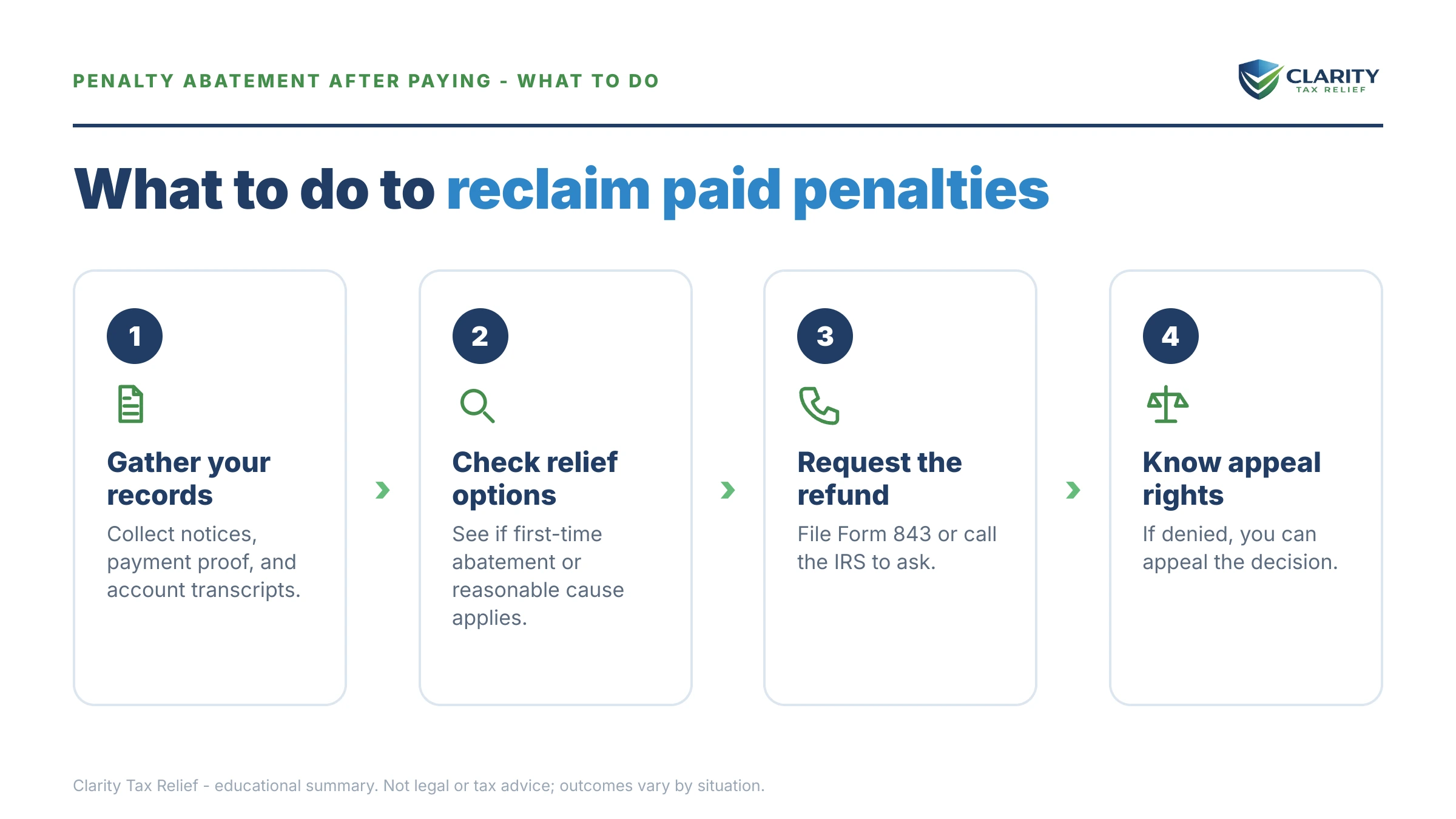
- Pull your account transcript. Confirm the penalty type, the amount assessed, and the exact date or dates you paid — the payment dates control your refund deadline. You can download it in minutes at IRS Get Transcript.
- Calculate your refund deadline. Take the later of 3 years from the date you filed the return or 2 years from the date you paid the penalty, and write that date down.
- Pick your strongest grounds. Use first-time abatement if your prior 3 years are penalty-free; use reasonable cause with documentation if they are not.
- File Form 843 for each tax period. State the penalty type, tax year, amount, and your grounds; attach your evidence; and mail it to the address for the notice you received or your service center. The official form and instructions are at About Form 843 on IRS.gov.
- Calendar the follow-up. If you get a denial, note the appeal window printed on the letter and the 2-year deadline to file a refund suit after a disallowance.
A well-built claim states the facts, the dates, and the legal ground in one page with exhibits attached — the same discipline as a strong IRS penalty abatement letter, just wrapped around Form 843.
If the IRS denies your claim
A denied Form 843 is a beginning, not an ending — the disallowance notice opens both an IRS appeal path and a court path. Inside the IRS, you can protest the denial to the Independent Office of Appeals; the process and the arguments that move appeals officers are laid out in penalty abatement appeal.
Outside the IRS, you have 2 years from the disallowance date to file a refund suit in federal district court or the Court of Federal Claims. Because you already paid in full, you've satisfied the full-payment rule that blocks many taxpayers from that door. If your claim simply sits unanswered, 6 months of silence lets you sue as if it were denied — and the Taxpayer Advocate Service can sometimes shake loose a claim stuck in processing before it comes to that.
When you can handle this yourself
Plenty of paid-penalty refunds need no professional at all. If it's one tax year, your prior 3 years are clean, and the penalty is a straightforward failure-to-file or failure-to-pay charge, a phone call requesting first-time abatement — backed by a simple Form 843 — is genuinely a do-it-yourself job. The IRS's FTA check is mechanical; there's no argument to win.
Experienced help changes the outcome in the messier fact patterns: penalties across multiple years where FTA covers only one, reasonable-cause cases that live or die on how the evidence is framed, business and payroll penalties with bigger dollars and stricter standards, installment-agreement payoffs where several refund clocks are expiring on different dates, and any claim that's already been denied once. In those cases the difference isn't filling out the form — it's choosing the ground, sequencing the years, and protecting the deadlines while the IRS takes months to respond.
If your paid penalties span multiple years or the deadline math is murky, have an experienced tax professional map your refund windows before one quietly closes — the case review is free, or call (888) 825-7779.
Terms on your claim, decoded
- Abatement — the IRS removing a penalty from your account; after payment, the removal becomes a refundable overpayment.
- Form 843 — the one-page claim form that formally requests the abatement and the refund; one per penalty type, per tax period.
- RSED (Refund Statute Expiration Date) — the last day the law allows the IRS to refund your money: the later of 3 years from filing or 2 years from payment.
- First-time abatement (FTA) — administrative relief based on a clean penalty history in the 3 prior years, not on why you slipped.
- Reasonable cause — relief based on documented circumstances beyond your control that prevented you from filing or paying on time.
- Notice of claim disallowance — the letter denying your claim; it starts your IRS appeal window and the 2-year clock to sue in federal court.
Penalty abatement after paying: your questions, answered
Can I get a refund of IRS penalties I already paid?
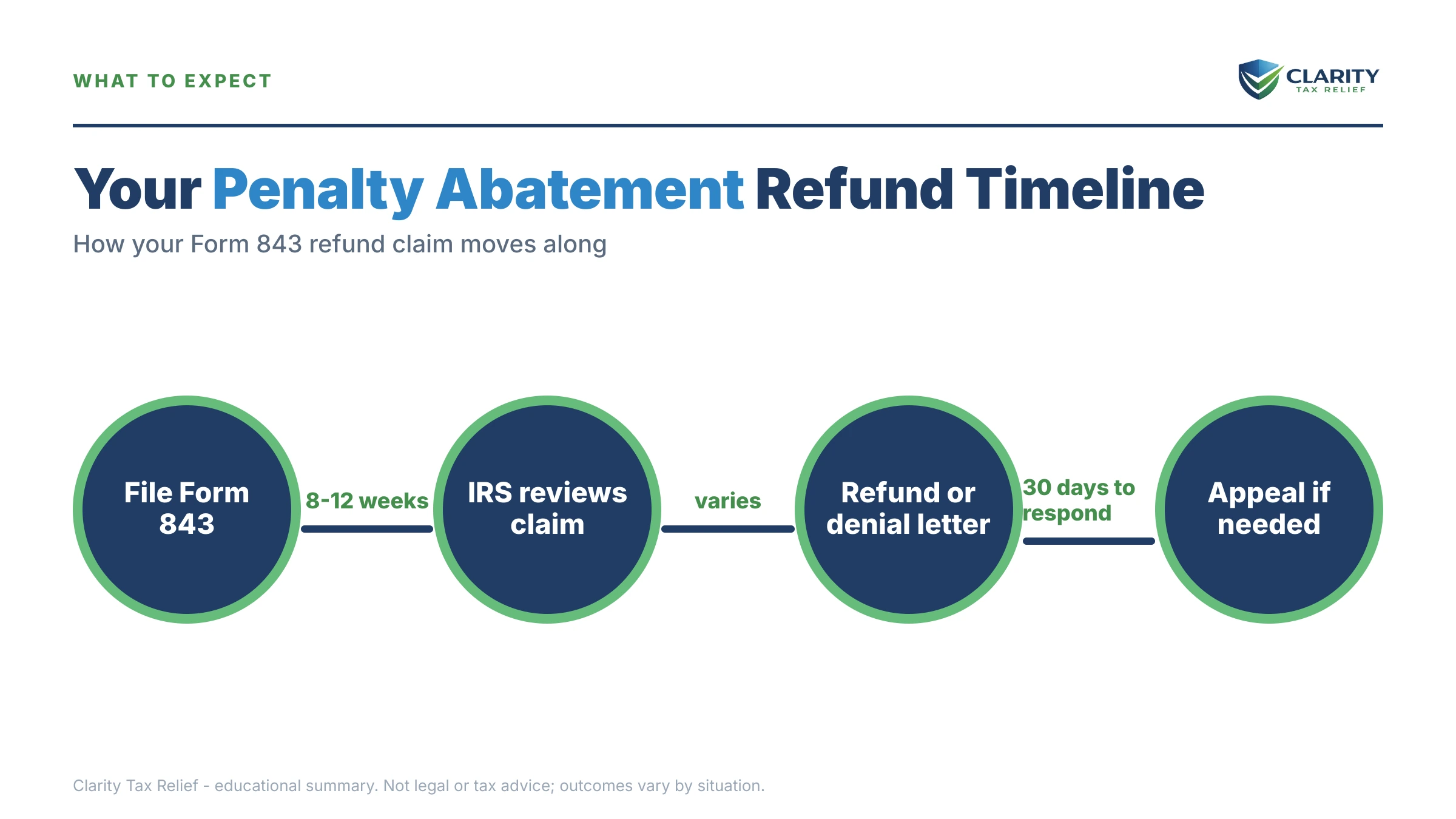
Yes. Paying a penalty does not waive your right to abatement — it converts the request into a refund claim. File Form 843 for each tax period, state your grounds (first-time abatement, reasonable cause, or a statutory exception), and if the IRS agrees, it refunds the penalty plus the interest that was charged on it. The claim must arrive before your refund deadline: 2 years from payment or 3 years from filing, whichever is later.
How far back can I claim penalty abatement after paying?
Generally 2 years from the date you paid the penalty or 3 years from the date you filed the return, whichever is later. If you paid in installments, each payment carries its own 2-year clock, so recent payments may still be claimable even when older ones are not. Once the window closes, the IRS cannot legally issue the refund no matter how strong your case is.
Does first-time abatement still work after the penalty is paid?
Yes — first-time abatement is available whether the penalty is unpaid, partly paid, or fully paid. The test is the same: a clean penalty history for the 3 prior tax years, all required returns filed, and current payment obligations addressed. When it is granted on a paid penalty, the IRS issues a refund instead of a balance reduction.
Do I get back the interest charged on an abated penalty?
Yes. Interest follows the penalty it was charged on, so when the penalty is abated, the interest that accrued on that penalty is refunded with it. Interest on the underlying tax is different — it generally stands unless the delay was caused by IRS error or unreasonable delay under Section 6404. The IRS may also add overpayment interest if your refund takes a long time to issue.
How long does a Form 843 refund take?
There is no fixed timeline. Simple first-time abatement requests handled by phone can resolve quickly, while paper Form 843 claims commonly take several months — and 2026 staffing cuts have stretched paper processing further. If a claim sits with no response, the Taxpayer Advocate Service can sometimes help, and a claim the IRS has not acted on within 6 months can be taken to court as if it were denied.
Does paying a penalty first hurt my abatement case?
No — if anything it helps. Payment stops the failure-to-pay penalty and interest from growing, shows good faith, and satisfies the full-payment rule you would need to meet before suing for a refund in federal court anyway. The abatement standards themselves — first-time abatement and reasonable cause — are judged exactly the same whether the penalty is paid or unpaid.
Can I claim abatement after paying for multiple tax years?
Yes, but file a separate Form 843 for each tax period, and know that first-time abatement typically covers only the first year in a string of penalties. Later years need reasonable cause or another basis. Check each year's refund deadline separately — an older year may already be outside its window even when a newer one is still open.
What happens if the IRS denies my Form 843 claim?
You get a notice of claim disallowance, and two clocks start. You can appeal within the IRS during the window stated in the letter, and you have 2 years from the disallowance date to file a refund suit in federal court. Initial denials are often automated form letters that never weighed your facts, so a documented appeal is frequently worth pursuing.
Will the new Automatic Exemption from Penalty (AEP) refund penalties I already paid?
AEP, which begins replacing first-time abatement in summer 2026, grants relief automatically without a request — but it is built around penalties as they are assessed. For a penalty you already paid, do not wait on AEP: Form 843 remains the path, and waiting only burns time off your refund deadline. Watch your IRS account, but file the claim.
Your next 24 hours
- Find your payment date. Pull your account transcript or your payment confirmation and write down the exact date each penalty dollar was paid — that date sets your 2-year clock.
- Gather three things: the notice that assessed the penalty, the return for that year, and anything documenting why you filed or paid late (medical records, disaster dates, correspondence).
- Get the claim reviewed free. Use the 2-minute form or call (888) 825-7779 — an experienced tax professional will confirm your grounds and your RSED so the refund window doesn't close while you're deciding.
This guide is general information, not tax or legal advice for your specific situation. Eligibility for IRS programs depends on individual facts and circumstances; no outcome is guaranteed.