
Penalty Relief
First Time Penalty Abatement Letter Sample: Copy-and-Send Template for 2026
The short answer: a first time penalty abatement letter sample needs five things: your identifying details, the tax year and notice number, the exact penalty dollar amounts, a citation to the First-Time Abate administrative waiver (IRM 20.1.1.3.6.1), and a statement that you had no penalties in the prior three years. The full copy-and-send template is below.
You're staring at a notice where the penalty lines might be bigger than a month of your income, and every template you've found online is either a hardship essay or a wall of legalese. Here's the good news: first-time abatement is a records test, not a sympathy test — you don't need a story, and the letter is one page.
This page gives you the exact letter, explains what each line is doing, and shows the math on what it can remove. If you'd rather see it than read about it, the image further down shows exactly what a finished abatement letter looks like and where each required element sits on the page.
⏱ Two clocks are running. There's no deadline to request FTA on an unpaid penalty — but the failure-to-pay penalty grows another 0.5% every month the tax stays unpaid, and interest compounds daily on both the tax and the penalties. If you already paid the penalty, you generally have 3 years from the return's filing date (or 2 years from the payment, whichever is later) to claim it back — see penalty abatement after paying.
Before you send it: do you qualify for first-time abatement?
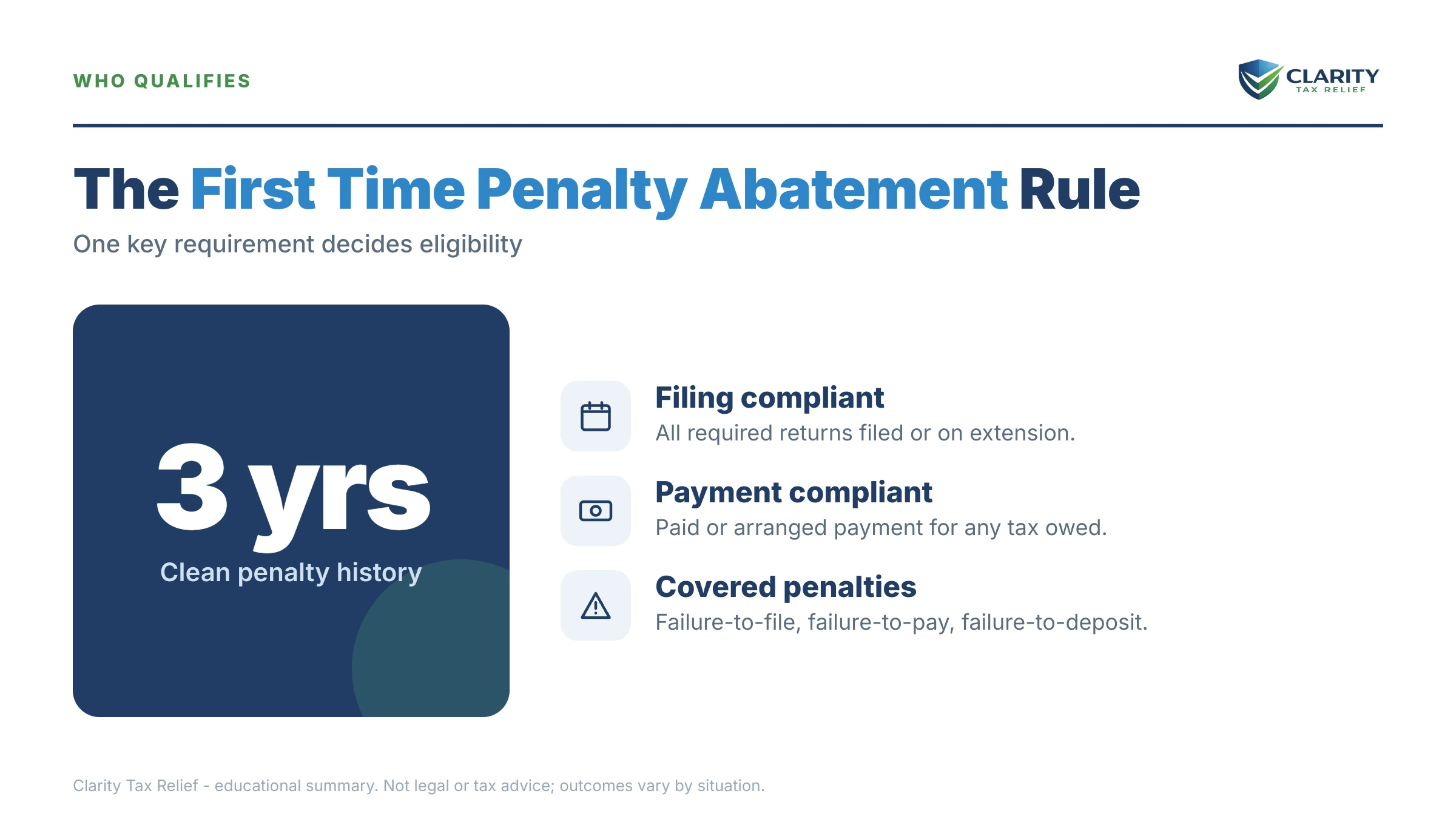
First-time abatement requires a clean penalty record for the three tax years before the penalty year — that single test decides most requests. The IRS agent who reads your letter doesn't weigh your reasons; they pull up your account and check three boxes:
- Clean prior history. No penalties (or none of any significance) for the three tax years before the year you're asking about. An estimated-tax penalty in a prior year generally doesn't break the streak — the test is aimed at filing and payment penalties.
- Filing compliance. Every return you're currently required to file has been filed, or a valid extension is in place.
- Payment compliance. The tax is paid, or you're current on an approved arrangement such as an installment agreement.
Miss any one of the three and the letter gets denied no matter how well it's written — which is why step one below is pulling your transcripts, not drafting. The full eligibility rules, including edge cases like S-corp late-filing penalties, live in our complete guide to first time penalty abatement.
One 2026 wrinkle worth knowing: the IRS is rolling out Automatic Exemption from Penalty (AEP) starting this summer, which grants the same relief automatically with no request. It's a genuine improvement — but a penalty already sitting on your account, accruing interest, is not something to wait on. Send the request.
And a scope note: FTA covers one year. When penalties span several years, the IRS applies the waiver to the earliest eligible period only; the rest need a different argument. If that's you, read first time abatement multiple years before mailing anything, because the order you request relief in changes how much comes off.
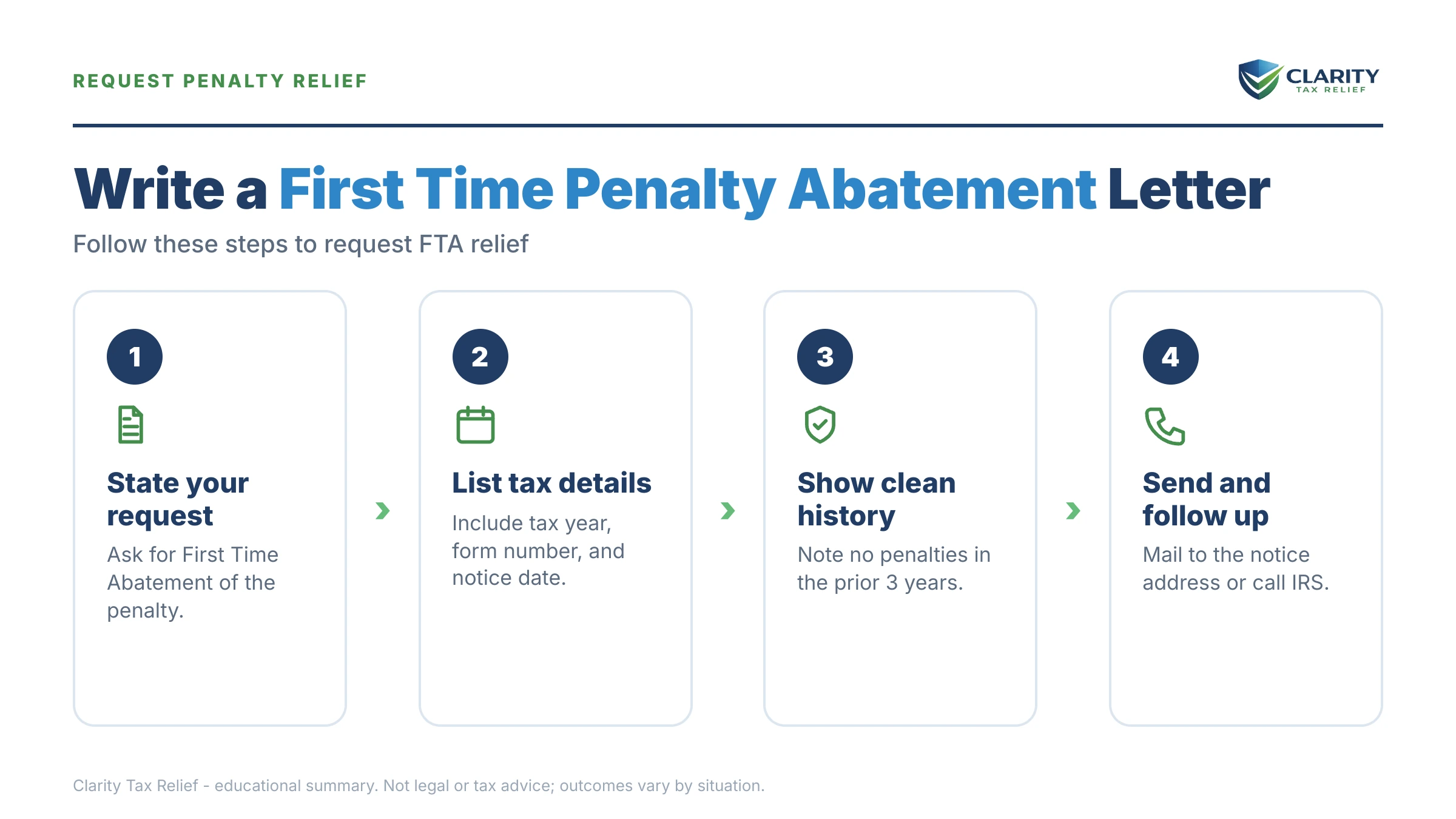
First time penalty abatement letter sample (copy and adapt)
A first-time abatement letter should fit on one page and cite the waiver by name — the agent needs your account details and the request, nothing more. Replace every bracketed item with your own information, taken directly from your notice:
[Your full name]
[Your mailing address]
[City, State ZIP]
[Date]
Internal Revenue Service
[The address printed on your notice]
Re: Request for First-Time Penalty Abatement
Taxpayer: [Your full name]
SSN: XXX-XX-[last four digits] (or EIN for a business)
Tax Form: [1040, 1120, 941, etc.]
Tax Period: [Year]
Notice: [Notice number and date, e.g., CP14 dated June 2, 2026]
To Whom It May Concern:
I am requesting abatement of the penalties assessed for the tax period above under the First-Time Abate administrative waiver described in Internal Revenue Manual 20.1.1.3.6.1.
I meet the criteria for this waiver:
1. I had no penalties for the three tax years prior to [Year] ([Year-3], [Year-2], and [Year-1]).
2. All tax returns currently required of me have been filed.
3. The tax due has been paid, or I am current on an approved payment arrangement.
I am requesting abatement of the following penalties, as shown on the notice referenced above:
• Failure-to-file penalty: $[amount]
• Failure-to-pay penalty: $[amount]
• Plus the interest charged on these penalties.
Please confirm the abatement in writing. A copy of the notice is enclosed. I can be reached at [phone number] if anything further is needed.
Sincerely,
[Signature]
[Printed name]
Mail it to the address printed on your notice — not a generic IRS address — with a copy of the notice enclosed. Send it certified mail with return receipt and keep a copy of everything. If you're requesting relief for a corporation, partnership, or payroll account, the entity version reads differently; use the business penalty abatement letter instead.
What every line of the letter is doing
Every element in the sample exists because leaving it out gives the IRS a reason to stall, misroute, or shrink your request. Here's the anatomy:
| Line in the letter | What it does | If you leave it out |
|---|---|---|
| "Re:" block — last four of SSN, form, period, notice number | Routes the request to the exact account and tax year | The letter sits unassigned, or gets applied to the wrong year |
| Naming the "First-Time Abate administrative waiver" with the IRM cite | Tells the agent which test to run — your three-year record, not your excuse | The request may be graded as a reasonable-cause claim and denied for lack of a story |
| The three numbered eligibility statements | Mirrors the exact criteria the agent verifies on screen, in order | The agent reconstructs your eligibility from scratch — slower, and easier to get wrong |
| Exact dollar amount of each penalty | Defines the full scope of the request | Ambiguous requests get partial abatements |
| "Plus the interest charged on these penalties" | Interest on an abated penalty comes off with it — this makes that explicit | Usually automatic, but stating it removes any doubt or follow-up dispute |
| Request for written confirmation | Creates the proof you need to follow up or appeal | You learn the outcome only by watching your transcript for a code 780 manual abatement to post |
Notice what the letter does not contain: no explanation of why you filed late, no apology, no hardship narrative. That's deliberate. Adding a "reason" invites the agent to evaluate the reason instead of your record — and a weak reason can sink a request your clean history would have won. If you genuinely need a reasons-based request because FTA doesn't fit, that's a different document entirely: see the IRS penalty abatement letter for reasonable cause.
What happens if you leave the penalties in place
An unaddressed penalty balance grows every single month until the failure-to-pay penalty caps at 25% of the tax. There's no enforcement "event" that makes penalties urgent — the urgency is arithmetic, and it runs alongside the IRS collection notice sequence:
- Every month: another 0.5% failure-to-pay penalty posts (transcript code 276), and interest compounds daily on the tax and on the penalties — you pay interest on your penalties.
- The bill stage: a CP14 gives you roughly 21 days (10 business days if the balance is $100,000 or more), then CP501 and CP503 reminders follow, each with a bigger balance than the last.
- CP504: the IRS declares intent to levy your state tax refund, and a federal tax lien becomes a realistic next step.
- LT11 / Letter 1058: the final notice starts a 30-day clock, after which wage and bank levies become legal — and your penalty balance is now baked into everything the IRS tries to collect.
The full compounding math — how a five-figure tax debt becomes a six-figure one — is worked through in our guide to how much IRS penalties on back taxes really grow. The short version: penalties are the one part of your balance that a single page of paper can remove, which makes them the cheapest problem on your notice to solve.
Penalties stacking up on your notice right now?
Send us a photo of it. An experienced tax professional will check your three-year record, tell you exactly which penalties can come off, and flag the ones this letter can't touch — free, before another month of failure-to-pay penalty posts.
Letter vs. phone vs. Form 843: three ways to request FTA
The IRS accepts first-time abatement requests by phone, by letter, or on Form 843 — and each channel fits a different situation. All three cost nothing but time and postage:
| Channel | Cost | Typical timeline | Best for |
|---|---|---|---|
| Phone — the number on your notice | $0, plus hold time (long in 2026) | Sometimes decided on the call; larger amounts get routed to written review | Smaller penalties; getting a fast read on whether your record is clean |
| Written letter — the sample above | $0 plus certified postage | Often a few months in 2026's staffing environment | Larger penalties; creating a paper trail; anything you might need to appeal |
| Form 843, Claim for Refund and Request for Abatement | $0 | Similar to a letter; refund claims can take longer | Penalties you already paid (refund claims), or requests filed by your representative |
A practical hybrid works well for many people: call first to confirm eligibility and try for an on-the-spot abatement, then follow with the letter if the agent says the amount exceeds what they can approve by phone. Nothing about a phone denial prevents a written request. If you go the form route, the line-by-line walkthrough is in our Form 843 penalty abatement request guide.
Whichever channel you use, the decision standard is identical — the same three-part test, run against the same computer records. The channel changes speed and documentation, not your odds.
Which penalties this letter can (and can't) remove
First-time abatement covers exactly three penalties: failure-to-file, failure-to-pay, and the failure-to-deposit penalty on payroll taxes. Everything else on your notice needs a different tool:
| Penalty on your notice | FTA eligible? | If FTA doesn't apply |
|---|---|---|
| Failure-to-file — 5% per month, up to 25% | Yes | — |
| Failure-to-pay — 0.5% per month, up to 25% | Yes | — |
| Failure-to-deposit (payroll taxes) | Yes | Reasonable cause — see 941 penalty abatement |
| Estimated-tax penalty (§6654) | No | Estimated tax penalty waiver via Form 2210 exceptions |
| Accuracy-related penalty (20%) | No | Reasonable cause, or challenge during the audit/appeal |
| Fraud and information-return penalties | No | Reasonable cause penalty abatement or specific statutory defenses |
This distinction matters most for self-employed readers. A 1099 contractor's notice frequently stacks three penalties — failure-to-file, failure-to-pay, and the estimated-tax penalty from skipped quarterlies. The FTA letter removes the first two; it cannot touch the third. Sending one letter and assuming the whole penalty block disappears is the most common mistake we see with this template.
Also note the ratio: the failure-to-file penalty runs at 5% per month — ten times the 0.5% failure-to-pay rate. The full comparison is in failure to file penalty vs failure to pay, but the takeaway for your letter is simple: if both appear on your notice, the file penalty is almost certainly the bigger number, and both go in the request.
Worked example: what the letter is worth on a $48,300 balance
A single FTA letter can remove five figures when the failure-to-file penalty is involved. Say you're a 1099 contractor who owed $48,300 on your 2025 return, had no withholding, and — between a brutal season and plain avoidance — filed and paid five months late, in September instead of April. This is hypothetical, but the math is the IRS's own formula:
- Failure-to-file: normally 5% per month, reduced to 4.5% for months when the failure-to-pay penalty also runs. 4.5% × 5 months = 22.5% of $48,300 = $10,868.
- Failure-to-pay: 0.5% × 5 months = 2.5% of $48,300 = $1,208.
- Combined penalties: $12,076 — a full 25% of the tax — plus interest compounding on the tax and on both penalties.
Now run the FTA test. If 2022, 2023, and 2024 show no penalties, all required returns are filed, and the tax is paid or on a plan, the one-page letter above requests removal of the entire $12,076 — and the interest that accrued on those penalties comes off with them. The interest on the $48,300 itself stays; interest on tax generally can't be waived except for IRS error or delay.
One more line probably appears on this contractor's notice: an estimated-tax penalty for the skipped quarterlies — call it $1,400 in this scenario. The FTA letter can't remove it; that piece needs its own Form 2210 waiver request, and only specific exceptions (casualty, disaster, retirement, disability) qualify. To model your own numbers before you write anything, run them through our Penalty & Interest Calculator — it estimates how your penalties and interest break down, which is exactly the figure your letter needs to request.
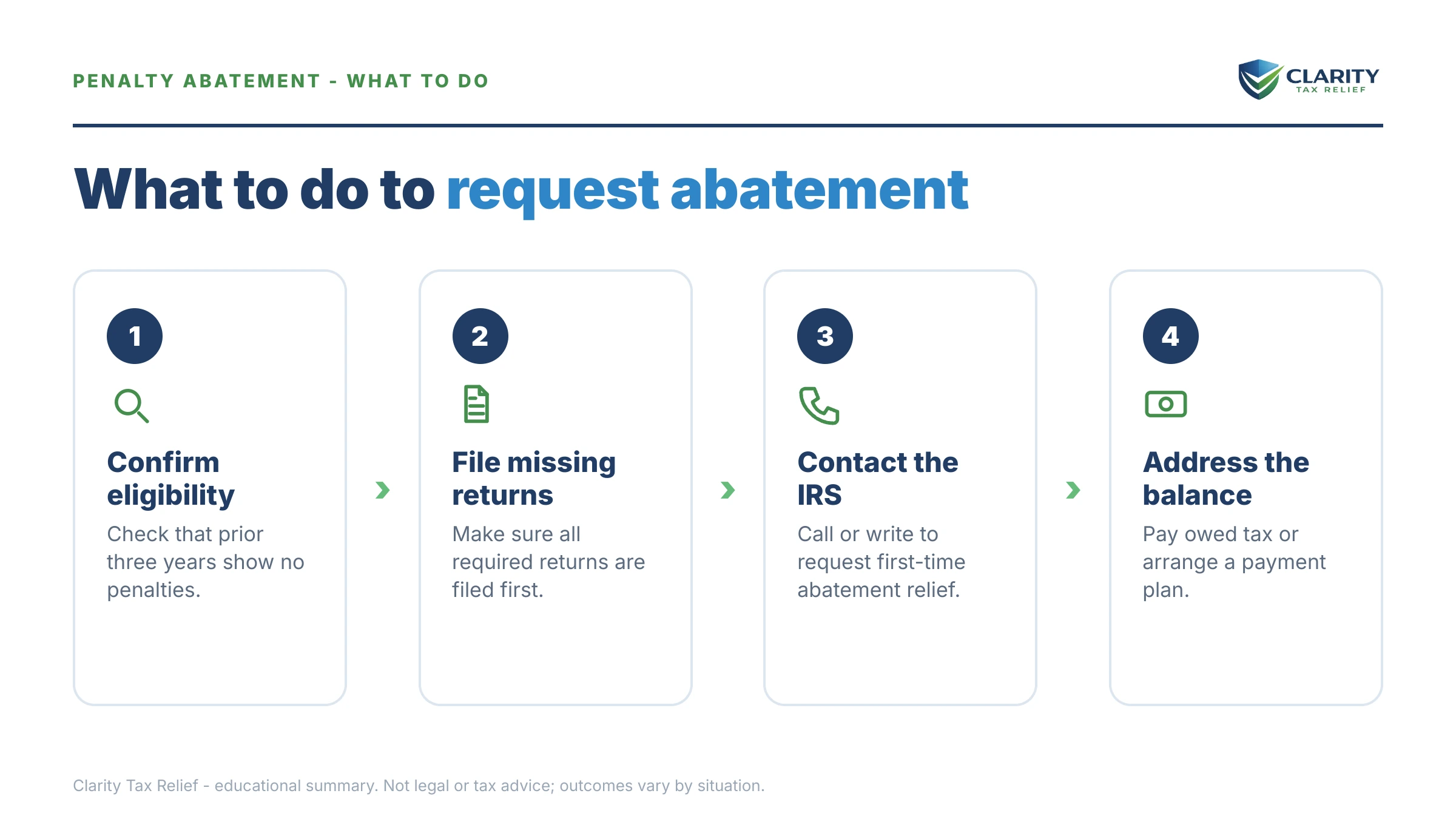
How to request first-time abatement, step by step
- Pull your transcripts — confirm no penalties posted in the three years before the penalty year, using your IRS online account or account transcripts.
- Confirm compliance — every required return filed, and the tax paid or an installment agreement in place.
- Fill in the sample letter — your identifying details, the notice number, and the exact penalty amounts printed on your notice.
- Mail it certified — with a copy of the notice attached, to the address printed on the notice itself, and keep copies of everything.
- Follow up — if no written response arrives after a couple of months, call the number on your notice with your certified-mail receipt.
- Appeal a denial — request review by the IRS Independent Office of Appeals, or pivot to a reasonable-cause argument if the clean-history test failed.
Approval shows up two ways: a letter confirming the abatement, and a credit adjustment on your account transcript. If a denial arrives instead, don't refile the same letter — the appeal process is a different track with its own leverage, covered in penalty abatement appeal.
When you can handle this yourself — and when help changes the outcome
Most single-year FTA requests are genuinely a do-it-yourself job. If one tax year has penalties, your prior three years are clearly clean, the penalties are failure-to-file or failure-to-pay, and the balance is paid or on a plan, this sample letter — or one phone call — is all the situation needs. Paying someone to send it would be paying for a stamp.
Experienced help changes the outcome in the harder patterns:
- Multiple penalty years. FTA covers only the earliest eligible year; sequencing FTA against reasonable-cause arguments across the rest determines the total that comes off.
- Business and payroll penalties. Failure-to-deposit penalties compound fast, and the abatement analysis interacts with trust-fund exposure — see business penalty abatement.
- A "clean history" that isn't. One small penalty three years back can sink the request; a professional can spot it on transcripts before you burn the attempt, and reframe the request around it.
- A denial you disagree with. Appeals have real win rates, but they run on procedure, not persistence.
- An underlying balance you can't pay. If the $48,300 itself is the real problem, penalty relief is step one of a bigger plan — payment terms, hardship status, or settlement math — and the order of operations matters.
Not sure which side of that line you're on? A quick free case review of your notice and transcripts will tell you whether this letter alone does the job — honestly, including when it does.
Terms on your notice, decoded
- First-Time Abate (FTA): an administrative waiver that removes certain penalties based on your clean three-year record — no excuse or hardship required.
- IRM 20.1.1.3.6.1: the Internal Revenue Manual section that tells IRS employees how to apply FTA; citing it routes your letter to the right test.
- Reasonable cause: the other abatement path, based on circumstances beyond your control — illness, disaster, reliance on bad advice — used when FTA doesn't fit.
- Failure-to-file vs. failure-to-pay: 5% per month versus 0.5% per month, each capped at 25% — the filing penalty is ten times the paying penalty.
- Form 843: the IRS form for requesting abatement, or a refund of penalties you already paid.
- AEP (Automatic Exemption from Penalty): the automated successor to FTA rolling out from summer 2026, which grants the relief without a request.
Primary sources if you want the IRS's own words: the overview at IRS penalty relief, the official Form 843 page, and — if your request stalls with no response for months — the Taxpayer Advocate Service.
FTA letter questions, answered
Can I request first-time penalty abatement by phone instead of a letter?
Yes — calling the number on your notice is often the fastest route, and IRS agents can frequently approve smaller FTA requests on the call itself. Larger penalty amounts usually get routed for written review anyway, so a letter creates the paper trail you'll want. If you request by phone, note the date, the agent's name and ID number, and ask for written confirmation of any abatement.
What should a first-time penalty abatement letter include?
Your name, the last four digits of your SSN (or full EIN for a business), the tax form and period, the notice number, the specific penalties and dollar amounts you want removed, and a statement that you meet all three First-Time Abate criteria: no penalties in the prior three years, all required returns filed, and tax paid or on an approved plan. Cite the First-Time Abate administrative waiver by name so the agent applies the right test.
Which penalties does first-time abatement cover?
FTA covers exactly three penalties: failure-to-file, failure-to-pay, and the failure-to-deposit penalty on payroll taxes. It does not cover the estimated-tax penalty, the 20% accuracy-related penalty, fraud penalties, or information-return penalties. If your notice includes an estimated-tax penalty — common for 1099 contractors — that piece needs a separate Form 2210 waiver request based on casualty, disaster, or other specific exceptions.
Do I have to pay my tax debt before requesting first-time abatement?
No — you must be compliant, which means either the tax is paid or you're current on an approved arrangement like an installment agreement. Many people set up a payment plan first, then send the FTA letter. One caution: the failure-to-pay penalty keeps accruing at 0.5% per month until the tax is actually paid, so some taxpayers wait until the balance is paid off and then request abatement of the full, final penalty amount.
How long does the IRS take to respond to a penalty abatement letter?
There is no fixed statutory timeline. In 2026, with the IRS workforce down roughly 27% after the 2025 cuts, written requests commonly take a few months to produce a response. Phone requests can be decided on the call for smaller amounts. If a couple of months pass with no letter, call the number on your notice with your certified-mail receipt in hand and ask for the status of your request.
Can I use first-time abatement for more than one tax year?
Not in one request — FTA is a first-time waiver, so when several years carry penalties, the IRS applies it only to the earliest eligible year. Penalties on the later years need a reasonable-cause argument instead: illness, disaster, reliance on bad professional advice, or other circumstances beyond your control. Stacking FTA on year one and reasonable cause on the rest is the standard multi-year strategy.
Does first-time abatement remove interest too?
It removes the interest that was charged on the abated penalties — when a penalty comes off, the interest that grew on it comes off with it. It does not remove interest on the underlying tax. Interest on the tax itself is set by statute and can generally only be abated when it resulted from IRS error or delay, which is a separate request under a different rule.
What happens if my first-time abatement request is denied?
You can appeal. A denial letter typically explains your appeal rights, and you can request review by the IRS Independent Office of Appeals. Denials often happen because a small penalty in the prior three years broke the clean-history test, or because a required return is still unfiled — both worth checking on your account transcripts before you appeal. If FTA truly doesn't fit, reasonable cause is the fallback argument.
Is first-time abatement going away in 2026?
It's being replaced, not eliminated. The IRS is rolling out Automatic Exemption from Penalty (AEP) starting in summer 2026, which grants the same first-time relief automatically — no letter or call required. Until AEP applies to your specific penalty, a request is still how assessed penalties get removed, so don't leave money accruing while you wait for automation to catch up.
Your next 24 hours
- Find the penalty breakout on your notice. Locate the lines labeled "failure-to-file" and "failure-to-pay" with their dollar amounts, plus the notice number in the top corner — those figures go straight into the letter.
- Gather your records. The notice itself, your return for the penalty year, and confirmation that the three prior years' returns were filed penalty-free — your IRS online account or transcripts will show it.
- Get the free review. Call (888) 825-7779 or use the 2-minute form. We'll check your three-year record, confirm which penalties this letter removes, and flag anything — like an estimated-tax penalty — that needs a separate request, before another month of failure-to-pay penalty posts to your account.
This guide is general information, not tax or legal advice for your specific situation. Eligibility for IRS programs depends on individual facts and circumstances; no outcome is guaranteed.