
IRS Penalties
Estimated Tax Penalty Waiver: Form 2210 Exceptions and Who Qualifies in 2026
The short answer: the IRS grants an estimated tax penalty waiver in two situations — you retired after age 62 or became disabled and had reasonable cause, or a casualty, disaster, or other unusual circumstance makes the penalty unfair. You request it on Form 2210, Part II. First-time abatement does not apply to this penalty.
You were pulling documents together for the refinance — pay stubs, bank statements, last year's return — and there it is: a penalty on your 1040 you didn't expect, or a CP30 saying the IRS added one after the fact. It stings, especially when you paid the tax itself. But this penalty has its own escape hatches, and this guide covers every one of them.
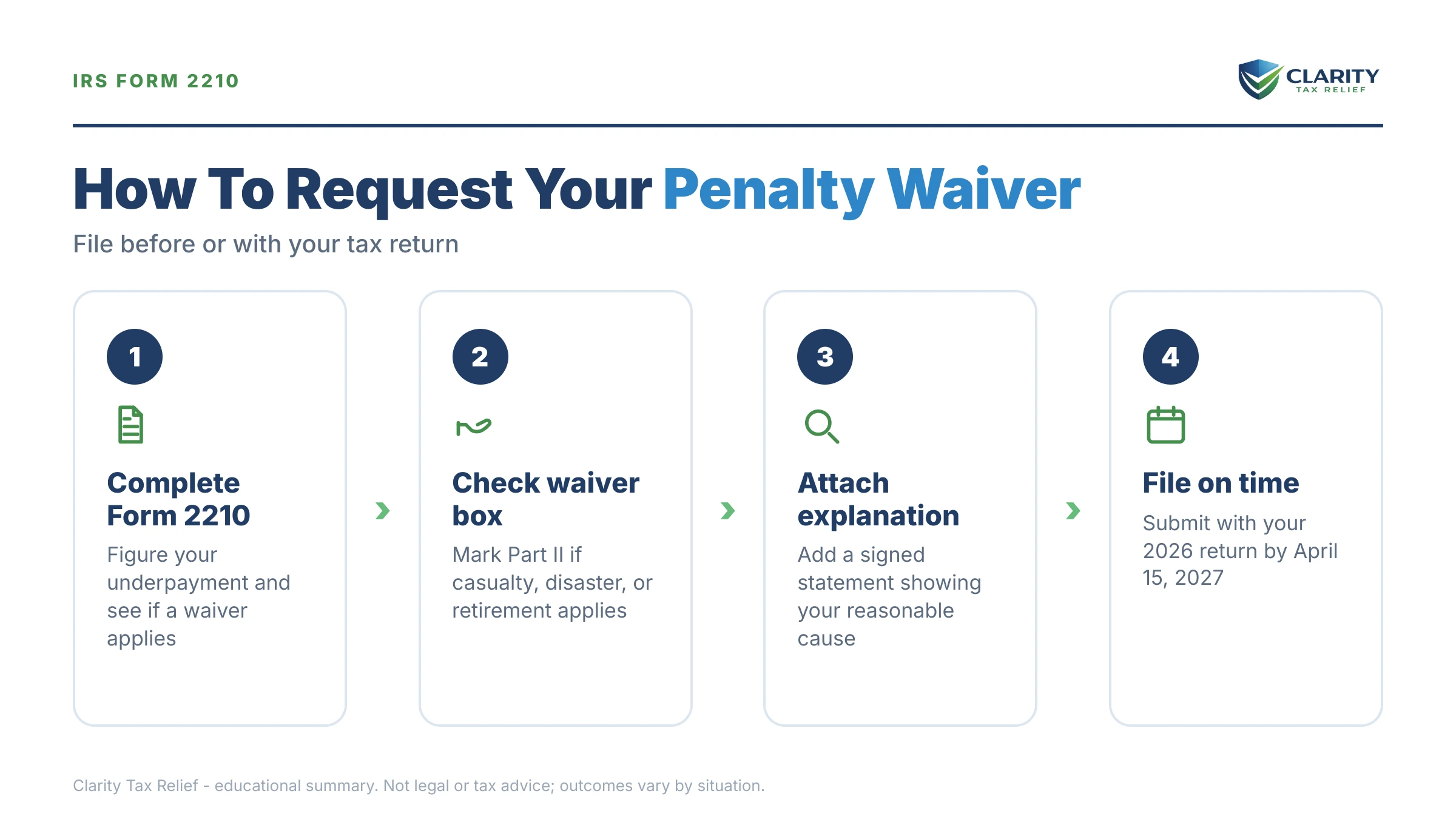
The waiver request lives on one specific form — the image below shows exactly what Form 2210 looks like and where your request goes, so you'll know what you're filling out before you start.
⏱ The clock that matters: requesting the waiver with your return has no separate deadline — it rides along with Form 2210. But if the penalty was already assessed and you paid it, you generally have 3 years from filing the return or 2 years from paying the penalty, whichever is later, to claim it back on Form 843. After that, the money is gone.
Why you got this penalty — and why the usual abatement rules don't apply
The estimated tax penalty under IRC §6654 is charged when you didn't pay enough tax during the year — even if you paid your full bill by April 15. The tax system runs pay-as-you-go: the IRS expects money each quarter, through withholding or estimated payments, and charges you for each quarter that came up short.
Common triggers: a first year of self-employment income, a large capital gain, retirement-account withdrawals, a year-end bonus, or a side business that grew faster than your withholding. If quarterlies are new to you, start with how quarterly estimated taxes work and the quarterly estimated tax deadlines 2026.
Here's what makes this penalty different from every other IRS penalty: neither first-time abatement nor a general reasonable-cause argument can remove it. First-time penalty abatement covers late-filing, late-payment, and deposit penalties — §6654 is excluded, and so is the new Automatic Exemption from Penalty (AEP) rolling out in summer 2026, which replaces FTA for those same penalty types. The estimated tax penalty can only be removed through the specific waivers Congress wrote into the statute — the ones on Form 2210, Part II.
One more thing worth knowing: this penalty is really interest in disguise. It's computed on each quarter's shortfall at the IRS underpayment rate (the federal short-term rate plus 3 percentage points, reset quarterly — see the current estimated tax penalty rate 2026). That's why the fix is either qualifying for a waiver or changing the math — not pleading hardship. For where this penalty fits among everything else the IRS charges, see how much IRS penalties on back taxes really cost.
What happens if you ignore the penalty
An unwaived estimated tax penalty is assessed the moment your return posts, and any unpaid portion enters the same collection stream as unpaid tax. The penalty amount itself is fixed once computed — but the sequence that follows is not:
- Assessment. The penalty posts to your account with the return — either the figure from your Form 2210 or the IRS's own calculation.
- CP30 or a balance-due bill. If the IRS computed or adjusted the penalty, a CP30 notice announces it. If it's part of a larger unpaid balance, it lands inside a CP14 bill with roughly 21 days to respond (10 business days if the balance is $100,000 or more). Interest starts accruing on the unpaid penalty.
- Reminder notices (CP501 / CP503). Still just bills — but the balance grows monthly, and next year's refund will be offset against it.
- CP504 — intent to levy your state refund. A federal tax lien becomes a live possibility at this stage. For a homeowner heading into a refinance, a filed lien is the outcome to avoid at all costs — it clouds title and can stall or kill the loan. If one has already been filed, see whether you can refinance with an IRS lien.
- LT11 — final notice of intent to levy. After a 30-day window, the IRS can levy bank accounts and garnish wages. You have appeal rights here, but far fewer clean options than you have today.
The good news: most estimated tax penalties are small enough that they never travel this road — if you deal with them while they're just a line on a return.
Penalty on your return and a refinance on the calendar?
Send us your return or CP30. An experienced tax professional will check every waiver and safe harbor you qualify for — free and confidential, before interest on an unpaid balance grows another month.
Every way to get the underpayment penalty waived, reduced, or erased
There are six ways to remove, reduce, or avoid the estimated tax penalty — and only two of them are formally called waivers. Check them in this order, because the earlier ones cost nothing to claim:
| Path | Who qualifies | How to request | Cost & timeline |
|---|---|---|---|
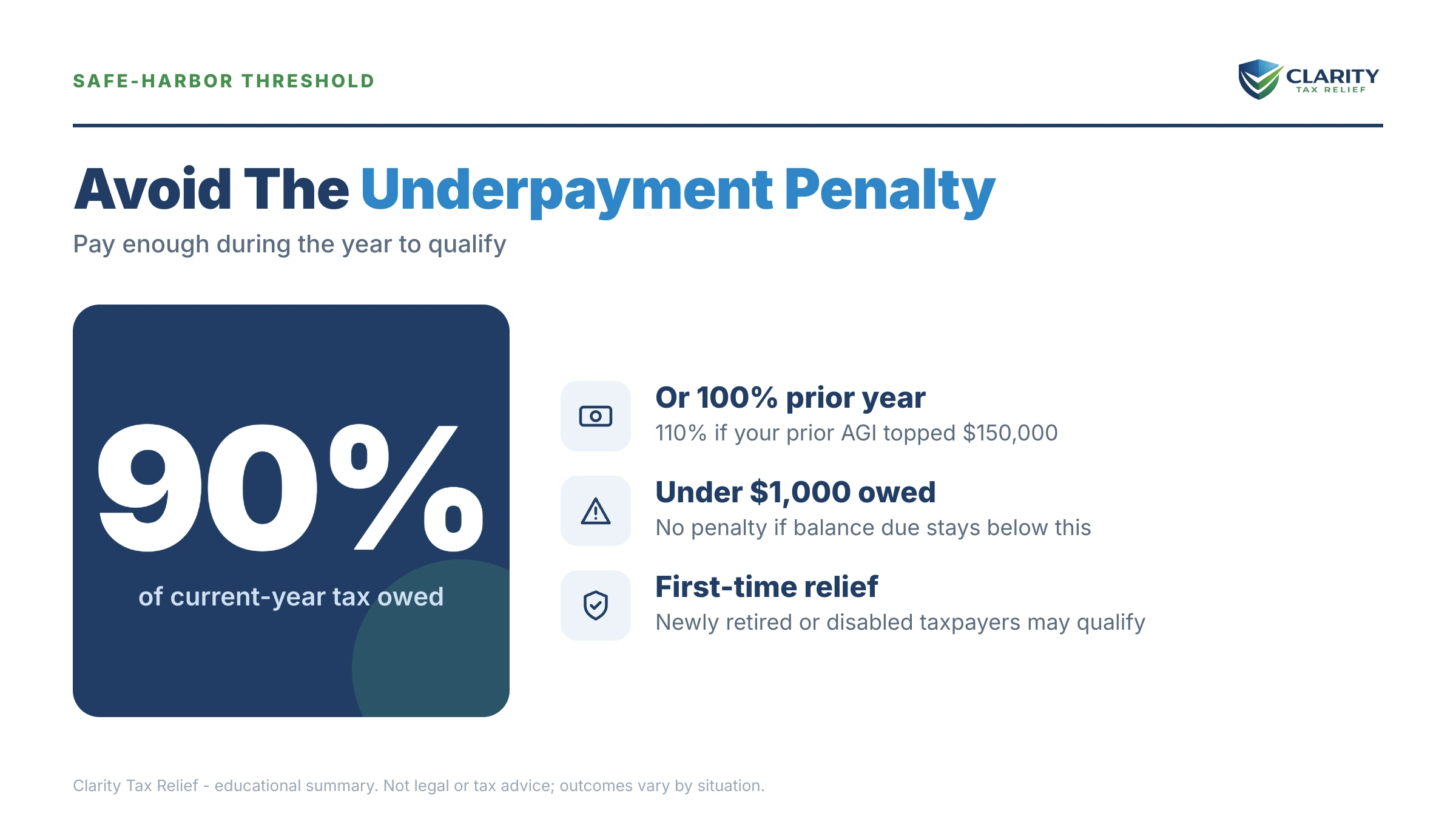
| Safe harbor (penalty never applies) | Owe under $1,000 after withholding, or paid 90% of this year's tax / 100% of last year's (110% if AGI over $150,000) | Nothing — verify the math on Form 2210, Part I | $0; resolved when you file |
| Retirement / disability waiver | Retired after age 62, or became disabled, in the tax year or the prior year — with reasonable cause | Form 2210, Part II + written statement, filed with your return | $0; decided during return processing |
| Casualty / unusual-circumstance waiver | A casualty, disaster, or other unusual event makes the penalty inequitable | Form 2210, Part II + documentation of the event and dates | $0; decided during return processing |
| Federally declared disaster relief | Your address is in a FEMA-declared disaster area | Automatic — the IRS applies it by ZIP code | $0; no request needed |
| Annualized income method (Schedule AI) | Income arrived unevenly — Q4 gain, seasonal business, year-end surge | Form 2210, Schedule AI, quarter-by-quarter recalculation | $0; often shrinks the penalty sharply |
| Form 843 abatement or refund | Penalty already assessed (CP30) or already paid, and a waiver ground applies | Form 843 penalty abatement request + the same documentation | $0 to file; IRS decisions commonly take months |
A few details that decide close cases:
The safe harbors are the first stop, not the last. If your balance due after withholding is under $1,000, the penalty doesn't exist — no waiver needed. The prior-year safe harbor (100%, or 110% above $150,000 AGI; the threshold is $75,000 if married filing separately) protects you even when this year's income exploded. Farmers and commercial fishermen have their own gentler rule: one January installment covering two-thirds of the year's tax.
Withholding has a superpower estimates don't. Tax withheld from a paycheck, pension, or IRA distribution is treated as paid evenly across all four quarters — even if it all came out in December. That's why a late-year withholding boost can erase a penalty that late estimated payments can't. It's the single best prevention move for next year.
The retirement/disability waiver is broader than people assume. It covers the year you retired (after 62) or became disabled and the year after — the two years when income and withholding patterns break. If you're newly retired and also missed a required distribution, the missed RMD penalty waiver runs on a separate track with its own form.
"Unusual circumstance" is a real category, not a loophole. A house fire, a serious illness, a records-destroying flood outside a FEMA zone — events that made timely payment impossible or the penalty unfair. What doesn't qualify: not knowing quarterlies existed. If that's your situation, the fix is the Schedule AI math and better planning, covered in didn't pay estimated taxes penalty.
California runs its own system. The FTB charges its own underpayment penalty with its own rules and forms — never assume an IRS waiver transfers. See the FTB estimated tax penalty guide for the state side.
What the penalty actually costs: a $27,500 example
Say you owe $27,500 for the year with no withholding and no estimated payments — a strong year of 1099 income while you were also carrying a mortgage. Here's the math, using an assumed 7% underpayment rate for round numbers (the real rate resets quarterly):
Your required annual payment is 90% of $27,500 = $24,750, or $6,187.50 per quarter. Each unpaid installment accrues the penalty from its due date until April 15:
- Q1 installment (due April 15, ~12 months late): $6,187.50 × 7% ≈ $433
- Q2 installment (due June 15, ~10 months late): ≈ $361
- Q3 installment (due September 15, ~7 months late): ≈ $253
- Q4 installment (due January 15, ~3 months late): ≈ $108
Total: roughly $1,155 — about 4% of the $27,500 bill. Not ruinous, but real money when you're trying to keep cash free for closing costs. You can estimate your own figure with our Penalty & Interest Calculator.
Now watch what the fixes do. If $15,000 of that income landed in the fourth quarter — a year-end contract payout, say — Schedule AI moves most of your required payments to Q4, potentially wiping out the Q1–Q3 penalty amounts entirely. And if you retired at 63 in March of that year, the Part II waiver could remove the whole $1,155 with one checked box and a short statement. Same penalty, three very different outcomes, all depending on which page of Form 2210 you use.
Waiver deadlines and rights: what you lose if you wait
The waiver itself has no application fee — the only thing you can lose here is time. Each stage has its own window, and each window that closes takes an option with it:
| Action | Deadline | What you lose if it passes |
|---|---|---|
| Request the waiver with your return (Form 2210, Part II) | Your return's due date, including extensions | The cleanest path — the penalty gets assessed and you must undo it after the fact |
| Respond to a CP30 notice | No enforcement clock yet, but interest accrues on the unpaid penalty monthly | The balance rolls into the collection notice stream (CP14 → CP501 → CP504) |
| Form 843 claim for a penalty you already paid | 3 years from filing the return or 2 years from paying, whichever is later | The refund itself — paid penalties become unrecoverable |
| Appeal a denied waiver or abatement | The window printed on your denial letter | Independent Appeals review; your remaining route is paying in full and suing for refund |
How to request an estimated tax penalty waiver, step by step
- Confirm you actually owe the penalty. No penalty applies if you owe under $1,000 after withholding, or if you paid at least 90% of this year's tax or 100% of last year's (110% if your AGI topped $150,000).
- Run Schedule AI if your income was uneven. The annualized income installment method recalculates the penalty around when income actually arrived — often shrinking it before you ever need a waiver.
- Complete Form 2210, Part II. Check Box A to request a waiver of the entire penalty or Box B for part of it, and for a partial waiver note the amount you want waived on the penalty line.
- Attach a written statement. Document the retirement date, disability, or disaster with dates and records, and explain why the underpayment was reasonable cause — not willful neglect.
- File Form 843 if the penalty was already assessed. Use the same documentation, and file within 3 years of the return or 2 years of paying the penalty, whichever is later.
- Pay the underlying tax. A waiver removes the penalty, not the tax — interest keeps accruing on any unpaid balance until it's paid.
The official form and instructions are at the IRS's About Form 2210 page; for post-assessment requests, see About Form 843. Any tax you still owe can be paid at IRS.gov/payments while the waiver is pending.
When you can handle this yourself — and when help changes the outcome
Most estimated tax penalty waivers are genuinely DIY-able. Handle it yourself when the penalty is a few hundred dollars and your software already computed it, when you clearly meet a safe harbor and just need to correct Form 2210, or when you're in a declared disaster area and the relief is automatic. A straightforward retirement waiver — you turned 63, retired in June, attach a one-page statement — doesn't need a professional either.
Experienced help earns its cost in four situations: Schedule AI with self-employment or K-1 income, where quarter-by-quarter income and deduction allocation is genuinely hard and errors get the whole recalculation rejected; multiple years of penalties, since each year's waiver stands on its own facts and there's no FTA shortcut; a penalty buried inside a larger balance already in collections, where sequencing the waiver against the payment plan changes what you pay; and a refinance deadline, where getting the account clean before underwriting matters more than the penalty amount itself.
Terms on Form 2210 and your notice, decoded
- Form 2210: the form that computes the underpayment penalty — and the only place to request the waiver, in Part II.
- Safe harbor: a payment level (90% current-year, 100%/110% prior-year, or a balance under $1,000) that makes the penalty not apply at all.
- Annualized income installment method (Schedule AI): a recalculation that matches each quarter's required payment to when your income actually arrived.
- Underpayment rate: the interest-style rate the penalty is computed at — the federal short-term rate plus 3 percentage points, reset every quarter.
- CP30: the IRS notice telling you it assessed or adjusted your estimated tax penalty — often reducing a refund to pay it.
- Form 843: the claim form used to abate or refund a penalty after it's been assessed or paid.
Estimated tax penalty waiver questions, answered
Does first-time penalty abatement apply to the estimated tax penalty?
No. First-time abatement covers failure-to-file, failure-to-pay, and failure-to-deposit penalties — the estimated tax penalty under IRC §6654 is excluded, and the Automatic Exemption from Penalty (AEP) replacing FTA in summer 2026 addresses those same penalty types. Your paths for this penalty are the Form 2210 waivers, the annualized income method, or showing the IRS computed it on the wrong numbers.
Who qualifies for an estimated tax penalty waiver?
Two groups: people who retired after reaching age 62 or became disabled during the tax year or the year before, with reasonable cause for the underpayment; and people hit by a casualty, disaster, or other unusual circumstance that makes the penalty unfair. Both are requested on Form 2210, Part II, with a statement documenting the dates and facts. Living in a federally declared disaster area gets you relief automatically, without asking.
How do I ask the IRS to waive the underpayment penalty on my return?
File Form 2210 with your return, check the waiver box in Part II (Box A for the entire penalty, Box B for part of it), and attach a written statement explaining the retirement, disability, or event with dates and documentation. If the IRS already assessed the penalty — usually announced on a CP30 notice — request abatement on Form 843 instead, with the same evidence.
Is there an estimated tax penalty if I owe less than $1,000?
No. If your balance due after withholding and refundable credits is under $1,000, the penalty doesn't apply at all. You're also protected if you paid at least 90% of the current year's tax or 100% of the prior year's tax during the year — 110% of prior-year tax if your AGI was over $150,000 ($75,000 if married filing separately). Check these safe harbors before requesting any waiver.
Can the penalty be reduced if my income was uneven during the year?
Yes — through the annualized income installment method on Form 2210, Schedule AI. It recalculates each quarter's required payment based on when income actually arrived, which often shrinks or eliminates the penalty for people with a year-end capital gain, a seasonal business, or a Q4 surge in self-employment income. It's a recalculation, not a waiver, so no reasonable-cause showing is needed — just the math, done quarter by quarter.
Can I get the estimated tax penalty back if I already paid it?
Yes, if you qualify for a waiver and act within the refund window. File Form 843 with a statement documenting the retirement, disability, or casualty that justifies relief. The deadline is generally 3 years from when you filed the return or 2 years from when you paid the penalty, whichever is later — after that window closes, the money is unrecoverable even with a perfect case.
Does the IRS waive the estimated tax penalty automatically after a disaster?
If your address is in a federally declared disaster area, yes — the IRS applies the relief by ZIP code, and you don't need to request anything. If you were affected by a casualty or disaster outside a declared area — a house fire, a flood that didn't make the FEMA list — you can still request the waiver on Form 2210, Part II, with documentation of the event and its dates.
Will an estimated tax penalty affect my mortgage refinance?
The penalty itself doesn't appear on your credit report — tax debt hasn't been credit-reported since 2018. What underwriters care about is an unpaid IRS balance: many lenders require proof of a payment plan with on-time payments, and a filed federal tax lien can block the refinance entirely. Resolving or waiving the penalty before you apply keeps your file clean.
Your next 24 hours
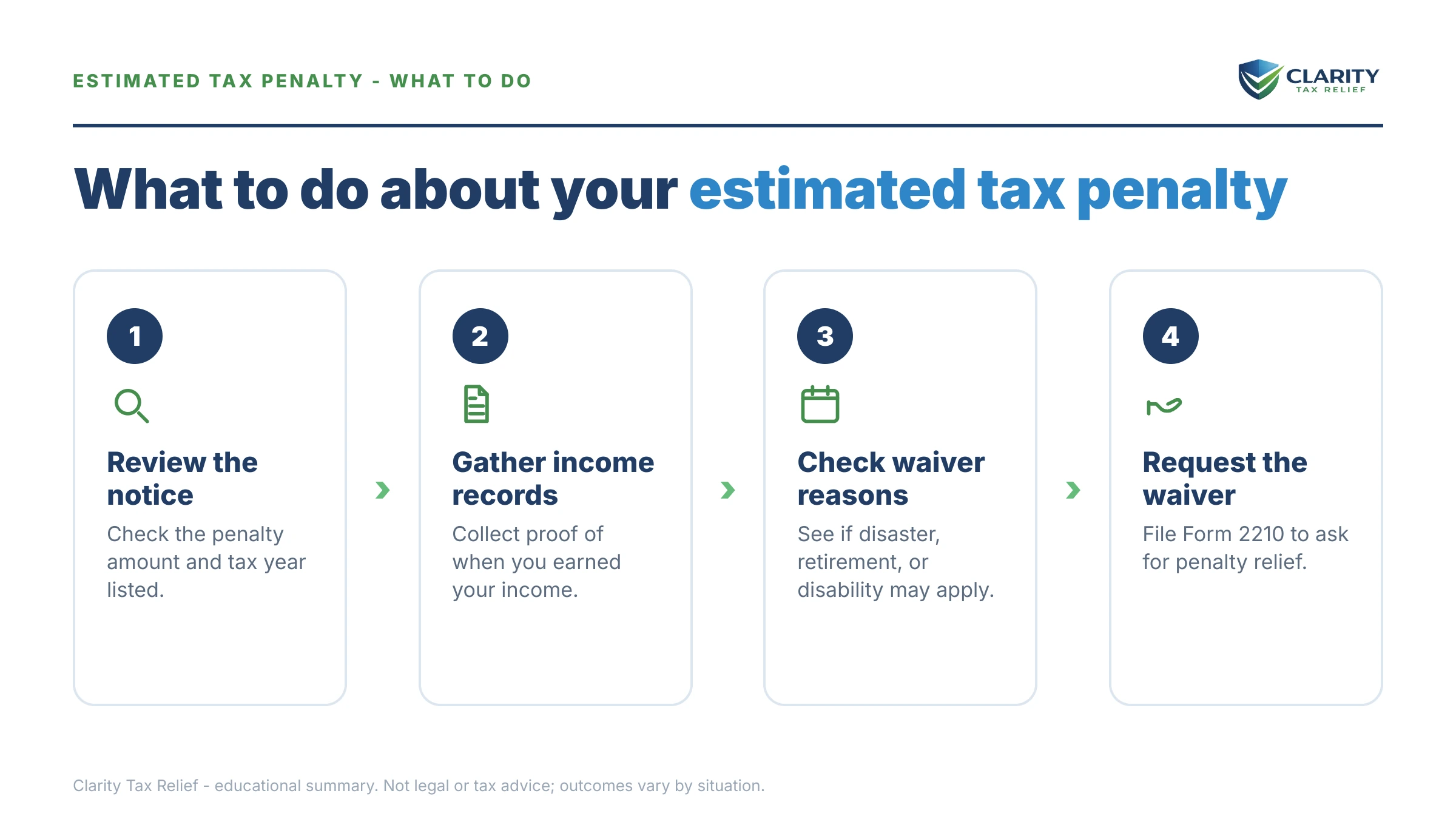
- Find the penalty. It's the "estimated tax penalty" line near the bottom of your Form 1040, or the amount shown on your CP30 — note the tax year and the exact dollar figure.
- Gather three things: this year's and last year's returns, records of when your income actually arrived during the year, and the dates of any retirement, disability, or disaster event.
- Get a free waiver review. Call (888) 825-7779 or use the 2-minute form at claritytaxrelief.com/#consult — an experienced tax professional will check every safe harbor and waiver you qualify for before interest on any unpaid balance adds another month's cost.
This guide is general information, not tax or legal advice for your specific situation. Eligibility for IRS programs depends on individual facts and circumstances; no outcome is guaranteed.