
California FTB
FTB Estimated Tax Penalty: How It Works and How to Fight It (2026)
The short answer: the FTB estimated tax penalty is an interest-based charge California adds when you underpay quarterly estimated taxes. It's computed on FTB Form 5805 against California's 30%/40%/0%/30% installment schedule, runs from each missed due date until you pay (or April 15), and can't be removed for reasonable cause — only narrow waivers apply.
You were pulling tax documents together for your refinance application when you spotted it: a line on your California return — or an FTB notice — labeled "underpayment of estimated tax," adding hundreds or thousands to a balance you were already bracing for. It's a gut-punch when every dollar and every credit detail suddenly matters for underwriting. Here's the good news: this penalty follows exact, published math, which means it can be checked, sometimes recomputed lower, occasionally waived — and the balance behind it can be resolved before it ever touches a lender's file.
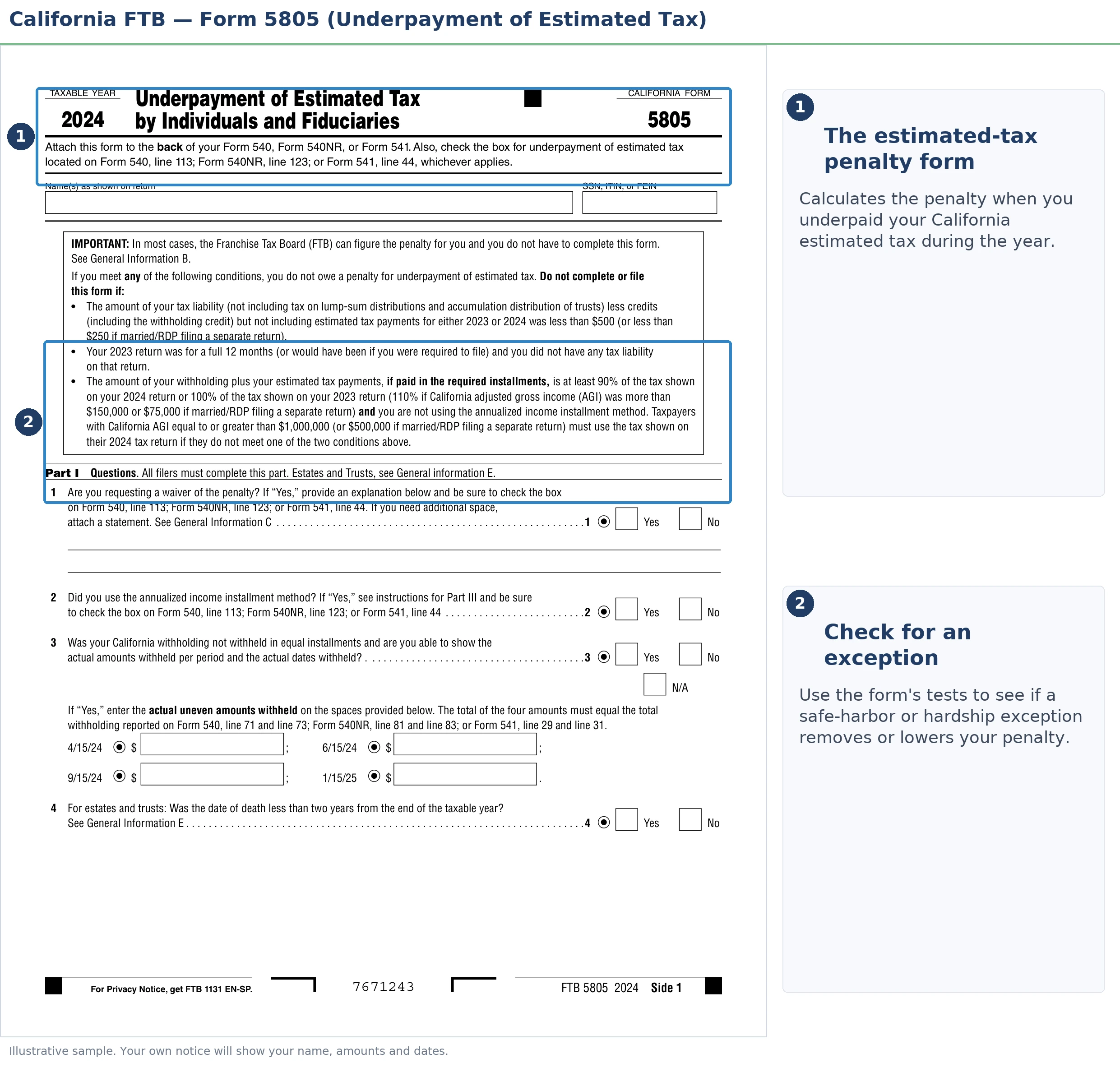
Two things make California's version different from the IRS penalty most articles describe: the state's lopsided 30/40/0/30 payment schedule, and the fact that California's one-time penalty abatement doesn't cover it. The image below shows exactly what this penalty computation looks like on paper and where to find the figures that drive it.
⏱ The clock on this penalty: the FTB estimated tax penalty stops growing at the original April 15 filing deadline — but any balance left unpaid after that date starts a separate late-payment penalty of 5% plus 0.5% per month (capped at 25%), plus interest at the FTB's rate. The longer the balance sits, the more the penalty-on-top-of-the-penalty grows.
Why you got the FTB estimated tax penalty
California charges the FTB estimated tax penalty when your withholding and quarterly payments fall short of your required installments — even if you paid every dollar of tax by April 15. It applies whenever you expect to owe at least $500 in California tax after withholding ($250 if married/RDP filing separately) and your payments miss the schedule below.
The usual suspects: self-employment or 1099 income with no withholding, a big stock or crypto sale, rental income, a home sale with capital gains, RSU vesting where the default withholding was too low, or a first year of business income. The penalty is authorized by Revenue and Taxation Code §19136, which largely mirrors the federal rule — but the payment schedule it enforces does not.
You'll see it one of two ways: as a self-computed amount on Form 5805 attached to your return, or — if the FTB runs the math for you — added via a Notice of Tax Return Change or a balance-due statement. This is not an audit and nobody is questioning your income. It's a mechanical charge for paying the right amount at the wrong times.
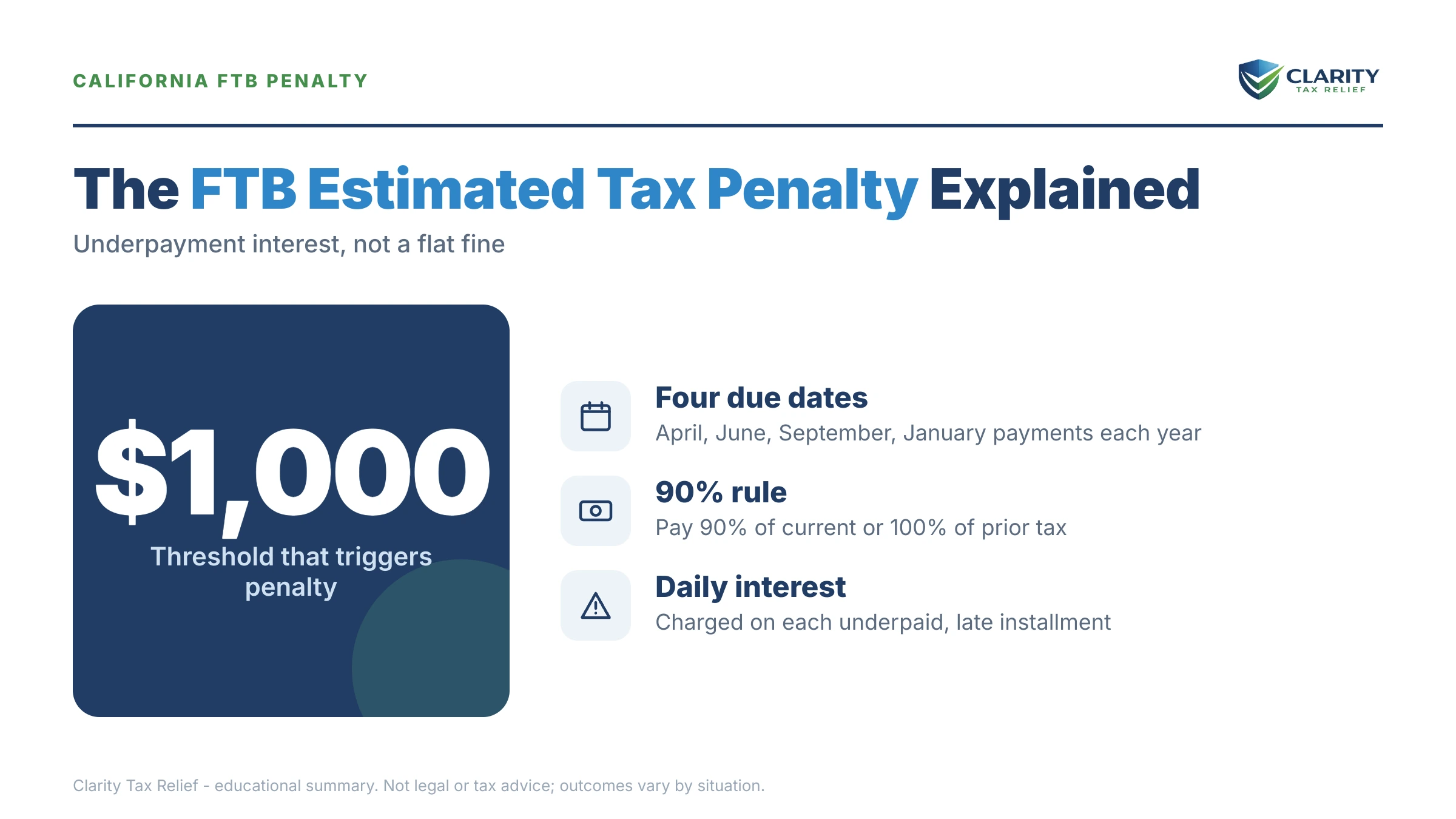
How California calculates the estimated tax penalty: the 30/40/0/30 trap
California front-loads estimated taxes: 70% of your required annual payment is due by June 15 — 30% in April and 40% in June — with nothing due in September. This is the single biggest reason people who dutifully pay "four equal quarterlies" still get an FTB estimated tax penalty: the even federal schedule underpays California's first two installments.
| Installment due date | California (FTB) share | IRS share |
|---|---|---|
| April 15 | 30% | 25% |
| June 15 | 40% | 25% |
| September 15 | 0% | 25% |
| January 15 | 30% | 25% |
Your "required annual payment" is the smaller of two safe harbors: 90% of this year's California tax, or 100% of last year's tax (110% if your AGI topped $150,000, or $75,000 married/RDP filing separately). One California-only trap: if your AGI reaches $1 million ($500,000 filing separately), the prior-year safe harbor disappears entirely — you must pay 90% of the current year, which is brutal in a windfall year you couldn't predict.
The penalty itself is interest-style: each underpaid installment accrues at the FTB's interest rate — which the FTB resets every six months — from its due date until you pay it or until your return's original due date (normally April 15 — later if the date falls on a weekend/holiday or a disaster postponement applies), whichever comes first. There's no flat percentage; time is the whole game. Withholding gets special treatment: it counts as paid evenly across the year no matter when it actually came out of your check. Estimated payments don't get that grace — they count only on the day they arrive. (New to quarterlies entirely? Start with how quarterly estimated taxes work, then come back for California's twist.)
One more California-only wrinkle: once you make a single estimated payment over $20,000 or file a return with total tax over $80,000, you fall under FTB mandatory e-pay — pay by paper check afterward and the FTB adds a separate 1% penalty on the payment.
Worked example: the penalty on an $83,100 California tax bill
Say you're self-employed, your 2025 California tax comes to $83,100 with no withholding, and — busy year, refinance on the horizon — you paid nothing until filing in April 2026. With no usable prior-year safe harbor, your required annual payment is 90% of $83,100, or $74,790, split 30/40/0/30:
- April 15, 2025: $22,437 due — underpaid for ~12 months
- June 15, 2025: $29,916 due — underpaid for ~10 months
- September 15, 2025: $0 due
- January 15, 2026: $22,437 due — underpaid for ~3 months
At an illustrative 8% annual rate, that's roughly $1,795 + $1,993 + $443 — call it about $4,200 of penalty stacked on top of the $83,100, before any late-payment penalty or interest if you can't pay at filing. Now flip the scenario: had you paid the April and June installments on time and missed only January's, the penalty falls to roughly $443. California's front-loading means the first two dates carry almost all of the risk — and for a homeowner heading into underwriting, an unresolved $87,000+ state balance is exactly the kind of item that stalls a file.
If you also skipped your federal quarterlies — most people who miss one miss both — you can estimate that side with our IRS Penalty & Interest Calculator and see the federal estimated tax penalty rate for 2026.
What happens if you ignore the balance behind the penalty
The FTB estimated tax penalty freezes at April 15, but the unpaid balance it rides on does not — and the FTB is widely regarded as a faster, more automated collector than the IRS. The sequence runs in stages:
- The penalty posts. It appears on your Form 5805 or the FTB recalculates and sends a Notice of Tax Return Change or balance-due statement.
- Costs stack monthly. The unpaid balance accrues the late-payment penalty (5% plus 0.5% per month, up to 25%) and FTB interest, compounding the original miss.
- Demand and collection fees. The FTB sends demand notices and adds a collection cost recovery fee to the balance — you now owe for the privilege of being collected on.
- A state tax lien is recorded. An FTB tax lien is a public record filed with the county recorder — the item most likely to surface in refinance underwriting and hold your loan hostage.
- Levy and garnishment. The FTB can issue an Order to Withhold against your bank account and an Earnings Withholding Order against your wages — no court order needed.
- The long tail. Under California's 20-year collection statute (R&TC §19255), the FTB can pursue this balance for two decades — double the IRS's window.
Staring at an FTB estimated tax penalty on top of a balance you can't pay?
Every month it sits, the late-payment penalty and FTB interest stack higher — and a recorded lien can stall a refinance for months. Get your California balance and penalty reviewed free by an experienced tax professional before the FTB's automated collection machine moves first.
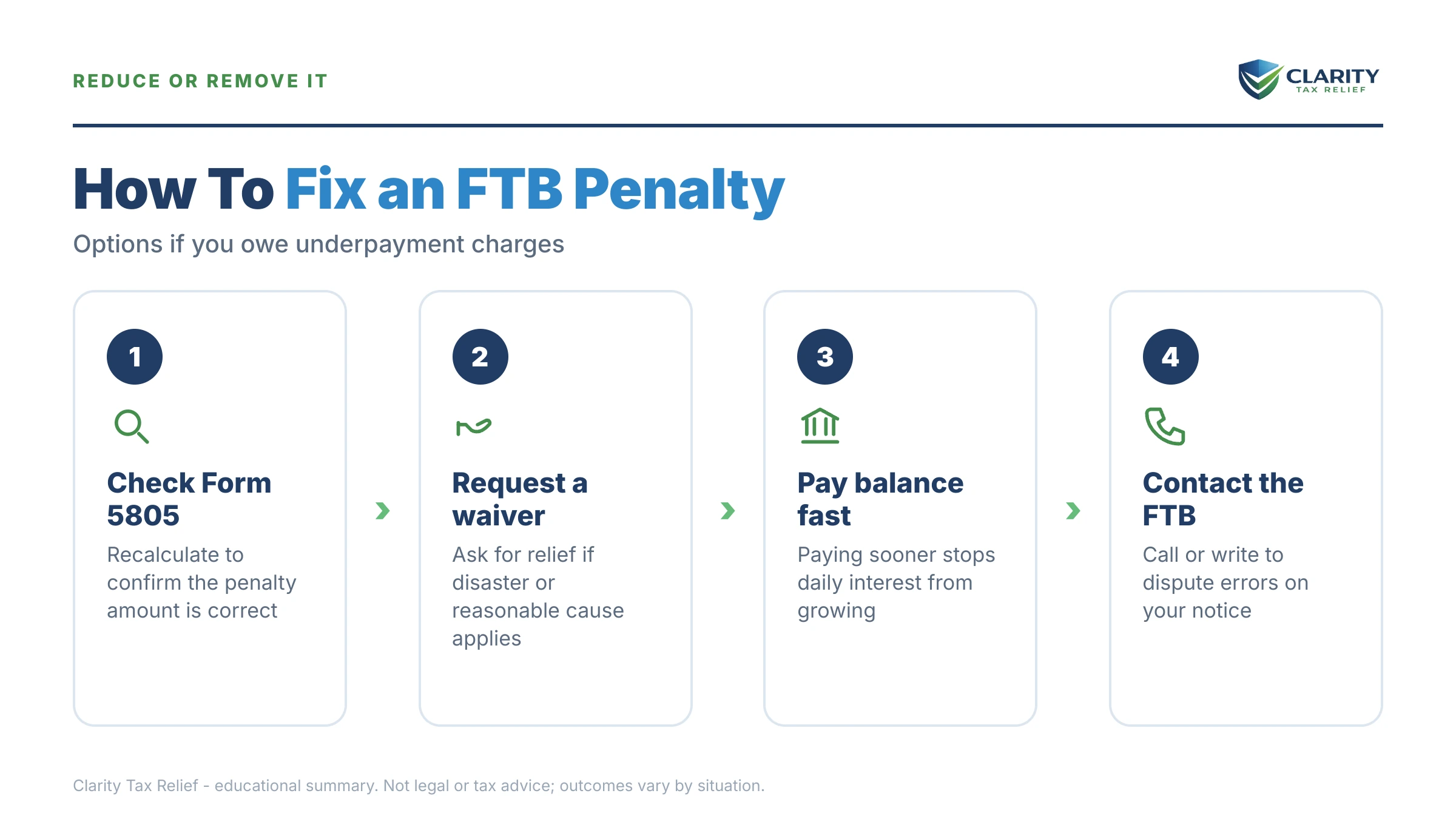
Your options: reducing the penalty and resolving the balance
There are two separate fights here — shrinking the penalty itself, and dealing with the tax balance underneath it — and they use different tools. The general playbook for penalty math is the same story on the federal side (see how big IRS penalties get on back taxes); what follows is what's specific to California.
| Option | Who it fits | What disqualifies you |
|---|---|---|
| Pay in full | Anyone who can — stops all further penalties and interest immediately | Nothing, but watch the mandatory e-pay 1% penalty if you mail a check |
| Annualized income method (Form 5805, Part III) | Uneven income — year-end sale, seasonal business, Q4 windfall | Steady income all year; annualizing won't change the math |
| Form 5805 waiver request | Casualty, disaster, or unusual circumstance; retired after 62 or disabled, with reasonable cause | Ordinary cash-flow problems, forgetting, or "my preparer never told me" |
| FTB payment plan | Individuals owing $25,000 or less who can pay within 60 months, all returns filed | Larger balances need financial disclosure on FTB Form 3561 |
| FTB Offer in Compromise | No realistic ability to ever pay the balance in full | Income or assets sufficient to pay over time — the FTB checks, hard |
| FTB hardship deferral | Paying would leave you unable to cover basic living expenses | It's temporary and reviewed; interest keeps accruing throughout |
Two things the options table can't say loudly enough. First, California's one-time penalty abatement (R&TC §19132.5) does not cover the estimated tax penalty — it applies only to late-filing and late-payment penalties. If a firm promises to "abate" this penalty with a clean-history request, they're describing the wrong penalty; the real paths are the annualization recompute and the Form 5805 waiver. Our FTB penalty abatement guide maps which California penalties each tool actually reaches, and the estimated tax penalty waiver guide covers the parallel federal Form 2210 exceptions.
Second, the annualized income method is the most underused fix in this entire area. If your income landed late in the year — you sold appreciated stock in November, your business booms in Q4 — Part III of Form 5805 recalculates each installment based on when you actually earned the money. For a taxpayer whose windfall came after June 15, that can erase most of the penalty on the two heavy early installments. It's tedious arithmetic, but it's free money.
| Option | Upfront cost | Ongoing cost | Typical timeline |
|---|---|---|---|
| Pay in full online | The full balance | None after payoff | Same day at ftb.ca.gov |
| Annualized recomputation | Free (your time, or a preparer fee) | None | Filed with the return, or by amending |
| Form 5805 waiver request | Free | None if granted | FTB review time varies — weeks to months |
| FTB payment plan | Modest setup fee | Interest + late-payment penalty continue until paid | Set up in days; runs up to 60 months |
| FTB Offer in Compromise | Documentation-heavy application | Interest accrues during review | Several months to a decision |
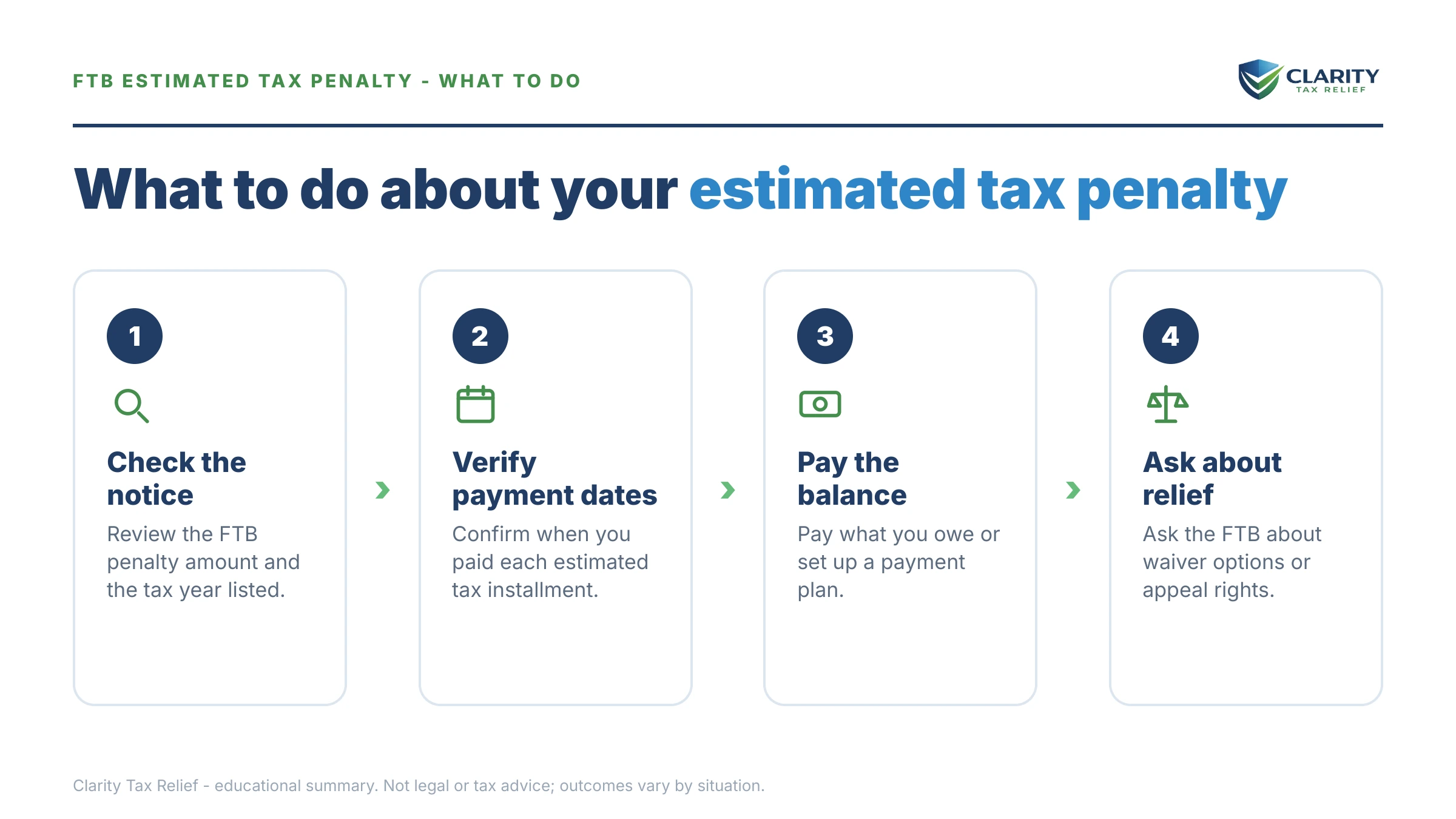
How to respond to the FTB estimated tax penalty, step by step
- Verify the penalty math: Pull the Form 5805 filed with your return — or the FTB notice that assessed the penalty — and confirm the installment amounts, due dates, and payments the FTB credited. Misapplied payments and wrong-year credits are common and fixable.
- Recompute with the annualized income method: If your income arrived unevenly — a year-end sale, a seasonal business, a Q4 bonus — Form 5805's annualized income installment method matches each installment to when you actually earned the money and can shrink or erase the penalty.
- Request a waiver if you qualify: The FTB can waive the penalty for a casualty, disaster, or other unusual circumstance, or if you retired after age 62 or became disabled during the year and the underpayment had reasonable cause. Ordinary cash-flow problems do not qualify.
- Pay the balance or set up an FTB payment plan: Pay online at ftb.ca.gov, or apply for an installment agreement before collection fees and lien filing begin. Balances over $25,000 require financial disclosure on FTB Form 3561.
- Fix the current year now: Increase withholding — which counts as paid evenly all year — or start paying this year's 30/40/0/30 installments so next April's return doesn't repeat the penalty.
When you can handle this yourself — and when help changes the outcome
Most FTB estimated tax penalties are a DIY fix. If the penalty is a few hundred dollars, the math checks out, and you can pay the balance, just pay it — no professional needed. Same if your income was steady and there's simply no annualization or waiver angle to work. Setting up a payment plan on a balance under $25,000 is a straightforward online task most people can do in an evening.
Experienced help earns its cost in specific situations: a five-figure balance where Form 3561 financial disclosure is required and every number you submit shapes your monthly payment; a windfall year where the annualization worksheet could cut thousands off the penalty but the arithmetic is genuinely painful; multiple years of missed quarterlies (see the penalty math when you didn't pay estimated taxes for how the years stack); a lien already recorded or threatened while a refinance or sale is pending; or a matching federal balance, where the order you resolve the two debts changes your total cost. If the FTB has already issued a levy or garnishment, get help the same week — releases are possible but timing-sensitive.
Terms on your notice, decoded
- Form 5805: the California worksheet that computes the underpayment penalty, installment by installment; its farmer/fisherman cousin is Form 5805F.
- Safe harbor: the payment target (90% of this year or 100%/110% of last year) that, if met on schedule, makes the penalty disappear entirely.
- Underpayment period: the days between an installment's due date and the day you finally paid it (or April 15) — the penalty is interest for exactly this window.
- Annualized income installment method: the Form 5805 recalculation that ties each installment to when your income actually arrived, instead of assuming it came evenly.
- Mandatory e-pay: California's rule that once you cross the $20,000-payment or $80,000-tax threshold, all future payments must be electronic — or a 1% penalty applies.
- One-time penalty abatement: California's clean-record relief under R&TC §19132.5 — useful for late-filing and late-payment penalties, but it does not reach the estimated tax penalty.
FTB estimated tax penalty FAQs
Can the FTB estimated tax penalty be waived or abated?
Only in narrow circumstances. The estimated tax penalty is excluded from California's one-time penalty abatement and generally can't be removed for reasonable cause the way late-filing penalties can. Form 5805 allows a waiver request if the underpayment was caused by a casualty, disaster, or other unusual circumstance, or if you retired after age 62 or became disabled during the year and had reasonable cause for the shortfall.
What is the safe harbor for California estimated tax payments?
You avoid the penalty by paying, through withholding and timely installments, the lesser of 90% of your current-year California tax or 100% of your prior-year tax. If your AGI was over $150,000 ($75,000 married/RDP filing separately), the prior-year target rises to 110%. And if your AGI reaches $1 million ($500,000 filing separately), the prior-year safe harbor disappears entirely — you must pay 90% of the current year.
Why is California's estimated tax schedule 30/40/0/30 instead of four equal payments?
California front-loads its installments for state budget reasons: 30% of your required annual payment is due April 15, 40% by June 15, nothing in September, and the final 30% by January 15. That means 70% is due by mid-June. Taxpayers who copy the IRS's even 25% quarterly schedule underpay the first two California installments and get the penalty even though they paid the same yearly total.
Can I owe the FTB estimated tax penalty even if I'm getting a refund?
Yes. The penalty is calculated installment by installment, so paying late matters even if you eventually overpay. If you paid little in April and June but caught up with a large January payment, each early installment was underpaid for months — and the penalty on those months survives, with the FTB simply deducting it from your refund.
Is the FTB estimated tax penalty the same as the IRS underpayment penalty?
They're cousins, not twins. Both are interest-style charges on underpaid installments, but California uses a 30/40/0/30 payment schedule while the IRS uses four equal 25% installments, and the two agencies set different interest rates. Missing your quarterlies usually triggers both penalties at once — the federal one is computed on Form 2210, California's on Form 5805.
How do I avoid the FTB estimated tax penalty next year?
Hit a safe harbor early. The most reliable fix is withholding, because California treats withheld tax as paid evenly across the year no matter when it comes out — a December withholding boost can retroactively cure the whole year. If you can't add withholding, calendar the 30/40/0/30 installment dates and pay 100% (or 110%) of last year's tax on that schedule.
Will an FTB estimated tax penalty stop me from refinancing my home?
The penalty itself won't — it doesn't appear on your credit report. The danger is the unpaid balance behind it: if the FTB records a state tax lien, that lien is a public record your underwriter will find, and most lenders won't close until it's resolved. Pay the balance or get on an FTB payment plan before you apply.
Your next 24 hours
- Find the penalty figure. Pull the Form 5805 attached to your return — or your FTB notice — and note the penalty amount, the installments it says you missed, and the payments the FTB actually credited.
- Gather your evidence. Your last two California returns, proof of every estimated payment and withholding, and — if your income was uneven — a rough quarter-by-quarter income breakdown. That's everything a waiver or annualization case is built from.
- Get the free case review. Send us the notice and the numbers at the 2-minute form or call (888) 825-7779. Interest and the late-payment penalty accrue on the balance every month it sits — and if a refinance is in your plans, resolving this before underwriting is far easier than after a lien hits the county record.
Primary sources: the California Franchise Tax Board publishes estimated-payment rules, current interest rates, and Form 5805 at ftb.ca.gov; federal estimated-payment options live at IRS.gov/payments.
This guide is general information, not tax or legal advice for your specific situation. Eligibility for IRS programs depends on individual facts and circumstances; no outcome is guaranteed.