
IRS Penalties
Estimated Tax Penalty Rate 2026: How It's Set, What It Costs, and How to Shrink It
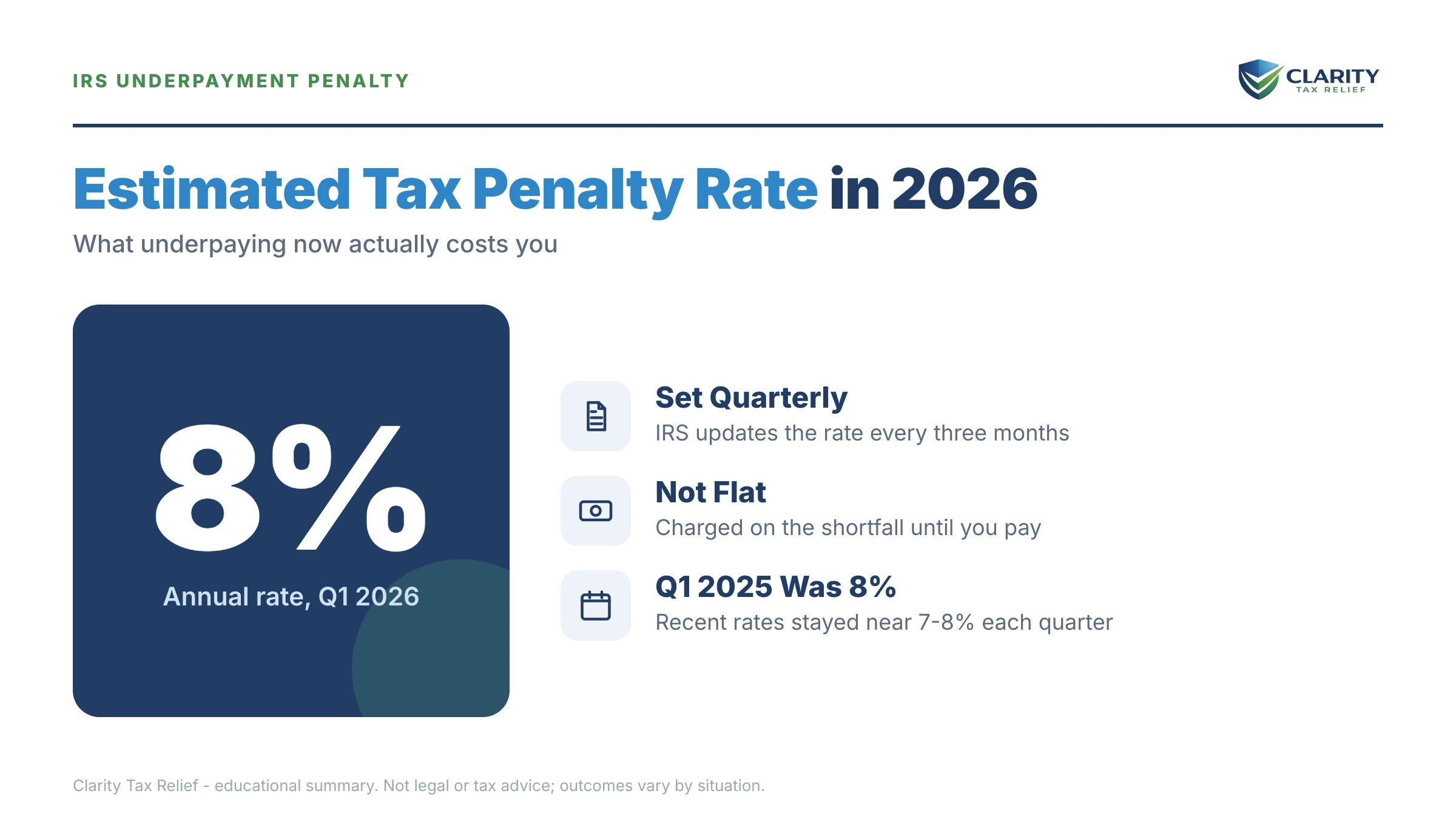
The short answer: the estimated tax penalty rate 2026 is the federal short-term rate plus 3 percentage points, reset each quarter under IRC §6621 — recently 7% for individuals. It works like simple daily interest: each missed 2026 quarterly installment accrues from its own due date until you pay, or until April 15, 2027.
Every payroll deposit for your crew went out on time this year. It was your own quarterlies that slipped — and now your preparer, your software, or an IRS notice is tacking a penalty onto a tax bill you were already bracing for. Here's the part nobody tells you: this is the most fixable penalty the IRS charges, and the fix often costs nothing but paperwork.
The whole calculation lives on Form 2210, and the image below shows you exactly what that form looks like and where the rate enters the math. That matters, because the standard calculation your software defaults to is often not the cheapest one you're allowed to use.
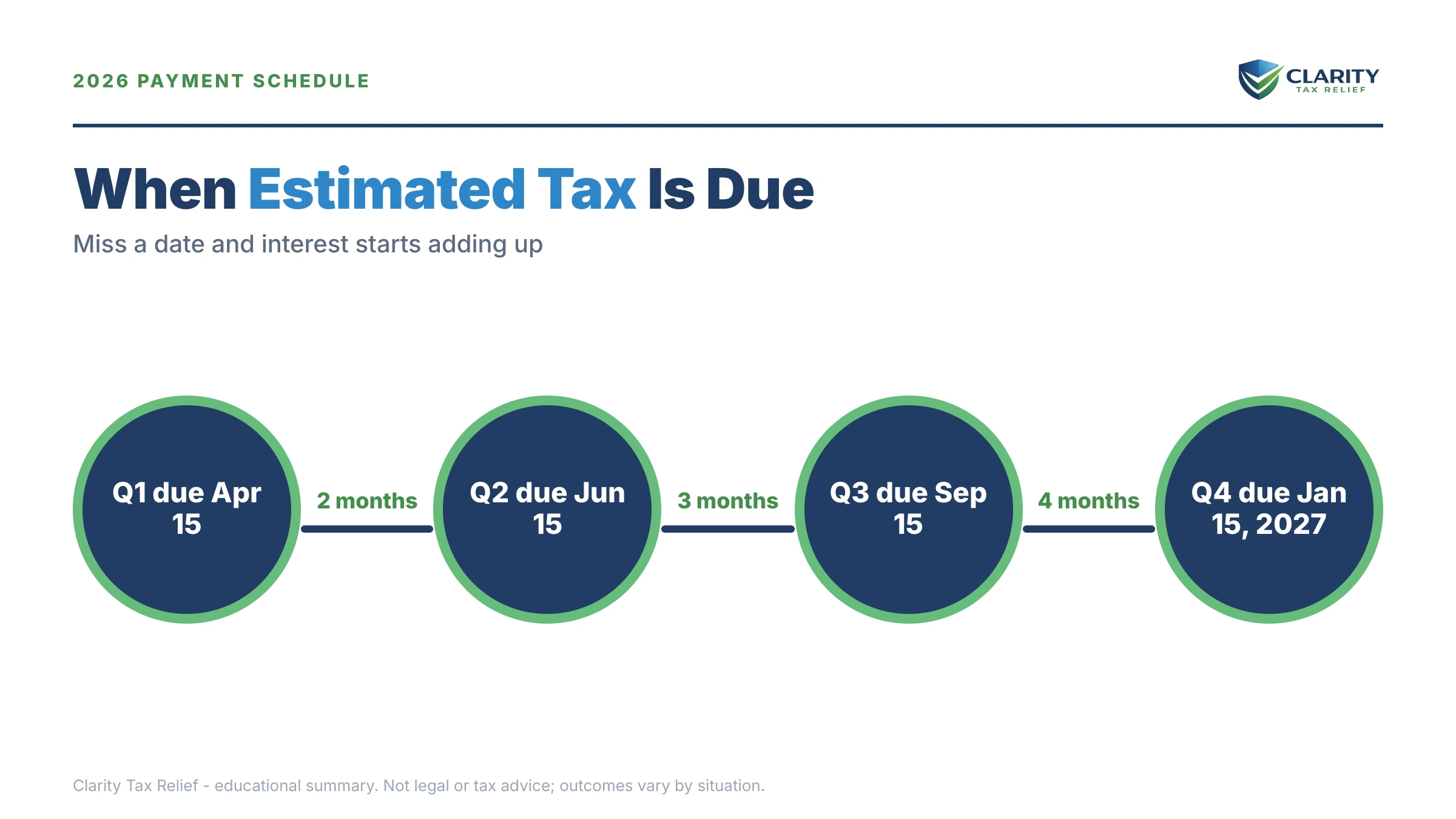
⏱ The real clock: this penalty accrues every single day. Each 2026 installment starts its own daily charge the day after its due date — April 15, June 15, and September 15, 2026, and January 15, 2027 — and runs until you pay or until April 15, 2027, whichever comes first.

Estimated tax penalty rate 2026: the formula behind the number
The 2026 estimated tax penalty rate equals the federal short-term rate plus 3 percentage points, recalculated every quarter under IRC §6621. In recent quarters the individual rate has been 7%. The IRS announces each quarter's figure a few weeks before it takes effect — our guide to IRS interest rates 2026 quarterly tracks the current number.
Two things make this penalty different from every other charge on your account. First, it is not a flat percentage. The failure-to-pay penalty runs 0.5% per month; this one is computed like simple daily interest, applied separately to each quarterly installment for exactly the number of days it went unpaid. There is no compounding on the penalty itself.
Second, it has a hard stop. Accrual on each installment ends at the earlier of the day you pay it or April 15, 2027 — the original filing deadline — even if you file late. Whatever the penalty is on that date is the ceiling. Any tax still unpaid after that switches over to the failure-to-pay penalty and daily-compounding interest, which is a different problem with different math.
Because the rate resets quarterly, one underpayment can accrue at two or three different rates across the year. Form 2210 handles this by splitting the year into rate periods and charging each stretch of days at that period's rate.
Why you're being charged this penalty
The tax system is pay-as-you-go: the IRS expects roughly a quarter of your year's tax by each installment date, not one lump sum the following April. If withholding and estimated payments together fall short of your "required annual payment," §6654 charges you for the shortfall — even if you pay every dollar of tax on time when you file. Our primer on how quarterly estimated taxes work covers the payment system itself; this page is about what the miss costs.
Three safe harbors make the penalty disappear entirely. You owe nothing if your balance after withholding is under $1,000; if your 2026 payments reach 90% of your 2026 tax; or if they reach 100% of your 2025 total tax — 110% if your 2025 AGI was over $150,000 ($75,000 married filing separately). Miss all three and the daily clock in the table below applies to each installment separately.
Business owners get hit hardest because their income arrives without withholding: S-corp distributions, draws, K-1 income, and 1099 revenue all bypass the paycheck system. Note that this is your personal penalty — it's completely separate from the deposit penalties your business faces on late 941 deposits, which we compare below.
| Income period | 2026 installment due date | Penalty starts accruing |
|---|---|---|
| January 1 – March 31, 2026 | April 15, 2026 | April 16, 2026 |
| April 1 – May 31, 2026 | June 15, 2026 | June 16, 2026 |
| June 1 – August 31, 2026 | September 15, 2026 | September 16, 2026 |
| September 1 – December 31, 2026 | January 15, 2027 | January 16, 2027 |
Each installment's charge runs until that installment is paid or until April 15, 2027. For the full-year payment calendar — including disaster postponements — see quarterly estimated tax deadlines 2026.
What a 2026 underpayment actually costs: the math on $7,400
A full-year miss typically costs about 4–5% of the underpayment at a 7% rate — here's the arithmetic. Say you run a small company, your payroll withholding covers your W-2 salary, but your 2026 pass-through profit needed four quarterly payments of $1,850 each — $7,400 total — and you paid none, settling up when you file on April 15, 2027. At an illustrative 7% rate held all year:
- Q1 installment ($1,850, due April 15, 2026): unpaid 365 days → $1,850 × 7% × 365/365 ≈ $130
- Q2 (due June 15, 2026): unpaid 304 days → $1,850 × 7% × 304/365 ≈ $108
- Q3 (due September 15, 2026): unpaid 212 days → $1,850 × 7% × 212/365 ≈ $75
- Q4 (due January 15, 2027): unpaid 90 days → $1,850 × 7% × 90/365 ≈ $32
Total: roughly $345 on a $7,400 underpayment — about 4.7%. The real return would split each stretch by the actual quarterly rates, but the shape of the math holds: early-quarter misses cost the most, and every day you pay sooner shaves the bill. Notice the flip side, too — catching up in October instead of April 2027 would cut the Q1–Q3 accrual off months early. You can rough out your own figure with our Penalty & Interest Calculator; it estimates, and your Form 2210 controls.
Now the fix that surprises people: if you'd bumped your own December payroll withholding by $7,400 instead, the penalty would be near zero — because withholding is treated as paid evenly across the year no matter when it actually came out. A December estimated payment can't do that; a December withholding increase can.
What happens if you ignore the underpayment penalty
Left alone, the penalty assesses itself — and then rides the same collection track as any tax debt. The sequence runs like this:
- Through 2026: each missed installment accrues daily at the quarterly rate. Nothing arrives in the mail yet; the meter just runs.
- At filing: the penalty is computed — by you on Form 2210 or by the IRS — and added to your balance. Accrual on the penalty stops at April 15, 2027, but any unpaid tax now picks up the failure-to-pay penalty and daily-compounding interest.
- If you skip the calculation: the IRS runs it for you and bills it on a CP30 notice — using the standard method, never the annualized method that might have cost you less.
- If the balance goes unpaid: it folds into a CP14 notice and the normal reminder-then-levy notice sequence. From that point it's ordinary collections, with all the leverage that implies.
The key asymmetry: the penalty itself stops growing on April 15, 2027 — the collection consequences don't. And in 2026, with IRS staffing down sharply, the notices are generated by automated systems that never pause; the hub on how much IRS penalties on back taxes really cost shows how fast the stack compounds once filing and payment penalties join in.
Behind on 2026 quarterlies while keeping payroll current?
That's the most common pattern we see in small-business cases — the crew got paid, the owner didn't pay themselves' taxes. Get your numbers reviewed free before the daily accrual adds another quarter's worth: an experienced tax professional will check your safe harbors, your Form 2210 method, and any waiver grounds.
Your options to reduce or erase the penalty
Almost every legal way out of this penalty runs through Form 2210 — and none of them run through first-time abatement. First-time abatement does not apply to the estimated tax penalty; it covers failure-to-file, failure-to-pay, and deposit penalties only. (The same goes for the automatic penalty exemption replacing it in summer 2026.) Your relief paths are these:
| Option | Who it fits | What it does |
|---|---|---|
| Prior-year safe harbor | Anyone with a filed 2025 return | Pay 100% of 2025 tax (110% if 2025 AGI > $150,000) through the year — no penalty regardless of how much 2026 income jumps |
| Withholding bump | Owners on their own payroll; spouses with wages; retirees with pensions/IRA distributions | Withholding counts as paid evenly all year — a late-year increase can erase penalty already accrued |
| Annualized income method (Schedule AI) | Seasonal businesses, late-year windfalls, uneven income | Recomputes installments to match when income arrived — often shrinks or zeroes early-quarter charges |
| Form 2210 waiver | Casualty, disaster, retirement after age 62, or disability with reasonable cause | Removes the penalty entirely when granted — claimed in Part II with a statement attached |
| Farmer / fisherman rule | Two-thirds of gross income from farming or fishing | One installment due January 15 — or no installment at all if you file and pay in full by March 1 |
| Pay sooner | Everyone | Daily accrual stops on each dollar the day it's paid — catching up in the fall beats catching up in April |
The waiver grounds have their own rules and evidence standards — our guide to the estimated tax penalty waiver walks through each Form 2210 exception in detail. And for how the penalty behaves when you skipped quarterlies entirely rather than underpaid them, see the underpayment penalty estimated taxes guide.
One more path worth naming: doing nothing on the form. If no exception applies, you're allowed to leave Form 2210 off and let the IRS bill the penalty. That's fine when the standard method is genuinely your cheapest — but you can't claim the annualized method or a waiver after accepting the IRS's own calculation without amending the position.
State penalties are a separate track entirely. States set their own rates, safe harbors, and forms — a federal fix does nothing for a state balance. California owners should read the FTB estimated tax penalty guide, because the Franchise Tax Board's rules differ from the IRS's in ways that bite high earners.
Quarterlies vs. payroll deposits: two different penalties on one business
If you run payroll, your business and your personal return are exposed to two unrelated penalty systems, and confusing them is expensive. Your personal quarterlies carry the interest-style §6654 charge on this page. Your company's 941 deposits carry the federal tax deposit penalty — flat tiers that reach 15% of the deposit, with personal-liability exposure behind the trust-fund portion. Triage accordingly: a late deposit penalty is almost always the more urgent fire.
| Penalty | How it's charged | Relief path |
|---|---|---|
| Estimated tax penalty (§6654) | Daily, at the quarterly underpayment rate (recently 7%), per missed installment | Form 2210 exceptions, annualized method, or waiver — no first-time abatement |
| Failure-to-pay | 0.5% per month of unpaid tax, up to 25% | First-time abatement or reasonable cause |
| Failure-to-file | 5% per month of unpaid tax, up to 25% | First-time abatement or reasonable cause |
| Federal tax deposit (payroll) | 2%, 5%, 10%, or 15% of the late deposit, by lateness tier | Reasonable cause; deposit-designation rules |
One entity note: if your business is a C corporation, its own estimated tax penalty is computed under a separate section on Form 2220, with different thresholds — don't apply the individual rules to the 1120.
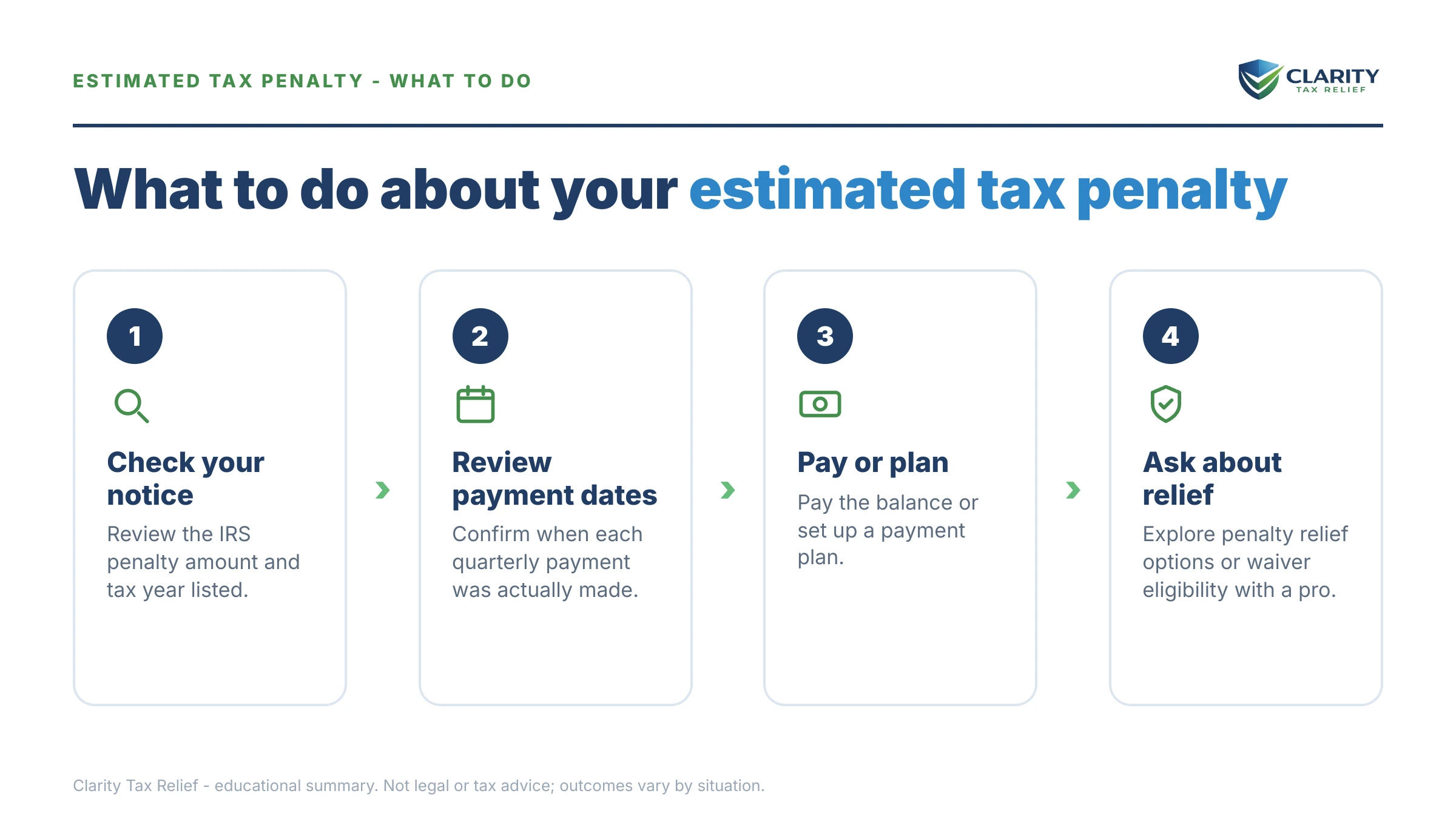
How to respond to the estimated tax penalty, step by step
- Pull your numbers. Get your 2025 return's total tax and your 2026 year-to-date withholding and estimated payments — those two figures decide whether a penalty even applies.
- Check the safe harbors. Compare what you've paid in against 100% of your 2025 tax (110% if your 2025 AGI topped $150,000) and against 90% of your projected 2026 tax — clearing either one ends the analysis.
- Run Form 2210 before accepting the IRS's math. Software defaults to the standard method; if your income was uneven, Schedule AI's annualized method can shrink or erase the penalty.
- Fix the shortfall the cheapest way. A withholding increase before December 31 counts as paid evenly all year; a late estimated payment only stops accrual going forward.
- Request a waiver if you qualify. Casualty, disaster, retirement after age 62, or disability with reasonable cause are the grounds — claim them on Form 2210 Part II, not in a phone call.
- Pay or arrange the assessed balance. If the penalty has already landed on a notice, pay it or fold it into a payment plan before the collection sequence starts adding interest on top.
When you can handle this yourself
Most estimated tax penalties don't need professional help. If your software computed a few hundred dollars, your income was steady across the year, and you can set a 2026 safe harbor going forward, pay it and move on — the fix is a Form 1040-ES schedule, not a representative. Same if the IRS's CP30 figure matches your own math.
Experienced help changes the outcome in a few specific situations: multiple years of missed quarterlies with a balance that has grown into full collections; a payroll deposit problem stacking on top of the personal penalty (where personal liability for the trust-fund portion is in play); a large penalty on lumpy income where nobody ran the annualized method; or a waiver claim that needs to be documented well enough to survive review. In those cases the order you fix things in — method, waiver, then payment arrangement — changes what you ultimately pay.
Terms on Form 2210 and your CP30, decoded
- Underpayment rate — the §6621 interest rate the penalty borrows: federal short-term rate plus 3 points, reset quarterly.
- Required annual payment — the smaller of 90% of this year's tax or 100%/110% of last year's; the target your four installments must hit.
- Safe harbor — reaching the required annual payment; once you have, no penalty applies no matter how big your April balance is.
- Annualized income installment method — the Schedule AI recalculation that matches each installment to when the income actually arrived.
- Form 2210 — the form that computes the penalty for individuals; Part II holds the waiver boxes, Schedule AI holds the annualized method.
- CP30 — the notice the IRS sends when it computes and charges the penalty for you, using the standard method.
Estimated tax penalty questions, answered
What is the estimated tax penalty rate for 2026?
The rate is the federal short-term rate plus 3 percentage points, reset every quarter under IRC §6621 — in recent quarters it has been 7% for individuals. Because it resets quarterly, an underpayment that runs across the year can accrue at more than one rate. Check the current quarter's figure before you run the math, and note that C corporations compute their penalty under a separate section with its own rules.
Is the estimated tax penalty a flat percentage?
No — unlike the failure-to-pay penalty (0.5% per month), the estimated tax penalty works like simple daily interest. Each missed installment accrues at the quarterly rate for exactly the number of days it was unpaid, so a first-quarter miss costs roughly four times what the same dollar miss in the fourth quarter costs. There is no compounding, and accrual stops at the earlier of the day you pay or the April filing deadline.
How do I avoid the underpayment penalty for 2026?
Hit a safe harbor: pay at least 90% of your 2026 tax through the year, or 100% of your 2025 total tax — 110% if your 2025 AGI was over $150,000 ($75,000 married filing separately). You also owe no penalty if your balance after withholding is under $1,000. The prior-year safe harbor is the most reliable, because it doesn't require guessing this year's income.
Can the IRS waive the estimated tax penalty?
Yes, but only through Form 2210 — not first-time abatement, which doesn't apply to this penalty. The IRS can waive it if the underpayment came from a casualty, disaster, or other unusual circumstance, or if you retired after reaching age 62 or became disabled during the year and had reasonable cause. Federally declared disaster relief can also postpone installment deadlines automatically.
Does increasing my withholding late in the year erase the penalty?
Usually, yes — tax withheld from wages, pensions, or IRA distributions is treated as paid evenly through the year no matter when it actually came out. A December withholding increase can therefore erase a penalty that built up since April, while a December estimated payment only stops future accrual. This is the single most powerful year-end fix for owners who run their own payroll.
What if my income was uneven during 2026?
Use the annualized income installment method on Schedule AI of Form 2210. It recomputes each installment based on when the income actually arrived, so a seasonal business or a big fourth-quarter sale doesn't get penalized for missing installments that came due before the money existed. It requires quarter-by-quarter income figures, which is why software and preparers often skip it unless you ask.
What happens if I just don't pay the penalty?
The IRS will compute it for you and bill it — typically on a CP30 notice, or folded into your balance due. Unpaid, it joins your tax debt in the normal collection sequence: a CP14 bill, reminder notices, then levy warnings, with interest accruing on the unpaid total. The penalty itself stops growing at the April filing deadline, but the collection consequences don't.
Do states charge their own estimated tax penalty?
Most states with an income tax charge their own version, at their own rate and under their own rules — never assume the federal numbers apply. California's Franchise Tax Board, for example, assesses its own estimated tax penalty with different safe-harbor mechanics for high earners. If you owe both, the state penalty needs its own fix; a federal Form 2210 waiver does nothing for a state balance.
Your next 24 hours
- Find your 2025 "total tax" line. Pull it from your 2025 Form 1040 — it's the anchor for the safe-harbor math. If a CP30 triggered this search, find the tax year and penalty amount printed on it instead.
- Gather your 2026 payment proof. Year-to-date paystubs showing withholding, EFTPS or Direct Pay confirmations for any quarterlies, and a rough profit number for the business — that's everything the safe-harbor check needs.
- Get a free case review. If quarterlies have slipped more than one year, or a payroll balance is stacking on top of the personal penalty, have an experienced tax professional map the cheapest way out — the accrual runs daily until the plan exists. Use the 2-minute form or call (888) 825-7779.
Primary sources: the current quarterly rate is published on the IRS's quarterly interest rates page, the official form and instructions live at About Form 2210, and 2026 estimated payments can be made directly at IRS.gov/payments.
This guide is general information, not tax or legal advice for your specific situation. Eligibility for IRS programs depends on individual facts and circumstances; no outcome is guaranteed.