
IRS Notices
CP30 Notice: Why the IRS Charged You an Estimated Tax Penalty (2026)
The short answer: a CP30 notice means the IRS charged you a penalty for underpaying estimated taxes during the year — and usually deducted it straight from your refund. It is not an audit and not a new tax bill. Form 2210's recalculation and waiver rules can often shrink or remove the penalty.
You filed on time. You may have even paid every dollar of tax you owed. And the refund still came up short — now a CP30 is telling you the IRS kept part of it as an "estimated tax penalty." The frustration is fair, because this penalty punishes when you paid, not whether you paid. It's also one of the most fixable notices the IRS prints, and the fix starts with checking their math.
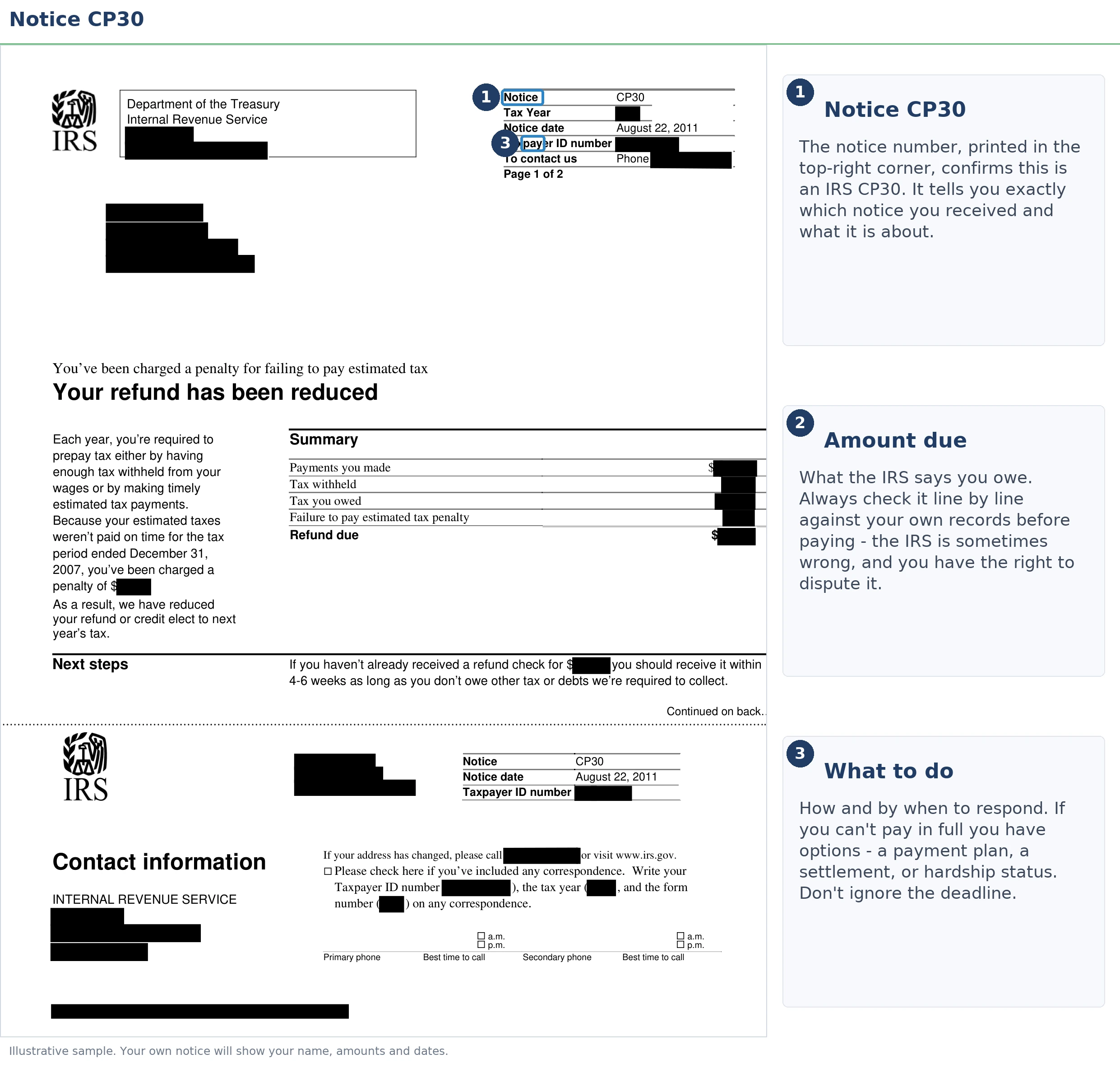
The image below shows exactly what a CP30 looks like and where to find the two numbers that matter — the penalty amount and the tax year it was charged against. You'll need both before you can challenge it.
⏱ Your deadline: a CP30 has no single statutory response deadline. If your notice shows a balance due, the pay-by date printed on it controls — after that date, interest plus a 0.5%-per-month late-payment penalty accrue on the unpaid amount. If your refund covered the penalty, the clock that actually matters is your next quarterly estimated payment: September 15, 2026.
Why you got a CP30 notice
The IRS sends a CP30 when it charged you the estimated tax penalty under IRC §6654 — a penalty for paying too little tax during the year, not for owing tax at all. The U.S. system is pay-as-you-go: the IRS expects its money in four installments (or through withholding) as you earn it, not in one check the following April.
W-2 employees rarely see this notice because withholding handles the pacing automatically. Self-employed people, contractors, landlords, and investors get CP30s constantly, because nobody withholds for them. If you skipped quarterly payments — or paid them late or light — the IRS computed the shortfall and billed it. Our guide on how quarterly estimated taxes work covers the underlying system.
Two things make a CP30 different from most IRS mail. First, it does not change your tax — unlike a CP11 notice or CP12 notice, which adjust the return itself, a CP30 only adds the §6654 timing penalty on top of a return the IRS otherwise accepted. Second, the penalty is usually already collected: the IRS subtracted it from your refund before the refund went out. In most cases there's nothing left to pay — only something worth checking.
If this is your first piece of IRS mail and you want the broader map of what different letters mean, start with why did I get a letter from the IRS, then come back here for the CP30 specifics.
How the CP30 penalty was calculated (with real math)
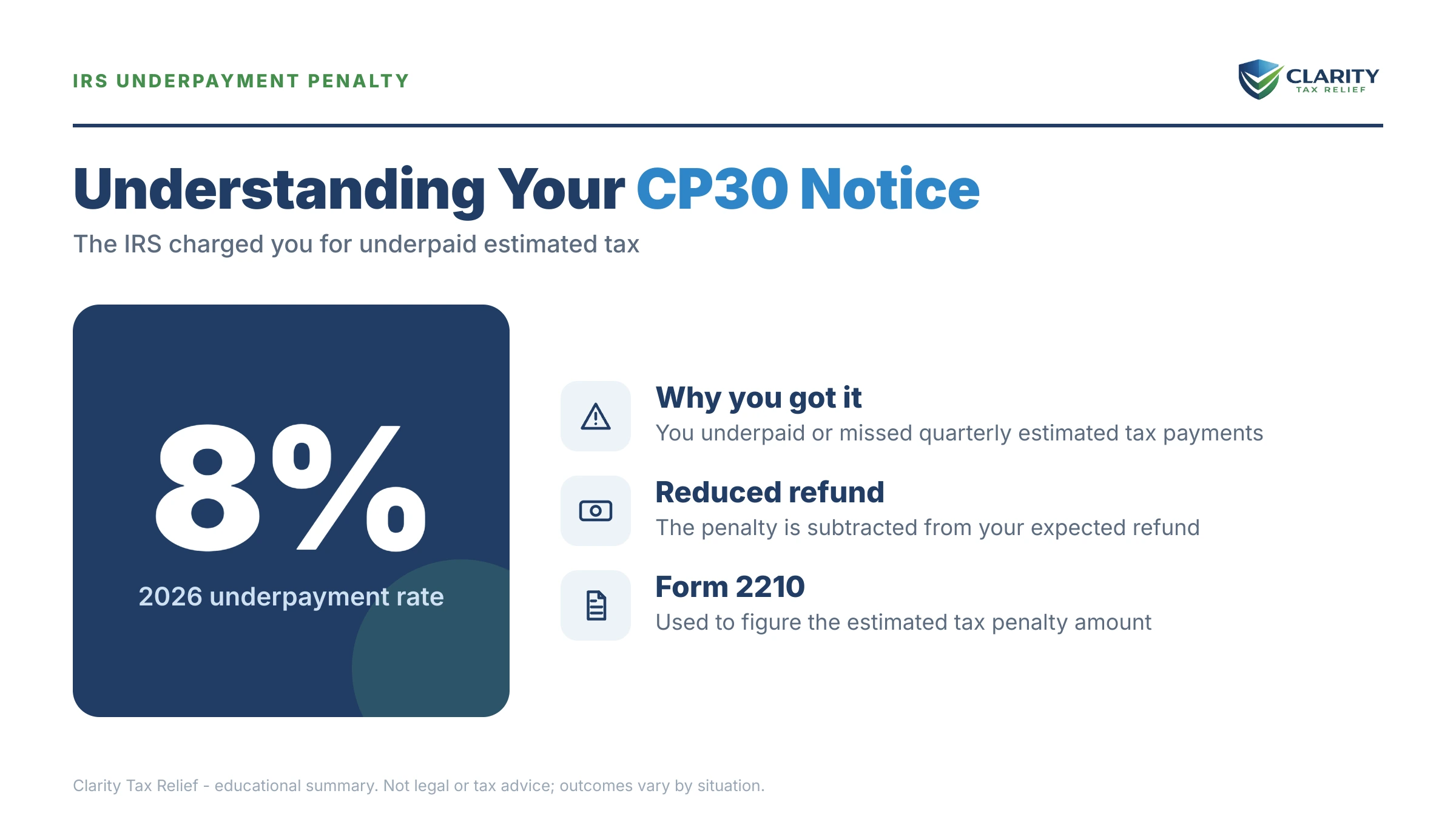
The estimated tax penalty works like interest, not a flat fine: the IRS charges the federal underpayment rate on each quarterly shortfall for exactly as long as it stayed unpaid. The rate resets every quarter — see the current IRS interest rates for 2026 — which is why the notice can't be checked with a single multiplication.
The IRS first figures your "required annual payment": the smaller of 90% of this year's tax or 100% of last year's tax (110% if your AGI was over $150,000). It splits that into four installments due April 15, June 15, September 15, and January 15. Each installment you missed or shorted accrues the penalty from its own due date until you paid it — or until April 15, whichever came first.
A worked example (hypothetical). Say you're a sole proprietor and your Schedule C left you with $41,800 in total tax for 2025. Your 2024 total tax was $34,000 and your AGI was under $150,000, so your required annual payment is the smaller number: $34,000, or $8,500 per quarter. You paid nothing until you filed on April 15, 2026. Using a flat 8% annual rate purely to keep the illustration simple:
- Q1 installment ($8,500, due April 15, 2025 — unpaid ~12 months): $8,500 × 8% = $680
- Q2 installment (due June 15, 2025 — ~10 months): $8,500 × 8% × 10/12 ≈ $567
- Q3 installment (due Sept. 15, 2025 — ~7 months): $8,500 × 8% × 7/12 ≈ $397
- Q4 installment (due Jan. 15, 2026 — ~3 months): $8,500 × 8% × 3/12 ≈ $170
Total: roughly $1,814 — even though every dollar of the $41,800 got paid by April 15. And here's the flip side worth memorizing: had you sent the IRS $8,500 each quarter, the penalty would be zero, even though $7,800 of tax would still have been due at filing. Safe harbors protect you from the penalty completely; they don't require you to prepay the whole bill.
Your actual notice uses the real quarterly rates and your real payment dates, so the exact figure will differ. You can estimate your own numbers with our Penalty & Interest Calculator, and the deeper math lives in our guide to the penalty when you didn't pay estimated taxes.
First: check whether your CP30 is even right
CP30s are computer-generated, and the computer only knows what posted to your account. Before accepting the number, spend fifteen minutes on these checks:
- Did every payment post to the right year? A January 15 estimated payment coded to the wrong tax year is the single most common CP30 error. Your account transcript shows exactly where each payment landed.
- If you filed jointly, whose SSN were the estimates paid under? Estimated payments made under one spouse's number sometimes fail to match a joint return, and the IRS's math treats them as missing.
- Did the IRS use the right prior-year tax? If last year's return was amended or adjusted, the safe-harbor baseline in the IRS's calculation may be stale.
- Did your income arrive unevenly? The default calculation assumes you earned income in four equal chunks. If your sole-proprietor income landed mostly in the fourth quarter — a big year-end contract, a Q4 sales season — the annualized income method on Form 2210 Schedule AI can legitimately cut the penalty, sometimes to zero. The IRS cannot apply this method for you; it doesn't know when your income arrived.
If any of these apply, you have grounds to ask for a recalculation — covered in the options section below.
What happens if you ignore a CP30
Most CP30s go nowhere if ignored, because the penalty was already paid out of your refund — the account is settled and no further notices follow. The escalation risk exists only when the refund didn't cover the penalty, or the notice arrived with a balance due. Then the standard automated collection sequence starts, and each stage carries more power than the last:
- CP30 — penalty assessed. If a balance remains, interest and the 0.5%-per-month late-payment penalty begin stacking after the pay-by date.
- CP501 / CP503 — reminder bills. Still just letters, but the balance grows every month they sit.
- CP504 notice — intent to levy your state tax refund under IRC §6331(d). A federal tax lien becomes a realistic possibility here.
- LT11 notice / Letter 1058 — final notice of intent to levy. A 30-day clock starts, along with your Collection Due Process appeal rights. After it runs, wage and bank levies become legal.
There's a quieter consequence too: a CP30 is a signal, not just a bill. If nothing about your quarterly payments changes, the same penalty prints again next April — larger if your income grew. The cheapest response to a CP30 is often not fighting this year's penalty but preventing next year's.
| Notice | What it can do | Where you stand |
|---|---|---|
| CP30 | Penalty assessed; refund reduced or balance billed | You are here — no enforcement power yet |
| CP501 / CP503 | Reminder bills; interest and 0.5%/month penalty continue | Typically arrive several weeks apart |
| CP504 | IRS may seize your state tax refund; lien risk rises | Serious, but still not the final notice |
| LT11 / Letter 1058 | Final notice of intent to levy wages and bank accounts | 30 days + Collection Due Process rights (Form 12153) |
Got a CP30 with a balance due — or a second one in two years?
Send us a photo of your CP30. An experienced tax professional will check the IRS's math, tell you whether a Form 2210 recalculation or waiver applies, and map out your quarterly fix — free and confidential. If a balance is due, get it reviewed before the pay-by date printed on the notice, because interest and the late-payment penalty keep accruing past it.
Your options after a CP30: recalculate, waive, correct, or pay
A CP30 penalty can be reduced or removed through four distinct doors — and notably, first-time abatement is not one of them. The §6654 estimated-tax penalty is excluded from first-time penalty abatement, so a clean compliance history doesn't help here. Relief runs through Form 2210 instead:
- Recalculate with the annualized income method. File Form 2210 with Schedule AI showing when your income actually arrived. If your earnings were back-loaded, your required installments shrink for the early quarters — and so does the penalty. This is the single most valuable option for seasonal and self-employed filers.
- Request a waiver. Form 2210 allows the IRS to waive the penalty if the underpayment was caused by a casualty, disaster, or other unusual circumstance — or if you retired after reaching age 62 or became disabled during the year and the underpayment had reasonable cause. Documentation matters; see our full guide to the estimated tax penalty waiver.
- Correct the IRS's records. If a payment posted to the wrong year or the wrong SSN, respond to the address on the notice with proof — canceled checks, EFTPS or IRS Direct Pay confirmations, and your transcript. This isn't a request for mercy; it's a request to fix an error, and it works.
- Pay (or arrange) any balance. If the math is right and the refund didn't cover it, pay by the printed date. Balances too large to pay at once qualify for the same payment plans as any other tax debt — short-term plans give up to 180 days with no setup fee.
If you already paid a penalty and later establish that a waiver or recalculation applied, you can pursue a refund claim — our Form 843 penalty abatement request guide covers when that form fits. The claim window is generally three years from filing or two years from payment, whichever is later.
| Action | Deadline | What you lose if it passes |
|---|---|---|
| Pay a CP30 balance due | Pay-by date printed on the notice | Interest plus 0.5%/month late-payment penalty begin; collection sequence starts |
| Request a Form 2210 recalculation or waiver | No fixed deadline — sooner is stronger | Nothing formally, but any unpaid balance keeps accruing while you wait |
| Claim a refund of a penalty already paid | Generally 3 years from filing or 2 years from payment, whichever is later | The right to recover the money at all |
| Q3 2026 estimated payment | September 15, 2026 | That installment starts accruing next year's penalty from this date |
How to respond to a CP30 notice, step by step
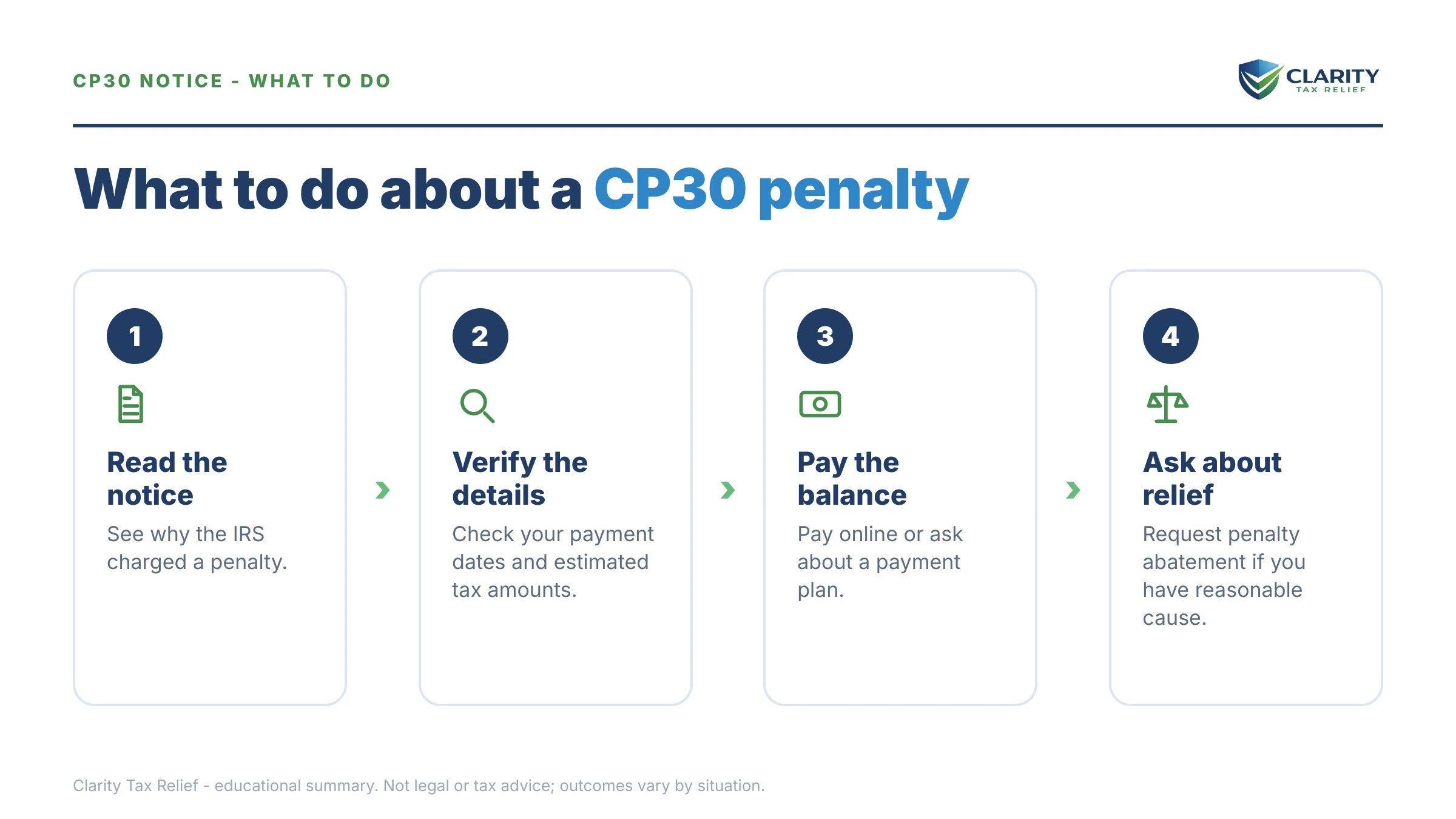
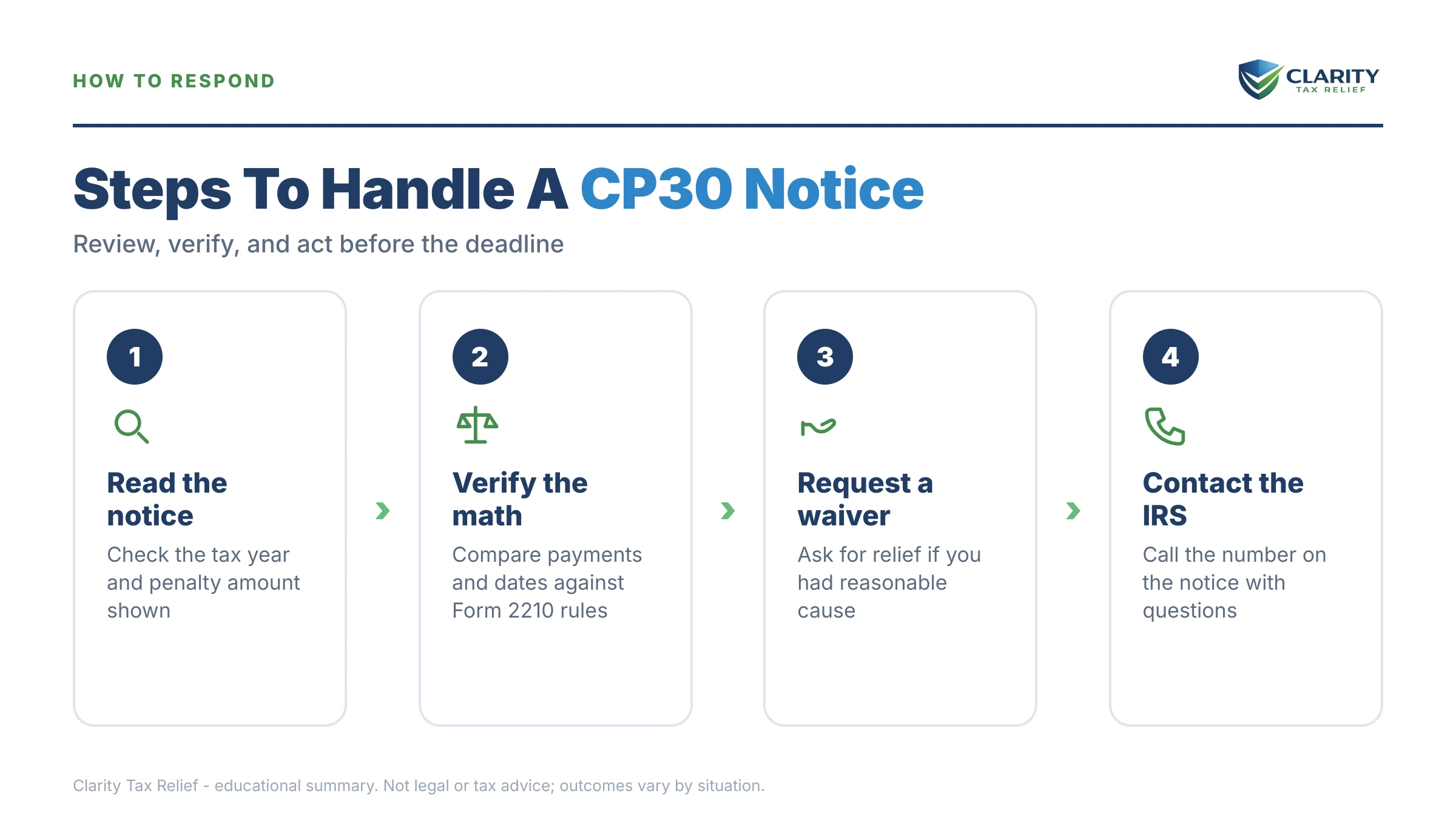
- Verify the penalty against your records. Log into your IRS online account, pull the account transcript for the year on the notice, and confirm every estimated payment and all withholding posted to the right year and the right SSN.
- Run Form 2210 yourself. Recompute the penalty with your real payment dates, and if your income arrived unevenly, complete Schedule AI — the annualized income installment method — to see whether the recalculated penalty is lower.
- Request a waiver if one fits. If you retired after age 62, became disabled, or were affected by a casualty or disaster, send a waiver request with Form 2210 and a short written statement to the address on the notice.
- Pay or arrange any balance due. If your refund didn't cover the penalty, pay by the date printed on the notice at IRS.gov/payments or set up a payment plan so the collection notice sequence never starts.
- Reset your 2026 payments. Pick a safe harbor now and adjust your remaining quarterly payments or withholding so next year's return prints no penalty at all.
How to make sure a CP30 never prints again
Hitting any safe harbor makes you penalty-proof for the year, no matter how much you owe at filing. For most self-employed filers, the prior-year safe harbor is the practical choice: take last year's total tax straight off your return, divide by four, and automate the payments. The number never changes mid-year, even if your income surges — you'd simply owe the difference, penalty-free, in April.
| Safe harbor | Who it applies to | What you must prepay |
|---|---|---|
| 90% of current-year tax | Anyone | 90% of the tax on this year's return, via withholding + quarterlies |
| 100% of prior-year tax | AGI of $150,000 or less ($75,000 if married filing separately) | Last year's total tax, in four installments |
| 110% of prior-year tax | AGI over $150,000 ($75,000 MFS) | 110% of last year's total tax |
| Under-$1,000 rule | Anyone | None — no penalty if the balance after withholding and credits is under $1,000 |
| Farmers & fishermen | Two-thirds or more of gross income from farming or fishing | 66⅔% of current-year tax, with special due-date rules |
Two traps to watch. If you're married filing separately, the prior-year safe harbor threshold drops to $75,000 of AGI before the 110% rule kicks in. And if last year was your breakout year, the 100%-of-prior-year number can be painfully large — the 90%-of-current-year harbor may be cheaper, at the cost of estimating as you go.
One more tool: withholding is treated as paid evenly across the year no matter when it actually came out. If you (or a spouse) have any W-2, pension, or retirement-distribution income, a withholding increase in November can retroactively cure underpayments from April. Quarterly payments can't do that; withholding can. Mark the remaining quarterly estimated tax deadlines for 2026 now — September 15, 2026 and January 15, 2027 are what's left of this year.
When you can handle a CP30 yourself — and when help pays for itself
Most CP30s are a do-it-yourself notice. If the penalty is a few hundred dollars, the IRS's math matches your records, and your refund already covered it, there is nothing to hire anyone for — read the notice, adjust your quarterlies, and move on. Even a straightforward waiver request (a documented disaster, a retirement at 63) is a form and a letter you can send yourself.
Experienced help changes the outcome in a narrower set of situations: a Schedule AI recalculation across lumpy business income, where the quarterly allocation math genuinely gets intricate; repeated CP30s stacking alongside balance-due years already moving through collections; payment-posting disputes the IRS has rejected once; or a CP30 that landed with other notices — a CP504 or LT11 on an older year — where the estimated-tax penalty is the smallest of your problems. In those cases the sequencing of fixes, not the CP30 itself, is what a professional gets right.
Terms on your CP30, decoded
- Estimated tax penalty (IRC §6654): an interest-style charge for prepaying too little tax during the year — owed even if you paid in full by April 15.
- Form 2210: the form that calculates the penalty and carries the only paths to reduce or waive it.
- Safe harbor: a prepayment level (90% of this year or 100–110% of last year) that blocks the penalty entirely, regardless of your final bill.
- Annualized income installment method: Form 2210 Schedule AI — recalculates required installments based on when income actually arrived, instead of assuming four equal quarters.
- Underpayment rate: the federal interest rate, reset each quarter, used to price each installment shortfall.
- CP30A: the companion notice the IRS sends when it reduces or removes an estimated-tax penalty — often the reply to a successful Form 2210 request.
CP30 questions, answered
Is a CP30 notice serious?
A CP30 is one of the mildest notices the IRS sends. The penalty has already been charged — usually out of your refund — so in most cases there is no collection activity coming. It becomes serious only if the notice shows a balance due and you ignore the pay-by date, which starts the normal collection notice sequence.
Why did the IRS reduce my refund with a CP30?
Because the estimated-tax penalty is assessed before your refund is released, the IRS simply subtracts it and sends you the difference. The notice shows the penalty amount and the tax year it applies to. If the remaining refund covered the whole penalty, your account is settled — you owe nothing more for that year.
Can the CP30 penalty be removed?
Sometimes. The estimated-tax penalty is not eligible for first-time penalty abatement, but Form 2210 offers real relief: recalculating with the annualized income method if your income arrived unevenly, or a waiver if you retired after age 62, became disabled, or were hit by a casualty or disaster. IRS payment-posting errors are also correctable.
Do I have to respond to a CP30 notice?
No response is required if the notice is correct and your refund covered the penalty — the matter is closed. Respond only if you dispute the math, qualify for a waiver, or the notice shows a balance due. In that last case, pay or arrange payment by the printed date to stop interest and further notices.
What is the difference between CP30 and CP30A?
A CP30 tells you the IRS charged an estimated-tax penalty; a CP30A tells you the IRS reduced or removed one, usually after a recalculation. If you receive a CP30A after responding to a CP30, compare the new figures to your request — it often means your Form 2210 recalculation or waiver was accepted, at least in part.
How is the CP30 estimated-tax penalty calculated?
It works like interest, not a flat fine. The IRS measures how much each required quarterly installment was short and applies the federal underpayment rate — reset quarterly — from that installment's due date until it was paid or April 15. That is why a shortfall in the first quarter costs roughly four times as much as the same shortfall in the fourth.
Will a CP30 lead to a levy or garnishment?
Not by itself. If your refund absorbed the penalty, nothing escalates. A levy becomes possible only if a CP30 balance goes unpaid long enough to travel the full notice sequence — CP501, CP503, CP504, then LT11 — and even then you get 30 days and formal appeal rights before the IRS can touch wages or bank accounts.
How do I avoid a CP30 next year?
Hit a safe harbor. Prepay at least 90% of this year's tax or 100% of last year's total tax (110% if your AGI topped $150,000) through quarterly payments or withholding, and no penalty applies no matter what you owe in April. Withholding counts as paid evenly all year, so a late-year withholding boost can cure earlier quarters.
Your next 24 hours
- Find two numbers on your CP30: the penalty amount and the tax year it applies to — both are printed near the top of the notice — and note whether it shows a balance due or says the penalty came out of your refund.
- Gather your proof: last year's return, this year's return, and every estimated-payment confirmation (IRS Direct Pay, EFTPS, or canceled checks), so you can match your records against the IRS's.
- Get a free case review: if the math doesn't match, a waiver might fit, or a balance is due, call (888) 825-7779 or use the 2-minute form — interest keeps accruing on any unpaid balance, and September 15 is the next installment that can start a 2026 penalty.
For the primary sources: the IRS explains this notice at Understanding your CP30 notice, the recalculation and waiver rules live on the About Form 2210 page, and any balance can be paid directly at IRS.gov/payments.
This guide is general information, not tax or legal advice for your specific situation. Eligibility for IRS programs depends on individual facts and circumstances; no outcome is guaranteed.