
IRS Forms
Form 843 Penalty Abatement Request: How to Get IRS Penalties Removed (2026)
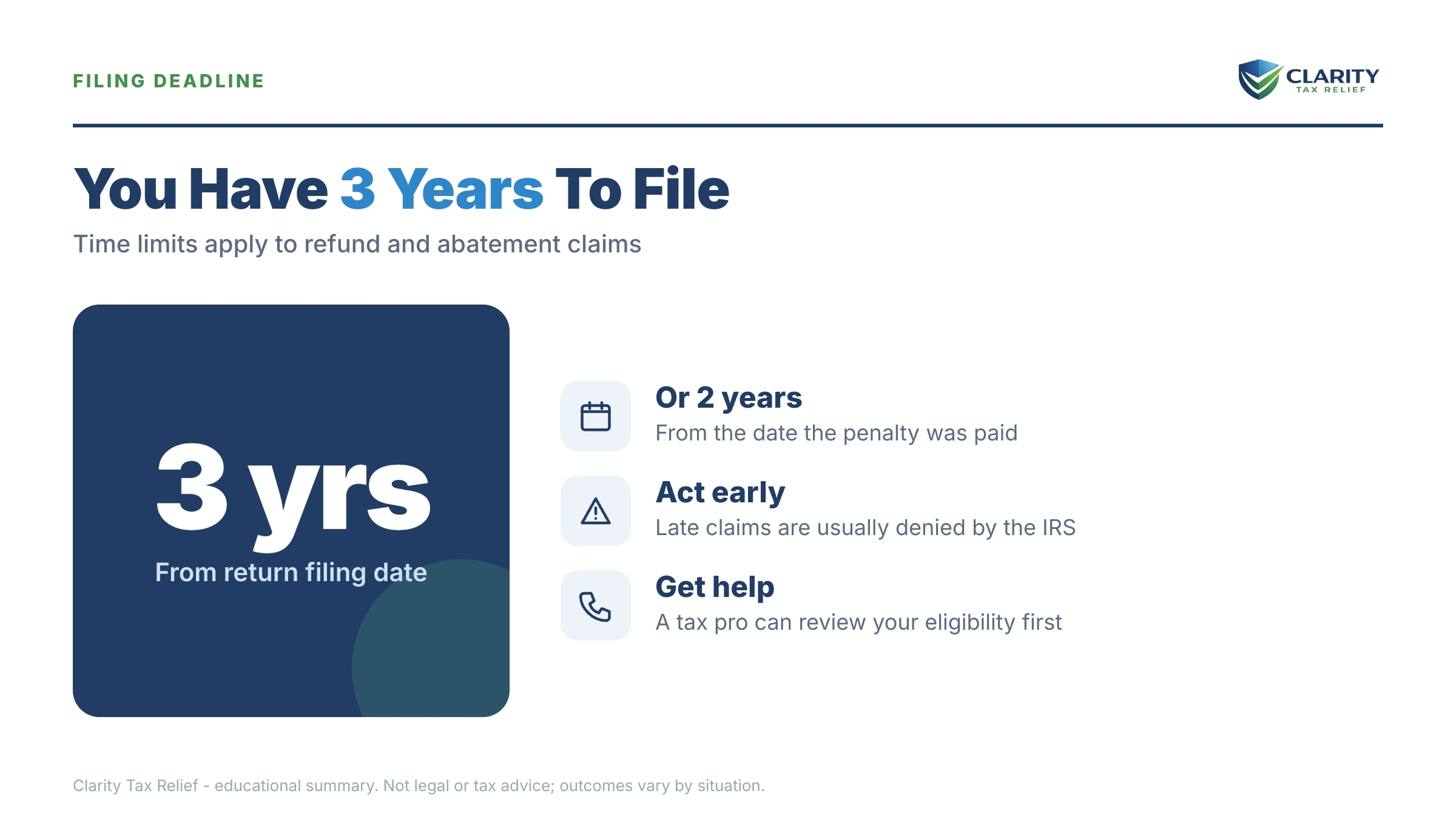
The short answer: a Form 843 penalty abatement request asks the IRS to remove — or refund — penalties based on reasonable cause, an IRS error, or erroneous written IRS advice. It costs $0 to file, requires a separate form for each tax period, and a refund claim must arrive within 3 years of filing or 2 years of paying, whichever is later.
You're staring at a balance where the penalties alone could cover a semester of your kid's tuition — added to a return that got buried under a divorce, a move, or a year you'd rather forget. A Form 843 penalty abatement request is the formal way to ask the IRS to take those penalties back off, and when the request is built on dated evidence instead of apologies, the IRS grants relief far more often than the notice suggests.
Form 843 is a single page, but the two entries most requests get wrong — the tax period box and the IRC section for the penalty — decide whether it even reaches the right unit. The image below shows exactly what the form looks like and where those entries sit, so keep reading before you fill anything in.
⏱ Your deadline: to get back a penalty you already paid, Form 843 must be filed within 3 years of filing the return or 2 years of paying the penalty — whichever is later. There is no fixed deadline to request abatement of an unpaid penalty, but the failure-to-pay penalty and interest keep growing every month you wait.

What a Form 843 penalty abatement request actually does
Form 843 — officially "Claim for Refund and Request for Abatement" — is the free, one-page IRS form that asks for a penalty to be removed before you pay it or refunded after you already have. It's the same piece of paper doing two different legal jobs, and which job it's doing changes your deadline.
Used as an abatement request, it asks the IRS to erase a penalty still sitting on your account. Used as a refund claim, it demands back a penalty you already paid — a path covered in depth in our guide to penalty abatement after paying. The refund version carries the hard statutory deadline in the box above; the abatement version doesn't, but delay has its own cost.
One structural rule trips up more filers than anything else: the IRS requires one Form 843 per tax period and per type of tax. Penalties on three late returns means three forms, even if the story behind them is identical. Each form names the period, the type of penalty, the IRC section it was assessed under, and the dollar amount — and attaches the evidence that supports removal.
If you're not sure why penalties appeared at all, start with the notice that announced them — our guide to why you got a letter from the IRS decodes the notice sequence. This page covers the strategy: what 843 can do, what evidence wins, and what to do if the IRS says no. For a box-by-box walkthrough of the form itself, see the Form 843 instructions guide.
What Form 843 can — and can't — remove
Form 843 covers penalties, certain interest, and certain fees — it cannot touch the underlying tax itself. Sending the wrong request on this form is the fastest way to lose months to a rejection letter, so check your situation against this list first:
- Yes — failure-to-file and failure-to-pay penalties. The two most common penalties on individual accounts, removable for reasonable cause or first-time abatement. (The failure-to-file vs. failure-to-pay distinction matters, because the late-filing penalty is ten times larger per month — though in months where both penalties apply, the failure-to-file portion drops to 4.5%, for a 5% combined monthly rate.)
- Yes — a penalty you already paid, as a refund claim, if you're inside the 3-year/2-year window.
- Yes — interest caused by IRS error or delay under IRC §6404, a narrow but real path covered in our IRS interest abatement guide.
- Yes — penalties caused by wrong written IRS advice you asked for and relied on (§6404(f)).
- No — the income tax itself. If the underlying tax is wrong, you need Form 1040-X, not Form 843.
- No — the estimated-tax underpayment penalty. That one has its own waiver route on Form 2210, explained in our estimated tax penalty waiver guide.
- No — interest that accrued just because the balance went unpaid. Ordinary interest is statutory and cannot be waived for hardship or fairness.
The deadlines that control your Form 843
You have 3 years from filing the return or 2 years from paying the penalty — whichever is later — to claim a penalty refund on Form 843. That clock, called the refund statute, is absolute: file one day late and the money is legally unrecoverable even if your reasonable cause is airtight. The other clocks in the process are just as mechanical.
| Clock | Deadline | What it means for you |
|---|---|---|
| Refund claim for a paid penalty | Later of 3 years from filing the return or 2 years from paying | Miss it and the refund is permanently barred, regardless of merit |
| Abatement of an unpaid penalty | No fixed statute | But the failure-to-pay penalty keeps accruing toward its 25% cap while you wait |
| IRS silent on your refund claim | 6 months after filing | You gain the right to file a refund suit in federal court instead of waiting |
| Claim formally disallowed | 2 years from the disallowance notice | Your window to sue; the Appeals window is printed on the denial letter itself |
The refund statute is why "I'll deal with the penalties later" is expensive advice. If you paid penalties in installments, each payment starts its own 2-year clock — meaning older payments can fall out of the window while newer ones remain claimable.
What happens if you wait to request abatement
Every month you wait, the failure-to-pay penalty adds another 0.5% of the unpaid tax, and interest compounds on the penalties themselves — not just the tax. Nothing about a penalty is frozen while you decide whether to fight it. Left alone, the sequence runs like this:
- The penalties compound. The failure-to-pay penalty accrues monthly until it hits its 25% cap, and daily-compounding interest attaches to both the tax and the penalties stacked on top of it.
- The collection notices keep arriving. Penalties are part of your assessed balance, so the automated notice sequence — bill, reminders, intent to levy — marches forward whether or not you're planning to contest them. A Form 843 in the mail does not pause it.
- The refund window starts closing. If any penalties were paid — including through refund offsets you may not have noticed — the 3-year/2-year statute is quietly running on each of those payments.
- The balance crosses enforcement thresholds. A growing balance can trigger a federal tax lien filing, and once total debt passes $66,000 (the 2026 figure), the IRS can certify it to the State Department and block your passport. A mid-five-figure balance with unaddressed penalties can drift toward that line within a few years of accrual.
The 2026 reality sharpens all of this: the IRS workforce shrank roughly 27% in 2025, which makes a human reviewer slower to reach — but the systems that assess penalties and escalate collection are automated and never slowed down. The math runs whether anyone is answering the phone or not.
Penalties stacking up on your balance?
Send us your notice or transcript. An experienced tax professional will identify every penalty on your account, which abatement ground fits, and what evidence you'd need — free, confidential, before another month of penalty accrues.
The four grounds for penalty abatement — and which needs Form 843
The IRS grants penalty relief on four main grounds: first-time abatement, reasonable cause, statutory exception, and erroneous written IRS advice. Form 843 is the vehicle for most written requests, but it isn't always the fastest route — first-time abatement, for example, is often granted over the phone in minutes.
| Relief ground | When it fits | How to request it |
|---|---|---|
| First-Time Abate (FTA) | Clean compliance history for the prior 3 years; first slip | Often a single phone call to the notice number; Form 843 for refunds of paid penalties. Being replaced by automatic AEP starting summer 2026 |
| Reasonable cause | Serious illness, death in the family, disaster, records you genuinely couldn't obtain | Form 843 (or a detailed letter) with a written statement and dated evidence |
| Statutory exception | A law or federally declared disaster extended your deadline | Usually applied automatically; Form 843 if the relief wasn't applied to your account |
| Erroneous written IRS advice (§6404(f)) | You relied on written IRS advice that turned out to be wrong | Form 843 with a copy of your written request and the IRS's written answer |
| Interest abatement (§6404(e)) | Interest caused by IRS error or unreasonable delay — not by your nonpayment | Form 843 with a timeline documenting the IRS-caused delay |
Two 2026-specific notes. First, the first-time penalty abatement program is being replaced by the Automatic Exemption from Penalty (AEP) starting summer 2026 — qualifying penalties will come off automatically, with no request needed. If your only issue is a single first slip after three clean years, it may pay to check whether AEP already covers you before drafting anything. Second, FTA and reasonable cause can be stacked across years: FTA for the earliest year, reasonable-cause penalty abatement for the rest — a sequencing decision that changes the total relief.
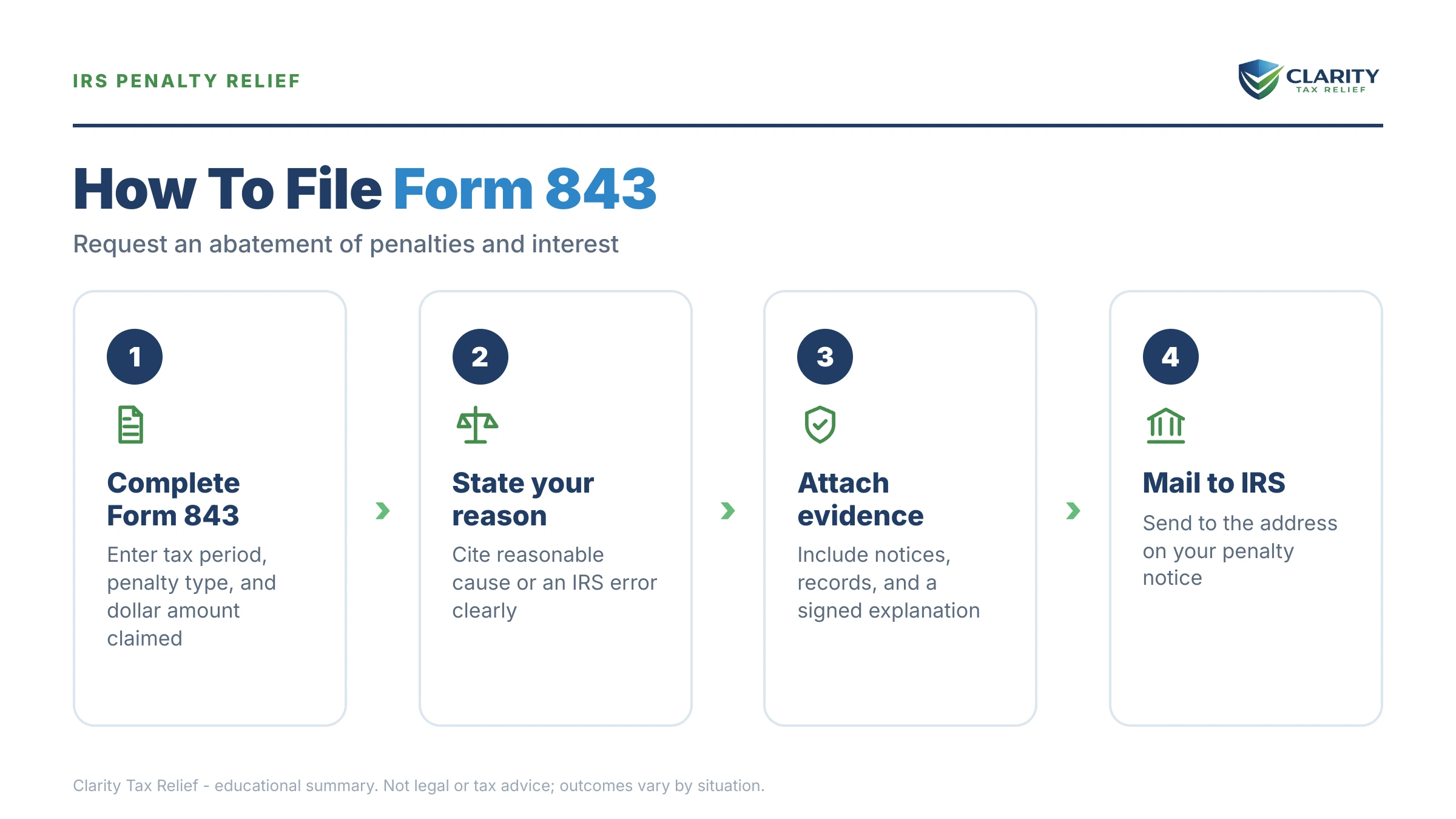
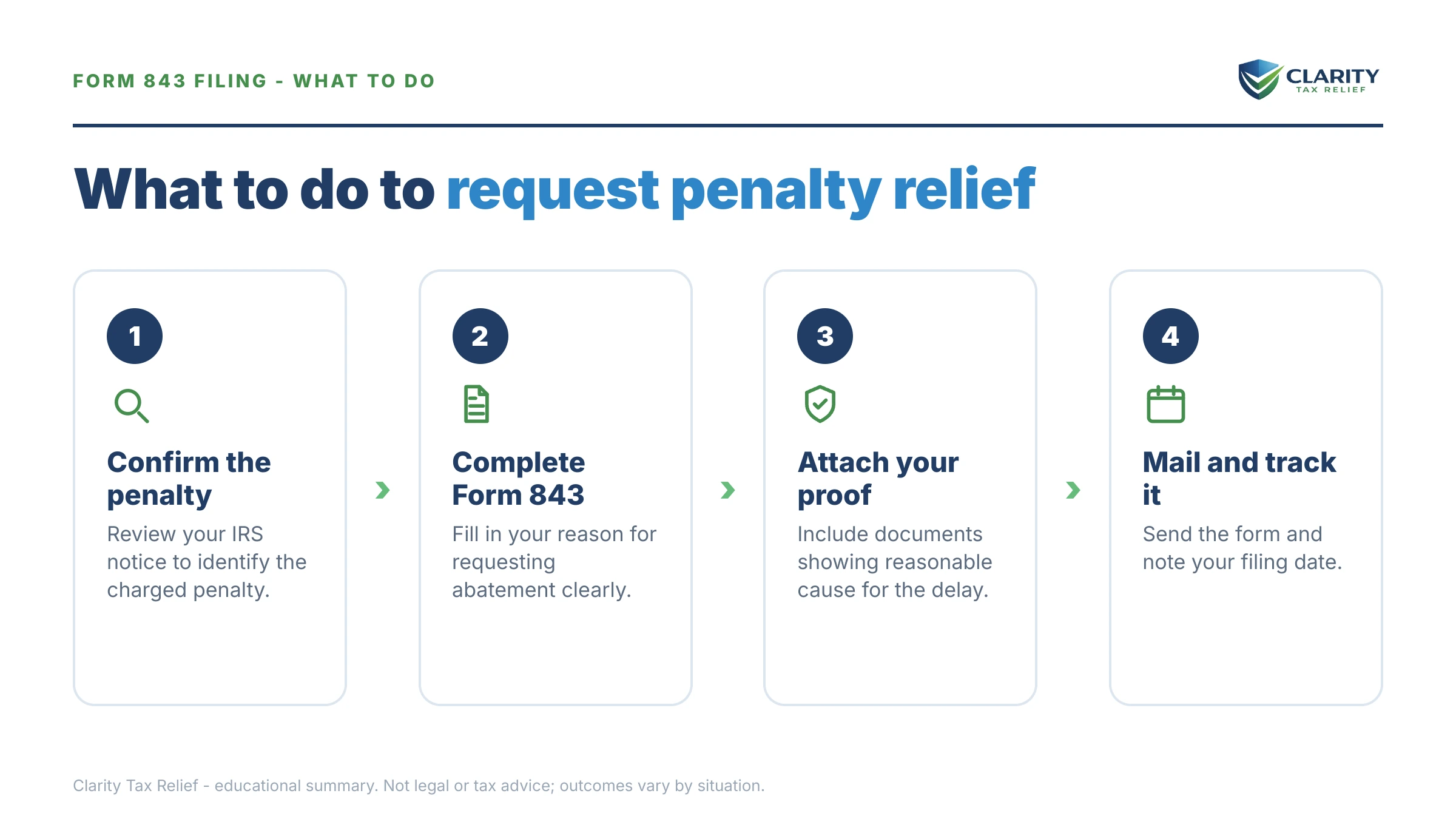
How to file a Form 843 penalty abatement request, step by step
- Pull your penalty breakdown. Get your account transcript or the penalty notice and identify each penalty by transaction code and dollar amount before you write anything.
- Confirm Form 843 is the right tool. Rule out a faster phone-based first-time abatement, and make sure you are disputing the penalty — not the tax itself, which needs Form 1040-X instead.
- Draft your reasonable-cause statement. Tie dated evidence to each missed deadline in a short, factual narrative — what happened, when it happened, and how it prevented you from complying.
- Complete one Form 843 per tax period. Fill in the period, the penalty type and IRC section, and the dollar amount; sign it, attach your evidence, and keep a complete copy.
- Mail it to the address on your notice. Send it certified mail with return receipt; if you have no notice, use the service-center address listed in the Form 843 instructions.
- Protect the balance while you wait. Keep or set up a payment plan on the remaining tax and calendar the 6-month mark, because a pending request does not pause collection.
A worked example: $54,600 after a divorce-year filing miss
Say your 2023 return got lost in a divorce and you finally filed it 20 months late, showing $38,000 of tax due. By mid-2026 the bill reads $54,600 — and understanding how it got there tells you exactly what Form 843 can claw back. In this simplified hypothetical:
- Tax: $38,000
- Late-filing penalty: $8,550 — the failure-to-file penalty ran at 4.5% a month while the failure-to-pay penalty ran alongside it, until it hit its combined cap (22.5% × $38,000)
- Failure-to-pay penalty so far: $4,750 — 0.5% a month for roughly 25 months (2.5 years × 6% ÷ 12... i.e., 12.5% × $38,000), still climbing toward its 25% cap
- Interest: roughly $3,300, compounding daily on the tax and the penalties
Total: $38,000 + $8,550 + $4,750 + $3,300 = $54,600. Notice that $13,300 of it — nearly a quarter of the bill — is pure penalty. If the IRS agrees you had reasonable cause for the late filing and late payment, that $13,300 comes off, and so does the slice of interest that accrued on those penalties, automatically. Total relief could land around $14,000, cutting the balance to roughly $40,600 — which fits a streamlined 72-month payment plan at about $564 a month before ongoing accruals. You can estimate your own penalty-and-interest split with our Penalty & Interest Calculator.
No outcome is guaranteed — reasonable cause is decided case by case on your facts. But this is why the abatement request comes before negotiating the payment plan amount, not after: it changes the number you're negotiating on.
Divorce and reasonable cause: what actually persuades the IRS
Divorce by itself is not reasonable cause — but the circumstances it creates often are. The IRS applies an "ordinary business care and prudence" standard: it asks whether something genuinely outside your control prevented compliance, not whether the year was hard. "My divorce was stressful" loses. Specific, documented obstacles can win:
- Records you couldn't get. If your ex-spouse controlled the brokerage statements, business books, or prior returns and wouldn't release them, inability to obtain records is a recognized reasonable-cause category. Attorney letters and discovery requests documenting the fight are gold.
- A documented health crisis. Treatment records for depression, anxiety, or other medical conditions during the filing window — with dates that overlap the missed deadline — carry real weight.
- Prompt action once the obstacle cleared. The IRS looks hard at what you did when you finally could comply. Filing within a reasonable time after receiving the records (or recovering) supports the claim; another year of drift undermines it.
- A clean history before the event. Years of on-time filing before the divorce frames the miss as an aberration, not a pattern.
The winning structure is a timeline, not a plea: event → dates → why compliance was impossible → what you did the moment it wasn't. Our library of reasonable cause examples shows which fact patterns the IRS has historically accepted and which it routinely rejects.
Reading your transcript after you file
Three transcript codes tell you almost everything about the penalties on your account: 166, 276, and 196. Pull your account transcript before you file — so you list the exact amounts — and again every few weeks after, because the transcript usually shows the decision before the letter arrives.
| Code | What it means | What to do |
|---|---|---|
| 166 | Late-filing (failure-to-file) penalty assessed | Verify the amount and list it, with its period, on your Form 843 |
| 276 | Failure-to-pay penalty posted — see our code 276 transcript guide | Note that this one keeps re-posting as it accrues; your request covers it through the abatement date |
| 196 | Interest charged on the balance | Only abatable for IRS error/delay — but interest on abated penalties comes off automatically |
| 161 / 277 / 197 | Penalty or interest abated | Your request worked — if you had paid, watch for the refund to issue |
| 971 | Notice issued | A determination letter is on its way — watch the mail and calendar any window printed on it |
If your Form 843 is denied
A denied Form 843 is not the end — you're entitled to an independent Appeals review, and a formally disallowed refund claim carries a 2-year window to sue in federal court. Many first requests are denied simply because the evidence was thin or the narrative didn't connect dates to deadlines; Appeals officers reverse a meaningful share of those when the file is rebuilt properly.
The sequence: the denial letter states the reason and your appeal rights — respond within the window printed on the letter with a written protest, or a Form 12203 appeal request for smaller disputes. Our guide to the penalty abatement appeal process walks through what a winning protest adds that the original request lacked. If Appeals also says no on a refund claim, you have 2 years from the disallowance notice to file suit in district court or the Court of Federal Claims — refund suits generally require the disputed amount to have been paid. And if the IRS simply never responds, the 6-month mark opens the courthouse door without a denial letter at all.
If the process stalls and it's causing you financial harm, the Taxpayer Advocate Service is an independent channel that can force movement on a stuck case.
When you can handle Form 843 yourself
Plenty of abatement requests need no professional at all. You can confidently go it alone when:
- You qualify for first-time abatement — three clean prior years, one slip. A phone call often resolves it, and from summer 2026 the AEP may handle it with no call at all.
- The penalty is small and the story is simple — one year, one clearly documented event (a hospitalization with records, a federally declared disaster), a few hundred to a couple thousand dollars at stake.
- The IRS made an obvious error you can prove with a single document, like a misapplied payment.
Experienced help tends to change outcomes when the stakes and complexity rise: five figures of penalties across multiple years, a reasonable-cause narrative tangled in a divorce or business collapse, an interest-abatement claim that requires reconstructing an IRS delay timeline, a denial you're taking to Appeals, or a refund-statute question where filing in the wrong order forfeits money permanently. A professional can also handle the whole exchange under a Form 2848 power of attorney, so you're not fielding IRS correspondence mid-process.
If your penalties run five figures like the $54,600 example above, it's worth having an experienced tax professional pressure-test the evidence before the form goes in the mail — start a free case review or call (888) 825-7779.
Terms on Form 843, decoded
- Abatement — the removal of a penalty, interest, or addition to tax from your account before you've paid it.
- Refund claim — a formal demand for money already paid, which is what Form 843 becomes once the penalty has been collected.
- Reasonable cause — the legal standard for relief: circumstances outside your control that prevented compliance despite ordinary care.
- Ordinary business care and prudence — the yardstick the IRS uses to judge reasonable cause: what a careful person would have done in your shoes.
- RSED (refund statute expiration date) — the date the 3-year/2-year refund window closes, after which paid money is unrecoverable.
- Notice of claim disallowance — the formal denial letter that starts your 2-year clock to sue in federal court.
Form 843 questions, answered
How long does the IRS take to process Form 843?
There is no published processing standard — most requests take several months, and the 2026 staffing cuts have stretched that further. If the IRS has not acted on a refund claim within 6 months, you gain the legal right to file a refund suit rather than keep waiting. In the meantime, the request itself does not pause collection, so keep any payment plan current.
Can I use Form 843 for first-time penalty abatement?
Yes, but you usually don't need to — first-time abatement can often be granted in a single phone call to the number on your notice. Form 843 makes sense when you are claiming a refund of a penalty you already paid, or pairing first-time abatement with a reasonable-cause request for other years. Starting summer 2026, the new Automatic Exemption from Penalty (AEP) begins applying this relief automatically, with no request at all.
Can Form 843 remove interest?
Only in narrow situations. Interest can be abated under IRC §6404 when it was caused by an IRS error or unreasonable delay, and interest charged on a penalty comes off automatically when that penalty is abated. Interest that accrued simply because a balance went unpaid cannot be waived, no matter how compelling your circumstances.
Do I need a separate Form 843 for each tax year?
Yes. The IRS requires one Form 843 per tax period and per type of tax or fee, so penalties on your 2022 and 2023 returns need two forms even if the reason is identical. You can mail them in the same envelope with one cover letter, but each form must stand on its own with the period, penalty type, and IRC section filled in.
Where do I mail Form 843?
If you are responding to a penalty notice, mail it to the address printed on that notice — that routes it to the unit already holding your account. If there is no notice, the Form 843 instructions list the correct service center based on the type of tax and where you file. Always send it by certified mail and keep a stamped copy; lost requests are common enough that proof of mailing matters.
Does filing Form 843 stop IRS collection?
No. A pending abatement request does not pause the collection notice sequence, levies, or the growth of the failure-to-pay penalty on the remaining balance. Set up a payment plan or other arrangement for the tax itself while the request is pending — if the abatement is granted, the plan simply pays off faster.
What happens if my Form 843 is denied?
You will receive a denial letter explaining the decision and your appeal rights — request an Appeals conference within the window printed on the letter, using a written protest or Form 12203 for smaller amounts. If the IRS formally disallows a refund claim, you have 2 years from that disallowance to file suit in federal court. Many denials are reversed at Appeals when the original request simply lacked documentation.
Is divorce a reasonable cause for penalty abatement?
Not by itself — the IRS treats divorce as a common life event, not an excuse. What can qualify are the specific circumstances around it: an ex-spouse who controlled or withheld the tax records, a documented medical or mental-health crisis, or a court proceeding that made timely filing genuinely impossible. The request succeeds or fails on dated evidence tying the event to the missed deadline.
Can I file Form 843 before paying the penalty?
Yes. Form 843 works both ways: as an abatement request for a penalty still sitting unpaid on your account, and as a refund claim for one you already paid. You do not have to pay a penalty first to ask for it to be removed — though if the request is denied, the balance will have kept growing with failure-to-pay penalty and interest in the meantime.
Your next 24 hours
- Identify every penalty on your account. Pull your account transcript or the most recent notice and write down each penalty code (166, 276), its tax period, and its dollar amount — that list is the skeleton of your request.
- Gather your evidence. The return, the penalty notice, and dated proof of what went wrong: medical records, divorce-docket dates, attorney correspondence over records, disaster declarations — anything that ties the event to the missed deadline.
- Get a free case review. Bring both to the 2-minute form at claritytaxrelief.com/#consult or call (888) 825-7779. An experienced tax professional will match your facts to the right abatement ground before another month of failure-to-pay penalty and interest posts to your balance — and before any refund window quietly closes.
For the government's own materials, see the official About Form 843 page and the IRS's payment options at IRS.gov/payments for keeping the remaining balance under control while your request is pending.
This guide is general information, not tax or legal advice for your specific situation. Eligibility for IRS programs depends on individual facts and circumstances; no outcome is guaranteed.