
Penalty Relief
Reasonable Cause Examples: What Actually Qualifies for IRS Penalty Relief (2026)
The short answer: reasonable cause examples the IRS accepts include serious illness or hospitalization, a death in your immediate family, a natural disaster, records you genuinely couldn't obtain, and incorrect written advice. The test: the circumstance was outside your control, and you acted with ordinary business care. Lack of money alone does not qualify.
You've been searching "reasonable cause examples" because you already know the penalties are coming — maybe you've added up three years of 1099 income you never filed, and the tax alone is scary before the IRS stacks its percentages on top. Here's the part that should steady you: the IRS abates penalties every single day for people whose reason holds up, and the difference between an approved request and a form-letter denial is almost never the hardship itself. It's whether the story matches the years, and whether the paper backs the story.
This guide walks through every category the IRS accepts, the excuses that fail on autopilot, and exactly how to ask. The image below maps how the qualifying circumstances line up against the ones that get rejected — it's worth a look before you draft a single sentence to the IRS.
⏱ Your real clock: there's no filing deadline for a reasonable cause request itself, but the penalties it targets grow every month — failure-to-file at 5% per month, failure-to-pay at 0.5% per month — until each hits its cap, with interest compounding on top. And if you already paid a penalty you want back, refund claims are time-limited (generally two years from payment or three years from the return), so old penalties don't stay recoverable forever.
Why you're facing these penalties in the first place
IRS penalties are assessed by computer the moment a late return or unpaid balance posts — no human judges you first, and no human excuses you automatically either. If you're self-employed or a gig worker, the platforms that paid you already reported your income to the IRS on 1099s, so unfiled years don't stay invisible: eventually the IRS files a substitute return for you with zero deductions and bills you for the worst-case number.
Two penalties do most of the damage. The failure-to-file penalty runs 5% of the unpaid tax per month — ten times the 0.5% failure-to-pay penalty — which is why filing, even when you can't pay, is always move one. Reasonable cause is the legal doorway for removing both, but the IRS grants it on evidence, not sympathy.
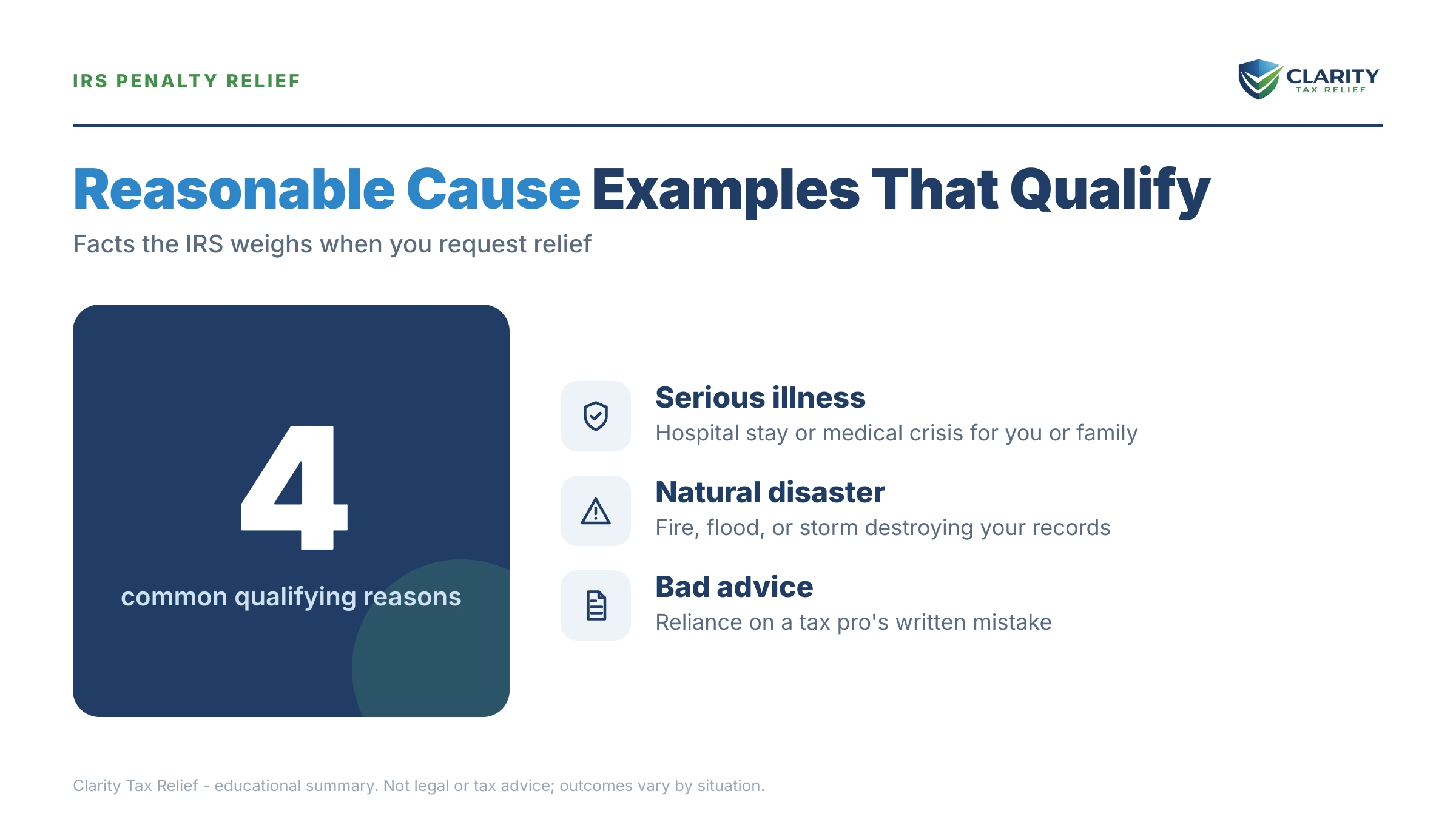
Reasonable cause examples the IRS actually accepts
The IRS grants reasonable cause when a circumstance beyond your control prevented compliance despite "ordinary business care and prudence." That phrase is the whole game. The IRS isn't asking whether life was hard; it's asking whether a careful person in your exact situation could have filed or paid on time anyway. Every winning category answers no — and proves it with documents dated during the event.
| Circumstance | Why it can qualify | Documentation the IRS expects |
|---|---|---|
| Serious illness or incapacitation (you or immediate family) | You physically or mentally couldn't handle your affairs during the deadline window | Hospital admission/discharge records, physician letters with dates, treatment timeline |
| Death in the immediate family | Grief and estate duties around the deadline disrupted compliance | Death certificate, obituary, proof of your role (executor, caregiver) |
| Fire, natural disaster, or casualty | The event destroyed records or displaced you near the deadline | FEMA or insurance claims, fire/police reports, photos, repair invoices |
| Inability to obtain records | You made real, documented efforts and the records still weren't available | Dated requests to employers/banks/exchanges, their responses or silence |
| Erroneous written advice from the IRS | You relied on specific written IRS guidance that turned out wrong | The written advice itself, your request for it, proof you followed it |
| Bad substantive advice from a tax professional | You reasonably relied on a pro's judgment call (not on them to mail the return) | The dated advice, engagement records, proof you gave the pro complete facts |
| Theft, embezzlement, or identity theft | Someone else's crime took the funds or hijacked your accounts | Police report, bank fraud claims, Form 14039 if identity theft |
Three details separate the requests that win from the ones that echo the same categories and lose:
- Timing has to overlap the deadline. A hospitalization in November doesn't explain a return due the previous April. The IRS lines your event dates up against each year's filing and payment dates — do that math yourself before you write.
- Mental health counts. Depression, addiction, and cognitive decline are legitimate incapacitation when a treating provider documents that you couldn't manage your affairs during the period. Untreated and undocumented, the same struggle scores as "neglect."
- You must show recovery behavior. The IRS expects you to have fixed the problem within a reasonable time after the circumstance ended. Filing promptly once you were back on your feet is itself evidence; letting two more years slide after recovery undercuts the whole claim.
What doesn't qualify as reasonable cause (and why most requests fail)
"I didn't have the money" is the single most common reasonable cause argument — and by itself it loses almost every time. The IRS treats inability to pay as a payment-plan problem, not a penalty excuse. The same is true for the rest of the reflex answers:
- Ignorance of the law. "I didn't know gig income was taxable" fails; the IRS presumes everyone knows filing obligations exist. (Not knowing a genuinely obscure rule, after asking a professional, is a different and stronger fact pattern.)
- "My preparer was supposed to file it." The Supreme Court settled this in United States v. Boyle: the duty to file on time can't be delegated. Reliance on a pro's wrong advice can qualify; reliance on them to hit "submit" cannot.
- Being too busy, business turmoil, or forgetfulness. These are the definition of failing "ordinary business care."
- An honest mistake, standing alone. A mistake can support relief only when paired with facts showing you exercised real care and got misled anyway.
Here's the nuance worth knowing: a losing argument can become a winning one when you name the cause behind the cause. "I couldn't pay" fails. "I couldn't pay because my apartment fire in March consumed my savings — here's the fire report and the insurance claim" can succeed, because the event, not the empty account, is the reasonable cause. If you're framing a no-money year, dig one layer deeper before you write.
One fear to retire while you're here: falling behind on filing or payment because of hardship is a civil matter, not a crime. If that worry has been keeping you frozen, read can you go to jail for owing irs — the honest answer is reassuring, and the fix is filing, not hiding.
What happens if you ignore the penalties
Unaddressed penalties don't plateau quietly — they grow to their caps while the IRS's automated collection sequence marches toward levy. Nothing about 2026's reduced IRS workforce slows the machine; the notices are generated by systems that never got cut. Here's the order of events:
- Penalties compound monthly. Failure-to-file stacks at 5% per month toward its cap of roughly 25% of the unpaid tax; failure-to-pay keeps adding 0.5% per month long after that, with interest compounding on everything — including the penalties themselves.
- For unfiled years, the IRS files for you. A substitute return assesses tax on your gross 1099 income with no expenses, no mileage, no deductions — usually far more than you'd owe on a real return.
- The billing sequence starts. A CP14 notice gives you about 21 days (10 business days if the balance is $100,000 or more), followed by CP501 and CP503 reminders — each one a bigger balance than the last.
- CP504 arrives. The IRS can now seize your state tax refund, and a federal tax lien becomes a live risk.
- LT11 / Letter 1058 — final notice. A 30-day clock starts; when it expires, the IRS can levy bank accounts and garnish income. Your best appeal rights exist at this stage, but far fewer good options than you have today.
The order matters for penalty relief too: reasonable cause is easiest to win while the file is young and the facts are fresh. Two years into collections, you're arguing the same case with a levy running in the background.
Behind on filings with penalties piling up?
Tell us what happened — illness, disaster, a preparer who let you down. An experienced tax professional will review your years for free, tell you which qualify for reasonable cause or first-time abatement, and map the cheapest path through, before another month of penalties and interest posts to your balance.
Reasonable cause vs. FTA vs. AEP: every penalty relief path compared
Reasonable cause is one of five distinct penalty relief paths, and it's often not the one you should use first. If a no-questions-asked option covers a year, spend it there and save your documented hardship for the years it can't reach. Here's the full menu:
| Relief path | Who qualifies | How to request |
|---|---|---|
| Reasonable cause abatement | Anyone with a documented circumstance beyond their control, tied to each year claimed | Written statement with a notice response, by phone, or on Form 843 per year |
| First-Time Abate (FTA) | Clean compliance history in the prior 3 years; removes one period's penalties, no story needed | Phone call or short written request |
| Automatic Exemption from Penalty (AEP) | Replacing FTA starting summer 2026 — applied automatically to qualifying accounts | No request; verify the abatement posted to your transcript |
| Statutory exception / disaster relief | Taxpayers in federally declared disaster areas or combat zones during the covered window | Usually automatic by address or status; flag it if missed |
| Interest abatement (§6404) | Narrow: interest caused by IRS error or unreasonable delay only | Form 843 with a timeline showing the IRS-caused delay |
The stacking play is the part most DIY requests miss: first time penalty abatement can clear your earliest delinquent year if the three years before it were clean — even when the years after it are a mess — and reasonable cause then carries the rest. Our guide to first time abatement multiple years walks through sequencing it, and the deeper process mechanics live in our reasonable cause penalty abatement guide. Note the honest limits: none of these erase the underlying tax, and interest on the tax survives everything except §6404 — see can irs interest be waived for why.
A worked example: $11,300 across three unfiled gig years
Say you drove and delivered on 1099s for three years, never filed, and the returns you finally prepare show $11,300 in total tax: $4,100 for the oldest year, $3,800 for the middle year, $3,400 for the newest. This is a hypothetical, but the arithmetic is real:
- Failure-to-file: all three years hit the cap of roughly 25% of unpaid tax — about $1,025 + $950 + $850 = ~$2,825.
- Failure-to-pay: still running at 0.5%/month. At roughly 36, 24, and 12 months late: ~$738 + $456 + $204 = ~$1,398.
- Total penalties: ~$4,223 — about 37% stacked on top of the $11,300, before interest compounds on all of it.
Now apply relief. Suppose the middle year coincided with a documented four-month hospitalization: reasonable cause could remove that year's ~$1,406 in penalties. If the three years before your oldest delinquent year were clean, first-time abatement could clear that year's ~$1,763 with no story at all. Combined, roughly $3,169 of $4,223 in penalties — three-quarters — comes off, plus the interest that accrued on those penalties, leaving the newest year's penalties and the tax itself to resolve on a payment plan. You can estimate your own penalty exposure with our Penalty & Interest Calculator, then compare payment options in our guide to the best way to pay the irs.
How to request reasonable cause relief, step by step
- File the missing returns first. The IRS won't seriously consider penalty relief while returns are outstanding, and filing stops the 5%-per-month failure-to-file penalty from stacking on future years.
- Check first-time abatement and AEP before writing anything. If your prior three years are clean, FTA removes penalties for the earliest year with no story required — save your reasonable cause argument for the years FTA can't reach.
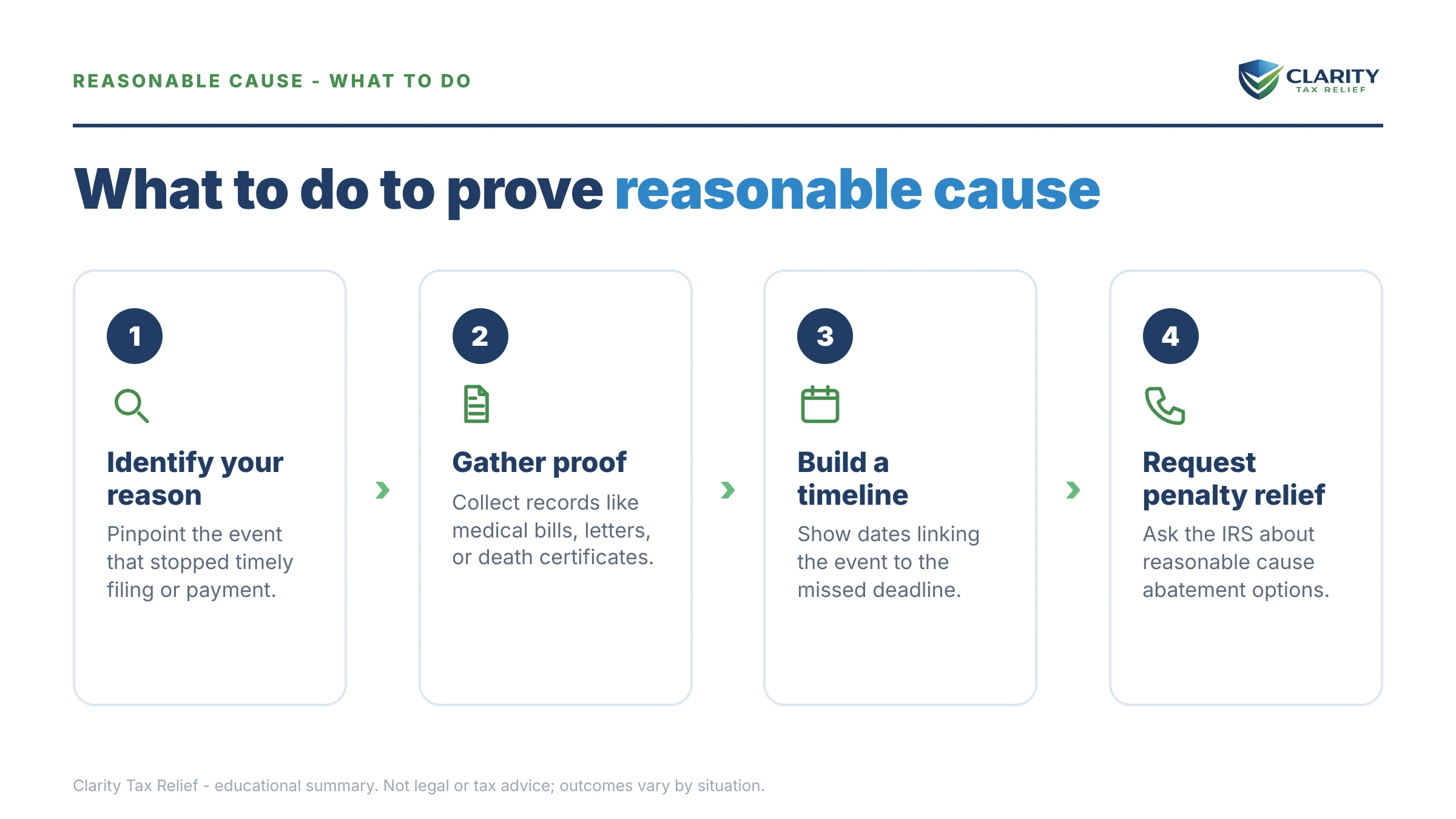
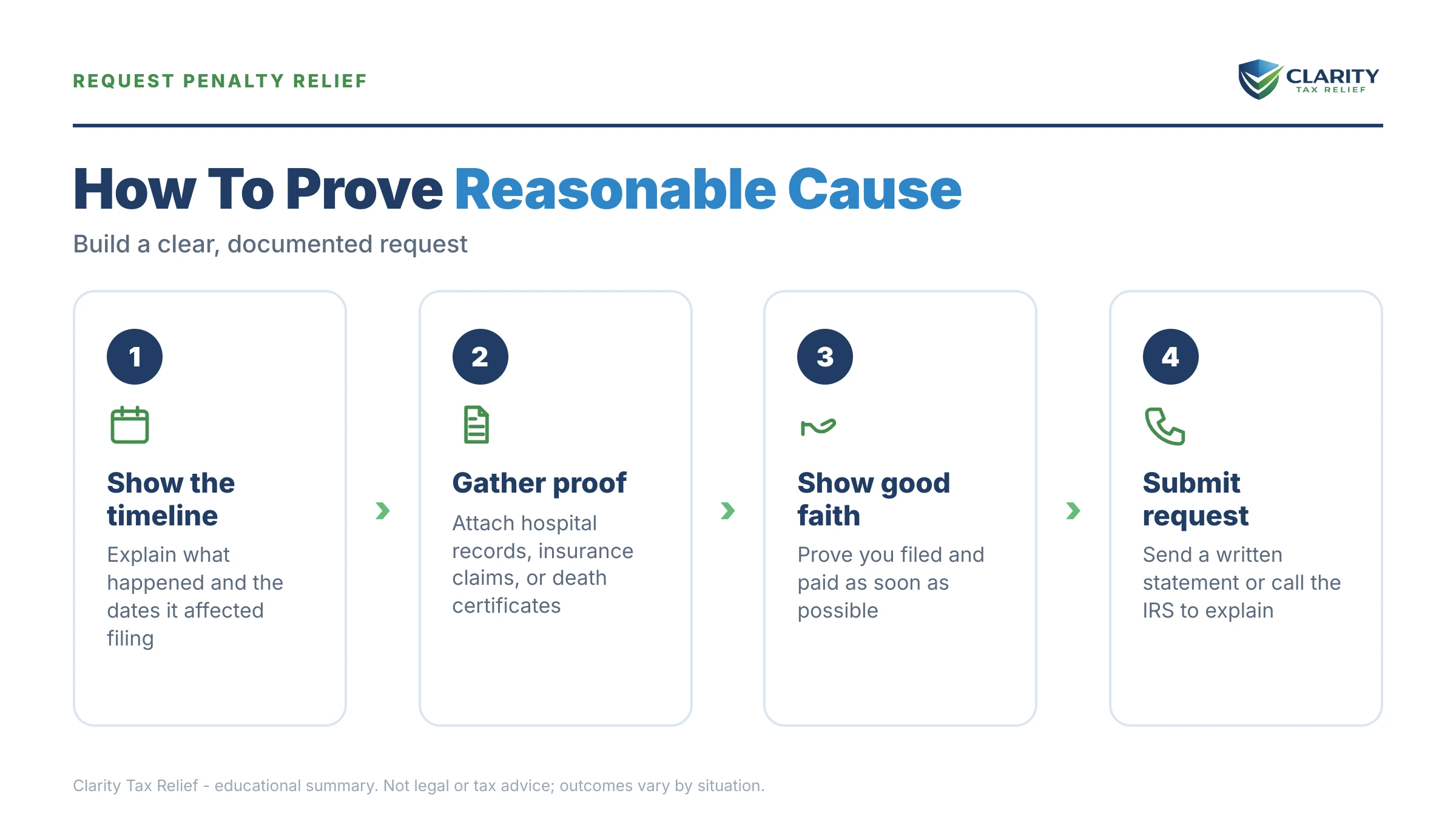
- Gather contemporaneous documentation. Pull hospital records, a death certificate, insurance or FEMA claims, or the dated written advice you relied on — documents created during the event, matched to each tax year's deadline.
- Submit the request. Respond to the penalty notice in writing, call the number on the notice for smaller amounts, or file Form 843 — one per tax year — with your statement and evidence attached.
- Appeal if denied. First-round denials are often computer-scored; a written protest to the IRS Independent Office of Appeals within the window on your denial letter puts your file in front of a human.
For the mechanics of the written request itself, our Form 843 penalty abatement request walkthrough and IRS penalty abatement letter guide cover format, wording, and where each year's request goes.
When you can handle this yourself — and when help changes the outcome
A single-year, well-documented reasonable cause request is genuinely a DIY project. If you filed late one year because of a hospitalization you can prove, and the penalty is a few hundred dollars, write the statement, attach the records, and send it — no professional needed. The same goes for a straightforward FTA phone call, or simply confirming an AEP abatement posted. Our hub on how to settle tax debt yourself covers the broader self-help toolkit.
Experienced help earns its cost when the file is layered: multiple unfiled years that need reconstructing before any penalty argument can even start (start with haven't filed taxes in 3 years to see the sequencing), a substitute return already assessed against your gross 1099 income, penalties north of a few thousand dollars where the FTA-versus-reasonable-cause sequencing decides real money, active collection notices running alongside the abatement request, or a first denial you need to appeal. In those cases the win usually comes from ordering the moves correctly — returns, then FTA, then reasonable cause, then the balance — not from a more dramatic hardship letter.
Terms on your penalty notice, decoded
- Reasonable cause — the legal standard for penalty forgiveness: a circumstance beyond your control prevented compliance despite genuine care.
- Ordinary business care and prudence — the yardstick the IRS measures you against: what a careful person in your shoes would have done.
- Failure-to-file vs. failure-to-pay — two separate penalties on the same balance: 5% per month for not filing, 0.5% per month for not paying.
- First-Time Abate (FTA) — administrative forgiveness of one period's penalties for taxpayers with a clean prior three years, no explanation required.
- AEP (Automatic Exemption from Penalty) — the FTA replacement rolling out from summer 2026 that applies the same relief automatically, without a request.
- Form 843 — the "Claim for Refund and Request for Abatement," the written vehicle for a reasonable cause request or a refund of penalties already paid.
Reasonable cause questions, answered
What qualifies as reasonable cause with the IRS?
Reasonable cause means a circumstance outside your control kept you from filing or paying on time even though you exercised ordinary business care and prudence. The strongest examples are serious illness or hospitalization, a death in your immediate family, a federally declared disaster, destruction of records, and incorrect written advice from the IRS. Each one has to line up in time with the missed deadline and be backed by documents.
Is not having the money to pay considered reasonable cause?
By itself, no — inability to pay is not reasonable cause for the failure-to-pay penalty. The IRS asks a follow-up question: what caused the inability? If the answer is a documented event like a medical crisis, job loss tied to a disaster, or theft of funds, the underlying event can qualify even though the empty bank account alone does not.
Is relying on my accountant reasonable cause for filing late?
For filing deadlines, no. The Supreme Court held in United States v. Boyle that the duty to file on time can't be delegated, so 'my accountant was supposed to do it' fails for late filing. Reliance on a professional's incorrect substantive advice — for example, advice that you had no filing requirement — is different and can qualify if the advice was reasonable to rely on.
Can I claim reasonable cause for more than one tax year?
Yes, and multi-year requests are common — but you must tie the circumstance to each year individually. A hospitalization that explains one missed deadline doesn't automatically excuse the two years after you recovered; the IRS expects you to show you fixed the problem within a reasonable time once the circumstance ended. Many people pair reasonable cause for one year with first-time abatement for another.
What documentation do I need to prove reasonable cause?
Contemporaneous records — documents created at the time of the event, not a letter written today describing it. Think hospital admission and discharge records, a death certificate, FEMA or insurance claims, a police or fire report, or the dated written advice you relied on. Your written statement matters, but it needs those anchors; the IRS's decision tools weigh documents far more than narrative.
Does reasonable cause abatement remove interest too?
Not directly. Interest is set by statute, so the IRS can't waive it for reasonable cause — but when a penalty is abated, the interest that accrued on that penalty is removed with it. Interest on the tax itself can only be abated in narrow cases of IRS error or delay under §6404, which is a separate request.
What happens if my reasonable cause request is denied?
You can appeal, and appeals succeed often enough to be worth it. The denial letter explains your appeal rights — typically a written protest to the IRS Independent Office of Appeals within the window stated on the letter. Appeals officers weigh the hazards of litigation, not just the service center's checklist, so a well-documented file that a computer scored poorly can win with a human.
Your next 24 hours
- Find the penalty lines. On your notice — or your IRS account transcript if you haven't received one — identify each year's failure-to-file and failure-to-pay amounts, so you know exactly what relief is worth.
- Gather your event evidence and income records. Pull the dated documents for whatever happened — medical records, death certificate, insurance claims — plus your 1099s and any unfiled-year income info, since returns come first.
- Get a free case review. Use the 2-minute form or call (888) 825-7779 — an experienced tax professional will map which years fit FTA, AEP, or reasonable cause before another month of penalties and interest posts to the balance.
Primary sources: the IRS's own criteria are at Penalty relief for reasonable cause, with payment options at IRS.gov/payments. If a stalled request is causing hardship, the Taxpayer Advocate Service can intervene at no cost.
This guide is general information, not tax or legal advice for your specific situation. Eligibility for IRS programs depends on individual facts and circumstances; no outcome is guaranteed.