
Tax Debt Basics
Can You Go to Jail for Owing IRS Back Taxes? The Civil vs. Criminal Line (2026)
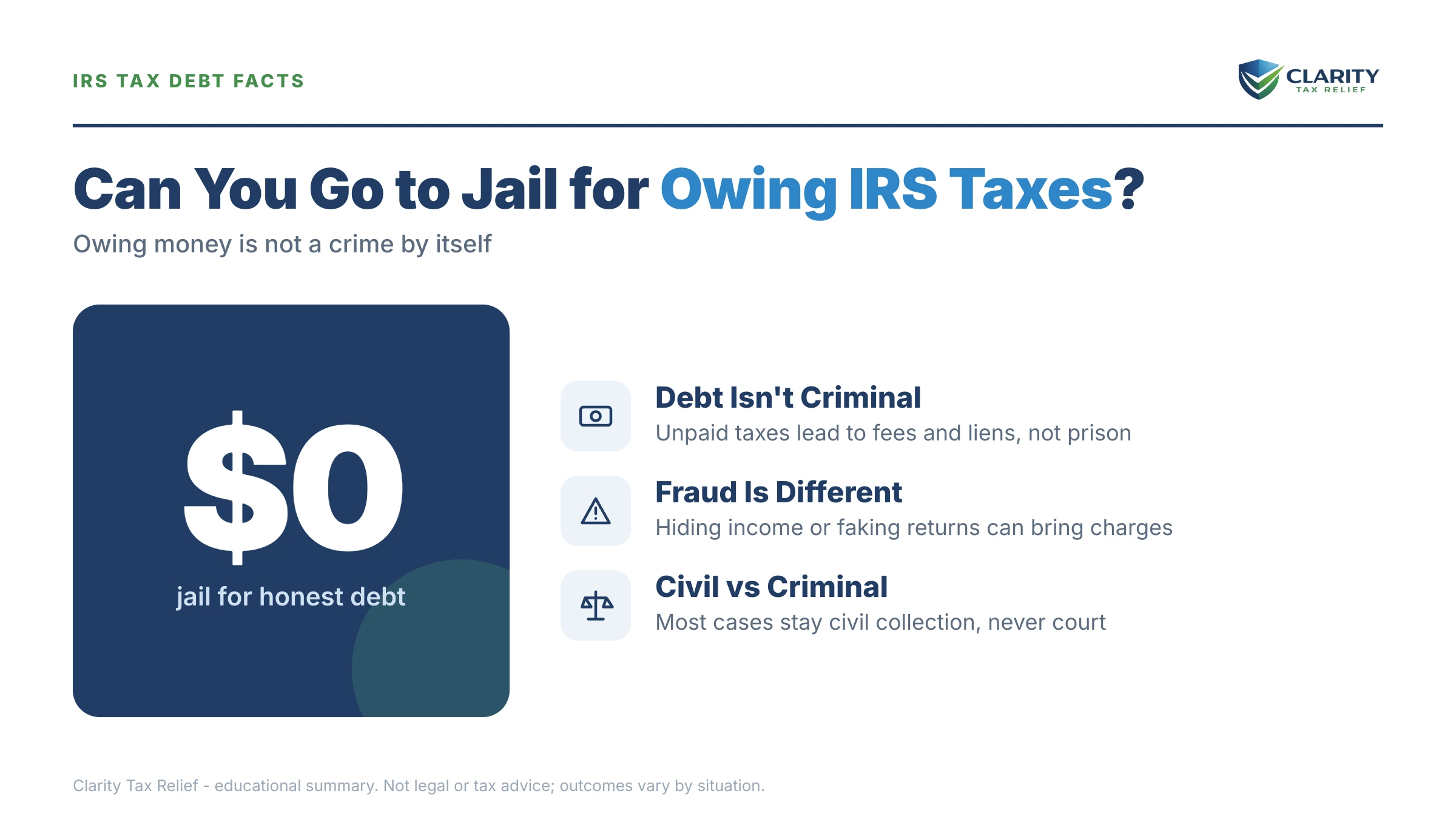
The short answer: no — you cannot go to jail for owing the IRS. Tax debt is a civil matter, collected through liens, levies, and garnishments, never handcuffs. Jail requires a criminal conviction for willful conduct: hiding income, filing false returns, or deliberately refusing to file. Owing money, even a lot of it, is not a crime.
It's late, the balance is staring back at you from a notice or an IRS login screen, and you typed the question you were half-afraid to ask out loud: can you go to jail for owing IRS money? Take a breath — the honest legal answer is on your side. The debt is a math problem, not a criminal charge, and every path to fixing it is still open.
This guide draws the exact line between the civil side (where you almost certainly are) and the criminal side (where prosecutors live), then walks through what the IRS actually does to collect and every realistic way to resolve the balance itself.
⏱ The real clock: there is no jail clock on a tax debt — but there is a money clock. The failure-to-pay penalty adds 0.5% of your unpaid balance every month, interest compounds on top, and the IRS's automated notice sequence escalates toward liens and levies on its own schedule. The sooner you pick a resolution, the less this costs.
Can you go to jail for owing the IRS? What the law actually says
Owing the IRS is a civil debt, and no amount of civil tax debt — $13,600 or $13 million — can put you in jail. The United States abolished debtors' prisons long ago, and the tax code follows that rule: every collection tool Congress gave the IRS for unpaid balances is financial. The agency can file a lien against your property, levy a bank account, garnish wages, and take refunds. It cannot arrest you for a balance due.
Jail exists in the tax system only for crimes, and tax crimes all share one element the government must prove beyond a reasonable doubt: willfulness — a voluntary, intentional violation of a known legal duty. Filing an honest return and being unable to pay it is the opposite of willful deception. You told the government the truth; you just don't have the money. That is a collections case, full stop.
This matters practically, not just legally. It means the scary scenarios in your head — police at the door, a warrant with your name on it — are not on any path the IRS is running against a person who filed and owes. What is on the path is a sequence of notices and, eventually, levies. Those are serious and worth acting on. They are not jail.
What actually crosses the criminal line
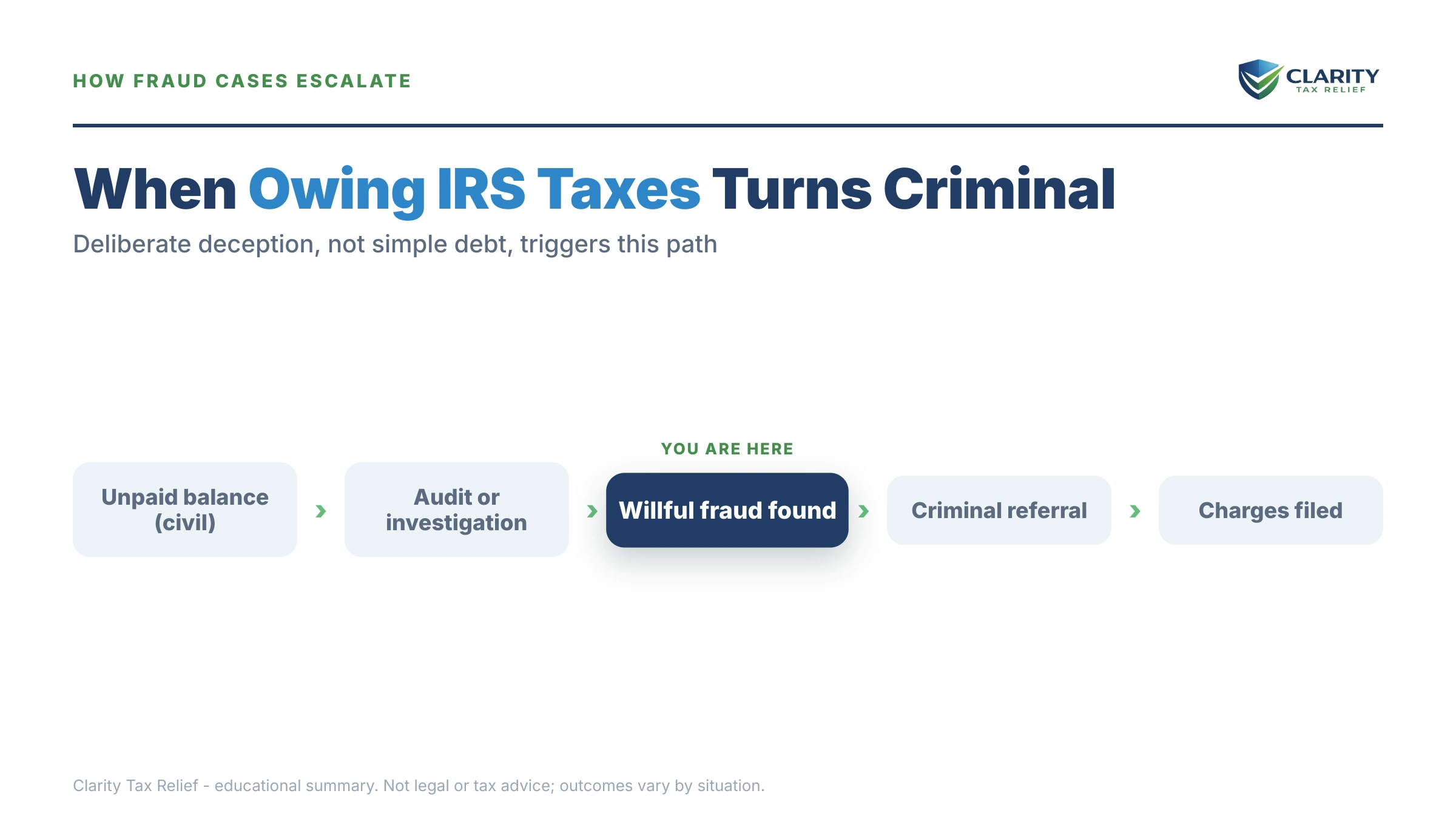
Criminal tax cases punish deception and defiance, never inability to pay. Three federal statutes do almost all the work:
- Tax evasion (IRC §7201) — a felony, punishable by up to five years in prison. Evasion requires an affirmative act of deceit: hiding income in someone else's name, keeping two sets of books, dealing in cash specifically to conceal it, or lying to investigators.
- Filing a false return (IRC §7206) — a felony for signing a return you know is materially false, such as invented deductions or omitted income you knew about.
- Willful failure to file (IRC §7203) — a misdemeanor, up to one year per unfiled year. This is the one everyday behavior with criminal exposure, which is why can you go to jail for not filing taxes gets a different, more nuanced answer than owing does.
Notice what is missing from that list: "owed a balance and couldn't pay it." There is no statute for that, which is the whole answer to can you go to jail for not paying taxes — non-payment alone is never a crime; non-payment plus concealment can be.
Criminal referrals are also genuinely rare. They run through a separate division — IRS criminal investigation — whose special agents pursue fraud cases, not balance-due accounts. If you want the honest breakdown of what tips a civil case over, see when does the IRS refer a case to criminal investigation. For a couple who filed a truthful joint return and owes $13,600, the realistic odds of criminal interest are zero.
| Your situation | Civil or criminal? | Jail exposure |
|---|---|---|
| Filed an accurate return, can't pay the balance | Civil only | None — collections case (plans, hardship, settlement) |
| Ignored every IRS notice about the debt | Civil only | None — but liens, levies, and garnishment become likely |
| Didn't file for a year or two, no intent to hide anything | Civil in practice | Minimal if you file voluntarily; penalties instead of prosecution |
| Willfully refused to file for years despite large income | Potentially criminal (§7203) | Real — up to 1 year per unfiled year in prosecuted cases |
| Hid income, faked deductions, or lied to the IRS | Criminal (§7201 / §7206) | Real — felony exposure up to 5 years |
| Withheld payroll taxes from employees and repeatedly spent them | Civil TFRP, criminal in egregious cases | Possible when "pyramiding" continues after warnings |
Three situations that change the risk picture
Married filing jointly. A joint balance makes both spouses civilly liable for the full debt — but criminal liability is always personal. If one spouse secretly ran unreported side income through the return, only the spouse who acted willfully has criminal exposure, and the other may be able to shed the civil debt too through innocent spouse relief. Signing a joint return you believed was honest does not make you a co-defendant.
Self-employed with cash income. The line here is reporting. A contractor who reports the cash and can't pay the self-employment tax is a civil case. A contractor who systematically deposits cash off the books to keep it off the return has committed the affirmative act evasion requires. Same money, opposite legal worlds.
Business owners with payroll debt. Withheld payroll taxes are your employees' money held in trust, so the government treats them differently from your own income tax. Unpaid 941 balances trigger the trust fund recovery penalty personally — still civil — but repeatedly collecting withholding and spending it quarter after quarter is the pattern most likely to draw criminal attention among ordinary business owners.
What happens if you ignore the debt: money moves, not handcuffs
Ignoring an IRS balance triggers an automated escalation of financial enforcement — and no stage of it includes arrest. Here is the sequence for a typical unpaid balance, using only the fixed windows the law actually sets:
- CP14 — the first bill. You have roughly 21 days from the notice date before the sequence moves.
- CP501 / CP503 — reminders. Still just bills, but the 0.5% monthly penalty and daily-compounding interest are running.
- CP504 — intent to levy. The IRS can now seize your state tax refund, and a federal tax lien becomes realistic. A recorded lien is why questions like can I buy a house if I owe the IRS get complicated at this stage.
- LT11 / Letter 1058 — final notice. A 30-day clock starts, along with your Collection Due Process appeal rights (Form 12153). After it runs, the IRS can levy.
- Active levies. A bank levy freezes funds for a 21-day hold before the money leaves; a wage levy is continuous until released; Social Security can be levied up to 15% under the Federal Payment Levy Program. Above $66,000 (the 2026 threshold), the IRS can also certify the debt to the State Department and block your passport.
Two clarifications people search for at this stage. First, the IRS does not suspend your driver's license — that's a state weapon in a few states, covered in can the IRS take my license. Second, 2026's IRS staffing cuts (roughly 27% of the workforce in 2025) haven't slowed any of this down, because the notice-and-levy machine is automated. The humans got harder to reach; the escalation didn't. The full map is in the IRS collection process step by step.
Worried about where your balance is headed?
You're not going to jail for owing — but penalties and interest are compounding every month you wait, and the notice sequence doesn't pause itself. Get a free case review from an experienced tax professional and know exactly which resolution fits your numbers before the next notice arrives.
Your real options for the debt itself
Every IRS balance has at least four legitimate resolution paths, and none of them requires perfection — just picking the one your finances support. (For the full DIY playbook on each program, see how to settle tax debt yourself; here's how they map to a typical balance.)
| Option | Who's eligible | Cost to set up | What it does |
|---|---|---|---|
| Short-term payment plan | Anyone who can pay in full within 180 days | $0 setup fee | Buys time; enforcement stops while penalties/interest continue |
| Guaranteed installment agreement | Individuals only, with an income-tax balance of $10,000 or less (excluding penalties and interest), all returns filed, timely filing and payment for the past 5 years with no installment agreement in that period, and full payment within 3 years | Setup fee applies (reduced for direct debit) | The IRS must accept it — but a $13,600 balance is over the line |
| Streamlined installment agreement | Up to $25,000 — or $50,000 with direct debit — over up to 72 months, set up online | Setup fee applies (waived or reduced for low income / direct debit) | Monthly payments with no detailed financial disclosure |
| Currently Not Collectible | Paying would prevent covering basic living expenses (financial disclosure required) | $0 | Pauses collection; debt and interest remain, CSED keeps running |
| Offer in Compromise | Assets + future income genuinely can't cover the debt; IRS accepted roughly 1 in 5 offers in FY2024 | $205 fee + 20% down on lump-sum offers (both waived with low-income certification) | Settles for less than the full balance when the math qualifies |
| Penalty abatement | Clean compliance for prior 3 years (FTA) or reasonable cause; AEP begins automating some relief in summer 2026 | $0 | Removes penalties; the underlying tax and interest remain |
A worked example: a couple owing $13,600
Say you and your spouse filed a truthful joint return and owe $13,600 you can't pay — an underwithholding year, a side-business surprise, whatever caused it. Because you filed on time, there's no 5%-per-month failure-to-file penalty; you're facing only the 0.5% monthly failure-to-pay penalty — about $68 a month at the start — plus compounding interest.
At $13,600 you're above the $10,000 guaranteed installment agreement ceiling but comfortably inside streamlined installment agreement territory. Stretched across the maximum 72 months, the minimum payment works out to roughly $13,600 ÷ 72 ≈ $189 a month before accruing interest and penalties — though paying, say, $350 a month clears it in well under four years and cuts the total interest substantially. You can estimate how much the penalties and interest add over your payoff window with our Penalty & Interest Calculator.
If a job loss meant even $189 was impossible, the same couple could request currently not collectible status and pause collection entirely. And if this is their first slip after years of clean filing, first-time penalty abatement may remove the failure-to-pay penalties that have posted — with the new Automatic Exemption from Penalty starting to apply some of that relief automatically from summer 2026.
How to respond to IRS tax debt, step by step
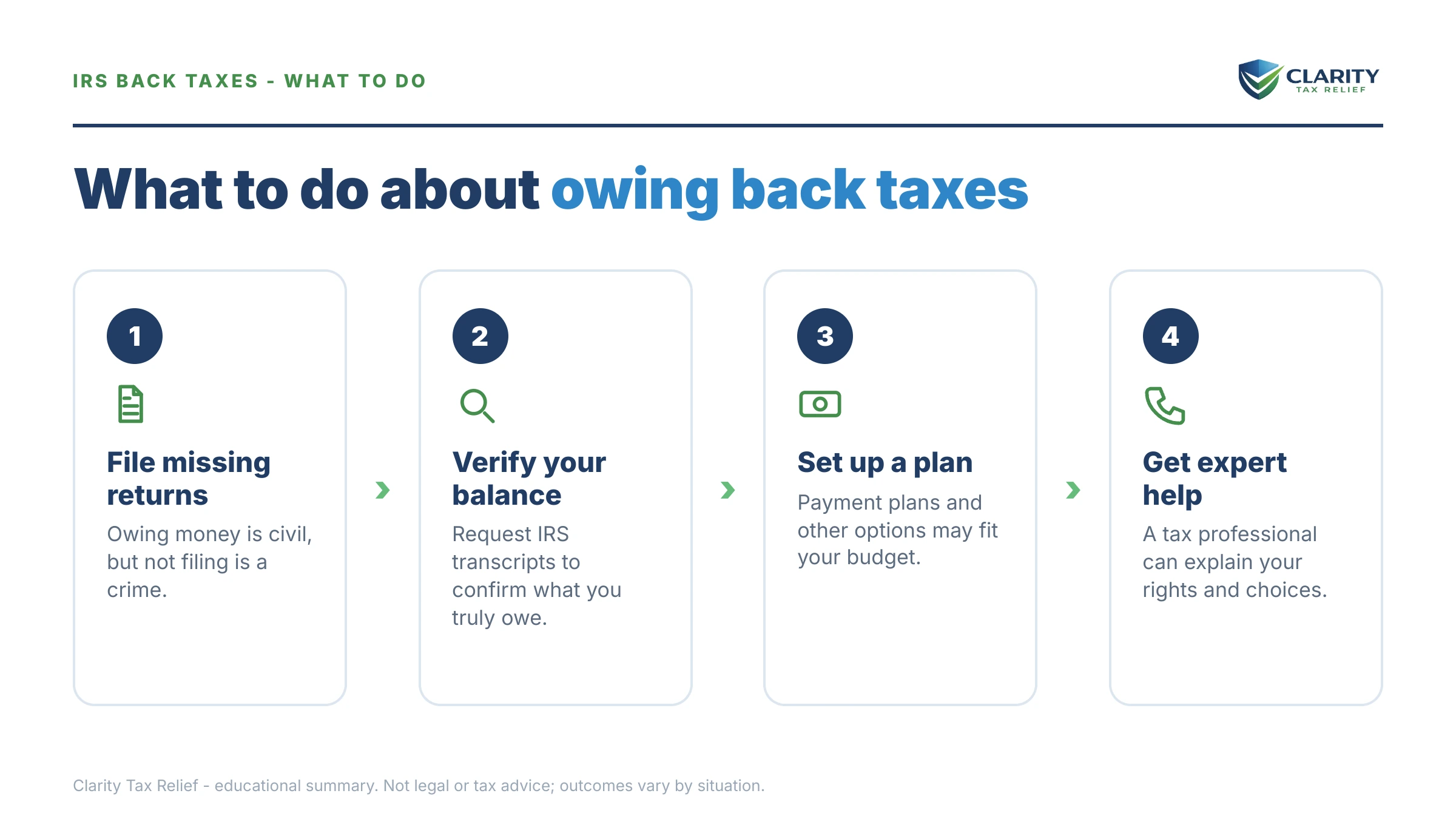
- Confirm every required return is filed. Filing is what separates civil debt from potential criminal exposure. If you have unfiled years, file them voluntarily before the IRS contacts you — the IRS generally wants the last six years.
- Verify the balance in your IRS online account. Log in at IRS.gov and confirm what you owe by year, including penalties and interest, before choosing a plan. Notices and payments cross in the mail; the online account is the current number.
- Choose a resolution track that fits your numbers. Pay within 180 days with no setup fee, set up a streamlined installment agreement online for balances up to $50,000, or request hardship status if paying would leave you unable to cover basic living expenses.
- Request penalty relief. If you were compliant for the prior three years, first-time abatement can remove penalties — and starting summer 2026, the IRS's Automatic Exemption from Penalty applies some relief with no request at all.
- Get experienced help if any criminal-exposure fact exists. Unfiled years plus unreported income, payroll taxes you withheld and spent, or contact from IRS Criminal Investigation are the situations where an experienced tax professional changes the outcome. Stop explaining yourself to the IRS and get representation first.
When you can handle this yourself — and when help changes the outcome
Most people asking this question can resolve their situation without hiring anyone. If your returns are filed, the balance is accurate, and you can manage a monthly payment, the online payment plan takes about twenty minutes to set up — a $13,600 streamlined agreement is squarely DIY territory. Same if you can pay in full within 180 days: just do it and request penalty abatement afterward.
Experienced help earns its cost in a narrower set of situations: multiple unfiled years combined with income the IRS doesn't know about, a business payroll balance where personal trust-fund liability is being assessed, a levy already in motion against your paycheck or bank account, an Offer in Compromise where the asset-and-income math decides everything, or any contact — a card, a visit, a letter — from IRS Criminal Investigation. In that last case especially, say nothing of substance and get representation before responding; well-meaning explanations are how civil problems become criminal exhibits.
Terms in this question, decoded
- Willfulness — the intent element of every tax crime: voluntarily and intentionally violating a legal duty you knew about, not forgetting, misunderstanding, or being broke.
- Tax evasion — the felony (IRC §7201) of using an affirmative act of deception to defeat a tax; owing without deceiving is never evasion.
- IRS Criminal Investigation (CI/CID) — the separate IRS division whose special agents build criminal fraud cases; regular collection employees have no arrest authority.
- Civil fraud penalty — a steep money penalty the IRS can add for fraudulent conduct in cases it handles civilly instead of prosecuting; expensive, but not jail.
- Levy vs. lien — a lien is a legal claim recorded against your property; a levy is the actual taking of money or assets. Both are financial tools, neither involves custody.
- CSED — the Collection Statute Expiration Date: the IRS generally has 10 years from assessment to collect, though appeals, offers, and bankruptcy pause the clock.
Jail-for-tax-debt questions, answered
Can you go to jail for owing the IRS money?
No. Owing the IRS is a civil debt, and the government cannot jail you for a civil debt — there is no debtors' prison for taxes. Jail requires a criminal conviction for willful conduct like tax evasion or filing a false return, which the government must prove beyond a reasonable doubt. The size of your balance never converts honest debt into a crime.
How much do you have to owe the IRS before you go to jail?
There is no dollar amount that triggers jail, because jail is about conduct, not the balance. Someone who honestly reports $500,000 they cannot pay faces only civil collection, while someone who deliberately hides $15,000 of income can face felony charges. What owing more does change is civil enforcement: at $66,000 in 2026, the IRS can certify your debt to the State Department and block your passport.
Can you go to jail for not filing taxes?
Yes, in rare willful cases — willful failure to file is a misdemeanor carrying up to one year in jail per unfiled year, and it is the most common way ordinary people create criminal exposure. Prosecution is reserved for deliberate, usually multi-year refusals, often with large income. Filing your late returns voluntarily, before the IRS contacts you, is the strongest protection available.
Will the IRS come to my house and arrest me?
No. The IRS contacts taxpayers about unpaid balances by mail, and civil employees like revenue officers have no arrest powers. Only special agents from IRS Criminal Investigation handle criminal cases, they identify themselves with badges, and they investigate fraud — not people who simply owe. Anyone calling to threaten arrest over a tax debt unless you pay immediately is a scammer.
Can my spouse go to jail for our joint tax debt?
No — a joint balance is a civil debt for both of you, and neither spouse faces jail for owing it. Criminal liability is personal: it requires that individual's own willful conduct, so one spouse's hidden income does not criminalize the other. If your spouse concealed income from you on a joint return, innocent spouse relief may remove your share of the civil debt too.
Does IRS debt ever go away if you can't pay?
Yes — the IRS generally has 10 years from assessment to collect, after which the remaining balance expires. But that clock pauses during offers in compromise, bankruptcy, and certain appeals, so it often runs longer than 10 calendar years. Meanwhile, currently not collectible status can pause collection during genuine hardship, and an offer in compromise can settle the debt when your finances qualify.
Should I still file my return if I can't pay what I owe?
Yes, always file. The failure-to-file penalty is 5% of the unpaid tax per month — ten times the 0.5% failure-to-pay penalty — so filing without paying saves you 90% of the penalty cost. Filing on time also keeps you cleanly on the civil side of the line, since willful failure to file is the one everyday behavior Congress made a crime.
Your next 24 hours
- Check your filing status. Confirm every year's return is actually filed — pull up your IRS online account or your records. Filed-and-owing is a purely civil problem; that fact alone should let you sleep tonight.
- Gather three things: your most recent tax return, any IRS notices you've received, and a rough picture of monthly household income and expenses. That's everything needed to choose between a plan, hardship status, or settlement.
- Get a free case review. Call (888) 825-7779 or use the 2-minute form and an experienced tax professional will map your balance to the right resolution — before another month of penalties and interest posts to the account.
For the IRS's own program details, see the official IRS payment plans and installment agreements page, the IRS payments hub, and — if collection action is causing genuine hardship — the independent Taxpayer Advocate Service.
This guide is general information, not tax or legal advice for your specific situation. Eligibility for IRS programs depends on individual facts and circumstances; no outcome is guaranteed.