
IRS Collections
Can the IRS Take My License? Driver's, CDL, and Professional License Rules for 2026
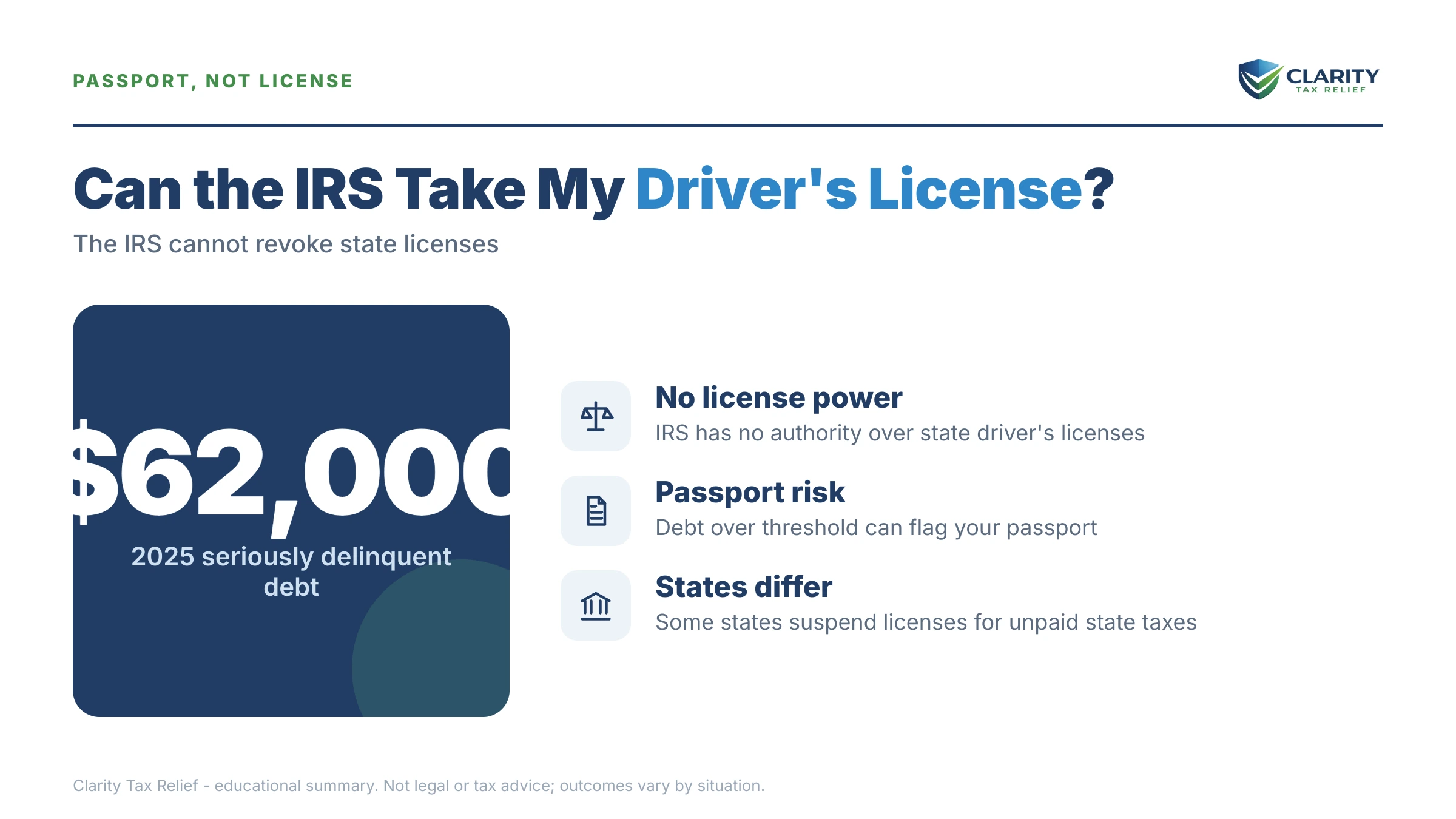
The short answer: if you're asking "can the IRS take my license," the answer is no. The IRS cannot take, suspend, or revoke a driver's license, CDL, or professional license — no federal law gives it that power. Two real exceptions: your state tax agency can suspend licenses over state tax debt, and the IRS can trigger passport revocation once federal debt passes $66,000.
You drive for a living, you have three tax years you never filed, and somewhere between the IRS envelopes and a late-night search you started wondering whether the government can pull the one card in your wallet that pays your rent. It can't — not the federal government, anyway. This guide maps exactly who can touch which license, where the $66,000 passport line sits, and how to close out the debt before the things the IRS can take come into play.
⏱ The clock that actually matters: there is no license deadline on IRS debt — but with unfiled returns, the failure-to-file penalty grows at 5% per month (up to 25% per year), interest compounds on top, and once your assessed balance crosses $66,000 the IRS can certify you for passport denial or revocation. Every month of waiting raises the price of the fix.
Can the IRS take your driver's license? The straight federal answer
The IRS has no legal authority to take, suspend, or revoke any state-issued license — driver's, commercial, or professional. Licenses are issued by state DMVs and state licensing boards, and the federal tax code gives the IRS power over your money and property: liens, levies on bank accounts and pay, and refund offsets. A license is not property the IRS can levy — there is no form, notice, or program by which the IRS reaches into a state licensing system.
So where does the fear come from? Two real programs get blended together in search results and word of mouth: state tax agencies that suspend licenses for state tax debt, and the IRS passport-certification program, which touches exactly one document — and it isn't in your wallet. The table below separates every credential people worry about.
| License or credential | Can the IRS take it? | Can your state take it? | The actual trigger |
|---|---|---|---|
| Driver's license | No — no federal authority exists | Yes, in some states | State tax debt (e.g., $10,000+ in New York) |
| CDL (commercial) | No | Yes — same state rules as any driver's license | State tax debt, never IRS debt |
| Professional / occupational license | No | Yes, in states that tie licensing to tax compliance | State tax delinquency (e.g., California's Top 500 list) |
| Vehicle registration | No | Yes, in some states (e.g., California FTB DMV holds) | State tax debt |
| U.S. passport | Yes — via State Department certification | No | Federal tax debt over $66,000 (2026 threshold) |
The one license the IRS can take: your U.S. passport
The IRS can trigger denial or revocation of your U.S. passport once your federal tax debt is legally "seriously delinquent" — over $66,000 for 2026, with a lien filed or levy issued. When that happens, the IRS certifies your debt to the State Department and mails you Notice CP508C. The State Department then denies new applications and renewals and can revoke the passport you hold. Our CP508C notice guide covers what that letter looks like line by line, and the passport revoked for tax debt article covers reversing a certification.
Just as important is what blocks certification: debt in an active installment agreement, a pending Offer in Compromise, or a timely collection due process hearing is not certified. In other words, the same payment arrangement that stops levies also fences off your passport. A $23,800 balance is well under the line today — but three more unfiled years of penalties and interest can close that gap faster than most people expect.
When your state — not the IRS — can suspend a license for tax debt
Every license-suspension-for-taxes program in the country is a state program aimed at state tax debt. The two most aggressive are worth knowing even if you live elsewhere, because they are what most "IRS took my license" stories actually describe:
- New York suspends driver's licenses once state tax debt reaches $10,000, working through the DMV. Our guide to NYS driver's license suspension for tax debt covers the warning letters and how to stop it; the program is run by the state tax department (tax.ny.gov), not the IRS.
- California publishes a list of its largest delinquent taxpayers and can suspend occupational, professional, and driver's licenses for people on it. See FTB license suspension and the FTB Top 500 delinquent list; California can also place FTB DMV registration holds. Details and thresholds live with the Franchise Tax Board (ftb.ca.gov).
Other states run their own versions with their own thresholds and appeal windows — if you owe your state, check directly with that agency rather than assuming IRS rules apply. The practical takeaway: federal tax debt alone has never suspended a driver's license in any state. If your only balance is with the IRS, your license is not the thing at risk. Your income is.
What the IRS takes instead: the real escalation for a gig worker with unfiled years
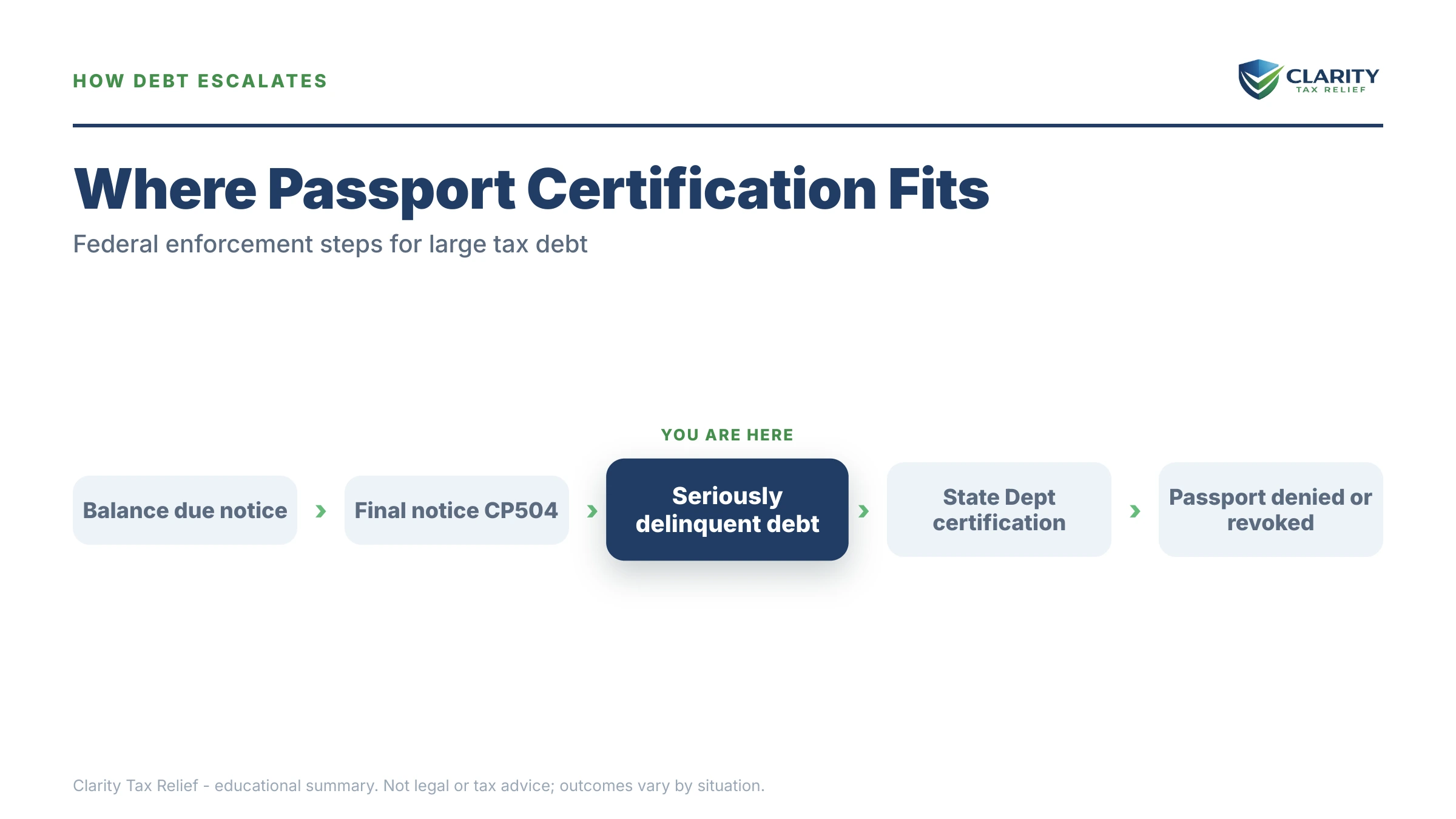
When returns go unfiled and a balance goes unpaid, the IRS escalates against your money — in a fixed, automated sequence that never includes a license at any stage:
- CP59 — "you didn't file." One notice per missing year. No enforcement yet, but the non-filer file is now open.
- Substitute for Return (SFR). The IRS builds a return from your 1099s with zero mileage, zero expenses, and single filing status, then proposes tax on that inflated number through a CP3219N 90-day letter. Our guide to the IRS filing a substitute return for you explains why the SFR number is almost always worse than the truth.
- Assessment and the first bill (CP14). Once assessed, the balance is collectible. A CP14 typically gives about 21 days before the reminder sequence begins.
- CP504 — intent to levy your state refund. The IRS can now take your state tax refund, and a federal tax lien becomes likely.
- LT11 / Letter 1058 — final notice. After 30 days, the IRS can levy bank accounts (a bank holds seized funds 21 days before sending them) and serve levies on the platforms that pay you. Because gig pay is contractor pay, that levy grabs whatever the platform owes you when it lands — see can the IRS garnish 1099 income.
- Passport certification (CP508C). If the assessed balance crosses $66,000, the State Department can deny or revoke your passport. Even here — the final stage — no driver's license action ever appears.
One 2026 reality check: IRS staffing fell roughly 27% in 2025, so reaching a human is harder than ever — but every step above is generated by automated systems that never stopped running. The sequence advances whether or not anyone at the IRS reads your file.
Unfiled years and a growing balance behind that license fear?
Your license is safe from the IRS — your bank account and platform pay are not, and the failure-to-file penalty compounds at 5% a month until those returns are in. Get your unfiled years and balance reviewed free by an experienced tax professional before the automated sequence reaches the levy stage.
Your options once the returns are filed
Every IRS resolution program requires filed returns first — the IRS will not approve a payment plan or an offer with open non-filer years. Once your returns are in, the balance itself has several exits; the shared mechanics of each program are covered in our guide to how to settle tax debt yourself, so here's how each one lines up against a mid-five-figure gig balance:
| Option | Who qualifies | Upfront cost | Typical timeline |
|---|---|---|---|
| Short-term payment plan | Can pay in full within 180 days; all returns filed | $0 setup fee | Up to 180 days |
| Streamlined installment agreement | Balance ≤ $25,000 (≤ $50,000 with direct debit); all returns filed | Setup fee varies (lowest online with direct debit) | Up to 72 months |
| Currently Not Collectible | Paying would leave you unable to cover basic living expenses (Form 433-F review) | $0 | Until finances improve; IRS reviews periodically |
| Offer in Compromise | Assets plus future income genuinely can't cover the full debt | $205 fee + 20% down on lump-sum offers (both waived with low-income certification) | Months to 2 years (auto-accepted if the IRS doesn't decide within 2 years, with narrow exceptions — a returned or rejected offer stops the clock, and time during court disputes does not count) |
| Penalty relief (FTA / AEP) | Clean compliance for the prior 3 years, or qualifying reasonable cause | $0 | Weeks to a few months |
Two notes on that last row: First-Time Penalty Abatement is being replaced by the Automatic Exemption from Penalty (AEP) starting summer 2026, which applies automatically with no request needed — so don't assume a formal abatement letter is your only path. And with three unfiled years, the failure-to-file penalty is usually the single largest removable chunk of the balance.
The math on $23,800, worked out
Say the tax itself across your three unfiled gig years is $23,800. Because none of those returns were filed, the failure-to-file penalty has likely maxed out at 25% on each year — roughly $5,950 (25% × $23,800) — plus the 0.5%-per-month failure-to-pay penalty and compounding interest. Call the realistic assessed total about $31,000. You can estimate your own figure with our IRS penalty and interest calculator.
At $31,000, you're over the $25,000 streamlined ceiling — but under the $50,000 direct-debit ceiling, so a 72-month direct-debit agreement works out to roughly $431 a month ($31,000 ÷ 72), with interest and penalties still accruing on the shrinking balance. Two moves change that number: filing the returns with real mileage and expense deductions can cut the base tax before it's ever assessed, and penalty abatement on the failure-to-file portion could pull the total back under $25,000 — where a plan needs no financial disclosure at all. This is a hypothetical, not a promise; your figures depend on your income, deductions, and dates.
If gig income barely covers rent and there's no equity anywhere, an Offer in Compromise or Currently Not Collectible status may fit better than any monthly plan — but the IRS accepted roughly 1 in 5 offers in FY2024, so the math has to genuinely support it before you spend anything pursuing one.
How to protect your license and fix the debt, step by step
- Pull your IRS wage and income transcripts. They show every 1099 the platforms reported for your unfiled years, so the returns you file match what the IRS already has on record.
- File the missing returns with real deductions. Mileage and expenses can cut a gig balance sharply, and filing stops the 5%-per-month failure-to-file penalty from growing.
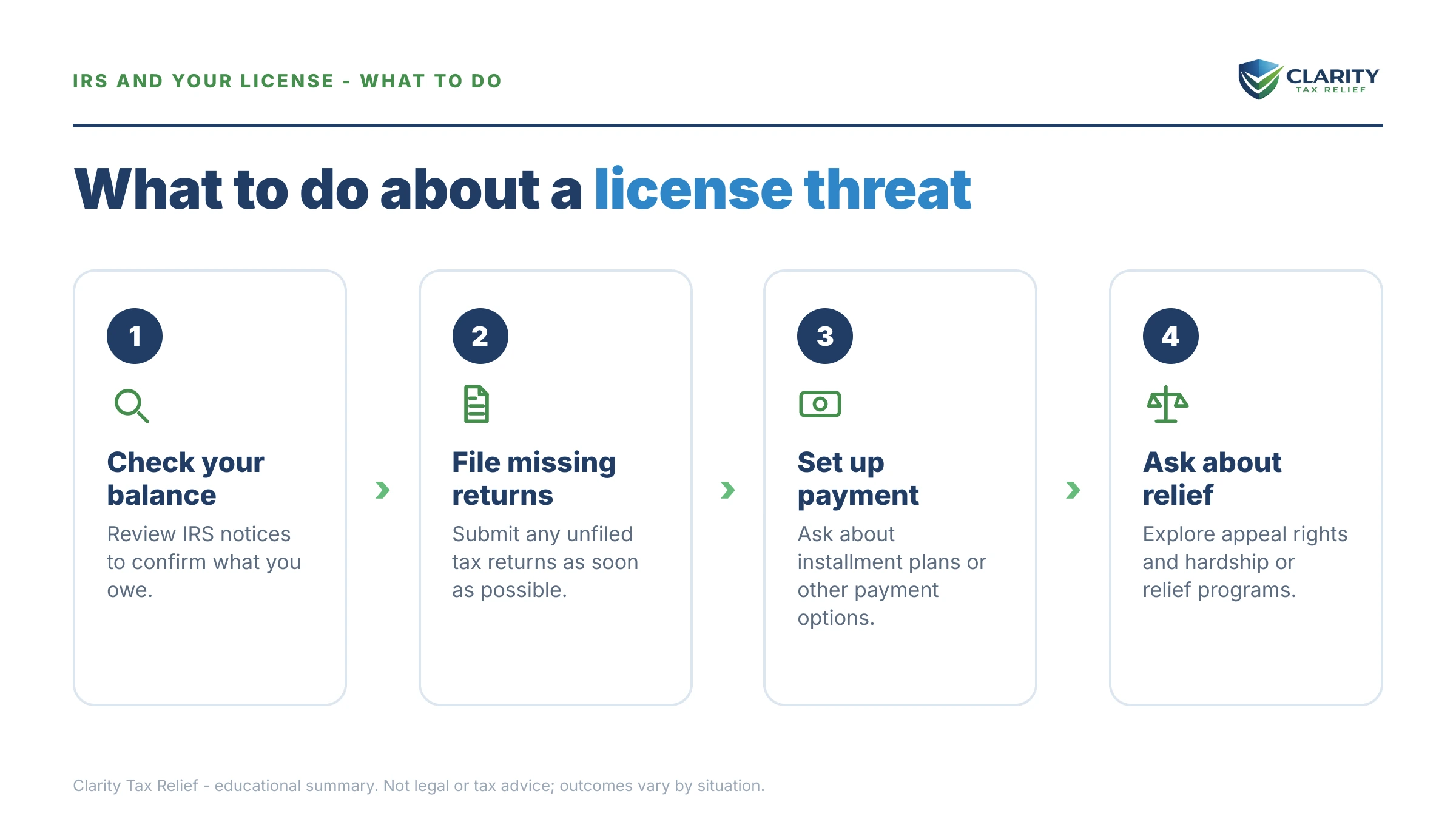
- Check your state tax account. State debt — not IRS debt — is what actually suspends licenses, so confirm your state balance is zero or already in a plan.
- Set up a payment arrangement. Choose a short-term plan, a streamlined installment agreement (Form 9465 or online), Currently Not Collectible status, or an Offer in Compromise based on what your budget honestly supports.
- Watch the $66,000 passport line. A balance covered by an active agreement is not certified as seriously delinquent, so getting into a plan protects your passport too.
When you can handle this yourself — and when help changes the outcome
If you have one missing year, records in hand, and a balance you could clear inside 180 days, you don't need to hire anyone: file the return, set up a plan directly on the IRS payment plans page, and you're done. Balances under $10,000 with filed returns generally fit the guaranteed installment agreement, which the IRS must accept when its conditions are met. If money is the obstacle, the Taxpayer Advocate Service and low-income taxpayer clinics offer free help.
Experienced help earns its cost in the harder versions of this situation: three or more unfiled years, especially when an SFR has already been assessed and needs to be replaced with a correct return; a levy already served on your bank or platform pay; a state license action already in motion alongside the IRS debt; or offer-in-compromise math with irregular gig income, where a miscalculated offer wastes months. Our guide to not having filed taxes in 3 years walks the filing catch-up in detail.
Terms behind license and passport actions, decoded
- Seriously delinquent tax debt — the legal label ($66,000+ for 2026, with a lien filed or levy issued) that lets the IRS certify you for passport action.
- Certification (CP508C) — the IRS's formal notice to the State Department, and to you, that your debt has crossed that line.
- Levy — a seizure of money or property; the IRS's real enforcement tool. It reaches bank accounts and pay, never state-issued credentials.
- Substitute for Return (SFR) — the return the IRS files for you with no deductions when you don't file, which is why unfiled gig years produce inflated balances.
- CSED — the 10-year collection clock that starts at assessment. On unfiled years, nothing has been assessed, so that clock hasn't even started running.
Can the IRS take my license? More questions, answered
Can the IRS suspend your driver's license for unpaid taxes?
No — the IRS has no authority over any state-issued license, and no federal tax law allows a driver's license suspension for IRS debt. State tax agencies are the real risk: New York suspends driver's licenses once state tax debt reaches $10,000, and California can suspend licenses for taxpayers on its Top 500 delinquent list. Federal debt alone never triggers either program.
Can the IRS take a CDL or commercial driver's license?
No. A CDL is issued by your state, and the IRS cannot suspend, revoke, or place a hold on it for federal tax debt. What the IRS can do is levy the pay behind the license — a levy served on a carrier or platform that pays you as a contractor grabs the money owed to you at that moment. Your credential stays valid; your income is the target.
Can the IRS take away a professional or occupational license?
It cannot. Nursing, real estate, contractor, cosmetology, and bar licenses are all state-issued, and federal tax debt gives the IRS no power over them. Several states, however, tie professional licenses to state tax compliance — California's FTB, for example, can suspend occupational licenses for its largest delinquent taxpayers. If you hold a state license and owe state tax, resolve that balance first.
Can the IRS stop me from driving for Uber, DoorDash, or Lyft?
The IRS cannot deactivate your account or touch the license you drive on. It can serve a levy on the platform, which seizes the contractor pay the company owes you on the day the levy hits — a one-time grab, not a continuous garnishment. Setting up any payment agreement, even a modest monthly plan, stops levies while it's active.
At what point does the IRS take your passport?
Once your assessed federal tax debt tops $66,000 (the 2026 inflation-adjusted threshold) and is legally 'seriously delinquent,' the IRS certifies you to the State Department, which can deny renewal or revoke the passport. You'll receive Notice CP508C when that happens. Debt covered by an installment agreement, a pending Offer in Compromise, or a timely collection due process hearing is not certified.
Do unfiled tax returns affect your driver's license?
Not directly — no state or federal agency suspends a driver's license because returns are missing. The danger is indirect: if you don't file, the IRS eventually files a substitute return with no deductions, assesses an inflated balance, and starts collection on it. For a gig driver, that means levies on bank accounts and platform pay, and a faster climb toward the $66,000 passport threshold.
Can the IRS take my car instead of my license?
Legally yes, practically rarely. The IRS can seize vehicles, but it almost never does when the car has little equity after loans, is needed to produce income, or when a payment arrangement is available. Seizures require multiple notices and internal approvals first. If you drive for a living, getting into any agreement before the final levy notice keeps both the car and the income safe.
Your next 24 hours
- Find your real numbers. Log into your IRS online account (or pull your account transcripts) and write down what — if anything — has been assessed for each of your three unfiled years, and check whether your state shows a balance too.
- Gather your income records. Collect your 1099s, platform annual summaries, mileage logs, and bank statements for the unfiled years — these are what turn an inflated SFR number back into the tax you actually owe.
- Get the free case review. Send us what you found — the 2-minute form or (888) 825-7779 — and an experienced tax professional will map the filing catch-up and the resolution that fits your budget, before another month of 5% failure-to-file penalty stacks on.
This guide is general information, not tax or legal advice for your specific situation. Eligibility for IRS programs depends on individual facts and circumstances; no outcome is guaranteed.