
California FTB
FTB License Suspension: Who Actually Loses a License Over California Tax Debt (2026)
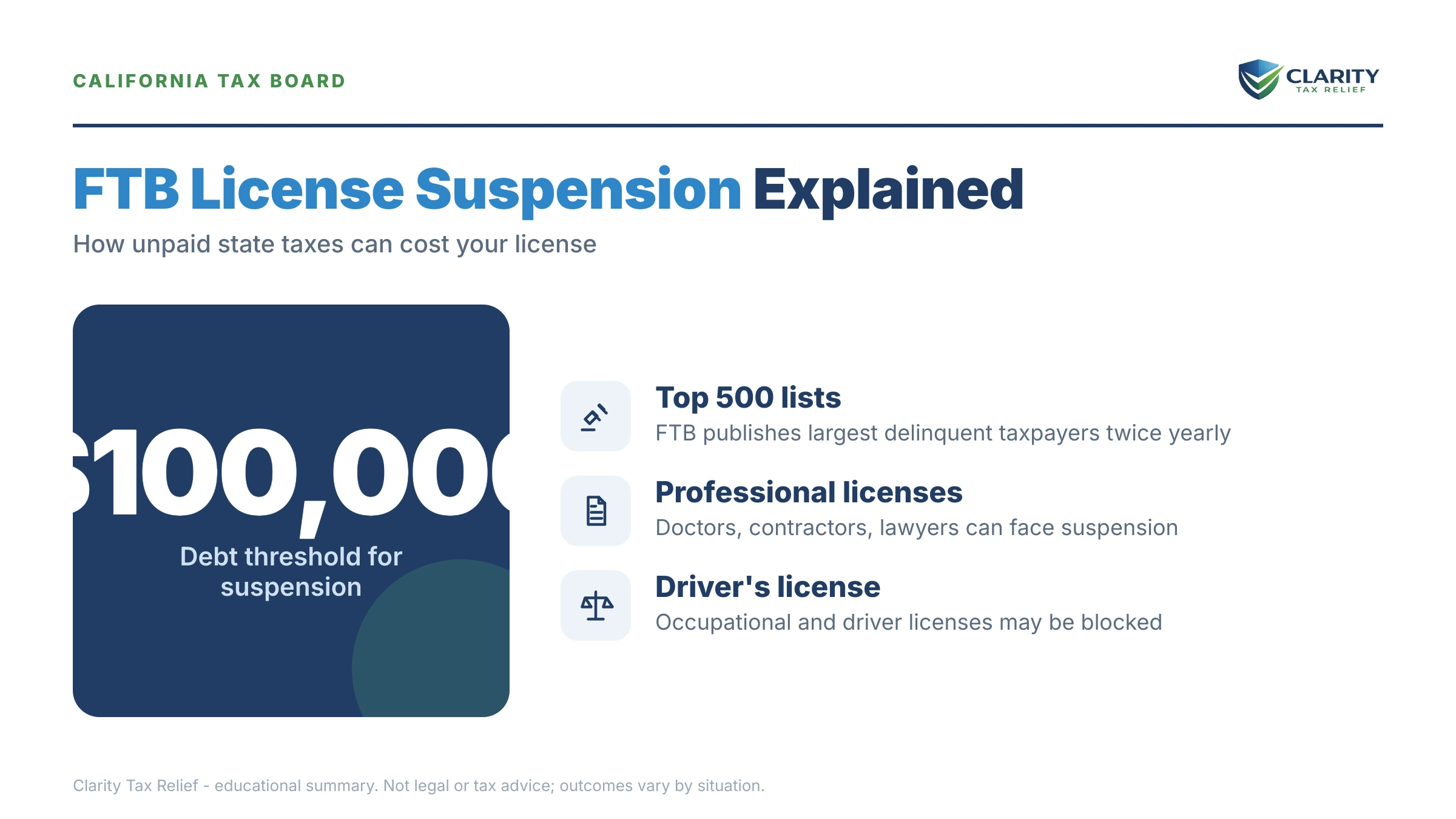
The short answer: FTB license suspension applies only to taxpayers on California's Top 500 Delinquent Taxpayers list — debts over $100,000. If you received the certified warning letter, the state can suspend your driver's license and professional licenses until the FTB issues a release. Below $100,000, your license is safe, but bank levies and wage garnishment are not.
You're self-employed in California, you owe the Franchise Tax Board money you can't pay today, and somewhere you read the state can take the driver's license or contractor's license your income depends on. For most people, that fear is bigger than the law actually reaches.
Here's the map: exactly who gets suspended, the one letter that starts the clock, and every way to stop it — or reverse it if it's already happened. The image below shows what the FTB's warning letter looks like and where to find the two things that matter most: your total balance and the date you must act by.
⏱ Your deadline: the respond-by date printed on the FTB's certified warning letter — typically about 30 days before the next Top 500 list is published. Resolve the balance or start an approved payment arrangement before that date, and your name never reaches the list — and your licenses never enter the process.
Why the FTB is threatening your license
The FTB can only suspend licenses through one program: the Top 500 Delinquent Taxpayers list, reserved for California tax debts over $100,000. There is no license suspension for ordinary balances — the FTB has plenty of collection tools, but this one is deliberately narrow.
Here's the legal chain. Roughly twice a year, the FTB publishes a public list of the state's 500 largest delinquent income-tax debts, each exceeding $100,000 including penalties, interest, and fees. Under California Business and Professions Code section 494.5, state licensing agencies must then act against anyone on it.
"Act" means real consequences: the DMV suspends your California driver's license, and state boards — the Contractors State License Board, the Department of Real Estate, nursing and medical boards, cosmetology, insurance — suspend your professional license or refuse to renew it. Listed taxpayers also become ineligible for state contracts.
Before any of that, the FTB mails a certified warning letter to everyone about to be added. That letter is your entire window: resolve the debt or start an approved arrangement before the printed date, and you stay off the list — see our full FTB Top 500 delinquent guide for how the list itself works.
Two clarifications that stop a lot of panic. First, the CDTFA runs a parallel list for large sales-tax debts — a separate program with its own letters. Second, license suspension over unpaid child support is run by Child Support Services at much lower amounts; if that's your situation, the FTB isn't the agency to call.
| Your situation | License at risk? | What the FTB can still do |
|---|---|---|
| Owe under $100,000 (e.g., $23,800) | No — the Top 500 list requires more than $100,000 | Bank levy, wage garnishment, state tax lien, refund intercept, collection fees |
| Owe over $100,000 and received the certified warning letter | Yes — driver's license plus occupational and professional licenses | Publish your name, bar you from state contracts, continue all levy powers |
| Already published on the Top 500 list | Yes — suspension or blocked renewal until the FTB issues a release | Enforce for up to 20 years under R&TC §19255 |
| Current on an approved FTB installment agreement | No — compliant taxpayers are not listed | Interest continues to accrue while you pay |
| License issued by another state | No — California can only suspend California-issued licenses | Levy California-source income, in-state accounts, and record liens |
| Behind on child support, not FTB tax | Different program — Child Support Services, not the FTB | Not an FTB matter; contact your local child support agency |
What happens if you ignore the FTB's warning letter
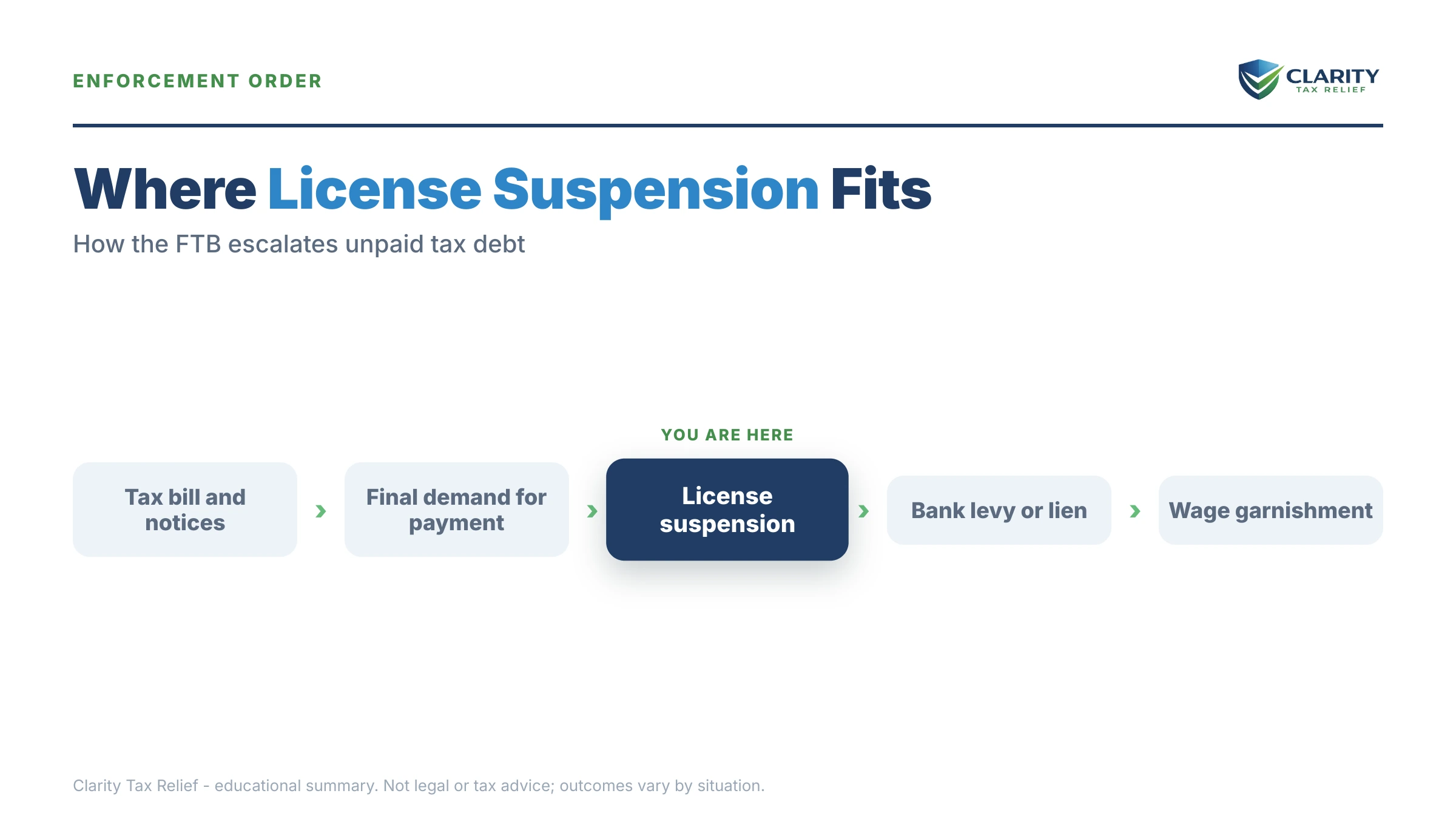
Once you're published on the Top 500 list, state agencies are required — not just allowed — to move against your licenses. The sequence runs on the FTB's calendar, not yours:
- Certified warning letter. The FTB notifies you it intends to add your name to the next list — typically about 30 days out. This is the cheapest moment to act.
- Publication. The list goes public on the FTB's website: your name, the amount you owe, and your occupational or professional license details, visible to clients, lenders, and anyone who searches you.
- Agencies act. The DMV moves to suspend your California driver's license. Your licensing board suspends your professional license or refuses to renew it under section 494.5.
- State contracts close. Listed taxpayers can't enter contracts with state agencies — a direct revenue hit for contractors and vendors.
- The suspension holds until the FTB releases it. No board or DMV clerk can reinstate you on sympathy; they need the FTB's release, which only comes when the debt is resolved or an arrangement is approved.
And the ordinary collection machine never pauses while this plays out. Interest compounds, an FTB collection fees charge gets added to the balance, and levies and garnishments continue — all backed by California's 20-year collection statute, twice the IRS's window.
Got the FTB's certified warning letter?
The respond-by date printed on it is the only thing standing between your name and the next published list. Send us the letter — an experienced tax professional will confirm your real balance, whether you're actually in listing territory, and the fastest arrangement that keeps your license safe. Free and confidential.
Your options to stop or reverse an FTB license suspension
Every path off the list — and back to a valid license — runs through the same gate: the FTB must consider the debt resolved or under an approved arrangement. The good news is that an approved FTB installment agreement in good standing is enough; you don't have to write one giant check.
| Option | Who it fits | Effect on your license |
|---|---|---|
| Pay in full | Anyone who can raise the funds (savings, refinance, borrowing) | Fastest path — name removed, FTB issues a release, agency reinstates |
| FTB installment agreement | Steady income; smaller balances can often be set up online, larger ones need financial disclosure | Kept off the list (or removed) while every payment stays current |
| FTB Offer in Compromise | Means-tested — income and assets genuinely can't cover the debt | Acceptance resolves the liability; the release follows |
| File missing returns / dispute the assessment | Balance built on estimated assessments after a demand to file | Accurate returns can shrink the debt — sometimes below $100,000 entirely |
| Hardship deferral | Documented inability to pay basic living expenses | Pauses levies; effect on listing depends on your facts — get advice first |
| Bankruptcy | Qualifying cases only — timing rules decide what's dischargeable | The automatic stay generally halts collection while the case is open |
A few specifics the table can't hold. The FTB payment plan is the workhorse: modest balances can usually be set up online in one sitting, while larger or business balances require a financial statement on FTB Form 3561 — the state's version of the IRS collection information statement. Interest keeps accruing during any plan, so shorter terms cost less overall.
The FTB offer in compromise is a separate application from the IRS version — an accepted federal offer does nothing for your California balance, and vice versa. It's real relief, but strictly means-tested; the FTB looks at what you could ever realistically pay, not what you'd prefer to.
If your balance came from the FTB estimating your income after an FTB demand to file, filing the actual returns is often the single biggest lever. Estimated assessments routinely overstate what a self-employed person owes because they ignore your business expenses entirely. For the general playbook on choosing among plans, offers, and hardship status, our guide on how to settle tax debt yourself walks through the full decision tree.
Say you owe the FTB $23,800: what's actually at risk
Say you're a sole proprietor who owes the FTB $23,800 across two tax years — a common landing spot after a couple of good 1099 years with no estimated payments. Here's the honest risk picture, with the math shown. (This is a hypothetical example, not a client case.)
Your license is not on the table. $23,800 is nowhere near the $100,000 Top 500 threshold, so no warning letter, no list, no DMV or board action. What is on the table: a bank levy on your business checking account, an earnings withholding order if you also have W-2 wages, a recorded lien, and a collection fee stacked onto the balance.
Resolution math: on a 60-month FTB installment agreement, $23,800 works out to roughly $397 a month ($23,800 ÷ 60) before the interest that continues to accrue; a 36-month plan runs about $661 a month and costs meaningfully less in total interest. Either one, kept current, shuts down levy activity.
Now flip the scenario to show how a self-employed Californian actually ends up in suspension territory: a contractor ignores four years of demand-to-file letters, the FTB estimates income from 1099s with zero expense deductions, and assessments plus late-filing penalties, interest, and fees stack past $100,000. At that point the certified letter arrives — and the CSLB license that generates every dollar of income is suddenly in the FTB's hands. The lesson cuts both ways: small debts don't threaten licenses, but unfiled years compound into debts that do.
How to respond to an FTB license suspension warning, step by step
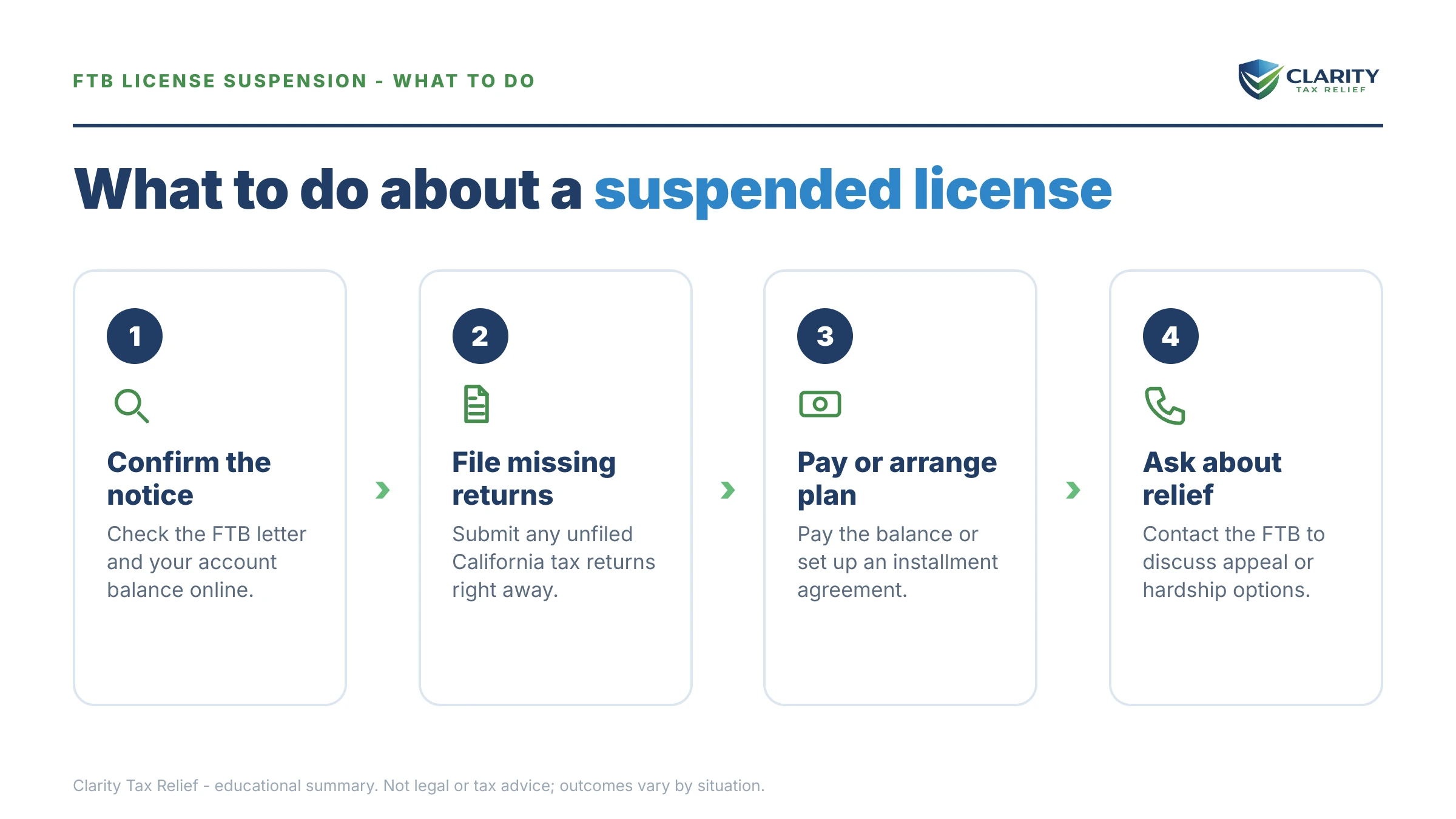
- Find your respond-by date. Pull the FTB's certified letter and locate the date you must act by — that single date controls whether your name reaches the next Top 500 list.
- Confirm your total balance. Log into MyFTB or call the FTB to verify the full amount across every tax year, including penalties, interest, and collection fees — the letter may not reflect recent payments.
- File any missing returns. If part of the balance comes from estimated assessments after a demand to file, filing accurate returns can shrink the debt substantially — sometimes below the listing threshold.
- Start a resolution before the list date. Pay in full, open an installment agreement, or submit an FTB Offer in Compromise — an approved arrangement in place before publication keeps you off the list.
- Get the release in writing. If a license is already suspended, obtain the FTB's release once you resolve the debt and confirm the DMV or your licensing board processed the reinstatement.
When you can handle this yourself
If you owe well under $100,000 and agree with the balance, you do not need to hire anyone. Set up an FTB installment agreement, keep every payment and future filing current, and the license question never arises. That covers the large majority of people who search this topic in a panic.
Experienced help changes outcomes in four situations. One: the certified warning letter is already in hand and a publication date is close — the order you fix things in (returns first, then the arrangement) matters, and there's no slack for a rejected application. Two: a license is already suspended and your income stops until it's back. Three: multiple unfiled years mean the "debt" is really an inflated estimate that accurate returns could cut dramatically. Four: the balance is genuinely unpayable and the FTB's offer-in-compromise math needs to be built correctly the first time.
Terms on your FTB letter, decoded
- Top 500 Delinquent Taxpayers list — the FTB's twice-yearly public list of the state's 500 largest income-tax delinquencies, each over $100,000.
- Business and Professions Code §494.5 — the California law requiring state licensing agencies to suspend or refuse to renew licenses of listed taxpayers.
- Release — the FTB's written notice to a licensing agency that your debt is resolved, which is what actually allows reinstatement.
- Demand for Tax Return / estimated assessment — when you don't file, the FTB files for you using income records and no deductions, usually overstating the tax.
- Collection Cost Recovery Fee — a fee the FTB adds to your balance once your account moves into active collections.
- R&TC §19255 — the statute giving the FTB generally 20 years from its earliest lien date to collect.
FTB license suspension questions, answered
Can the FTB suspend your driver's license for back taxes?
Yes, but only if you appear on the FTB's Top 500 Delinquent Taxpayers list, which is reserved for California tax debts over $100,000. Once you're listed, the DMV suspends your California driver's license until the FTB issues a release. California cannot suspend a license issued by another state, though it can still levy your accounts and California-source income.
How much do you have to owe for an FTB license suspension?
More than $100,000 in delinquent California tax, penalties, interest, and fees. The FTB publishes its Top 500 list roughly twice a year, and only listed taxpayers face license suspension under Business and Professions Code section 494.5. If you owe less — say $23,800 — your license is not at risk, but bank levies, wage garnishment, and liens still are.
How do I get my license back after an FTB suspension?
Resolve the debt — pay in full, enter an approved installment agreement, or reach another accepted resolution — and the FTB removes your name and notifies the licensing agency to reinstate you. Ask the FTB for written confirmation of the release and follow up with the DMV or your board directly. Reinstatement is not automatic on your end: confirm the agency actually processed it, and keep a copy of the release.
Does an FTB payment plan stop license suspension?
Yes. Taxpayers who are current on an approved FTB installment agreement are not published on the Top 500 list, and entering one after the warning letter generally resolves the listing threat. The protection lasts only while you stay compliant — miss a payment or a new filing deadline and the agreement can default, putting the listing and suspension back in play.
Is an FTB license suspension the same as a DMV registration hold?
No. A registration hold blocks your vehicle registration renewal — usually because the FTB is collecting unpaid DMV fees on the DMV's behalf — and can happen at any debt size. License suspension targets your driver's license or professional license and only applies to Top 500-listed taxpayers with debts over $100,000. Different programs, different fixes.
Can the IRS suspend your driver's license too?
No — driver's and professional licenses are state tools, and the IRS has no authority over them. The IRS's closest equivalent is passport certification: at $66,000 or more in seriously delinquent federal tax debt (the 2026 threshold), the State Department can deny or revoke your passport. New York runs its own driver's-license suspension program for state tax debt, with a far lower entry point than California's.
Will my professional license renewal be denied if I owe the FTB?
Only if you're on the Top 500 list — then state licensing boards must suspend your license or refuse to renew it until the FTB issues a release. Below the $100,000 listing threshold, California boards do not deny renewals over income tax debt alone. Contractors, real estate agents, nurses, and other licensees on the list are treated the same as driver's-license holders.
Does FTB tax debt go away if I wait long enough?
Not for a very long time. The FTB generally has 20 years from its earliest lien date to collect under Revenue and Taxation Code section 19255 — double the IRS's 10-year window. Waiting out a debt that grows with interest and collection fees for two decades is not a strategy; a payment plan or offer usually costs far less than the wait.
Curious how the FTB's program compares elsewhere? See can the IRS take my license for the federal picture, the NYS license suspension for tax debt program for New York's much lower threshold, and our guide to the FTB DMV registration hold — the program people most often confuse with this one. You can also verify anything about your own account directly with the California Franchise Tax Board, and check your license status with the California DMV.
Your next 24 hours
- Find the two numbers that matter. On your FTB letter, locate the total balance and the respond-by date. If you have no letter and owe under $100,000, license suspension is not your problem — collections still are.
- Gather your file. The FTB letter, your last filed California return, a list of any unfiled years, and current income and expense figures — everything a resolution decision depends on.
- Get a free case review before the letter's date passes. Call (888) 825-7779 or use the 2-minute form — an experienced tax professional will map the fastest arrangement that keeps your name off the list and your license in your wallet.
This guide is general information, not tax or legal advice for your specific situation. Eligibility for IRS programs depends on individual facts and circumstances; no outcome is guaranteed.