
California Tax Problems
FTB Top 500 Delinquent Taxpayer List: How It Works and How to Get Off It (2026)
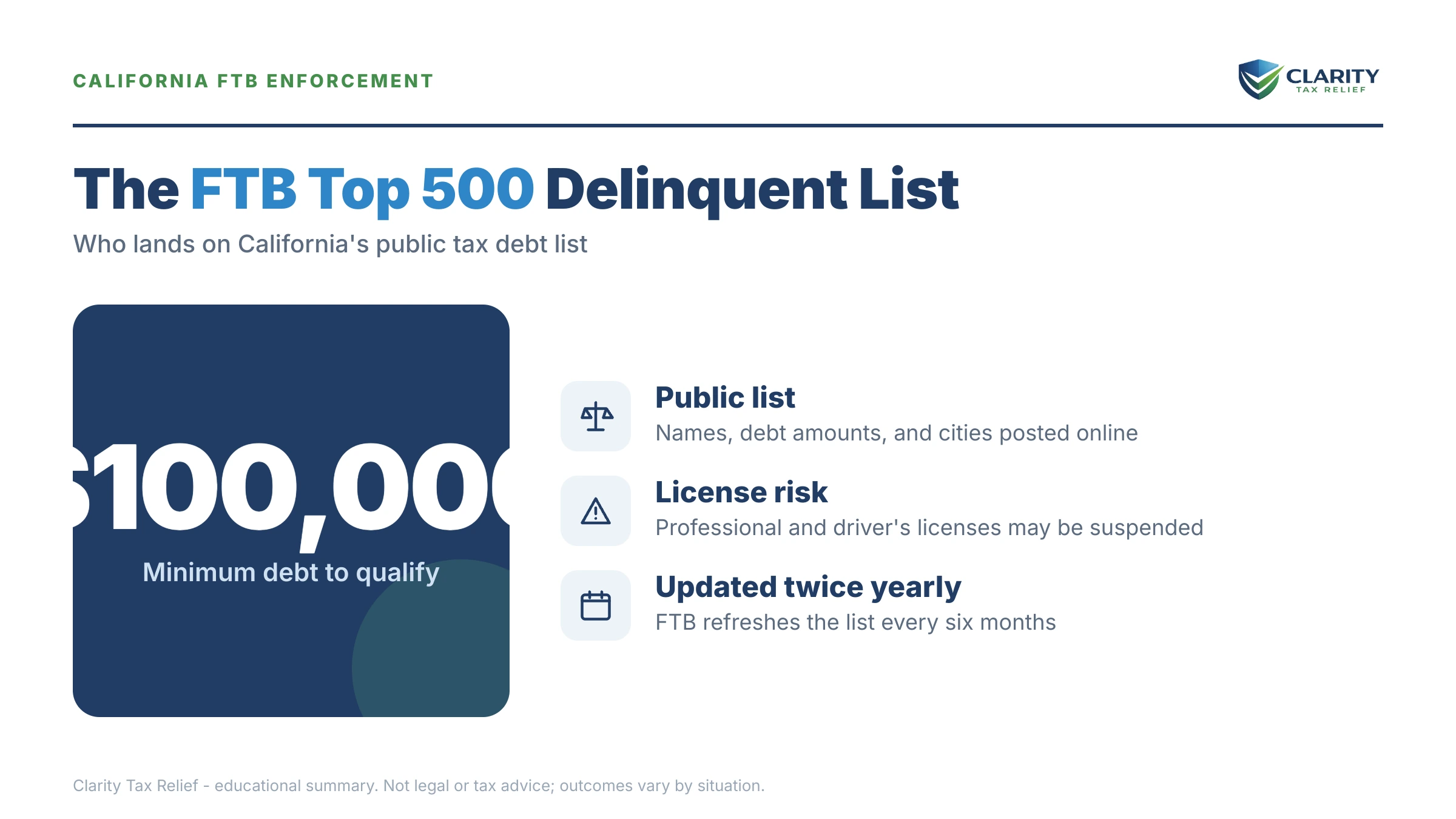
The short answer: the FTB top 500 delinquent taxpayer list is California's twice-yearly public roster of the state's 500 largest unpaid income-tax debts — every entry over $100,000. Listed taxpayers face professional and driver's license suspension and a state-contract ban. Paying in full or entering an approved payment arrangement keeps you off it.
Maybe you got the Franchise Tax Board's certified letter warning that your name is scheduled for publication. Or maybe you owe the FTB and just discovered the state publishes debtors' names online — and now you're wondering whether yours is next. Either way, this is a program with clear rules, a real warning period, and several documented exits.
The single most important fact: the list only reaches balances over $100,000 — and even then, only the 500 largest in the state. Below, you'll see exactly who qualifies, what listing actually costs you, and the arrangements that keep your name off it. The image below shows you exactly what the FTB's pre-publication warning letter looks like and where to find your deadline on it.
⏱ Your deadline: if you received the FTB's certified pre-publication letter, you have 30 days from the date printed on it to pay or get an approved payment arrangement in place before your name goes on the published list. If you haven't received a letter, there's no publication clock running — but interest and collection fees accrue on your balance every month regardless.
Why your name ends up on the FTB top 500 delinquent list
California Revenue and Taxation Code §19195 requires the Franchise Tax Board to publish the state's 500 largest delinquent income-tax balances — all over $100,000 — at least twice a year. This isn't a discretionary shaming campaign; it's a statute the FTB has to follow, and the entries include names, the amounts owed, and professional-license information where it applies.
Getting on the list takes two things at once. First, your balance must exceed $100,000. Second, it must rank among the 500 largest delinquent balances in the state at the time the FTB compiles its update — so the practical cutoff floats higher than $100,000 in most cycles.
Both individuals and businesses appear. A corporation or LLC with a large unpaid franchise or income-tax balance sits on the same list as an individual filer. What gets people here is rarely one bad year: it's usually several years of assessments — sometimes from returns the FTB filed for you after an FTB demand to file went unanswered — compounding with penalties, interest, and FTB collection fees until the total crosses six figures.
Certain taxpayers are excluded even above the threshold: you won't be listed while you're in an approved installment agreement, once an Offer in Compromise has been accepted, or while you're in an open bankruptcy case — simply submitting an offer does not keep you off the list; FTB removes names only for full payment, an approved installment agreement, or an accepted OIC. That exclusion is the entire strategy of this article — the list is avoidable right up until the publication date.
The certified letter: your 30-day warning
The FTB mails a certified letter at least 30 days before it adds any name to the Top 500 list. That letter states your balance, tells you that publication is pending, and gives you the window to resolve the account. The image below shows what this letter looks like and where the key figures sit, so you can match it against the one in your hand.
Two practical warnings about this letter. First, certified mail to your last known address counts as notice — if you've moved and never updated the FTB, the clock can run without you ever seeing it, and the first sign of trouble becomes a suspended license. Second, calling the FTB and "working on it" is not the same as an approved arrangement. Until a plan is formally accepted, you're still on track for publication.
What happens if you ignore the FTB's publication warning
Ignoring the FTB's pre-publication letter leads to public listing, mandatory license suspension, and a ban on state contracts — while liens and levies continue in parallel. The sequence runs in this order:
- The certified letter arrives. Your balance exceeds $100,000 and ranks among the state's 500 largest. The 30-day window opens.
- The window closes with no approved arrangement. Your name, the amount you owe, and your license information are published in the FTB's next list update.
- Licensing agencies act. Under Business and Professions Code §494.5, state licensing boards must suspend the occupational and professional licenses of listed taxpayers — contractor, medical, nursing, legal, real estate, cosmetology, liquor. The DMV suspends driver's licenses of listed individuals.
- State contracts close off. State agencies are barred from entering contracts with listed taxpayers — a direct revenue hit if you or your business sells to the state.
- Regular enforcement never paused. Throughout all of this, the FTB can record a tax lien, issue an Order to Withhold against your bank accounts, and garnish wages — and it can keep collecting for up to 20 years from assessment under California's 20-year collection statute.
Notice what's different from a federal problem: the IRS can levy your money, but it can't take your contractor's license or your driver's license for the debt alone. For a listed Californian, the Top 500 program attacks your ability to earn — which is exactly why the 30-day window is worth treating as a hard deadline.
Got the FTB's pre-publication letter?
Get it reviewed free before the 30-day window closes and your name — and your license — go on the line. An experienced tax professional will map your fastest path to an approved arrangement.
Your options: how to get off (or stay off) the Top 500 list
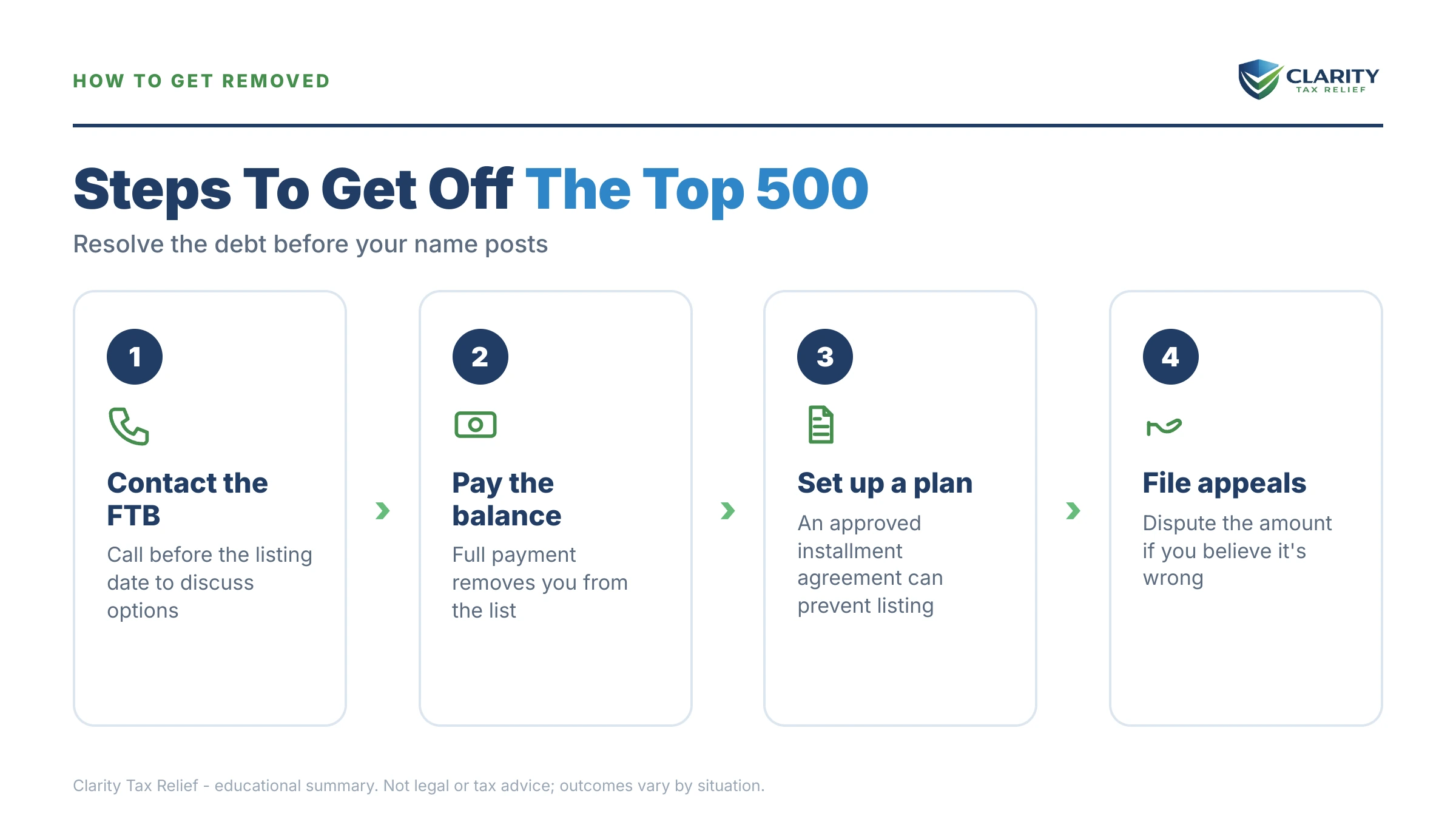
An approved payment arrangement keeps you off the Top 500 list even if you can't pay a dollar of the balance in full today. That's the part the fear-driven headlines skip: the statute excludes taxpayers who are formally resolving their debt. Your realistic paths:
| Option | Who it fits | Effect on Top 500 listing |
|---|---|---|
| Pay in full | Anyone with access to the funds (savings, refinance, asset sale) | Name never published — or removed at the next list update; license suspensions released |
| FTB payment plan (installment agreement) | Can realistically repay over time; all required returns filed | Approved plan excludes you from listing and gets a listed name removed at the next update |
| FTB offer in compromise | Income and assets genuinely can't cover the debt — the FTB verifies the math | Acceptance keeps you off the list — a pending offer alone does not |
| Hardship deferral | Documented inability to pay basic living expenses (see FTB currently not collectible) | Pauses active collection — but get your listing status confirmed by the FTB in writing; hardship alone is not a published exclusion |
| Bankruptcy | Case filed and open | Excluded from the list while the case is active; the tax debt itself may or may not be dischargeable |
For any arrangement above the FTB's self-service limits, expect a financial disclosure. The FTB's version of the IRS collection statement is FTB Form 3561 — it documents your income, expenses, and assets, and it drives both installment-agreement terms and Offer in Compromise decisions. For the general playbook on negotiating a tax debt on your own — the sequence of file first, then penalties, then the balance — see how to settle tax debt yourself; everything below is what's specific to the FTB and this list.
How much you owe changes your realistic options
You cannot appear on the FTB Top 500 list with a balance under $100,000 — but the FTB enforces every balance, at every size. Here's how exposure and options break down by amount:
| Your FTB balance | Top 500 exposure | Realistic options |
|---|---|---|
| Under $25,000 | None — the list floor is $100,000 | Self-service online payment plan (pay within 60 months); hardship deferral if you truly can't pay |
| $25,000 – $100,000 | None — but full lien, levy, and garnishment enforcement applies | Installment agreement by phone or mail (financial statement possible); FTB OIC if you can never realistically pay in full |
| Over $100,000 | Eligible — listed only if your balance ranks among the state's 500 largest | Negotiated arrangement with financials, OIC, or full payment — before a pre-publication letter ever arrives |
| Among the 500 largest | Certified letter → publication → license suspension → state-contract ban | Approved arrangement inside the 30-day window; experienced representation strongly advised |
A worked example: $31,200 and self-employed
Say you're a self-employed sole proprietor — a freelance electrician in Fresno — who owes the FTB $31,200 across two tax years of underpaid estimates. Here's your actual position:
- Top 500 exposure: zero. The list's floor is $100,000; you're $68,800 below it. Your CSLB license is not at risk from this program at this balance, and no publication clock exists for you.
- Online plan: not quite. The FTB's self-service payment plan is built for balances of $25,000 or less repaid within 60 months. At $31,200 you're over the line, so you'll request an arrangement by phone or mail — and the FTB may ask for financials on Form 3561.
- The math: on a five-year schedule, $31,200 ÷ 60 = $520 a month before ongoing interest and fees. Stretch to $700 a month and the base balance clears in roughly 45 months ($31,200 ÷ $700 ≈ 44.6), cutting the interest that accrues along the way.
- The real risk at this size isn't publicity — it's an Order to Withhold hitting the business bank account you run payroll-of-one from, or an earnings withholding order if you also have W-2 income. See FTB bank levy and how much can FTB garnish for what those look like.
- The trap to avoid: a new balance from next April's return can default the plan you just set up. As a sole proprietor, building quarterly estimated payments into the budget alongside the $520 is what keeps this fixed for good.
How to respond to an FTB Top 500 letter, step by step
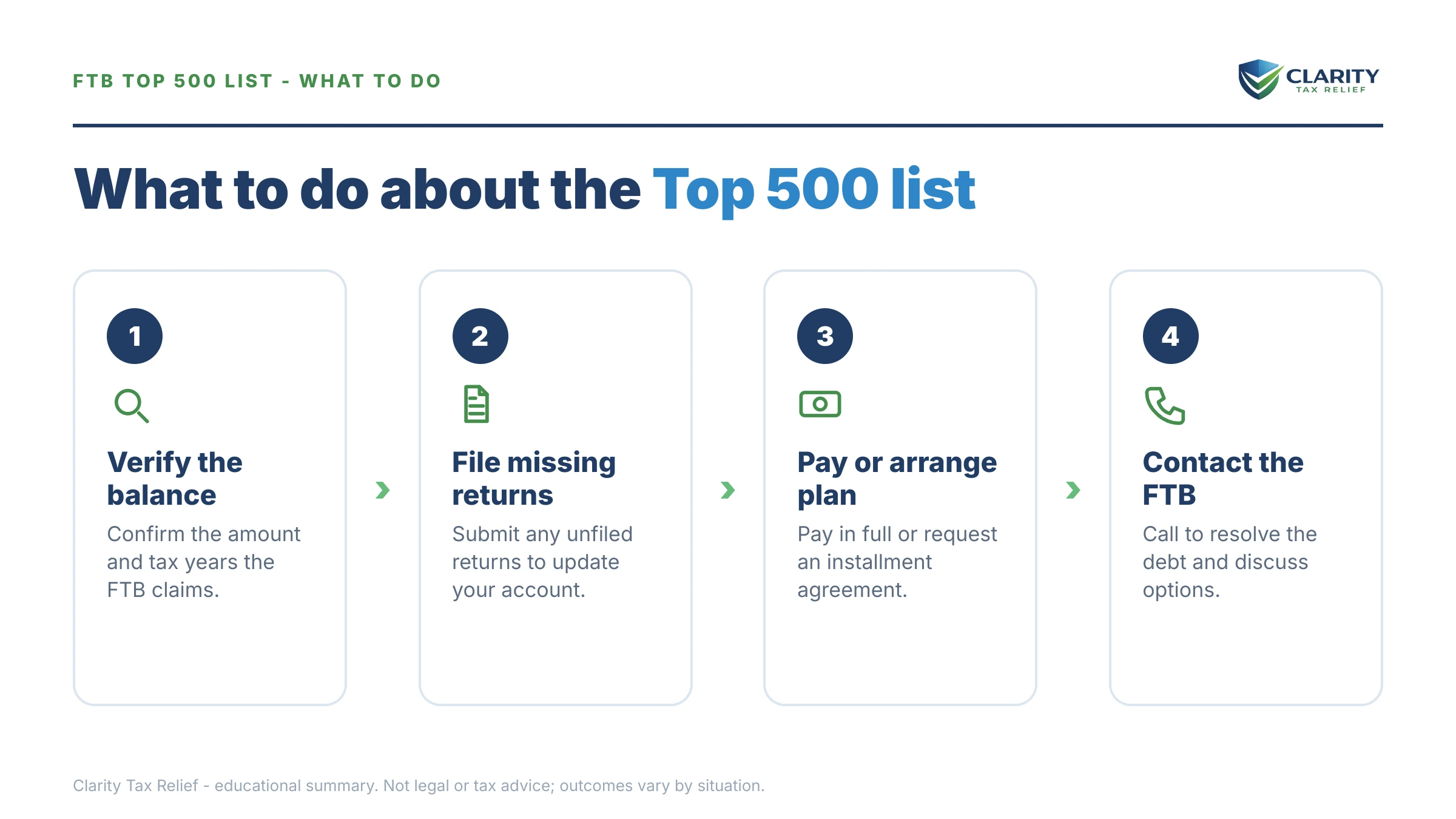
- Find the deadline on your certified letter. Locate the date printed on the FTB's pre-publication letter — you have 30 days from that date to resolve your account before your name is scheduled for publication.
- Verify the balance. Log in to MyFTB or call the number on the letter to confirm the amount, the tax years involved, and whether the FTB shows any missing returns.
- File any missing California returns. The FTB won't approve a payment arrangement while required returns are unfiled — file them first, even if you can't pay what they show.
- Choose and request a resolution. Pay in full, request an installment agreement, or pursue an Offer in Compromise — only full payment, an approved installment agreement, or an accepted OIC keeps your name off the list.
- Get written confirmation before the deadline. Ask the FTB to confirm in writing that your arrangement is approved and your account is excluded from the upcoming publication.
When you can handle this yourself — and when help changes the outcome
You can usually resolve an FTB balance under $25,000 on your own using the FTB's online payment plan. If your returns are filed, the balance is accurate, and you can commit to a monthly payment within 60 months, you don't need to hire anyone — set it up, keep current on new-year taxes, and you're done. The same is true if you can simply pay the bill and want the fastest exit.
Experienced help changes outcomes in four situations. First, if the certified pre-publication letter has already arrived — the 30-day window is short, the FTB will want financials, and a rejected or stalled request doesn't stop the publication clock. Second, if you hold a professional license (contractor, medical, legal, real estate) whose suspension would end your income — see FTB license suspension for how fast that cascade moves. Third, if part of the balance comes from returns the FTB estimated for you: filing accurate originals can shrink a six-figure assessment before you negotiate what's left. Fourth, if the debt belongs to a business that contracts with the state, where listing means lost revenue on top of lost licenses.
One honest caution: nobody — not us, not anyone — can promise the FTB will accept a particular plan or offer. What representation does is get the financial disclosure right the first time, keep the request moving inside the window, and pick the program your numbers actually support.
Terms on your letter, decoded
- R&TC §19195 — the California statute that requires the FTB to publish the Top 500 list at least twice a year.
- BPC §494.5 — the law requiring state licensing boards to suspend the licenses of listed taxpayers.
- Order to Withhold (OTW) — the FTB's bank levy: a one-time seizure order sent to your bank or another party holding your money.
- Earnings Withholding Order for Taxes (EWOT) — the FTB's wage garnishment, sent to an employer and continuous until released.
- R&TC §19255 — California's 20-year collection statute; the FTB has twice the IRS's 10-year window to collect.
- MyFTB — the FTB's online account portal, where you can verify your balance, tax years, and notices before responding.
FTB Top 500 list questions, answered
What is the FTB Top 500 delinquent taxpayer list?
It's a public list of California's 500 largest delinquent income-tax debts, published by the Franchise Tax Board under Revenue and Taxation Code §19195. Every entry owes more than $100,000, and the list shows names, amounts owed, and — for professionals — license information. Both individuals and businesses appear, and the list is updated at least twice a year.
How much do you have to owe to be on the FTB Top 500 list?
More than $100,000 — but crossing $100,000 doesn't automatically put you on it. The list only holds the 500 largest delinquent balances in the state, so the practical cutoff floats with each update. If you owe less than $100,000, you cannot be listed, though the FTB can still lien, levy, and garnish at any balance.
How do I get my name off the FTB Top 500 list?
Pay the balance in full, enter an approved installment agreement, or get an Offer in Compromise accepted. Simply submitting an offer does not keep you off the list — FTB removes names only for full payment, an approved installment agreement, or an accepted OIC. Once your account is in an approved arrangement, the FTB removes your name when it next updates the list — it isn't instant, but license suspensions tied to the listing can then be lifted. Simply calling the FTB isn't enough; the arrangement has to be formally approved.
Does the FTB warn you before publishing your name?
Yes. The FTB mails a certified letter at least 30 days before adding you to the list, telling you the balance and the deadline to resolve it. If you pay or get an approved payment arrangement in place within that window, your name never appears. If the letter went to an old address, you may not learn you're listed until a license suspension hits — keep your address current with the FTB.
Can the FTB really suspend my driver's license or professional license?
Yes. California Business and Professions Code §494.5 requires state licensing boards to suspend the occupational and professional licenses of taxpayers on the Top 500 list, and the DMV suspends driver's licenses. Contractors, doctors, nurses, attorneys, real estate agents, and liquor licensees are all covered. The suspension lifts once you resolve the debt or enter an approved payment arrangement and the FTB issues a release.
How often is the FTB Top 500 list updated?
At least twice a year. Each update, the FTB re-ranks delinquent balances, adds new names after the 30-day warning process, and removes taxpayers who paid or entered approved arrangements. That schedule matters: if you resolve your account right after an update, your name can stay visible until the next one — one more reason to act inside the 30-day warning window before you're ever published.
Does being on the Top 500 list mean extra collection action?
The listing adds three consequences on top of normal collection: professional-license suspension, driver's-license suspension, and a ban on state agencies contracting with you. Meanwhile the FTB's regular tools — tax liens, bank levies, and wage garnishment — continue in parallel, and California's collection statute runs 20 years from assessment under R&TC §19255, twice the IRS's window.
Can a business be on the FTB Top 500 list?
Yes — the list covers both personal and business income-tax debts, so corporations and LLCs appear alongside individuals. For a business, listing can suspend licenses the company needs to operate, including liquor licenses, and blocks new state contracts — which can be fatal for a company that sells to the state. The same 30-day certified-letter warning and the same exit paths apply to business entities.
Your next 24 hours
- Find your deadline. Pull out the FTB's certified letter and circle the date printed at the top — add 30 days, and that's the day your name is eligible for publication. No letter? Log in to MyFTB and confirm your exact balance and tax years instead.
- Gather three things: the letter, your most recent California return, and a rough monthly income-and-expense picture — that's what any payment arrangement or Form 3561 disclosure will be built from.
- Get a free case review. Send us the letter at the 2-minute form or call (888) 825-7779. An experienced tax professional will tell you which arrangement your numbers support and how to get it approved before the window closes.
Official resources: the California Franchise Tax Board publishes the Top 500 list and its payment-arrangement criteria, and the California DMV handles driver's-license suspensions and reinstatements tied to the program.
This guide is general information, not tax or legal advice for your specific situation. Eligibility for IRS programs depends on individual facts and circumstances; no outcome is guaranteed. The same is true of California FTB programs — approval depends on your verified financials.