
California FTB
FTB Collection Fees in 2026: What Each Charge Is, When It's Added, and How to Avoid It
The short answer: FTB collection fees are flat charges California's Franchise Tax Board adds when it has to force compliance — a collection cost recovery fee when you miss a Demand for Payment date, a filing enforcement fee when you don't file after a demand, and lien fees. Unlike penalties, they generally can't be abated — only avoided, or disputed as errors.
You compared this FTB notice to the last one and the balance grew — not from new tax, but from line items labeled "fees" that nobody asked you to approve. On a fixed income, a bill that inflates itself is the part that gets under your skin. Here's the good news: every one of these fees has a visible trigger, and the next ones are still avoidable.
These charges sit in the middle of the notice, easy to mistake for penalties — the image below shows what an FTB balance notice looks like and exactly where to look for each fee line, so you can tell which charges you can fight and which you can only stop from multiplying.
⏱ Your controlling date: the "respond by" date printed on your FTB Demand for Payment. Miss it and the collection cost recovery fee posts automatically — and interest keeps accruing on the entire balance every month until you pay or set up a resolution.
Why the FTB added collection fees to your account
The FTB adds its collection cost recovery fee automatically the moment your account moves into involuntary collections — no human reviews the file first. The trigger is almost always the same: a Demand for Payment went out, the printed response date passed, and the system moved your account to the next stage.
These fees exist because California law — Revenue and Taxation Code Section 19254 — lets the FTB bill you for the cost of chasing you. That legal basis matters. A penalty punishes conduct, so it can be forgiven for reasonable cause. A cost-recovery fee reimburses the state for work it already did, so "I had a good reason" doesn't undo it. The realistic paths are prevention (act before the trigger date) or error correction (prove the trigger never should have fired).
If your notice also shows a filing enforcement fee, the story started earlier: the FTB sent a demand for a missing return, you didn't file, and the state assessed you from the income records it already had. That path — and how to unwind the assessment — is covered in our FTB demand to file guide.
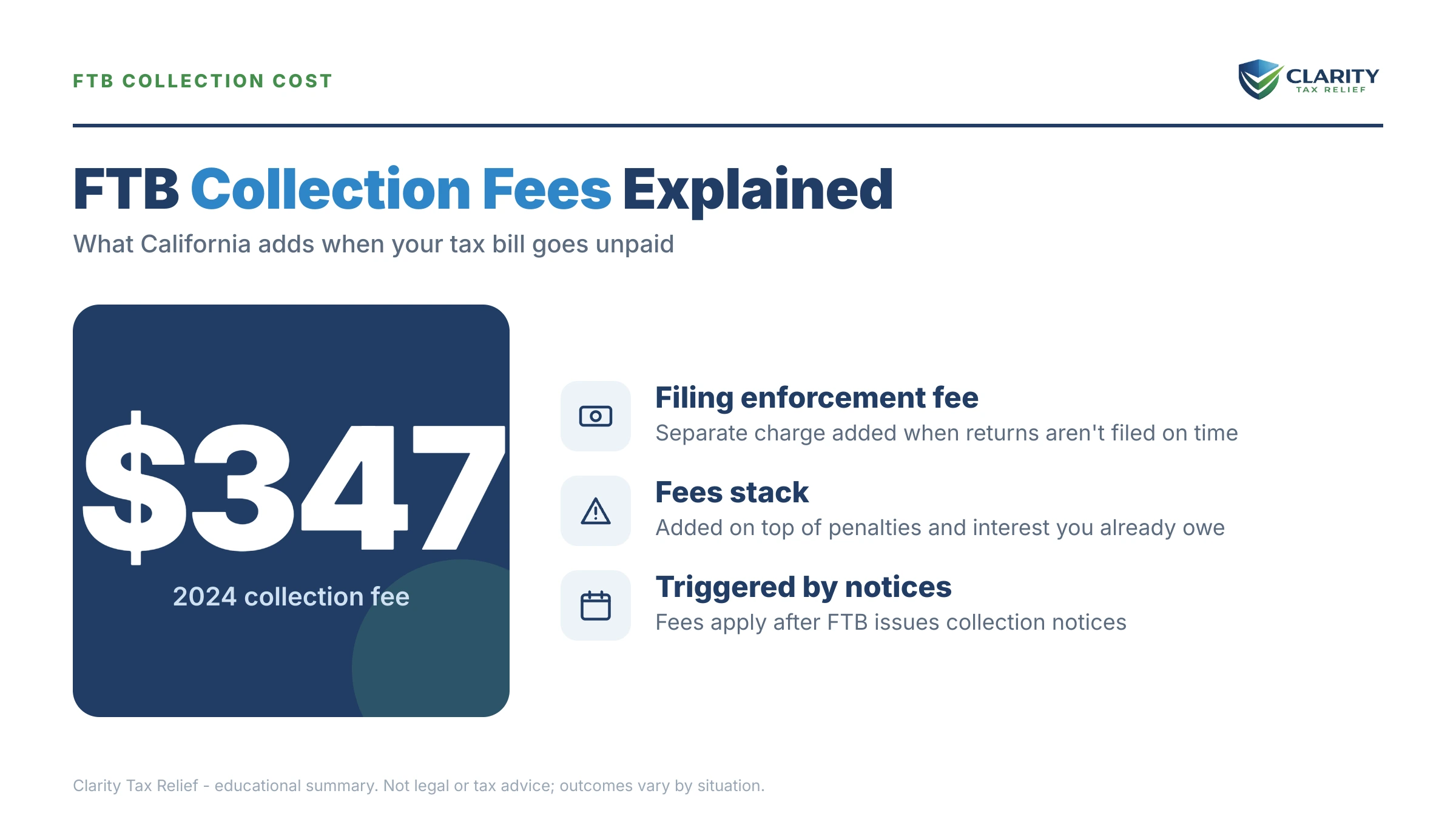
FTB collection fees, one by one
The FTB charges several distinct fees, and each has its own trigger and its own (narrow) removal path. The amounts are reset each fiscal year, so the current figures live on the FTB's website — but the mechanics don't change:
| Fee | When the FTB adds it | Can it be removed? |
|---|---|---|
| Collection cost recovery fee | Your account enters involuntary collections after you miss the date on a Demand for Payment. Roughly $300–$400 for individuals in recent years; set annually. | Only if charged in error — there is no reasonable-cause abatement for fees |
| Filing enforcement cost recovery fee | You don't file after a Demand for Tax Return, and the FTB assesses you from income records. Roughly $100 for individuals in recent years. | Only if charged in error; filing the real return later usually doesn't remove it |
| Lien fee | The FTB records a state tax lien with your county recorder — and charges again when it releases the lien | Reversed if the lien itself was recorded in error |
| Dishonored payment fee | A check or electronic payment to the FTB bounces | Rarely — usually only when your bank, not you, caused the failure |
| Court-ordered debt collection fees | Non-tax debts (court fines, victim restitution) the FTB collects for other agencies carry their own cost-recovery charges | Governed by the referring agency's rules, not standard FTB tax procedures |
One note on that last row: if your notice references a court fine or vehicle-related debt rather than income tax, you're in a different program with different rules — see FTB court-ordered debt collections before you follow tax-debt advice.
Keep the three buckets straight, because they follow different rules. Penalties are percentage-based and can be abated for reasonable cause — that fight is covered in FTB penalty abatement. Interest is rate-based, accrues until you pay, and is almost never waived. Fees are flat, and only reversible as errors. Readers who lump all three together often spend energy disputing the one line item that can't be disputed.
What happens if you ignore an FTB balance
California's Franchise Tax Board has 20 years to collect a tax debt — double the IRS's 10-year window — and each stage of its escalation adds cost. The sequence is automated, and each step below stacks a new charge or a new enforcement power on top of the last:
- Balance due notice — the first bill. No fees yet. Penalties and interest are already running, but this is the cheapest moment you will ever have.
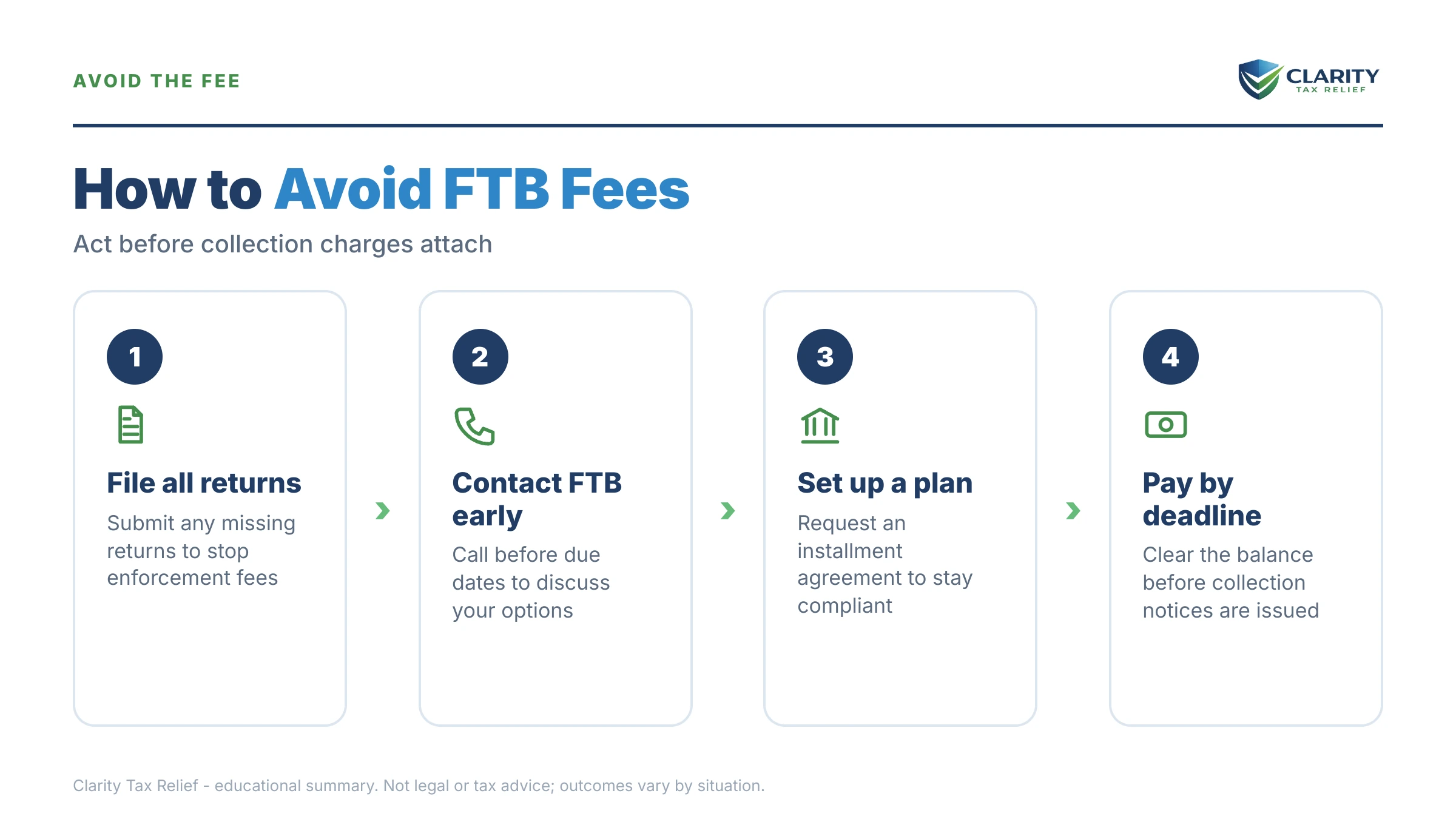
- Demand for Payment — the warning shot with a printed respond-by date. Responding by this date — even just by starting a payment plan — is what keeps the collection fee off your account.
- Involuntary collections — the demand date passes and the flat collection cost recovery fee posts. Your account is now in the queue for enforcement.
- State tax lien — the FTB records a lien with your county, adding the lien fee and putting the debt on the public record against your home and other property.
- Levy — the FTB issues an Order to Withhold to your bank or an Earnings Withholding Order to an employer. For a retiree, the bank account is the exposed flank — an FTB bank levy can reach an account even when the money in it started as protected benefits.
- Ongoing intercepts for up to 20 years — state tax refunds, lottery winnings, and other state payments get intercepted, and the clock runs far longer than most people expect. See how California's 20-year collection statute works before assuming this ages out.
Notice what's absent from that list: any stage where the FTB forgets. In 2026, state collection systems are as automated as the IRS's — the escalation continues whether or not anyone ever reads your file.
Fees already stacking on your FTB notice?
Send us a photo of it before the respond-by date passes and the next charge posts. An experienced tax professional will separate what's disputable from what's stoppable — free, confidential, no pressure.
Your options when you can't pay the FTB in full
An FTB balance can be resolved through a monthly payment plan, hardship status, or an FTB Offer in Compromise — and which one fits depends on your income and assets, not on the size of the fees. The general playbook for negotiating a tax debt on your own lives in our guide on how to settle tax debt yourself; here's how each option plays specifically against FTB fees and enforcement:
| Option | Who it typically fits | What it does to fees and collection |
|---|---|---|
| Pay in full | You have savings or assets that cover the balance | Stops interest and every future fee immediately; existing fees are paid with the balance |
| FTB payment plan | Steady income that supports a realistic monthly payment; all returns filed (thresholds for the online version are published at ftb.ca.gov) | Halts levies while you stay current; interest continues; small setup fee — far cheaper than the collection fee inaction triggers |
| Hardship / deferred collection | Income covers only basic living costs — common on fixed Social Security income; documented on a financial statement | Pauses active collection; the balance, interest, and existing fees remain and the 20-year clock keeps running |
| FTB offer in compromise | No realistic ability to ever pay in full — limited assets, fixed income, age and health considered | Settles the entire balance, fees included, for a documented lesser amount the FTB agrees reflects what you can pay |
| Penalty abatement | Reasonable cause (serious illness, disaster) or FTB error behind a penalty | Reduces penalties only — it does not touch collection or filing enforcement fees |
| Fee dispute | You paid or responded before the demand deadline, or the demand went to a stale address | Reverses a fee charged in error; requires written proof, not a phone argument |
Two eligibility realities worth naming. First, the FTB's simplest plans are built for smaller balances paid over a few years; larger debts usually require a full financial disclosure on FTB Form 3561 before the state agrees to anything. Second, hardship status at the FTB is its own animal — the rules differ from the IRS version, and our guide to FTB currently not collectible status walks through what the state actually looks at.
What $61,200 in FTB debt really costs: a worked example
Say you're retired, living on Social Security and a small pension, and you owe the FTB $61,200 from the sale of a long-held rental property. Here's the hypothetical arithmetic of doing nothing versus acting:
Doing nothing. The Demand for Payment date passes and the collection fee posts — call it roughly $350 for illustration. Balance: $61,550. A lien gets recorded, adding the county recording cost. Interest — assume 8% a year purely for illustration; the FTB resets its rate twice a year, so check the current figure — adds about $4,896 over twelve months, roughly $408 every month. One year of silence and the balance is pressing toward $66,500, plus whatever penalties were already running.
Acting. A straight payment plan on $61,200 over 60 months runs about $1,020 a month before interest — likely impossible on Social Security and a small pension. That's the point of the financial statement: if Form 3561 shows your income barely covers rent, food, medicine, and utilities, the honest paths are hardship status (collection pauses, debt remains) or an FTB Offer in Compromise (the state accepts what your finances show you can actually pay — fees and all — and closes the account). Neither is automatic, and eligibility depends entirely on your documented numbers, but both exist precisely for this situation.
The lesson in the math: at $61,200, interest is the engine and the fees are the ignition. The flat fees are the part you fully control — respond before the demand date and they never post — while the interest only stops when a real resolution is in place.
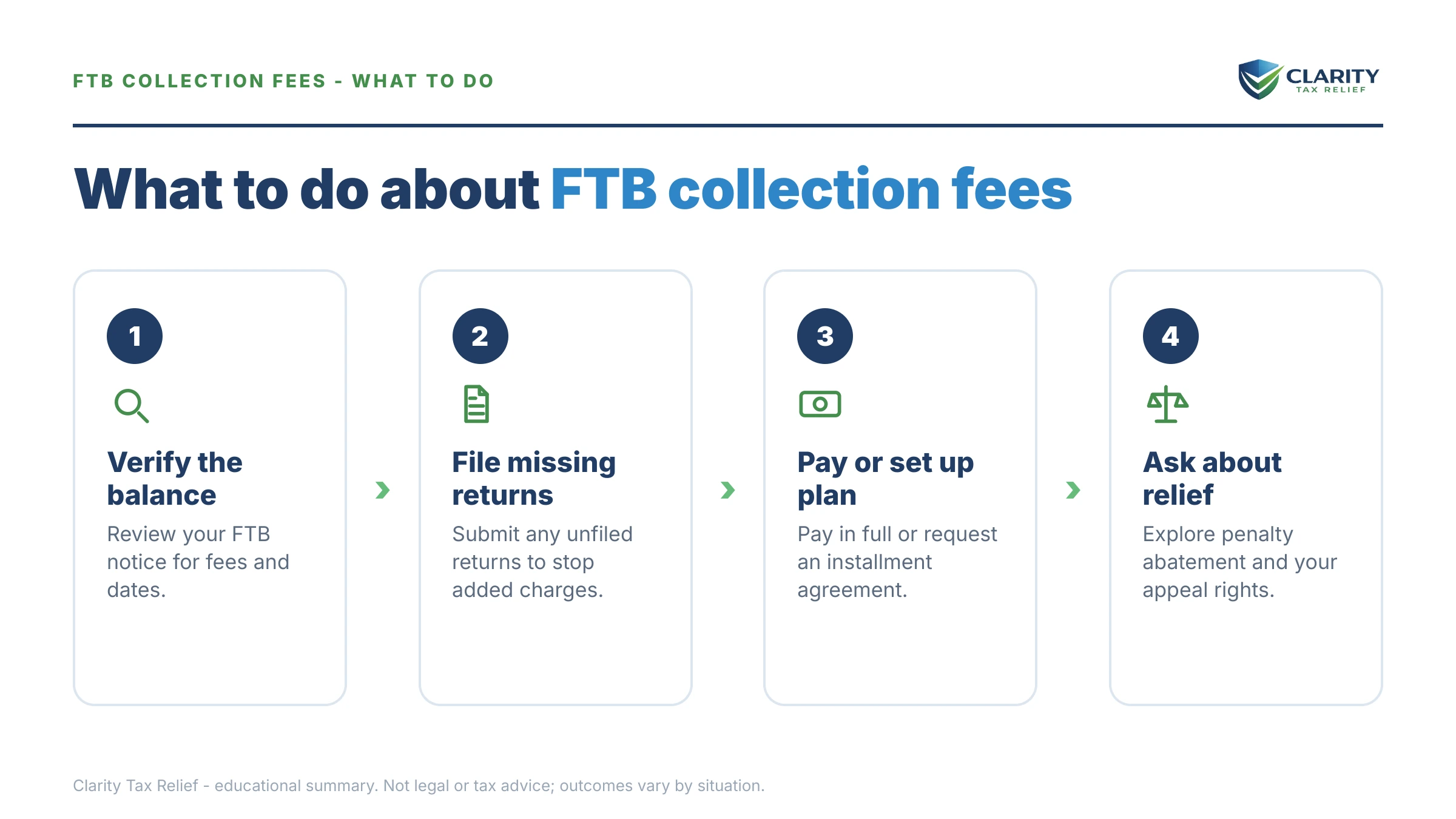
How to respond to FTB collection fees, step by step
- Read your notice line by line. Separate the tax, each penalty, the interest, and each fee — and circle the respond-by date printed on the notice, because that date controls whether the next fee posts.
- Verify the underlying balance. Check your account with the FTB and confirm the tax year, the assessed amount, and that every payment you've made was actually applied before you pay anything.
- Dispute any fee charged in error. If you paid or responded before the demand deadline, or the notice went to an address the FTB should have updated, send written proof and ask for the fee to be reversed.
- Choose a resolution before the next stage. Set up an FTB payment plan, request hardship status, or pursue an Offer in Compromise — any of these stops the escalation that adds lien fees and leads to levies.
- Get experienced help for large or levy-stage balances. If a bank levy is in motion, you have unfiled years after a demand, or your balance requires Form 3561 financials, have an experienced tax professional map the order of moves before you call the FTB.
When you can handle this yourself — and when help changes the outcome
You can probably handle this alone if the balance is small, the fee hasn't posted yet, and a straightforward payment plan fits your budget. The same is true if your only issue is a fee charged in error and you hold the proof — a dated payment confirmation or a certified-mail receipt makes that dispute a paperwork exercise, not a negotiation.
Experienced help earns its cost in four situations. A levy is already in motion against your bank account — the release windows are short and the sequencing matters. Your balance is large enough to require full Form 3561 financials, where how expenses are presented changes what the FTB will accept. You're weighing an Offer in Compromise on a fixed income, where the state's math on your assets and life expectancy of income decides everything. Or there are unfiled California years behind the fees, because the order you fix things — returns first, then penalties, then the balance — changes what you ultimately pay.
Terms on your FTB notice, decoded
- Collection cost recovery fee: the flat charge for the FTB having to collect involuntarily after you missed a demand date.
- Filing enforcement cost recovery fee: the flat charge for the FTB having to assess you because you didn't file after a demand.
- Demand for Payment: the notice whose printed respond-by date is the trigger for the collection fee — your last free exit.
- Order to Withhold: the FTB's levy instruction to your bank, freezing and taking funds from your account.
- Earnings Withholding Order for Taxes: the FTB's wage garnishment, sent to an employer and continuing until released.
- Interagency Intercept: the program that grabs your state tax refunds, lottery winnings, and other state payments and applies them to the debt.
FTB collection fee questions, answered
What is the FTB collection cost recovery fee?
It's a flat fee the Franchise Tax Board adds when your account moves into involuntary collections — typically because you didn't respond to a Demand for Payment by its printed date. The amount is set each fiscal year under Revenue and Taxation Code Section 19254 and has run a few hundred dollars for individuals in recent years. It's charged on top of penalties and interest, and it doesn't shrink if you later pay quickly.
Can FTB collection fees be waived or removed?
Generally no — collection and filing enforcement fees are cost-recovery charges, not penalties, so the reasonable-cause abatement that works on penalties doesn't apply to them. The FTB will reverse a fee that was charged in error: for example, you paid or responded before the demand deadline, or the demand went to an address the FTB should have updated. If the fee was properly charged, your leverage is usually on the penalties instead, which can be abated for reasonable cause.
Why did the FTB charge me a filing enforcement fee?
The filing enforcement cost recovery fee means the FTB had to force the filing issue — you didn't file a California return after receiving a Demand for Tax Return, so the state assessed you based on the income data it already had. The fee has run roughly $100 for individuals in recent years and is separate from any late-filing penalty. Filing your actual return can lower the assessed tax, but the fee itself generally stays.
Are FTB collection fees the same as penalties?
No — your FTB balance has three separate add-ons that follow different rules. Penalties are percentage-based and can be abated for reasonable cause; interest is rate-based, accrues until you pay, and is almost never waived; fees are flat cost-recovery charges that can only be reversed if charged in error. Knowing which bucket each line item falls into tells you which ones you can actually fight.
Does the FTB charge a fee to set up a payment plan?
Yes — the FTB charges a modest setup fee for an installment agreement, and it's far smaller than the collection cost recovery fee you'd trigger by doing nothing; check ftb.ca.gov for the current amount. Interest and any late-payment penalty continue to accrue while you're on the plan, but active collection, including new levies, stops while you stay current.
Can the FTB take my Social Security to pay collection fees?
No — federal law protects Social Security benefits from state tax collection, so the FTB cannot garnish your monthly check the way the IRS can take up to 15% through the federal levy program. But once benefits land in a bank account and mix with other money, the account itself can be levied, and the rules about what stays protected get technical. Pensions, rental income, and state tax refunds are also within the FTB's reach.
How long can the FTB collect a tax debt and its fees?
Generally 20 years, under Revenue and Taxation Code Section 19255 — double the IRS's 10-year collection statute. The fees ride along with the underlying tax, so they don't expire separately. Waiting out the FTB is rarely a realistic strategy, especially since liens and levies can hit at any point during those two decades.
Does the collection fee get bigger if I owe more?
No — the collection cost recovery fee is flat, so a $61,200 balance and a $2,000 balance get the same charge. What grows with your balance is interest, which is percentage-based and accrues every month until you pay. On a large balance, interest will dwarf the fees within months; on a small one, the fees can add a double-digit percentage to what you owe almost overnight.
Your next 24 hours
- Find the respond-by date and the fee lines on your notice. Circle the date near the top and mark every line labeled "fee" separately from penalties and interest — that's your map of what's disputable and what's stoppable.
- Gather three things: your last California return, the notice itself, and proof of your income — Social Security award letter, pension statements, bank statements. Everything the FTB will ask for starts with these.
- Get your notice reviewed free before the respond-by date passes. Use the 2-minute form at claritytaxrelief.com/#consult or call (888) 825-7779 — an experienced tax professional will tell you which fees can be reversed and which resolution keeps the next one from ever posting.
Current fee amounts, interest rates, and payment plan thresholds are published by the California Franchise Tax Board — the amounts reset each fiscal year, so verify before you rely on any figure. If you owe the IRS as well as the FTB, federal payment options are separate and live at IRS.gov/payments.
This guide is general information, not tax or legal advice for your specific situation. Eligibility for IRS programs depends on individual facts and circumstances; no outcome is guaranteed.