
California FTB
FTB Demand to File: What It Means and How to Respond (2026)
The short answer: an FTB demand to file means California believes you owe a tax return you never filed. Respond by the date printed on the notice — file the return, prove you filed, or show you had no filing requirement — or the FTB assesses tax for you and adds a 25% demand penalty.
The letter from Sacramento names a tax year you may barely remember, tells you the Franchise Tax Board has no return on file, and gives you a date to fix it. Maybe you left California that year. Maybe a 1099 landed and quarterlies never got paid. Either way, this letter is not a suggestion — it's the last cheap moment in a process that ends with California inventing a tax bill for you.
Here's what makes this notice different from an IRS bill: with a demand to file, you still control the number. The moment you stop responding, the FTB computes your tax from raw third-party data — gross income, zero deductions — and the penalties that follow are among the harshest in state tax law. The image below shows exactly what this notice looks like and where to find the tax year and reply-by date, so you can orient yourself before doing anything else.
⏱ Your deadline: the "Reply by" date printed on your Demand for Tax Return — FTB demand notices typically allow about 30 days from the notice date. Miss it and the FTB issues a Notice of Proposed Assessment based on its own income estimate and tacks on a 25% demand penalty.
Why you got an FTB demand to file
The FTB sends a demand to file when its data shows California income or California ties for a year with no return on record. Filing enforcement is a matching program, not a human decision: the FTB cross-references IRS filings, W-2s and 1099s, mortgage-interest statements, EDD wage records, professional and occupational license rolls, and DMV registrations against its return database. When the data says "this person should have filed" and no return exists, the notice goes out automatically.
The sequence usually starts softer than it ends. Many people first get a Request for Tax Return (FTB 4600) — a polite version asking you to file or explain. The demand is the formal escalation, and it carries a legal consequence the request doesn't: once you ignore a demand, California law authorizes a demand penalty of 25% of whatever tax the FTB later assesses (Revenue and Taxation Code §19133).
Three groups get these notices most often:
- Self-employed and 1099 earners whose payers reported income to the state, but who never filed the year the money was tight.
- People who moved out of California — a lingering professional license, DMV registration, or a CA-source 1099 keeps them in the FTB's data long after they've left.
- Business owners — an LLC or corporation that skips a California return can be suspended outright; if you got a demand addressed to your entity, see our guide to an FTB suspended LLC.
One more thing worth knowing up front: because no return was filed, there is no statute of limitations on assessment for that year. The FTB can demand a 2016 return in 2026. Old years don't age out — they wait.
What happens if you ignore the demand
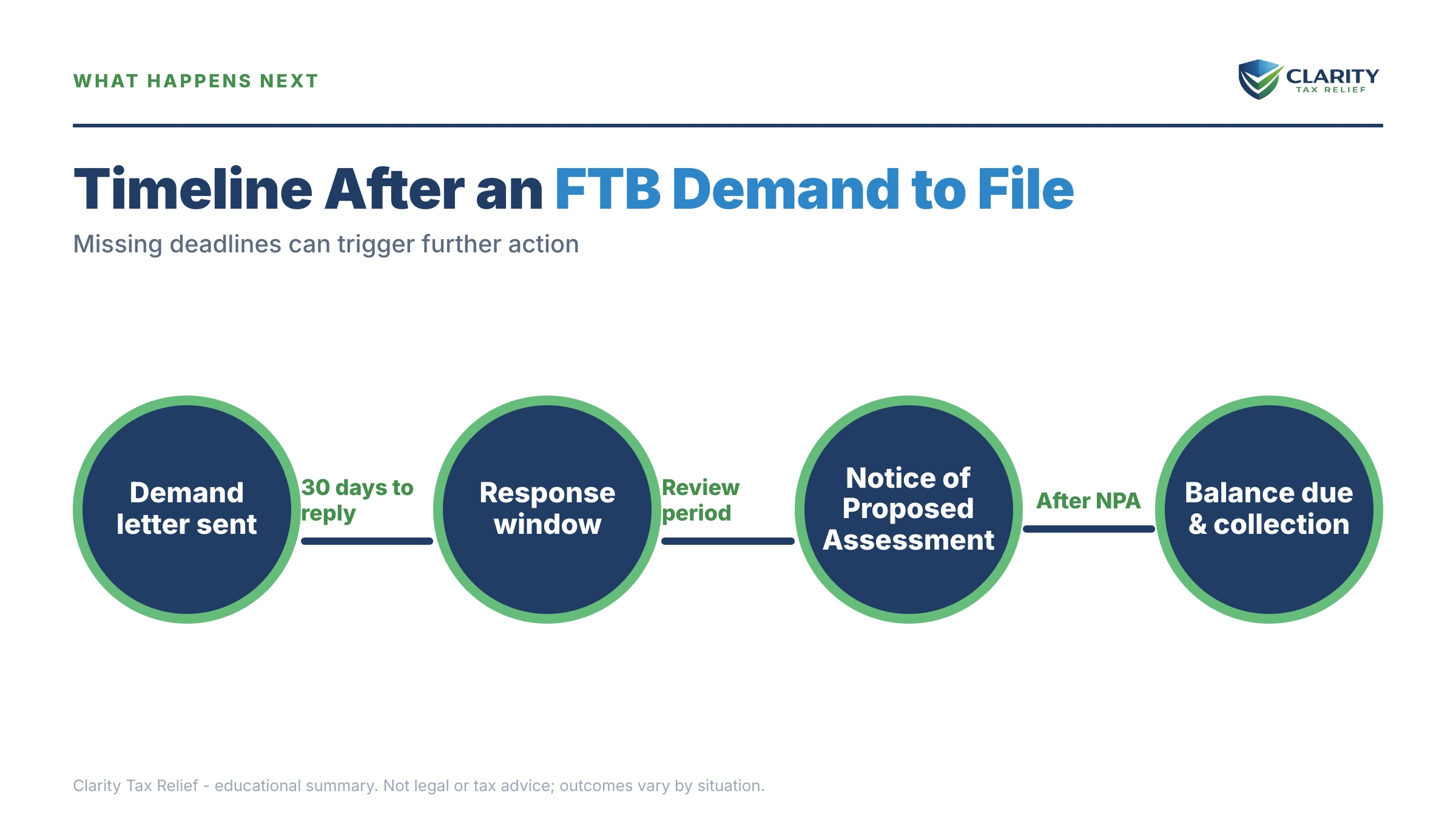
Ignoring an FTB demand to file leads to an estimated assessment with no deductions, a 25% demand penalty, and a balance collectible for up to 20 years. The escalation runs in a fixed order, and each stage removes an option you have today:
- Request for Tax Return (FTB 4600) — the first touch. File, prove you filed, or explain why you don't have to. No penalty attaches to the request itself.
- Demand for Tax Return — the formal stage you're likely at now. Ignoring this is what triggers the 25% demand penalty on any tax later assessed.
- Notice of Proposed Assessment (NPA) — the FTB computes your tax from third-party income data, applying no deductions, no business expenses, and often the least favorable filing status. You have 60 days from the NPA date to file a written protest.
- Final assessment — if the protest window passes, the proposed number becomes a legal debt. The demand penalty, the late-filing penalty, a filing enforcement cost recovery fee, and interest are all baked in, and FTB collection fees get added as enforcement starts.
- Active collection — the FTB can issue an Order to Withhold against your bank account (an FTB bank levy), send an Earnings Withholding Order to your employer (FTB wage garnishment), and record a state tax lien — all without going to court. Under California's 20-year collection statute (R&TC §19255), that debt can follow you for two decades.
Notice what's brutal about this design: the FTB's estimate is intentionally unfavorable. Gross 1099 income with no expenses. Sale proceeds with no basis. It isn't personal — the estimate exists to make you file. But if you never do, the inflated number is the one that gets collected.
| Penalty or charge | Amount | When it applies |
|---|---|---|
| Demand penalty | 25% of the assessed tax | Failing to file after a formal demand (R&TC §19133) |
| Late-filing penalty | 5% of unpaid tax per month, up to 25% | Return filed after the due date (R&TC §19131) |
| Filing enforcement cost recovery fee | Flat fee — current amount printed on your notice | The FTB has to pursue the missing return through filing enforcement |
| Interest | Accrues on unpaid tax and penalties at the FTB's current rate | Runs from the original due date until the balance is paid |
Holding an FTB demand to file right now?
Send us a photo of it before the reply-by date on your notice passes. An experienced tax professional will confirm whether you actually owe a California return, what the year really looks like with proper deductions, and how to stop the estimated assessment — free and confidential.
Your options: how to answer an FTB demand for tax return
Every FTB demand to file has exactly three valid responses — file, prove, or explain — and each stops the estimated assessment. What happens after depends on whether the real return shows a balance you can pay.
| Option | Who it fits | What it does |
|---|---|---|
| File the actual return | Anyone who had a California filing requirement that year | Replaces the FTB's zero-deduction estimate with your real numbers; penalties recompute on the true tax |
| Prove you already filed | You filed but it didn't post (name change, address change, paper return) | Send a copy of the return and proof of filing; the case closes with no penalty |
| Show no filing requirement | Nonresidents, people below the filing threshold, no CA-source income | A written explanation by the reply-by date closes the year — silence gets you assessed as a resident |
| Protest the NPA | You already received a Notice of Proposed Assessment and disagree | A written protest within 60 days of the NPA date keeps the assessment from becoming final |
| FTB payment plan | The filed return shows a balance you can pay monthly | Monthly installments stop levies and garnishments while you pay; interest continues |
| Hardship / deferred collection | Paying anything would leave you unable to cover basic living costs | Documented on FTB Form 3561, the FTB can pause active collection while your finances stay tight |
| FTB offer in compromise | The balance genuinely exceeds what your income and assets could ever pay | Settles for less than the full amount — means-tested and requires all returns filed first |
Note the sequencing built into that last row: every resolution program requires the missing returns filed first. You cannot negotiate a balance built on an estimate — filing is step one no matter which path you end up on. For the general playbook on payment plans, hardship status, and settlements, see our pillar guide on how to settle tax debt yourself; this page stays focused on what's unique to the demand-to-file situation.
If penalties survive the filing — and the demand penalty often does even after you file, since the trigger was ignoring the demand — FTB penalty abatement is a separate request with its own reasonable-cause standard. California is stingier here than the IRS, but relief for documented illness, disaster, or FTB error is real.
The math: how a $76,400 FTB balance grows from unfiled returns
Say you're a renter with three unfiled California years, and 1099s from those years put the FTB's estimated tax at $48,000 total. You ignored the request, then the demand, then the NPAs. Here's how the final bill stacks — this is a hypothetical, but the mechanics are exactly what the statute prescribes:
- Estimated tax (three years, no deductions): $48,000
- Demand penalty (25% of tax): $12,000
- Late-filing penalty (up to 25% of tax): $12,000
- Filing enforcement fees plus accrued interest: roughly $4,400
- Total: $76,400 — and an Order to Withhold hits your bank account for it
Now run the counterfactual. Those 1099s were gross self-employment income; the real returns, with legitimate business expenses, show actual tax of $19,000 across the three years. File them — even this late — and the tax drops by $29,000, while the percentage penalties recompute on $19,000 instead of $48,000: roughly $4,750 each instead of $12,000 each. The total falls from $76,400 to somewhere near $30,000 before interest. Filing the real returns cuts the bill by more than half — and a $30,000 balance fits an ordinary payment plan, while a $76,400 levy on a renter's checking account does not.
That's the core lesson of every demand-to-file case: the FTB's number is a placeholder designed to be replaced. The only person who can replace it is you.
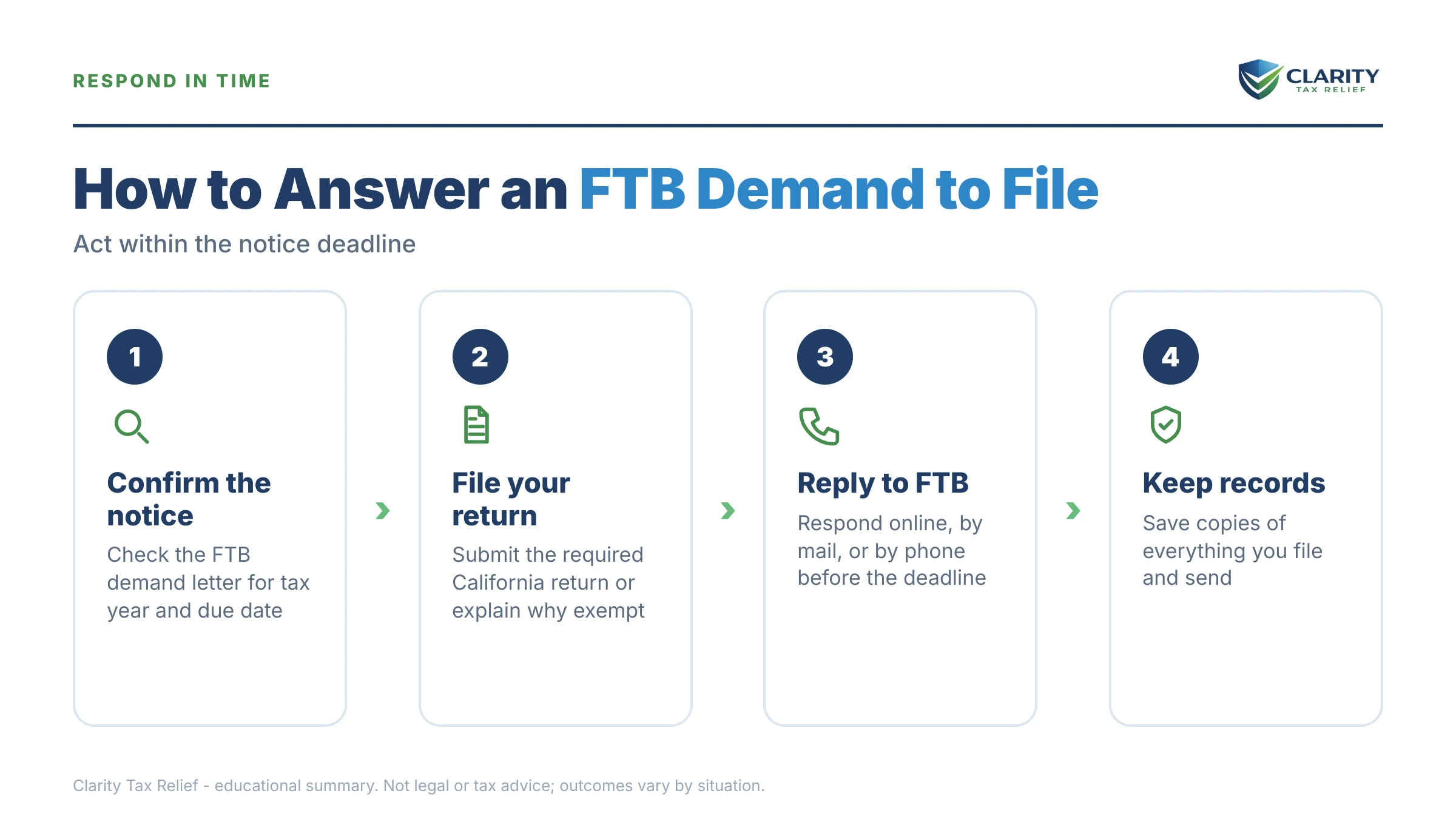
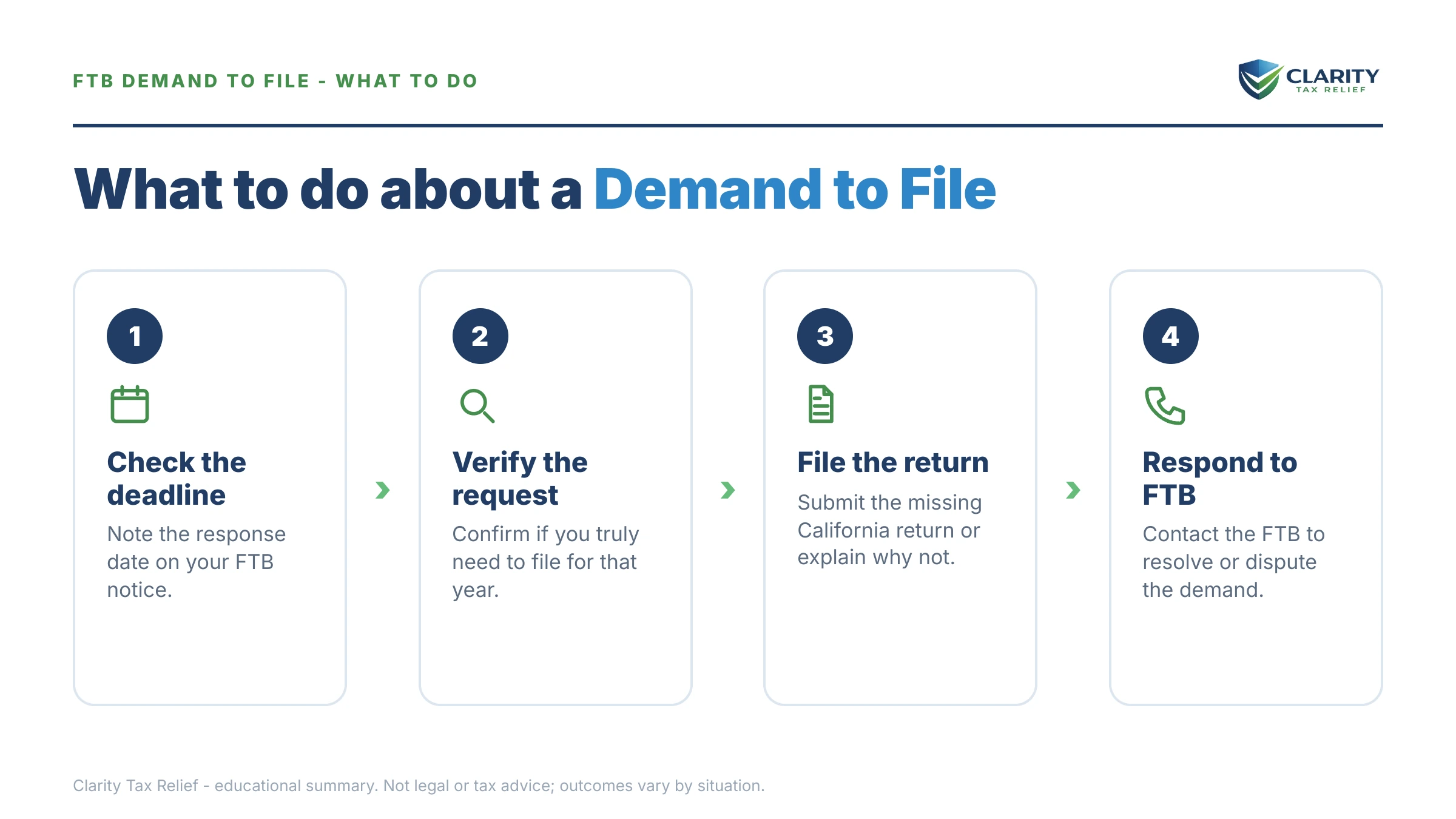
How to respond to an FTB demand to file, step by step
- Find the tax year and reply-by date. Read the notice carefully: it names the specific tax year the FTB wants and prints the date your response is due. Everything else runs off that date.
- Confirm whether you had a California filing requirement. Check your residency, income sources, and California's filing thresholds for that year on ftb.ca.gov. If you had no requirement, your response is an explanation, not a return.
- Pull your income records. Request an IRS wage and income transcript for the year, open a MyFTB account to see what California has on file, and gather bank statements if you had self-employment income.
- File the real return — or send proof or an explanation — by the printed date. File an accurate return with every deduction you're entitled to, send proof if you already filed, or explain in writing why you had no filing requirement. Any of the three stops the estimated assessment.
- Resolve any balance before collection starts. If the return shows tax you can't pay, set up an FTB payment plan, document hardship on Form 3561, or evaluate an FTB Offer in Compromise before liens and levies begin.
If the records for that year are long gone, don't let that stall you — reconstruction is standard practice, and our guide to filing back taxes with no records walks through rebuilding a year from transcripts and bank statements.
What if you weren't a California resident that year?
Nonresidency is a defense you must raise — the FTB will never assume it for you. Demands to file routinely reach people in Texas, Nevada, and Florida years after they left, because the state's data still shows a California license, a registered vehicle, or a CA-source 1099.
Your response depends on the facts. If you had genuinely no California-source income and weren't a resident, a written explanation with your move date and out-of-state evidence usually closes the year. If you had partial-year or CA-source income, a nonresident/part-year return (Form 540NR) reports only the California portion — often a fraction of what a resident assessment would be. Silence gets you assessed as a full-year resident on everything.
Be careful with high-income move-out years: if the FTB contests when residency actually ended, the dispute can escalate into a full California residency audit, where the state examines where you slept, banked, voted, and worked. A clean, well-documented response to the demand is often what keeps that door closed.
When you can handle this yourself — and when to get help
Handle it yourself when the situation is simple: one missing year, records you can pull from a wage transcript, and a return that will show a small balance or a refund. Filing that return by the reply-by date, then setting up a payment plan online if needed, requires no professional and costs you nothing but an afternoon.
Experienced help changes the outcome when the stakes or the complexity climb:
- A levy or garnishment is already in motion — the filing fixes the number, but stopping the enforcement action is a separate, time-critical negotiation.
- Multiple unfiled years — the order you file in, and how self-employment expenses are reconstructed and documented, can swing the total by tens of thousands, as the worked example above shows.
- A residency dispute — the wrong sentence in a self-written explanation can hand the FTB the argument it needs.
- Federal returns are also missing — the FTB and IRS share data, so a California filing usually needs a coordinated federal plan behind it.
If any of those describe your situation, get your notice and the year's income picture in front of an experienced tax professional before you respond — a free review at Clarity's consultation page or a call to (888) 825-7779 takes minutes and can't make things worse.
Terms on your notice, decoded
- Demand for Tax Return — the FTB's formal notice that it wants a missing return; ignoring it is what authorizes the demand penalty.
- Notice of Proposed Assessment (NPA) — the FTB's computed tax bill for the unfiled year; it becomes final unless you file a return or a written protest within 60 days.
- Demand penalty — 25% of the assessed tax, added under R&TC §19133 for failing to file after a demand; separate from and on top of the late-filing penalty.
- Filing enforcement cost recovery fee — a flat fee the FTB charges to recover the cost of chasing the return; the current amount is printed on your notice.
- Order to Withhold — the FTB's bank levy: a one-shot seizure order sent directly to your bank, no court involved.
- Earnings Withholding Order for Taxes — the FTB's wage garnishment, served on your employer and continuous until the debt is resolved or released.
FTB demand to file: questions people ask
What happens if you ignore an FTB demand to file?
The FTB files for you: it issues a Notice of Proposed Assessment built from third-party income data with zero deductions, then adds a 25% demand penalty on top of the late-filing penalty (up to another 25%), plus interest and a filing enforcement fee. Once the assessment turns final, the balance is collectible for up to 20 years, and the FTB can levy bank accounts and garnish wages without a court order.
How much is the FTB demand penalty?
The demand penalty is 25% of the tax the FTB assesses, imposed under California Revenue and Taxation Code Section 19133 when you fail to file after a formal demand. It stacks on top of the separate late-filing penalty, which also runs up to 25%, so ignoring a demand can add roughly half the tax again in penalties alone. Filing a correct return recomputes those penalties on your real tax, which is usually far lower than the FTB's estimate.
What if I wasn't a California resident that year?
You still have to respond — nonresidency is a defense you must raise, not one the FTB assumes. Demands routinely go to people who moved away, because a California professional license, DMV record, or CA-source 1099 stayed in the state's data. Reply by the printed date explaining why you had no California filing requirement; if you stay silent, the FTB assesses you as if you were a full-year resident, and a contested case can escalate into a residency examination.
Can I still respond after the FTB has already assessed the tax?
Yes. Within 60 days of a Notice of Proposed Assessment you can file a written protest, and even after the assessment turns final, filing the actual return generally gets the balance revised down to the true tax, with penalties recomputed. What does not happen automatically is a pause in collection — if a bank levy or wage garnishment is already in motion, you need to contact the FTB about the enforcement action at the same time you file.
How does the FTB know I didn't file?
Filing enforcement runs on data matching. The FTB cross-references IRS filings, W-2 and 1099 records, mortgage-interest statements, EDD wage data, professional and occupational license rolls, and DMV registrations against its own return database. When income or California ties show up with no return attached, a Request for Tax Return goes out automatically. And because no return was filed, there is no statute of limitations stopping the FTB from assessing that year — even a decade later.
Can I get a refund if the demanded return shows California owes me?
Yes, if you're inside the refund window — generally four years from the original due date of the return, or one year from the date of an overpayment, whichever is later. Plenty of demand-to-file cases end this way: withholding covered the tax, and the FTB's scary estimate evaporates once the real return is filed. File past the window and the refund is forfeited, but filing still cancels the proposed assessment.
Do I need records to file a return the FTB is demanding?
You don't need original records — you need a reasonable reconstruction. An IRS wage and income transcript recovers W-2s and 1099s for the year, a MyFTB account shows what California has on file, and bank statements can rebuild self-employment income and expenses. The FTB accepts reconstructed returns prepared in good faith, and a reconstructed return with real deductions almost always beats the FTB's zero-deduction estimate.
Your next 24 hours
- Find two things on the notice: the tax year the FTB wants and the reply-by date printed near the top. Write both down — every option on this page runs off that date.
- Gather your income picture for that year: your federal return if you filed one, an IRS wage and income transcript (free at IRS.gov Get Transcript), and any 1099s or bank statements you can locate.
- Get the notice reviewed free before the reply-by date passes. Send a photo through the 2-minute form or call (888) 825-7779 — an experienced tax professional will tell you whether you truly owe a California return and what the year looks like with real deductions.
For the FTB's own guidance on filing requirements, notices, and payment options, start at the California Franchise Tax Board website.
This guide is general information, not tax or legal advice for your specific situation. Eligibility for IRS programs depends on individual facts and circumstances; no outcome is guaranteed.