
California FTB
FTB Suspended LLC: What It Means and How to Revive It (2026)
The short answer: an FTB suspended LLC has lost its legal right to do business in California — usually because it stopped filing Form 568 returns or stopped paying the $800 annual tax. To restore it, file every missing return, pay or arrange the balance, and submit Form FTB 3557 for a Certificate of Revivor.
You probably didn't find out from the Franchise Tax Board. You found out from a bank rejecting a business account, an escrow officer flagging a closing, or a client's attorney typing your company name into the Secretary of State's search and seeing the word "Suspended." If the divorce split the business one way and the paperwork habit the other, that discovery stings — but suspension is a status, not a sentence, and California has a defined path back called a revivor.
Before it suspends an entity, the FTB mails a warning notice to the LLC's last address on record — the image below shows exactly what that paperwork looks like and where the balance and status details sit, which matters because divorced and relocated owners are exactly the people who never received it.
⏱ The clock that's running: there is no fixed response window on a suspension — the cost is continuous. The $800 annual tax, penalties, and interest keep accruing every year the LLC stays suspended, every contract you sign in the meantime is voidable by the other party, and your business name loses its protection. Each month of delay is a month of pure downside.
Why the FTB suspended your LLC
The FTB suspends an LLC for one of two reasons: it stopped filing its California returns, or it stopped paying what it owes — including the $800 annual tax that is due every year, even in years with zero income. Under Revenue and Taxation Code §23301, the entity's "powers, rights, and privileges" are suspended until the account is cured.
For most LLCs the trigger is Form 568, the Limited Liability Company Return of Income. Miss a filing and the FTB typically sends a demand first — our FTB demand to file guide covers that notice — then a pending-suspension warning, then the suspension itself. Unpaid balances follow the same road: the annual tax, the gross-receipts LLC fee (which starts at $900 once receipts reach $250,000), penalties, and interest all count.
Divorce is a common backstory here. One spouse kept the LLC in the settlement; the other had always handled the filings. Nobody filed 568s for a few years, the notices went to an old address, and the suspension landed silently. The FTB doesn't read divorce decrees — it reads its own account ledger.
FTB suspension vs. SOS suspension: which one you have
California LLCs can be suspended by two different agencies, and the cure list is different for each. The status label on the Secretary of State's business search tells you which problem you have:
| Status label | What triggered it | What cures it |
|---|---|---|
| Suspended – FTB | Unfiled Form 568 returns and/or unpaid annual tax, LLC fee, penalties, or interest | File all missing returns, pay or arrange the balance, submit Form FTB 3557 |
| Suspended – SOS | Failure to file the Statement of Information (Form LLC-12) with the Secretary of State | File a current Statement of Information ($20 fee) and pay the $250 penalty, which the FTB bills and collects |
| Suspended – FTB/SOS | Both problems at once — common after several years of neglect | Cure both: returns and balance with the FTB, Statement of Information and penalty for the SOS side |
If both agencies are involved, cure both before expecting the status to flip — reviving one side while the other stays delinquent leaves you suspended.
What an FTB suspended LLC can't do (and what it still owes)
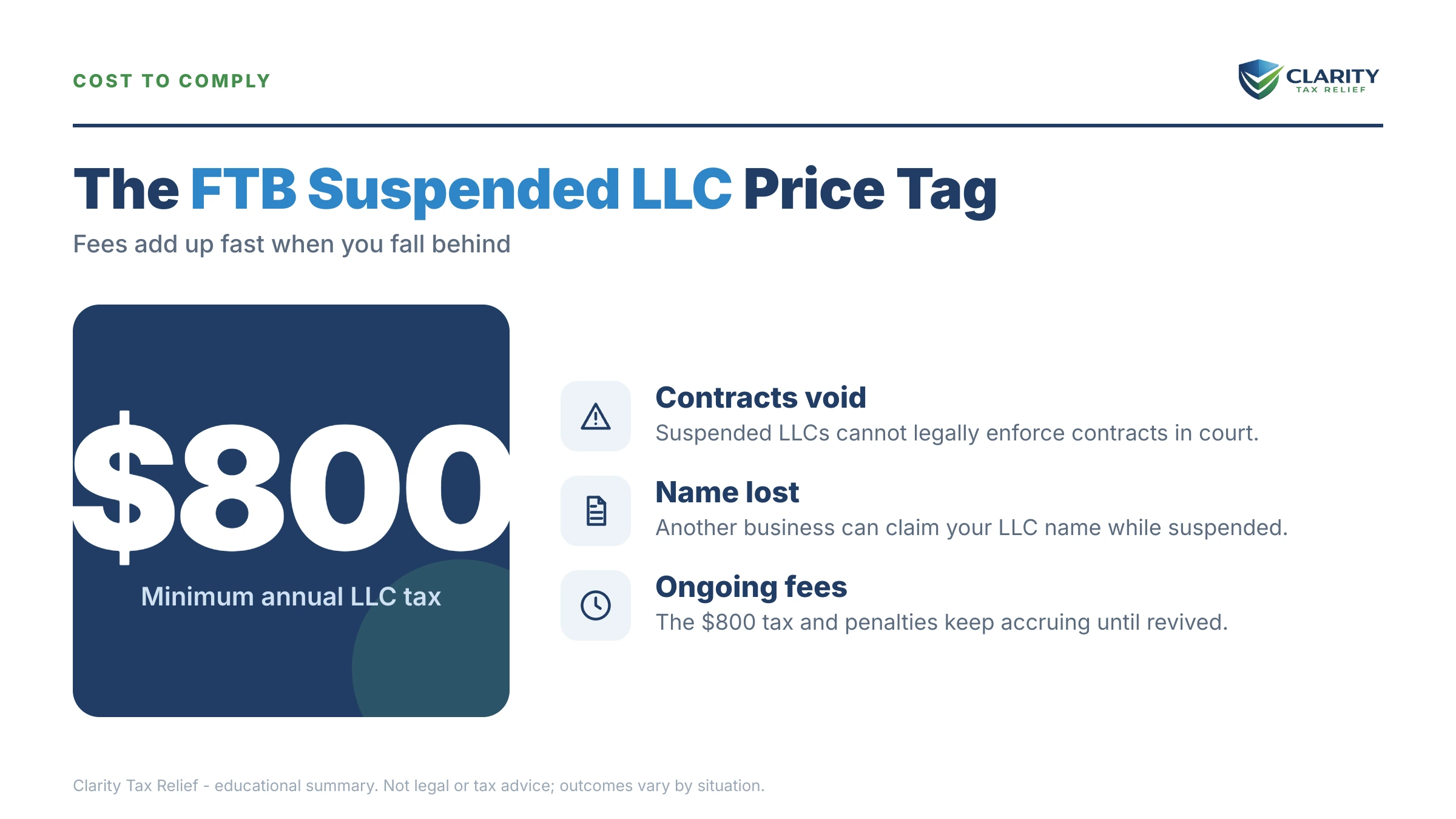
A suspended California LLC loses its legal right to do business, and every contract it signs while suspended can be voided by the other party. Concretely, suspension blocks the LLC from:
- Enforcing its contracts. Agreements made during suspension are voidable at the other side's option — a customer who owes you money can raise your status as a defense.
- Suing or defending in California courts. A suspended LLC can't file a lawsuit or answer one. If you're sued while suspended, a default judgment is a real possibility.
- Closing escrow, refinancing, or getting a certificate of good standing. Banks, lenders, title companies, and many licensing boards check the status.
- Protecting its name. While suspended, another filer can take the LLC's name — and if that happens, revivor will require choosing a new one.
- Dissolving. This is the trap that surprises owners who just want out: a suspended LLC cannot file a cancellation with the Secretary of State, so the $800 annual tax keeps accruing until you revive it and close it properly.
What suspension does not do is pause the debt. Penalties and interest run, and the FTB's collection machinery — refund intercepts, liens, levies — keeps operating against the balance. Suspension freezes your rights, not the FTB's.
What happens if you ignore the suspension
Suspension is not the FTB's final move — it's the stage where your business rights stay frozen while collection keeps running. Here's the sequence, in order:
- Missed filings or unpaid balance. The FTB sends billing notices and a demand to file for missing Form 568 years. Ignore these and it can assess the tax on its own.
- Notice of pending suspension. Mailed to the LLC's last address on record — which is why owners who moved or divorced often never see it.
- Suspension posted. The status flips on the Secretary of State's public record. Contracts become voidable, court access closes, and the name loses protection.
- The balance compounds. Each new year adds another $800 of annual tax plus late-filing and late-payment penalties, and the FTB layers on its own FTB collection fees as the account moves through enforcement. Keep operating while suspended after a written demand and a $2,000-per-year penalty can be added on top.
- Enforcement against the entity — and against you. The FTB can record an FTB tax lien and issue an FTB bank levy on the entity's accounts. And because a single-member LLC's profits pass through to your personal return, any personal-side assessment follows you individually — wage garnishment included.
- The 20-year clock. Under R&TC §19255, California's 20-year collection statute gives the FTB twice the IRS's runway. Waiting this out is not a strategy.
The whole sequence is automated. Nobody at the FTB is deciding to squeeze you — the system simply keeps adding cost until someone cures the account.
LLC showing "Suspended" right now?
Every year it stays that way adds another $800 plus penalties, and every contract you sign stays voidable until you're revived. Send us your FTB notice or your SOS status page — an experienced tax professional will map the exact revivor path and what it will cost. Free, confidential, no pressure.
Your options to restore good standing
Every path back runs through the same gate: all returns filed, the balance addressed, and Form FTB 3557 (Application for Certificate of Revivor) submitted. The variable is how you handle the money and how fast you need it done:
| Path | Who it fits | What the FTB requires |
|---|---|---|
| Pay in full + revivor | Entity balance you can cover now | All missing Form 568s filed, balance paid, Form 3557 submitted |
| Payment arrangement + revivor | Balance too large to clear at once | Returns filed, then ask the FTB about an FTB payment plan — the FTB decides case-by-case whether an arrangement supports revivor |
| Walk-through (expedited) revivor | Pending escrow, contract, license renewal, or lawsuit | Same cure list, processed on an expedited basis — call the FTB and explain the urgency |
| Revive, then cancel | You're done with the business | Entity must be Active before the SOS accepts a cancellation; file a final Form 568 marked final to stop future $800 years |
| FTB Offer in Compromise | Balance genuinely beyond your ability to ever pay | Full financial disclosure and strict review — see how an FTB offer in compromise works before counting on it |
One narrow extra path worth asking about: California has an administrative-dissolution process for certain domestic LLCs that stopped doing business, which in limited cases can abate unpaid annual taxes for the dormant years. Eligibility is tight — confirm your facts with the FTB before assuming it applies.
Here's what the pieces actually cost. Note the revivor application itself is free — the price tag is entirely the cure:
| Item | Typical cost | Notes |
|---|---|---|
| Form FTB 3557 revivor application | $0 | No filing fee; processing typically takes weeks once the account is cured — walk-through revivors move faster |
| $800 annual tax | $800 × each unpaid year | Accrues every year until the LLC is formally canceled — suspension does not stop it |
| LLC gross-receipts fee | Starts at $900 at $250,000 in receipts | Only for years the LLC's California receipts crossed the threshold |
| Late-filing penalty (Form 568) | About $18 per member, per month, up to 12 months | Applies per unfiled return year, plus late-payment penalties on unpaid tax |
| Statement of Information (if SOS-suspended) | $20 filing fee + $250 penalty | Filed with the Secretary of State; the penalty is billed and collected by the FTB |
| Interest | Varies with balance and age | Compounds until the balance is paid or resolved |
Say the divorce left you with a suspended LLC and $48,300 in FTB debt
Here's a clearly hypothetical example with the math shown. Say your 2022 divorce left you the consulting LLC while your ex kept the bookkeeper. The last Form 568 filed was 2020; the FTB suspended the entity in 2023, with notices going to the old marital address. By mid-2026 the combined damage looks like this:
- Entity side: five unfiled years (2021–2025) × $800 annual tax = $4,000, plus roughly $1,080 in late-filing penalties (about $216 per year for a single-member LLC) and about $1,220 in late-payment penalties and interest — call it $6,300 at the LLC level.
- Personal side: because the LLC's profits pass through to your 1040 and 540, the FTB assessed the unreported income against you personally — $42,000 in tax, penalties, and interest across those years.
- Total: $48,300.
The good news is those two accounts resolve separately. The revivor only requires the entity side cured: file the five Form 568s and pay or arrange the roughly $6,300, then submit Form 3557. The FTB won't hold your LLC's revivor hostage to your personal balance — but the same agency is collecting both, so the $42,000 needs its own plan. At that size it's above the FTB's online payment-plan threshold (generally $25,000 or less, paid within 60 months), which means a financial disclosure on FTB Form 3561. Spread over 60 months, $42,000 is roughly $700 a month before interest — a number worth knowing before you call, because it frames whether a payment plan, hardship status, or an offer is the realistic route.
One more divorce-specific point: if the decree says your ex is responsible for the tax years you filed jointly, the FTB isn't bound by it. Depending on the facts, FTB innocent spouse relief may reassign part of the personal-side balance — but that's a separate application, not automatic.
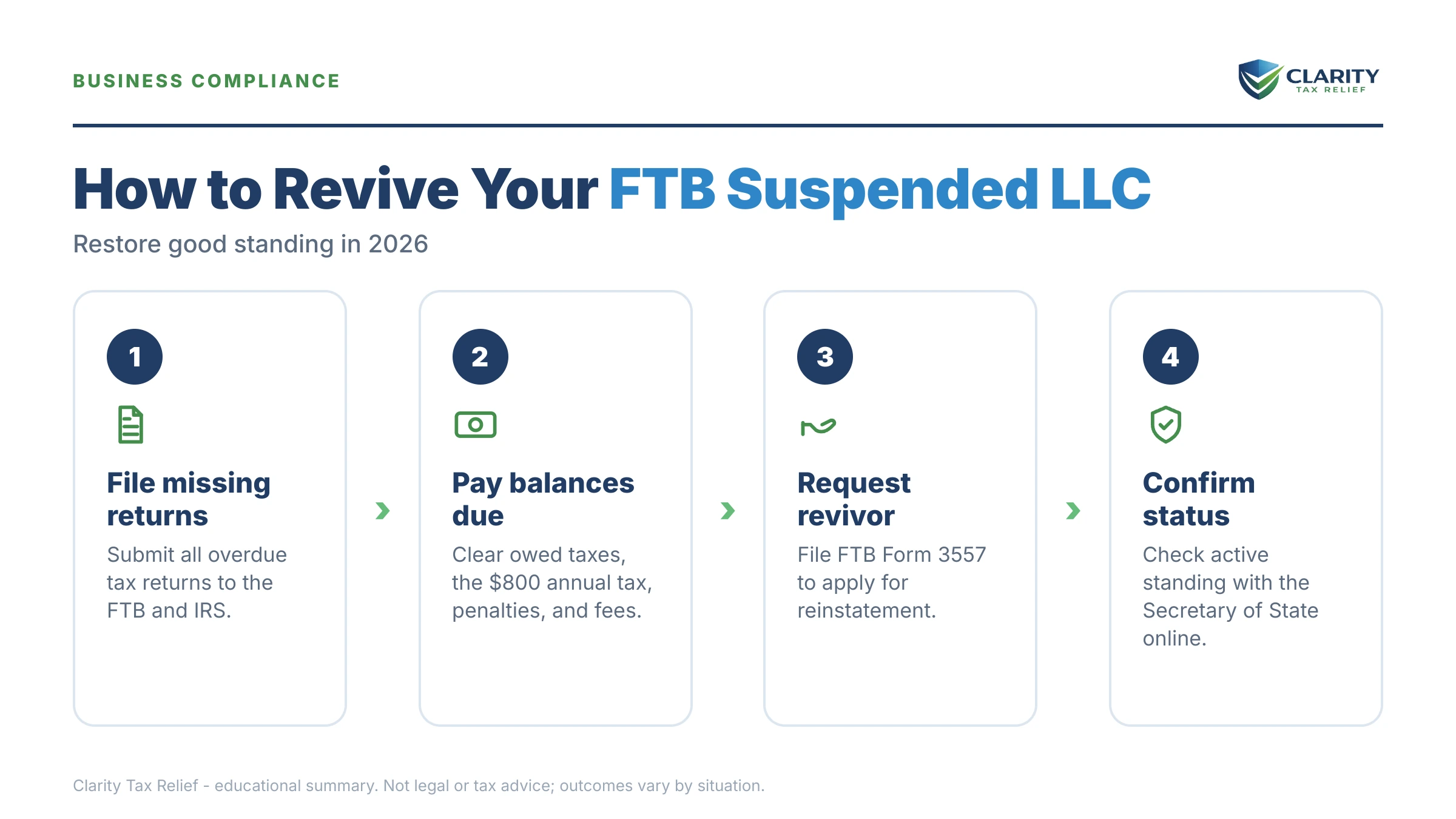
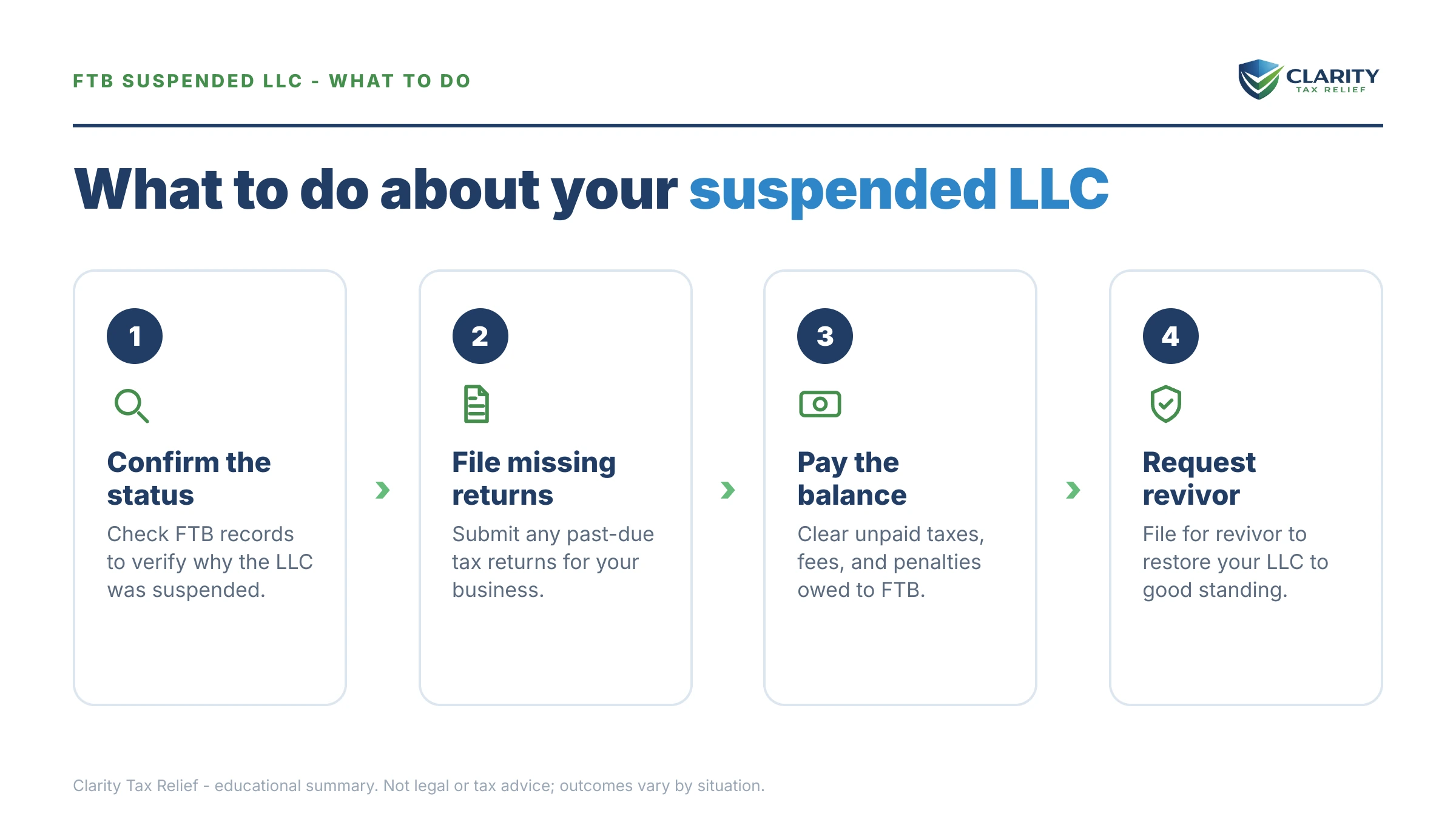
How to revive an FTB-suspended LLC, step by step
- Confirm which agency suspended you — look up the LLC on the Secretary of State's business search and note whether the status reads Suspended – FTB, Suspended – SOS, or both; the cure list depends on it.
- File every missing Form 568 — prepare and file each unfiled year's Form 568, and file a current Statement of Information (Form LLC-12) if the SOS is part of the suspension.
- Address the entity balance — pay the LLC's annual taxes, penalties, and interest in full, or contact the FTB about a payment arrangement; the FTB decides case-by-case whether an arrangement supports revivor.
- Submit Form FTB 3557 — file the Application for Certificate of Revivor, and request a walk-through revivor if a contract, escrow, license, or lawsuit is waiting on your good standing.
- Verify Active status and calendar the deadlines — check the SOS record shows Active again, confirm your name wasn't taken while suspended, and calendar the Form 568, annual tax, and Statement of Information due dates so this never repeats.
When you can handle the revivor yourself
Plenty of suspensions are genuinely DIY. If your LLC is one or two returns behind, the balance is a few thousand dollars you can pay, and nothing urgent is pending, you can file the missing 568s, pay online, and submit Form 3557 without hiring anyone. An SOS-only suspension is even simpler: file the Statement of Information, pay the fee and penalty, done. Our how to settle tax debt yourself guide covers the general self-help playbook.
Experienced help changes the outcome in a narrower set of situations: multiple unfiled years on both the entity and personal side, a personal balance too large for a self-service plan, a pending escrow or lawsuit that needs a walk-through revivor done right the first time, divorce-tangled records where innocent spouse relief is in play, or any question about whether the entity's debt reaches you personally — our guide to sole proprietorship vs LLC taxes explains where that line sits. Sequencing matters here: filing the returns in the wrong order, or paying the wrong account first, can delay the revivor by months.
Terms on your notice, decoded
- Suspension / forfeiture: the same penalty by two names — "suspended" for domestic entities, "forfeited" for out-of-state entities registered in California. Both mean the entity's rights are frozen.
- Certificate of Revivor: the FTB document that restores the LLC to good standing once the account is cured; you apply with Form FTB 3557.
- Walk-through revivor: the FTB's expedited revivor process for urgent situations — pending escrow, litigation, or a contract that can't wait for standard processing.
- Contract voidability: the rule that lets the other party cancel any contract your LLC entered while suspended; the FTB has a separate relief-from-voidability application, with its own assessment, for contracts signed during the gap.
- Statement of Information: the Form LLC-12 report filed with the Secretary of State (not the FTB) listing the LLC's address, managers, and agent — skipping it triggers the SOS side of suspension.
- Annual tax vs. LLC fee: the annual tax is the flat $800 every California LLC owes every year; the LLC fee is the additional charge that kicks in once gross receipts reach $250,000.
FTB suspended LLC questions, answered
Can a suspended LLC still operate in California?
Not legally. A suspended LLC loses its right to do business, and every contract it enters can be voided by the other party. If the LLC keeps operating and ignores a written demand to file, the FTB can also assess a $2,000 penalty per tax year on top of the existing balance. Operating while suspended adds risk without adding any protection.
How much does it cost to revive an FTB suspended LLC?
The revivor application itself (Form FTB 3557) is free. The real cost is curing the suspension: $800 in annual tax for each unpaid year, late-filing and late-payment penalties, interest, and — if the Secretary of State is involved — a $20 Statement of Information filing fee plus a $250 penalty. For an LLC that missed three years, the entity-level cost typically lands in the low thousands.
How long does an FTB revivor take?
It depends on how fast you can file the missing returns and address the balance — that is usually the slow part, not the FTB's processing. Once everything is filed and paid or arranged, standard revivor processing can take several weeks. If a contract, escrow, or lawsuit is pending, ask the FTB for a walk-through revivor, which is handled on an expedited basis.
Does the $800 annual tax stop while the LLC is suspended?
No — this is the most expensive misconception about suspension. The $800 annual tax keeps accruing every year until the LLC is formally canceled with the Secretary of State, and a suspended LLC can't file a cancellation. That means walking away doesn't cap the bill; the balance grows until you revive the entity and either operate it or close it properly.
Can I just abandon the suspended LLC and start a new one?
You can form a new LLC, but the old debt doesn't vanish. Pass-through income tax from the old LLC is already your personal liability, the FTB can collect entity balances for up to 20 years, and the suspended LLC keeps accruing $800 a year because it can't be canceled while suspended. In most cases reviving and properly closing the old entity costs less than ignoring it.
Am I personally liable for my suspended LLC's FTB debt?
It depends on which tax. Income tax on a single-member LLC's profits passes through to your personal return, so that debt is yours regardless of the entity's status. The $800 annual tax and LLC fee are generally the entity's liability, though continuing to run the business while suspended can expose you personally. A divorce decree assigning the business to one spouse does not bind the FTB.
Can a suspended LLC sue or defend itself in court?
No. A suspended LLC cannot bring a lawsuit, defend one, or enforce its contracts in California courts. If someone sues the LLC while it's suspended, it can lose by default because it isn't allowed to answer. Reviving the entity restores the ability to litigate, which is one of the most common reasons owners request a walk-through revivor.
Your next 24 hours
- Look up the real status. Search your LLC on the California Secretary of State's business search and write down exactly what the status field says — FTB, SOS, or both — then dig out any FTB notice for the balance figure and the years involved.
- Gather the paper. Your last filed Form 568, whatever income records exist for the missing years, the divorce decree if the business changed hands, and your Franchise Tax Board account login if you have one.
- Get the revivor path mapped free. Call (888) 825-7779 or use the 2-minute form at claritytaxrelief.com/#consult. Every year the LLC stays suspended adds another $800 plus penalties and interest — curing it now is the cheapest it will ever be.
This guide is general information, not tax or legal advice for your specific situation. Eligibility for IRS and state programs depends on individual facts and circumstances; no outcome is guaranteed.