
California / FTB
California Residency Audit: What Triggers It, the Tests the FTB Uses, and How to Respond (2026)
The short answer: a California residency audit is the Franchise Tax Board's examination of whether you were truly a nonresident during years you claimed to live elsewhere. The FTB applies the "closest connections" test — not just day counts — and if you lose, it can assess tax, a 20% accuracy penalty, and interest going back four years or more.
You signed the lease in Reno, updated your address, and filed California's Form 540NR as a part-year resident — you thought the move was done. Now an FTB letter says your residency for those years is under examination, and it wants to know where you slept, banked, voted, and saw the dentist.
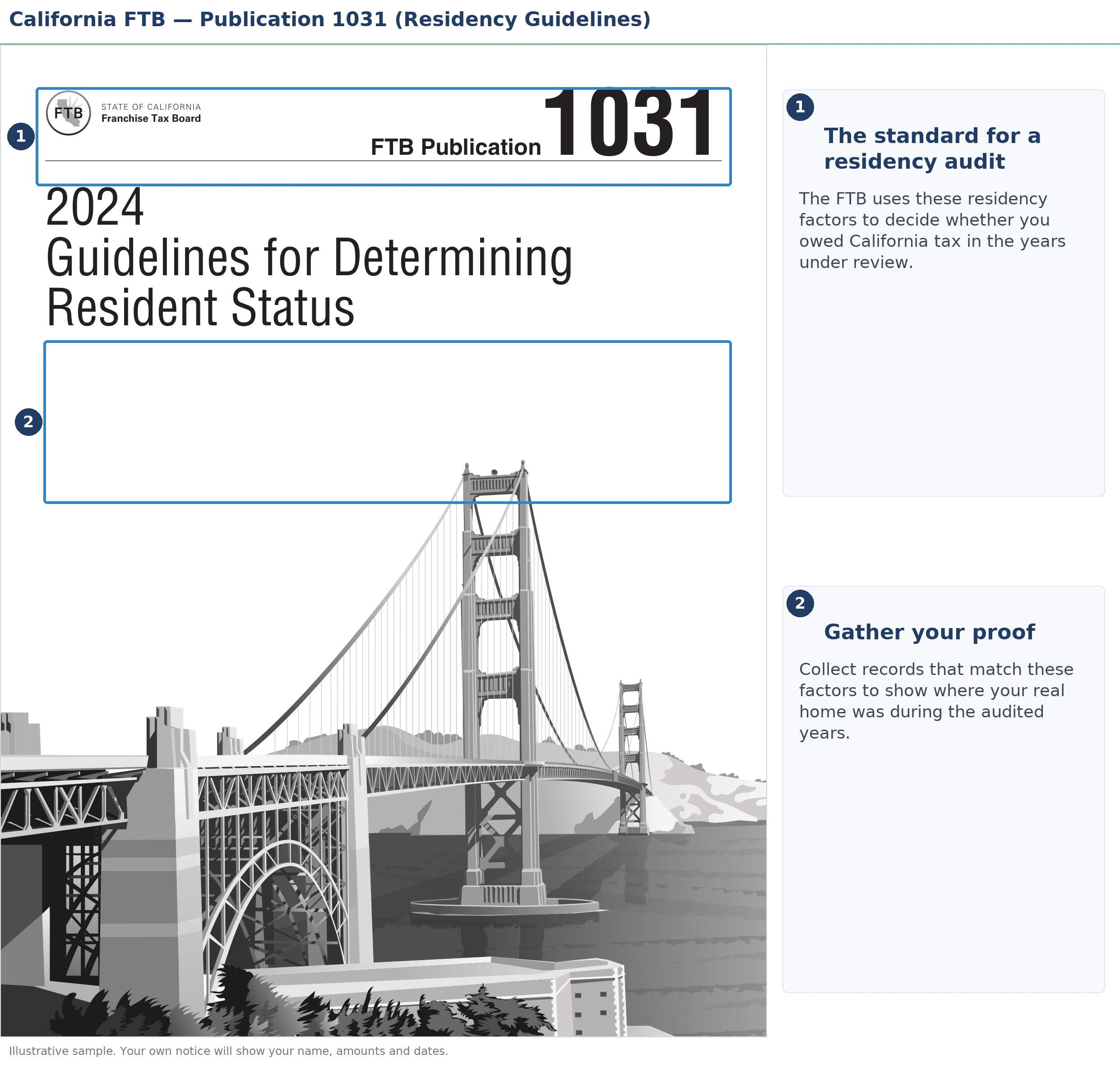
This is winnable, but it's won on paper. The FTB already built a file on you before mailing that letter; your job now is to build a better one. The image below shows what the FTB's residency audit paperwork looks like and where to find the two things that drive everything else — your response deadline and the tax years under exam.
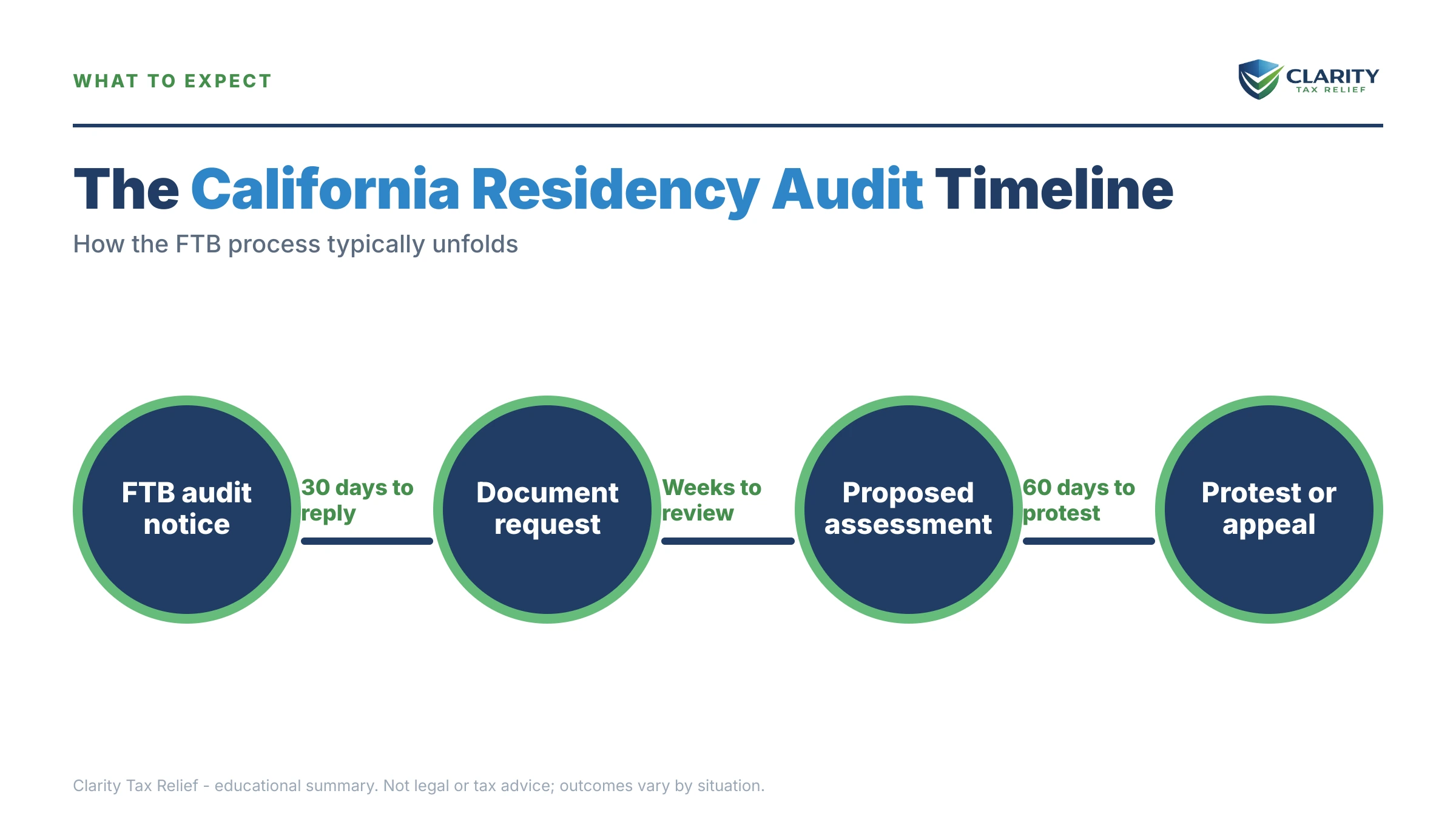
⏱ Your deadlines: the first one is the response date printed on your audit letter. If the audit ends in a bill, you have 60 days from the date on a Notice of Proposed Assessment to file a protest. Miss that window and the assessment becomes final — and California can then collect it for up to 20 years.
Why the FTB opened a residency audit on you
The FTB opens residency audits almost exclusively around one pattern: someone who filed California resident returns for years suddenly files a nonresident return — or stops filing — in a year with a large income event. A stock or RSU sale, a business sale, an IPO windfall, a big bonus, or a retirement payout landing in the same year as a move to Nevada, Texas, Florida, or Washington is the profile the FTB's screening is built to catch.
The state doesn't need you to tell it anything. It cross-matches W-2 and 1099 addresses, K-1s from partnerships and S corps, mortgage-interest and property records, DMV registrations, voter rolls, professional licenses, and your own prior Form 540s. If any of that trail still points to California in your "gone" year, the mismatch generates the letter.
Timing matters here too. The FTB generally has four years from the date you filed to audit a return — a year longer than the IRS's standard window — and if you never filed a California return for a year it thinks you were a resident, there's no time limit at all. That's why audits of a 2022 or 2023 move are landing in 2026 mailboxes now. If you're weighing this against a federal balance, our hub on state tax debt vs IRS covers which fire to put out first; this page stays on the California fight. And if you haven't moved yet, the planning version of this problem is covered in moving out of California taxes.
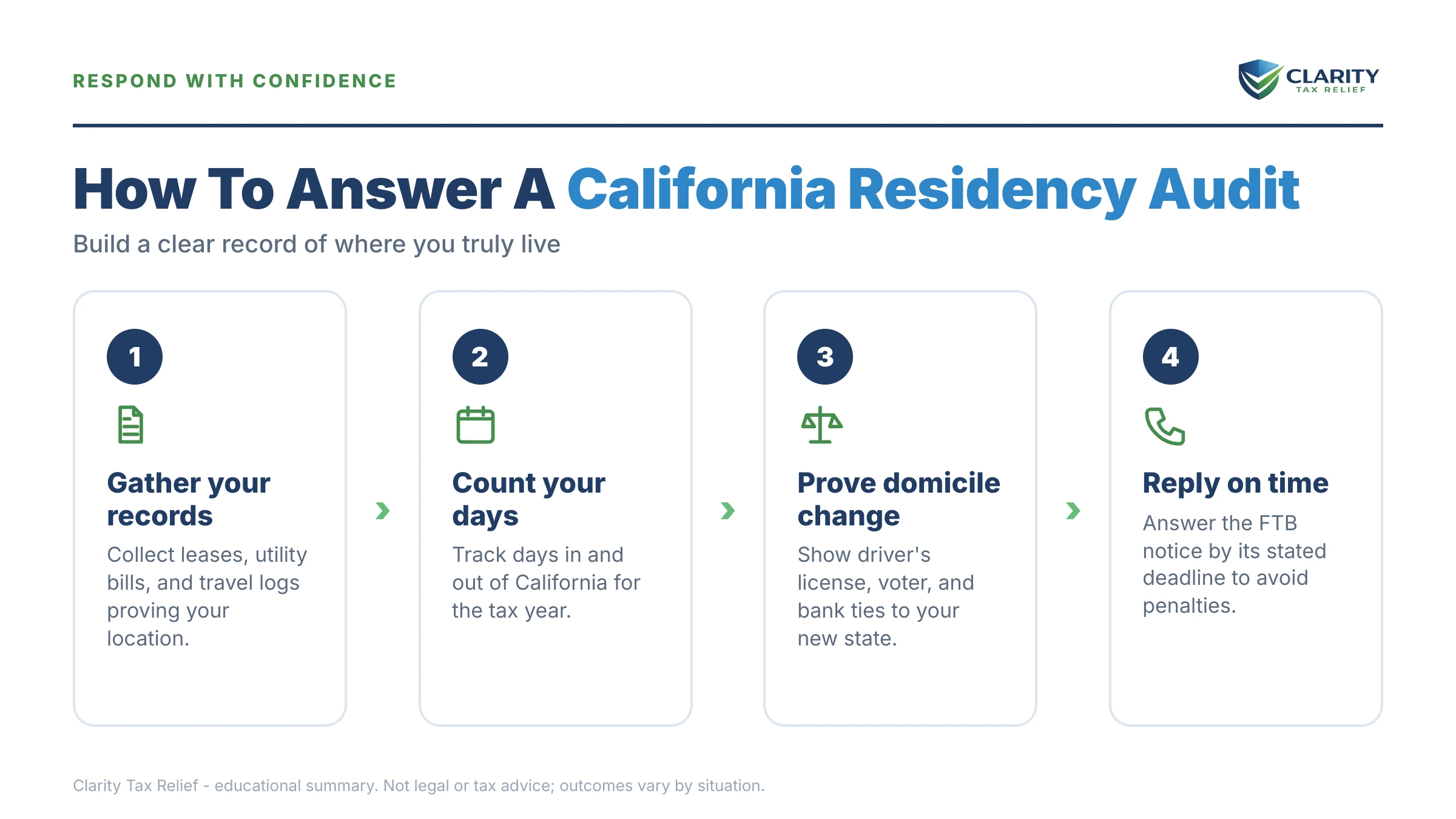
The tests the FTB uses to decide California residency
California defines a resident as anyone in the state for other than a temporary or transitory purpose — and anyone domiciled in California who is outside the state only for a temporary or transitory purpose (Revenue and Taxation Code Section 17014). That second clause is the trap: leaving physically isn't enough if California can argue you always intended to come back.
Domicile is your one true home — the place you intend to return to. Residency is broader. You can be domiciled in Texas and still be taxed as a California resident for a year you effectively lived here. The FTB's own guide to these rules is Publication 1031, and its auditors apply a handful of specific presumptions and safe harbors on top of the general test:
- The nine-month presumption. Spend more than nine months of a tax year in California and you are presumed to be a resident. It's rebuttable, but rarely overcome — and it only runs one direction. Spending less than nine months creates no presumption that you're a nonresident.
- The six-month "visitor" safe harbor. This is narrower than internet folklore suggests. It protects someone domiciled elsewhere who visits California for vacation-type purposes for six months or less, with a home elsewhere and only minor California contacts. It is not a general rule that under-183 days makes you safe.
- The 546-day employment safe harbor. A California domiciliary who leaves under an employment contract for at least 546 consecutive days is treated as a nonresident — but the safe harbor fails if your California-source intangible income exceeds $200,000 in a year, if you return to California more than 45 days in a year, or if the main purpose of the absence is tax avoidance.
If no presumption or safe harbor decides your case — and in most audits none does — the FTB falls back on the test that actually resolves residency disputes: where your closest connections are.
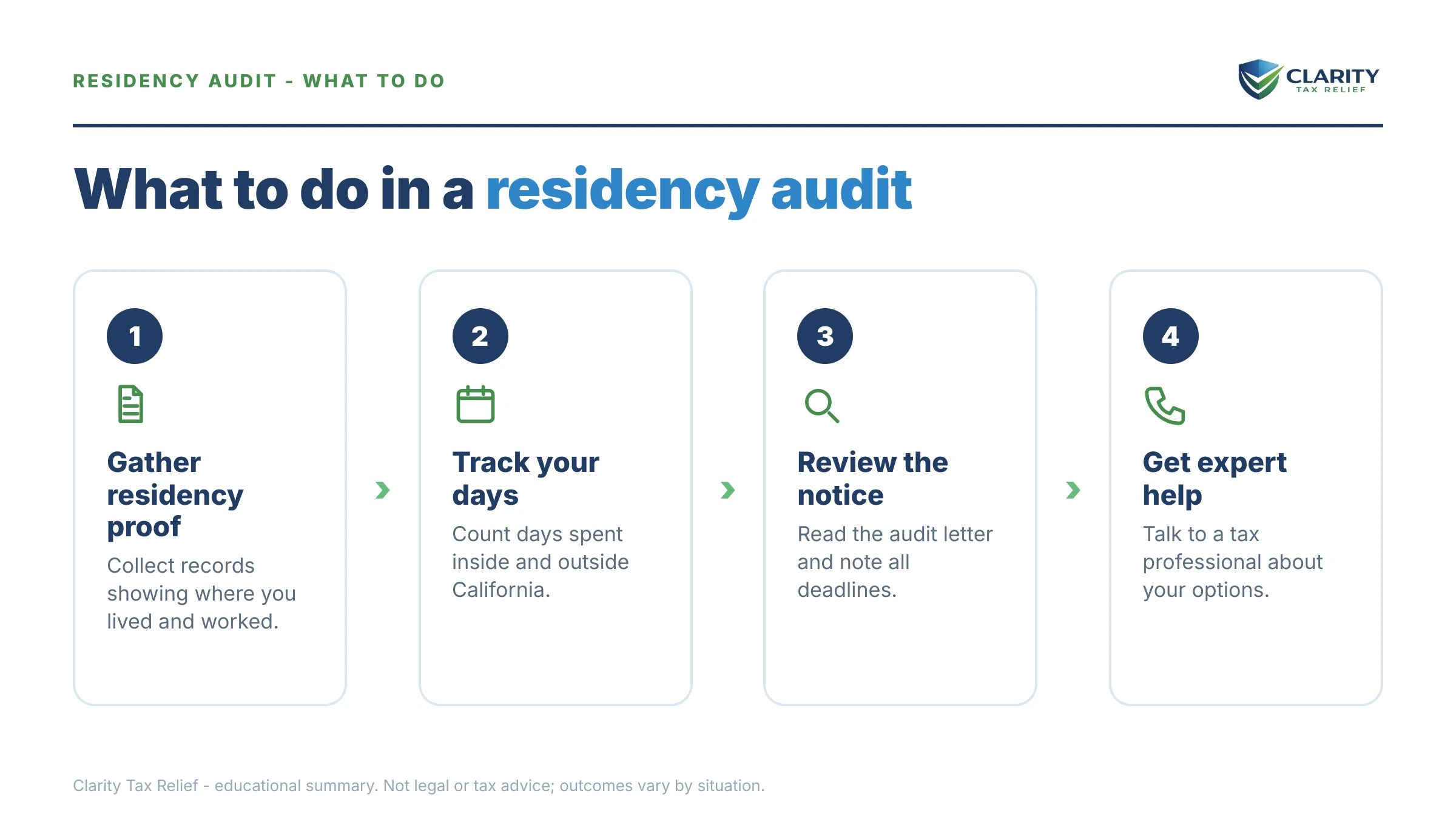
The closest connections test: what the FTB actually weighs
The closest connections test compares your ties to California against your ties to your new state, and the state with the stronger set wins. The factor list comes from the Appeal of Bragg decision and runs to roughly nineteen items; no single factor controls, but a few carry outsized weight. Here's how auditors read them:
| Connection | Points toward California residency | Points toward nonresidency |
|---|---|---|
| Home | You kept a California house or apartment available to you | You gave up the California home; lease or deed in the new state |
| Time | Most days — and holidays — spent in California | Most days, and the ordinary rhythms of life, in the new state |
| Family | Spouse or children remained in California | The whole household moved together |
| License & vehicles | California driver's license and plates kept after the move | New state's license and registration obtained soon after arrival |
| Voting | Still registered (or voting) in California | Registered and voting in the new state |
| Money | California banks, brokers, safe-deposit box, accountant | Accounts and advisors moved or opened in the new state |
| Health care | Ongoing California doctors and dentists | New providers established after the move |
| Work & licenses | California office, in-person clients, active state licenses | Work base, business registrations, and licenses in the new state |
Two practical points. First, contemporaneous records beat testimony every time — a lease signed in March proves more than a sworn statement written two years later. Second, the sequence matters as much as the facts: the FTB is really asking whether your connections moved before the income event or after it. A license swapped three weeks after your stock sale reads very differently than one swapped three months before.
What happens if you ignore a California residency audit
An ignored residency audit doesn't stall — it resolves against you, on the FTB's evidence, and then converts into one of the most durable tax debts in America. The sequence runs in stages, each one closing a door:
- The audit letter goes unanswered. The auditor decides on the state's own records — W-2 addresses, DMV files, property data, your filing history — which almost always point to California. You lose the only stage where you control the record.
- Notice of Proposed Assessment (NPA). The FTB bills the tax it computed, typically adds a 20% accuracy-related penalty, and charges interest back to each year's original due date. The 60-day protest clock starts on the notice date.
- The NPA goes final. Sixty days pass without a protest and the proposed assessment becomes a final one. A demand for payment follows, and FTB collection fees get tacked onto the balance.
- Collections begin. The state can record an FTB tax lien against you, freeze accounts with an FTB bank levy (an Order to Withhold sent straight to your bank), and take pay through FTB wage garnishment via an Earnings Withholding Order to your employer.
- The debt outlives almost everything. California's collection window runs 20 years — double the IRS's — as covered in our guide to the FTB statute of limitations on collections. Large enough balances can also bring FTB license suspension and public listing among the state's top delinquent taxpayers.
Moving out of state changes none of this. The FTB levies national banks, garnishes out-of-state employers, and records liens that follow you. Distance is not a defense; only a response is.
Holding an FTB residency audit letter right now?
Send us a photo of it before your response date passes. An experienced tax professional will map your audit years, your deadlines, and the evidence that decides closest-connections cases — free, confidential, no pressure.
Your options at every stage of an FTB residency audit
Every stage of a residency audit has a live option — but each stage that passes takes the cheapest one off the table. Here's the full menu, from fighting the finding to resolving a balance you can't pay:
| Option | Who qualifies | The trade-off |
|---|---|---|
| Answer the audit with evidence | Anyone, before the response date on the letter | Your best and cheapest shot — the record you build here controls everything after |
| Protest the NPA | Anyone, within 60 days of the notice date | Free and blocks final assessment while pending, but interest keeps accruing |
| Appeal to the Office of Tax Appeals | Anyone whose protest is denied, within 30 days of the Notice of Action | Independent review without paying first; adds months to the timeline |
| Pay, then claim a refund | Anyone who can raise the funds | Stops interest immediately and preserves a court path — but ties up your cash |
| FTB payment plan | Generally, balances of $25,000 or less payable within 60 months qualify online; larger balances require financial disclosure | Interest continues, and a lien may still be recorded |
| FTB offer in compromise | You must show the balance genuinely can't be collected from your income and assets | Full financial disclosure and a long review — never an easy or assured approval |
| Hardship / deferred collection | Documented inability to cover basic living expenses | Collection pauses, but the debt survives under the 20-year statute |
| FTB penalty abatement | Reasonable cause, or California's one-time abatement for timeliness penalties (2022 and later years) | Can trim penalties, but the 20% accuracy penalty needs its own reasonable-cause case |
One strategic note: unlike an IRS fight, a residency case is often winnable in whole or in part even after an assessment, because the dispute is factual — where you lived — not mathematical. A strong protest that concedes two months of residency and documents the rest can cut a proposed bill dramatically. Never treat the NPA amount as final just because it's printed on state letterhead.
A worked example: how a move becomes a $68,500 assessment
Say you filed California returns for six years, then moved to Las Vegas on March 1 and sold vested company stock that June for a $500,000 gain, reporting none of it to California. The FTB audits and concludes your closest connections stayed in California past the sale date — the apartment you kept through September, the California license you never swapped, the doctors you kept seeing. Its Notice of Proposed Assessment stacks up like this:
- Additional California tax on the $500,000 gain at the state's upper brackets: roughly $55,400
- 20% accuracy-related penalty: about $11,080 ($55,400 × 0.20)
- Interest accrued since the original due date: roughly $2,020
- Total proposed assessment: about $68,500
Now play it forward. As a renter, you have no home equity for a lien to sit against quietly — so collection comes straight at your cash. Once the assessment is final, an Order to Withhold can freeze your bank account and an Earnings Withholding Order can attach to every paycheck. At $68,500 you're well over the general online payment-plan threshold, so the FTB will demand a full financial disclosure before agreeing to terms — and even spread over five years, that's roughly $1,140 a month before ongoing interest.
The cheap version of this case existed 60 days earlier: a timely, documented protest showing the Nevada lease started March 1, the gain was on stock (an intangible, sourced to your residence at sale), and the connections genuinely moved before June. In residency cases, the difference between $68,500 and a fraction of it is usually a calendar and a folder of paper — assembled on time.
How to respond to a California residency audit, step by step
- Calendar the deadline. Find the response date printed on your FTB audit letter and mark it. If you need more time to gather records, request an extension in writing before the date passes.
- Reconstruct your day count. Pull calendars, flight records, credit-card statements, and phone-location history for every audit year so you can show where you physically were, day by day.
- Assemble your connections file. Gather the lease or deed in your new state, your new driver's license, vehicle and voter registrations, and medical and financial records that pin down your move date.
- Review the questionnaire before submitting. Have an experienced tax professional review every answer on the FTB residency questionnaire first — each one becomes evidence, and inconsistent dates do lasting damage.
- Respond on time and in writing. Send organized, labeled documents by the deadline, keep copies of everything, and never guess at a date you can't support with a record.
- Protest any Notice of Proposed Assessment within 60 days. If the audit ends in an assessment you disagree with, file a written protest within 60 days of the notice date — a timely protest keeps your appeal rights alive.
Situations that change the answer in a residency audit
The same audit letter plays out very differently depending on who's holding it. These are the fact patterns that most change the outcome:
Your spouse stayed in California. This is the single heaviest factor against you. A spouse and household remaining in-state makes the FTB's "temporary absence" argument almost write itself, and California's community-property rules can pull a share of a resident spouse's income into the picture too. If the family split states, document why — job, school, a home sale in progress — with dates.
Your income is equity compensation. Moving before a vest doesn't erase California's claim on RSU and option wage income: that piece is generally allocated to California based on your workdays here between grant and vest, no matter where you live when it vests. What your new residency does control is the capital gain on shares you sell later. Auditors routinely conflate the two — separating them correctly can be worth tens of thousands.
You're self-employed or remote. Winning the residency fight doesn't automatically zero out California tax — income from California customers or services performed in the state can remain California-source even for a true nonresident. The audit then shifts from "were you a resident" to "how much is California-source," which is a smaller but still real fight.
You never filed for the move year. No return means no statute of limitations — the FTB can assess that year whenever it finds it, and the letter often arrives as a FTB demand to file rather than a polite question. Filing a defensible part-year return, even late, starts the clock and frames the facts your way.
Multiple years are open. The FTB frequently audits the move year plus the years after it. Concede nothing globally: each year stands on its own facts, and it's common to lose part of the move year while winning every year that follows.
If the audit years also carry unpaid balances from before the move, resolve them as part of one plan — our guides to California FTB back taxes and California tax debt relief cover how the pieces fit together.
When you can handle this yourself — and when help changes the outcome
Not every residency audit needs professional defense. You can reasonably handle it yourself when the money at stake is small, your facts are clean — a true one-way move, whole household, license and voter registration swapped promptly, no big income event near the move date — and the FTB is asking for documents you actually have. Answer completely, on time, with copies, and many of these close without an assessment.
Experienced help changes outcomes in the harder patterns: a six-figure income event inside the audit years, a spouse or home that stayed behind, equity compensation that needs to be split between wage and gain, unfiled move years with no statute protection, or a levy already in motion against your accounts or wages. In those cases the questionnaire itself is a minefield — the FTB's questions are drafted by people who litigate these cases, and answers can't be un-said. Representation also matters at the protest and Office of Tax Appeals stages, where the argument turns on marshaling the Bragg factors persuasively, not just producing paper.
If a six-figure event sits inside your audit years, have an experienced tax professional pressure-test your day counts and documents before the FTB does — start with a free case review or call (888) 825-7779.
Terms on your FTB audit letter, decoded
- Domicile — your one permanent home, the place you intend to return to; you keep it until you establish a new one somewhere else.
- Temporary or transitory purpose — the statute's phrase for a stay that doesn't make you a resident; vacations qualify, open-ended relocations for work or life generally don't.
- Closest connections test — the factor-weighing comparison (home, family, time, money, licenses) between California and your new state that decides most audits.
- Notice of Proposed Assessment (NPA) — the FTB's formal proposed bill after an audit; it becomes final unless you protest within 60 days.
- Order to Withhold — the FTB's bank levy, sent directly to your financial institution to seize funds toward a final assessment.
- Sourcing — the rules deciding which state income "belongs" to; wages follow where you worked, while gains on stocks and other intangibles generally follow where you lived when you sold.
California residency audit FAQs
What triggers a California residency audit?
The classic trigger is a nonresident or final part-year return filed in the same year as a large income event — a stock sale, business sale, or bonus — especially after a move to a no-income-tax state like Nevada, Texas, or Florida. The FTB cross-matches W-2 addresses, 1099s, K-1s, property records, DMV files, and voter rolls, so a paper trail that still points to California often starts the audit.
How far back can the FTB audit my residency?
Generally four years from the date you filed the return in question — a year longer than the IRS's standard three. If you never filed a California return for a year the FTB believes you were a resident, there is no time limit at all; the state can assess that year whenever it discovers it. That's why non-filed move years are the highest-risk fact pattern.
Do I have to spend six months outside California to be a nonresident?
No single day count makes you a nonresident — residency turns on where your closest connections are, not on crossing a six-month line. The "six-month rule" is actually a narrow safe harbor for out-of-state domiciliaries visiting California for vacation-type purposes, not a general test. You can spend under six months in California and still be found a resident if your home, spouse, and financial life stayed there.
What is the nine-month presumption?
Under Revenue and Taxation Code Section 17016, spending more than nine months of a tax year in California creates a presumption that you are a resident. The presumption is rebuttable, but rarely overcome. Importantly, it only runs one way: spending less than nine months in California creates no presumption that you're a nonresident.
Do I have to answer the FTB's residency questionnaire?
The audit will proceed with or without your answers — if you stay silent, the FTB decides using its own records, which usually favor residency. But every answer you give becomes evidence, and vague or inconsistent dates can sink an otherwise good case. Have an experienced tax professional review the questionnaire before you submit it, especially if a six-figure income event sits in the audit years.
How do I prove I actually left California?
With contemporaneous records that predate the income event: a lease or deed in the new state, a new driver's license and vehicle registration, voter registration, new doctors and dentists, moved bank and brokerage addresses, and day-count evidence like flight records and credit-card statements. The single most persuasive fact is a clear move date, well documented, that comes before the sale or payout the FTB wants to tax.
What happens if I lose a residency audit?
The FTB issues a Notice of Proposed Assessment for the tax, typically a 20% accuracy-related penalty, and interest back to the original due dates. You have 60 days to protest; after that the assessment goes final and California's 20-year collection statute takes over — liens, bank levies, and wage garnishment are all on the table. You can still appeal to the Office of Tax Appeals or pay and sue for a refund.
Can the FTB levy my bank account after I've moved out of state?
Yes. Moving does not put your money out of reach — the FTB issues Orders to Withhold to banks and financial institutions that operate in California, which includes virtually every national bank. It can also garnish wages through your employer and record a lien that follows you. Distance slows nothing; only a resolution — payment, a plan, a protest, or hardship status — stops collection.
Is a residency audit the same as the California exit tax?
No. The much-discussed California exit tax is proposed wealth-tax legislation that has never become law; a residency audit is existing law applied every day. The FTB doesn't need an exit tax — if it can show your closest connections stayed in California through your income event, it taxes the income under current rules. Worry about the audit, not the headline.
Primary sources: the Franchise Tax Board publishes its residency guidelines (Publication 1031) and audit contact procedures at ftb.ca.gov, and appeals from FTB decisions are heard by the independent California Office of Tax Appeals.
Your next 24 hours
- Find two things on your FTB letter: the response date and the tax years under examination. Write both on your calendar today — every strategy above hangs on those two facts.
- Gather your move file: the California and new-state returns for the audit years (Form 540 and Form 540NR), your lease or deed, license and registration records, and anything that shows where you were month by month.
- Get the letter reviewed free before your response date: use the 2-minute form or call (888) 825-7779 and an experienced tax professional will tell you whether your facts support nonresidency — and exactly what to send the FTB.
This guide is general information, not tax or legal advice for your specific situation. Eligibility for IRS programs depends on individual facts and circumstances; no outcome is guaranteed.