
California FTB
How Much Can the FTB Garnish From Your Paycheck? California Limits for 2026
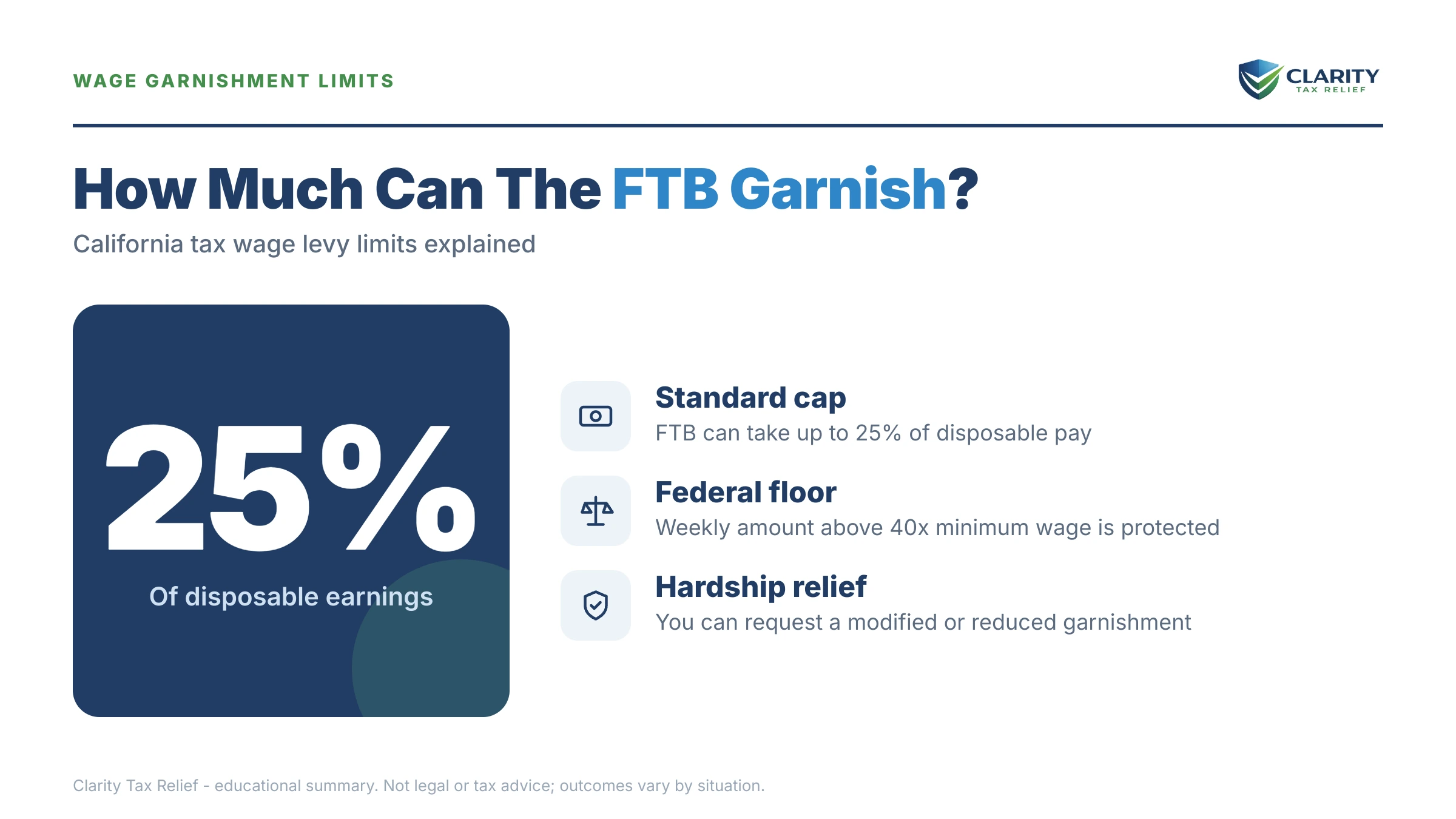
How much can FTB garnish? Up to 25% of your disposable earnings — or 50% of the amount by which your weekly disposable earnings exceed 40 times California's minimum hourly wage, whichever is less. The order needs no court approval, hits every paycheck, and continues until the balance is paid or the FTB releases it.
Your paycheck just landed hundreds of dollars short, and HR told you why: an Earnings Withholding Order for Taxes from the California Franchise Tax Board. Nobody sued you. No judge signed anything. It's already running — and it will run again next payday unless you act.
Here's the part payroll can't tell you: FTB garnishments can be modified, reduced, or released, and the amounts above are ceilings, not sentences. If payroll gave you a copy of the order, the image below shows you exactly what an FTB earnings withholding order looks like and where to find the balance, the tax years, and the contact information that matter.
⏱ The real clock: an FTB earnings withholding order takes up to 25% of your disposable earnings from every single paycheck until the balance is paid or the order is released — while interest and collection fees keep accruing on top. Every pay period you wait is money you don't get back.
How much can the FTB garnish in 2026? The exact limits
The FTB can take up to 25% of your disposable earnings from every paycheck through an Earnings Withholding Order for Taxes (EWOT) — an administrative order that skips the courtroom entirely.
The legal formula, which comes from California's wage garnishment law, is the lesser of two numbers:
- 25% of your disposable earnings for the pay period, or
- 50% of the amount by which your weekly disposable earnings exceed 40 times California's minimum hourly wage.
"Disposable earnings" is not your gross pay and not your take-home pay. It's your gross wages minus only the deductions the law requires — federal and state income tax withholding, Social Security, Medicare, and state disability insurance. Your 401(k) contribution, health premiums, and union dues generally don't reduce the number the FTB calculates from.
The 40-times-minimum-wage floor matters if you earn near minimum wage: because California's minimum wage is high, a full week of pay at that rate is fully protected, and workers just above it lose less than 25%. For most full-time earners, though, the 25% branch of the formula controls — check the current state minimum wage before assuming the floor helps you.
Wages are only one target. Here is how much each FTB collection order can take:
| FTB order | What it reaches | How much it takes | Your best move |
|---|---|---|---|
| Earnings Withholding Order for Taxes (EWOT) | W-2 wages and salary, every pay period | Lesser of 25% of disposable earnings or 50% of the amount over 40× the state minimum wage | Payment plan or a hardship modification with Form 3561 |
| Order to Withhold (OTW) | Bank and financial accounts — one-time grab | Up to 100% of the funds in the account, capped at the balance owed | Act during the short hold before funds are sent — see our FTB bank levy guide |
| Continuous Order to Withhold (COTW) | 1099/contractor payments, rent, royalties, commissions | Typically up to 25% of each payment, ongoing rather than one-time | Resolve the balance directly — no exempt-earnings floor protects contractors |
| Refund intercept | California refunds, lottery winnings, and often federal refunds via the offset program | 100% of the refund, up to the balance owed | Adjust withholding so you stop over-refunding while you resolve the debt |
Two things employees are often surprised by: your employer must comply — refusing exposes the company to liability for the amounts it should have withheld — and withholding starts fast, usually with the first full pay period after the order arrives. There is no built-in grace month.
Worked example: a married couple with a $7,400 FTB balance
Say you and your spouse filed a joint California return and owe $7,400 you couldn't pay. This is a hypothetical, but the math is exactly how the order works.
One spouse earns $2,600 gross per biweekly paycheck. After required withholding — federal and state income tax, Social Security, Medicare, SDI — disposable earnings come to about $2,020 per check. The EWOT takes 25% of that:
- $2,020 × 25% = $505 withheld per paycheck — roughly $1,094 per month.
- At $505 per check, clearing $7,400 plus accruing interest and collection fees takes about 15 paychecks: 15 × $505 = $7,575 — roughly seven months of short paychecks.
Compare that to a negotiated FTB installment agreement on the same debt: $7,400 spread over 36 months is about $206 per month ($7,400 ÷ 36 ≈ $205.56), or roughly $124 per month over 60 months — while interest continues in either case. The garnishment takes more than five times the monthly cash of a payment plan, on the FTB's schedule instead of yours.
One more wrinkle for joint filers: both spouses are personally liable for the full $7,400, so the FTB can direct an order at either employer. And because California is a community-property state, even a debt that belongs to only one spouse can often reach the other's wages.
Why the FTB is garnishing your wages
An EWOT means the FTB assessed a balance, mailed its collection notices, and got no resolution — so it moved to your employer. The debt usually traces to one of four sources:
- A filed return you couldn't pay. The most common path — the balance, plus penalties and interest, sat until collections took over.
- An estimated assessment because you never filed. If you ignored an FTB demand to file, the FTB estimates your income — often from W-2s, 1099s, or even professional-license data — and assesses tax on it. These estimates run high, and filing the real return can shrink them dramatically.
- A return change or audit adjustment you didn't respond to.
- An old balance you assumed died. California gives the FTB 20 years from assessment to collect under R&TC §19255 — see our guide to California's 20-year collection statute. Debts from a decade ago are still fully enforceable.
If none of this rings a bell, check the address on file. The FTB's warnings — including its pre-levy notice — go to your last known address. Movers often learn about the debt from payroll, not the mailbox.
What happens if you ignore an FTB wage garnishment
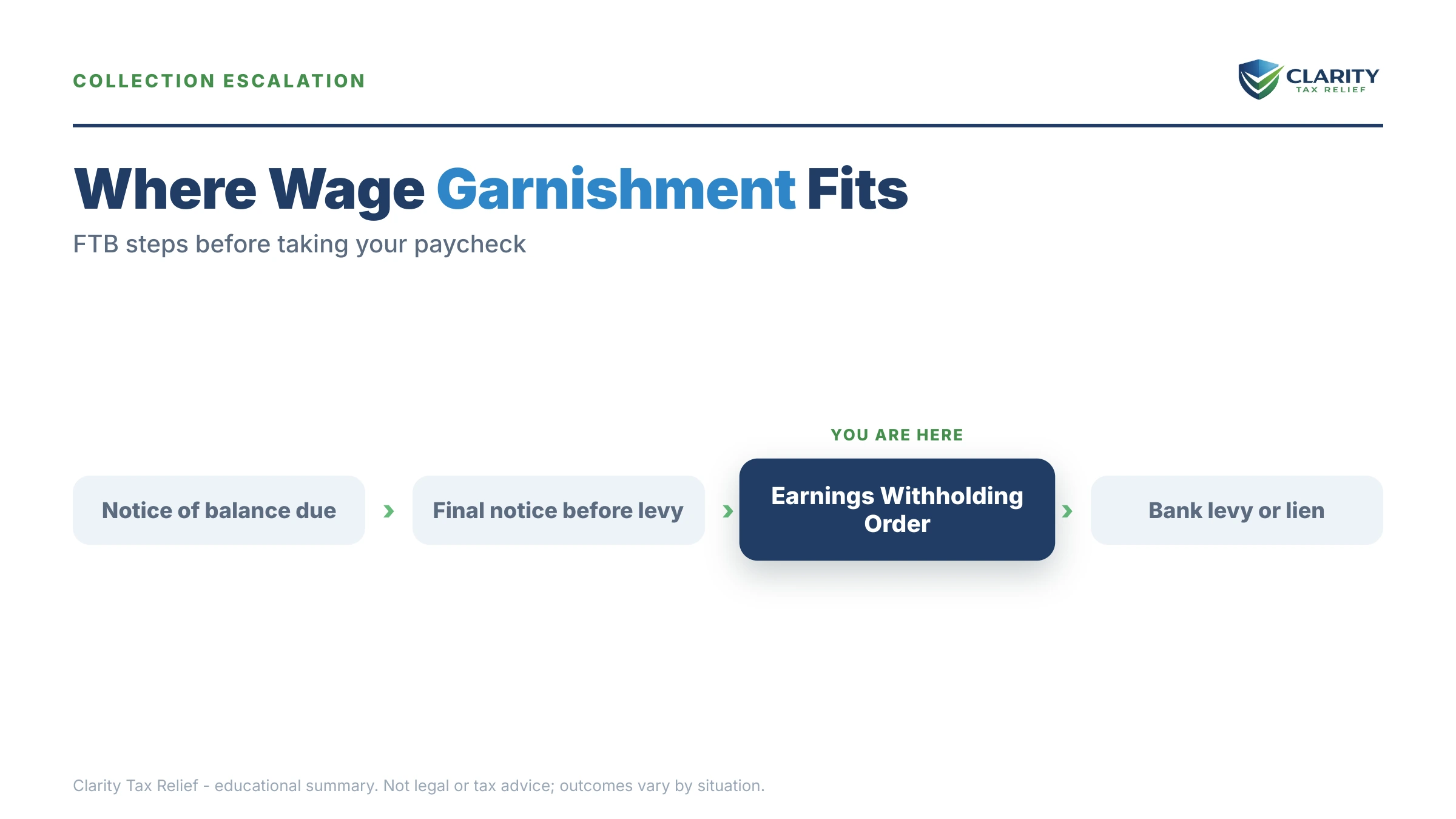
An EWOT is not the FTB's last tool — it's one tool, and ignoring it invites the others in sequence:
- The order keeps running. Every paycheck loses up to 25% of disposable earnings, while interest and cost-recovery fees stack onto the balance you're trying to outrun.
- A bank levy lands on top. A garnishment doesn't preclude an Order to Withhold — the FTB can grab your bank account while garnishing wages.
- A Notice of State Tax Lien gets recorded. That's a public record against your property that complicates selling or refinancing a home until released.
- Refund intercepts continue. State refunds — and often federal refunds through the offset program — are applied to the balance every year until it's gone.
- Larger balances draw harsher tools. The FTB's most aggressive measures, like public delinquency listing and license actions, are reserved for six-figure debts — but the point stands: this agency escalates, and it has 20 years to do it.
| FTB document | What it means | Your window and move |
|---|---|---|
| Balance-due notice / Statement of Tax Due | The FTB's bill — collections hasn't started yet | Pay or set up a plan by the date printed on the notice; this is the cheapest moment to act |
| Final Notice Before Levy | Levy and garnishment are authorized after the date printed on it | Act before that date — see our FTB intent to levy guide for what still works |
| EWOT (served on your employer) | Wage withholding begins with the first applicable pay period | Request a payment plan or modification before your next payday |
| Order to Withhold (served on your bank) | Account funds are frozen and remitted after a short hold | Contact the FTB immediately during the hold — after remittance, recovery is much harder |
| Notice of State Tax Lien | A recorded public claim against your property | Resolve or pay the balance, then request the lien release |
Losing 25% of every paycheck to the FTB?
Send us the order. An experienced tax professional will verify the balance, map your fastest path to a modification or release, and tell you exactly where you stand — free, confidential, before another pay cycle runs.
Your options to reduce or stop the FTB garnishment
The FTB can release or modify an EWOT at any time — it garnishes because it hasn't heard a better plan. These are the plans it accepts:
- FTB payment plan. The workhorse. The FTB's online installment agreement is generally available when you owe $25,000 or less and can pay within 60 months — a $7,400 balance fits comfortably. Once approved, the FTB typically releases the wage order, though you should request the release explicitly and confirm payroll received it. Interest continues while you pay.
- Hardship modification. If losing 25% means you can't cover rent, utilities, or food, the FTB can lower the withholding amount. It won't take your word for it — you'll document income and necessary expenses on FTB Form 3561, the state's financial statement.
- File the missing return. If the balance is an estimated assessment from an unfiled year, filing the actual return often cuts the debt sharply — sometimes below what's already been garnished. This is the single highest-leverage move for non-filers, and it comes before any payment negotiation.
- FTB hardship status. The state's version of collection pause for people who genuinely cannot pay anything. The debt remains and interest accrues, but active collection stops while your finances stay documented as hardship-level.
- FTB Offer in Compromise. Settlement for less than the full balance exists at the state level, but the FTB reserves it for taxpayers who realistically will never be able to pay — limited income, no meaningful assets, and no expectation that changes. A working couple who can fund a $206/month plan is unlikely to qualify; someone on fixed income with no assets might.
- Dispute a wrong balance. If the FTB has the wrong year, missed a payment, or garnished the wrong person, respond with documentation immediately — don't let a wrong debt collect itself while you wait for the agency to notice.
How to respond to an FTB wage garnishment, step by step
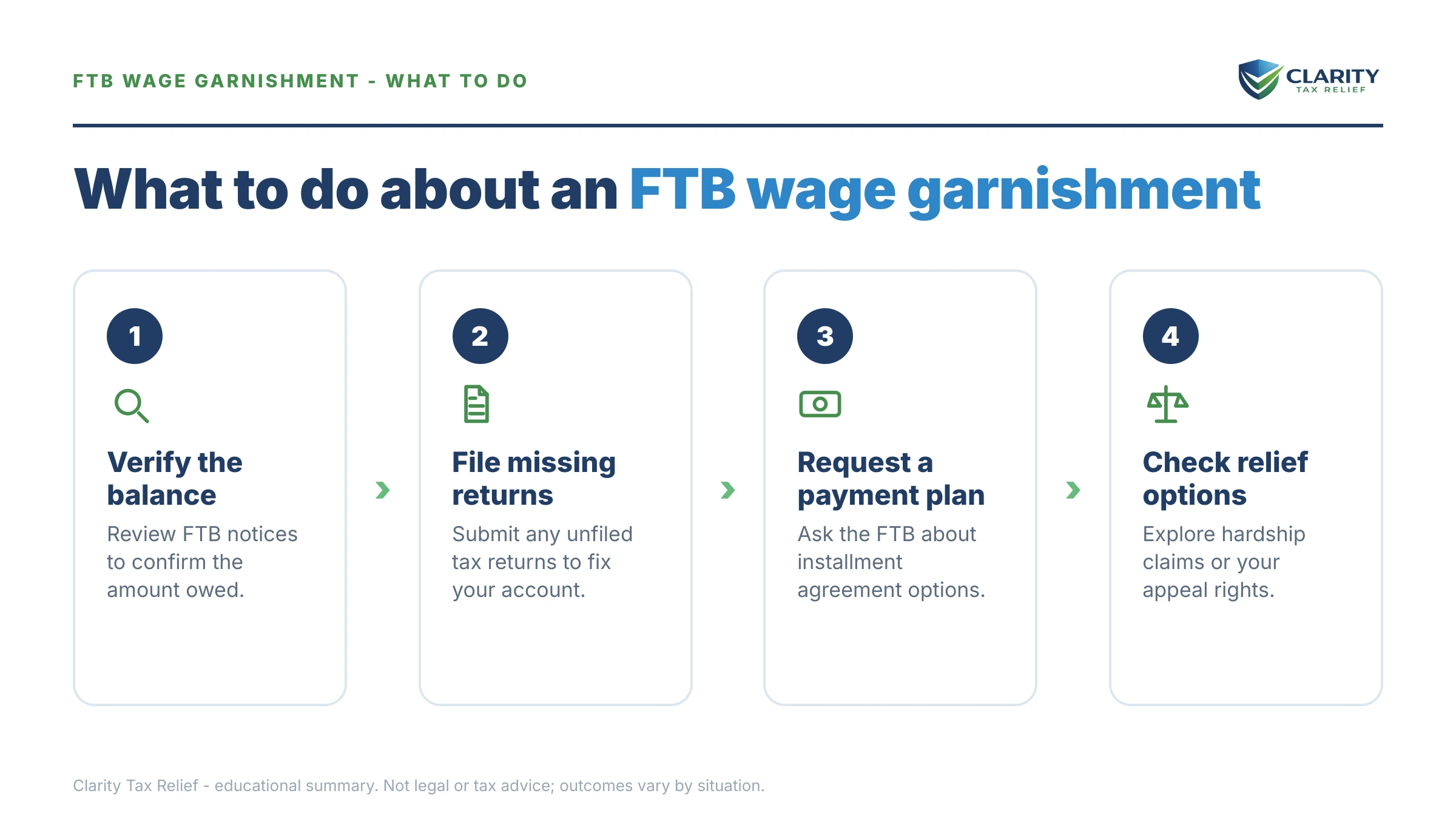
- Get a copy of the order — ask payroll for the earnings withholding order; it shows the balance, the tax years, and the FTB contact information you'll need.
- Verify the debt — check your MyFTB account and your filed returns; if the balance comes from a year you never filed, filing the real return can shrink or erase an estimated assessment.
- Contact the FTB before your next payday — call the number printed on the order (or have a representative call) and ask about an installment agreement or a modified withholding amount.
- Document hardship if 25% breaks your budget — complete FTB Form 3561 with your income and necessary living expenses to support a reduced withholding amount or hardship status.
- Confirm the release or modification in writing — get written confirmation from the FTB and make sure your payroll department receives it before the next pay cycle processes.
FTB vs. IRS wage garnishment: the difference matters
The FTB takes a percentage of your pay; the IRS leaves you a fixed exempt amount and takes everything above it. That structural difference changes who gets hit hardest.
The IRS calculates a protected amount from your filing status and dependents and levies the rest — for higher earners, that can claim far more than 25% of a paycheck. Our guide to how much the IRS can garnish from a paycheck walks through those tables, and you can estimate the federal side with our IRS Wage Garnishment Calculator. The FTB's flat 25% cap can be gentler at high incomes but bites harder in the middle, and unlike the IRS's 10-year collection window, the FTB has 20 years to keep coming back.
Contractors face a parallel split: the IRS typically levies 1099 pay as a one-time grab of what's owed to you — covered in can IRS garnish 1099 income — while the FTB's Continuous Order to Withhold keeps skimming payments over time. If you owe both agencies, the release strategies differ too; the playbook in how to stop IRS wage garnishment covers the federal side, and the sequencing of which agency to resolve first is worth getting right before you commit cash to either.
When you can handle this yourself
You likely don't need professional help if the balance is accurate, it's a single tax year, and it fits the FTB's online payment plan limits — generally $25,000 or less, payable within 60 months. In that case: verify the balance in MyFTB, set up the agreement, request the garnishment release, and confirm payroll got it. A $7,400 debt with steady income is very often a DIY fix.
Experienced help changes outcomes when the situation is layered: estimated assessments across multiple unfiled years (where filing order and figures determine what you actually owe), a bank levy already in motion alongside the wage order, simultaneous IRS and FTB debt competing for the same paycheck, business or EDD payroll exposure tangled into personal liability, or a hardship case that needs Form 3561 financials presented the way the FTB actually evaluates them. In those cases the fee usually costs less than the mistakes it prevents.
Terms on your FTB order, decoded
- EWOT (Earnings Withholding Order for Taxes): the FTB's administrative wage garnishment — served on your employer, no court involved.
- Disposable earnings: gross pay minus only legally required deductions (taxes, Social Security, Medicare, SDI) — the base the 25% is computed on.
- OTW (Order to Withhold): a one-time levy, most often on a bank account, taking up to the full balance owed.
- COTW (Continuous Order to Withhold): an ongoing order aimed at non-wage income like contractor payments, rent, or royalties.
- Notice of State Tax Lien: a recorded public claim securing the FTB's debt against your property until released.
- R&TC §19255: the California statute giving the FTB 20 years from assessment to collect — twice the IRS's window.
FTB garnishment questions, answered
How much can the FTB garnish from my paycheck?
Up to 25% of your disposable earnings — your pay after legally required deductions like taxes and Social Security — or 50% of the amount by which your weekly disposable earnings exceed 40 times California's minimum hourly wage, whichever is less. Most full-time workers lose the full 25%. The order applies to every paycheck until the balance, including interest and fees, is paid or the FTB releases it.
Can the FTB garnish my spouse's wages too?
In most cases, yes. If you filed jointly, both spouses are personally liable for the full balance, so the FTB can send an earnings withholding order to either employer. Even when only one spouse owes, California's community-property rules can put the other spouse's wages within reach. If the debt predates your marriage, have an experienced tax professional review what is actually collectible from you.
Can the FTB garnish Social Security or disability benefits?
No. Federal law protects Social Security retirement, SSDI, and SSI from state tax collectors, so the FTB cannot garnish those benefit checks. Be careful with bank accounts, though: the FTB can levy a bank account, and while directly deposited federal benefits carry some automatic protection, mixed funds get complicated fast. If a levy grabs protected benefits, contact the FTB immediately to claim the exemption.
Does the FTB need a court order to garnish wages?
No. The FTB issues earnings withholding orders administratively under California law — no judge, no lawsuit, no court date. That is why the garnishment can seem to appear out of nowhere: the required warnings were the collection notices mailed to your last known address. If you moved and never updated your address with the FTB, you may never have seen them, but the order is still valid.
How long does an FTB wage garnishment last?
An FTB wage garnishment continues until the balance — tax, penalties, interest, and collection fees — is fully paid, the FTB releases or modifies the order, or the debt expires. California gives the FTB 20 years from assessment to collect under R&TC Section 19255, double the IRS's 10-year window, so waiting it out is rarely a realistic strategy.
Can I stop an FTB garnishment once it starts?
Yes. The fastest paths are an approved payment plan, a hardship modification supported by FTB Form 3561 financials, or proving the underlying assessment is wrong — for example, filing an actual return to replace an estimated assessment. The FTB can release or reduce the order at any point; the key is getting the release to your payroll department before the next pay cycle runs.
Can the FTB garnish 1099 or independent contractor income?
Yes, through a different tool. The FTB sends a Continuous Order to Withhold to companies that pay you, typically capturing up to 25% of each payment for an extended period rather than making a single grab. Because contractors do not get the exempt-earnings floor calculation that protects low-wage employees, resolving the balance directly is usually the better move.
Will the FTB release the garnishment if I set up a payment plan?
Generally, yes — once the FTB approves an installment agreement, it will typically release or stop the wage garnishment, though the release is not automatic and the FTB may keep an order in place until your first payments clear. Ask specifically for the release when you set up the plan, get confirmation in writing, and verify that your payroll office actually received it.
Your next 24 hours
- Find the numbers. Get a copy of the earnings withholding order from payroll and locate the total balance and the tax years listed on it — that tells you whether you're fighting a real debt or an estimated one.
- Gather your file. Your last filed California return, your two most recent pay stubs, and a quick list of monthly essentials (housing, utilities, food, transportation). That's the raw material for both a payment plan and a hardship modification — and you can verify your account anytime at the Franchise Tax Board's website. (If you also owe federally, IRS.gov/payments is the parallel starting point on that side.)
- Get the order reviewed free. Call (888) 825-7779 or use the 2-minute form — an experienced tax professional will map your fastest release path before another paycheck loses 25%.
This guide is general information, not tax or legal advice for your specific situation. Eligibility for IRS programs depends on individual facts and circumstances; no outcome is guaranteed. The same is true of California FTB programs, which apply their own criteria and timelines.