
California FTB
FTB DMV Hold: Why the FTB Is Collecting Your Vehicle Registration (2026)
The short answer: an FTB DMV hold means the California DMV referred your unpaid vehicle registration fees to the Franchise Tax Board for collection. The DMV won't renew that vehicle's registration until the debt is resolved, and the FTB can garnish wages or levy bank accounts to collect it — no court judgment required.
You tried to renew your tags and the system wouldn't take your money. Then a demand letter showed up — not from the DMV, but from the Franchise Tax Board, about a car that got tangled up in your divorce paperwork. Take a breath: this is one of the most fixable problems the FTB handles, and this guide walks you through exactly who to pay, what to dispute, and how to get current tags back.
The most common surprise: the hold usually isn't about your income taxes at all. It's the reverse of what most people assume — the DMV handed its unpaid registration fees to the FTB to collect. The image below shows exactly what the FTB's vehicle registration demand notice looks like and where to find the account number, vehicle description, and pay-by date.
⏱ Your deadline: the pay-by date printed on the FTB's demand notice. There is no fixed statutory window beyond it — but DMV late penalties tier upward the longer the registration stays expired, the FTB adds its own collection fees, and once active collection starts, the FTB can garnish wages without ever going to court.
Why the FTB has your DMV registration debt
An FTB DMV hold starts at the DMV, not the FTB: the DMV refers delinquent vehicle registration fees to the Franchise Tax Board, which collects them through its Vehicle Registration Collections program. Once the referral happens, the FTB collects registration fees with the same tools it uses for unpaid income tax — demand notices, refund intercepts, wage garnishment, and bank levies.
Three situations put most people here:
- The registration simply lapsed. A renewal notice went to an old address — common after a divorce or a move — and the fees sat unpaid long enough for the DMV to hand them off.
- Your name stayed on a car you no longer have. You sold it, traded it, or your ex kept it, but the DMV's records still list you as a registered owner. Fees that accrue on that vehicle attach to everyone on the registration.
- A payment never posted. A check bounced, a card payment failed, or a partial payment left a balance — and penalties grew on the remainder.
Check the vehicle description and plate number on your notice carefully (you can see where they sit in the image below). If the car isn't yours anymore — or never was — that changes your entire response, and we cover the dispute path in the options section.
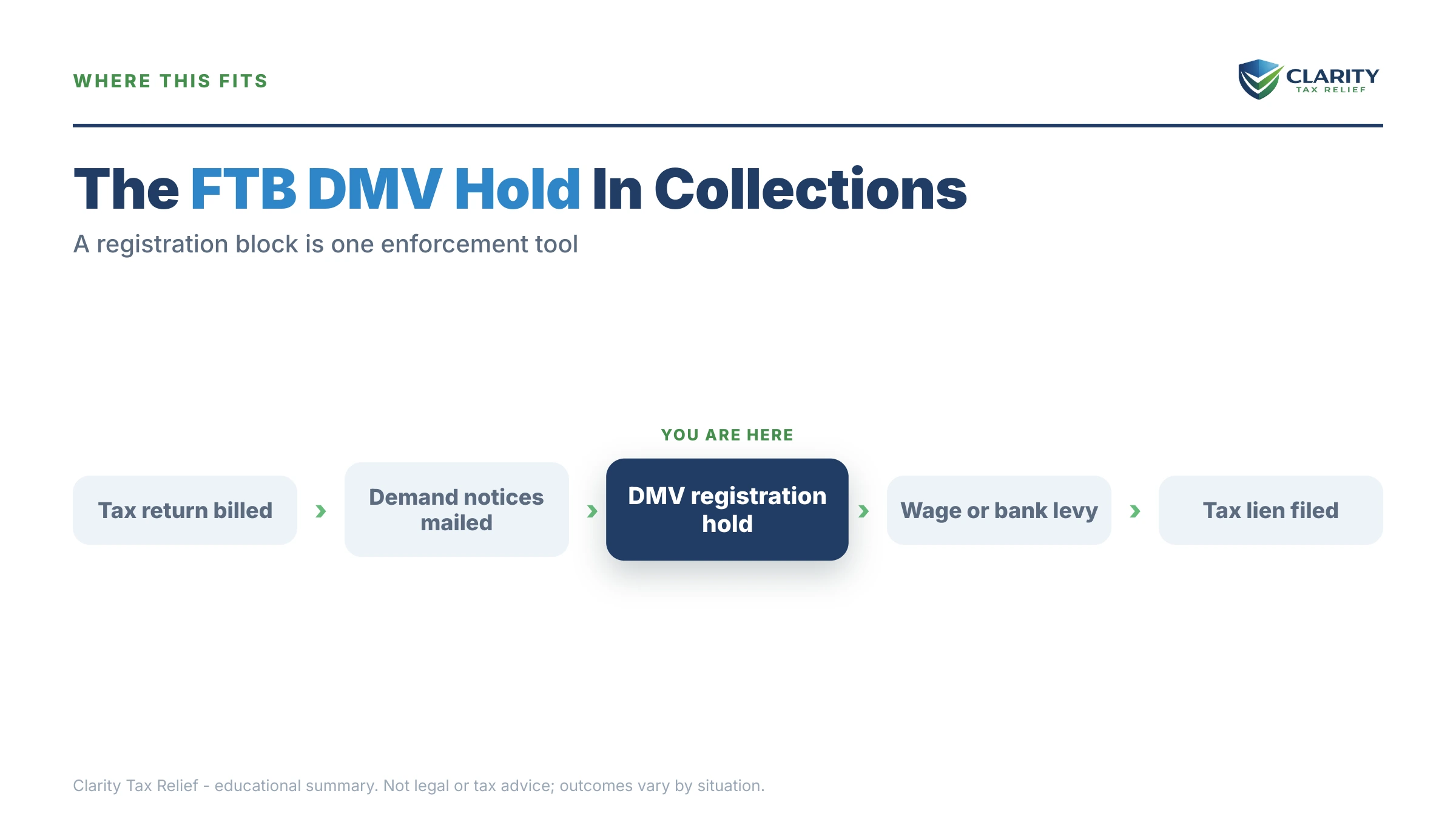
| Stage | Who's collecting | What's happening |
|---|---|---|
| Registration lapses | DMV | Late penalties tier upward the longer the registration stays expired; renewal requires paying everything owed |
| Referral to the FTB | FTB Vehicle Registration Collections | Collection fees are added and a demand notice is mailed; payment now goes to the FTB, not the DMV window |
| Active FTB collection | FTB | State refund intercept, wage garnishment, and bank levy become available — no court judgment needed |
| Renewal hold | DMV | The vehicle's registration cannot be renewed until the delinquent fees are resolved |
What happens if you ignore an FTB registration hold
Ignoring an FTB registration hold turns a fee problem into a garnishment problem. The sequence below is an order of escalation, not a fixed calendar — but every stage adds cost, and the FTB's collection systems run automatically:
- DMV late penalties stack up. California's registration penalties grow in tiers the longer the registration stays expired, so the same debt costs more every stage you wait.
- The debt transfers to the FTB. Collection fees are added on top of the DMV's penalties, and a demand notice arrives with a pay-by date. See FTB collection fees for how these charges accumulate.
- Your state refund gets intercepted. Through the Interagency Intercept Collection program, the FTB can grab your California refund — and lottery winnings — and apply them to the registration debt. Our guide to the FTB refund intercept explains how to spot it.
- Involuntary collection begins. The FTB can issue an earnings withholding order to your employer or levy your bank account — without ever going to court. How much comes out of each check is covered in our FTB wage garnishment guide.
- The car itself becomes a liability. Driving on expired tags invites citations, and California law allows officers to impound a vehicle whose registration has been expired for more than six months.
One thing that does not happen: your driver's license is not suspended over registration fees. That's a separate FTB tool aimed at the state's largest income-tax debtors — more on the difference below.
Holding an FTB registration demand right now?
Send us a photo of the notice before the pay-by date passes. An experienced tax professional will confirm whether the vehicle and amounts are actually yours, what a dispute would take, and the fastest path to current tags — free and confidential.
Your options to clear an FTB DMV hold
For most drivers, paying the registration debt in full is the only guaranteed way to lift the hold — but "pay it" is not the right answer for everyone, especially if the vehicle was sold, transferred, or awarded to an ex. Match your situation to the row that fits:
| Option | Works when | What it does |
|---|---|---|
| Pay the FTB in full | The fees are yours and you can cover them | Closes the collection account and clears the way to renew; the fastest path to current tags |
| FTB payment arrangement | The fees are yours but the balance is unmanageable | Can stop garnishment and levies — but the renewal hold generally stays until the registration fees are paid, so confirm timing with the FTB |
| Dispute — vehicle sold or transferred | The fees accrued after the car left your hands | File DMV Form REG 138 (Release of Liability) with proof of the transfer date, then dispute the referred debt with the FTB in writing |
| Dispute — wrong person or wrong vehicle | The plate, VIN, or name on the notice isn't yours | Contact the FTB with identification and documentation before the pay-by date; don't pay a debt that was never yours |
| Hardship review | Any payment would leave you unable to cover basic living costs | The FTB can pause involuntary collection while your finances recover — the debt and the hold remain, but garnishment stops |
Two cautions on the middle rows. First, a payment arrangement protects your paycheck, not necessarily your tags — ask the FTB directly whether and when the DMV hold releases under your arrangement. Second, a divorce decree that assigns the car (and its fees) to your ex does not bind the DMV or the FTB; until the registration record changes, both registered owners remain collectible. If you also carry FTB income-tax debt from joint returns, the broader playbook lives in our California FTB back taxes hub, and the general do-it-yourself sequence for any tax balance is in how to settle tax debt yourself.
A worked example: one divorce, one SUV, $54,600
Say you're recently divorced and your total FTB exposure is $54,600 — but only a sliver of it is what's blocking your car. Hypothetically:
- $52,750 in income tax from two joint return years where your ex under-withheld ($31,400 + $21,350, with penalties and interest).
- $1,850 in registration debt on the SUV: say the original renewal was $612, DMV late penalties over 14 expired months pushed it to roughly $1,620, and FTB collection fees brought the demand to $1,850.
The math points to a clear order of operations: $1,850 — about 3% of the total — is all that's blocking the vehicle. Paying the registration debt in full closes the Vehicle Registration Collections account, releases the renewal hold, and takes garnishment on that account off the table. The $52,750 income-tax balance then gets its own strategy: an FTB payment plan, and — because the under-withholding came from your ex's income on joint returns — a serious look at FTB innocent spouse relief, which can remove your liability for a spouse's share when the facts support it. Treating the whole $54,600 as one problem is how people stay stuck; splitting it is how the car gets back on the road this month.
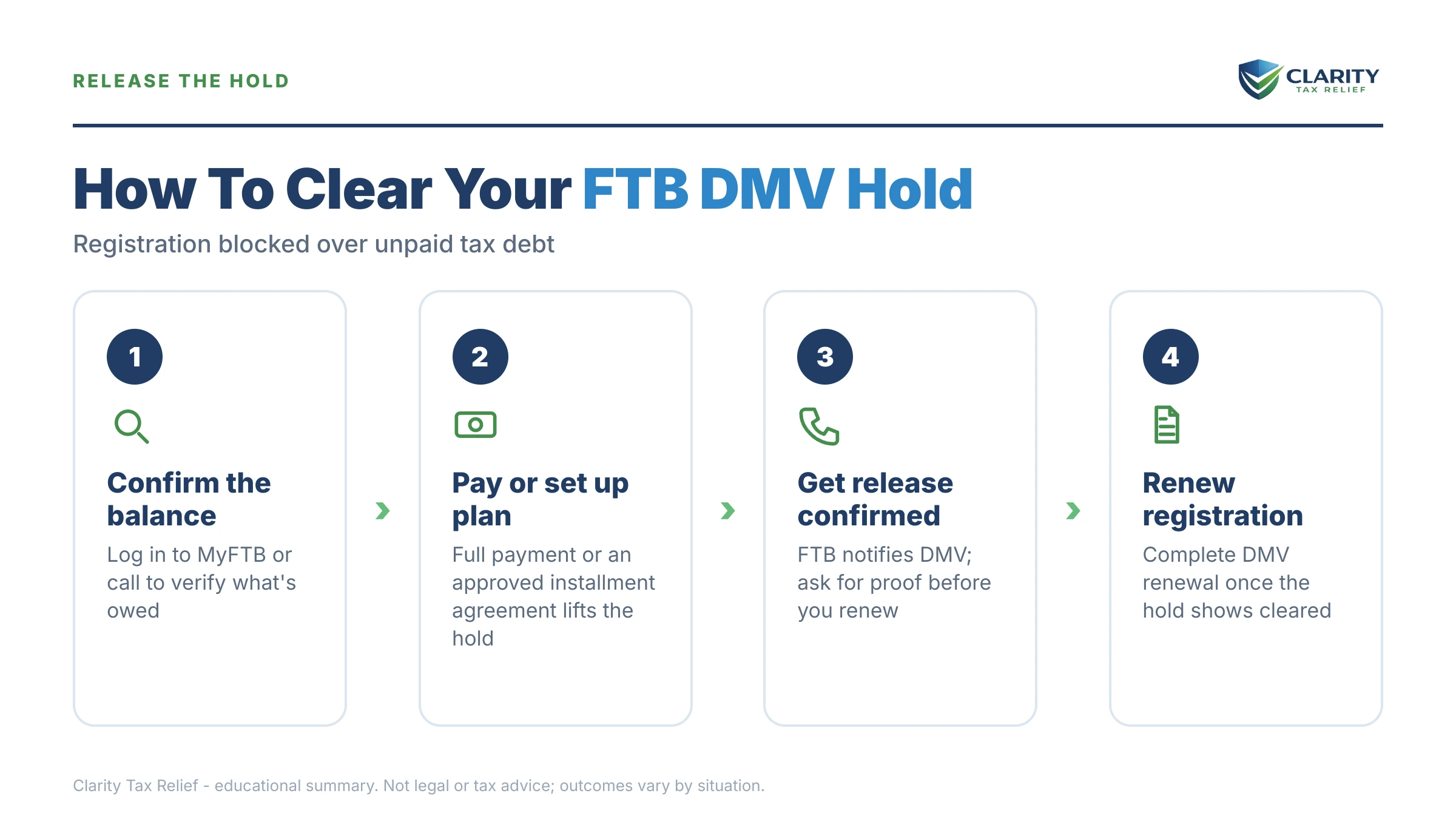
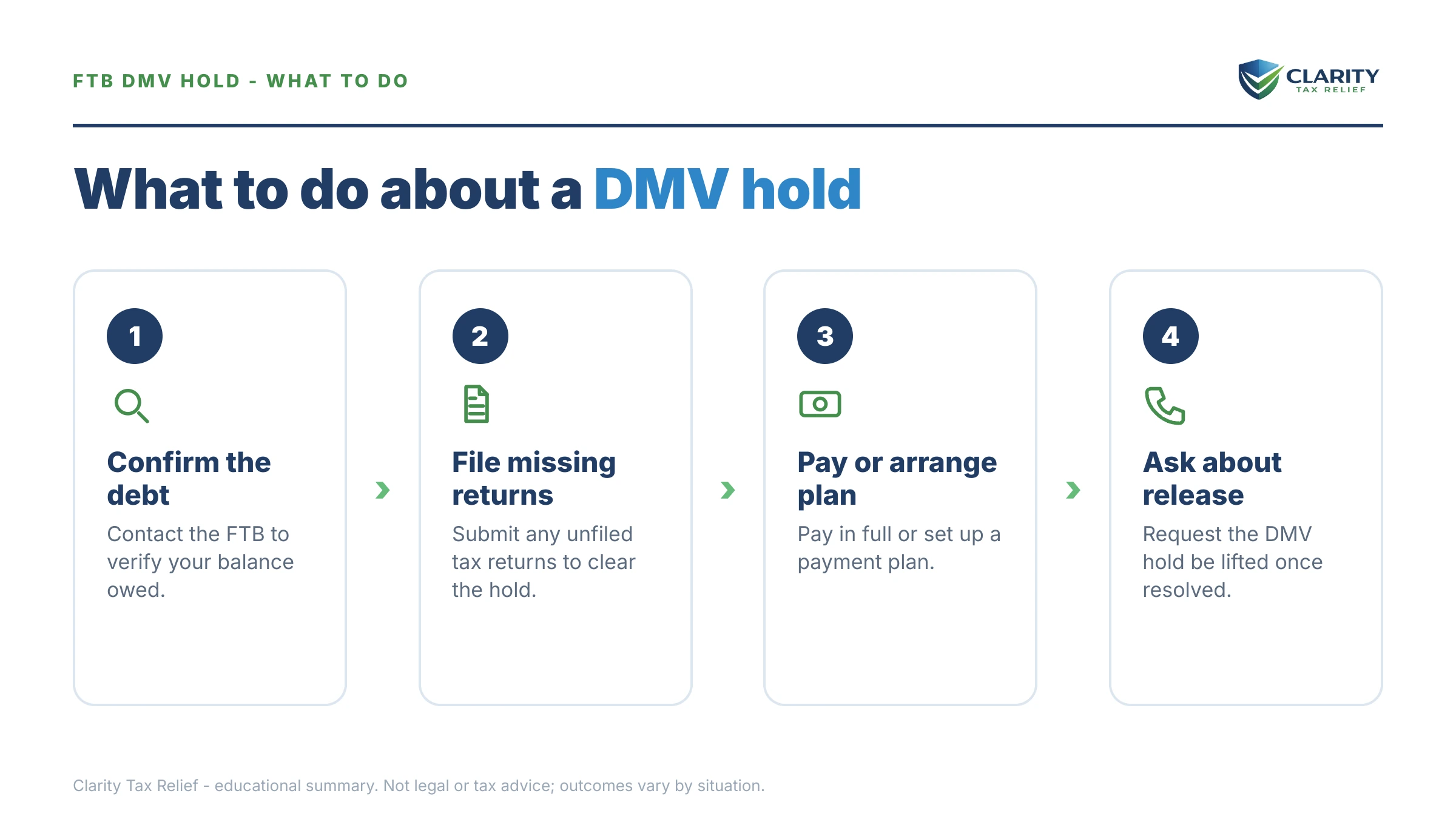
How to respond to an FTB DMV hold, step by step
- Find the details on your notice — the account number, vehicle description, license plate, and pay-by date identify exactly which debt is blocking your renewal.
- Verify the vehicle and the amount — pull your DMV record and confirm the fees are yours and the car wasn't sold or transferred before the fees accrued.
- File a Release of Liability if you sold or transferred the car — DMV Form REG 138 documents the date the vehicle left your hands, then dispute the referred debt with the FTB in writing.
- Pay the FTB, not the DMV — once registration debt is referred, payment on the delinquent balance goes to the Franchise Tax Board, using the account number on your demand notice.
- Confirm the release before you renew — verify with the DMV that the hold has cleared and be ready to pay current-year fees so the renewal actually processes.
Registration hold vs. license suspension vs. refund intercept
California uses three different enforcement tools that people lump together as "the FTB took my DMV stuff" — and each one has a different trigger and a different fix:
| Action | What triggers it | Where to go |
|---|---|---|
| DMV registration hold | Unpaid vehicle registration fees referred to the FTB | This guide — pay or dispute the referred debt, then renew |
| Driver's license suspension | Landing on the state's Top 500 delinquent income-tax list | FTB license suspension and the FTB Top 500 delinquent list |
| State refund or lottery intercept | Debt owed to almost any California agency, including the DMV | FTB refund intercept |
| Court-ordered debt collection | Unpaid court fines and fees referred to the FTB | FTB court-ordered debt collections |
Why the distinction matters: paying your registration debt clears the hold but does nothing for a license suspension, and vice versa. If you received more than one FTB notice this year, decode each one separately before sending money anywhere.
When you can handle this yourself
Most FTB DMV holds are do-it-yourself problems. If the vehicle is yours, the amount looks right, and the balance is a few hundred to a couple thousand dollars, paying the FTB in full and confirming the release with the DMV is the whole fix — no professional needed. You can pay the Franchise Tax Board directly through ftb.ca.gov and check your vehicle record with the California DMV. A clean sold-car dispute with a bill of sale is also very manageable on your own.
Experienced help changes the outcome in a narrower set of situations: a wage garnishment or bank levy already in motion, registration debt stacked on top of a five-figure FTB income-tax balance, a divorce where liability needs to be separated between spouses, or unfiled California returns lurking behind the collection notices. In those cases, the order you resolve things in — returns first, disputes second, balances last — determines what you ultimately pay, and a professional review before you send the first check costs nothing.
Terms on your FTB notice, decoded
- Vehicle Registration Collections (VRC): the FTB program that collects delinquent DMV registration fees on the DMV's behalf.
- Registered owner: the person (or people) listed on the DMV's registration record — the ones liable for the fees, regardless of who actually drives the car.
- Earnings withholding order: the FTB's wage garnishment order, sent straight to your employer without a court judgment.
- Release of Liability (REG 138): the DMV form that records the date you sold or transferred a vehicle, cutting off fees that accrue afterward.
- Interagency Intercept: the FTB program that seizes state tax refunds and lottery winnings to pay debts owed to California agencies, including the DMV.
- Renewal hold: the block on a specific vehicle's registration renewal — distinct from a license suspension, which targets the driver, not the car.
FTB DMV hold questions, answered
Why is the Franchise Tax Board collecting my DMV registration fees?
The DMV refers delinquent vehicle registration debt to the FTB, which acts as its collection agency under California law — the program is called Vehicle Registration Collections. Once the referral happens, the FTB adds a collection fee, sends a demand notice, and uses the same collection tools it uses for tax debt. The debt is still registration fees — but the collector is now the FTB, and payment goes to the FTB, not the DMV window.
Can the FTB garnish my wages over unpaid vehicle registration?
Yes. The FTB can issue an earnings withholding order to your employer for referred registration debt without suing you or getting a court judgment first. It can also levy bank accounts and intercept your California state tax refund. If a garnishment is already in motion, paying the referred balance or resolving the account with the FTB is what stops the withholding.
Will an FTB payment plan release the DMV registration hold?
Not necessarily. A payment arrangement with the FTB can stop involuntary collection like garnishment, but the DMV generally will not renew the registration until the registration fees themselves are paid. When you set up any arrangement, confirm with the FTB exactly when the renewal hold clears — for most drivers, paying the registration debt in full is the only way to get current tags.
I sold the car — why am I still on the hook for its registration?
Because the DMV's records still show you as the registered owner. Until a transfer is processed or you file a Notice of Transfer and Release of Liability (DMV Form REG 138), fees that accrue on the vehicle stay attached to your name. File the REG 138 with the sale date and your documentation, then dispute the referred debt with the FTB in writing.
My ex kept the car in the divorce — am I still liable for the registration debt?
If your name is still on the registration, yes. The DMV and FTB go by the registered owners of record, not your divorce decree — a decree divides responsibility between you and your ex, but it doesn't bind state agencies. Get your name off the title and registration, keep proof of the transfer date, and pursue reimbursement through the family court if the decree assigned the debt to your ex.
Is an FTB DMV hold the same as a driver's license suspension?
No. A registration hold blocks a specific vehicle's renewal over unpaid registration fees. License suspension is a separate FTB enforcement tool reserved for taxpayers on California's Top 500 delinquent list — people owing very large income-tax balances. Clearing the registration debt fixes the hold; it has nothing to do with your driver's license.
Can I pay the DMV directly instead of the FTB?
Once the debt is referred, pay the agency named on your most recent notice — for referred registration debt, that's the FTB. Paying the wrong agency can leave the collection account open even after your money posts. When you renew, the DMV will still collect any current-year fees; the FTB payment covers the delinquent amounts it's collecting.
Does unpaid California registration debt follow me if I move out of state?
Moving out of state doesn't erase it. The FTB can garnish wages and levy bank accounts across state lines, intercept any future California state refund, and the unpaid fees will resurface if you ever register a vehicle in California again. The cheapest moment to resolve it is before involuntary collection starts, because penalties and fees only grow.
Your next 24 hours
- Find the vehicle description, account number, and pay-by date on your FTB demand notice. Confirm the plate and VIN actually match a car you own today — that single check decides whether you're paying or disputing.
- Gather your paper trail: the notice itself, your DMV registration record, and — if the car was sold or awarded to an ex — the bill of sale, transfer paperwork, or divorce decree with dates.
- Get a free case review before the pay-by date passes. If the balance is stacked on top of bigger FTB debt, a garnishment is moving, or a dispute needs building, call (888) 825-7779 or use the 2-minute form — an experienced tax professional will map the fastest route back to current tags.
This guide is general information, not tax or legal advice for your specific situation. Eligibility for IRS programs depends on individual facts and circumstances; no outcome is guaranteed.