
California FTB
FTB Refund Intercept: Why California Took Your Refund and How to Stop It (2026)
The short answer: an FTB refund intercept means the Franchise Tax Board applied your California refund to a government debt — FTB back taxes, another agency's debt through the Interagency Intercept Collection program, or an IRS levy. Your intercept notice names who got the money; that agency, not the FTB, controls the debt.
You tracked your California refund for weeks — money you'd already assigned to a vendor invoice or next month's payroll cushion — and instead of a deposit, a one-page notice arrived saying the state kept it. It's jarring, especially when you don't recognize the debt. But an intercept follows fixed rules, and once you know which of three doors your money went through, the fix is usually straightforward.
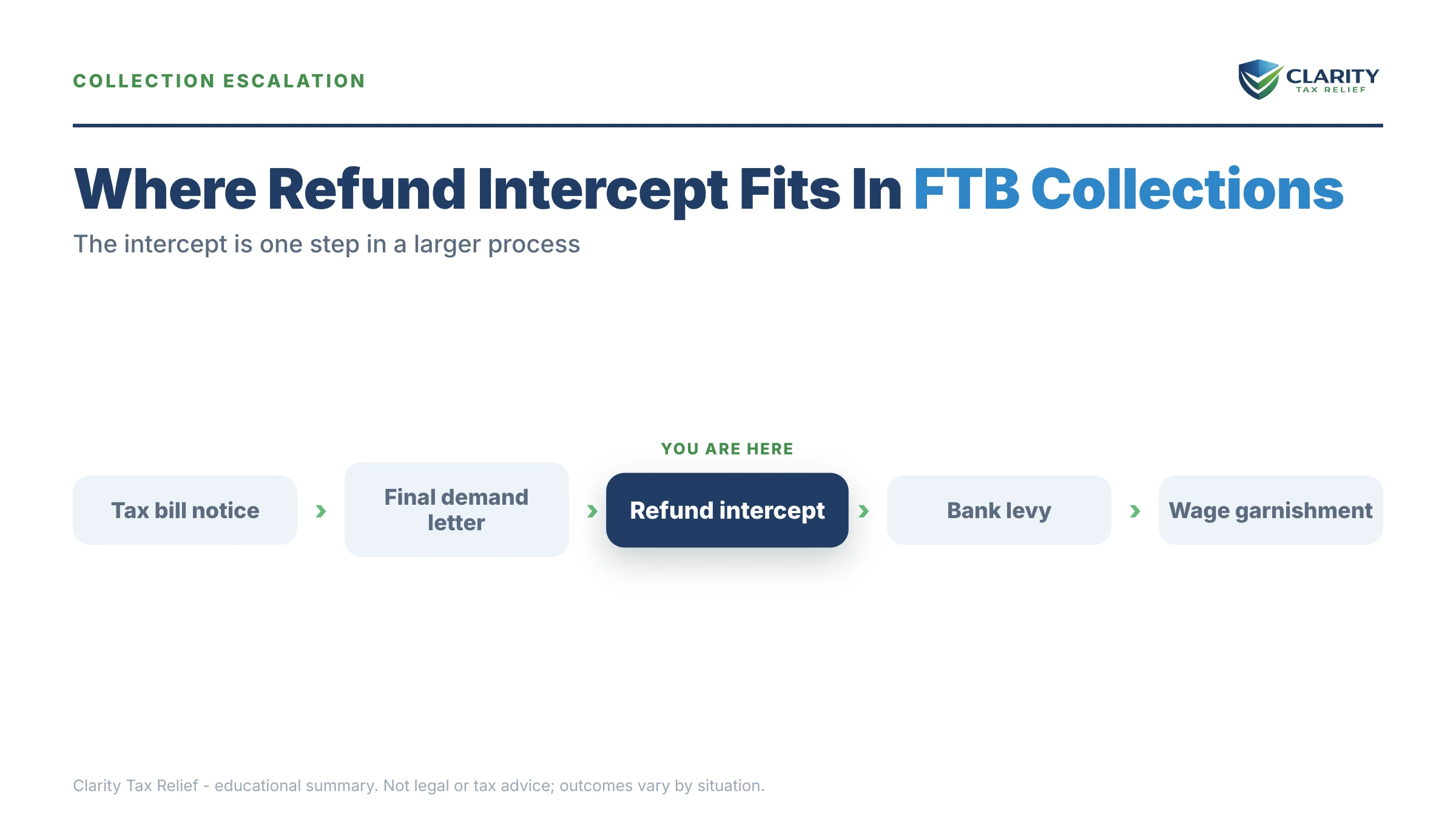
The single most common mistake is calling the FTB about a debt the FTB doesn't own. For most intercepts, the Franchise Tax Board is only the cashier — a court, the DMV, a city, or even the IRS is the actual creditor. The image below shows exactly what an FTB intercept notice looks like and where to find the requesting agency and its phone number — the two details that determine your next move.
⏱ The real clock: an intercept notice has no response deadline — the money is already applied. What keeps running is the balance behind it: interest and FTB collection fees accrue on what remains, and California's collection window is 20 years under R&TC §19255. The debt will not quietly expire before you deal with it.
Why the FTB intercepted your refund: three doors, three different fixes
The FTB intercepts California refunds for three separate kinds of debt — its own back taxes, other agencies' debts, and federal tax debt — and each one has a different resolution path.
Door 1: you owe the FTB itself. If you have an unpaid California income tax balance — an old return, an assessment after an audit, or a return the FTB filed for you — the Board applies your refund to that balance automatically before paying you anything. This is the version most small-business owners hit, because uneven income years and missed estimated payments create back balances quietly.
Door 2: another agency submitted your debt. Through the Interagency Intercept Collection (IIC) program, courts and state and local agencies hand delinquent debts to the FTB, which grabs refunds on their behalf: unpaid vehicle registration, toll and parking penalties, city and county fines, college balances, and EDD overpayment assessments — a frequent surprise for employers. Court fines, fees, and restitution flow through a related channel covered in our guide to FTB court-ordered debt collections. For these debts, the FTB only forwards the money; the agency named on your notice — not the FTB — controls the debt, the dispute process, and any refund of it.
Door 3: the IRS levied your state refund. If you owe federal back taxes, the IRS can seize your California refund through the State Income Tax Levy Program. In that case the paper trail comes from the IRS — typically a CP504 warning beforehand and a CP92 confirming the levy — and the fix lives entirely on the federal side.
One edge case worth naming: a joint California refund can be intercepted for a debt only one spouse owes, and community-property rules blur whose money it was. If your refund vanished for a partner's old debt, see ex-spouse's tax debt took my refund; for FTB tax from a joint return you believe isn't fairly yours, innocent joint filer relief exists on the state side.
| Debt behind the intercept | How it reached your refund | Who to contact |
|---|---|---|
| FTB back income taxes | FTB applies refunds to its own balances automatically | The FTB — verify the balance in your MyFTB account |
| Court fines, fees, restitution | Court-Ordered Debt Collections, administered by the FTB | The court or the FTB unit named on the notice |
| DMV registration, tolls, city/county fines, college debts, EDD overpayments | Interagency Intercept Collection (IIC) program | The requesting agency on the notice — FTB only forwards the money |
| Federal back taxes | IRS levy via the State Income Tax Levy Program | The IRS — expect a CP92 confirming the levy |
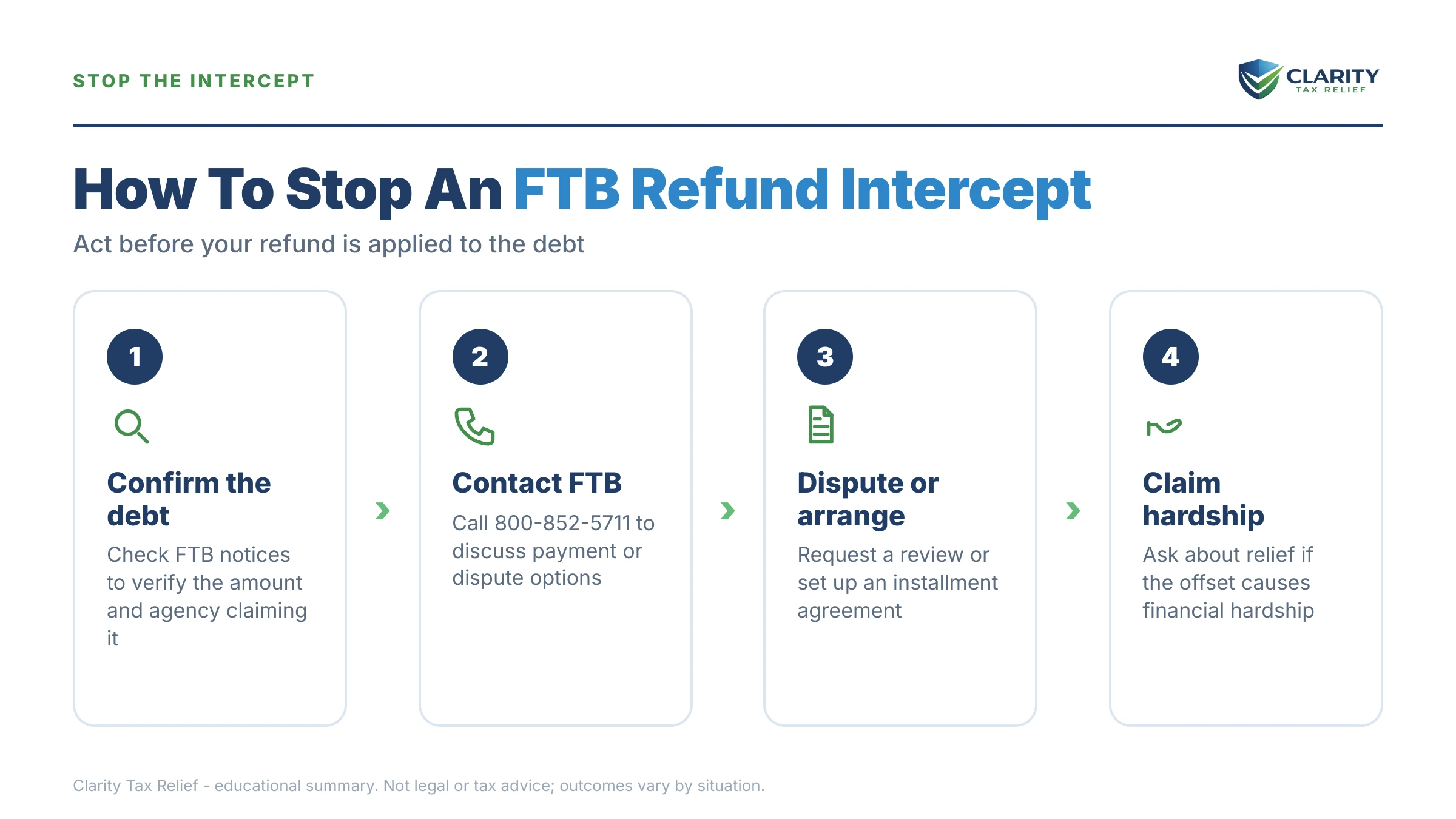
What happens if you ignore an FTB refund intercept
A refund intercept is the gentlest tool in FTB collections — every tool queued behind it is more aggressive. If the intercept was for an FTB balance and you do nothing, the sequence continues in stages:
- The intercept itself. Your refund is applied and a notice is mailed. Passive collection — the state only kept money it already held.
- The remainder keeps growing. Interest and FTB collection fees accrue on whatever the refund didn't cover, so next year's intercept chases a bigger number.
- Demand letters, then a state tax lien. A recorded lien is a public record that surfaces in lender and vendor searches — a real problem when your business depends on credit lines or equipment financing.
- Active levies. The FTB can issue an Order To Withhold against your bank — the FTB bank levy that can land on the same account you run payroll from — and a continuous earnings withholding order against wages.
If the intercept was for another agency's debt, the FTB won't chase you further — but that agency's own remedies continue separately: DMV registration holds, license consequences, or court collection on unpaid fines. Either way, the system doing this is automated. It escalated to your refund without a human decision, and it will escalate past it the same way.
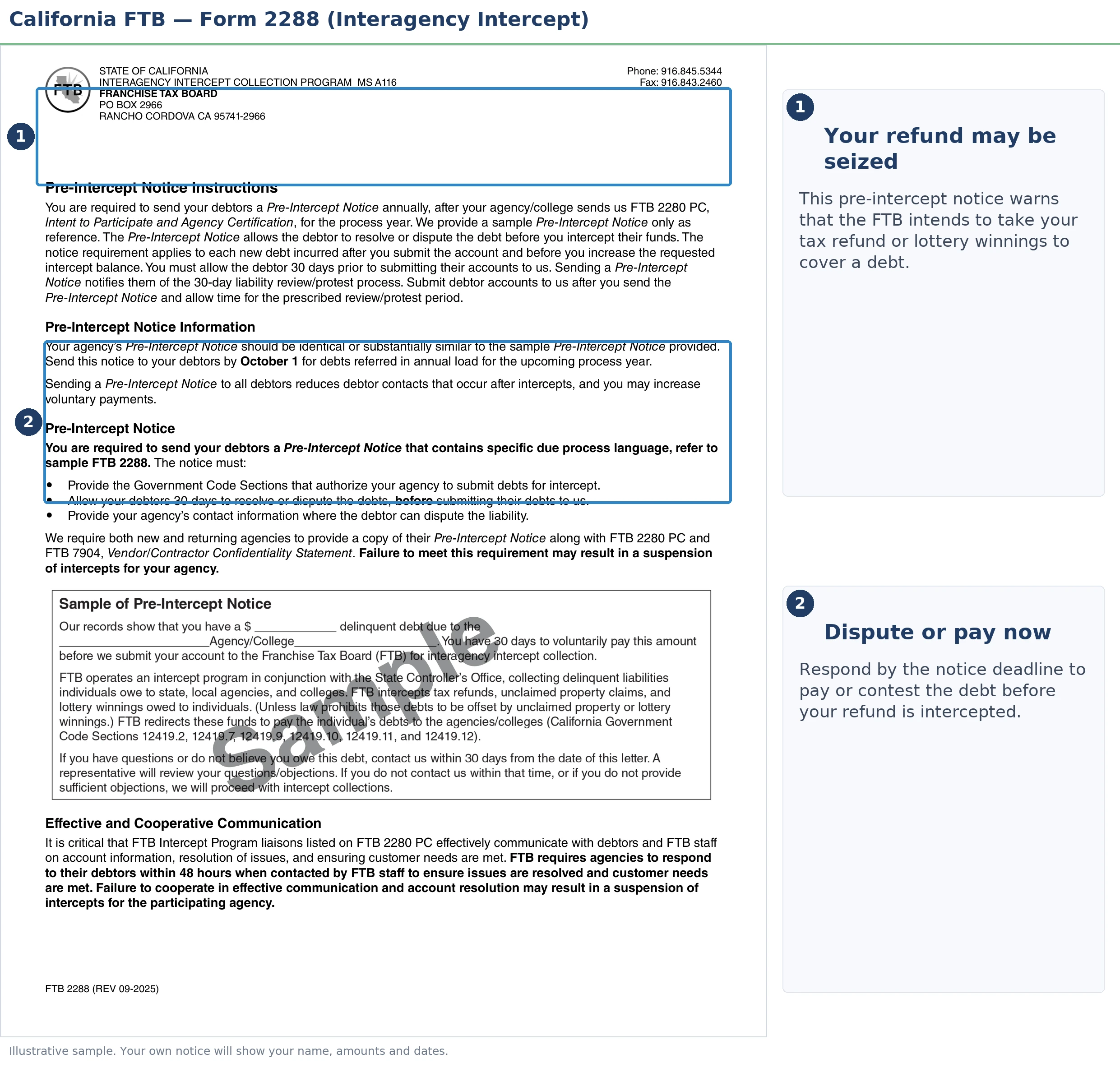
Your refund is gone — the levies behind it don't have to follow
An intercept means your account is already in active collections, and interest and fees are compounding on what's left. Send us your intercept notice: an experienced tax professional will identify who actually has your money and map the fastest way to shut the cycle down — free and confidential.
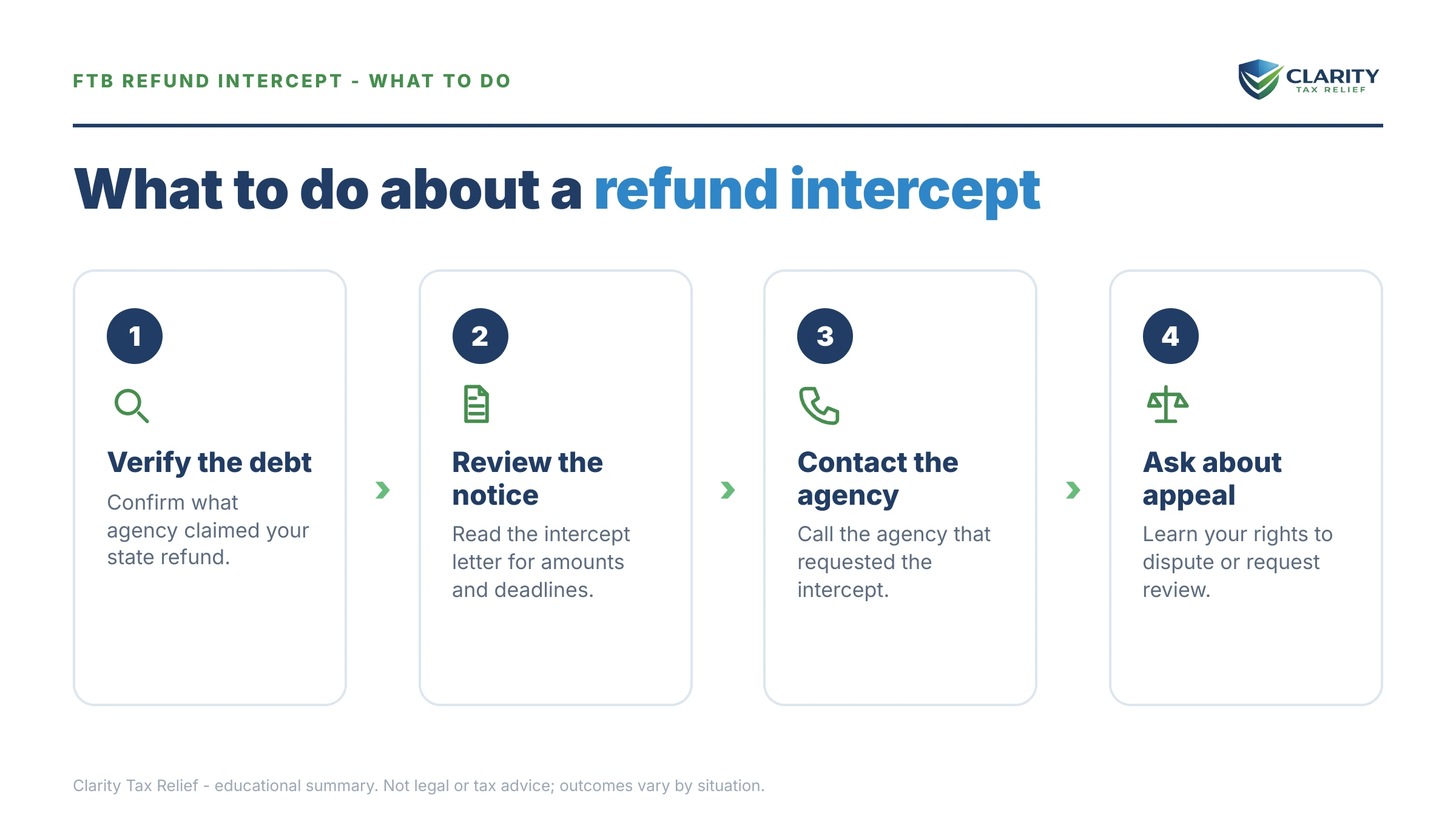
Your options after a California refund intercept
Nothing returns an intercepted refund except proving the underlying debt was wrong — so your real options are about the balance that remains. The general playbook for negotiating a tax balance on your own is in our guide to how to settle tax debt yourself; here is what's specific to the FTB.
| Option | Who it generally fits | What it does about intercepts |
|---|---|---|
| Dispute with the requesting agency | Debt already paid, not yours, or overstated — bring documentation | The only path to getting intercepted money returned |
| Pay the balance in full | Balances you can cover without starving the business | Ends intercepts once the account reaches zero |
| FTB payment plan | Smaller balances often set up online; larger ones (like $48,300) usually require financial disclosure to the FTB | Stops levies and wage orders; refunds are typically still applied while the plan runs |
| FTB financial hardship status | Documented inability to cover basic living or operating costs | Pauses active collection; refunds can still be intercepted |
| FTB Offer in Compromise | Strict, asset-based review — considered only when income and assets show the balance can never realistically be paid | Resolves the debt if accepted, which ends the intercept cycle |
| Adjust withholding or estimated payments | Anyone repeatedly overpaying California | Stops creating refunds for the state to keep while you resolve the balance |
Two FTB-specific realities shape which option you pick. First, refunds are generally still applied to your balance even while you're current on a payment plan — the plan protects you from levies, not from offsets. Second, California's 20-year collection statute means "wait it out" is not a strategy the way it sometimes is federally; see California's 20-year collection statute for why the clock rarely saves anyone. And if you also owe the IRS, expect identical treatment on the federal side — will the IRS take your refund every year walks through that mirror-image cycle.
What an intercept really does to a $48,300 balance: a worked example
Say you run an S-corp with four employees and owe the FTB $48,300 in personal income tax across two back years — a common shape when distributions outran estimated payments. This year you overpaid through withholding and filed expecting a $5,700 California refund. The FTB intercepts all of it. Here's the arithmetic (hypothetical figures):
- $48,300 owed − $5,700 intercepted = $42,600 still due — with interest and collection fees continuing to accrue on that remainder.
- If future refunds averaged the same $5,700, intercepts alone would need roughly 7–8 more years to cover the principal ($42,600 ÷ $5,700 ≈ 7.5) — and that ignores accruing interest, which intercepts alone may never outrun.
- A structured alternative: $42,600 spread over 60 months is about $710 a month before interest — predictable for cash-flow planning, and it takes bank levies and wage orders off the table while you stay current.
The deeper fix for a business owner: stop generating the refund. Trimming estimated payments so you land near zero keeps that $5,700 in your operating account all year instead of lending it to Sacramento interest-free and watching it get kept.
How to respond to an FTB refund intercept, step by step
- Read the intercept notice. Find the requesting agency, the amount taken, and the contact number printed on the notice — those three details determine every next move.
- Verify the debt. Check your MyFTB account for FTB balances, or call the requesting agency for court and interagency debts, and confirm the amount matches your records.
- Dispute in writing if the debt is wrong. Send proof of payment or identity to the requesting agency — the FTB cannot reverse an intercept for another agency's debt.
- Resolve the remaining balance. Set up an FTB payment plan, request hardship status, or explore an Offer in Compromise before stronger collection tools follow the intercept.
- Adjust your withholding or estimated payments. Stop overpaying California so future refunds are never there to take while you pay the balance down on your own terms.
When you can handle this yourself — and when help changes the outcome
Most single-agency intercepts for a few hundred dollars are a phone call, not a professional engagement. You likely don't need help if: the debt is one you recognize (a registration renewal, a toll penalty, a court fee), the intercept covered most or all of it, and no other balance is lurking behind it. Verify, confirm the account is closed, and move on — the FTB's official site at ftb.ca.gov is where to check balances and set up simple payment arrangements, and IRS.gov/payments handles the federal side if the levy came through SITLP.
Experienced help tends to change outcomes in four situations: an FTB balance in the tens of thousands (at $48,300, how your financial disclosure is presented shapes both your monthly payment and whether a levy gets issued in the meantime); a bank levy or wage order already in motion; multiple unfiled California years, because the FTB assesses non-filers aggressively and those assessments are often overstated; and any case where the same dollars are being chased by both the FTB and the IRS, where sequencing which agency you resolve first matters. For business owners, there's a fifth: EDD overpayment or payroll-side assessments feeding the intercept, which pull in a second agency with its own rules.
Terms on your intercept notice, decoded
- Interagency Intercept Collection (IIC): the program that lets courts and state and local agencies use the FTB to grab tax refunds, lottery winnings, and unclaimed property for their debts.
- Court-Ordered Debt (COD): fines, fees, and restitution referred by California courts to a dedicated FTB collection unit.
- State Income Tax Levy Program (SITLP): the IRS program that seizes state tax refunds to pay federal back taxes.
- Order To Withhold (OTW): the FTB's bank levy — a one-time order directing your bank to send the FTB funds from your account.
- Collection cost recovery fee: a fee the FTB adds to accounts that reach active collection, on top of tax, penalties, and interest.
- R&TC §19255: the California statute giving the FTB generally 20 years from a final liability to collect — twice the IRS's window.
FTB refund intercept FAQs
Why did the FTB take my state tax refund?
Because a government agency claims you owe it money. The FTB intercepts California refunds for three kinds of debt: its own back income taxes, debts that courts and state or local agencies submit through the Interagency Intercept Collection program, and federal back taxes the IRS levies through the State Income Tax Levy Program. Your intercept notice names the agency that received the money — that agency, not the FTB, controls the debt.
Can I get an intercepted refund back from the FTB?
Usually only by proving the underlying debt was wrong. If you already paid it, the debt isn't yours, or the amount is overstated, contact the requesting agency named on your notice with documentation — that agency, not the FTB, must authorize returning the money. If the FTB applied your refund to its own tax balance in error, such as a payment that never posted, correct the account with the FTB directly.
Will California take my refund every year until the debt is paid?
Yes — intercepts repeat automatically every year a refund exists while the debt remains. California's collection statute runs 20 years under R&TC §19255, so FTB tax debt will not quietly age out first. The practical fixes are adjusting your withholding or estimated payments so you stop overpaying the state, and resolving the balance itself through a payment plan or other program.
Can the FTB intercept a joint refund for my spouse's separate debt?
Yes. A joint California refund can be intercepted for a debt only one spouse owes, and community-property rules make it hard to wall off your share. Ask the requesting agency whether it will release your portion, and if the debt is FTB tax from a joint return you believe you shouldn't owe, innocent joint filer relief may apply.
Does an FTB payment plan stop refund intercepts?
Generally no. Like the IRS, the FTB typically keeps applying state refunds to your balance even while you are current on an installment agreement — the plan protects you from levies and wage orders, not from refund offsets. Treat each intercepted refund as an extra payment that shortens the plan rather than a sign it has failed.
Can the IRS take my California state refund?
Yes. Through the State Income Tax Levy Program, the IRS levies state refunds to collect federal back taxes — a CP504 notice is the IRS's required warning before it does. If your California refund disappeared but your debt is federal, the explanation will arrive from the IRS, not the FTB, and you resolve it on the federal side.
How long can the FTB keep intercepting refunds?
As long as the debt survives, and FTB income tax debt generally survives 20 years from the date the liability became final under Revenue and Taxation Code §19255 — double the IRS's 10-year window. Debts other agencies submit through the intercept program follow their own rules, and court-ordered debts can persist even longer. Waiting out an FTB balance is rarely a realistic strategy.
What is the difference between a refund intercept and an FTB levy?
An intercept is passive: the state keeps money it already owed you. A levy is active: the FTB sends an Order To Withhold to your bank or a continuous earnings withholding order to your employer and takes money you were counting on for rent, payroll, or groceries. An intercept is often the first visible sign that your account sits in active collections with those stronger tools queued behind it.
Your next 24 hours
- Find the requesting agency on your intercept notice — the agency name, the debt amount, and the contact phone number. This tells you which of the three doors your refund went through.
- Gather three things: the intercept notice, your most recent California return, and proof of any payments you've made on the debt (or your MyFTB balance screenshot if the debt is FTB tax).
- Get a free case review — the form takes two minutes, or call (888) 825-7779. Interest and collection fees are accruing on whatever the intercept didn't cover, and the tools behind an intercept — liens, bank levies, wage orders — are worth getting ahead of, not reacting to.
This guide is general information, not tax or legal advice for your specific situation. Eligibility for IRS programs depends on individual facts and circumstances; no outcome is guaranteed.