
IRS Collections
Will the IRS Take Your Refund Every Year? What Actually Stops the Offset (2026)
The short answer: yes — if you owe back taxes, the IRS will take your refund every year, automatically, until the balance reaches $0 or the 10-year collection statute expires. It happens even while you're on a payment plan. You'll get a CP49 notice each time. Resolving the debt, a hardship bypass, or fixing your withholding breaks the cycle.
You checked Where's My Refund expecting a deposit date and found the same message as last year: your refund was applied to a past-due balance. Second filing season in a row, gone before it touched your account. The frustrating part is that nobody at the IRS decided to do this — it's a computer rule that fires every single year. Which means it's also a rule you can plan around, and this page maps every way to do that.
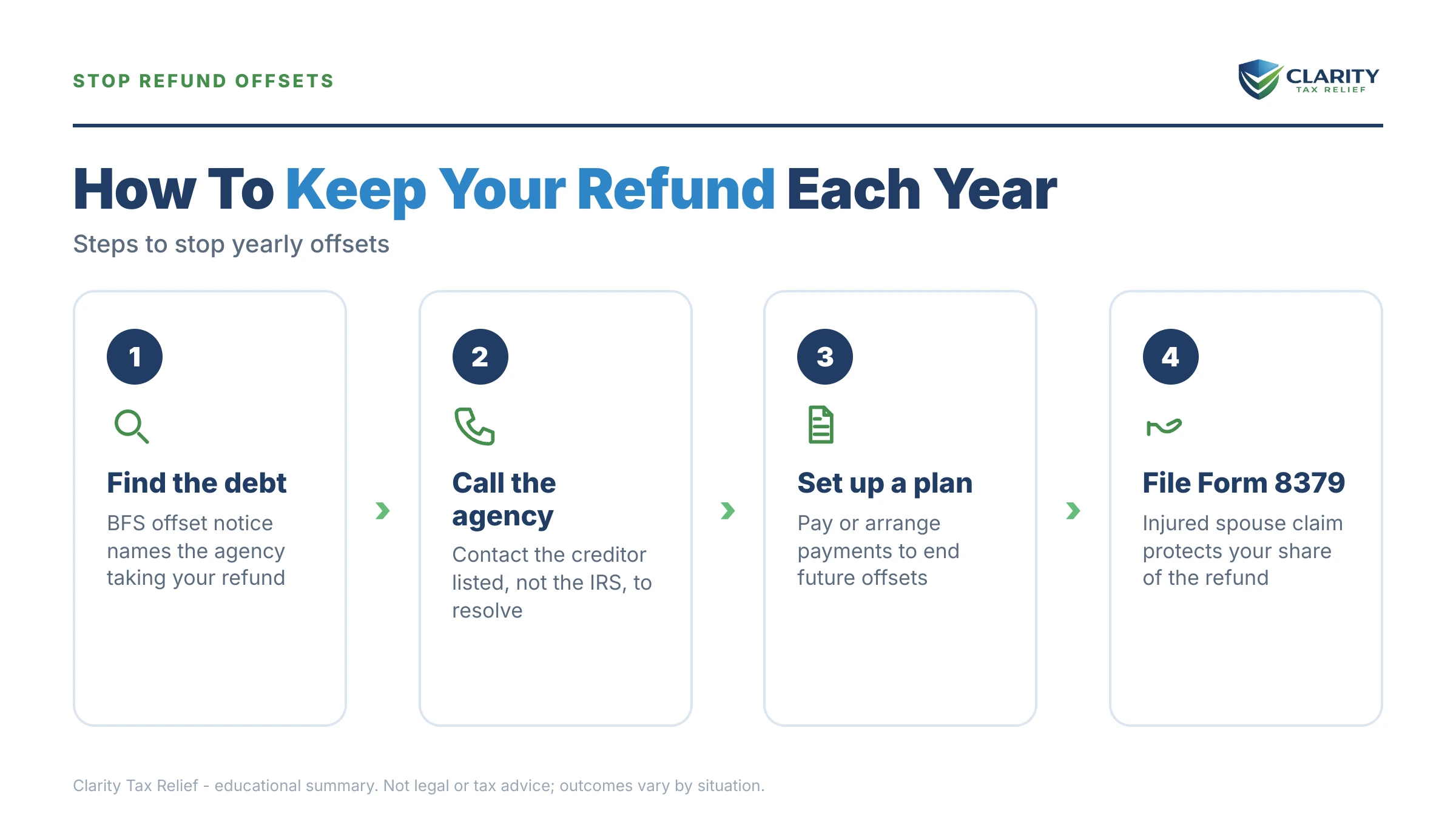
The offset repeats on a predictable cycle — the image below shows how that yearly loop works and the exact points where you can break it.
⏱ The real clock: a refund offset has no response deadline — but it repeats every filing season, and interest plus a monthly late-payment penalty keep accruing on whatever balance the offset doesn't cover. For many taxpayers, the yearly offset doesn't even keep pace with the accruals, so the debt grows anyway.
Why the IRS takes your refund every year
The IRS applies every federal refund to your unpaid back taxes automatically — no employee reviews it, and no warning letter arrives before it happens. On your account transcript, the offset posts as code 826 — refund applied to another year, and a CP49 refund-applied notice follows in the mail confirming which year's debt absorbed the money.
Two facts about this offset surprise almost everyone. First, being on an installment agreement does not protect your refund — keeping your refunds is a written condition of every IRS payment plan, a rule covered in detail in our guide to refund offset while on a payment plan. Second, Currently Not Collectible status doesn't protect it either. Hardship status pauses levies and garnishments, but the computer still sweeps refunds every year you're in it.
The only true endpoint is the Collection Statute Expiration Date — the IRS generally has 10 years from the date each balance was assessed to collect it, and offsets stop when that date passes. But the clock pauses during an Offer in Compromise, bankruptcy, or certain appeals, so it rarely runs out as fast as people hope. You can estimate your own expiration dates with our CSED Calculator.
Does the offset happen in every situation? What changes the answer
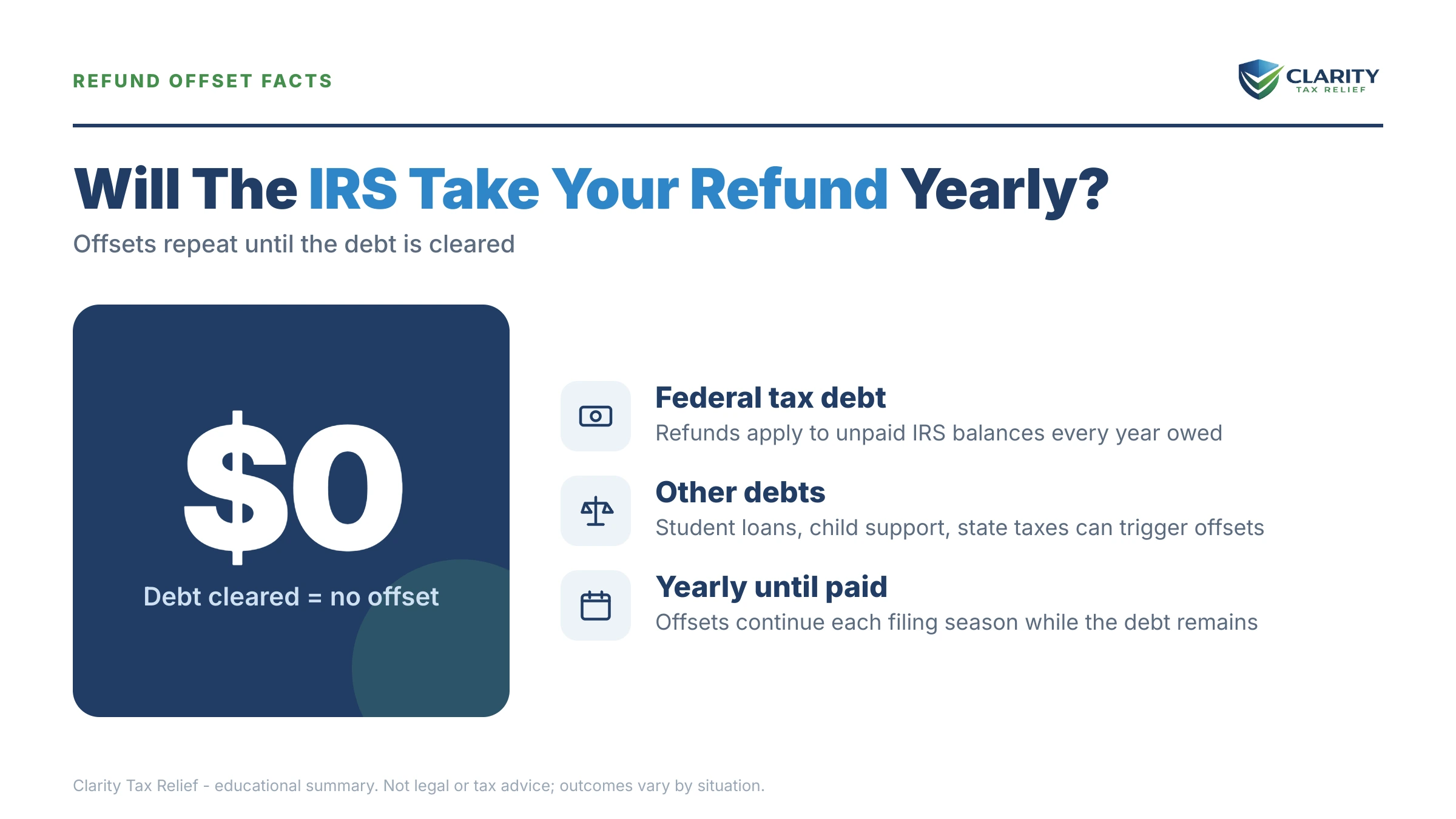
Not every taken refund is the same offset — and the fix depends entirely on which one hit you. If your transcript shows code 826 and you got a CP49, the IRS took it for your own back taxes. If it shows code 898 — offset to another agency and the letter came from the Bureau of the Fiscal Service, the Treasury Offset Program took it for a different debt entirely — student loans, child support, or a state obligation.
There's also a third pattern that matters if you have missing returns: the IRS can hold your refund — not offset it, freeze it — until you file, announced by a CP63 notice. If you have unfiled years, that hold blocks everything else on this page until the returns go in.
| Your situation | What happens to your refund | What you'll see |
|---|---|---|
| You owe back taxes, no agreement | Entire refund offset automatically, every year, until paid or the statute expires | CP49 notice + code 826 |
| On an installment agreement | Refund still taken as an extra payment — it does not replace that month's payment | CP49 notice + code 826 |
| Currently Not Collectible (hardship) | Levies pause, but refunds are still offset every year | CP49 notice + code 826 |
| Offer in Compromise accepted | Yearly offsets end once your offer is accepted and its terms are met | Offer acceptance letter |
| The debt belongs only to your spouse | Your share of a joint refund is recoverable with an injured-spouse claim | Offset notice; file Form 8379 |
| You have unfiled returns | Refund frozen — held, not applied — until the missing returns are filed | CP63 notice |
| Debt is student loans, child support, or state debt | Taken through the Treasury Offset Program, not by the IRS | Bureau of the Fiscal Service letter + code 898 |
Two of these deserve their own note. If the balance is entirely your spouse's — from before your marriage, or from their separate liability — Form 8379 injured spouse lets you recover your portion of a joint refund each year it's taken. And once your account reaches the intent-to-levy stage, the IRS can grab your state refund too, through the State Income Tax Levy Program — so both refunds can vanish in the same season.
What happens if you just let the offset happen every year
A yearly refund offset is not a payment plan — the IRS treats an account with no agreement as an account being ignored, and the collection sequence keeps moving underneath the offsets. Here's the order events unfold in if you do nothing else:
- Every filing season: your refund disappears (CP49), and a CP71 annual reminder restates the growing balance.
- Between seasons: interest and the failure-to-pay penalty — roughly 0.5% of the balance per month — accrue continuously. On larger debts, the accruals outrun the offset, so the balance rises even as refunds are taken.
- The notice ladder climbs: reminder notices give way to a CP504, which authorizes the IRS to seize your state refund and puts a federal tax lien in play.
- Final notice: an LT11 or Letter 1058 opens a 30-day window; after it closes, the IRS can levy your bank account and garnish wages — enforcement far beyond a refund sweep.
- Passport certification: once your assessed debt crosses $66,000 (the 2026 threshold), the IRS can certify it to the State Department, which can deny or revoke your passport (CP508C).
That last stage matters if your balance is anywhere near the line. A $61,200 debt with no agreement is less than $5,000 from the passport threshold — at typical accrual rates, penalties and interest alone can push it across within about a year, even with a refund offset landing in between. And in 2026, with IRS staffing down roughly 27%, this ladder is climbed entirely by automated systems: hard to reach a human, impossible to be forgotten by the machine.
Losing your refund every year and the balance still isn't shrinking?
That's the offset treadmill — and there are specific exits. An experienced tax professional will review your transcript, your balance, and your filing history free, and show you which option actually ends the yearly cycle before penalties push the debt higher.
How to stop the IRS from taking your refund: your real options
Only two things permanently end the yearly offset: a $0 balance or an accepted Offer in Compromise — everything else either sidesteps it or interrupts it once. The full playbook for negotiating a balance is in our guide to how to settle tax debt yourself; here's how each option treats your refund specifically:
| Option | Who qualifies | Cost | Stops the yearly offset? |
|---|---|---|---|
| Pay in full | Anyone | Balance + accrued penalties and interest | Yes — offsets end at $0 |
| Short-term plan (up to 180 days) | Balances you can clear within 6 months | $0 setup; accruals continue | No — refunds offset until paid |
| Long-term installment agreement | Up to $50,000 online, up to 72 months | Setup fee; interest and penalty continue | No — refund taken every year of the plan |
| Currently Not Collectible | Documented hardship (Form 433-F review) | $0; balance keeps accruing | No — offsets continue during CNC |
| Offer in Compromise | Means-tested; roughly 1 in 5 offers accepted in FY2024 | $205 fee + 20% down on lump-sum offers (both waived with low-income certification) | Yes — once accepted and terms are met |
| Offset Bypass Refund (OBR) | Documented immediate hardship, via the Taxpayer Advocate | $0 | One refund at a time — not permanent |
| Adjust withholding / estimates | Anyone | $0 | Sidesteps it — no refund to take |
| Form 8379 injured spouse | Joint filers where the debt is one spouse's alone | $0 | Recovers the non-debtor spouse's share only |
Three of these need honest fine print. The Offset Bypass Refund for hardship must be requested through the Taxpayer Advocate Service before your return finishes processing — once the offset posts, it can't be undone — and it only rescues that one refund. An Offer in Compromise is real but strictly means-tested on your income and assets, and the treatment of the refund in the year your offer is accepted has its own rules — see will the IRS keep my refund after an offer in compromise before you count on that money.
The withholding fix deserves more attention than it gets. If you're going to owe the IRS the money either way, a big refund is just an interest-free loan to the government that gets confiscated on arrival. Setting your withholding or quarterly estimates so you break roughly even lets you decide where every dollar goes — including whether it goes to the debt on your terms.
Say you owe $61,200: the offset treadmill, in real numbers
Say you're a gig worker who just filed three overdue years — the exact spot covered in our guide for people who haven't filed taxes in 3 years — and the assessed total lands at $61,200. This year you also worked a part-time W-2 job, so your current return shows a $2,600 refund. Here's the hypothetical math:
- The offset: the $2,600 is applied automatically (code 826), dropping the balance to $58,600. You never see the money.
- The accrual: the failure-to-pay penalty alone runs about 0.5% per month — roughly $300/month, or about $3,600 a year at this balance — before interest is added on top. The yearly offset recovers less than the penalty adds. The balance grows anyway.
- The threshold problem: at that accrual rate, an unresolved $61,200 crosses the $66,000 passport-certification line in roughly a year and a half.
- A plan changes the math: $61,200 is above the $50,000 online-agreement ceiling, so you'd either submit financials or pay the balance down by about $11,200 first. Under $50,000 with direct debit, a 72-month plan runs roughly $850/month before accruals — and inside an agreement, the offsets that continue each year actually shorten the plan instead of just treading water.
- An offer might change it more: if your income and assets genuinely can't cover $58,600 within the collection window, an Offer in Compromise is worth pricing out — the IRS accepts an offer based on what it could realistically collect, not what you owe.
This example is hypothetical, but the shape of it is universal: without an agreement, the offset is a leak in a rising tide. The decision isn't whether to lose the refund — that's automatic — it's whether the rest of the debt is on a track that ends.
How to respond to a yearly refund offset, step by step
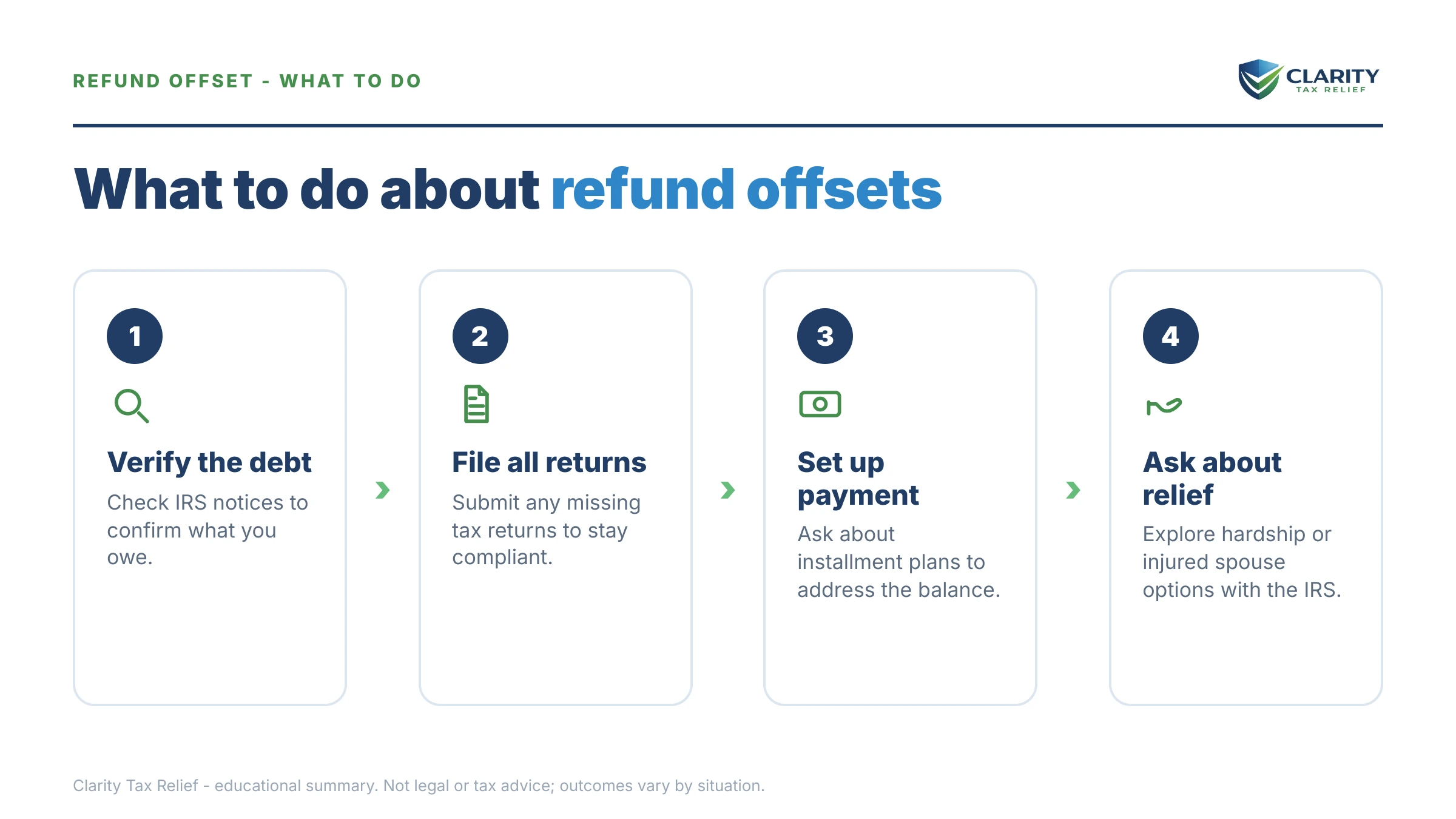
- Pull your IRS account transcript — confirm who took the refund: code 826 means the IRS applied it to your own back taxes; code 898 means another agency took it through the Treasury Offset Program. The fix is different for each.
- File every unfiled return — the IRS holds refunds (CP63) and blocks most resolution options while returns are missing. Nothing permanent can be negotiated until you're filing-compliant.
- Fix your withholding or estimated payments — aim your next return at a near-zero refund so there's nothing to offset. For gig income, that means right-sizing quarterly estimates instead of overpaying.
- Choose a resolution track for the balance — compare a payment plan, Currently Not Collectible status, and an Offer in Compromise against your real numbers — only full payment or an accepted offer actually ends the yearly offset.
- Request an Offset Bypass Refund before filing if you're in hardship — if losing this year's refund means you can't cover rent, utilities, or medical costs, contact the Taxpayer Advocate Service before your return processes — an OBR can't be granted after the offset posts.
When you can handle this yourself — and when help changes the outcome
If your balance is under about $10,000, your returns are all filed, and you agree with the amount, you likely don't need professional help. Set up a payment plan online, adjust your withholding so next year's refund is near zero, and let any remaining offsets accelerate the payoff. That's a clean DIY case.
Experienced help earns its cost in a few specific situations: multiple unfiled years (where the order you file and resolve things changes what you ultimately pay), balances above the $50,000 disclosure line (where the financial statement you submit shapes your monthly payment), offsets landing while you genuinely can't cover essentials (where an OBR request has to be timed precisely), and Offer in Compromise math (where a miscalculated offer wastes months and a rejection). If your situation is on that list, a free review before you file this year's return costs nothing and can change which column your refund ends up in.
One more piece of perspective: a refund offset is the mildest tool the IRS has, because it only takes money you overpaid. Seizing property is a different universe of process and protection — see can the IRS take my house and can the IRS take my 401(k) for where those lines actually sit. The offset is the warning shot; the goal is resolving the balance before the heavier tools come out.
Terms on your CP49, decoded
- Refund offset: the automatic application of your refund to a debt before it's ever paid to you.
- CP49: the IRS notice confirming your refund was applied to your own back taxes, and to which year.
- Code 826: the transcript entry showing the IRS moved your overpayment to a balance-due year.
- Code 898: the transcript entry showing your refund went to a non-IRS debt through the Treasury Offset Program.
- CSED: the Collection Statute Expiration Date — generally 10 years from assessment, after which the IRS can no longer collect or offset for that year's debt.
- Offset Bypass Refund (OBR): a one-time hardship release of a refund that would otherwise be offset, requested through the Taxpayer Advocate before the refund posts.
Yearly refund offset questions, answered
Will the IRS take my refund every year until my debt is paid?
Yes. The offset is automatic and repeats every filing season until your balance reaches $0 or the 10-year collection statute (CSED) expires — whichever comes first. You'll get a CP49 notice each time it happens. An Offer in Compromise, bankruptcy, or a collection appeal pauses the 10-year clock while it is pending (plus a short additional period), pushing the collection deadline later — it does not restart the 10 years.
Will the IRS take my refund if I'm on a payment plan?
Yes. Keeping your refund is a standard condition of every IRS installment agreement — being current on your monthly payments does not protect it. The offset is applied on top of your plan as an extra payment against the balance, which does shorten the plan. It never replaces that month's payment, so keep paying as scheduled.
Does a refund offset count as my monthly installment payment?
No. The offset is applied to your total balance, but the IRS still expects that month's installment payment on time. Skipping a payment because your refund was taken can put your agreement into default, which restarts collection notices. Treat the offset as a bonus principal payment, not a substitute.
Can I stop the IRS from taking my refund every year?
There are three real levers: resolve the balance (pay it off or get an Offer in Compromise accepted), request an Offset Bypass Refund through the Taxpayer Advocate Service if the offset causes immediate financial hardship, or stop generating a refund by adjusting your withholding or estimated payments. A payment plan and Currently Not Collectible status do not stop the offset — refunds are still taken in both.
Will the IRS take my Earned Income Credit or Child Tax Credit refund?
Yes, when the debt is federal back taxes. Refundable credits like the EITC and Additional Child Tax Credit become part of your refund, and the IRS offsets the entire refund against your balance. The only carve-out is an Offset Bypass Refund granted for documented hardship before the refund posts. Rules differ for non-IRS debts collected through the Treasury Offset Program.
Does the IRS take your state tax refund too?
It can. Once your account reaches the CP504 stage, the IRS is authorized to levy your state refund, and it routinely does through the State Income Tax Levy Program in participating states. Your state can also intercept its own refunds for state tax debt under separate rules — so a person with both IRS and state balances can lose both refunds in the same year.
How do I know whether the IRS took my refund or another agency did?
Check the paperwork and your transcript. A CP49 notice plus transaction code 826 on your account transcript means the IRS applied the refund to your own back taxes. A letter from the Bureau of the Fiscal Service plus code 898 means the Treasury Offset Program took it for a different debt — student loans, child support, or state obligations. The fix is completely different for each, so identify the taker before you act.
Your next 24 hours
- Find the code. Log into your IRS online account, open your account transcript, and note whether the offset posted as code 826 (IRS back taxes) or code 898 (another agency) — everything else depends on that answer.
- Gather three things: your CP49 (or Fiscal Service letter), your most recent filed return, and a rough list of any unfiled years and current-year income — that's everything needed to size your options.
- Get the balance reviewed free. Interest and penalties are accruing on whatever the offsets don't cover, and they don't wait for filing season. Call (888) 825-7779 or use the 2-minute form at claritytaxrelief.com/#consult — an experienced tax professional will show you which exit from the yearly offset cycle fits your numbers.
For the IRS's own documentation, see Understanding your CP49 notice, the IRS payment plans and installment agreements page, and the Taxpayer Advocate Service for hardship bypass requests.
This guide is general information, not tax or legal advice for your specific situation. Eligibility for IRS programs depends on individual facts and circumstances; no outcome is guaranteed.