
IRS Collections
Will the IRS Take My Refund for Back Taxes? (2026 Guide)
The short answer: yes. If you owe back taxes, the IRS automatically applies your federal refund to that balance before sending you anything — even if you're on a payment plan. The offset posts as code 826 on your transcript, and a CP49 notice confirms it. Only an injured-spouse claim or a hardship bypass can redirect the money.
You filed this year's return already counting the refund — maybe as part of the cash cushion for the refinance you've been planning — and it never hit your bank account. That silence usually means the offset already happened. The money didn't vanish: it paid down your oldest tax year, and everything from here is a decision you still get to make.
The paper trail shows up afterward as a CP49 notice and a code 826 entry on your transcript — the image below shows exactly what that confirmation looks like and where to find the amount taken and the year it was applied to.
⏱ The clock that matters: a refund offset has no response deadline — but the balance it didn't cover keeps growing. The failure-to-pay penalty adds 0.5% per month, and interest compounds daily, until the debt is resolved.
Will the IRS take my refund for back taxes? How the offset actually works
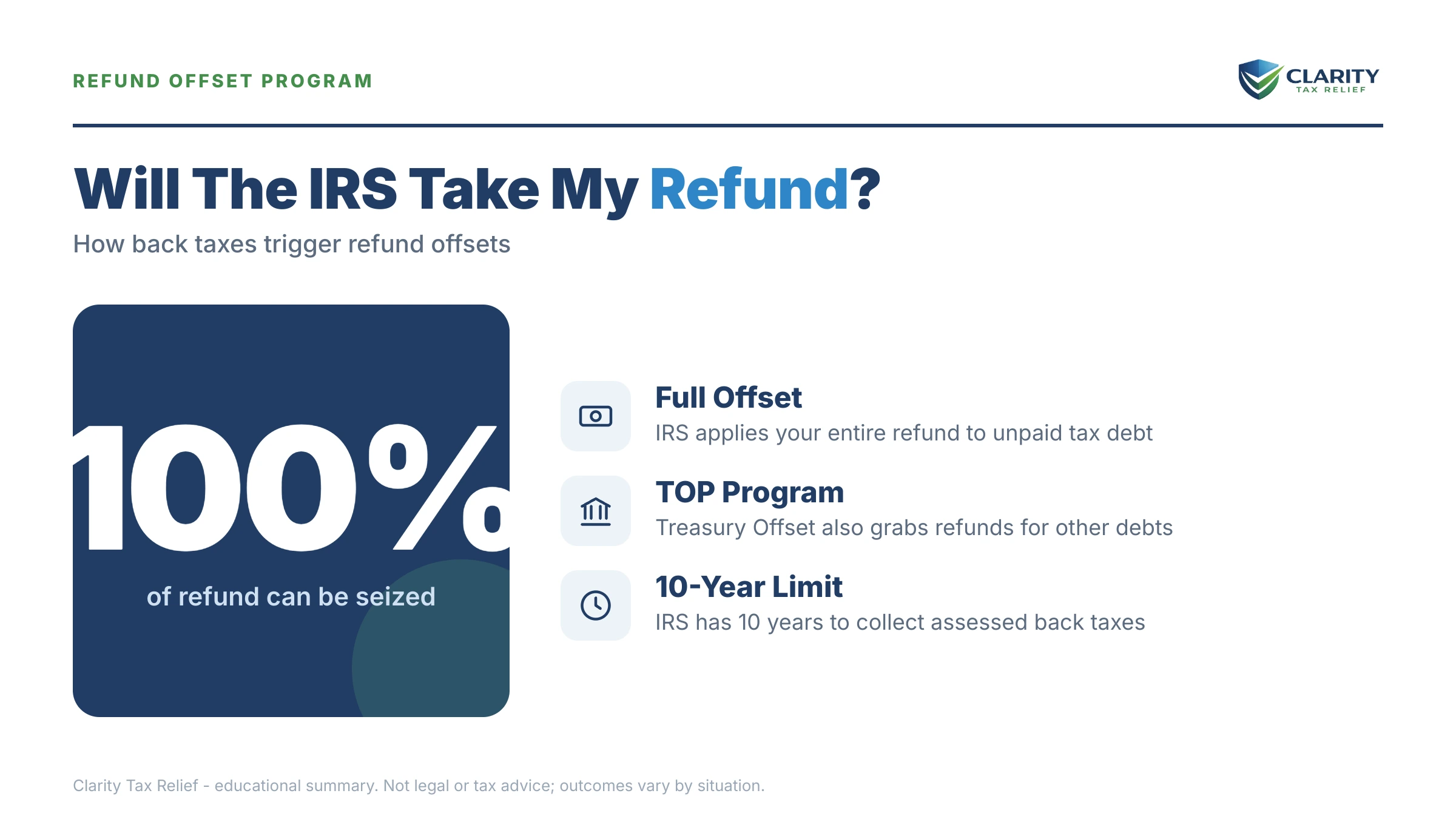
The IRS applies 100% of your federal refund to any unpaid federal tax balance before it sends you anything — automatically, with no warning letter and no levy paperwork. The authority is IRC §6402(a), and because the IRS already holds the money, none of the protections that apply to seizures apply here. An offset requires no final notice, no hearing, and no court order — it happens the moment your return finishes processing.
That's the key distinction people miss: an offset is not a levy. A levy — taking money from your bank or paycheck — requires a final notice like an LT11 and a 30-day window with appeal rights. Keeping a refund you were about to receive requires nothing at all.
When the offset happens, three things post to your records. A code 826 appears on the transcript of the year that gave up the refund. A matching credit lands on the back-tax year that received it — the oldest unpaid year first. And a CP49 refund applied notice arrives in the mail confirming the amount, the year it went to, and whatever balance is left.
One more rule worth knowing: an offset is an involuntary payment, so you can't designate where it goes. The IRS applies it to the oldest period, and within that period to tax first, then penalties, then interest. With a voluntary payment, you could direct it — with an offset, you can't.
Who takes your refund — and for which debts
Three different systems can intercept a tax refund: the IRS itself for federal tax debt, the Treasury Offset Program for non-tax debts, and the State Income Tax Levy Program for your state refund. They leave different fingerprints, and knowing which one took your money determines who you call.
| Who intercepts it | For which debts | Transcript clue | The notice you'll get |
|---|---|---|---|
| IRS internal offset (IRC §6402(a)) | Your own unpaid federal income taxes | Code 826 | CP49 from the IRS |
| Treasury Offset Program (Bureau of the Fiscal Service) | Past-due child support, defaulted federal student loans, state income tax, unemployment overpayments | Code 898 | Offset letter from the Bureau of the Fiscal Service |
| State Income Tax Levy Program (SITLP) | Your state refund taken for federal back taxes | Payment credit on the federal year | CP92 from the IRS |
The distinction matters because the IRS can only fix its own offsets. If your refund went to child support or student loans through the Treasury Offset Program, the money is already at the other agency — you'll see code 898 on your transcript, and disputes go to the agency named in the offset letter, not the IRS.
And the pipeline runs both directions. If you owe the IRS, your state refund can be levied through SITLP; if you owe your state, your federal refund can be intercepted through TOP. The full two-way picture is covered in our guide to a state refund taken for IRS debt.
What the codes on your transcript mean after an offset
Code 826 on your transcript means your overpayment was moved to a tax year with a balance due — it is the transcript fingerprint of a back-tax refund offset. Here's how to read the entries around it:
| Code / notice | What it means | What to do |
|---|---|---|
| 150 | Your return posted and the tax was assessed | Nothing — this appears on every processed return |
| 806 | Your withholding and estimated payments were credited | Confirm it matches your W-2s and 1099s |
| 826 | Your overpayment was applied to a year with a balance due | Note which year received it; verify the remaining balance |
| 898 | Your refund went to a non-tax debt through TOP | Contact the agency named in the Fiscal Service letter — not the IRS |
| 846 | A refund was actually sent to you | If it's smaller than expected, look for an 826 or 898 just above it |
| 971 + CP49 | The IRS issued the notice confirming the offset | Keep it; compare its figures against your transcript |
If your refund was bigger than your debt, you'll see both: an 826 wiping out the balance, then an 846 releasing the remainder. A partial refund is often the first hint people get that an old balance existed at all. For a line-by-line walkthrough of the offset entry itself, see code 826 on your IRS transcript.
A worked example: $16,400 owed, a $3,800 refund, and a refinance on the calendar
Say you owe $16,400 in back taxes from two years ago, you're expecting a $3,800 refund this spring, and you're planning to refinance your mortgage this fall. This is hypothetical, but the math is exactly what the IRS's system will run.
The moment your return processes, the full $3,800 is applied to the old year — $16,400 − $3,800 = $12,600 remaining. No fee came out, and the payment hit tax before penalties and interest, which is the most efficient place a payment can land. In that narrow sense, the offset is the cheapest payment you'll ever make.
But $12,600 doesn't sit still. The failure-to-pay penalty alone adds roughly 0.5% a month — about $63 on this balance — and interest compounds daily on top of it. Over a year of doing nothing, you'd give back a meaningful slice of what the offset just accomplished. Our guide to the IRS interest rate on back taxes in 2026 shows how the compounding works, and you can estimate your own numbers with our IRS Penalty & Interest Calculator.
On a streamlined 72-month installment agreement, $12,600 works out to about $175 a month before accruals — most people set $200–$225 so the plan actually retires the interest too. Paying faster always costs less in total.
Now the refinance angle, because it changes your urgency. An unresolved federal tax debt is exactly the kind of thing underwriting surfaces, and if the IRS files a Notice of Federal Tax Lien before you close, it attaches to your home and complicates everything. A documented installment agreement in good standing — set up before a lien is filed — is what most lenders want to see. If a lien already exists, read can I refinance with an IRS lien before you lock a rate; there are subordination paths, but they take time you'd rather not spend mid-closing.
What happens if you do nothing
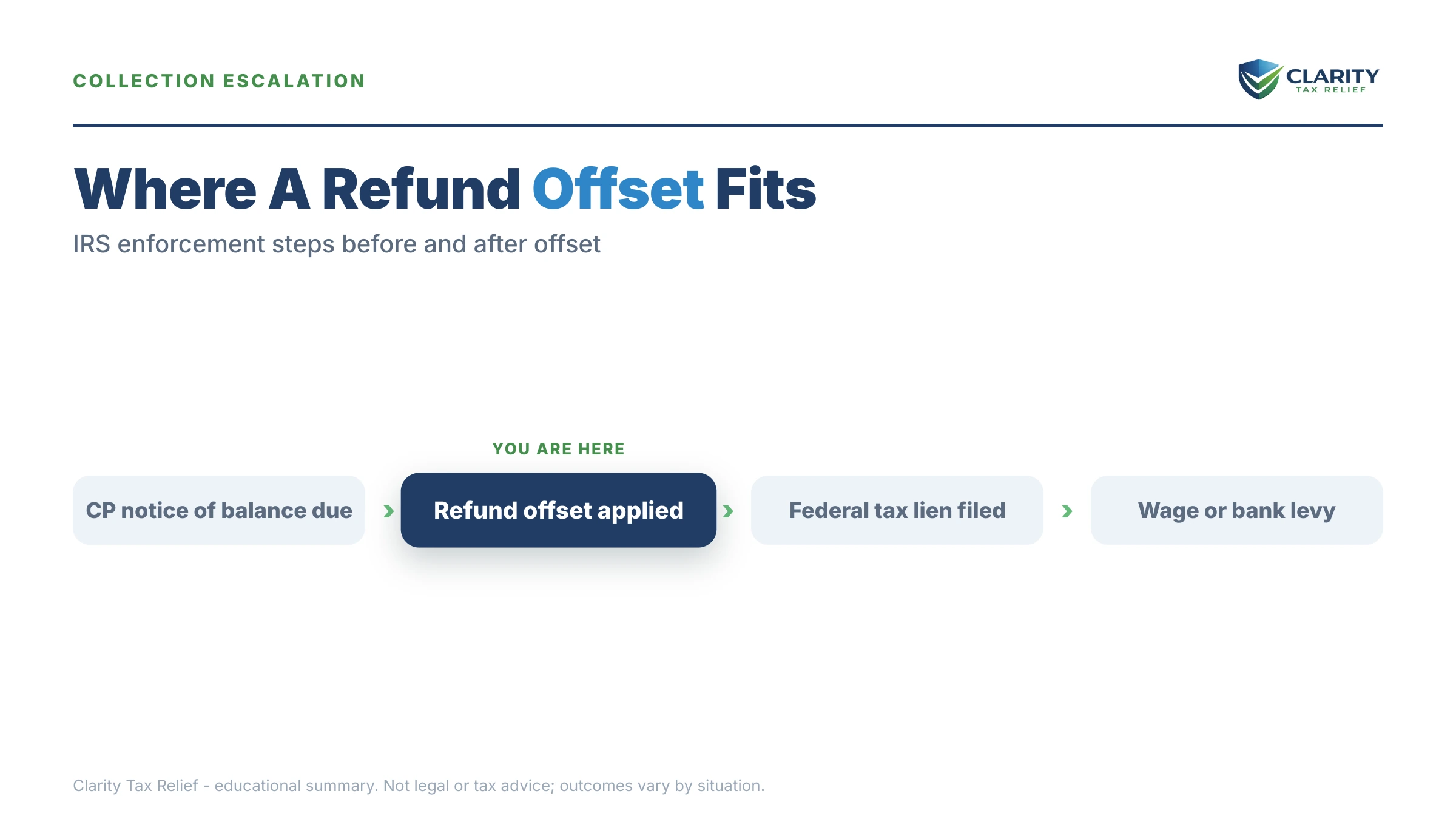
A refund offset is the gentlest thing the IRS collection system does — every stage after it has more teeth. The offset doesn't pause collections, and it doesn't count as "dealing with" the debt. Left alone, here's the sequence:
- Every future refund is intercepted. The offset repeats each filing season until the balance is gone — see will the IRS take my refund every year for how long that cycle runs.
- The balance keeps compounding. The 0.5% monthly failure-to-pay penalty accrues up to a 25% cap, with daily interest on top of penalties as well as tax.
- The notice sequence advances. Balance-due bills and reminders give way to a CP504 — which lets the IRS levy your state refund under IRC §6331(d) — and then an LT11 or Letter 1058 final notice, which starts a 30-day clock and your Collection Due Process rights.
- A federal tax lien becomes a live risk. A recorded lien attaches to your home and is exactly what derails a refinance or sale — the stage a homeowner most wants to stay in front of.
- Levies begin after the final-notice window closes. Wage levies run continuously until released; a bank levy freezes funds for 21 days before the money leaves.
- The 10-year collection statute runs in the background. The IRS has 10 years from assessment to collect, but the clock pauses during appeals, offers, and bankruptcy — waiting it out is rarely a plan on a fresh balance.
One 2026 reality check: the IRS workforce shrank roughly 27% in 2025, so reaching a human is harder than ever — but offsets, notices, and levies are generated by automated systems that never stopped running. Slow phones do not mean slow enforcement.
Just lost a refund to the offset — and still owe?
Get the remaining balance reviewed free before penalties and interest add another month's growth. An experienced tax professional will confirm exactly what's left, which years it covers, and the cheapest realistic way to resolve it — no pressure, no obligation.
Your options for the balance the refund didn't cover
Every mainstream IRS resolution keeps the refund offset running — the honest question isn't how to stop the offset, it's how to resolve the balance behind it. Here's the full menu, with what each one does and doesn't change:
| Option | Who is eligible | Stops the refund offset? | Cost |
|---|---|---|---|
| Pay the remaining balance in full | Anyone | Yes — offsets end when the balance hits $0 | No fee; stops penalty and interest accrual |
| Short-term payment plan (up to 180 days) | Balance you can clear within 180 days | No — refunds are still applied | $0 setup; interest and penalties continue |
| Streamlined installment agreement | Balance ≤ $50,000, up to 72 months online | No — and the offset doesn't count as your monthly payment | Setup fee varies; interest and penalties continue |
| Currently Not Collectible (hardship) | Documented inability to pay basic living costs | No — refunds are still taken | $0; collection pauses but the balance grows |
| Offer in Compromise | Assets plus future income genuinely below the debt | Special refund rules apply — see below | $205 fee + 20% down on lump-sum offers (both waived with low-income certification) |
| Injured spouse claim (Form 8379) | Joint filer whose spouse alone owes the debt | Yes — for your share of the joint refund | $0 |
| Offset Bypass Refund | Severe documented hardship, requested before the refund posts | Yes — a one-time release | $0, arranged through the Taxpayer Advocate Service |
| Penalty relief (First-Time Abate / AEP) | Clean compliance history for the prior 3 years | No, but it shrinks the balance being offset | $0 |
A few specifics the table can't hold. On a payment plan, the IRS keeps your refund and still expects that month's payment — the offset is a bonus principal payment, not a substitute, a wrinkle covered in will the IRS take my refund on a payment plan. For the $12,600 in our example, a streamlined agreement can be set up online without financial disclosure; details are on the IRS payment plans page. If your balance were under $10,000, a guaranteed installment agreement — the IRS's official name for the program — would apply instead.
An Offer in Compromise is real but strictly means-tested: the IRS accepted roughly 1 in 5 offers in FY2024, and acceptance turns entirely on whether your assets and future income genuinely can't cover the debt. A homeowner with equity — the person refinancing — usually has too much reachable value for an offer to make sense, which is worth knowing before paying anyone to pursue one.
Penalty relief is the quiet win most people skip. If the prior three years were clean, first-time abatement can remove the failure-to-pay penalty — and starting summer 2026, the IRS's new Automatic Exemption from Penalty (AEP) applies similar relief automatically, with no request needed. Either way, a smaller balance means smaller future offsets. For the full do-it-yourself playbook on all of these programs, see how to settle tax debt yourself.
Can you stop the IRS from taking your refund for back taxes?
For most people, no — but three narrow paths exist, and a fourth strategy makes the question moot.
Injured spouse claim. If you filed jointly and the back taxes belong only to your spouse — debt from before your marriage, or their separate liability — Form 8379, the injured spouse allocation, recovers your share of the joint refund. It works for spouse-only tax debts and for their child support or student loans taken through TOP. File it with the return or after the offset, and refile it every year the debt exists.
Offset Bypass Refund. If losing the refund creates a severe, documentable hardship — a pending eviction, a utility shutoff, an unfillable prescription — the IRS can release the money instead of applying it. The catch: an offset bypass refund must be requested before the refund posts, usually through the Taxpayer Advocate Service with Form 911 and proof of the hardship. Once the offset happens, the window is gone for that year, and it only works against IRS tax debt — not TOP debts like child support.
An accepted Offer in Compromise. Refund treatment during and after an offer has its own rules, which trip up a lot of applicants — see will the IRS keep my refund after an offer in compromise for how the offer year is handled.
Or stop creating refunds. The most reliable move needs no IRS approval at all: adjust your W-4 so you stop over-withholding. Money that stays in your paycheck is yours to aim at the debt voluntarily — where you can designate which year and which liability it pays — instead of arriving as a refund the IRS takes on its own terms.
How to respond when the IRS takes your refund, step by step
- Confirm the offset and the remaining balance. Log into your IRS online account and pull your account transcript. Match the code 826 amount and the CP49 notice against the refund you expected, and write down the exact balance left on each year.
- Verify the money went to the right year. Offsets apply to the oldest balance first. If the transcript shows the refund applied to a year you already paid or are disputing, respond to the CP49 with proof rather than letting the error stand.
- File Form 8379 if the debt belongs only to your spouse. An injured-spouse claim recovers your share of a joint refund taken for your spouse's separate debt. File it now — and attach it to every future joint return while the debt exists.
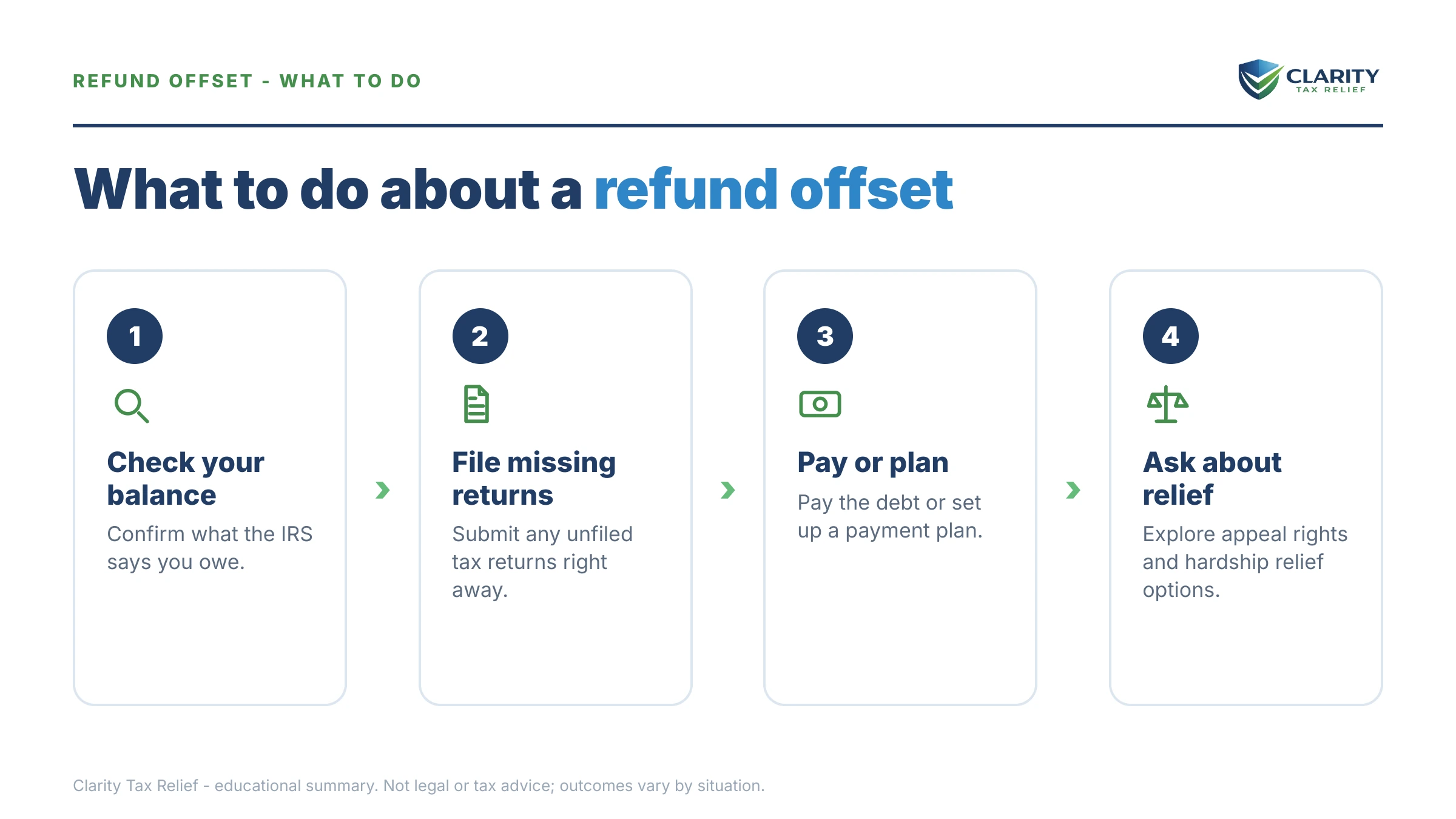
- Put a real resolution on the remaining balance. Pick the option that fits your finances — a short-term plan, a streamlined installment agreement, hardship status, or an Offer in Compromise — and set it up before the notice sequence escalates past reminder letters.
- Adjust your withholding so next year's money stays in your paycheck. Update your W-4 so you stop over-withholding. Money in your paycheck is yours to direct at the debt on your terms; money in a refund is taken automatically.
Payments and plan setup all run through IRS.gov/payments — the fastest way to stop the accrual math from getting worse.
Situations that change the answer
The offset rule is universal, but what you should do about it shifts with your circumstances. The five that change the playbook most:
You filed jointly and the debt isn't yours
An injured-spouse claim (above) recovers your share this year. Longer term, some couples weigh filing separately to keep future refunds apart — that trades away joint-filing tax benefits, so run both numbers before switching.
You owe for multiple years
The offset hits the oldest year first, which matters because each year has its own 10-year collection clock. Track which year each 826 credit lands on — it tells you which balances are shrinking and which statutes are closest to expiring.
You're self-employed and pay quarterlies
The election to apply this year's overpayment to next year's estimated taxes gets overridden by the offset — the money goes to the back taxes instead. Budget your quarterly payments assuming no carry-forward exists, or you'll start next year already behind.
You're in Chapter 13 bankruptcy
The automatic stay changes what the IRS can keep, and your plan or trustee may have a claim on refunds too. How refunds are handled during a repayment plan is covered in Chapter 13 and IRS back taxes — don't assume the normal offset rules apply mid-case.
You dispute the underlying balance
Don't let offsets quietly pay a bill you believe is wrong. Respond to the CP49 with documentation, amend the return if the numbers were off, or pursue audit reconsideration if the balance came from an exam — an offset applied to a corrected-away balance can be refunded.
One related trap that isn't an offset: if you have unfiled back years, the IRS can freeze your refund entirely under a CP63 hold until the missing returns come in. The fix there is filing, not a payment program.
When you can handle this yourself
Much of the time, you don't need anyone. If the balance is right, the remaining debt is one you could clear within 180 days, or you simply need a streamlined installment agreement under $50,000, the IRS's online tools handle it in an evening — no professional required. A single CP49 that matches your own records needs no response at all.
Experienced help changes outcomes in a narrower set of situations: a refinance or sale closing with a lien filed or threatened, several unfiled years muddying what you actually owe, a final notice already started the 30-day levy clock, offer-in-compromise math you can't verify yourself, or a spouse-liability question where injured spouse, innocent spouse, and community-property rules overlap. In those cases, the sequencing — returns first, penalties second, balance last — often changes the total you pay, and getting it wrong is expensive.
If your situation lands on the professional side of that line — a closing at risk, multiple years in play, or offer math you're unsure of — a free review of your remaining balance takes one call: (888) 825-7779 or the 2-minute form.
Terms on your notice and transcript, decoded
- Refund offset — the IRS keeping a refund and applying it to a debt; an internal accounting move, not a seizure.
- CP49 — the after-the-fact notice confirming how much of your refund was applied and to which tax year.
- Code 826 vs. code 898 — 826 means the IRS kept the refund for your own federal tax debt; 898 means another agency received it through the Bureau of the Fiscal Service's Treasury Offset Program.
- Injured spouse — a joint filer reclaiming their share of a refund taken for the other spouse's separate debt (different from innocent spouse, which contests the liability itself).
- Offset Bypass Refund (OBR) — a one-time hardship release of a refund, arranged through the Taxpayer Advocate before the offset posts.
- CSED — the collection statute expiration date, 10 years from assessment; offsets stop when it passes, but the clock pauses during appeals, offers, and bankruptcy.
Refund offset questions, answered
Will the IRS take my whole tax refund for back taxes?
Yes — the IRS applies your entire federal refund to the back-tax balance, up to the full amount you owe including penalties and interest. If your refund is larger than the debt, the leftover is released to you, usually posting as code 846 on your transcript. When you owe for multiple years, the money goes to the oldest year first.
Will the IRS take my refund if I'm on a payment plan?
Yes. Standard installment agreement terms let the IRS keep any refund and apply it to your balance while the agreement is active. The offset does not count as your monthly payment — you still owe that month's amount — but it also isn't a default, and it shrinks your balance faster than the plan alone would.
How do I know before I file whether my refund will be offset?
Check your IRS online account: if it shows any unpaid balance for a prior year, your refund will be applied to it automatically. For non-tax debts like child support or defaulted federal student loans, the Bureau of the Fiscal Service runs a separate offset database you can check before filing. No pre-filing letter warns you — a CP49 arrives only after the money is taken.
Can I stop the IRS from taking my refund for back taxes?
Rarely, and only in specific situations. An injured-spouse claim on Form 8379 protects your share of a joint refund when the debt belongs only to your spouse, and an Offset Bypass Refund can release the money if you can document a severe hardship such as a pending eviction or utility shutoff. Otherwise the offset stands — the practical fix is adjusting your withholding so you stop building refunds while you owe.
What is a CP49 notice?
A CP49 is the IRS notice confirming your refund was applied to a back-tax balance. It shows the refund amount, the tax year it was applied to, and whatever balance remains — or the leftover refund being sent to you. It arrives after the offset happens; it is not a warning and requires no response unless the numbers are wrong.
Is a refund offset the same as a levy?
No. An offset is an internal accounting move under IRC §6402 — the IRS simply keeps money it already holds — so it needs no final notice and gives you no Collection Due Process hearing rights. A levy is forced seizure of wages, bank accounts, or property, and it can only happen after the IRS sends a final notice such as an LT11 and waits 30 days.
What if the back taxes are my spouse's, not mine?
File Form 8379, Injured Spouse Allocation, to recover your share of a joint refund taken for a debt that is solely your spouse's — old taxes from before the marriage, their child support, or their student loans. You can attach it to your joint return or file it after the offset. Expect processing to take a few months, and plan to file it every year the debt exists.
Does the offset count as a payment toward tax, penalties, or interest?
The IRS applies offset money to the oldest tax period first, and within that period to tax, then penalties, then interest. Because an offset is an involuntary payment, you can't designate where it goes the way you can with a voluntary check. That ordering usually works in your favor anyway, since paying down tax reduces the base that future penalties and interest grow on.
Will the IRS keep taking my refund every year?
Yes — the offset repeats every filing season until the balance is fully paid, settled through an accepted offer, or the 10-year collection statute expires (a clock that pauses during offers, appeals, and bankruptcy). Getting into a payment plan or hardship status does not turn refunds back on. The only way to keep your money each spring is to owe nothing or to have no refund to take.
Your next 24 hours
- Find the numbers. Log into your IRS online account — or pull the CP49 from the envelope — and write down the exact remaining balance and which tax years it covers. That one piece of paper answers half your questions.
- Gather three things. Your last filed return, the CP49 or your account transcript, and a rough picture of monthly income and expenses. That's everything any resolution decision needs.
- Get the remaining balance reviewed free. Call (888) 825-7779 or use the 2-minute form — the offset already made a payment for you; put a plan on the rest before penalties and interest claw it back.
This guide is general information, not tax or legal advice for your specific situation. Eligibility for IRS programs depends on individual facts and circumstances; no outcome is guaranteed.