
IRS Collections
State Refund Taken for IRS Debt: Why It Happened and What to Do Now (2026)
The short answer: a state refund taken for IRS debt means the IRS levied your state tax refund through the State Income Tax Levy Program (SITLP) and applied it to your federal back taxes. You should receive a CP92 notice afterward — it prints your deadline, typically 30 days, to request an appeal hearing.
You filed your state return, the tracker said approved — and the deposit never came. Instead there's a letter explaining your refund went to the IRS for a federal balance, one that may trace back to a return you signed during your marriage. It's a jolt, especially in your first filing season after a divorce. But the levy follows fixed rules, the appeal path is real, and there are concrete ways to keep it from repeating next year.
The letter that confirms this levy — the CP92 — is short, but it carries your single most important right after the money is gone. The image below shows exactly what this notice looks like and where to look for the amount taken and the hearing-request deadline.
⏱ Your deadline: the hearing-request date printed on your CP92 — typically 30 days from the notice date. File Form 12153 by that date and you keep your right to challenge the levy before an independent appeals officer. Miss it, and the levy stands while interest and the 0.5% monthly failure-to-pay penalty keep growing on whatever balance remains.
Why was my state refund taken for IRS debt?
The IRS takes state refunds through the State Income Tax Levy Program (SITLP) — and your state refund is the one major asset the IRS can levy before sending a final notice. Under IRC §6331(d), the CP504 notice you received earlier — even if you don't remember it — is specifically a notice of intent to levy your state tax refund. Everything else (bank accounts, wages) requires the later LT11 final notice first. Your state refund doesn't.
The mechanics are automated. Participating state revenue departments match refund files against IRS balances. When your name and Social Security number hit a match, the state sends your refund to the IRS instead of to you, and the IRS mails a CP92 notice confirming the levy — with post-levy Collection Due Process rights, because this is the rare levy that happens before a hearing is offered.
If you're recently divorced, there's a second layer: every signer on a joint return is liable for 100% of that year's balance — the IRS is not bound by your divorce decree, no matter what it says about who pays. If this debt came from a joint return, the IRS can take your state refund for all of it, even if a judge assigned the debt to your ex. Our guides on divorce and who pays IRS debt and what to do when your ex-husband's tax debt took your refund cover the relief paths — innocent spouse relief and separation of liability — in depth.
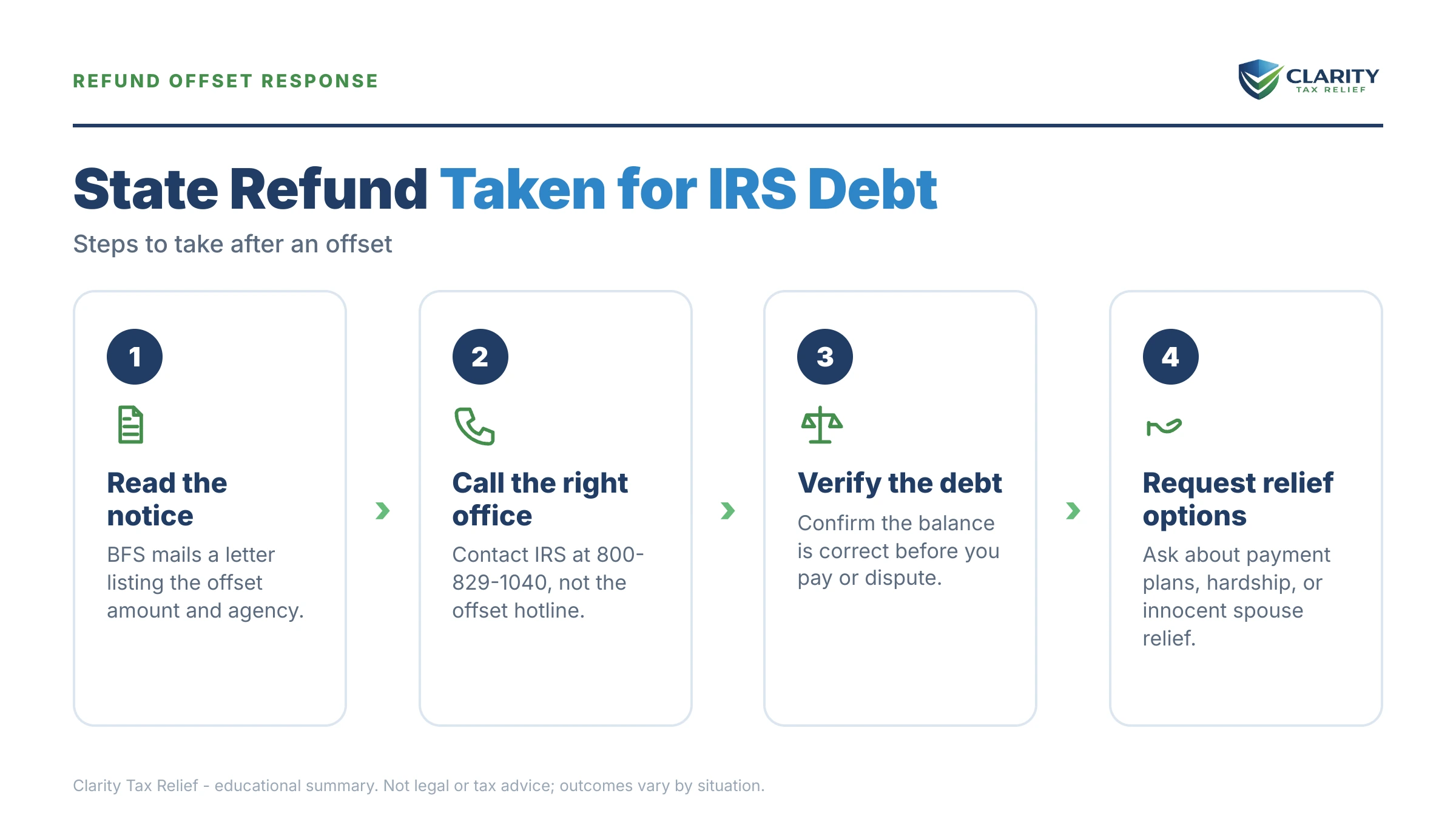
Did the IRS take your state refund — or did something take your federal refund?
Three different programs can swallow a tax refund, and each has a different letter and a different appeal path. Getting the direction right is step one, because people search this question from both sides — and the fix for a SITLP levy does nothing for a Treasury offset.
| What happened | Program behind it | Letter you receive | How you fight it |
|---|---|---|---|
| IRS took your state refund for federal tax debt | State Income Tax Levy Program (SITLP) — a levy | CP92 from the IRS | CDP hearing via Form 12153 by the CP92 deadline |
| Your federal refund went to your own IRS back taxes | Internal IRS refund offset | CP49 from the IRS | Dispute the underlying balance; hardship bypass exists only before the offset happens |
| Your federal refund went to state tax, child support, or student loans | Treasury Offset Program (TOP) | Offset notice from the Bureau of the Fiscal Service | Dispute with the agency that submitted the debt — not the IRS |
If you owe both your state and the IRS at the same time — common after a divorce splits one household's withholding across two returns — read state tax debt vs IRS: which to resolve first before you send anyone money.
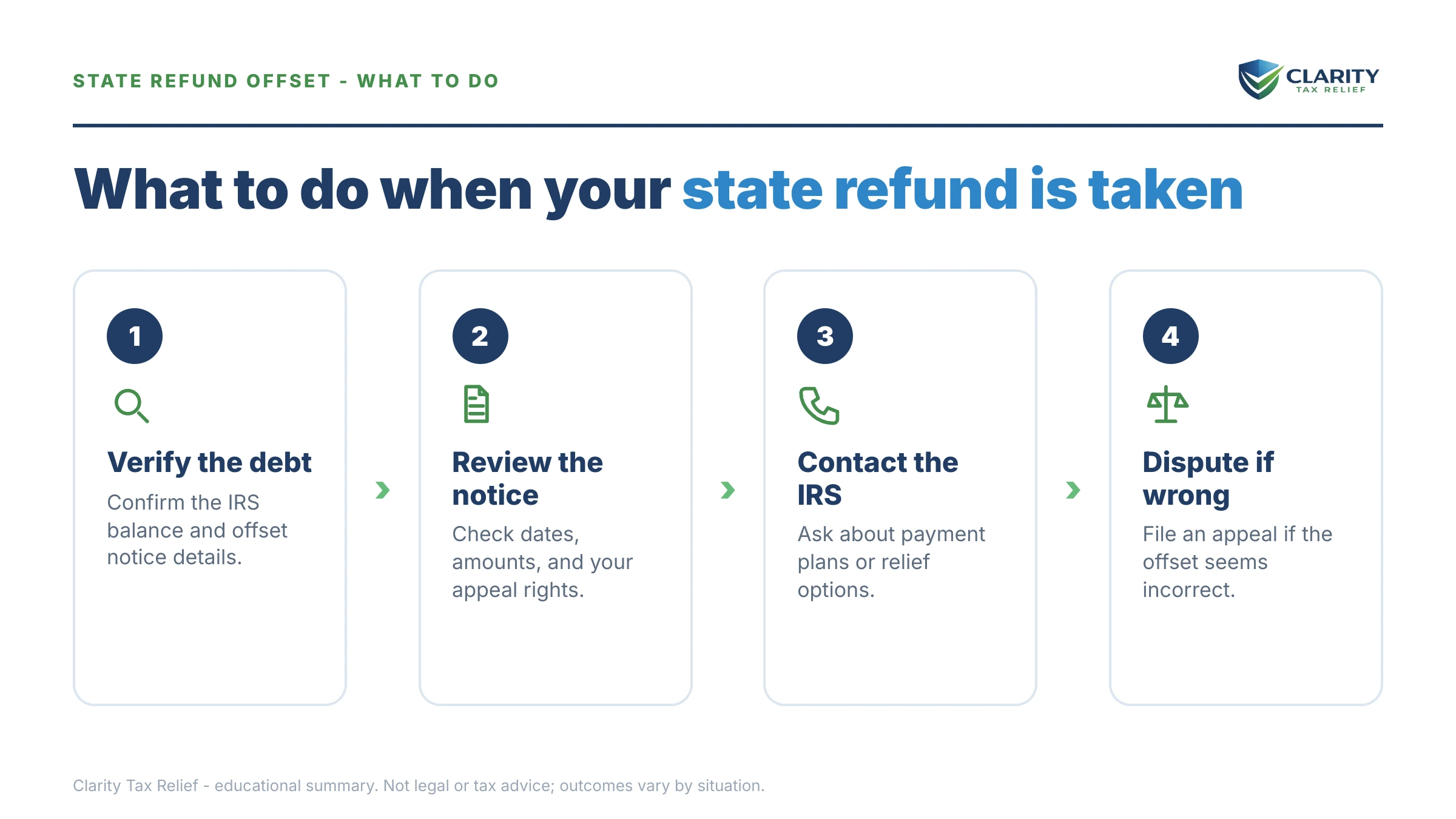
What happens if you ignore the levy
A state refund levy is an early rung on the IRS enforcement ladder — ignoring it invites every rung above it. The sequence is automated, and the 2026 IRS workforce cuts didn't touch it: humans are harder to reach, but the levy computers never stopped. Here is the stage order if you do nothing:
- The refund is applied — and the balance keeps growing. The levy pays down part of your debt, but interest compounds daily and the failure-to-pay penalty adds 0.5% per month on what's left.
- The capture repeats every filing season. SITLP re-matches your account each year, and your federal refunds are offset too. Nothing about one levy satisfies the debt — see will the IRS take my refund every year. The only outer limit is the 10-year collection statute, which pauses during appeals, offers, and bankruptcy; you can estimate your own expiration date with our CSED Calculator.
- The final notice arrives. If the IRS hasn't already sent an LT11 or Letter 1058, it comes next — starting a 30-day clock before bank accounts and wages become fair game.
- Full enforcement opens up. After that window: bank levies (a 21-day hold before funds leave), continuous wage levies, and possible federal tax lien filing. Balances that grow past $66,000 add passport certification to the list.
None of this is about punishment — the system simply escalates on a schedule until someone puts the account into a resolution. To be clear, this is a money problem, not a criminal one; if that worry is keeping you up, read can you go to jail for owing the IRS.
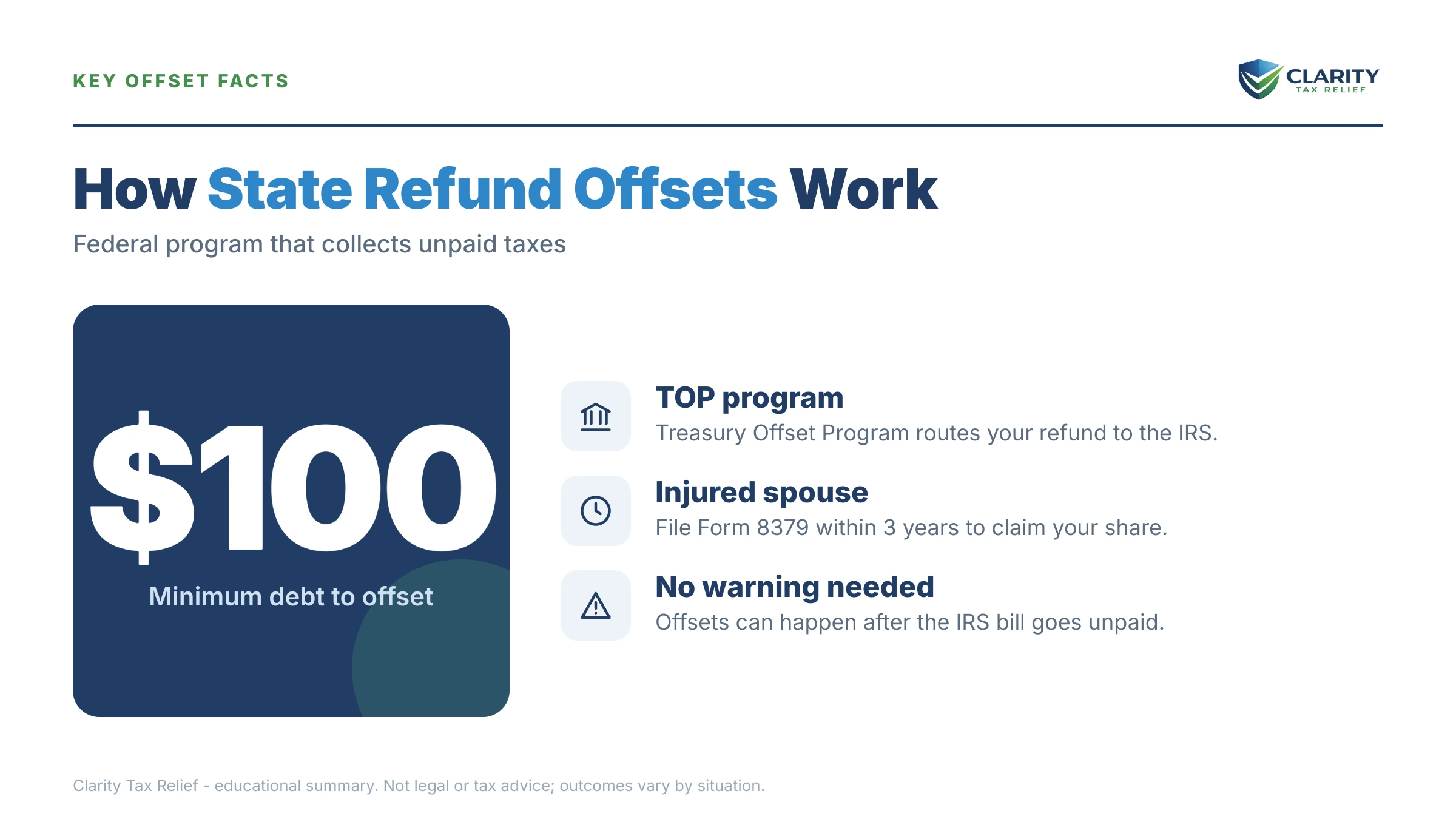
Your state refund is gone — the appeal window isn't. Yet.
The hearing-request deadline printed on your CP92 doesn't wait. Send us the notice and an experienced tax professional will check whether the levy was even correct, whether an ex-spouse's debt is driving it, and which resolution stops next year's capture — free and confidential.
Your options after a state refund levy
Every option that stops future refund captures requires getting into a formal arrangement before the next filing season — the match runs again whether or not you're paying attention. The step-by-step mechanics of setting each of these up on your own live in our guide to how to settle tax debt yourself; here's how they compare for this specific situation:
| Option | Who's eligible | Cost to set up | Effect on refund captures |
|---|---|---|---|
| Pay in full | Anyone | $0 (pay at IRS.gov) | Ends all levies and offsets immediately |
| Short-term plan (up to 180 days) | You can clear the balance within 180 days | $0 setup fee | Halts new levy action; interest and penalties continue |
| Streamlined installment agreement | Balance $50,000 or less; up to 72 months | Setup fee applies (reduced with direct debit) | Generally stops new SITLP levies; federal refunds still applied to the balance |
| Guaranteed installment agreement | Individuals only, with an income-tax balance of $10,000 or less excluding penalties and interest; all required returns filed; timely filing and payment for the past 5 years with no installment agreement during that period; and full payment within 3 years | Same fee tiers | The IRS must accept it; stops new levy action |
| Currently Not Collectible | Income barely covers IRS allowable living expenses | $0 | Pauses levies; refunds are still taken and the balance keeps growing |
| Offer in Compromise | The IRS's own collection math shows it can never collect the full balance | $205 fee + 20% down on lump-sum offers (both waived with low-income certification) | Levy action generally pauses while the offer is under review |
Two honest notes on that table. First, an installment agreement stops future SITLP levies, but not federal refund offsets — the IRS keeps applying your federal refunds to the balance even while you're on a plan. Second, an Offer in Compromise is means-tested math, not a discount program: the IRS accepted roughly 1 in 5 offers in FY2024, so treat any promise of easy approval as a red flag.
Penalty relief is a separate lever worth pulling regardless of which option you choose. If your compliance was clean for the three prior years, first-time abatement can strip the failure-to-pay penalty from a year — and starting summer 2026, the new Automatic Exemption from Penalty (AEP) begins applying similar relief automatically, with no request needed.
A worked example: $11,300 in joint debt after a divorce
Say you owe $11,300 from a joint return filed during your marriage, and this spring the IRS levied your $1,850 state refund through SITLP. Your balance drops to roughly $9,450 — but the failure-to-pay penalty alone adds about $47 a month (0.5% × $9,450), plus daily-compounding interest, so standing still costs you money every month.
Here's the twist worth noticing: the levy just pushed you under $10,000. If you're an individual whose income-tax balance (excluding penalties and interest) is now $10,000 or less, you've filed all required returns, you've filed and paid on time for the past 5 years with no installment agreement in that period, and you can pay the balance within three years, you may now qualify for a guaranteed installment agreement the IRS cannot refuse — about $265 a month over 36 months before interest ($9,450 ÷ 36), a level the IRS must accept if the criteria are met. Stretch to a streamlined 72-month plan instead and the floor is roughly $131 a month ($9,450 ÷ 72), though the real payment runs higher because interest keeps accruing. And if your ex caused the understatement on that joint return, innocent spouse relief could remove your share of the $11,300 entirely — which changes this math from the ground up. This is a hypothetical illustration; your figures will differ.
How to respond when your state refund is taken, step by step
- Identify the letter. Confirm whether you received a CP92 (the IRS levied your state refund) or an offset notice from the Bureau of the Fiscal Service (your federal refund was redirected) — the fix is different for each.
- Verify the balance. Log in to your IRS online account and confirm the tax years, the amount owed, and that the levied refund actually posted against your balance.
- Protect your appeal rights. If anything is wrong — wrong person, wrong amount, debt already paid — file Form 12153 by the hearing deadline printed on your CP92.
- Set up a resolution. Choose a payment plan, hardship status, or an Offer in Compromise before the next filing season so the capture does not repeat.
- Get a free professional review. If the debt is joint with an ex, spans multiple years, or the numbers look wrong, have an experienced tax professional map the order of fixes before you commit to anything.
When you can handle this yourself
Most people whose remaining balance sits under $25,000 can resolve a state refund levy without paying anyone. If the debt is genuinely yours, the CP92 numbers match your records, and you can set up a payment plan online, do exactly that — the arrangement itself is what stops future levies, and the IRS doesn't care whether a professional filed it or you did.
Experienced help changes outcomes in a narrower set of situations: the debt comes from a joint return and you believe your ex caused it (innocent spouse cases are won or lost on how the facts are documented); the CP92 amount doesn't match anything you recognize; there are unfiled years underneath the balance; or the LT11 final notice has already gone out and bank or wage levies are next. In those cases the order you fix things in — returns first, penalty relief second, resolution third — materially changes what you end up paying, and a misstep can waive appeal rights you can't get back.
Terms on your notice, decoded
- SITLP — the State Income Tax Levy Program, the automated data match that lets the IRS intercept refunds from participating state revenue departments.
- CP92 — the notice the IRS sends after levying your state refund; it states the amount taken and your deadline to request a hearing.
- Levy — a legal seizure of money or property to pay a tax debt; different from a lien, which is only a claim recorded against your property.
- Collection Due Process (CDP) hearing — an independent Appeals review of a levy, requested on Form 12153; it can raise errors, hardship, and alternatives like a payment plan.
- CSED — the Collection Statute Expiration Date, the 10-year deadline after assessment for the IRS to collect; it pauses during appeals, offers, and bankruptcy.
- Treasury Offset Program (TOP) — the Bureau of the Fiscal Service program that redirects federal payments, including federal refunds, to state tax and other government debts.
State refund levy questions, answered
Why did the IRS take my state tax refund?
The IRS matched your federal tax debt against your state refund through the State Income Tax Levy Program (SITLP) and levied it before the state paid you. This is legal once the IRS has sent a CP504 notice of intent to levy for that balance. You should receive a CP92 notice confirming the levy amount and explaining your right to a hearing.
Can the IRS take my state refund before sending a final notice?
Yes — the state tax refund is the one major asset the IRS can levy after a CP504 but before the LT11 final notice. That is exactly why the CP504 is worded as a notice of intent to levy your state refund. Because the levy comes first, the IRS gives you appeal rights afterward, through the hearing request explained on the CP92.
Can I get my state refund back after the IRS takes it?
Sometimes. If the levy was wrong — the debt is not yours, was already paid, or the assessment is in dispute — request a Collection Due Process hearing by the deadline printed on your CP92 and raise the error there. If the levy is causing genuine economic hardship, you can also ask for a release on hardship grounds. If the debt is valid, the money typically stays applied to your balance.
Will the IRS take my state refund every year until the debt is paid?
Yes, the match repeats each filing season as long as a balance remains and your state participates in SITLP. Your federal refund gets applied to the debt too, through an internal offset. The captures stop when the balance is resolved, when you enter certain agreements, or when the 10-year collection statute on the debt expires — though that clock pauses during appeals, offers, and bankruptcy.
Does a payment plan stop the IRS from taking my state refund?
An approved installment agreement generally stops new levy activity, including SITLP levies on state refunds, as long as you stay current on payments and filings. Federal refunds are different: the IRS keeps applying those to your balance even while you are on a plan. Interest and the reduced failure-to-pay penalty continue to accrue until the debt is paid.
My state refund was taken for my ex-spouse's tax debt — do I have options?
Possibly. If the debt comes from a joint return you signed, you are legally liable for all of it regardless of what your divorce decree says — but innocent spouse relief (Form 8857) or separation of liability may remove your share if your ex caused the understatement. If the debt is solely your ex's from a separate return, the levy may be wrong and you should contest it immediately.
What is the difference between a refund offset and a refund levy?
An offset moves your federal refund to a debt automatically — either the IRS applying it to your own back taxes (CP49) or the Treasury Offset Program sending it to a state or other agency. A levy is a seizure action, which is how the IRS takes a state refund under SITLP. The distinction matters because a levy carries Collection Due Process appeal rights and an offset generally does not.
Your next 24 hours
- Find two things on your CP92: the amount levied and the hearing-request deadline printed near the top. Circle both — the deadline controls your appeal rights.
- Gather three documents: the CP92 itself, the tax return for the year the debt comes from (including any joint return with your ex), and your state return showing the refund amount you expected.
- Get the free case review before the hearing deadline on your notice passes — use the 2-minute form or call (888) 825-7779. Fifteen minutes tells you whether to appeal, whose debt this really is, and which arrangement stops next season's capture.
For the primary sources behind this guide, see the IRS's own explanation of the CP504 notice that authorizes state refund levies, the official IRS payment plan options, and the Bureau of the Fiscal Service's Treasury Offset Program page for offsets running in the other direction.
This guide is general information, not tax or legal advice for your specific situation. Eligibility for IRS programs depends on individual facts and circumstances; no outcome is guaranteed.