
IRS Payment Plans
Will the IRS Take Your Refund on a Payment Plan? Refund Offsets Explained (2026)
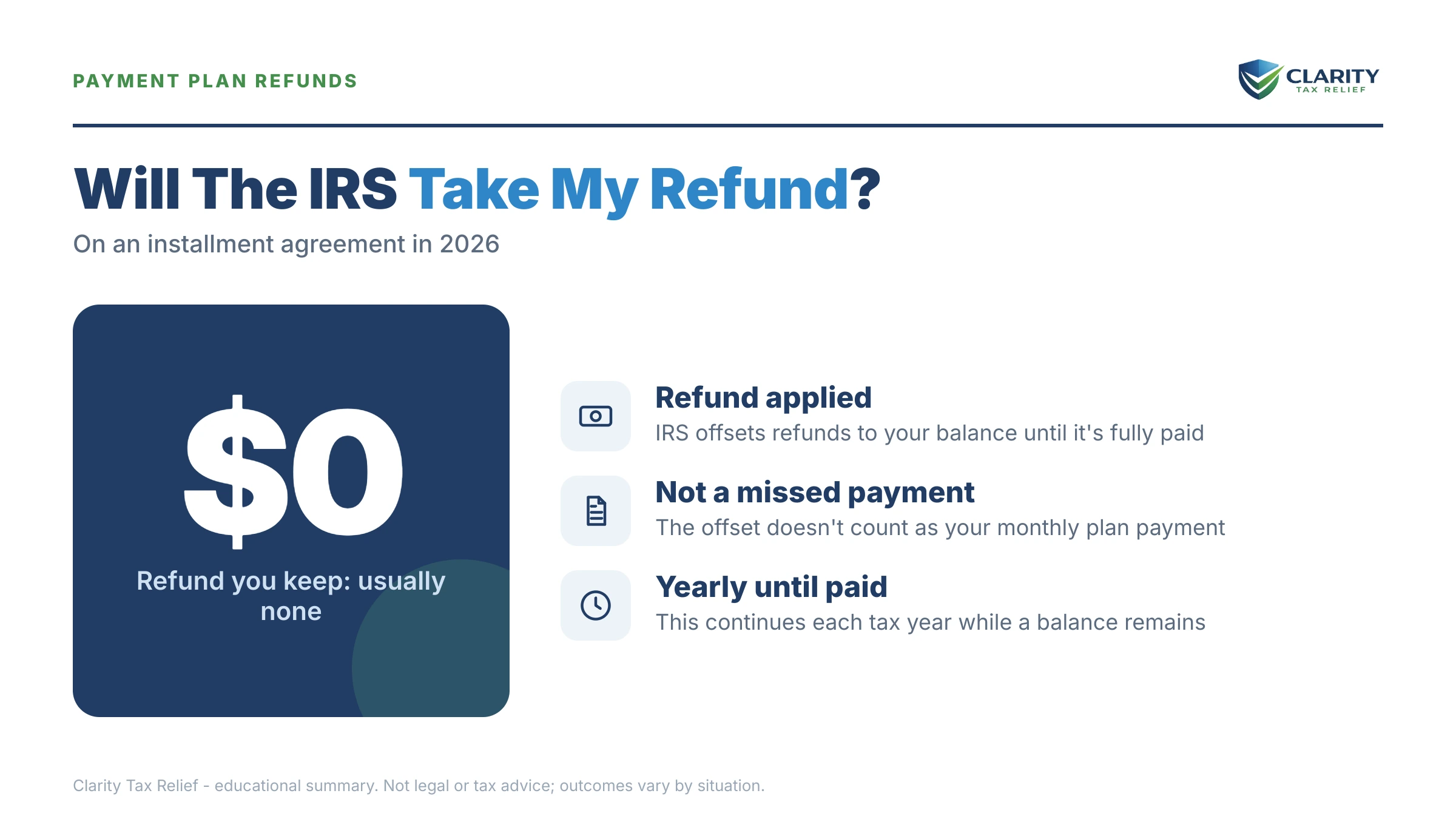
The short answer: yes — while you're on an IRS installment agreement, the IRS keeps your federal tax refund and applies it to your oldest unpaid tax year. This refund offset is a standard condition of every payment plan. It does not count as your monthly payment — but it does shrink your balance and shorten the plan.
So if you searched "will the IRS take my refund on a payment plan," the answer is yes — and you probably just lived it. You set up the agreement, you haven't missed a single monthly payment, and you filed in February counting on that refund. Then "Where's My Refund" flipped to a message about your refund being applied to a past-due obligation, and nothing landed in your bank account. That's not a glitch, and it's not a penalty for anything you did wrong. It's a written condition of the agreement you signed — and, oddly enough, it's working in your favor.
The paper trail arrives within a few weeks: a transcript entry and a notice. The image below shows exactly what that offset paperwork looks like and where to find the amount the IRS kept and the tax year it went to.
⏱ The real clock: there's no response deadline here — the offset is automatic and repeats every filing season until your balance is zero. What keeps running is interest, which the IRS compounds daily, plus a monthly late-payment penalty. Every refund the IRS keeps stops that meter sooner. The one hard deadline that still matters: your next monthly payment due date, because the offset never covers it.
Why the IRS takes your refund when you're on a payment plan
Every IRS installment agreement includes a written condition that the IRS will apply your future federal tax refunds to your balance until it is paid in full. It's printed in the terms of Form 9465 (the request) and Form 433-D (the agreement you sign), and it applies whether you set the plan up online, by phone, or through a professional. If you need the full setup background, our guide to how to set up an IRS payment plan online covers it — this page is about what happens to your refund once you're in one.
Legally, this is an overpayment offset under Internal Revenue Code §6402, not a levy. The distinction matters. A levy is enforced collection — seizing money you hold. An offset is bookkeeping: you overpaid this year's tax through withholding, you owe tax from a prior year, and the IRS nets the two before cutting a check. Being on a plan in good standing protects you from levies. It does not — and was never designed to — protect a refund.
The offset applies to every flavor of individual agreement: a guaranteed installment agreement under $10,000, a streamlined plan, and larger negotiated agreements alike. The refund is applied to the oldest tax year you owe first, which is exactly where interest has been compounding the longest — so dollar for dollar, it's the most efficient payment you'll make all year.
How to tell the IRS took your refund: the offset paperwork, decoded
When the IRS keeps your refund on a payment plan, it posts code 826 to your account transcript and mails a CP49 notice confirming where the money went. Neither one is a new enforcement action — but each tells you something specific, and one of them (code 898) means your money didn't go to the IRS at all.
| What you see | What it means | What to do |
|---|---|---|
| CP49 notice | Your refund was applied to a back-tax balance; shows the year and any leftover refund | Match the amount to your transcript; file it with your plan records |
| Code 826 on transcript | Overpayment transferred to another tax year's balance | Confirm it posted to the oldest year you owe |
| Code 898 on transcript | Refund sent to a different agency (student loans, child support, state debt) — not your IRS balance | Call the Treasury Offset hotline to identify the agency; your IRS debt did not shrink |
| CP39 / CP42 notice | Your refund was applied to your spouse's separate tax debt | Consider an injured spouse claim if the refund was partly yours |
| CP44 notice | Refund delayed while the IRS decides whether to apply it to a balance | Wait for the follow-up notice; verify your account balance meanwhile |
Ten minutes with your account transcript answers the question most people call the IRS about: which year the money went to, and how much of it arrived. Given 2026 phone wait times — the IRS workforce shrank roughly 27% in 2025 — the transcript is almost always faster than the phone.
What happens if you treat the offset as your monthly payment
A refund offset never counts as your monthly installment payment — skip a payment because "the IRS already took my refund" and your agreement starts moving toward default. This is the one genuinely dangerous mistake on this topic, and it plays out in a predictable sequence:
- Filing season: the offset posts (code 826), the CP49 arrives, your balance drops. Your plan is unchanged — the monthly payment is still due on its usual date.
- The trap: you assume the refund covered this month and skip the payment. The IRS's automated system flags the missed installment — your routine CP521 payment reminders make the miss visible on paper. A missed IRS payment plan payment usually has a short cure window, but it is not automatic forgiveness.
- CP523: the CP523 notice announces the IRS intends to terminate your agreement. It carries a deadline printed on the notice itself — act before that date and the plan can usually be saved.
- Termination: the agreement ends, the entire remaining balance becomes immediately collectible, and the levy protection you had disappears. Wage and bank levies are back on the table.
- Starting over: reinstating a terminated agreement can mean a new setup fee and, at higher balances, fresh financial disclosure — all to get back to where you already were.
In 2026 this sequence runs on autopilot. Staffing cuts mean it's harder than ever to reach a human to un-default an agreement, but the notices and terminations are generated by systems that never call in sick. The cheapest fix is the boring one: keep paying on schedule, every month, regardless of what happens to your refund.
Refund gone — or missed a payment because of it?
Send us your CP49 or CP523 and your plan terms. An experienced tax professional will confirm where your refund went, whether your agreement is still safe, and whether you're overpaying — free, confidential, no pressure. Interest compounds daily on your balance; the review costs nothing.
Does the IRS keep your refund under every program? Your options compared
The refund offset continues under every IRS payment arrangement except paying off the balance — even hardship status doesn't stop it. Here's how each path treats your refund:
| Resolution option | Does the IRS keep your refund? | What that means for you |
|---|---|---|
| Short-term plan (up to 180 days, $0 setup) | Yes | The offset reduces what you must clear before the window closes |
| Long-term installment agreement (guaranteed or streamlined) | Yes — every year until paid | Applied to the oldest year; never replaces the monthly payment |
| Direct debit installment agreement | Yes | Direct debit only changes how monthly payments are made — the offset rule is identical |
| Currently Not Collectible (hardship) | Yes — offsets continue even while collection is paused | Often the only way a CNC balance shrinks at all |
| Offer in Compromise | Different rules — under the policy in effect since late 2021, the IRS generally no longer keeps the refund for the year an offer is accepted | See will the IRS keep my refund after an offer in compromise |
| Balance paid in full | No | Future refunds arrive normally the season after your balance hits zero |
Notice what that table implies: you cannot pick your way out of the offset by picking a different program. The only levers that actually change how much refund you keep are your withholding, an injured spouse claim, or a hardship bypass — all covered below.
How much you owe shapes which agreement you're in, and how much a typical offset moves the needle:
| Balance | Typical agreement | What a $2,000 refund offset does |
|---|---|---|
| Under $10,000 | Guaranteed installment agreement — no financial disclosure, paid within three years | Wipes out 20%+ of the debt in one filing season |
| $10,000–$25,000 | Streamlined plan, up to 72 months, set up online | Roughly a year's worth of minimum payments, applied all at once |
| $25,001–$50,000 | Streamlined, with direct debit generally required | Meaningfully cuts total interest by front-loading pay-down |
| Over $50,000 | Financial disclosure required — see IRS payment plan over $50,000 | Helps, but plan terms are driven by your full financial picture |
The math on $13,600: what refund offsets do to a real payment plan
A worked example makes the offset's real effect obvious — it can cut years off a plan. Say you owe $13,600 — you're a single W-2 employee, and your withholding produces about a $2,100 refund each spring. This is hypothetical, but the arithmetic is the arithmetic:
- Minimum streamlined payment: $13,600 ÷ 72 months ≈ $189/month before interest and penalties (the IRS calculates the exact figure).
- Say you set $225/month. Payments alone retire $2,700 of balance per year.
- Add the offset: the IRS keeps your ~$2,100 refund each filing season. Combined pay-down: roughly $4,800 per year.
- Result: $13,600 ÷ $4,800 ≈ under 3 years of principal, versus nearly 6 years at the bare minimum with no offsets. Interest and penalties keep accruing, so the true payoff runs somewhat longer than the principal-only math — but the offsets slash total interest because the balance falls faster.
Two accruals run against you the whole time: interest (set quarterly, compounded daily) and the failure-to-pay penalty — normally 0.5% per month, but cut to 0.25% per month while an installment agreement is in effect on a timely-filed return. You can estimate what your own balance is costing you with our IRS Penalty & Interest Calculator.
Now the alternative version. That $2,100 refund is really $175 per month of over-withholding — an interest-free loan you're making to the government while paying interest to it on the other side of the ledger. Fix your W-4, take the $175 home, and raise your plan payment to $400/month: $13,600 ÷ $400 = 34 months of principal. Same speed, but the money moves on your schedule instead of once a year on the IRS's. Either way, once offsets and payments get you close, it's worth asking for an exact payoff figure — our guide to paying off an IRS payment plan early shows how much interest an early payoff saves.
How to respond when the IRS takes your refund, step by step
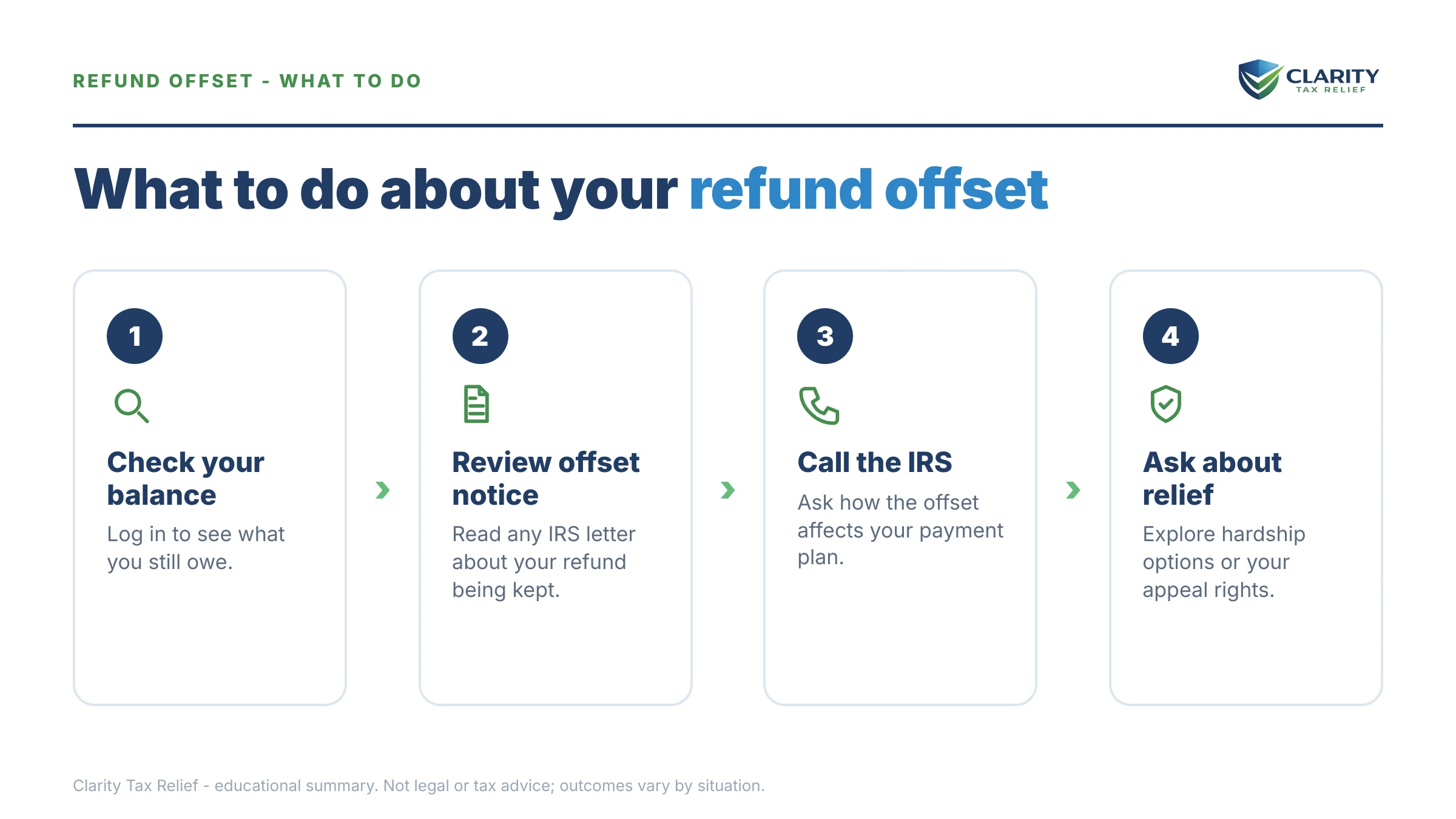
- Pull your account transcript — confirm the code 826 entry and the tax year your refund was applied to.
- Check your agreement status in your IRS online account — verify it still shows active and note your next due date.
- Make your regular monthly payment on time — the offset never replaces it.
- File Form 8379 if part of a joint refund belonged to a spouse who doesn't owe the debt.
- Adjust your Form W-4 with your employer so next year's refund is small — and put the difference toward the plan instead.
- Request a payoff amount if offsets have nearly cleared your balance — small trailing interest can keep an account open after you think it's done.
Can you stop the IRS from taking your refund on a payment plan?
You can't opt out of the offset itself — but four situations change what actually happens to the money, and one legal move puts you back in control of it.
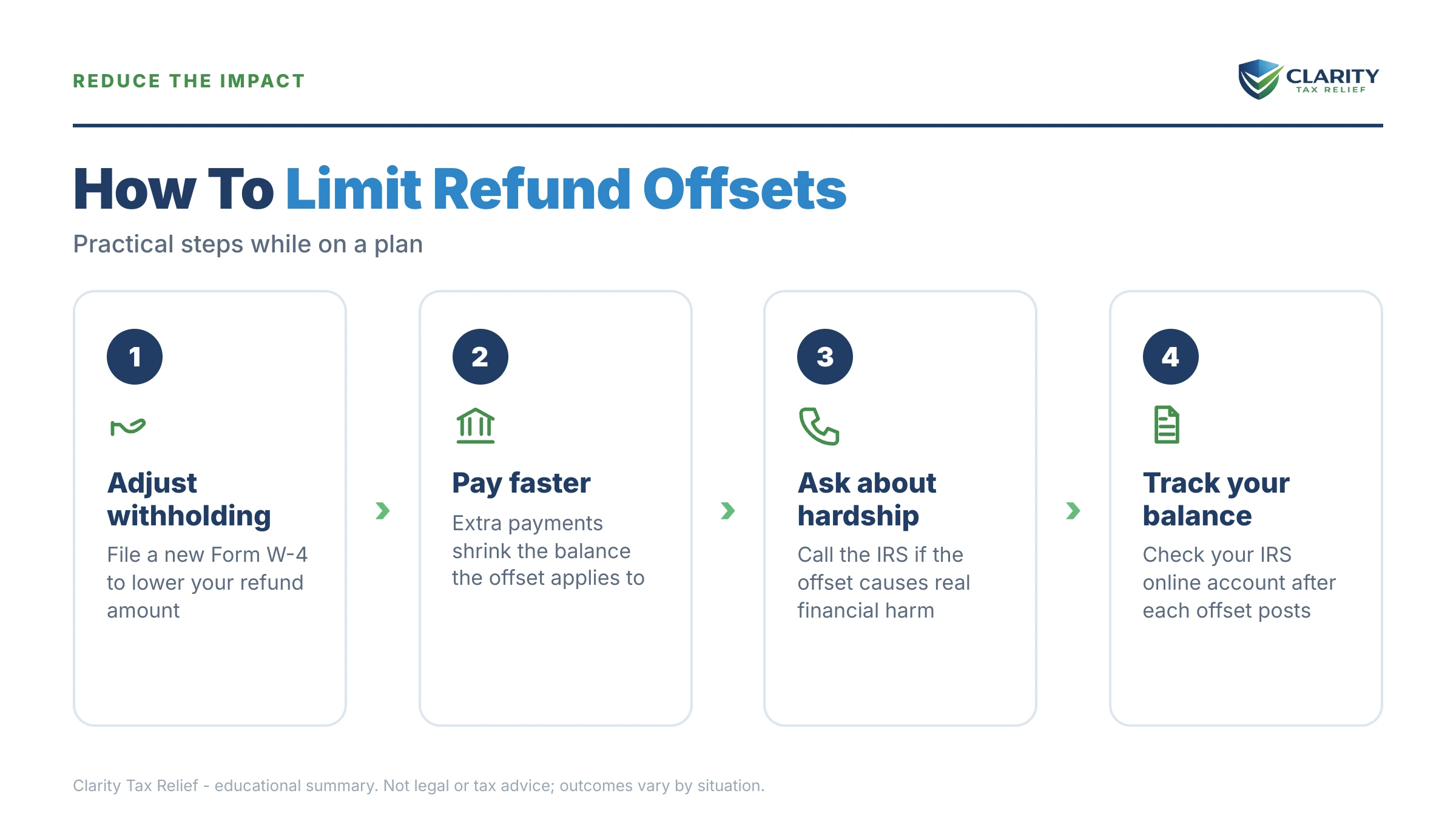
1. The withholding fix (works for almost everyone). The offset can only take a refund that exists. Adjust your Form W-4 so your withholding roughly matches your actual tax, and there's little or nothing to offset — the money stays in your paycheck all year. This is completely legal and, for most W-2 filers on a plan, the single smartest move on this page. Run your numbers through the IRS Tax Withholding Estimator before changing anything. One caution: don't overcorrect into owing next April — a new unpaid balance violates the terms of your agreement and can default it, which costs far more than any refund.
2. Genuine hardship: the Offset Bypass Refund. If losing the refund means an eviction, a utility shutoff, or similar immediate hardship, the Taxpayer Advocate Service can sometimes intercept the offset before it happens through an offset bypass refund for hardship, requested via Form 911. Timing is everything — an OBR generally must be arranged before the refund posts as an offset, and it only works against federal tax debt, not debts routed through Treasury's program.
3. Married filing jointly when the debt is yours alone. If the balance on your plan comes from before the marriage or from a return only you signed, your spouse's share of a joint refund shouldn't pay your debt. Form 8379, the injured spouse allocation, recovers their portion — it can be filed with the return or after the offset. It does not apply when the debt is a joint liability you both owe, and the allocation math works differently in community-property states.
4. Debts that aren't the IRS at all. Your IRS agreement gives you zero protection from the Treasury Offset Program, which grabs federal refunds for defaulted student loans, past-due child support, and state debts. If your transcript shows code 898 instead of 826, that's what happened — and your IRS balance didn't drop a dime, so budget accordingly.
A note on state refunds: an agreement in good standing stops IRS levies, including levies on state refunds. But states run their own intercept programs for their own debts, on their own rules — an IRS plan doesn't reach them. And if you're self-employed on the side with no withholding, there's usually no refund to offset in the first place; your risk is the opposite one, a new balance from missed quarterlies.
When you can handle this yourself — and when help changes the outcome
Most refund offsets on a payment plan need no professional help at all. If your balance is accurate, your agreement shows active, and the code 826 amount matches the refund you expected, there is nothing to fix — the system worked, your debt shrank, and your only jobs are the next monthly payment and (optionally) a W-4 adjustment you can make with your employer in ten minutes. Setting up or maintaining a streamlined plan under $50,000 is likewise a genuine do-it-yourself task.
Experienced help changes outcomes in a narrower set of situations: the offset went to a year you dispute or already paid (misapplied payments are fixable, but only with documentation and persistence); you have multiple balance years tangled with unfiled returns; a CP523 is already in hand or the agreement has terminated; a joint refund was taken for a spouse's separate debt and the Form 8379 allocation isn't straightforward; or the real question is whether years of payments-plus-offsets still beat an Offer in Compromise on your numbers — a math problem worth getting right before you commit either way.
If any of those describe your situation, a free review of your installment agreement and transcript with an experienced tax professional — (888) 825-7779 or the 2-minute form — can settle in one conversation what months of IRS hold music won't.
Terms on your notice and transcript, decoded
- Refund offset — the IRS applying your refund to a balance you owe instead of sending it to you; an accounting move, not a levy.
- Overpayment — the IRS's official word for your refund before it's paid out; offsets legally attach to the overpayment, not the check.
- Code 826 — the transcript entry showing your overpayment was transferred to another tax year's balance.
- CP49 — the notice confirming the offset, the year it paid, and any refund remainder being sent to you.
- Injured spouse — a spouse whose share of a joint refund was taken for the other spouse's separate debt; recovered with Form 8379.
- Offset Bypass Refund (OBR) — a hardship-based release of a refund before it offsets, typically arranged through the Taxpayer Advocate Service.
Will the IRS take your refund on a payment plan? Your questions, answered
Does a refund offset count as my monthly installment payment?
No. The refund the IRS keeps is applied to your balance as an extra payment, but it never replaces the monthly amount you agreed to. Your next installment is still due on its regular date, in full. Skipping a payment because "the IRS already got my refund" is the single most common way these agreements slide toward default.
Will the IRS take my refund every year while I'm on a payment plan?
Yes. The offset repeats every filing season until your balance reaches zero — it is a standing condition of the agreement, not a one-time event. Each year's refund is applied to the oldest tax year you owe first. The only ways to keep future refunds are to pay off the balance or reduce your withholding so there is no meaningful refund to take.
Can I get my refund back after the IRS applies it to my balance?
Usually no — once the offset posts, that money has paid down a debt you legally owe. The exceptions: if part of a joint refund belonged to a spouse who doesn't owe, Form 8379 (injured spouse allocation) can recover their share; and if the IRS applied the refund to a balance you dispute or a year you already paid, you can contest the accounting with proof.
Does the offset mean my payment plan defaulted?
No — the opposite. The offset happens because your agreement is active and working exactly as written. Nothing about it changes your standing, your monthly amount, or your due date. It actually helps you: the refund reduces your balance faster than your payments alone would, which means less total interest and an earlier payoff date.
Will the IRS take my state tax refund while I'm on a payment plan?
An installment agreement in good standing stops IRS levies, including levies on state refunds. But your state runs its own offset program: if you owe state taxes or other state debts, the state can keep your state refund regardless of your IRS arrangement. And your federal refund can still be routed to state income-tax debts through the Treasury Offset Program.
Should I change my withholding so I don't get a refund?
For most people on a payment plan, yes. A refund is money you over-paid during the year; adjusting your Form W-4 keeps it in your paycheck, where you can direct it to the plan on your own terms. Just don't overcorrect — under-withholding creates a new balance due next April, and a new unpaid liability can default your existing agreement.
What do transcript code 826 and the CP49 notice mean?
Code 826 on your account transcript means your overpayment — your refund — was transferred to another tax year's balance; the transcript shows the amount and the year it went to. The CP49 is the letter version: it confirms the IRS applied your refund to back taxes and shows any remaining refund. Together they are the paper trail of a routine offset, not a new enforcement action.
What happens if my refund pays off my whole balance?
The agreement ends because there is nothing left to collect. Check your IRS online account a few weeks after the offset posts to confirm the balance reads zero — interest accrues daily, so a refund that almost covers the payoff can leave a small trailing amount. If you pay by direct debit, confirm the withdrawals have stopped once the account shows zero.
Can my refund still be taken for student loans or child support while I'm on an IRS plan?
Yes. The Treasury Offset Program routes federal refunds to defaulted student loans, past-due child support, and state debts — and it operates independently of your IRS agreement. In that case your transcript shows code 898 instead of 826, and the money goes to the other agency, not to your IRS balance, so your tax debt doesn't shrink.
Your next 24 hours
- Log into your IRS online account (or pull your account transcript) and find three numbers: your current balance, the code 826 offset amount, and your next payment due date.
- Gather four documents: the CP49 notice, last year's return, your agreement terms (monthly amount and due date), and a recent pay stub so you can check your withholding.
- Get a free case review — the 2-minute form or (888) 825-7779. Interest compounds on your balance every day it stays open; twenty minutes with an experienced tax professional will tell you whether your plan, your withholding, and your offset are all pulling in the same direction.
For the primary sources on everything above, see the IRS's payment plans and installment agreements page and, for hardship bypass requests, the Taxpayer Advocate Service.
This guide is general information, not tax or legal advice for your specific situation. Eligibility for IRS programs depends on individual facts and circumstances; no outcome is guaranteed.