
IRS Enforcement
IRS Criminal Investigation: How CI (CID) Works and What to Do in 2026
The short answer: an IRS criminal investigation means IRS Criminal Investigation (CI, long called CID) is building a potential tax-crime case — not collecting a bill. Owing back taxes alone never triggers it; willful acts do. If two special agents contact you, decline the interview politely and call a criminal tax attorney before saying anything.
Maybe two agents left business cards wedged in your door. Maybe your bank mentioned a records request with your name on it. Or maybe you have three unfiled years sitting on your conscience and just typed the scariest phrase you could think of into a search bar. Whichever it is, here's the part that matters: the line between civil trouble and criminal trouble is bright, knowable — and for almost everyone reading this, you're still on the safe side of it.
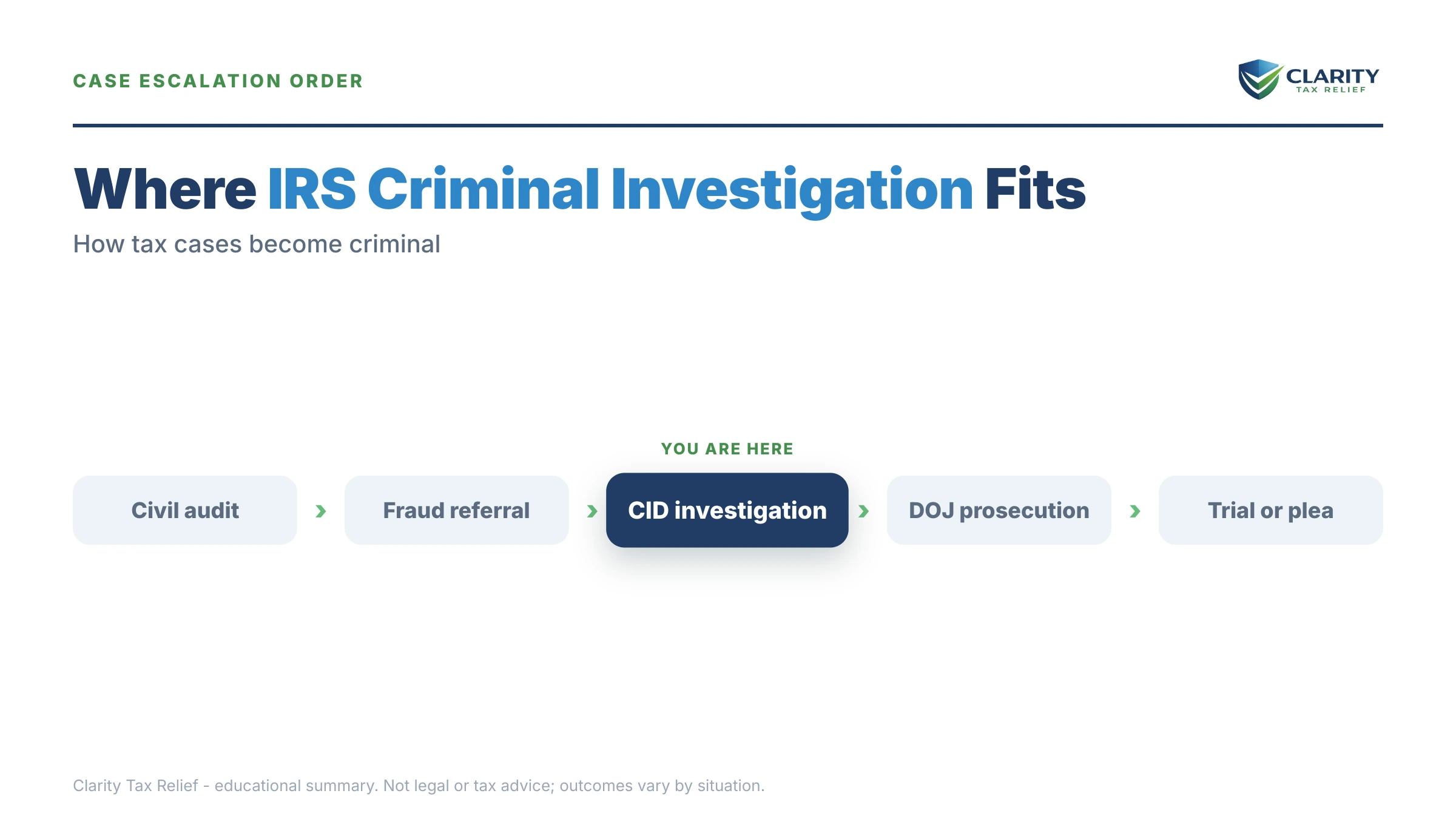
This guide walks that line precisely: who investigates tax crimes, what actually crosses over, how a case moves stage by stage, and the handful of moves that protect you. The image below maps how a case travels from routine civil contact all the way to a criminal referral — look at where you actually sit on that path before you panic.
⏱ The clock that matters: a criminal case has no printed deadline — the window that closes is voluntary disclosure. It ends the moment the IRS opens an exam or investigation, or receives your information from a third party. Meanwhile, on unfiled years, the failure-to-file penalty builds at 5% per month (up to a 25% cap) and interest compounds daily.
Why the IRS opens a criminal investigation — and why owing money isn't it
IRS Criminal Investigation opens only a few thousand cases a year nationwide, and nearly all of them involve willful deception — not unpaid bills. CI is the IRS's law-enforcement arm: federal agents who investigate tax evasion, false returns, employment-tax fraud, and money laundering, then recommend prosecution to the Department of Justice. They do not negotiate payment plans, and they do not care whether you can pay. We break down the actual case volumes in our IRS criminal investigation statistics guide.
The legal hinge is willfulness — a voluntary, intentional violation of a known legal duty. Tax evasion under IRC §7201 is a felony carrying up to five years per count; filing a false return under §7206 carries up to three years; willful failure to file under §7203 is a misdemeanor carrying up to one year per unfiled year. Every one of those requires intent. Owing money you honestly reported, filing late because life fell apart, or losing an audit over deductions you genuinely believed in — none of that is a crime.
What does move a file toward CI? The IRS calls them badges of fraud: two sets of books, fabricated receipts or W-2s, cash deposits structured to dodge reporting, income routed to accounts in other names, and — the most common one in practice — lying to an auditor or revenue officer once an exam is underway. Our companion guide covers exactly when the IRS refers a case to criminal investigation and how referrals get made.
For a gig worker with unfiled years, the honest picture is this: your 1099s were already reported to the IRS by the platforms. The IRS knows the income exists, which means simply not filing looks like avoidance, not concealment — a civil problem with civil fixes, as long as you don't add deception on the way back in.
Civil or criminal? Decode which IRS employee contacted you
Only one IRS job title — special agent — means a criminal investigation; every other IRS contact is civil. Special agents from CI are unmistakable once you know the pattern: they arrive in pairs, in person, carry gold badges and firearms, and read you an advisement of your rights before asking a single question. If the person contacting you doesn't fit that picture, you're dealing with the civil side of the house — a different problem with far more forgiving options.
| Who contacted you | Their job | What it means for you |
|---|---|---|
| Revenue agent | Conducts audits (civil) | Your return is being examined. Respond, ideally with representation — an audit alone is not criminal. |
| Revenue officer | Collects assessed debt (civil) | The IRS wants payment or financial disclosure. Serious, but resolvable through payment programs. |
| Special agent, IRS Criminal Investigation | Investigates tax crimes | Works in pairs, shows a badge, reads a rights advisement. Decline the interview and call a criminal tax attorney. |
| Caller threatening immediate arrest or demanding gift cards | Nobody — it's a scam | Real IRS enforcement never starts with a threatening phone call or unusual payment demand. Hang up. |
Home visits by the civil side have become rare and appointment-based, which makes an unannounced pair of special agents even more distinctive — our guide on whether the IRS will come to your house covers the full 2026 picture.
How an IRS criminal investigation unfolds, stage by stage
An IRS criminal investigation passes through at least five review stages before any charge is filed — and you may not learn it exists until the middle of the sequence. There are no fixed day counts at any stage; cases commonly run a year or more. What escalates a case isn't time — it's evidence:
- Civil origin. Most cases start inside the civil IRS: an auditor spots badges of fraud, a revenue officer catches concealed assets, an informant files a tip, or matching systems flag large unreported income. This is where an eggshell audit — a civil exam with criminal exposure underneath — becomes the most dangerous room you can walk into unrepresented.
- Primary investigation. CI quietly evaluates whether the allegation is worth pursuing. Nothing is public; you are almost never told.
- Subject criminal investigation. A case is formally opened. Agents summons bank records, interview your clients, platforms, ex-partners, and preparer — often before they ever approach you. Many people first learn of the investigation from a nervous banker or accountant.
- Special agent report and review. The case memo passes through CI management, IRS counsel, and then the Department of Justice Tax Division. Each layer can kill the case — which is one reason CI only advances cases it expects to win.
- Prosecution. A grand jury indictment or criminal information is filed. The overwhelming majority of cases CI recommends for prosecution end in conviction or plea.
- After conviction. Prison exposure under the statute of conviction, fines, restitution — and the tax itself never goes away. The civil fraud penalty of 75% of the underpayment typically follows the criminal case, on top of the balance and interest.
One more stage matters for non-filers specifically: ignored long enough, unfiled years generate substitute returns, non-filer notices, and — at higher incomes — placement in the IRS's high-income non-filer initiative. A long, documented pattern of ignoring IRS contact is exactly the kind of fact that lets the government argue willfulness later. The cheapest exit is always before that record builds.
Unfiled years and a knot in your stomach?
Send us the facts. An experienced tax professional will tell you honestly whether you have a filing problem or an attorney problem — free, confidential, no pressure — while penalties and interest are still the only thing growing.
Your options before CI is involved: getting compliant safely
Your compliance options shrink the moment the IRS knows about your problem — which is why the safest path is always the one you start first. There are four ways back, and they are not interchangeable:
| Path | Built for | Key requirement / main risk |
|---|---|---|
| File the back returns now | Non-willful non-filers whose income the IRS already knows about (1099s, W-2s) | Do it before any IRS contact. Penalties and interest still apply, but voluntary filing is powerful evidence against willfulness. |
| IRS Voluntary Disclosure Practice (Form 14457) | Genuinely willful conduct — concealed cash, false returns, hidden offshore accounts | Must be timely: the door closes once the IRS opens an exam or has your information. Requires full cooperation and arrangements to pay. |
| Open, documented amended returns | Honest errors on returns you already filed | Have counsel review first if any fraud exposure exists — how you correct matters as much as that you correct. |
| Quiet disclosure | Nobody — back-filing or amending quietly to "slip in" unnoticed | Flags the account without any of the protection a formal disclosure provides; CI can still prosecute. |
Two of these deserve their own reading before you act: the formal IRS Voluntary Disclosure Practice for willful cases, and why the quiet disclosure shortcut backfires. If your situation is the common one — behind on filing, nothing hidden — the mechanics of catching up and resolving the balance live in our guide to how to settle tax debt yourself.
A worked example: $83,100 across three unfiled years
Say you drove and delivered on 1099s for three straight years, never filed, and the combined income and self-employment tax works out to $83,100 — roughly $27,700 per year. This is a hypothetical, but the math is real:
Path A — file now, before any IRS contact. The failure-to-file penalty runs 5% per month and caps at 25% of the unpaid tax: about $20,775 here. The failure-to-pay penalty (0.5% per month) and daily-compounding interest stack on top, so the true balance lands well north of $110,000 over time. Because the total exceeds $50,000, a payment plan requires financial disclosure rather than the streamlined online setup — or paying the balance down below that line first. Expensive and stressful, yes. But entirely civil, because the platforms already reported your income and nothing was concealed. You can rough out your own penalty picture with our IRS Penalty & Interest Calculator.
Path B — same numbers, plus deception. Now suppose the catch-up returns invent $30,000 of fake business expenses per year to shrink the bill, or you tell an auditor the income "wasn't yours." The dollar amount hasn't changed — but the conduct has. False statements on a return are §7206 exposure; concealment plus evasion of payment is §7201 territory. The lesson of both paths in one sentence: how you come back into compliance matters far more than what you owe. Our haven't filed in 3 years guide walks the Path A mechanics start to finish.
How to respond if IRS special agents contact you, step by step
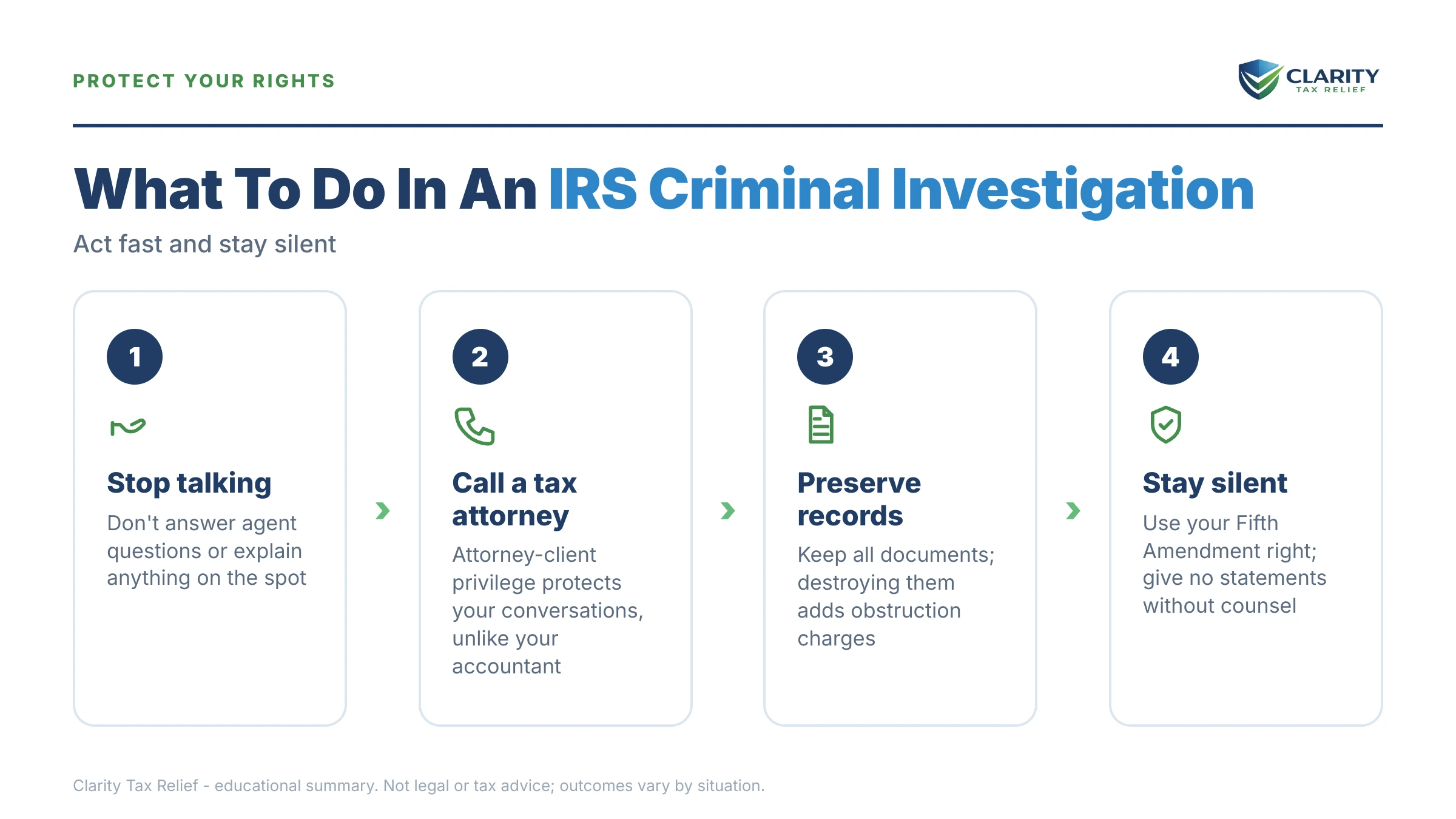
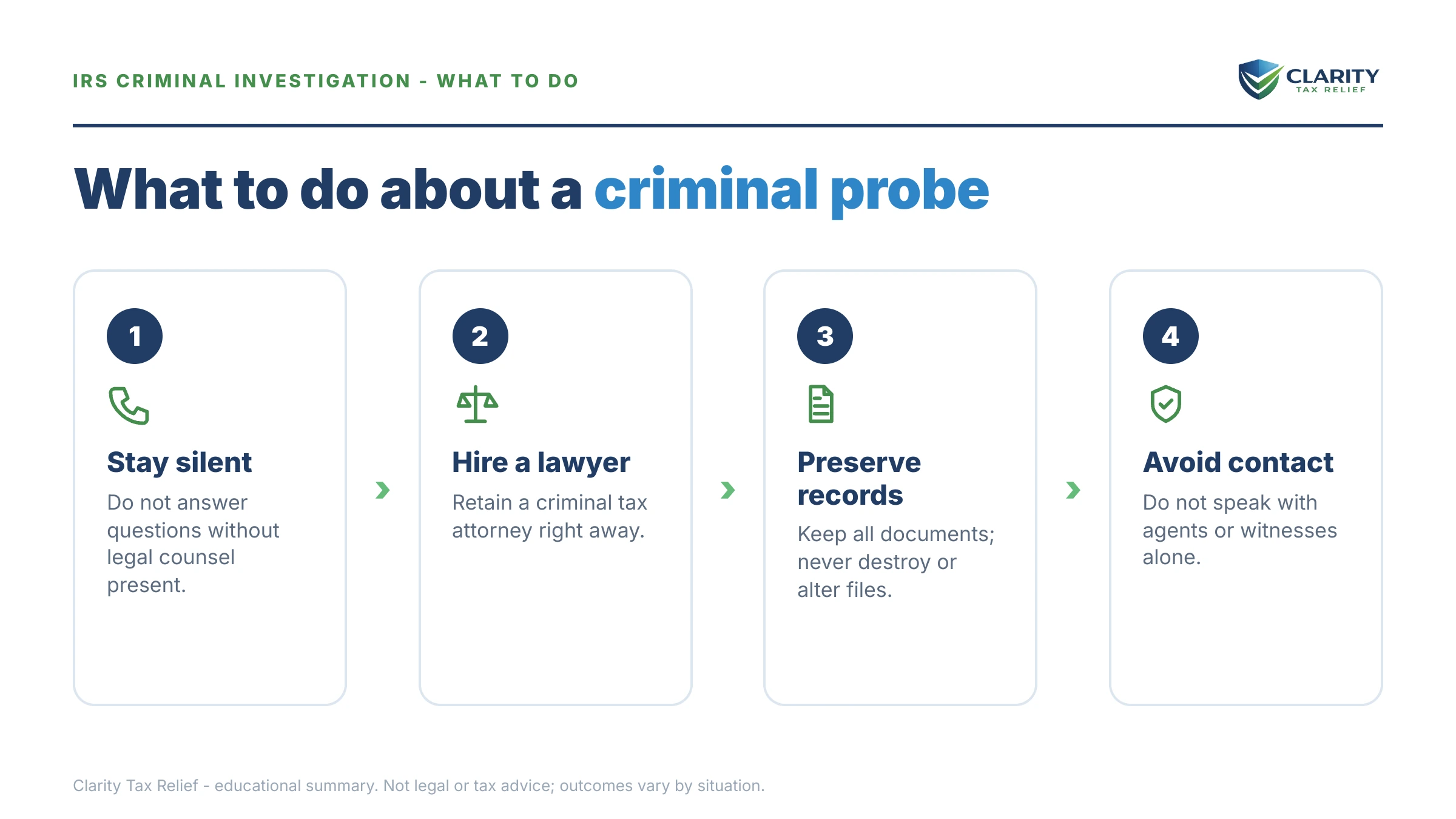
- Identify who contacted you. Match the name and title on the business card against the roles table above. Only the title "special agent" means a criminal investigation — a revenue agent or revenue officer is a civil matter.
- Decline the interview politely. Say your representative will contact them, take their cards, and stop talking. Never guess, explain, or shade the truth — false statements to a federal agent are a separate felony; silence is not.
- Hire a criminal tax attorney. Not your CPA or return preparer — only attorney-client privilege survives a criminal case, and your accountant can be compelled to testify about what you told them.
- Preserve every record exactly as it is. Deleting files, shredding receipts, or "cleaning up" your books can convert a weak tax case into an obstruction charge that is far easier to prove.
- Stop all filings until counsel reviews them. A hastily amended or back-filed return can become evidence against you. The order and wording of every filing matters once agents are involved.
- Let your attorney choose the compliance path. Voluntary disclosure, straightforward back-filing, or a defense posture each fit different facts — that judgment call belongs to counsel, not to a form you find online.
When you can handle this yourself — and when you can't
Most unfiled-return problems never need a criminal tax attorney — but every special-agent contact does. Here's the honest split:
You can likely handle it yourself if no one from the IRS has contacted you, your income was reported on 1099s or W-2s, and your unfiled returns would be truthful. Pull your wage and income transcripts, file the missing years, and set up a payment arrangement — the process in our guide to coming clean on unfiled returns voluntarily. Filing before contact is both the cheapest fix and your best legal protection.
You need an experienced tax professional when the balance is large enough to require negotiated financials, when multiple years interact, or when a civil audit touches years with problems underneath — the eggshell scenario, where one careless answer creates the referral. And you need a criminal tax attorney, full stop, the moment special agents appear, a grand jury subpoena lands, or your conduct was genuinely willful. A tax-relief firm's role in that scenario is the civil side — returns, transcripts, and the eventual balance — working under counsel's direction, never in place of it. Our comparison of when you need a tax attorney for back taxes draws the line in detail.
Terms in a criminal tax case, decoded
- Special agent: a sworn federal law-enforcement officer in IRS Criminal Investigation who builds prosecution cases — the only IRS employee whose contact means a criminal matter.
- Willfulness: the voluntary, intentional violation of a known legal duty — the element the government must prove in every tax crime, and the reason honest mistakes aren't crimes.
- Eggshell audit: a civil examination of returns that have criminal problems hidden underneath, where the taxpayer's own answers can trigger a referral.
- Grand jury subpoena: a compulsory demand for records or testimony in a criminal proceeding — receiving one about your own finances means counsel first, response second.
- Voluntary Disclosure Practice (Form 14457): CI's formal program for willful taxpayers to come forward before the IRS finds them, trading full cooperation and payment for a strong (though not absolute) shield against prosecution.
- Rights advisement: the non-custodial warning special agents read before questioning you — confirmation in itself that you are speaking with criminal investigators, not a bill collector.
IRS criminal investigation questions, answered
How do I know if I'm under IRS criminal investigation?
The clearest sign is two IRS special agents appearing in person, showing gold badges, and reading you a rights advisement before asking questions. Indirect signs include your bank or accountant receiving a summons for your records, or an ongoing audit that suddenly goes silent — auditors suspend contact when they refer a case. Most people under investigation don't know for months, which is why any of these signs means calling a criminal tax attorney immediately.
Can you go to jail just for owing the IRS money?
No. Owing tax you can't pay is a civil matter handled through notices, liens, levies, and payment programs — not prosecution. Criminal cases require willfulness: an intentional act like hiding income, faking documents, or lying to investigators. A gig worker who filed honestly but can't pay the bill has a collection problem, not a criminal one.
Can you go to jail for not filing taxes?
It's legally possible — willful failure to file is a misdemeanor under IRC §7203, punishable by up to one year per unfiled year — but prosecution for non-filing alone is rare. CI typically pursues non-filers who combine years of unfiled returns with large income and affirmative concealment. Filing your back returns voluntarily, before the IRS contacts you, is the single strongest fact in your favor.
Should I talk to IRS special agents without an attorney?
No. You have the right to decline the interview, and polite silence cannot be used to charge you — but false statements can, because lying to a federal agent is a separate felony. Special agents interview subjects early precisely because unprepared answers make cases. Take their cards, say your attorney will contact them, and end the conversation.
Is what I tell my CPA or tax preparer confidential?
Not in a criminal case. There is no accountant-client privilege in federal criminal matters, so your CPA can be subpoenaed and compelled to testify about what you told them. Only attorney-client privilege holds up, which is why criminal tax attorneys — who can hire accountants under privilege through a Kovel arrangement — handle these cases instead of return preparers.
How long does an IRS criminal investigation take?
Typically a year or more from the day CI opens a case to a prosecution decision, and you may not know it's happening for much of that time. Cases pass through multiple layers of review — CI management, IRS counsel, and the Department of Justice Tax Division — before any charge is filed. Most federal tax crimes carry a six-year criminal statute of limitations, so older conduct can still be reachable.
What triggers an IRS criminal referral?
Auditors and revenue officers refer cases when they find what the IRS calls badges of fraud: two sets of books, faked receipts or W-2s, unexplained cash deposits, income diverted to hidden accounts, or false statements made during the exam itself. A math error or an aggressive-but-disclosed deduction is not a badge of fraud. Referrals come from conduct that shows intent to deceive, not from the size of the balance.
Your next 24 hours
- Pin down exactly who has contacted you — or confirm no one has. Keep any business cards and letters, and write down every name and title. If there's been no contact at all, log into your IRS account and pull your wage and income transcripts so you know what the IRS already knows.
- Gather what exists and touch nothing else. Collect the years you haven't filed, your 1099s and bank statements, and any IRS mail — and do not delete, edit, or "organize away" a single record.
- Get the situation reviewed free. If it's special agents, call a criminal tax attorney today. If it's unfiled years and growing penalties — the far more common case — call (888) 825-7779 or use the 2-minute form, and we'll map the civil path back while filing voluntarily still works in your favor.
For primary sources, see the IRS's own overview of IRS Criminal Investigation, its payment options at IRS.gov/payments for the civil side of any catch-up, and the independent Taxpayer Advocate Service for rights issues inside the civil process.
This guide is general information, not tax or legal advice for your specific situation. Eligibility for IRS programs depends on individual facts and circumstances; no outcome is guaranteed.