
IRS Collections
Will the IRS Come to My House? Revenue Officer & CID Home Visits in 2026
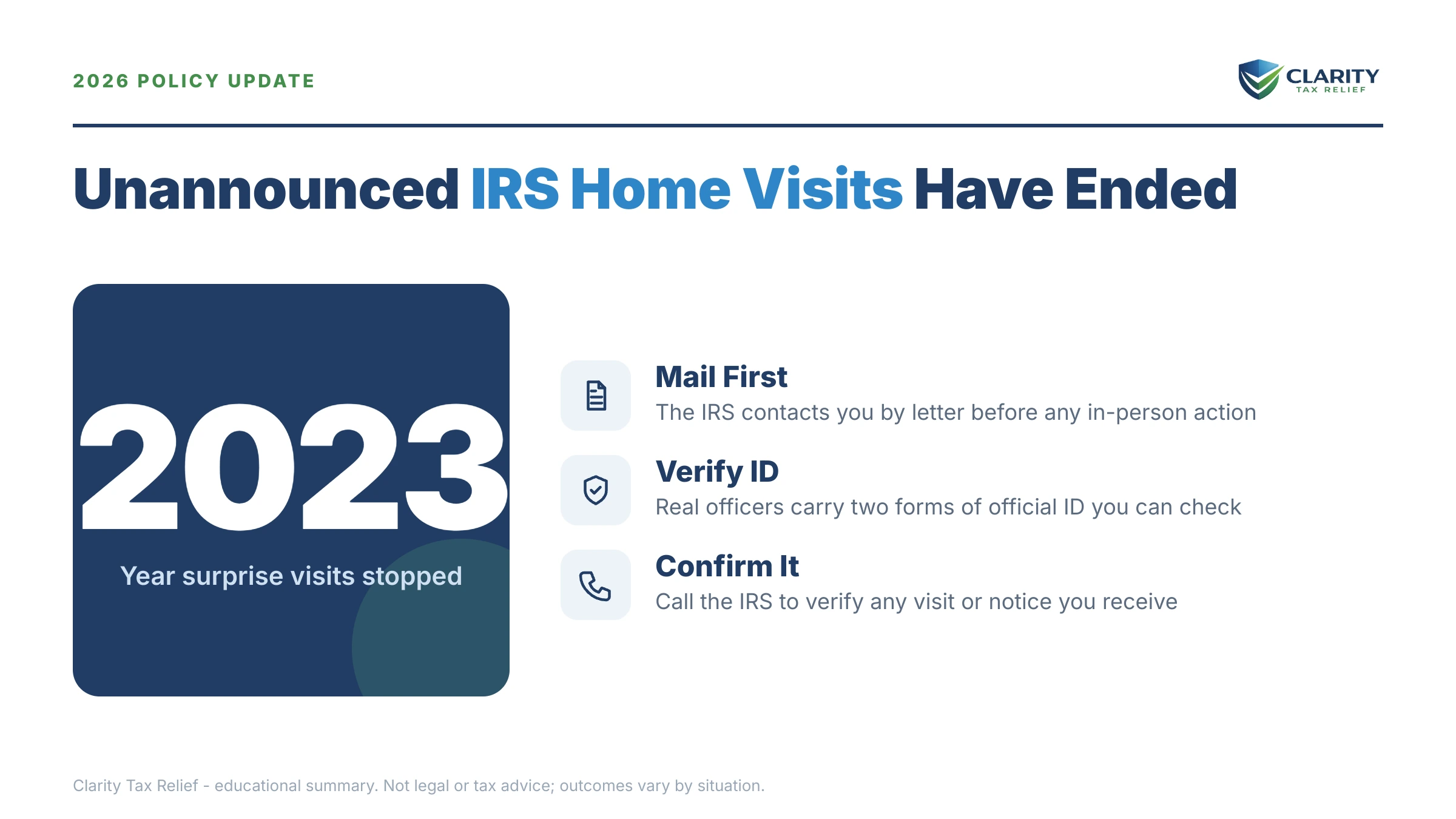
The short answer: will the IRS come to my house? Almost never without warning. Since July 2023, the IRS has ended most unannounced revenue officer visits — you get Letter 725-B in the mail first, asking to schedule an appointment. The narrow exceptions: serving a summons, certain asset seizures, and criminal investigations.
You've been avoiding the mail pile, and now every unexpected knock makes your stomach drop. Maybe a neighbor mentioned "the IRS came to someone's house" or a collector on the phone implied agents were on their way. Here's the reality: the visit you're picturing is far rarer than the fear — and everything that leads to it arrives by mail first, which means you have a map and time to act.
The single document that precedes a legitimate collection visit is Letter 725-B — a mailed appointment request from a named revenue officer. The image below shows you exactly what this letter looks like and where to find the appointment details, so you can tell a real one from a scare tactic in seconds.
⏱ The real clock: there's no countdown printed on this question itself — but if a Letter 725-B is in your mail, it proposes a specific appointment date. And every month you wait, a 0.5% failure-to-pay penalty plus daily-compounding interest gets added to the balance, whether or not anyone ever knocks.
Why the IRS would come to your house — and who actually knocks
Since July 2023, IRS revenue officers no longer make routine unannounced home visits — they mail Letter 725-B to schedule an appointment instead. That policy change ended decades of surprise doorstep collection contact. If your case ever reaches a human collector, you'll know it from your mailbox first.
Only three situations still bring an unannounced IRS employee to a door: serving a summons or subpoena, carrying out an asset seizure in a small number of enforcement cases, and criminal investigations. All three sit at the far end of long case histories — none of them starts with a first-time balance due.
It also matters who is standing there, because different IRS employees have completely different jobs — and the most common doorstep visitor claiming to be "the IRS" is a scammer. Here's how to tell them apart:
| Who | How a real one arrives | What they handle |
|---|---|---|
| Revenue officer (collections) | Letter 725-B by mail first, then a scheduled appointment | Collecting larger or complex debts — payroll taxes, six-figure balances, unfiled returns |
| Revenue agent (audits) | Mailed exam letter proposing a field-audit appointment | Examining a return — an audit, not collection |
| CI special agent | Can still arrive unannounced; shows law-enforcement credentials | Criminal tax investigations — say nothing substantive, get counsel |
| Scammer | No letter behind the visit; demands payment now, gift cards, threats of arrest | Stealing your money — close the door and verify independently |
Every legitimate IRS employee carries two credentials — a pocket commission and an HSPD-12 government ID card — and will show both on request. No real IRS employee collects payment at your door, and none threatens arrest for a civil tax debt. If mailed contact confuses you, our guide to real vs. fake IRS letters covers the paper side of the same problem.
What happens if you ignore the notices that come before a visit
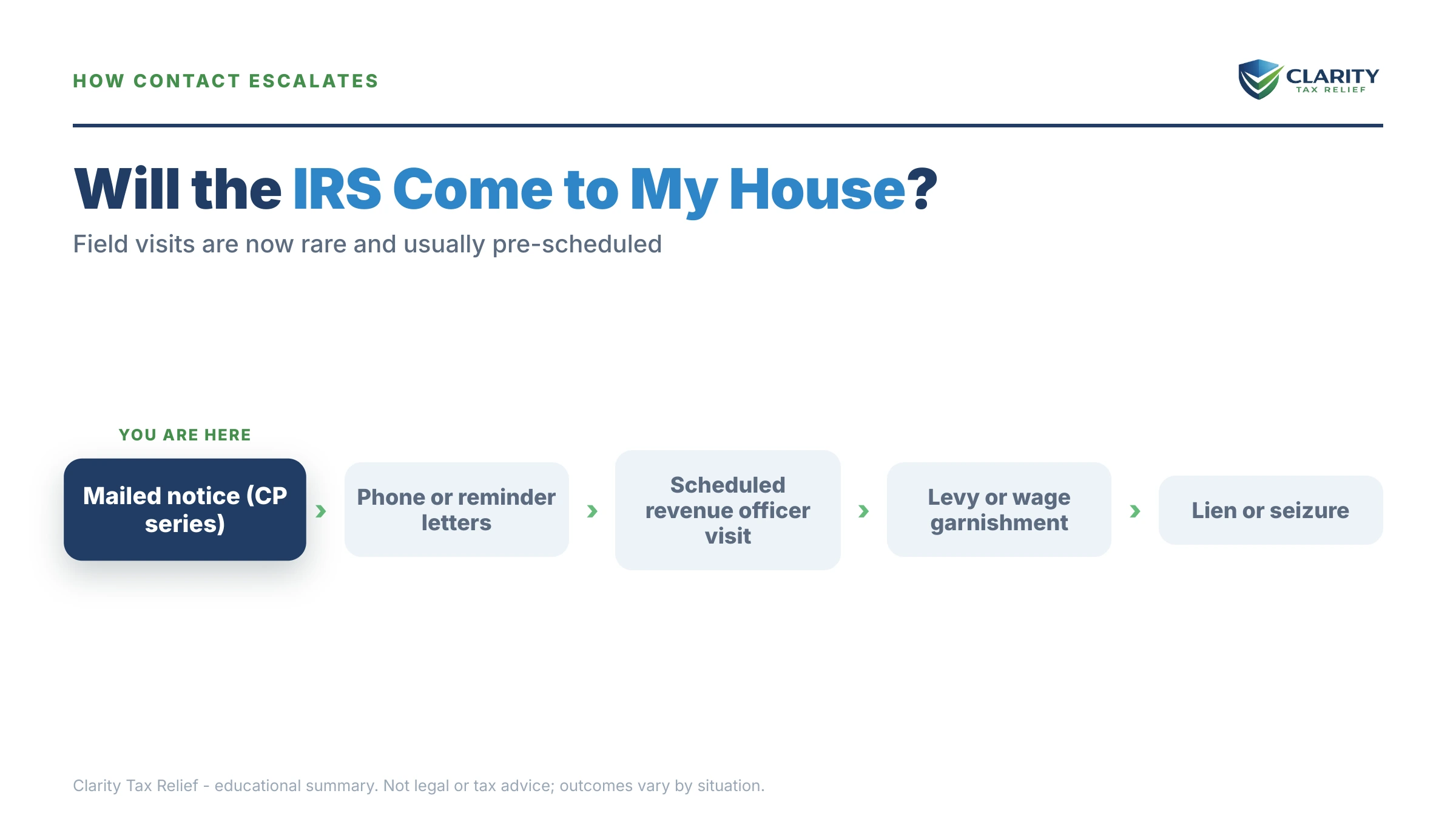
Every legitimate IRS home visit sits at the end of a long, automated mail sequence — it is never the opening move. The stages before any human is assigned run in this order, and each one narrows your options:
- CP14 — the first bill, typically giving about 21 days to pay or arrange payment. Pure mail; nobody is coming.
- CP501 / CP503 — reminder notices, arriving weeks apart while penalties and interest compound.
- CP504 — Notice of Intent to Levy. The IRS can seize your state tax refund, and a federal tax lien becomes realistic. Still no visit.
- LT11 / Letter 1058 — the final notice, starting a 30-day clock and your Collection Due Process appeal rights (Form 12153). After it lapses, levies can begin.
- Levy — a bank levy freezes funds with a 21-day hold before they leave; a wage levy runs continuously until released. All executed remotely, by mail to your bank or employer.
- Revenue officer assignment — for balances or situations the automated system can't resolve, a human takes the file, mails Letter 725-B, and requests a meeting. Refuse to engage from here, and the RO can issue a summons compelling you to appear with records.
Seizure of a primary residence sits even further out — it requires a federal court's approval and is genuinely rare; our guide to whether the IRS can take your house walks through exactly how protected a home is.
One 2026 wrinkle: the IRS workforce shrank roughly 27% in 2025, so there are fewer revenue officers making field contact than at any point in decades. But the notices, liens, and levies above are generated by automated systems that never got cut. Fewer knocks does not mean fewer levies — it means the machine escalates while humans are harder to reach.
Got a Letter 725-B — or expecting one?
A revenue officer's name on a letter means your case has left the automated queue and a human collector now controls it. Get the letter and your balance reviewed free before that first meeting — call (888) 825-7779 or use the 2-minute form. Interest and penalties keep accruing while you wait; your options don't improve with silence.
Will the IRS come to my house over my balance? It depends on the amount
For most balances under $100,000, the realistic risk is a levy by mail, not a knock on the door. Revenue officers are reserved for the cases automation can't close — and your balance size is the best single predictor of whether your file ever reaches one:
| What you owe | Realistic visit risk | Your realistic path |
|---|---|---|
| Under $10,000 | Essentially none — all mail and automated collection | Guaranteed installment agreement; pay within 180 days if you can |
| $10,000–$50,000 | Very low — stays in the automated/phone collection track | Streamlined installment agreement up to 72 months; CNC if paying creates hardship |
| $50,000–$100,000 | Low, but rises with unfiled returns; passport certification possible above $66,000 | Installment agreement with financial disclosure; OIC if your numbers genuinely qualify |
| Over $100,000, or business payroll debt | Realistic — revenue officer assignment is common here | RO-negotiated resolution; get representation before the first meeting |
The clearest visit trigger isn't a personal balance at all — it's unpaid business payroll taxes. Withheld employee taxes are treated as government money in your hands, so those cases get human attention fast. If that's your situation, start with what happens when the IRS moves against a business, because the stakes and timeline are different from a 1040 debt.
Your options before anyone is ever assigned to your case
Every resolution program the IRS offers works better before a revenue officer holds your file, because you deal with a system instead of a negotiator. The mechanics of each program are covered in our guide to how to settle tax debt yourself — here's the eligibility map at a glance:
| Option | Who qualifies | Cost and catch |
|---|---|---|
| Short-term payment plan | You can pay in full within 180 days | $0 setup; interest and penalties continue until paid |
| Streamlined installment agreement | Balance of $50,000 or less, all returns filed | Up to 72 months, set up online; accruals continue |
| Installment agreement over $50,000 | Anyone, with full financial disclosure (Form 433 series) | IRS reviews income, expenses, and equity before agreeing |
| Currently Not Collectible | Allowable living expenses meet or exceed your income | Collection pauses; the debt and interest remain, and a lien is possible |
| Offer in Compromise | Assets plus future income genuinely can't cover the debt | $205 fee (waived for low-income applicants); the IRS accepted roughly 1 in 5 offers in FY2024 |
| Penalty relief | Clean 3-year compliance history (First-Time Abate); the new Automatic Exemption from Penalty starts applying some relief automatically from summer 2026 | Removes penalties, not the underlying tax or interest |
A worked example: $36,900 owed and a refinance on the calendar
Say you owe $36,900 and you're planning to refinance your home next spring. First, the fear check: at that balance, nobody is coming to your house — your case lives entirely in the automated collection track, and the real threats are a lien filing and a levy by mail.
Because $36,900 is under the $50,000 streamlined ceiling, you can set up a plan online with no financial disclosure. Spread over the full 72 months, the base math is $36,900 ÷ 72 ≈ $513 per month — with the actual payment set somewhat higher because interest and the 0.5% monthly failure-to-pay penalty keep accruing until the balance is gone.
The refinance is the part most people miss. A filed Notice of Federal Tax Lien shows up in your lender's title search and can stall underwriting cold. Getting into a direct-debit agreement early and staying current can reduce the chance the IRS files a lien at all — and if one already exists, refinancing with an IRS lien is still possible through subordination, just slower. Buying instead of refinancing? The same logic applies to buying a house while owing the IRS.
The takeaway: at $36,900, the door-knock is imaginary, but the lien risk to your mortgage plans is real — and it's the one you can defuse this week.
How to respond if the IRS shows up at your door, step by step
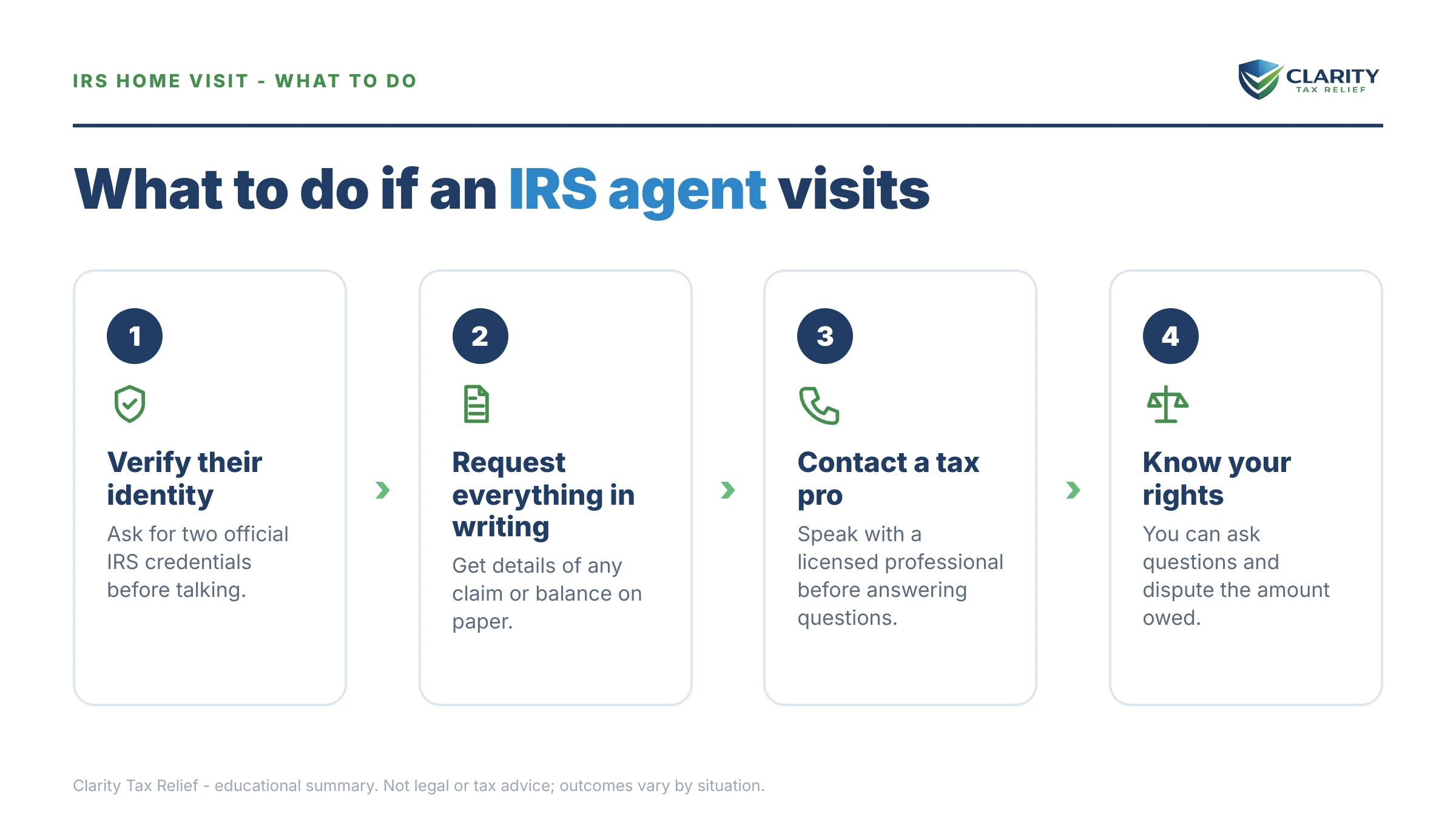
You have more rights at your own front door than almost anywhere else in the collection process. If someone claiming to be the IRS appears — or Letter 725-B just arrived — here's the sequence:
- Stay calm and keep the door closed — you are not required to let anyone inside your home without your consent or a court order.
- Ask for both credentials — a real IRS employee carries a pocket commission and an HSPD-12 government ID card and will show them on request.
- Say nothing substantive — especially if the visitors identify as Criminal Investigation special agents; take their cards and say your representative will contact them.
- Verify the contact independently — log into your IRS online account or call the IRS through a number you look up yourself, never one the visitor alone provides.
- Re-read any letter you received — Letter 725-B names your revenue officer and proposes the appointment; the meeting terms are negotiable, the debt is not ignorable.
- Get representation before any meeting — filing Form 2848 routes IRS contact through your representative instead of your doorstep.
When you can handle this yourself
Most people asking this question don't need professional help — they need to stop avoiding the mail. If you owe under $50,000, agree with the balance, and have all returns filed, you can set up a streamlined payment plan online in under an hour, and the escalation stops there. A first notice you agree with and can pay within 180 days needs nothing but a payment.
Experienced help changes the outcome in four situations: a revenue officer is already assigned (that first Form 9297-driven meeting sets the tone for everything after), the debt involves business payroll taxes and possible personal liability, you have multiple unfiled years the RO wants immediately, or Criminal Investigation has made contact — where you should say nothing and get counsel before any conversation. In those cases, the gap between a prepared response and an improvised one is measured in real dollars and, occasionally, in legal exposure.
Terms you'll hear, decoded
- Revenue officer (RO): a civilian IRS collection employee assigned to larger or complex unpaid-tax cases — not law enforcement, not armed.
- Special agent (CI): a federal law-enforcement officer from IRS Criminal Investigation who investigates potential tax crimes and can visit unannounced.
- Letter 725-B: the mailed appointment request that replaced unannounced revenue officer visits in July 2023.
- Summons: a legal demand — enforceable in court — to appear, testify, or produce records; one of the few things still delivered in person.
- HSPD-12 card: the government-issued photo ID every legitimate IRS employee carries alongside a pocket commission.
- Notice of Federal Tax Lien: a public filing that attaches the government's claim to your property — the quiet threat that matters far more than a door-knock for most balances.
IRS home visit questions, answered
Does the IRS show up at your house unannounced?
Almost never anymore. In July 2023 the IRS ended most unannounced revenue officer visits and replaced them with Letter 725-B, a mailed request to schedule an appointment. The remaining exceptions are narrow: serving a summons or subpoena, certain asset seizures, and criminal investigations. If a stranger appears claiming to be the IRS with no letter behind it, treat that as a red flag and verify before engaging.
What makes the IRS send a revenue officer to your home?
Revenue officers are assigned to cases the automated system can't resolve — typically larger balances, unpaid business payroll taxes, or years of unfiled returns. Most consumer-sized debts never leave the mail-and-phone collection track. If a revenue officer has your case, you'll generally know it from Letter 725-B or prior direct contact, not from a surprise knock.
How do I know the person at my door is really from the IRS?
Ask for both credentials. A genuine IRS employee carries a pocket commission and an HSPD-12 government ID card and will show both on request. Real IRS employees never demand payment on the spot, never ask for gift cards or wire transfers, and won't threaten immediate arrest. If anything feels off, close the door and verify through your IRS online account or the IRS directly.
Can IRS criminal investigators come to my house unannounced?
Yes. Special agents from IRS Criminal Investigation are federal law-enforcement officers and were never covered by the 2023 policy change, so they can still arrive without warning. If two agents appear and identify themselves as CI, be polite, take their cards, and say your attorney will contact them. Anything you say in that doorway conversation can be used in the investigation.
Will the IRS come to my house for a $5,000 or $10,000 balance?
It would be extraordinary. Balances that size are handled entirely by automated notices, phone collection, and — if ignored long enough — levies on bank accounts or wages, all done remotely. A balance under $10,000 also qualifies for a guaranteed installment agreement, which stops the escalation completely. The visit risk lives with six-figure and payroll-tax cases, not consumer balances.
Can I refuse to let an IRS employee into my house?
Yes. You are not required to let any IRS employee inside your home without your consent or a court order, and a legitimate revenue officer will not push past a closed door. You can conduct any legitimate meeting at an IRS office or through a representative instead. Refusing entry is not obstruction — but ignoring the underlying debt keeps the collection machine running.
Does hiring a tax professional stop IRS home visits?
Largely, yes. Once you file Form 2848, the IRS is required to direct contact about your case through your authorized representative, and revenue officers routinely deal with representatives instead of taxpayers. It doesn't erase the debt or every field activity — a seizure action still targets assets — but it ends doorstep conversations and puts an experienced buffer between you and the collector.
Does the IRS call, text, or email before visiting?
The IRS's first contact is almost always postal mail — a numbered notice or letter. It does not initiate contact by text, email, or social media, and it doesn't robocall threatening arrest. A revenue officer may call after mailed contact, but a demand that starts on your phone screen is a scam. When in doubt, check your IRS online account for any real balance.
Your next 24 hours
- Go through the mail pile. Find the most recent IRS letter and read the code in its corner — a CP14 or CP503 means you're early in the sequence; an LT11 or Letter 725-B means a clock or a collector is already in motion.
- Gather three things: your last filed return, every IRS notice you've received, and a rough picture of your monthly income and expenses. That's everything a resolution decision needs.
- Get a free case review. Call (888) 825-7779 or use the 2-minute form and we'll tell you honestly whether your balance is on a visit track at all — and which fix protects your home plans while penalties and interest are still accruing.
If you want to verify anything here yourself, the IRS's own pages on payment plans and installment agreements and paying the IRS are the primary sources, and the independent Taxpayer Advocate Service can step in when normal channels fail.
This guide is general information, not tax or legal advice for your specific situation. Eligibility for IRS programs depends on individual facts and circumstances; no outcome is guaranteed.