
IRS Collections
Can the IRS Take My Business? What the IRS Can Actually Seize in 2026
The short answer: yes, the IRS can take my business is legally true — the IRS can seize business assets and, in rare cases, an entire operating business. But it almost never starts there. What's actually exposed depends on whose debt it is and how the business is structured, and the IRS must send a final notice and wait 30 days first.
You have a W-2 job, a business you built on nights and weekends, and an IRS balance in the five figures — and now you're wondering whether that balance puts the business itself on the table. It can, in specific situations. Those situations follow rules, the rules include a warning shot, and everything you do before that warning shot expires protects what you built.
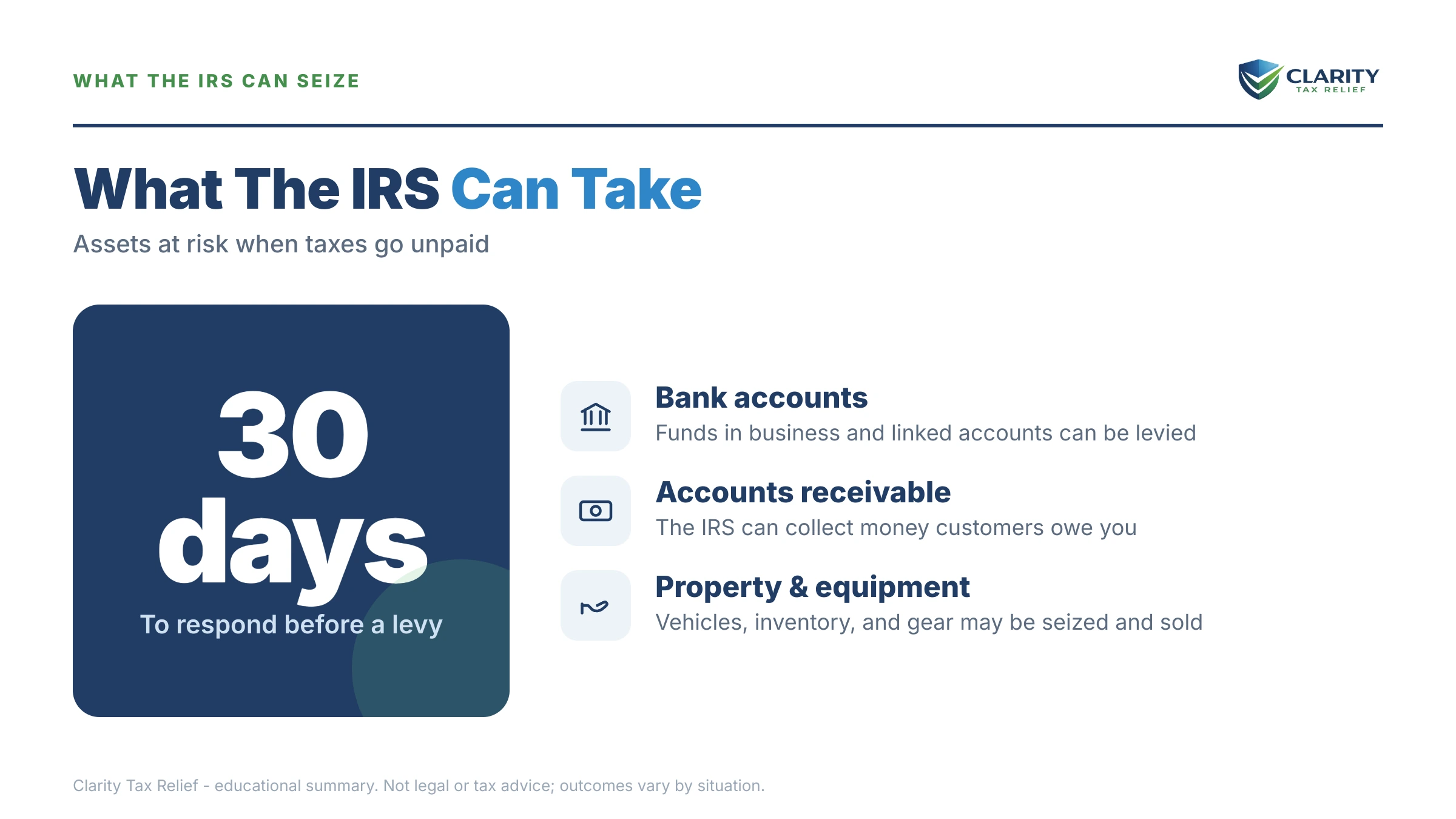
⏱ The clock that matters: before the IRS can seize business assets, bank funds, or wages, it must send a final notice of intent to levy (LT11 or Letter 1058) and give you 30 days to pay, arrange a resolution, or request a Collection Due Process hearing. If you haven't received that letter, no seizure is imminent — but interest and penalties are accruing every month you wait.
Whose debt is it? Why your business structure decides what the IRS can take
The IRS can only seize property that legally belongs to whoever owes the tax — which makes your business structure the single biggest factor in what's exposed. A sole proprietorship has no legal wall between you and the business: its bank account, its equipment, and its receivables are your property, and a personal 1040 debt reaches all of it. A corporation or multi-member LLC is a separate legal person, so your personal debt generally can't touch the entity's own assets — instead the IRS reaches what you own: your shares or membership interest, your salary, and any distributions the company pays you.
The wall works in both directions. If the business owes the debt — unpaid 941 payroll taxes, an 1120 corporate balance — the IRS pursues the entity's assets, not automatically yours. The big exception is payroll tax: the withheld "trust fund" portion can be assessed personally against owners and check-signers through the trust fund recovery penalty, piercing the entity from the other side. And in either direction, the wall collapses if you commingle funds or the IRS establishes the entity is merely your nominee or alter ego. For a deeper dive on entity exposure, see sole proprietorship vs LLC taxes.
| Business structure | You owe (personal 1040 debt) | The business owes (941/1120 debt) |
|---|---|---|
| Sole proprietorship | Everything — the business is legally you: bank account, equipment, inventory, receivables | Same — there is no separation; business tax debt is your debt |
| Single-member LLC | Your membership interest and owner draws; the LLC's own assets if funds are commingled or the IRS shows nominee/alter-ego status | Depends on the tax: employment tax is generally collectible from the LLC; the trust-fund share can also be assessed against you personally |
| Multi-member LLC / partnership | Your partnership interest and your share of distributions — generally not the entity's own assets | Entity assets, plus personal Trust Fund Recovery Penalty assessments against responsible persons |
| S corp / C corp | Your shares, your salary (via wage levy), and dividends or distributions — corporate assets are generally out of reach | Corporate assets; responsible persons personally for the trust-fund portion of payroll taxes |
What the IRS actually takes first (it's almost never the whole business)
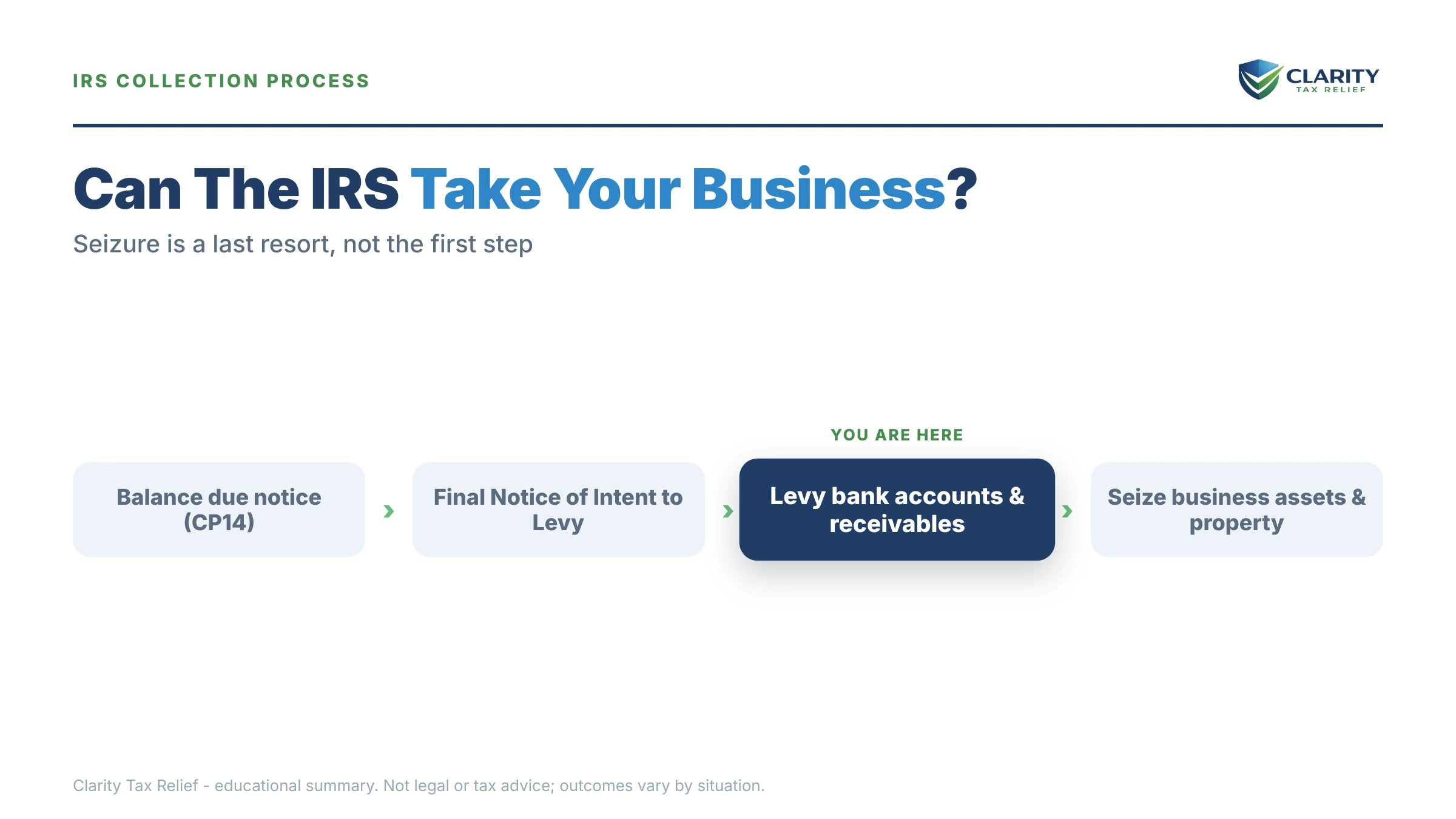
Before any physical seizure, the IRS collects through paper: levies on your bank accounts, your paycheck, your state refund, and your business's receivables. These cost the IRS almost nothing to issue, which is why they come first — and why "can the IRS take my business" usually plays out as "the IRS took the money my business runs on."
- Bank levy — one notice to your bank freezes whatever is in the account that day. The bank holds the funds for 21 days before sending them to the IRS, a short window in which a release is still possible. A levy on the company's operating account works the same way — see IRS levy business bank account.
- Wage levy — if you also hold a W-2 job, this is the IRS's easiest target, and it's continuous until released. You can estimate how much of your paycheck a levy could reach with our IRS Wage Garnishment Calculator.
- Accounts receivable levy — the IRS can send levy notices directly to your clients, ordering them to pay the IRS instead of you. Nothing embarrasses a small business faster or cuts off cash flow harder; see IRS levy accounts receivable.
- Federal tax lien — filed publicly, it attaches to business property, inventory, and receivables, and can choke off business credit even though nothing is physically taken. Details at tax lien on business.
Notice what's missing from that list: padlocked doors. Physical seizure of an operating business requires a human revenue officer, layers of managerial approval, an equity analysis showing a sale would meaningfully pay the debt, and — for a going concern — usually court involvement. It happens, but it's reserved for cases with repeated broken promises or mounting payroll tax debt. If that's your fear, read IRS shut down my business.
What happens if you ignore the debt: the escalation sequence
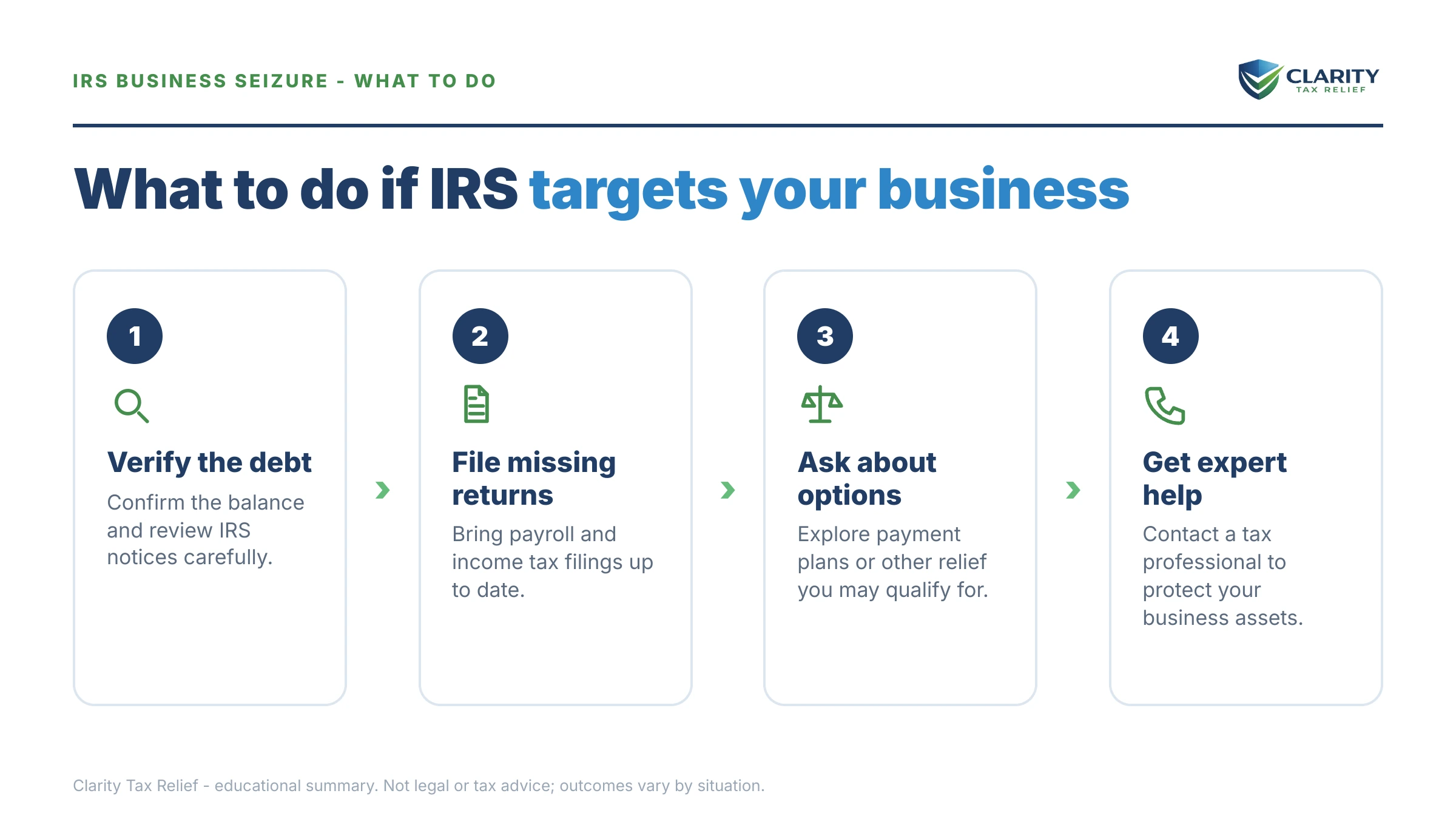
Business seizure sits at the very end of an automated notice sequence that starts with a simple bill. Every stage you let pass costs money and removes options — and in 2026, with IRS staffing down roughly 27%, the humans are harder to reach while the automated levies never paused. Here's the order:
- CP14 (or CP161 for a business balance) — the first bill. No enforcement power yet; the cheapest moment to act.
- CP501 / CP503 — reminder notices. Still just bills, but the balance grows monthly with interest and the failure-to-pay penalty.
- CP504 — Notice of Intent to Levy under IRC §6331(d). The IRS can now seize your state tax refund, and a public federal tax lien becomes a real possibility.
- LT11 / Letter 1058 — the Final Notice of Intent to Levy. This starts the 30-day clock and your Collection Due Process rights. Once it expires, bank levies, wage levies, and client-facing receivable levies are all on the table.
- Levy and seizure — automated levies hit accounts and paychecks; persistent cases get assigned to a revenue officer, who can pursue equipment, vehicles, and — with approvals — the business itself.
There's no fixed number of days between each notice — the sequence is what's certain, not the calendar. What is certain: nothing in the sequence reverses on its own, and every stage is easier to resolve than the one after it.
Worried the IRS is closing in on your business?
If any letter on your desk says "intent to levy," the 30-day window that protects your accounts and your clients may already be running. An experienced tax professional will review your notices and your options free — before the window closes, not after the levy lands.
Your options to protect the business
The IRS generally cannot levy while an installment agreement is pending or active — which means the fastest way to take your business off the table is usually a resolution you can set up yourself online. The full DIY playbook lives in our guide to how to settle tax debt yourself; here's how each option fits a personal balance that has a business standing behind it:
| Option | Who qualifies | Upfront cost | What it does |
|---|---|---|---|
| Short-term payment plan | Can pay in full within 180 days | $0 setup | Stops levy action while active; interest and penalties still accrue |
| Streamlined installment agreement | Balance up to $50,000; up to 72 months, set up online without full financial disclosure | Modest online setup fee (reduced or waived at lower incomes) | Monthly payment; blocks levies while pending and while you stay current |
| Currently Not Collectible | Financials show paying would leave you unable to cover basic living costs | $0 | Pauses collection entirely; debt and interest remain and the IRS re-reviews later |
| Offer in Compromise | Assets plus future income genuinely can't cover the debt — means-tested, not marketed | $205 fee + 20% down on lump-sum offers (both waived with low-income certification) | Settles for less; the IRS accepted roughly 1 in 5 offers in FY2024 |
| Penalty relief (FTA / AEP) | Clean compliance for the prior 3 years; the new Automatic Exemption from Penalty begins applying some relief automatically starting summer 2026 | $0 | Removes penalties from the balance; tax and interest on the tax remain |
Say you owe $11,300: the real math
Say you're a single W-2 employee with a side business, and the balance on your personal account is $11,300. That's just over the $10,000 line for a guaranteed installment agreement, so approval isn't automatic — but it's far under the $50,000 streamlined ceiling, so you can still set up a plan online in one sitting.
The minimum plan is the balance spread over 72 months: $11,300 ÷ 72 ≈ $157 a month. But interest plus the 0.5%-per-month failure-to-pay penalty add roughly $56 a month at the start, so a minimum payment barely outruns the accrual. Bump the payment to $400 a month and the principal alone clears in about 28 months ($11,300 ÷ $400), meaning a realistic payoff of around two and a half years with far less interest paid.
What about settling? With a steady salary and equity in a working business, the IRS's collection math will usually show it can collect the full $11,300 over time — so most steady earners at this balance don't qualify for an Offer in Compromise, and a payment plan is honestly the right tool. This is a hypothetical illustration, not a prediction for your case.
How to respond, step by step
- Confirm whose debt it is — Check whether your IRS notices show your Social Security number or the business's EIN, then pull your IRS online account or transcripts to see the exact balance and tax years. Everything else flows from this answer.
- Find your most recent notice — The notice number in the top corner tells you how close a levy is. A CP504 means the IRS can take your state refund; an LT11 or Letter 1058 means the 30-day final-notice clock is already running.
- File anything unfiled — The IRS will not approve a payment plan, hardship status, or an offer with missing returns on file — and the failure-to-file penalty runs ten times the failure-to-pay penalty (in months where both apply, the failure-to-file portion drops to 4.5 percent, for 5 percent combined), so file even if you cannot pay.
- Set up a resolution before the final-notice window closes — Choose the option that fits your finances — a short-term plan, a streamlined installment agreement, Currently Not Collectible status, or an Offer in Compromise — and get it submitted. The IRS generally cannot levy while an installment agreement is pending or active.
- If you are holding an LT11, request a CDP hearing — File Form 12153 within 30 days of the notice date. A timely request preserves your appeal rights and generally pauses levy action against you and your business while the hearing is pending.
Payment plans can be set up directly at the IRS payment plans page, and one-time payments at IRS.gov/payments. The CDP process is covered in detail in our Form 12153 CDP hearing guide.
When you can handle this yourself — and when help changes the outcome
Most people asking this question can protect their business without hiring anyone. If your debt is personal, under about $25,000, your returns are filed, and no final notice has arrived, a streamlined plan set up online tonight ends the threat — the IRS has no reason to look at your business once you're in a current agreement.
Experienced help changes outcomes in a narrower set of situations: a levy already in motion (the 21-day bank hold and a client-facing receivable levy are races against real clocks), a revenue officer assigned to your case, payroll or trust-fund debt where personal liability is being decided, multiple unfiled years that block every resolution, or a disputed balance you'd otherwise pay twice. In those cases, the order you fix things in — returns, penalties, liability, then the balance — changes what you ultimately pay and what the IRS can reach. If a levy causes genuine hardship or you can't get a response, the Taxpayer Advocate Service is a free, independent avenue as well.
Terms you'll hear, decoded
- Levy — the actual taking of property or money; a lien is the legal claim, a levy is the seizure.
- Lien — a public legal claim against everything you own, filed to protect the government's position; nothing is physically taken.
- Going concern — an operating business; seizing one requires extra IRS approvals and often court involvement, which is why it's rare.
- Disregarded entity — a single-member LLC the tax law treats as inseparable from its owner, which weakens its protection against the owner's tax debt.
- Trust Fund Recovery Penalty (TFRP) — personal liability for the withheld portion of payroll taxes, assessable against owners, officers, and check-signers even when the business is an LLC or corporation.
- CDP hearing — the Collection Due Process appeal you can request within 30 days of a final levy notice; a timely request generally pauses levy action while it's pending.
Can the IRS take my business? Your questions, answered
Can the IRS shut down my business or LLC?
It can, but shutting down an operating business is the IRS's last resort, not its first move. Seizing a going concern requires a revenue officer, managerial sign-off, and in many cases court approval — so the IRS almost always levies bank accounts, receivables, and wages instead. If a revenue officer has been assigned to your case, take the risk seriously and get help before assets are targeted.
Can the IRS take my business if I owe personal taxes?
It depends on how the business is structured. A sole proprietorship is legally you, so its bank account, equipment, and receivables are fair game for a personal 1040 debt. A corporation or multi-member LLC generally shields the entity's own assets — the IRS instead reaches your ownership interest, your salary, and any distributions the company pays you.
Does an LLC protect my business from my personal IRS debt?
Only a multi-member LLC taxed as a partnership or corporation offers meaningful separation — a single-member LLC is a disregarded entity, and the IRS can often reach past it. Even with a multi-member LLC or corporation, protection fails if you commingle funds or the IRS shows the entity is your nominee or alter ego. Clean books and real corporate formalities are what make the shield hold.
Can the IRS levy my business bank account without warning?
Not without notice. Before its first levy, the IRS must send a final notice of intent to levy (LT11 or Letter 1058) and give you 30 days to pay, arrange a resolution, or request a Collection Due Process hearing. Once a bank levy lands, the bank holds the funds for 21 days before sending them to the IRS — a short window in which a release is still possible.
Will the IRS take my side business income?
It can, and this is more common than physical seizure. The IRS can send levy notices directly to your clients or platforms, intercepting accounts receivable and 1099 payments before they reach you. A levy on a contractor payment is generally one-time — it grabs what's owed on that date — but the IRS can reissue it, and a wage levy on your W-2 job is continuous until released.
Can the IRS take my business equipment or inventory?
Yes — after the 30-day final-notice window closes, a revenue officer can seize equipment, inventory, and vehicles titled to you or to a liable entity. Federal law exempts a limited value of the tools of your trade, and the IRS must weigh whether a sale would actually net enough to justify seizure. In practice, equipment seizures are far rarer than bank and receivable levies.
How often does the IRS actually seize an entire business?
Rarely. Physical seizure of a going business requires layers of internal approval, an equity analysis showing a sale would meaningfully pay down the debt, and often court involvement — hurdles that push the IRS toward paper levies instead. The businesses that do get seized or padlocked usually share a pattern: repeated broken promises, an ignored revenue officer, or growing payroll tax debt.
Your next 24 hours
- Pull your most recent IRS letter and find the notice number in the top corner. If it says CP504, LT11, or Letter 1058, note the date printed on it — that date starts the clock that governs your business's exposure.
- Gather three things: your last filed return, every IRS notice you have, and a rough picture of your income and business assets. That's everything needed to pick the right resolution.
- Get a free case review — send us what you found through the 2-minute form or call (888) 825-7779. An experienced tax professional will tell you exactly what the IRS can and can't reach in your structure, and which option shuts the sequence down — while the fix is still a payment plan, not a levy release.
This guide is general information, not tax or legal advice for your specific situation. Eligibility for IRS programs depends on individual facts and circumstances; no outcome is guaranteed.