
IRS Disclosure Programs
Quiet Disclosure IRS Risk (2026): Why Amending Quietly Backfires
The short answer: a quiet disclosure is filing amended or late returns — often with late FBARs — outside the IRS's official disclosure programs, hoping nobody looks closely. It carries zero penalty protection: if spotted, you face the same fraud and FBAR penalties as never fixing anything, while the official paths cap or eliminate those penalties.
Someone — a friend, a forum, maybe even a preparer — told you to "just amend the old returns and mail them in quietly." You're retired, the overlooked account or income has been sitting there for years, and not raising your hand to the IRS feels like the safe move. The truth runs the other way: quiet is the only route with no safety net, and in most cases it's also the more expensive one.
This guide shows how the IRS recognizes a quiet disclosure, what an examiner can assess when it does, and the four paths that usually cost less. Farther down, the image shows you exactly what these filings look like — worth seeing before you decide what goes in the envelope.
⏱ The real clock: no date is printed on anything — your window stays open only until the IRS reaches you first. The streamlined procedures and the Voluntary Disclosure Practice both close permanently the moment an examination or investigation opens for a covered year. Meanwhile, interest compounds daily on the unpaid tax.
What counts as a quiet disclosure to the IRS
A quiet disclosure means filing amended returns, delinquent returns, or late FBARs outside the IRS's official disclosure programs, hoping the corrections get processed without questions. The classic version: three Forms 1040-X adding foreign interest income, mailed alongside six late FBARs, with no explanation attached.
For retirees, the trigger is usually not scheming — it's discovery. An account inherited from a sibling overseas, a small foreign pension from years worked abroad, a brokerage account a spouse managed. You find it, you want it fixed, and quietly amending feels proportionate to an honest mistake.
Here's the flaw in that logic. Amended returns get human review that original returns don't, and this exact pattern — several amended years adding foreign income, plus first-ever FBARs covering old years — is one the IRS has trained screeners to recognize. The IRS has publicly warned that it reviews quiet disclosures and can impose full penalties, including fraud and FBAR penalties, on them.
Foreign banks also report US-owned accounts directly to the IRS under FATCA. So the account you're quietly disclosing may already be in the IRS's data, waiting to be matched against a return that never mentioned it.
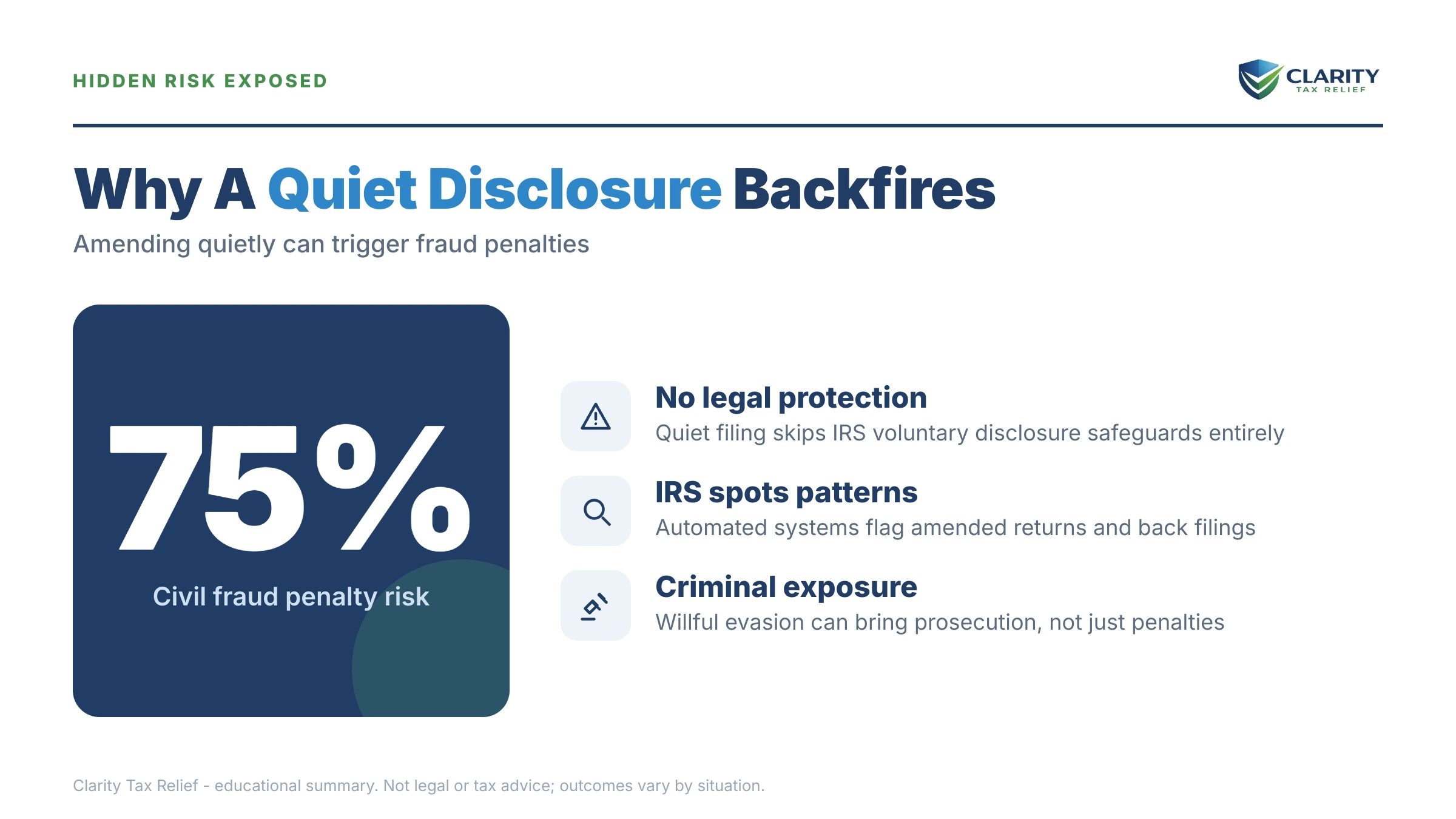
What happens if the IRS spots a quiet disclosure
A quiet disclosure leaves every penalty from the original mistake fully in play, because no program terms ever attached to it. The sequence when one draws attention runs in stages:
- Your filings post normally. Nothing seems to happen — but silence proves nothing. The IRS generally has 3 years to assess more tax, 6 years if you omitted more than 25% of gross income, and no time limit at all for fraud or unfiled returns.
- Screening flags the pattern. Multiple amended years, newly reported foreign income, and first-time FBARs covering prior years are exactly the combination examiners are told to pull for review.
- An examination opens. At that moment, every official disclosure program closes to you — permanently for those years. If the history includes anything deliberate, you're now in an eggshell audit: a civil exam with criminal exposure underneath.
- Penalties assess at full rates. The table below shows what stays on the table — the accuracy-related penalty at minimum, the civil fraud penalty if the examiner concludes you knew, and FBAR penalties on top, assessed under a separate statute.
- Willful cases can be referred to Criminal Investigation. Rare, but real — and a quiet amendment can itself be read as evidence you knew the original returns were wrong. Here's when the IRS refers cases to criminal investigation.
| Penalty | Rate / amount | When it applies |
|---|---|---|
| Failure-to-file | 5% per month, up to 25% | Returns filed late (each unfiled year) |
| Failure-to-pay | 0.5% per month, up to 25% | Tax paid after the original due date |
| Accuracy-related | 20% of the understatement | Negligence or substantial understatement on the original return |
| Civil fraud (IRC §6663) | 75% of the underpayment | Examiner concludes the omission was intentional |
| Non-willful FBAR | Over $10,000 per late report (inflation-adjusted) | Unfiled FBARs; assessed per report, not per account, after Bittner |
| Willful FBAR | Greater of ~$100,000 (adjusted) or 50% of the account balance | Willful failure to report a foreign account — can apply per year |
Interest compounds daily on top of everything above, and interest generally can't be negotiated away — see can IRS interest be waived. To see how fast the tax-side penalties stack on your own numbers, you can estimate them with our IRS Penalty & Interest Calculator. FBAR penalties are separate and follow their own 6-year assessment statute; the ceiling for those is covered in our guide to the didn't file FBAR penalty.
Weighing a quiet disclosure right now?
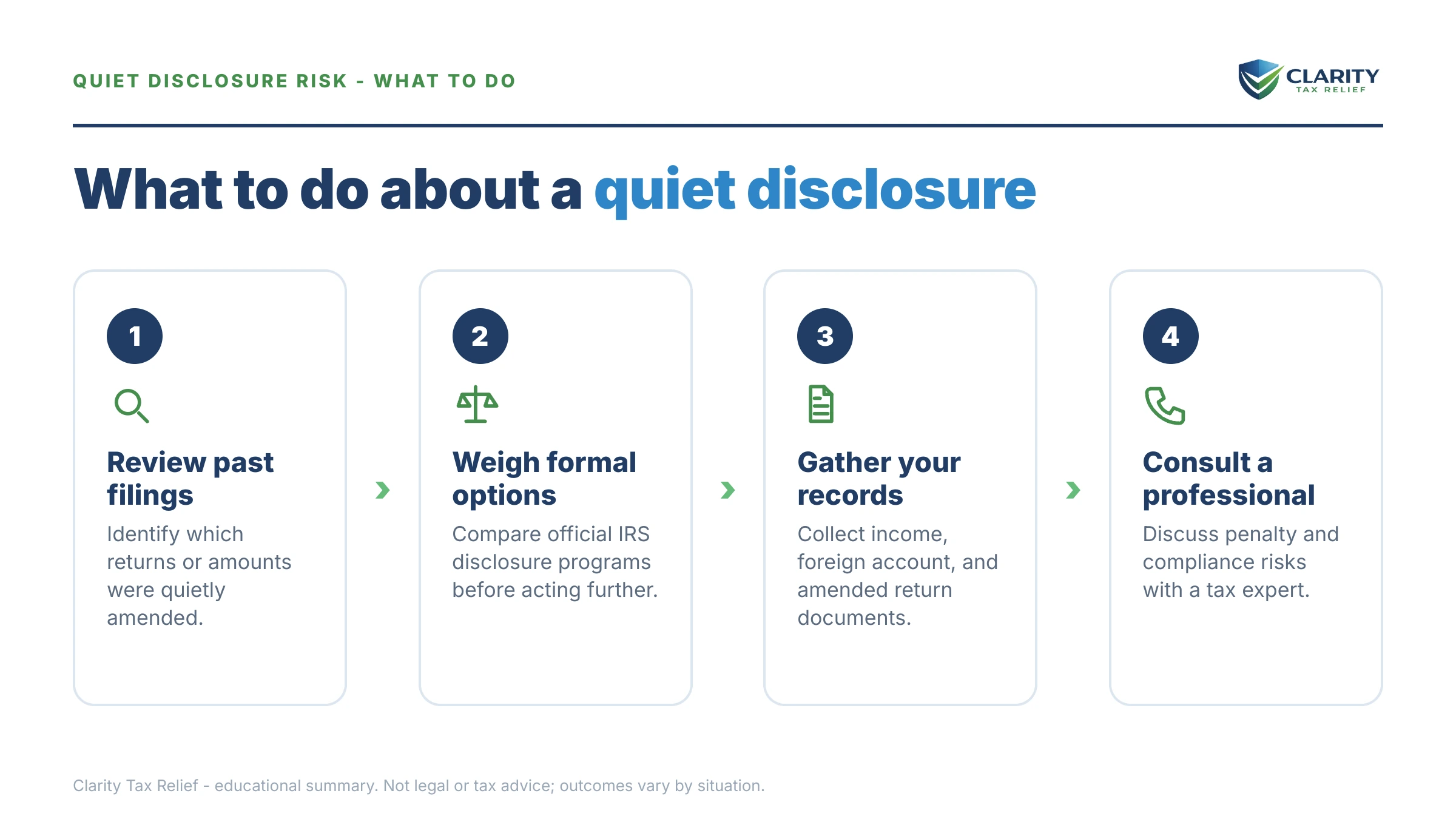
Before anything goes in the mail, have an experienced tax professional map which disclosure path your facts actually fit — every official program stays open only until the IRS reaches you first, and a mailed filing can't be taken back. The review is free and confidential.
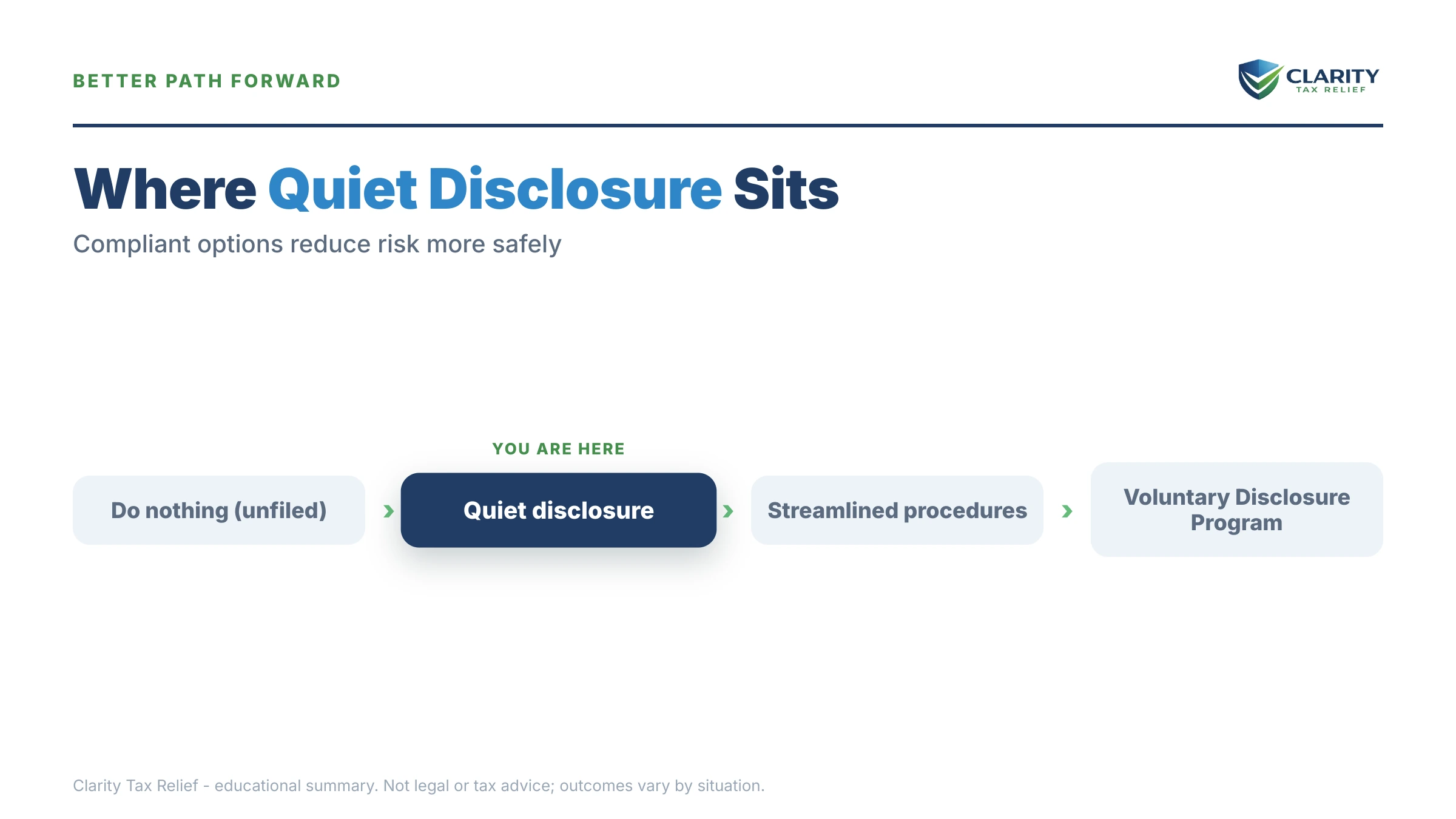
Your options instead of a quiet disclosure
There are four routes back to compliance, and each one trades transparency for a defined — usually smaller — penalty. Which one fits depends on two questions: was any income unreported, and was the original omission willful?
| Path | Built for | What you pay | Penalty protection |
|---|---|---|---|
| Quiet disclosure | Nobody — no program exists | Tax + interest now; full penalties later if examined | None |
| Ordinary amended return | Domestic honest mistakes, no foreign accounts, no willfulness | Tax + interest, possibly a 20% accuracy penalty | None needed — this isn't "quiet," it's just correct |
| Late FBAR filing with explanation | All income reported and taxed, no tax due — only the FBARs are missing | Nothing beyond the filings | No guaranteed program since the IRS removed the DFSP on June 30, 2026 — but penalties are not automatic when the income was reported and taxed |
| Streamlined (SDOP / SFOP) | Non-willful conduct with unreported foreign income | Tax + interest + 5% offshore penalty (SDOP); 0% penalty abroad (SFOP) | Replaces accuracy, FBAR, and information-return penalties |
| Voluntary Disclosure Practice | Willful conduct, including criminal exposure | Tax + interest + a negotiated civil penalty framework | Defined penalties; generally shields against criminal referral |
If you reported all the income and only the forms are missing, you're the easiest case. The IRS removed the Delinquent FBAR Submission Procedures on June 30, 2026, so there's no longer a guaranteed penalty-free program — but you can still e-file the late FBARs through FinCEN with a short explanation, and penalties are not automatic when the account income was reported and taxed.
If foreign income went unreported but you honestly didn't know, the streamlined procedures are the main road. US residents use the streamlined domestic offshore path: three years of amended returns, six years of FBARs, a non-willful certification on Form 14654, and a 5% miscellaneous offshore penalty on the highest year-end value of the foreign assets — which replaces the accuracy, FBAR, and information-return penalties entirely. Taxpayers living abroad use the streamlined offshore procedures for non-residents, where that penalty drops to zero.
If anything in the history was deliberate — accounts moved to avoid reporting, a "No" checked on Schedule B's foreign-account question you knew was wrong — the streamlined certification is off-limits, because you'd be signing a false statement under penalties of perjury. That's what IRS voluntary disclosure exists for: preclearance through Form 14457, full cooperation, and a defined civil penalty framework (typically concentrated on the highest-liability year rather than every year) in exchange for protection that a quiet filing can never provide.
Whichever route fits, the corrected balance becomes ordinary tax debt — and payment plans, hardship status, and settlement options for it are covered in our guide to how to settle tax debt yourself.
The math: a $13,600 quiet disclosure vs. the streamlined path
Say you're 71, living on Social Security, and in 2022 you inherited your sister's bank account in Dublin. Nobody told you the interest was US-taxable or that the account needed an FBAR. Across three tax years, the unreported interest and a small foreign pension add up to $13,600 in extra federal tax, and the account's highest year-end balance was $85,000. This is a hypothetical — but the arithmetic is real.
Quiet route, if examined:
- Tax: $13,600, plus daily-compounding interest from each year's original due date
- Accuracy-related penalty: 20% × $13,600 = $2,720
- Non-willful FBAR exposure: three late reports, each capped above $10,000 after inflation adjustments — a potential ceiling over $30,000 on top
- If the examiner reads the facts as willful: up to 50% of the $85,000 balance — $42,500 — per year, plus a possible 75% fraud penalty in place of the 20%
Streamlined domestic route:
- Tax: the same $13,600, plus interest
- Miscellaneous offshore penalty: 5% × $85,000 = $4,250
- Accuracy, FBAR, and information-return penalties: replaced — $0
So the "scary" official program costs $4,250 in penalties with certainty, while the "safe" quiet route risks $32,000-plus in the ordinary case and far more if willfulness is asserted. The quiet route only wins if nobody ever looks — and the whole point of FATCA data and amended-return screening is that somebody often does.
How to come clean the right way, step by step
- Stop before you mail anything. A quiet filing can't be recalled once it's in the system, and every official program stays open only until the IRS reaches you first. Deciding the route comes before any envelope.
- Sort your facts into willful or non-willful. Write down what you knew, when you knew it, and what your returns said each year. This one distinction decides whether you belong in the streamlined procedures or the Voluntary Disclosure Practice.
- Match your facts to one path. All income reported and no tax due: e-file the late FBARs through FinCEN with an explanation. Unreported foreign income, honestly non-willful: streamlined. Anything deliberate in the history: voluntary disclosure through Form 14457. Purely domestic honest mistake: a normal amended return.
- Assemble the complete package. For streamlined, that means three years of amended returns, six years of FBARs, the signed certification, and payment of tax, interest, and any program penalty — submitted together, not piecemeal.
- Pay or arrange payment for the balance. Pay through IRS.gov if you can; if not, set up a payment plan at the same time you disclose so the corrected balance never drifts into the collection notice stream.
The official eligibility rules and submission mechanics for both streamlined tracks are published at the IRS's Streamlined Filing Compliance Procedures page, and any payment or plan can be set up directly at IRS.gov/payments. For comparing how to fund the balance itself, see the best way to pay the IRS.
When you can handle this yourself
Not every correction needs a program — or a professional. You can generally handle it alone when the mistake is purely domestic, involves one or two years, has no foreign accounts, and nothing in the history could be read as intentional: just file the corrected return and pay. Our guides to amending a return and voluntarily filing old tax returns walk through both versions, and filing before the IRS contacts you is consistently the cheapest position to be in.
Experienced help changes the outcome in four situations: any foreign account or asset is involved; more than two years need correcting; any fact could be argued as willful (a Schedule B "No" box, moved accounts, cash handling); or you're choosing between streamlined and the Voluntary Disclosure Practice. The non-willful certification is signed under penalties of perjury — signing the wrong one is worse than signing nothing, and that judgment call is precisely where a second set of trained eyes earns its fee.
One more note for readers on fixed income: if the corrected balance ends up unpaid, the IRS can take up to 15% of Social Security through the Federal Payment Levy Program. Disclosing and arranging payment in the same move keeps that off the table. If money is tight, the Taxpayer Advocate Service and low-income taxpayer clinics can also help at no charge.
Terms on these filings, decoded
- Quiet disclosure — correcting old returns or FBARs outside any official IRS program, with no penalty terms attached.
- Willful vs. non-willful — whether you knew (or deliberately avoided knowing) about the reporting duty; this single distinction routes you to VDP or streamlined.
- FBAR (FinCEN Form 114) — the annual report of foreign financial accounts, filed separately from your tax return with its own penalty statute.
- Streamlined procedures — the IRS's non-willful catch-up program: 3 years of returns, 6 years of FBARs, and a 5% (domestic) or 0% (foreign) penalty.
- Voluntary Disclosure Practice (VDP) — the formal Criminal Investigation program (Form 14457) for willful conduct, trading cooperation for defined penalties.
- Eggshell audit — a civil examination where undisclosed willful conduct sits underneath, so every answer carries criminal-exposure weight.
Quiet disclosure questions, answered
Is a quiet disclosure illegal?
No — filing accurate amended returns and paying the tax is legal. The problem is what it doesn't do: it provides no penalty protection and no protection against criminal referral. And if the original omission was willful, the corrected filings can themselves become evidence that you knew — which is exactly the situation the IRS Voluntary Disclosure Practice was built to handle safely.
What are the chances the IRS catches a quiet disclosure?
There's no published catch rate, but the IRS has said for years that it screens amended returns and late FBARs for the quiet-disclosure pattern. Foreign banks also report US-owned accounts directly to the IRS under FATCA, so an offshore account often self-reports whether you disclose or not. The risk rises with foreign accounts, multiple amended years, and larger dollar amounts.
Can I just file late FBARs without using a program?
The IRS removed the Delinquent FBAR Submission Procedures on June 30, 2026, so there is no longer a guaranteed penalty-free program. You can still e-file the late FBARs through FinCEN with a short explanation, and penalties are not automatic when the account income was reported and taxed. If any of the account income went unreported and tax is due, that path doesn't apply — you'd be looking at the streamlined procedures or the Voluntary Disclosure Practice instead.
What is the difference between a quiet disclosure and a voluntary disclosure?
A voluntary disclosure is a formal program run through IRS Criminal Investigation: you request preclearance on Form 14457, and in exchange for full cooperation you get a defined civil penalty framework and, generally, protection from criminal referral. A quiet disclosure is just mailing corrected returns with no program behind them — no preclearance, no defined penalties, and no protection of any kind.
Do the streamlined procedures require an attorney?
No — there's no representation requirement. But the non-willful certification on Form 14654 or 14653 is signed under penalties of perjury, and it's the single document the IRS tests if it questions your submission. When the facts are clean, a careful taxpayer can manage it; when anything in the history could be read as willful, experienced help before you sign is worth far more than it costs.
I already made a quiet disclosure — is it too late to fix?
Usually not, if the IRS hasn't opened an examination yet. Taxpayers who quietly amended returns can generally still make a streamlined submission covering those years, provided they meet the non-willfulness and other eligibility rules. The key is moving before any exam or investigation starts, because that door closes permanently once one does.
Does filing an amended return trigger an audit?
Not automatically — the IRS processes millions of amended returns without examining them. But amended returns get more human review than original filings, and a set of them adding previously unreported foreign income draws far more attention than a corrected W-2. Remember too that omitting more than 25% of gross income extends the IRS's assessment window from three years to six.
Your next 24 hours
- Find your two numbers. Rough out the unreported income by year and the highest year-end balance of any foreign account — that balance is what the 5% streamlined penalty is measured against.
- Gather the paper. The returns you filed for each affected year, account statements, any foreign pension or bank documents, and your Schedule B pages showing how the foreign-account question was answered.
- Get a free case review before you mail anything. An experienced tax professional can tell you in one conversation which path your facts fit — and every official option stays open only until the IRS contacts you first. Call (888) 825-7779 or use the 2-minute form.
This guide is general information, not tax or legal advice for your specific situation. Eligibility for IRS programs depends on individual facts and circumstances; no outcome is guaranteed.