
International & Expat Taxes
Streamlined Offshore Procedures (SFOP): How Expats Catch Up Penalty-Free in 2026
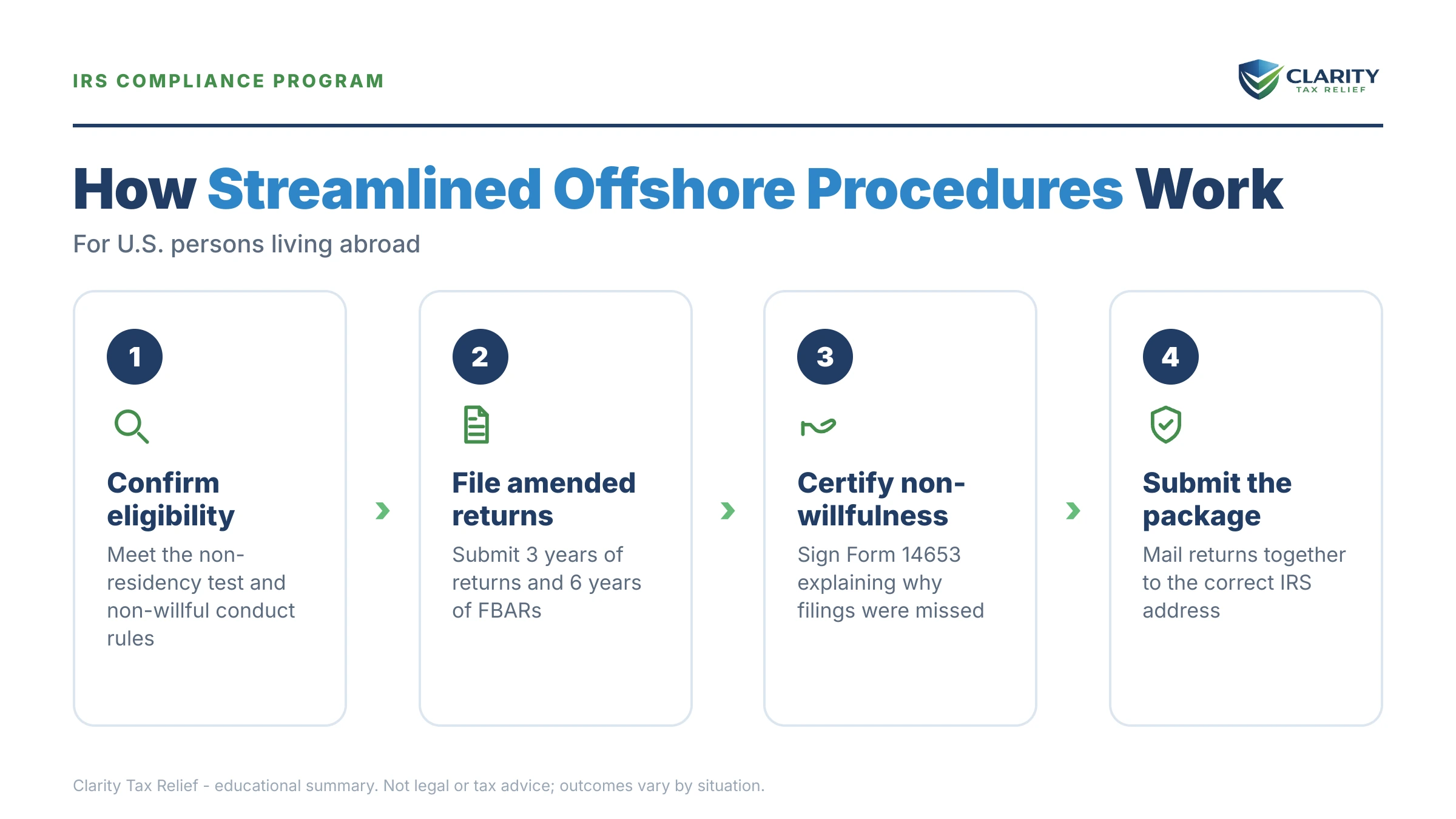
The short answer: the streamlined offshore procedures (formally the Streamlined Foreign Offshore Procedures, or SFOP) let non-willful U.S. taxpayers living abroad catch up by filing 3 years of returns and 6 years of FBARs with a Form 14653 certification — paying only the tax and interest, with every penalty waived, including the offshore penalty.
Somewhere along the way — a W-9 request from your bank overseas, an FBAR thread in an expat forum — you learned the U.S. taxes its citizens on worldwide income no matter where they live. Now you and your spouse are years behind and reading about penalties that dwarf the tax itself. Take a breath: the rules are strict, but the IRS built a specific come-forward path for exactly your situation, and used correctly it erases every penalty.
The heart of the whole submission is a certification called Form 14653, where you tell the IRS in your own words why your failure to file was non-willful. The visual guide below maps the deadlines and options at a glance — and that certification narrative is the single most important part of the package.
⏱ The real clock: SFOP has no application deadline — but two clocks run anyway. The IRS has said it can end the streamlined program at any time, and your personal eligibility ends the day the IRS opens an examination or contacts you about the missing years. This is a come-forward-first program: it only works if you move before the IRS does.
What the streamlined offshore procedures cover in 2026
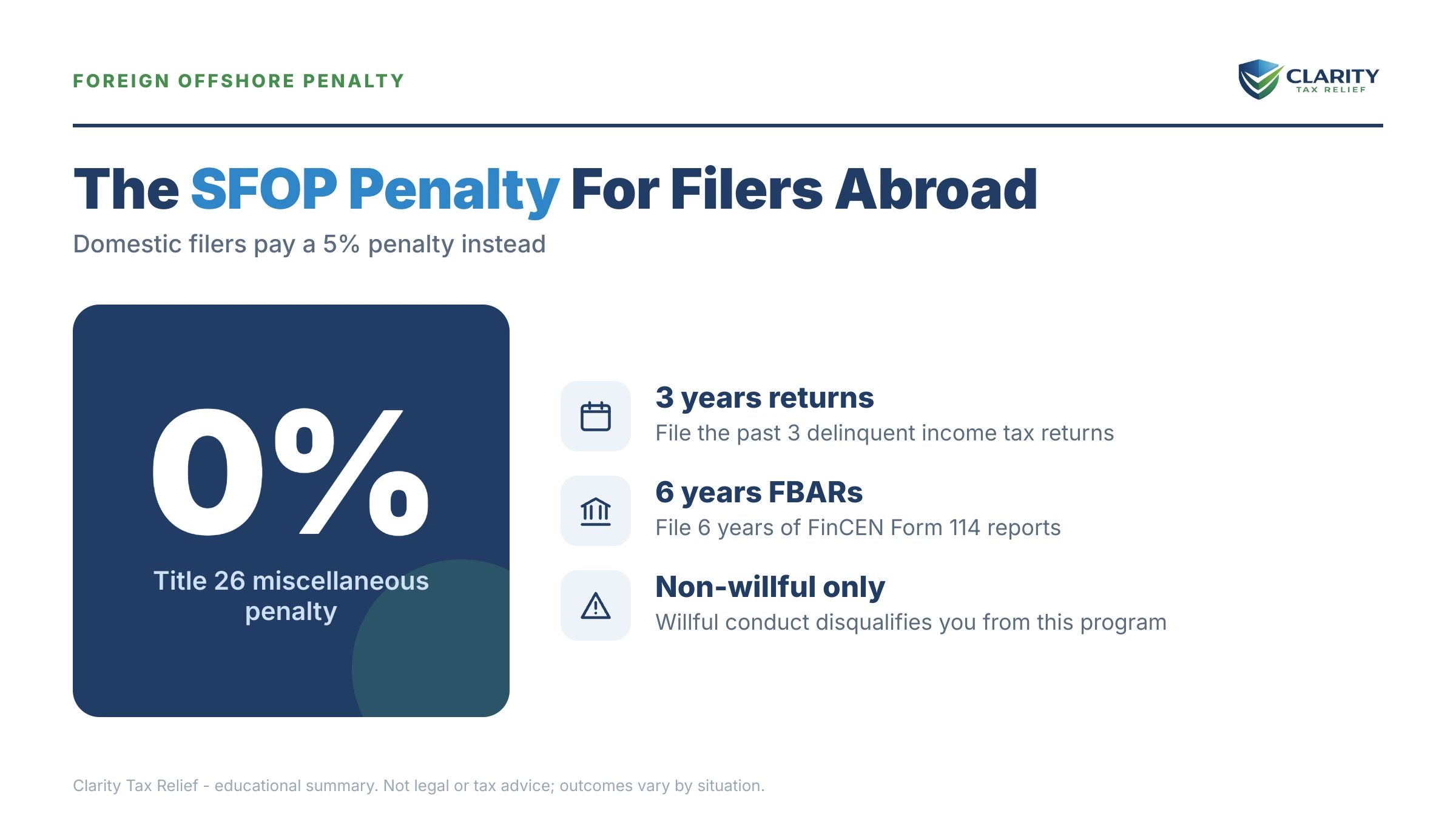
The Streamlined Foreign Offshore Procedures waive 100% of penalties — including the miscellaneous offshore penalty — for non-willful U.S. taxpayers abroad who file three years of tax returns and six years of FBARs. They're one of two tracks inside the IRS's Streamlined Filing Compliance Procedures, expanded to their current form in 2014 and still open in 2026.
The foreign track (SFOP, certified on Form 14653) is for people who live outside the United States. The domestic track — covered in our separate guide to the streamlined domestic offshore procedures — is for U.S. residents, and it charges a 5% penalty on the highest year-end value of the undisclosed foreign assets. Living abroad is what earns you the zero-penalty version.
What you submit: original or amended returns for the three most recent years whose due dates have passed (with every required international information return attached — Forms 8938, 5471, 3520, and so on), FBARs for the six most recent years, the signed Form 14653, and payment of the tax plus interest. What you don't pay: failure-to-file penalties, failure-to-pay penalties, accuracy-related penalties, FBAR penalties, or information-return penalties.
Two honest caveats. First, the IRS never sends an acceptance letter — streamlined returns are processed like ordinary filings, with no closing agreement, and they remain subject to normal audit selection. Second, the program is a certification, not an application: you swear under penalties of perjury that your conduct was non-willful, and a false certification converts a paperwork problem into a fraud problem.
Why so many Americans abroad end up here
FATCA is the reason most people discover this problem: foreign banks across most of the world's banking system now report U.S.-person accounts directly to the IRS. That's why your bank suddenly asked for a W-9 or threatened to close your account — it's flagging you to the U.S. government whether you file or not.
The underlying mistakes are almost always innocent. You didn't know citizens abroad still have to file. You assumed the foreign earned income exclusion meant no return was required (it isn't — you have to file to claim it). You're an "accidental American" who left as a child. You're a green-card holder who moved home and assumed the obligation ended. Or a local preparer told you, wrongly, that paying tax in your country of residence settled everything.
None of that changes what the IRS's computers see: FATCA data showing accounts and income, and no matching U.S. return. The streamlined offshore procedures exist precisely because Congress's penalties were built for tax evaders, and the IRS needed a way to let honest non-filers back in without financially destroying them.
Do you qualify? The three tests SFOP applies
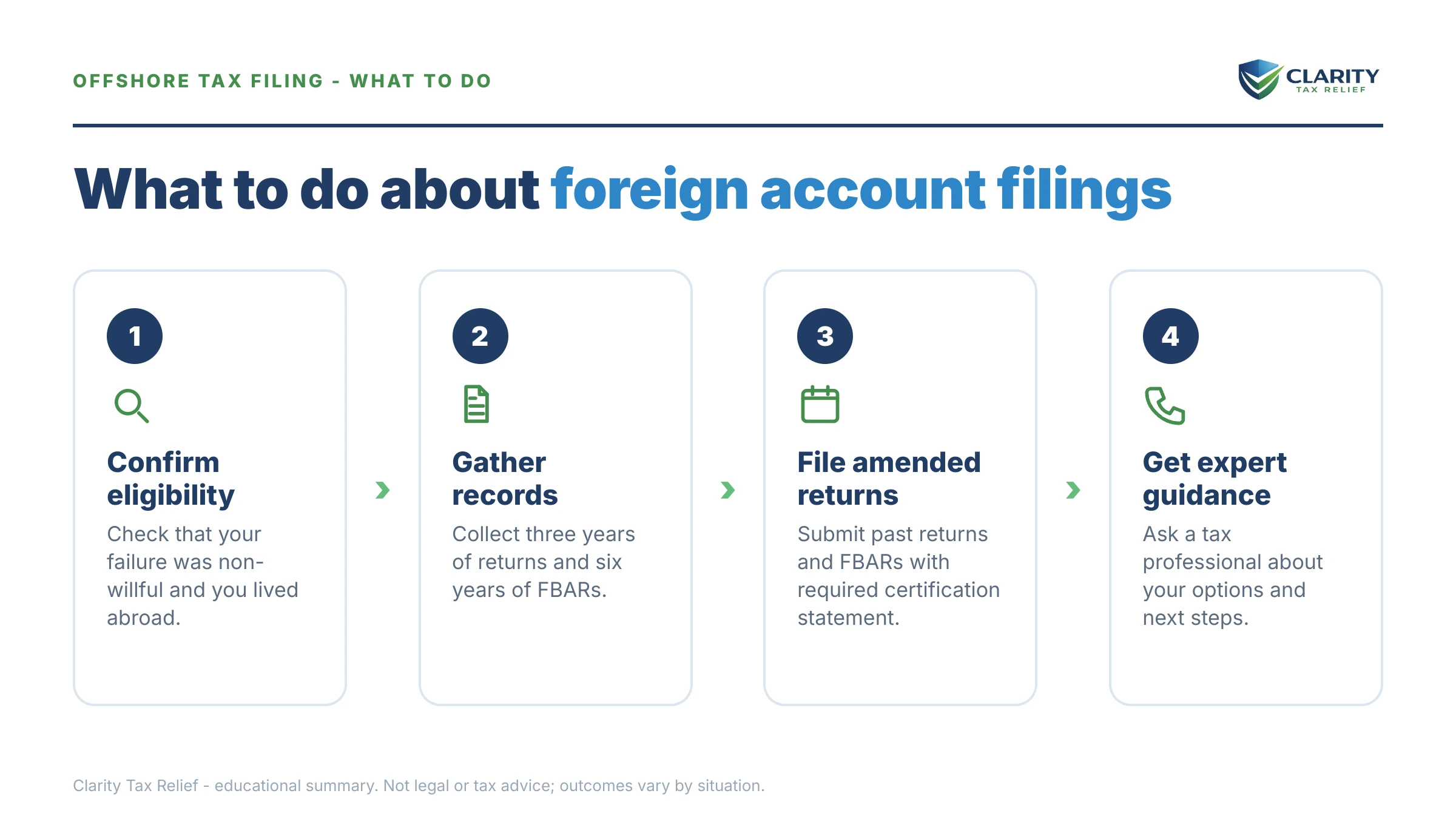
SFOP eligibility comes down to three tests: non-residency, non-willfulness, and no open IRS examination. Fail any one and this track is closed — though a different path usually remains open, which is why the diagnosis matters more than the paperwork.
| Test | What it requires | How you show it |
|---|---|---|
| Non-residency | For citizens and green-card holders: in at least one of the three most recent tax years whose due dates have passed, no U.S. abode and at least 330 full days physically outside the U.S. | Travel records, foreign lease or property records, employment abroad |
| Non-willfulness | The failure came from negligence, inadvertence, mistake, or a good-faith misunderstanding of the law — for every year covered | The sworn narrative on Form 14653 |
| No open examination | The IRS has not started a civil examination of any of your tax years — for any issue, offshore or not | No exam letters received; your account transcripts are clean |
| Valid taxpayer ID | Each filer has an SSN or ITIN (or applies for an ITIN with the submission) | SSN card or ITIN application attached |
Three situations change the answer. Married couples: on a joint Form 14653, both spouses must independently pass the non-residency test. If one spouse stayed stateside, the qualifying spouse can submit alone with married-filing-separately returns — usually at a higher tax cost, so run both numbers first. Non-citizens without green cards: you meet the non-residency requirement by failing the substantial presence test (you must still certify non-willful conduct and meet the other SFOP conditions) in one of the three years, a different and often easier standard. Recently moved back to the U.S.: you may still pass, because the test only needs one qualifying year out of the last three — and if you don't, the domestic track's 5% penalty is the fallback, not disaster.
What happens if you wait
Waiting doesn't preserve your options — it burns them, in a predictable sequence. Every stage below narrows what's available, and the streamlined door slams shut at stage three:
- FATCA data accumulates. Your foreign bank reports your name, account numbers, and balances. The IRS matches that data against filings — and finds none.
- A soft letter arrives. The IRS sends foreign-account compliance letters — like Letter 6291 — nudging you to fix the gap. Depending on the letter's wording, streamlined eligibility may already be in question, so treat any IRS contact as urgent.
- An examination opens. The moment a civil exam starts on any of your years — even a domestic issue unrelated to the accounts — SFOP is off the table permanently for those years.
- Penalties get assessed the ordinary way. Failure-to-file at 5% per month (4.5% in months where the failure-to-pay penalty also applies, for 5% combined), failure-to-pay, accuracy-related penalties, $10,000-per-form information-return penalties, and non-willful FBAR penalties year by year.
- The willfulness argument hardens. Once you know the rules — and reading this page arguably starts that clock — continued silence looks less like a mistake and more like a choice. Willful FBAR penalties can reach the greater of six figures or 50% of the account balance per year, and willful cases belong in the IRS voluntary disclosure practice, a far more expensive door.
One tempting shortcut deserves a specific warning: quietly filing amended returns and hoping nobody notices. A quiet disclosure gives you none of the streamlined program's penalty protection while handing the IRS a signed confession that you knew about the problem.
Behind on foreign filings and not sure which door you're eligible for?
Streamlined eligibility ends the day the IRS contacts you first — and the non-willfulness certification is not something to guess on. An experienced tax professional will review your years, your accounts, and your facts free of charge, and tell you plainly whether SFOP fits before you sign anything.
Your offshore catch-up options, compared
SFOP is the best offshore compliance path for most non-willful expats, but it's one of four real doors — and picking the wrong one can cost five figures. Here's how they stack up:
| Path | Who it fits | Offshore penalty | Key requirement |
|---|---|---|---|
| Streamlined Foreign Offshore (SFOP) | Non-willful taxpayers who meet the non-residency test | $0 — all penalties waived | 3 years of returns, 6 years of FBARs, Form 14653, tax + interest paid |
| Streamlined Domestic Offshore (SDOP) | Non-willful U.S. residents who filed returns but omitted foreign items | 5% of the highest year-end foreign asset total | 3 amended returns, 6 FBARs, Form 14654 |
| Late FBAR filing (the Delinquent FBAR Submission Procedures were removed by the IRS on June 30, 2026) | People who reported all income and owe no tax — only the FBARs are missing | Not automatic when account income was reported and taxed, but no longer a guaranteed penalty-free program | Late FBARs e-filed through FinCEN with an explanation |
| IRS Voluntary Disclosure Practice (VDP) | Willful conduct or criminal exposure | Substantial civil penalty framework | Preclearance through IRS Criminal Investigation |
| Quiet disclosure | No one — it's a risk, not a program | None waived; full exposure remains | Nothing — and no protection |
The forks in plain English: if you reported all your income and simply missed the bank-account form, note that the IRS removed the delinquent fbar procedures on June 30, 2026 — you can still e-file late FBARs through FinCEN with an explanation, and penalties are not automatic when the account income was reported and taxed, but there is no longer a guaranteed penalty-free program. If you live in the U.S., SDOP and its 5% penalty apply instead. If your facts include hidden accounts, nominee names, or deliberately unchecked boxes, willfulness is on the table and VDP — not streamlined — is the safe route. And if your problem is simply a U.S. balance you can't pay, with nothing offshore about it, start with our guide on how to settle tax debt yourself — payment plans and hardship programs live there, not here.
Expats with broader unfiled-year problems — more than three years behind, or U.S.-source income mixed in — should read our companion guide to expat back taxes, because SFOP's three-year window doesn't always cover the whole exposure.
What SFOP saves: a worked example at $36,900
Say you and your spouse are U.S. citizens who've lived abroad since 2019 and never filed, and catching up produces three returns owing $10,400, $12,100, and $14,400 — $36,900 in tax across the three years, driven by rental income and investment gains the foreign earned income exclusion doesn't cover. This is a hypothetical, but the arithmetic is real.
Under SFOP, you pay the $36,900 plus statutory interest — which accrues at the federal underpayment rate, compounded daily and adjusted quarterly — and nothing else. Depending on how long each year has been outstanding, interest typically adds a few thousand dollars. Every penalty is waived.
Outside SFOP, the same three returns carry: a failure-to-file penalty of 5% per month — reduced to 4.5% in months where the failure-to-pay penalty also applies (5% combined) — capped at 25%, or $9,225 on this balance ($36,900 × 25%) — plus failure-to-pay penalties of 0.5% per month accruing toward their own 25% cap. Then the offshore layer: the Form 8938 penalty starts at $10,000 per missed form — $30,000 across three years — and six late FBARs apiece can each support a non-willful fbar penalty of more than $10,000 per report after inflation adjustments, before anyone even argues willfulness. That's a realistic penalty exposure well into six figures on a $36,900 tax bill — exposure the IRS can assert, not a promise that it always will, but you don't want to be the test case.
You can estimate the failure-to-file and failure-to-pay side of your own numbers with our IRS penalty and interest calculator — then remember that a valid streamlined submission zeroes out that entire column.
One more practical point: if you can't pay the full tax with the package, pay what you can and request a payment plan for the balance — inability to pay in full doesn't disqualify you from the penalty relief. For a remaining balance under $50,000, a streamlined installment agreement spreads it over up to 72 months, though interest continues to accrue.
How to file under the streamlined foreign offshore procedures, step by step
A complete SFOP package has four parts — returns, certification, FBARs, and payment — and each part has a rule that trips up do-it-yourselfers. Here's the sequence:
- Confirm your eligibility. Verify that each spouse meets the non-residency test, that your conduct was non-willful for every year, and that the IRS has not opened an examination or contacted you about the missing filings.
- Prepare three years of returns. File original or amended returns for the three most recent years whose due dates have passed, attach every required information return, and write "Streamlined Foreign Offshore" in red ink at the top of the first page of each return.
- Complete Form 14653. Write a specific, honest narrative explaining how the accounts were opened, why the income went unreported, and why the failure was non-willful — both spouses must sign a joint certification.
- E-file six years of FBARs. Submit FinCEN Form 114 for each of the six most recent years through the BSA E-Filing System, selecting the streamlined procedures as the reason for late filing.
- Mail the package with payment. Send the returns, Form 14653, and payment of the tax plus statutory interest to the IRS Austin address in the current instructions, and keep a complete copy of everything.
- Stay compliant going forward. File complete, on-time returns and FBARs for every future year — the certification you sign commits you to it, and a new lapse reopens everything.
| Item | What it is | Where it goes |
|---|---|---|
| 3 years of returns | Original or amended 1040s, marked "Streamlined Foreign Offshore" in red, with all schedules and international forms attached | Mailed to the IRS Austin campus, per the current instructions |
| Form 14653 | The signed non-willfulness certification and narrative — one joint form for a married couple | Included in the mailed package (a copy attached to each return) |
| Payment | Tax shown on all three returns, plus statutory interest | Included with the package |
| 6 years of FBARs | FinCEN Form 114 for each year, flagged as a streamlined late filing | E-filed separately through FinCEN's BSA system — never mailed |
| Information returns | Forms 8938, 5471, 3520, and any others your assets require | Attached to the relevant year's return |
The official rules and the mailing address live on the IRS's Streamlined Filing Compliance Procedures page, and late FBARs are filed through FinCEN's BSA E-Filing System. Payments can be made by check with the package or arranged through IRS.gov/payments for any balance that remains.
When you can handle this yourself — and when you shouldn't
You can reasonably self-prepare an SFOP submission if your facts are simple: wage income from one foreign employer, ordinary bank and savings accounts, a clearly innocent reason you didn't file, and the patience to prepare three returns with the foreign earned income exclusion or foreign tax credit correctly. The forms are public and the process is well documented.
Experienced help changes the outcome in specific situations. If your history has willfulness gray areas — you filed U.S. returns but checked "No" on Schedule B's foreign-account question, or a preparer once mentioned FBARs and you let it slide — the certification itself is the risk, and a professional should assess it before you swear to it. If your assets include a foreign corporation (the form 5471 penalty is $10,000 per missed form on its own), a foreign trust or large foreign gift, or crypto on overseas exchanges — see our guide to offshore crypto reporting — the returns are technical enough that errors invite the audit the program otherwise avoids. And if the IRS has already written to you, the eligibility question needs answering before anything gets mailed. Honest rule of thumb: the simpler your accounts, the more DIY-able this is; the more entities, years, and gray areas, the more a professional earns their fee.
Terms on Form 14653 and your FBARs, decoded
Six terms you'll keep running into, in plain English:
- Non-willful conduct — the IRS's phrase for failures caused by negligence, inadvertence, mistake, or a good-faith misunderstanding of the law, as opposed to a knowing choice.
- FBAR (FinCEN Form 114) — the annual electronic report of foreign financial accounts, required when their combined value tops $10,000 at any point in the year.
- Miscellaneous offshore penalty — the streamlined program's price of admission: 5% of foreign assets on the domestic track, and $0 on the foreign track.
- Form 14653 — the sworn certification for taxpayers abroad, containing your non-willfulness narrative; its domestic twin is Form 14654.
- FATCA — the 2010 law that makes foreign banks report U.S. account holders to the IRS, and the reason non-filing abroad stopped being invisible.
- Quiet disclosure — filing late or amended returns outside any program and hoping nobody notices; it carries all of the risk and none of the protection.
Streamlined offshore procedures: your questions, answered
Are the streamlined offshore procedures still open in 2026?
Yes. The IRS has not announced an end date for the Streamlined Filing Compliance Procedures, and both the foreign and domestic tracks are accepting submissions in 2026. But the IRS has said publicly that it can close or change the program at any time, and your individual eligibility ends the moment the IRS opens an examination or contacts you about the missing years — whichever comes first.
What does non-willful actually mean?
Non-willful means your failure to report came from negligence, inadvertence, mistake, or a good-faith misunderstanding of the law — for example, you genuinely didn't know the U.S. taxes citizens on worldwide income. Willfulness means you knew about the requirements and chose to ignore them, or deliberately avoided learning about them. Gray areas — like checking 'No' on Schedule B's foreign-account question — deserve professional review before you certify.
Do both spouses have to meet the non-residency test to file a joint streamlined submission?
Yes. On a joint Form 14653, each spouse must independently satisfy the non-residency requirement — no U.S. abode and at least 330 full days outside the United States in one of the three most recent years. If only one spouse qualifies, that spouse can submit alone using married-filing-separately returns, though that usually raises the tax; run both calculations before deciding.
Is there any penalty under the streamlined foreign offshore procedures?
No. SFOP is the only offshore path with a zero miscellaneous offshore penalty — you pay the tax on the amended or delinquent returns plus statutory interest, and the failure-to-file, failure-to-pay, accuracy-related, FBAR, and information-return penalties are all waived. The domestic track (SDOP) charges a 5% penalty on the highest year-end aggregate of your foreign financial assets.
Will the IRS tell me my streamlined submission was accepted?
No — the IRS does not issue an acceptance letter or closing agreement for streamlined submissions. Your returns are processed like ordinary filings, and silence generally means the package was processed. The trade-off is that streamlined returns remain subject to normal audit selection, which is why the Form 14653 narrative and the numbers on the returns need to hold up if examined.
What if I can't pay the full tax with my streamlined submission?
Pay as much as you can with the package and request a payment plan for the rest — the IRS's streamlined guidance anticipates this. Interest keeps accruing on any unpaid balance, but an inability to pay in full does not disqualify you from the penalty relief. For balances under $50,000, a streamlined installment agreement of up to 72 months can usually be set up without detailed financial disclosure.
Do crypto accounts on foreign exchanges count for the streamlined procedures?
Any income from crypto held on foreign exchanges — trades, staking, interest — belongs on the three years of returns you submit, and unreported crypto income is one of the fastest-growing reasons people need SFOP. Whether the accounts themselves go on FBARs and Form 8938 depends on how the exchange holds your assets, so get specific advice before you certify.
What if I've moved back to the United States since the non-filing years?
You test non-residency against the three most recent tax years whose due dates have passed — so a recent move home doesn't automatically disqualify you if you meet the 330-day test in one of those years. If you fail the test for all three years, the streamlined domestic offshore procedures remain available, but they carry a 5% offshore penalty that the foreign track doesn't.
Your next 24 hours
- List your accounts. Write down every foreign account you and your spouse hold and pull the highest balance for each of the last six years — year-end e-statements are enough to start, and this list drives both the FBARs and the eligibility analysis.
- Gather your records. Collect the last three years of income records (payslips, rental statements, brokerage summaries), any U.S. returns you did file, and any letter from your bank or the IRS about your U.S. status.
- Get the eligibility question answered free. Call (888) 825-7779 or use the 2-minute form for a free case review. Streamlined relief is only available to people the IRS hasn't contacted first, and interest on the tax accrues daily either way — the analysis costs nothing, and it tells you which door is actually yours.
This guide is general information, not tax or legal advice for your specific situation. Eligibility for IRS programs depends on individual facts and circumstances; no outcome is guaranteed.