
Back Taxes
Expat Back Taxes in 2026: How US Citizens Abroad Catch Up Without Crushing Penalties
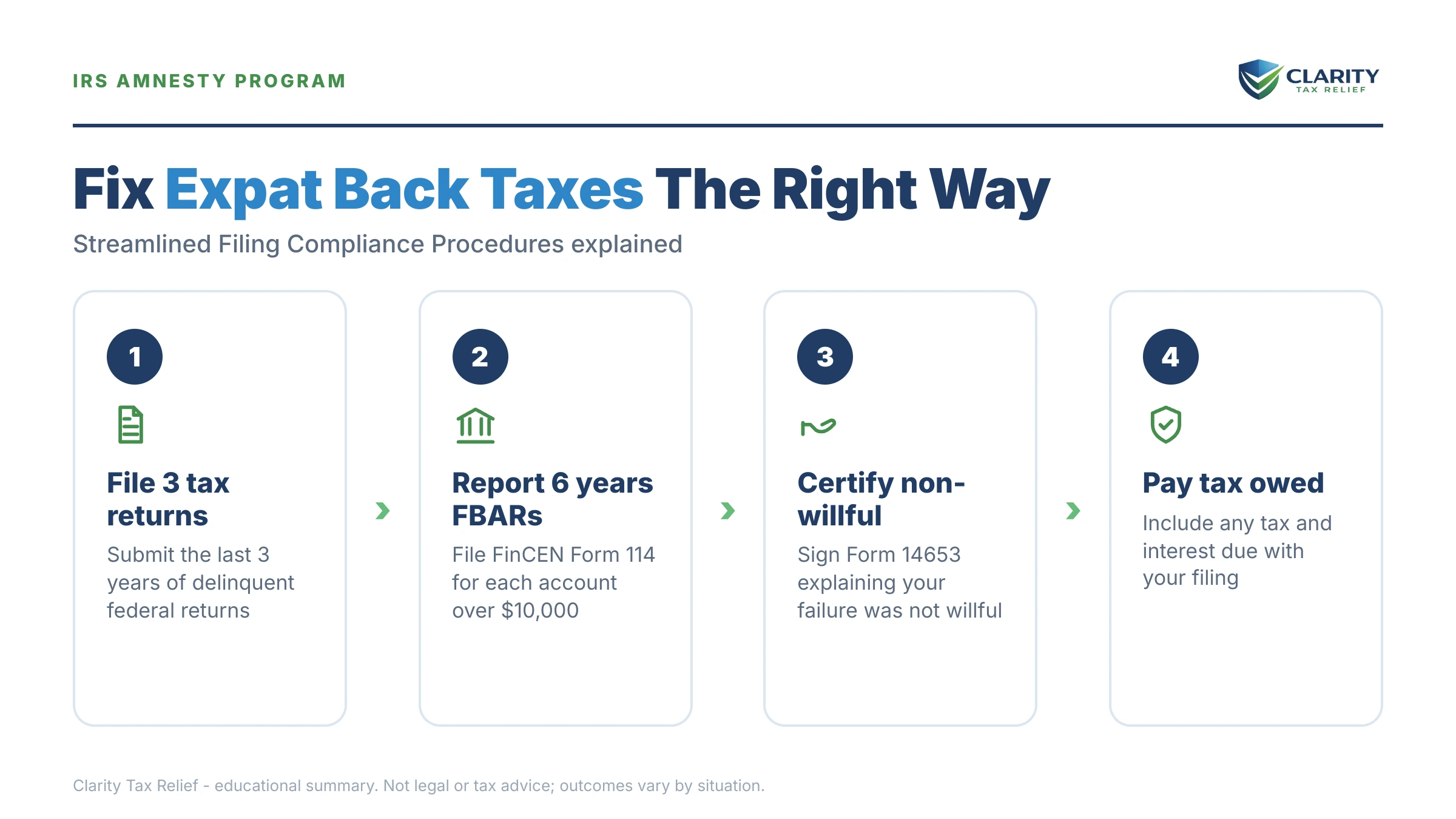
The short answer: expat back taxes rarely mean crushing penalties. Most US citizens abroad who are behind can catch up through the Streamlined Foreign Offshore Procedures: file your last 3 tax returns and 6 FBARs, certify the lapse was non-willful, and every late-filing, late-payment, and FBAR penalty is waived — you pay only tax owed plus interest.
Maybe your foreign bank sent a letter asking whether you're a "US person." Maybe another American at a dinner abroad mentioned that citizens have to file from anywhere on earth, and your stomach dropped. Either way, you've just discovered years of returns you never knew you owed — and the fix is far more forgiving than the panic suggests.
The heart of the catch-up package is a certification called Form 14653 — the document where you tell the IRS, under penalty of perjury, why you didn't file. The visual guide below maps the deadlines and options, so you know what you're working toward before you start.
⏱ The real clock: the streamlined program has no application deadline — but your eligibility ends the day the IRS opens an examination or investigation of any of your years. The IRS has also closed offshore amnesty programs before with limited notice (OVDP ended in 2018). Interest on any unpaid tax accrues the entire time you wait.
Why you're behind — and why you may owe far less than you fear
The United States is one of only two countries that taxes its citizens on worldwide income no matter where they live. Moving abroad never ended your Form 1040 obligation — it just moved your automatic filing deadline to June 15 (though interest on any balance still runs from April 15).
Most expats who stopped filing did so innocently: they assumed paying tax in France or Japan or Australia settled the matter. And for income tax, that assumption is nearly right. The Foreign Earned Income Exclusion (Form 2555) shields just over $130,000 of foreign wages or self-employment earnings per person per year — the figure adjusts annually — and the Foreign Tax Credit (Form 1116) offsets US tax dollar-for-dollar with foreign tax paid. Run the numbers and most salaried expats owe the IRS nothing for the missing years.
The exception is the reader this page is written for: the 1099 contractor or freelancer abroad. The exclusion wipes out income tax, but it does not touch the 15.3% self-employment tax that funds Social Security and Medicare. Unless you live in one of the roughly 30 countries with a US totalization agreement and pay into that country's system, SE tax follows you overseas — and unpaid SE tax is where most real expat back-tax balances come from. The same is true if you have US-source income the exclusion can't reach, like rent from a stateside property (see Airbnb host owes taxes if you've been renting out your US home while abroad).
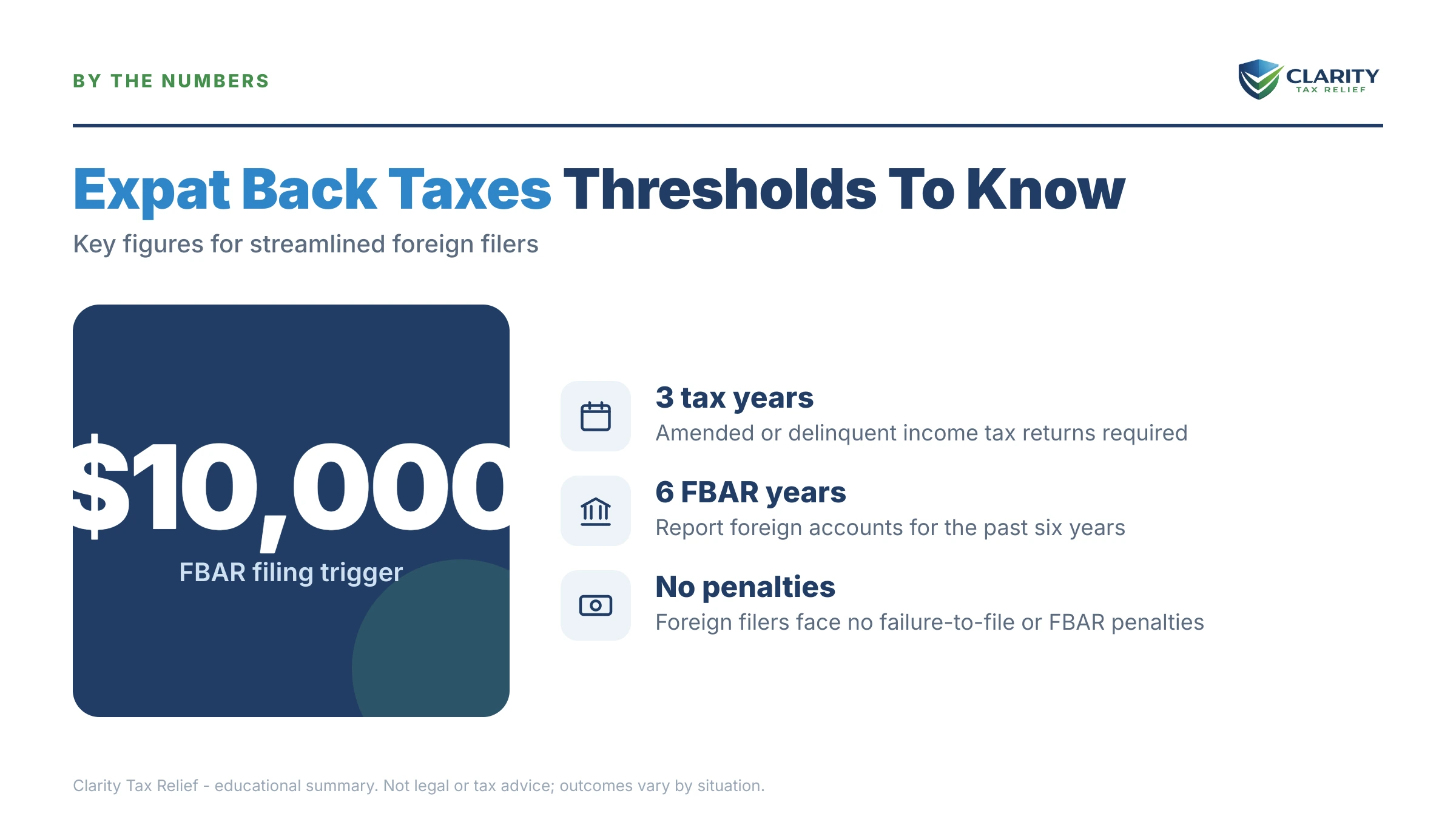
Separate from the tax returns is the reporting layer: the FBAR (FinCEN Form 114), required once your foreign accounts total more than $10,000 at any point in a year, plus FATCA's Form 8938 at higher thresholds. These forms carry their own penalties even when zero tax is due — which is exactly why the streamlined program's blanket penalty waiver matters so much.
What happens if you ignore expat back taxes
Unfiled years never close: the statute of limitations on assessment doesn't start running until a return is actually filed, so every skipped year stays open to the IRS forever. The sequence that follows silence usually looks like this:
- The FATCA match. Your foreign bank reports your account balances and identity to the IRS every year. When those reports show a US citizen with income-producing accounts and no returns on file, automated screening flags the mismatch — this is how most non-filing expats surface, not through detective work.
- Compliance letters. The IRS mails contact letters — often to a US address you left years ago. Letters about foreign-account compliance (like Letter 6291) are the warning shot that a human or algorithm has looked at your file.
- The streamlined door closes. The moment an examination or investigation opens, you are disqualified from the streamlined procedures. The zero-penalty path exists only for people who come forward first.
- Substitute-for-return assessment. The IRS can construct returns for you using the raw FATCA and 1099 data — with no Foreign Earned Income Exclusion, no Foreign Tax Credit, no business deductions. The resulting balance is often several times what you'd owe on properly prepared returns, and collection notices start against that inflated number.
- Collection reaches what it can touch. The IRS levies US bank accounts, US-source income, brokerage accounts, and federal payments, and files liens against US property. Under treaty, it can also ask Canada, France, Denmark, Sweden, and the Netherlands to collect on its behalf.
- Passport certification. Once the assessed debt passes $66,000 (the 2026 threshold) with a lien or levy in place, the IRS certifies it to the State Department, which can deny renewal of the one document an expat cannot live without. See passport revoked for tax debt for how certification works and reverses.
None of this happens overnight — and in 2026, with the IRS workforce down roughly 27%, human follow-up is slower than ever. But the FATCA matching, substitute returns, and passport certifications are automated. The machine doesn't need a staffed office to escalate your file.
Behind on US taxes while living abroad?
Get your situation reviewed free before the IRS reaches out first — streamlined eligibility ends the day an examination opens. An experienced tax professional will map your years, your FBAR exposure, and your cheapest path back to compliance. Confidential, no pressure.
Your catch-up options: which amnesty path fits your facts
The Streamlined Foreign Offshore Procedures waive every penalty — failure-to-file, failure-to-pay, accuracy, information-return, and FBAR — for expats whose non-filing was non-willful. But it's one of five distinct paths, and choosing the wrong one is expensive:
| Path | Who it fits | Penalty exposure | What you file |
|---|---|---|---|
| Streamlined Foreign Offshore Procedures (SFOP) | Non-willful, and in at least one of the last 3 years you had no US abode and spent 330+ full days abroad | Zero — all penalties waived; tax + interest only | 3 returns, 6 FBARs, Form 14653 |
| Streamlined Domestic Offshore (SDOP) | Non-willful, but you fail the non-residency test (US-based with foreign accounts) | 5% miscellaneous penalty on highest year-end foreign balances | 3 amended returns, 6 FBARs, Form 14654 |
| Delinquent FBAR submission procedures (removed by the IRS June 30, 2026) | Returns filed, all income reported — only the FBAR forms were missed | Penalties are not automatic when account income was reported and taxed, but there is no longer a guaranteed penalty-free program | Late FBARs e-filed through FinCEN with an explanation |
| Standard late filing | No foreign accounts over $10,000 — just unfiled returns | Normal failure-to-file / failure-to-pay penalties where tax is due; abatement possible | Generally the last 6 years of returns |
| IRS Voluntary Disclosure Practice | Conduct that was willful — deliberate hiding of income or accounts | Substantial civil penalties, but protection against criminal referral | Preclearance through IRS Criminal Investigation, then a managed disclosure |
Two eligibility points decide everything. First, non-willfulness: your failure must stem from negligence, mistake, or a good-faith misunderstanding — "I genuinely didn't know citizens abroad had to file" is the classic qualifying fact pattern. Second, the non-residency test: no US abode and at least 330 full days outside the US in one of the three delinquent years. Miss the residency test and you slide to SDOP with its 5% penalty; cross into willfulness and streamlined is the wrong (and dangerous) form to sign.
Form 14653 itself is short — but the statement of facts carries all the weight. It's a sworn narrative the IRS can hold against you later, which is why it deserves more care than any of the returns in the package.
One path that is not on the table: quietly mailing in the old returns and hoping nobody notices. A quiet disclosure forfeits the penalty protection you were entitled to for free and signals to any later examiner that you knew about the obligation.
The forms US citizens abroad actually have to file
An expat catch-up package is judged on completeness — a streamlined submission missing a required international form can unravel the whole penalty waiver. Here's the checklist most expats need to screen against:
| Form | Trigger | Exposure if missed |
|---|---|---|
| Form 1040 | Worldwide income above the standard filing threshold — residence abroad is irrelevant | Failure-to-file penalties where tax is due; year stays open forever if unfiled |
| FBAR (FinCEN Form 114) | Foreign accounts totaling over $10,000 at any point in the year, combined | Non-willful penalties starting around $10,000 per unfiled form — see didn't file FBAR penalty |
| Form 8938 (FATCA) | For expats: foreign financial assets over $200,000 at year-end ($400,000 married filing jointly) | $10,000 penalty per year — details at Form 8938 penalty |
| Form 5471 | Ownership in a foreign corporation — including a local company you formed to invoice clients | $10,000 per form, per year — see Form 5471 penalty |
| Form 3520 | Foreign gifts or inheritances over $100,000, or foreign trust involvement | Penalties that can reach 25% of the unreported amount |
The Form 5471 row trips up more expat freelancers than any other. If you incorporated locally — a UK limited company, a Hong Kong entity, an Estonian e-residency company — you likely owe this form for every year of ownership, and it changes both the cost and the strategy of your catch-up. That's a structural question worth settling before anything gets filed; if you instead run a US LLC from abroad, the exposure works differently — see LLC back taxes personal liability.
What catching up actually costs: a worked example
For a self-employed expat, the streamlined bill is mostly self-employment tax plus interest — and the program's penalty waiver is where the savings live. Say you're a 1099 web developer who moved to Thailand (no US totalization agreement) and hasn't filed in three years, netting $48,000 a year after expenses:
- Income tax: $0. The Foreign Earned Income Exclusion covers all $48,000 each year — elected on the late-filed Forms 2555 inside the streamlined package.
- Self-employment tax: about $6,782 per year. $48,000 × 92.35% = $44,328 of net earnings; × 15.3% = $6,782. Over three years: roughly $20,350.
- Interest: roughly $3,450 at the federal underpayment rate, compounding daily and weighted toward the oldest year.
- Total streamlined bill: about $23,800. Penalties waived: $0 in failure-to-file, failure-to-pay, or FBAR penalties.
Now the counterfactual. Outside the streamlined program, failure-to-file and failure-to-pay penalties can stack to 47.5% of the tax — nearly another $9,700 on this balance — before a single FBAR penalty (starting around $10,000 per unfiled form, and this contractor missed several) is even considered. And if the IRS built substitute returns first, the assessment would be computed with no exclusion and no expense deductions at all. You can estimate your own exposure with our IRS Penalty & Interest Calculator.
Every figure above is hypothetical, but the shape is typical: the tax itself is survivable; the penalties you avoid by choosing the right doorway are the difference between a manageable bill and a spiraling one.
If you still owe after filing: payment options by balance
A streamlined submission is supposed to include payment of the tax and interest — but a balance you can't pay in full doesn't disqualify you. The assessed debt simply moves into normal IRS collections, where the same programs available to any taxpayer apply (our how to settle tax debt yourself guide covers each in depth). What fits depends on the size of the balance:
| Balance after filing | Realistic options | Expat-specific watch-outs |
|---|---|---|
| Under $10,000 | 180-day full-pay plan ($0 setup), or a guaranteed installment agreement | IRS Direct Pay needs a US bank account — keep one open, or budget for international payment options |
| $10,000–$25,000 | Streamlined installment agreement set up online, up to 72 months | Use your IRS online account from abroad; mail-based setup to a foreign address is slow and unreliable |
| $25,000–$50,000 | Streamlined installment agreement — direct debit from a US account typically required above $25,000 | Interest and the 0.5%/month late-payment penalty keep accruing during the plan |
| $50,000–$66,000 | Non-streamlined agreement with financial disclosure (Form 433-F/433-A); hardship status or an Offer in Compromise where the numbers genuinely support one | You're approaching the $66,000 passport certification threshold — resolve before crossing it |
| Over $66,000 | Negotiated agreement with full financials; OIC or Currently Not Collectible in true hardship cases | Passport certification territory; a pending or active agreement is what blocks or reverses it |
On the $23,800 example above, a 72-month streamlined installment agreement runs roughly $330 a month, with interest continuing to accrue on the shrinking balance — setup fees range from about $22 (online, direct debit) to $178, waived or reimbursed for low-income taxpayers. An Offer in Compromise is possible for expats, but the IRS counts foreign assets and foreign income in its collection math, and it accepted only about 1 in 5 offers in FY2024 — it's a fit for genuine inability to pay, not a discount program. And if you're planning a move abroad with an existing IRS balance rather than discovering one overseas, that's a different playbook — see owe the IRS and moving abroad.
How to catch up on expat back taxes, step by step
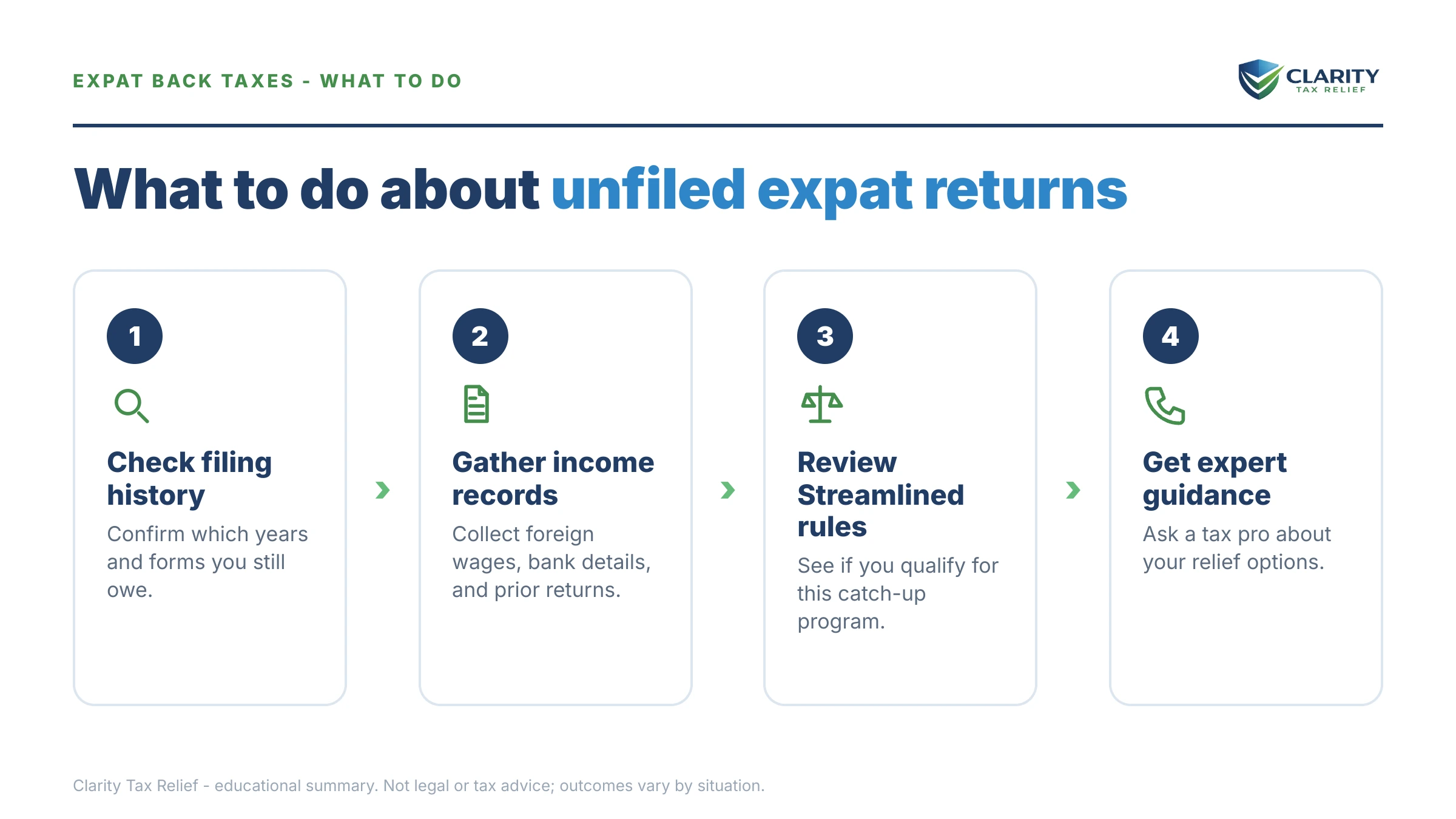
- Confirm you are eligible for the streamlined path — verify the IRS has not already opened an examination or investigation of any year, and that you meet the non-residency test: no US abode and at least 330 full days outside the US in one of the last three years.
- Gather three years of income records — foreign pay statements, 1099s, invoices, bank statements, and the year-end balance of every foreign account for the last six years.
- Prepare the last three delinquent returns — claim the Foreign Earned Income Exclusion or the Foreign Tax Credit on each, and attach every required international form (8938, 5471, 3520) so the package is complete.
- File six years of FBARs — submit FinCEN Form 114 electronically for each of the last six years, marked as filed under the streamlined procedures.
- Certify non-willfulness on Form 14653 — write and sign the statement of facts explaining why you didn't file; this narrative is the heart of the submission, so get it reviewed before you sign under penalty of perjury.
- Resolve any remaining balance — pay the tax and interest with the package if you can; if you can't, submit anyway and set up a payment plan once the balance is assessed, before interest compounds further.
When you can handle this yourself — and when help changes the outcome
Plenty of expats can complete a streamlined submission on their own. You're a good DIY candidate if all of these are true: your income was foreign wages from an employer, fully covered by the exclusion; your foreign accounts are ordinary bank accounts; you never formed a foreign company or received a large foreign gift; and your non-willfulness story is simple and true ("I never knew"). In that case the package is three straightforward returns, six online FBAR filings, and an honest narrative — our companion guide for an expat who hasn't filed US taxes walks the DIY route in detail.
Experienced help genuinely changes the outcome in five situations. Self-employment income — the totalization analysis, expense reconstruction, and SE-tax math determine whether you owe $0 or five figures. A foreign corporation or trust — Form 5471 and 3520 exposure can dwarf the tax itself and complicates the whole submission. Gray-zone willfulness — if you filed some years but not others, or moved money in ways that could be read badly, the 14653 narrative needs a professional's eye before you swear to it; the wrong words convert a zero-penalty case into a willful one. The IRS has already written to you — eligibility may be closing, and the response strategy changes. A balance near the $66,000 passport line — sequencing the filing and the payment arrangement correctly keeps your passport out of it.
If any of those five describe you, have an experienced tax professional pressure-test your plan before anything is signed — the free case review takes minutes, or call (888) 825-7779 from anywhere.
Terms on your streamlined paperwork, decoded
- Non-willful: conduct due to negligence, inadvertence, or a good-faith misunderstanding of the law — the standard you certify to on Form 14653.
- FBAR: the Report of Foreign Bank and Financial Accounts (FinCEN Form 114), filed with the Treasury's FinCEN — not the IRS — once foreign accounts exceed $10,000 combined.
- FEIE: the Foreign Earned Income Exclusion, which shields just over $130,000 of foreign earned income per person from US income tax — but never from self-employment tax.
- Totalization agreement: a social security treaty (about 30 countries have one with the US) that can exempt a self-employed expat from US SE tax if they pay into the local system.
- SFR (substitute for return): a return the IRS constructs for a non-filer from third-party data — with no exclusions, credits, or deductions.
- Certification (§7345): the IRS's referral of a seriously delinquent debt ($66,000+ in 2026) to the State Department, enabling passport denial or revocation.
Expat back taxes: your questions, answered
Do US citizens living abroad have to file US taxes?
Yes. The US taxes citizens and green card holders on worldwide income no matter where they live, so the filing requirement follows you abroad. Filing rarely means paying: the Foreign Earned Income Exclusion (just over $130,000 in recent years) and the Foreign Tax Credit erase most or all US income tax for most expats. Self-employment income is the big exception — the exclusion does not touch the 15.3% self-employment tax.
How many years of back taxes do I have to file as an expat?
Under the Streamlined Foreign Offshore Procedures, exactly three years of tax returns and six years of FBARs. Outside the streamlined program, the IRS generally asks non-filers for the last six years of returns. Because the statute of limitations never starts running on a return you never filed, catching up is the only way to close those years for good.
What penalties do expats face for not filing US taxes?
If you qualify for the streamlined program, none — the failure-to-file, failure-to-pay, accuracy, information-return, and FBAR penalties are all waived, and you pay only tax plus interest. Outside the program, exposure is real: failure-to-file penalties of 5% per month up to 25% of tax due, non-willful FBAR penalties starting around $10,000 per unfiled form, and $10,000-per-year penalties for missed international forms like the 5471.
Do I qualify for the Streamlined Foreign Offshore Procedures?
You may qualify if your failure to file was non-willful and you meet the non-residency test: in at least one of the last three years, you had no US abode and spent at least 330 full days outside the United States. You are disqualified the moment the IRS opens an examination or investigation of any of your years, which is why timing matters more than anything else.
Can the IRS collect back taxes from me if I live overseas?
Yes — more easily than most expats assume. The IRS can levy US bank accounts, US-source income, and federal payments; certify your debt to the State Department once it passes $66,000 (the 2026 passport threshold); and request collection help from tax authorities in Canada, France, Denmark, Sweden, and the Netherlands under treaty. Distance delays collection; it does not prevent it.
Do expats owe self-employment tax on freelance income earned abroad?
Usually yes. The Foreign Earned Income Exclusion removes income tax but not the 15.3% self-employment tax, so a 1099 contractor abroad owes SE tax on net profit just as they would stateside. The exception is a totalization agreement: if you live in one of the roughly 30 countries with a US social security agreement and pay into that country's system, a certificate of coverage can exempt you from US SE tax.
Will the IRS take my passport over back taxes?
It can once your debt is 'seriously delinquent' — $66,000 or more in 2026, with a lien filed or levy issued. The IRS certifies the debt to the State Department, which can deny your passport renewal or application; for an expat, that can mean being unable to renew the one document you live on. Entering a payment plan or an accepted offer reverses the certification.
Can I just start filing from this year forward and ignore the old years?
That approach — a quiet restart — leaves every unfiled year permanently open to audit and assessment, because the statute of limitations never begins on a return that was never filed. It also looks worse if the IRS later examines you, since it shows you knew about the obligation. The streamlined program exists precisely so you can close old years cheaply; use it while you still can.
Can I renounce US citizenship to escape back taxes?
No. Renouncing requires certifying five years of tax compliance on Form 8854, so you have to catch up before you can expatriate cleanly. Renouncing without certifying compliance can make you a 'covered expatriate,' triggering an exit tax and punitive rules on future gifts to US persons — and the old debt survives renunciation anyway.
Your next 24 hours
- Check whether the IRS has reached you first. Log into (or create) your IRS online account and look for filed returns, balances, or notices on any year — and dig out any "US person" letter your foreign bank sent. If no exam is open, the zero-penalty door is still open too.
- Gather the raw material. Income records for the last three years and the year-end balance of every foreign account for the last six — that's the entire evidence base a streamlined package is built from.
- Get a free case review. Send us your situation through the 2-minute form or call (888) 825-7779 — an experienced tax professional will confirm which catch-up path you fit and what your years will actually cost, before interest adds another month and before an IRS letter takes the streamlined option off the table.
Primary sources: the IRS's official pages on the Streamlined Filing Compliance Procedures and IRS payment options, and the Treasury's Financial Crimes Enforcement Network (FinCEN) for FBAR filing.
This guide is general information, not tax or legal advice for your specific situation. Eligibility for IRS programs depends on individual facts and circumstances; no outcome is guaranteed.