
IRS Penalties
Form 5471 Penalty: The $10,000-Per-Year Fine and How to Fight It (2026)
The short answer: the Form 5471 penalty is $10,000 per form, per year under IRC §6038(b) — assessed automatically, even if the foreign corporation made no money. Ignore the IRS's notice for 90 days and continuation penalties add $10,000 per 30 days, up to $60,000 total per form. Reasonable cause can remove it.
The Form 5471 penalty is different from almost every other penalty the IRS charges: it's a flat fine for a missing information form, not a percentage of tax you owe. You can owe zero U.S. tax on your foreign company and still be billed $10,000 — many people first learn the form exists when the bill arrives. You probably late-filed a return with Forms 5471 attached, or a preparer just told you the forms were never filed at all, and now you're staring at a five-figure number for paperwork.
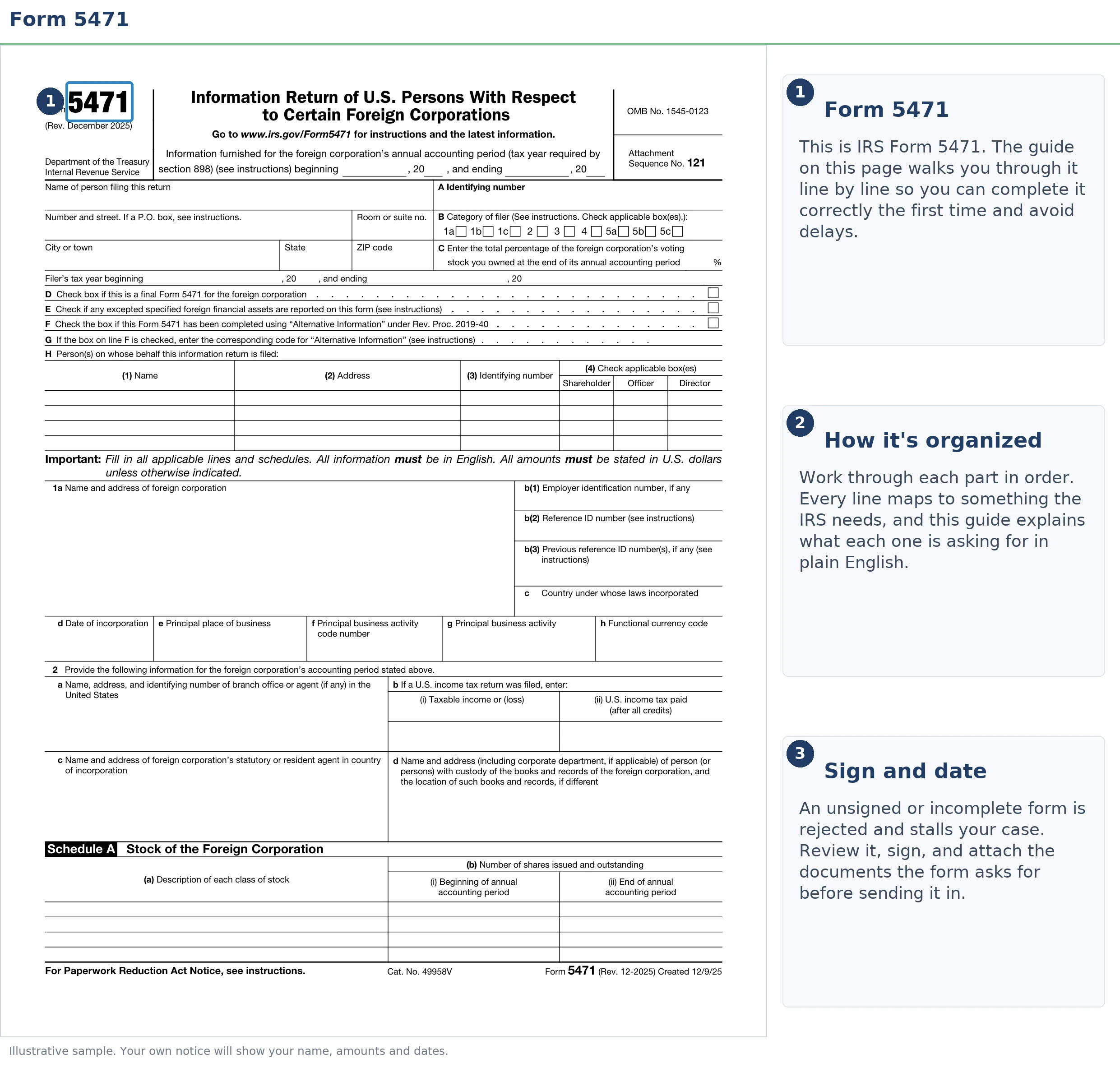
Here's the part that matters: this penalty is assessed by a computer, and it's one of the most frequently abated penalties in the international space when you push back correctly. The image below shows you exactly what the IRS's penalty notice looks like and where to find the amount, the tax year, and the date that starts your clock.
⏱ Your clock: if the IRS has mailed you a notice about the missing form, you have 90 days from the date on that notice before continuation penalties start stacking — $10,000 for each 30-day period the form stays unfiled, up to $50,000 more per form. If no notice has arrived yet, the clock hasn't started — which makes right now the cheapest moment to fix this.
Why you got a Form 5471 penalty
Form 5471 is required from U.S. persons who own, control, or hold officer roles in certain foreign corporations — and the penalty for skipping it applies whether or not any tax was due. The form attaches to your income tax return, and the filing duty is triggered by ownership, not profit. The most common filers:
- U.S. shareholders owning 10% or more of a foreign corporation, especially a controlled foreign corporation (CFC) — a foreign company more than 50% owned by U.S. shareholders.
- Anyone who acquired or disposed of a 10% stake in a foreign corporation during the year.
- Officers and directors of foreign corporations in which a U.S. person made a qualifying acquisition.
- Self-employed people and small-business owners who formed a foreign entity — a UK Ltd, a Hong Kong company, an Estonian OÜ — to bill overseas clients, hold IP, or run an e-commerce operation. This group gets hit hardest, because nobody told them a one-person foreign company triggers a U.S. filing.
The assessment itself is usually systemic. Late-file a return with Forms 5471 attached, and IRS computers assess $10,000 per form before any human reviews your facts. The bill arrives as a civil penalty notice — CP15 for individuals, or a CP215 notice for businesses. The same automated machine issues Form 3520 penalty and Form 8938 penalty assessments — if you missed one international form, check whether you missed the others, because they stack.
How much is the Form 5471 penalty in 2026?
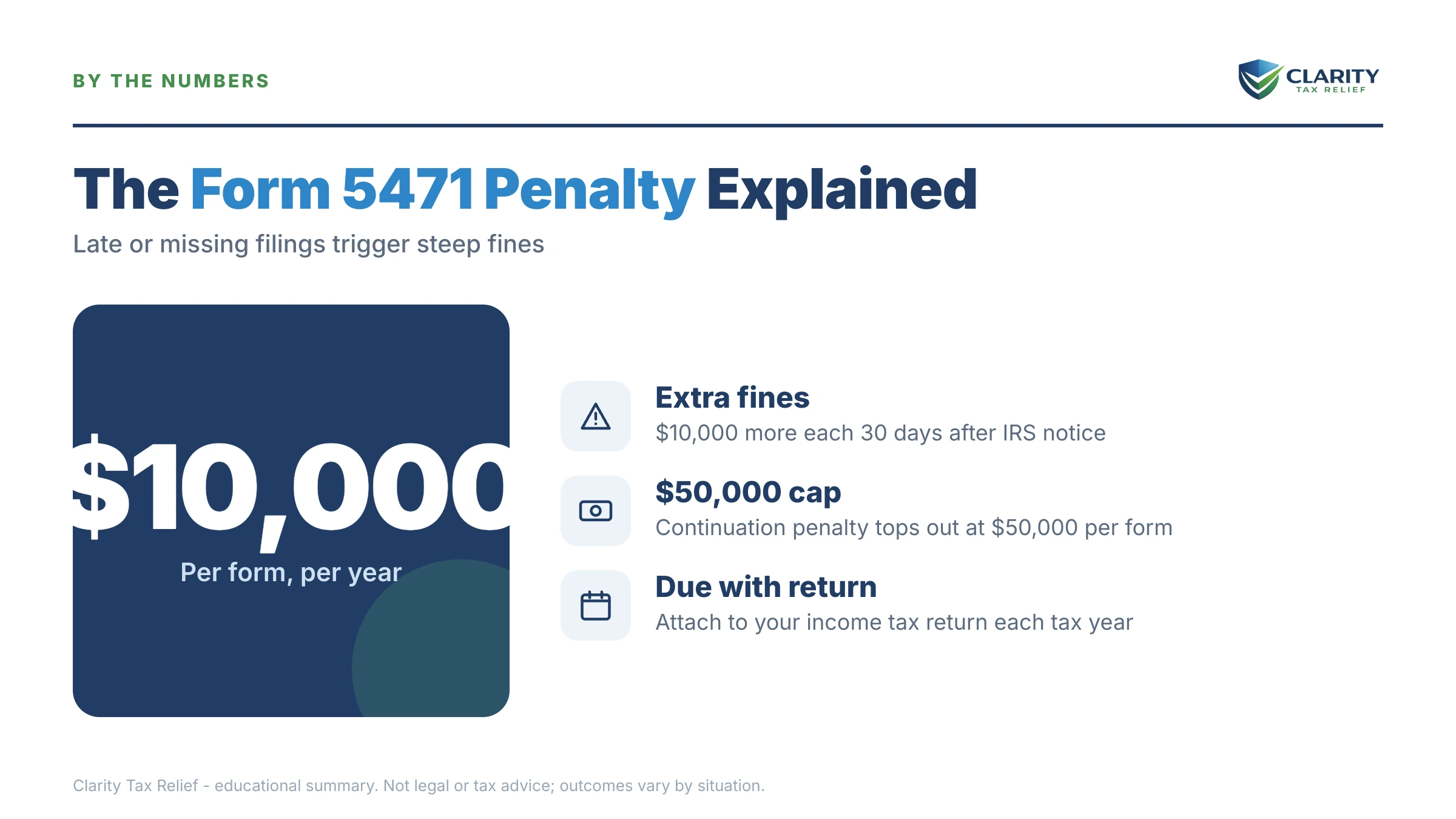
A single missed Form 5471 costs $10,000 — and an ignored one can cost $60,000 per form, per year, plus a cut to your foreign tax credits. The penalty has layers, and each layer has its own trigger:
| Penalty layer | Amount | When it applies |
|---|---|---|
| Initial penalty — IRC §6038(b)(1) | $10,000 per form, per year | Form filed late, substantially incomplete, or not at all |
| Continuation penalty — IRC §6038(b)(2) | $10,000 per 30-day period | Starts 90 days after the IRS mails notice of the failure |
| Continuation cap | $50,000 additional per form | Reached after five unanswered 30-day periods |
| Maximum dollar penalty | $60,000 per form, per year | Initial penalty plus fully stacked continuation |
| Foreign tax credit reduction — IRC §6038(c) | 10% of foreign taxes, more if failure continues | Can apply on top of the dollar penalties |
| Open assessment statute — IRC §6501(c)(8) | No dollar amount — unlimited time | Your entire return stays open to IRS adjustment until the form is filed |
Three multipliers make this worse than it first looks. The penalty is per form, so two foreign corporations means two $10,000 penalties per year. It's per year, so three unfiled years for one company is $30,000 before any continuation penalty. And a form that's filed but substantially incomplete — missing required schedules, missing ownership data — draws the same penalty as no form at all.
A missed Form 5471 also usually means missed income calculations — Subpart F or GILTI inclusions that never made it onto your return. If the IRS adjusts those, the 20% accuracy related penalty can attach to the extra tax, separate from everything in the table above.
A worked example: $13,600 in tax debt next to a $60,000 form
Say you're a self-employed consultant — a sole proprietor on Schedule C — who already owes the IRS $13,600 from an underpaid year. In 2023 you formed a foreign limited company to bill your overseas clients, and no one mentioned Form 5471. You've now missed it for 2023 and 2024. Here's the arithmetic:
- Initial exposure: 2 years × $10,000 = $20,000 — already bigger than your entire $13,600 tax debt, on a company that may have owed no U.S. tax at all.
- If the IRS mails a notice and you sit on it for eight months: the first 90 days are a grace period, then roughly five 30-day periods elapse — 5 × $10,000 = $50,000 per form, hitting the cap. Two forms means $100,000 in continuation penalties on top of the $20,000.
- Total worst case: $120,000 in Form 5471 penalties sitting next to a $13,600 tax balance. The paperwork fine is nearly nine times the actual tax debt.
- If you act before a notice arrives: a delinquent filing with a solid reasonable cause statement can hold the exposure at $0 — or get a systemic $20,000 assessment abated after the fact.
Meanwhile, your underlying $13,600 balance keeps growing its own failure-to-pay penalty and interest each month — you can estimate that side of the problem with our Penalty & Interest Calculator. But notice the asymmetry: the 5471 penalty is flat and event-driven, so acting before the continuation clock starts is worth far more than acting fast on the ordinary balance.
What happens if you ignore the penalty notice
An unpaid Form 5471 penalty is collected exactly like unpaid tax — with liens, levies, and garnishment at the end of the sequence. Here's the order of escalation:
- Systemic assessment. The IRS computer assesses $10,000 per late or missing form and mails a CP15 or CP215 civil penalty notice. No human has weighed your facts yet.
- The continuation clock starts. Once the IRS has notified you of the failure, 90 days later the continuation penalty begins: $10,000 per 30-day period, per form, up to $50,000 more per form.
- The balance enters the collection stream. The penalty rides the same rails as any tax debt — a CP504 (which lets the IRS take your state refund), then a final notice of intent to levy with a 30-day window to request a Collection Due Process hearing, then bank levies, wage levies, and a federal tax lien.
- Your foreign tax credits shrink. Under §6038(c), continued failure can cut the foreign tax credits you'd otherwise use to offset U.S. tax on the same income.
- Your return never closes. Under §6501(c)(8), the assessment statute on your entire return stays open until the form is filed, unless you can show the late filing was due to reasonable cause and not willful neglect, in which case the extended statute applies only to the items related to the missing Form 5471, not your entire return. A missing 2020 form means the IRS can still adjust anything on your 2020 return in 2026, 2030, or beyond.
One more 2026 reality: IRS staffing is down sharply, so getting a human to review your reasonable cause statement takes longer than it used to — but the assessments, continuation penalties, and collection notices are automated and never paused. The machine escalates on schedule whether or not anyone answers the phone.
Holding a Form 5471 penalty notice right now?
If the IRS has already notified you, the 90-day continuation clock is running — every 30 days after it expires adds $10,000 per form. Send us the notice and an experienced tax professional will map your abatement or disclosure options — free, confidential, no pressure.
How to remove a Form 5471 penalty: every option, with costs
Reasonable cause is the primary defense to a Form 5471 penalty, and the right path depends on one question: has the IRS contacted you yet? (For how these penalties compare to the IRS's ordinary failure-to-file and failure-to-pay penalties, see our guide to how much IRS penalties on back taxes really cost — this page covers only what's unique to §6038.)
| Option | Out-of-pocket cost | Who it fits | Typical timeline |
|---|---|---|---|
| Reasonable cause abatement | $0 IRS fee (professional fees if represented) | Penalty already assessed; you relied on a preparer who never asked about foreign entities, faced serious illness, or genuinely couldn't have known | Several months; longer if it goes to Appeals |
| First-Time Abate / AEP | $0 | Systemic assessment with a clean prior 3 years — applied inconsistently to international penalties | Weeks to a few months |
| Delinquent international information return procedures | $0 IRS fee | Not yet contacted by the IRS; little or no unreported tax; non-willful conduct | File with a reasonable cause statement attached; fight any penalty that's assessed anyway |
| Streamlined Foreign Offshore Procedures | $0 offshore penalty; pay tax + interest on 3 amended years | Non-willful filers who meet the foreign-residency test | Months; varies with IRS processing |
| Streamlined Domestic Offshore Procedures | 5% miscellaneous offshore penalty on certain foreign assets, plus tax + interest | Non-willful U.S. residents with unreported foreign income | Months; varies with IRS processing |
| Voluntary Disclosure Practice | Substantial — negotiated civil penalties | Willful conduct with potential criminal exposure | A year or more |
| Appeals or refund claim (Form 843) | $0 IRS fee | Abatement denied, or penalty already paid | Many months |
The dividing lines, in plain English:
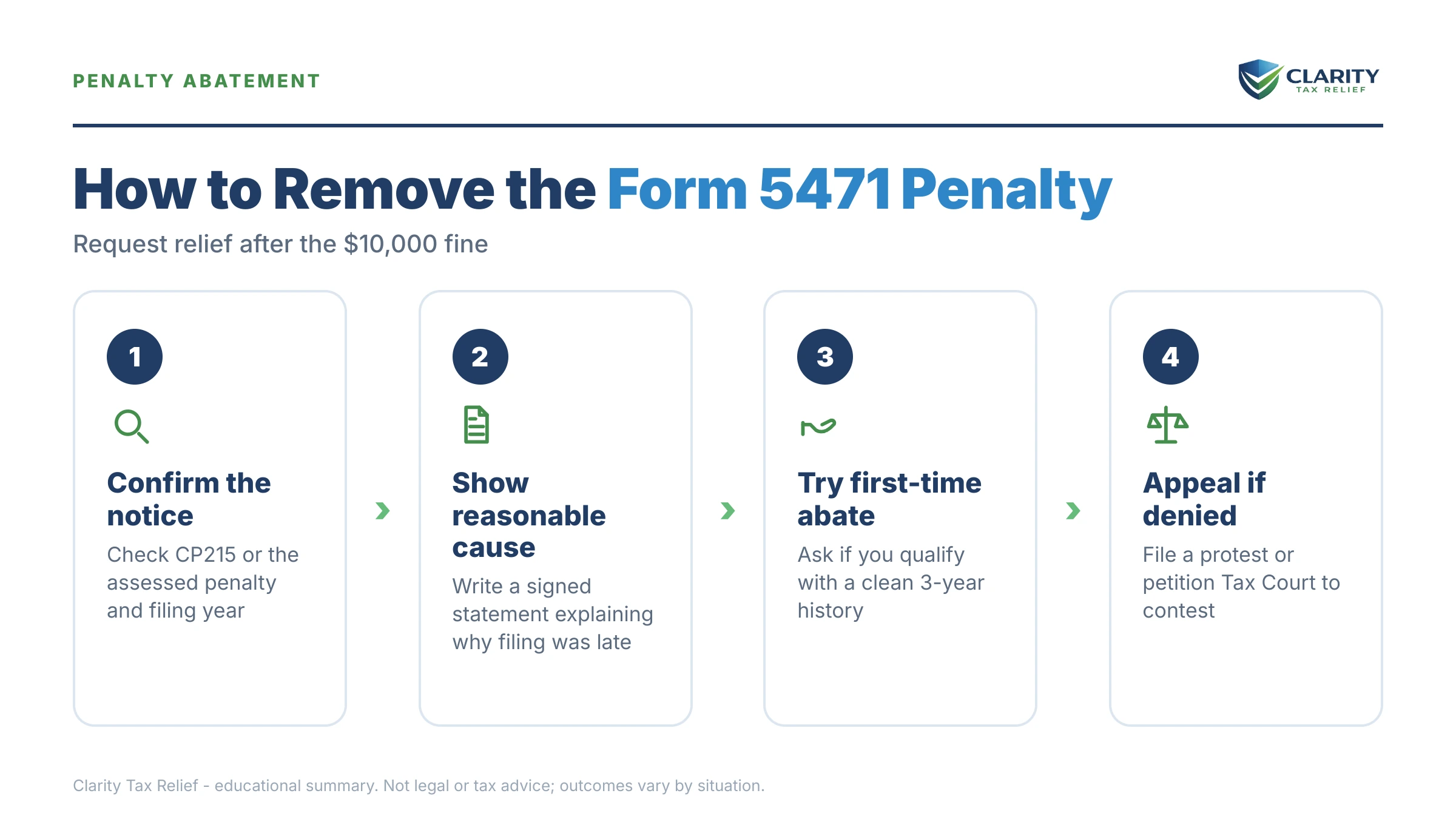
- Penalty already assessed? Request reasonable cause penalty abatement in writing. The strongest 5471 arguments: you hired a competent preparer, gave them complete facts, and they never raised the foreign filing; you had no reason to know the requirement existed; or events outside your control (serious illness, disaster) made compliance impossible. Vague "I didn't know" claims lose; documented reliance on a professional wins regularly. If it's denied, a penalty abatement appeal puts a human at the IRS Independent Office of Appeals on your file — often the first human to read it.
- Not contacted yet, and no meaningful unreported tax? The delinquent international information return procedures let you file the late forms with a reasonable cause statement attached — your defense is on record before the computer can assess. Whatever you do, avoid a quiet disclosure: filing old forms silently, with no statement, hands the IRS an easy assessment and you an uphill abatement fight.
- Unreported foreign income across multiple years, non-willful? The streamlined offshore procedures (for those meeting the foreign-residency test) or the streamlined domestic offshore program (for U.S. residents) wrap the 5471s, the amended returns, and the penalty exposure into one certified non-willful package.
- Willful? If you knew about the requirement and chose not to comply, the IRS voluntary disclosure practice is the path that manages criminal exposure. Do not attempt streamlined certification with willful facts — that certification is signed under penalty of perjury.
- First-Time Abate? It sometimes clears a systemically assessed 5471 penalty when your prior three years are clean, but the IRS applies it unevenly to international penalties. Starting summer 2026, FTA is being replaced by the automatic exemption from penalty AEP 2026 framework — worth checking, but for Form 5471, reasonable cause remains the workhorse.
How to respond to a Form 5471 penalty, step by step
- Confirm your filing category and the missing years — Form 5471 has five filer categories based on ownership and control; list every foreign corporation and every year a form was due.
- Pull your IRS account transcripts — see whether penalties have already been assessed, for which years, and whether a notice has started the 90-day continuation clock.
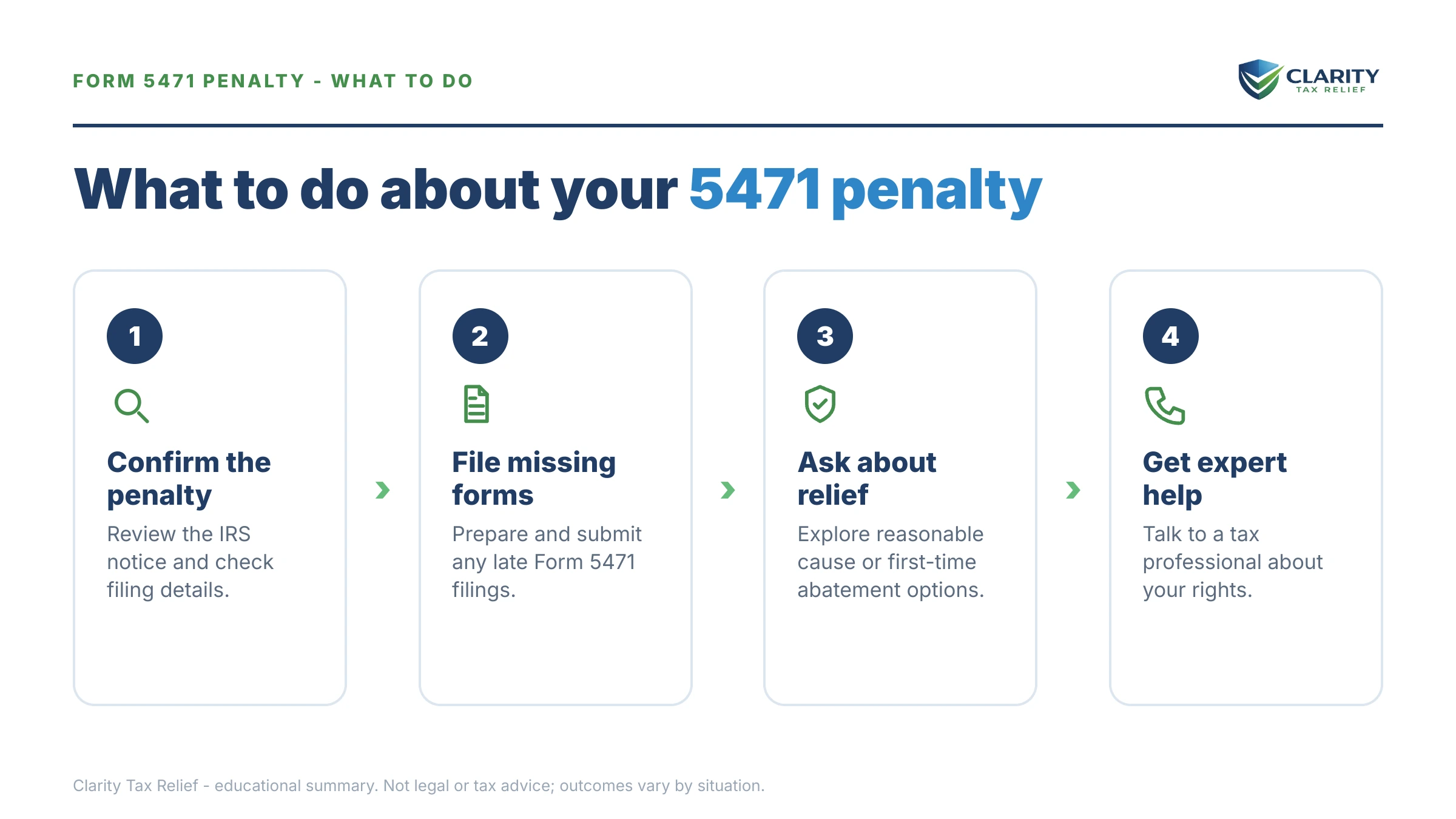
- Choose your path before you file anything — reasonable cause abatement if assessed, delinquent submission procedures or streamlined procedures if the IRS hasn't contacted you, Voluntary Disclosure Practice if the conduct was willful.
- File complete forms with a reasonable cause statement — a substantially incomplete Form 5471 draws the same $10,000 penalty as no form, so include every required schedule and attach your facts in writing.
- Respond to every notice and appeal a denial — a rejected abatement can go to the IRS Independent Office of Appeals, and a paid penalty can be pursued as a refund claim on Form 843.
When you can handle this yourself — and when help changes the outcome
Not every Form 5471 penalty needs professional representation. You can reasonably go it alone when:
- One year, one form, clear facts. A single systemic $10,000 assessment, a documented history of giving your preparer complete information, and a clean compliance record — a well-written reasonable cause letter is something a careful person can produce.
- The form was actually filed. If the penalty is simply wrong — the form was attached and complete — respond with proof and your transcript.
Experienced help genuinely changes outcomes when:
- Multiple years or multiple entities are unfiled — sequencing matters, because the wrong first filing can lock you out of the streamlined programs.
- There's unreported foreign income underneath — GILTI and Subpart F math on the amended returns drives both the tax and the accuracy-related exposure, and it is genuinely hard.
- The willfulness question isn't obviously clean — the non-willful certification is signed under penalty of perjury, and getting that call wrong converts a paperwork problem into a criminal one.
- The continuation clock is running or collection has started — deadlines, appeals rights, and abatement requests have to move in parallel.
If cost is the barrier, the Taxpayer Advocate Service can intervene when IRS delays or systemic errors are causing you harm — though it can't argue reasonable cause for you.
Terms on your notice, decoded
- CFC (controlled foreign corporation): a foreign corporation more than 50% owned by U.S. shareholders — the ownership pattern that triggers most Form 5471 filings.
- Category filer: which of the five filer categories you fall into — it determines which schedules your Form 5471 must include, and a form missing required schedules counts as unfiled.
- Continuation penalty: the extra $10,000 charged for each 30-day period the form remains unfiled after 90 days from the IRS's notice, capped at $50,000 per form.
- Reasonable cause: the legal standard for removing the penalty — you exercised ordinary business care and prudence and still couldn't comply.
- §6501(c)(8): the rule that keeps your entire tax return open to IRS assessment, with no time limit, until the missing international form is filed.
- DIIRSP: the Delinquent International Information Return Submission Procedures — the IRS's channel for filing late forms with a reasonable cause statement before you've been contacted.
The official form, instructions, and schedules live on the IRS's page About Form 5471.
Form 5471 penalty FAQs
How much is the penalty for not filing Form 5471?
The penalty is $10,000 per form, per year, under IRC §6038(b) — even if the foreign corporation made no money and you owe no tax on it. If the IRS notifies you of the failure and you don't file within 90 days, continuation penalties add $10,000 for each 30-day period, capped at $50,000 more. That's a maximum of $60,000 per form, per year, and the IRS can also cut your foreign tax credits by 10%.
Can a Form 5471 penalty be removed?
Yes — reasonable cause is the main path, and these penalties are abated more often than most people expect. You must show you exercised ordinary business care and still couldn't comply: reliance on a qualified preparer who never asked about foreign entities is the most common winning fact. A denial can be appealed to the IRS Independent Office of Appeals, and a paid penalty can be pursued as a refund claim.
Does first-time penalty abatement apply to Form 5471 penalties?
Sometimes, but don't count on it. The IRS applies First-Time Abate inconsistently to international information return penalties — it's most likely to work when the penalty was assessed automatically with a late-filed return and your prior three years are clean. Reasonable cause is the stronger argument for Form 5471. Note that FTA is being replaced by the Automatic Exemption from Penalty (AEP) starting in summer 2026.
Is there a statute of limitations on Form 5471 penalties?
Effectively no — until you file the form. Under IRC §6501(c)(8), the assessment statute on your entire tax return stays open until Form 5471 is filed, then runs for three years, unless you can show the late filing was due to reasonable cause and not willful neglect, in which case the extended statute applies only to the items related to the missing Form 5471, not your entire return. That means a missing 2019 form can keep your whole 2019 return open to IRS adjustment in 2026 and beyond. Filing the delinquent form is what starts the clock.
Do I have to file Form 5471 if my foreign company lost money or was dormant?
Usually yes. Form 5471 is an information return — the filing requirement is based on your ownership or control, not on profit, distributions, or U.S. tax due. A dormant foreign corporation may qualify for a simplified summary filing under Rev. Proc. 92-70, but you still file something. The $10,000 penalty applies to a missing form even when the corporation produced zero taxable income.
What notice does the IRS send for a Form 5471 penalty?
Most people learn about the penalty from a civil penalty notice — CP15 for individuals or CP215 for businesses — showing a $10,000 assessment per missing form. It arrives by mail, often weeks after you late-file a return with Forms 5471 attached, because the assessment is systemic. If unpaid, the balance then moves into the normal collection stream: CP504, a final intent-to-levy notice, and potential lien filings.
Can the IRS assess the Form 5471 penalty without a court order?
As of 2026, yes. The Tax Court held in Farhy v. Commissioner (2023) that the IRS lacked authority to assess §6038(b) penalties on its own, but a federal appeals court reversed that decision in 2024. The IRS never stopped assessing during the dispute, and it currently assesses and collects Form 5471 penalties like any other tax. Preserving a Farhy-style argument may still matter in some cases — raise it with an experienced tax professional, not on your own.
Should I just quietly file my old Forms 5471 now?
File them — but not silently. A quiet disclosure with no reasonable cause statement invites automatic $10,000 assessments on each late form with no defense already on record. The delinquent international information return procedures let you attach a reasonable cause statement up front, and the streamlined offshore procedures can resolve non-willful multi-year failures more cheaply. Choose the route before you file, because filing first closes some doors.
Your next 24 hours
- Find the notice date, the penalty amount, and the form count on your CP15 or CP215 — the notice date is what starts the 90-day continuation clock, and the form count tells you whether the IRS caught every year and entity or only some.
- Gather the paper trail: the notice, your last filed returns, your foreign company's formation documents and ownership percentages, and every email showing what you told your preparer — that correspondence is the backbone of a reasonable cause case.
- Get a free case review — before the 90-day window closes and $10,000-per-30-day continuation penalties begin, an experienced tax professional can tell you whether abatement, delinquent submission, or a streamlined filing fits your facts. Use the 2-minute form at claritytaxrelief.com/#consult or call (888) 825-7779.
This guide is general information, not tax or legal advice for your specific situation. Eligibility for IRS programs depends on individual facts and circumstances; no outcome is guaranteed.