
IRS Penalties
Form 3520 Penalty: The Foreign Gift & Trust Reporting Penalty, Explained (2026)
The short answer: the Form 3520 penalty for an unreported foreign gift is 5% of the gift per month late, capped at 25% — even though the gift itself is usually tax-free. Foreign trust failures run the greater of $10,000 or 35% of the amount. Reasonable cause, not first-time abatement, is how these penalties get removed.
Money came from family overseas — a down payment, an inheritance, help through a lean 1099 year — and nobody told you the IRS wanted a form about it. Now you've either just learned Form 3520 exists, or a CP15 notice has arrived charging a five-figure penalty on money you never owed a dime of tax on. That's the cruel design of this penalty: it punishes the missing paperwork, not the money. It is also one of the most abatable penalties the IRS charges, if you respond the right way.
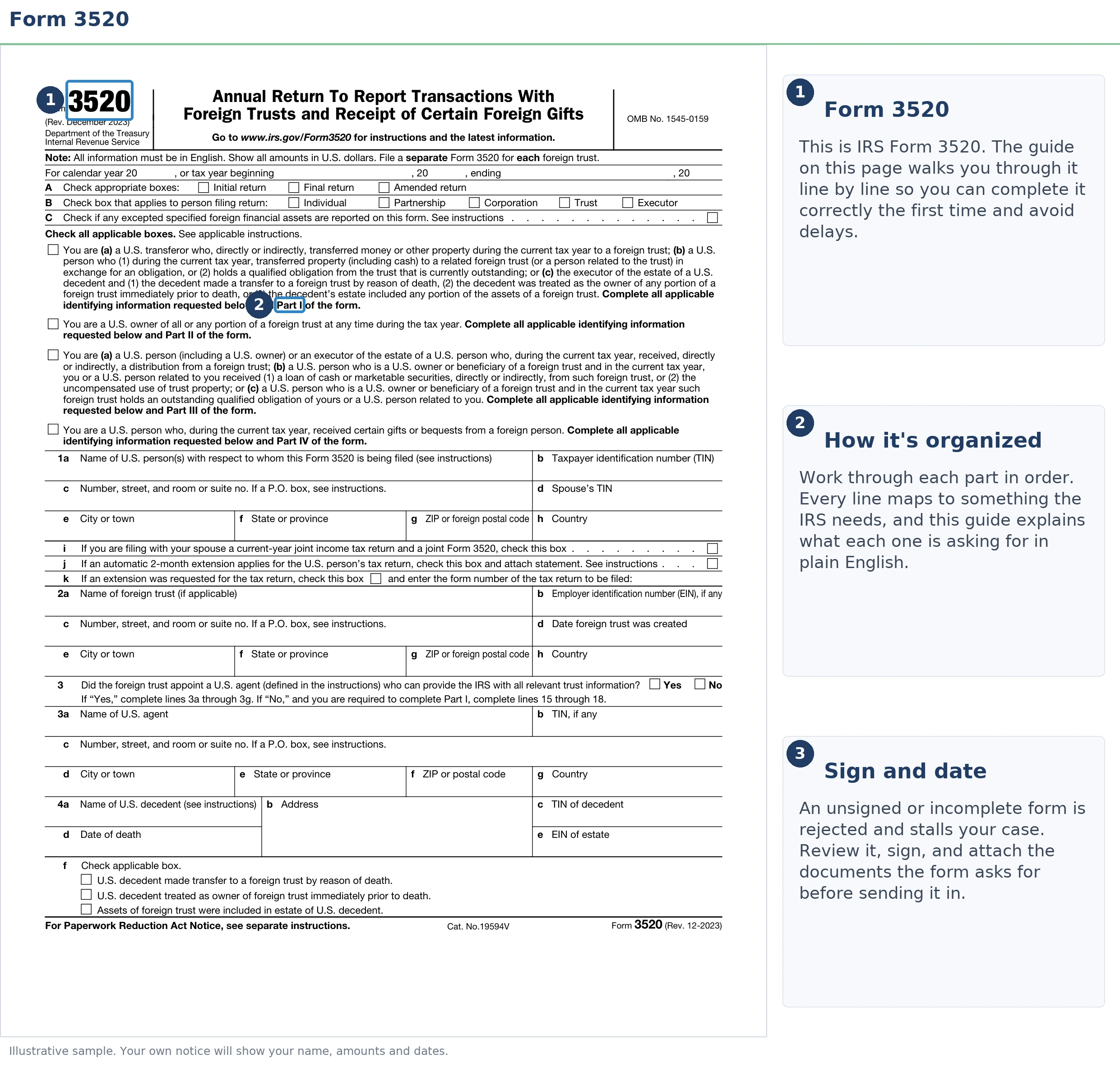
Form 3520 doesn't look like anything else in your tax file — it's an information return, filed on paper separately from your 1040. The image below shows you exactly what the form looks like and which parts of it decide whether, and how hard, the penalty hits.
⏱ Your clock: if a CP15 Notice of Penalty Charge has arrived, you typically have 30 days from the notice date to protest in writing — the exact response date is printed on the notice, and that date controls. If no notice has arrived yet, the clock is the penalty itself: for an unreported gift, another 5% accrues each month the form stays unfiled, until it caps at 25%.
Why the IRS charges a Form 3520 penalty
You must file Form 3520 when you receive more than $100,000 in gifts or bequests from a foreign individual or estate in a single year — or have almost any dealing with a foreign trust. The form reports the money; it does not tax it. Foreign gifts are generally not income to you at all, which is exactly why so many people miss the requirement: no tax due looks like nothing to file.
Three details catch people who thought they were under the line. First, gifts from related foreign persons are aggregated — $60,000 from your mother plus $50,000 from your father in the same year is one $110,000 reportable total. Second, gifts from foreign corporations or partnerships have a far lower threshold, roughly $20,000 (inflation-adjusted — check the current Form 3520 instructions for the exact figure). Third, foreign trusts have no threshold: any distribution you receive, any transfer you make, and any year you're treated as an owner is reportable, and owners also need the trust to file Form 3520-A.
The due date is the same as your income tax return, including extensions — but the form is mailed separately, not attached to your 1040. Plenty of people who filed their taxes perfectly on time still owe this penalty because the separate envelope never went out.
| Situation | You must file if | Penalty for not filing |
|---|---|---|
| Gift or bequest from a foreign individual or estate | Total exceeds $100,000 for the year (related givers combined) | 5% of the gift per month late, up to 25% (IRC §6039F) |
| Gift from a foreign corporation or partnership | Total exceeds roughly $20,000 (inflation-adjusted) | Same 5% per month, up to 25% |
| Distribution from a foreign trust | Any amount — no threshold | Greater of $10,000 or 35% of the distribution (IRC §6677) |
| Transfer to, or ownership of, a foreign trust | Any transfer; owners must also ensure Form 3520-A is filed | Greater of $10,000 or 35% of the transfer; owner's 3520-A failure runs the greater of $10,000 or 5% of the trust's assets |
How the Form 3520 late filing penalty is calculated
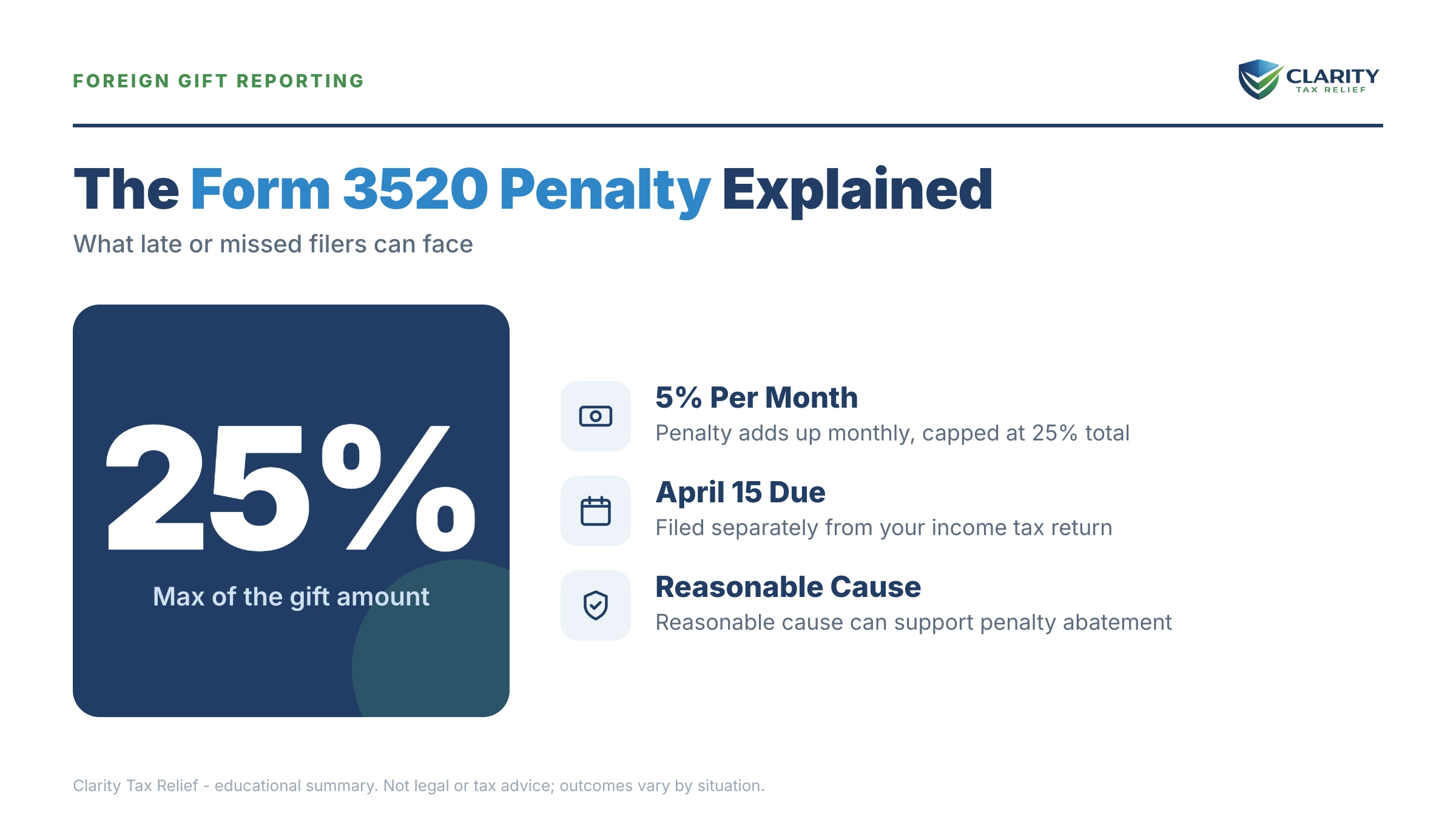
The Form 3520 late-filing penalty for a foreign gift is 5% of the gift's value for each month the form is late, capped at 25%. It reaches its maximum in just five months, then stops growing — but once the IRS assesses it, interest starts accruing on the penalty balance like any other tax debt.
Say you're a 1099 contractor and your parents abroad wired you $147,600 toward a house during a slow contract year. Nobody mentioned Form 3520, and you discovered the requirement fifteen months after the filing deadline. Here's the hypothetical math:
- Month 1 late: 5% × $147,600 = $7,380
- Month 3 late: 15% × $147,600 = $22,140
- Month 5 late and beyond: capped at 25% × $147,600 = $36,900
That's a $36,900 penalty on a gift that generated zero taxable income — more than many contractors clear in profit in a year. And because the failure happened fifteen months ago, the cap was reached long before you knew the form existed. That's typical: almost every gift penalty case arrives already at the 25% maximum, which is why the fight is about removal, not slowing the accrual. You can rough out your broader penalty-and-interest exposure with our Penalty & Interest Calculator — it estimates, and Form 3520 penalties are computed from the gift value rather than a tax balance, but it shows how fast assessed amounts grow once interest attaches.
Trust-side failures are harsher. A $200,000 unreported foreign trust distribution carries a penalty of the greater of $10,000 or 35% — $70,000 — and if you still don't file after the IRS formally demands the form, additional continuation penalties of $10,000 per 30-day period can stack on top, limited overall to the gross reportable amount.
| What happened | Rule that applies | Maximum penalty exposure |
|---|---|---|
| $30,000 gift from a foreign corporation | 5%/month, 25% cap | Up to $7,500 |
| $147,600 gift from a foreign parent | 5%/month, 25% cap | Up to $36,900 |
| $400,000 inheritance from a foreign estate | 5%/month, 25% cap | Up to $100,000 |
| $200,000 foreign trust distribution | Greater of $10,000 or 35% | $70,000, plus continuation penalties if you still don't file |
What happens if you ignore a Form 3520 penalty
A Form 3520 penalty is an "assessable" penalty — the IRS charges it directly to your account and collects it like any tax debt, lien and levy included. There is no audit report or notice of deficiency first, and no automatic day in Tax Court before you owe it. Left alone, the sequence runs:
- CP15 Notice of Penalty Charge — the penalty is assessed and on your account. The notice states a response date, typically 30 days out, to protest in writing. This is your best and cheapest window.
- Interest attaches — once the protest window lapses unanswered, interest compounds on the full penalty from the notice-and-demand date forward.
- Balance-due collection notices — the debt enters the same automated stream as unpaid income tax, escalating toward an intent-to-levy notice that lets the IRS take your state tax refund.
- Final notice of intent to levy (LT11 / Letter 1058) — a 30-day clock and Collection Due Process rights, after which wage and bank levies become available. A federal tax lien can be filed along the way.
- Passport certification — assessed penalties plus interest count toward the $66,000 seriously-delinquent threshold (2026) for passport denial or revocation — a brutal outcome for someone whose family lives abroad.
One more consequence has no notice attached at all: under IRC §6501(c)(8), until the missing Form 3520 is filed, the statute of limitations on your entire tax return for that year never starts running. The IRS can reopen that whole year indefinitely. Silence doesn't just leave the penalty in place — it keeps the year permanently open.
Holding a CP15 for a foreign gift?
The protest window is typically 30 days from the date printed on your notice — and a well-built reasonable-cause protest is the difference between owing the full 25% and owing nothing. Get your CP15 and gift records reviewed free before that date passes.
Your options to remove or reduce a Form 3520 penalty
Reasonable cause is the primary way a Form 3520 penalty gets removed — first-time penalty abatement does not apply to international information return penalties, and neither will the Automatic Exemption from Penalty (AEP) replacing it in summer 2026, which covers standard return penalties. Which path you take depends entirely on where you are in the sequence:
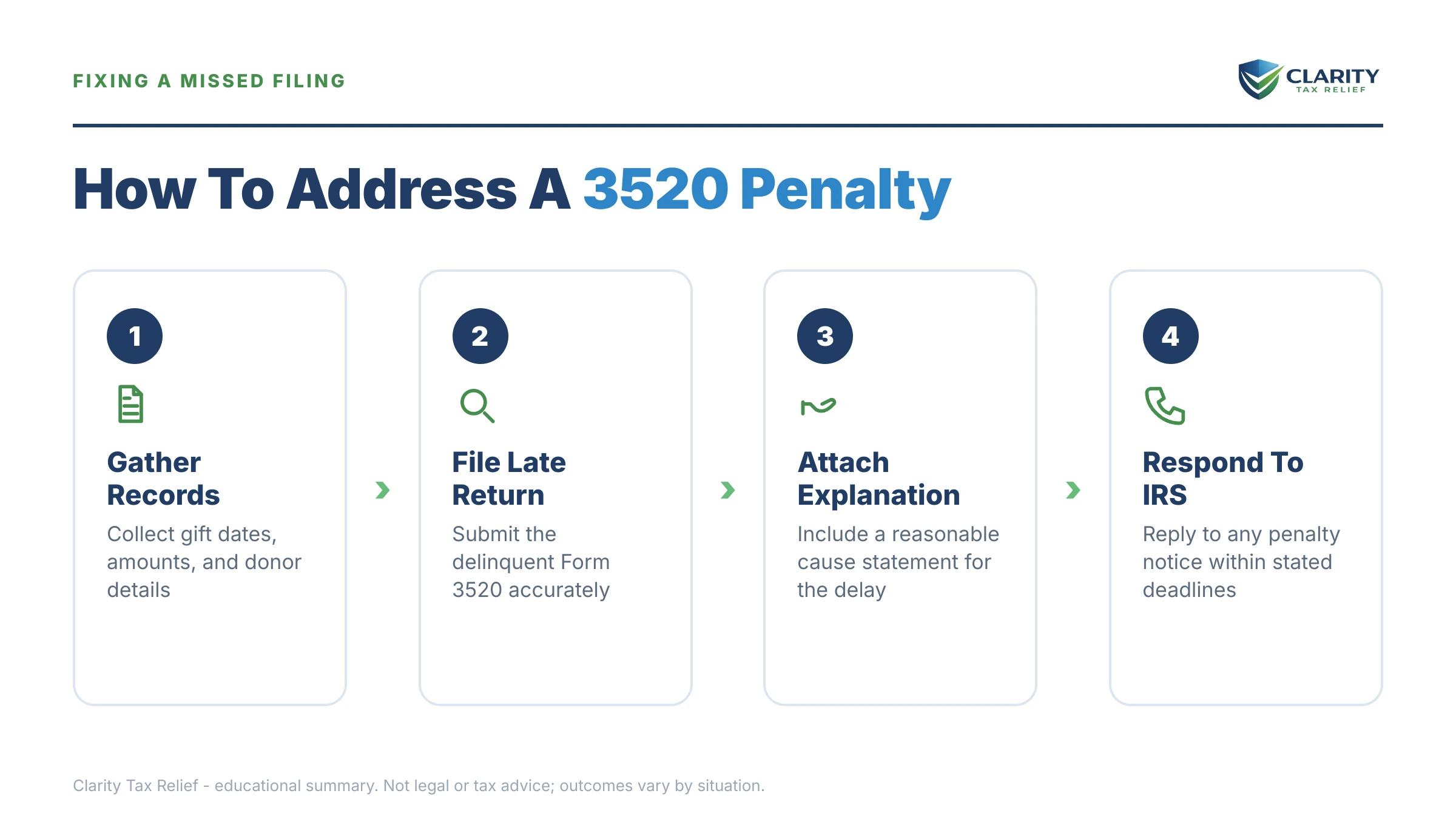
- No notice yet, no unreported income: file the delinquent Form 3520 with a detailed reasonable-cause statement attached. Since late 2024, the IRS has said it will review reasonable-cause statements on late-filed gift reports before assessing the penalty rather than auto-assessing and making you fight afterward — a genuine improvement that rewards coming forward with a strong statement. On the account-reporting side, note that the IRS removed the Delinquent FBAR Submission Procedures on June 30, 2026 — late FBARs can still be e-filed through FinCEN with an explanation, and penalties are not automatic when the account income was reported and taxed, but there is no longer a guaranteed penalty-free program.
- You also have unreported foreign income (interest on the gifted funds sitting in a foreign account, trust income): the streamlined procedures are usually the better vehicle — streamlined domestic offshore for US residents (a 5% miscellaneous offshore penalty on certain foreign assets, in place of the stack of information-return penalties) or the streamlined offshore procedures for those living abroad, which carry no miscellaneous penalty at all. Both require certifying your conduct was non-willful. Do not just quietly amend and mail forms — quiet disclosure forfeits these protections and can make things worse.
- CP15 already assessed: protest in writing before the response date on the notice, laying out reasonable cause. If the protest is denied, you can take the case to IRS Appeals — see how appealing a denied abatement works.
- Already paid, or want interest stopped: pay the penalty and file a Form 843 penalty abatement request as a refund claim. If it's denied, this preserves the right to sue for a refund — the main court route, since assessable penalties skip the Tax Court deficiency process.
- Can't pay while you fight or after you lose: the penalty balance is collectible like any tax debt, so payment plans, hardship status, and the other tools covered in our guide to how much IRS penalties on back taxes grow all apply to it.
| Option | Best when | Cost to you |
|---|---|---|
| Late-file with reasonable-cause statement | No CP15 yet; all income was reported | $0 in IRS fees; preparation only — IRS now reviews gift-report statements before assessing |
| Streamlined offshore procedures | Unreported foreign income accompanies the missed form | 5% miscellaneous offshore penalty (domestic) or 0% (foreign), plus back tax and interest on the income |
| Written protest of the CP15 | Penalty assessed within the last month | $0 filing cost; must be postmarked by the notice's response date |
| IRS Appeals | Protest denied | $0 filing cost; expect a long wait — Appeals inventories are heavy after the 2025 staffing cuts |
| Pay + Form 843 refund claim | You want interest stopped and a court route preserved | Full penalty upfront; refunded with interest if the claim succeeds |
What does a winning reasonable-cause case look like? The IRS weighs whether you exercised ordinary business care: you had no reason to know a no-tax-due gift required a form, you relied on a preparer who never asked about foreign gifts, English isn't your first language, you were dealing with a death in the family abroad — and, critically, you fixed the failure promptly once you learned of it. Our guide to reasonable-cause penalty abatement covers how to frame and document these facts.
How to respond to a Form 3520 penalty, step by step
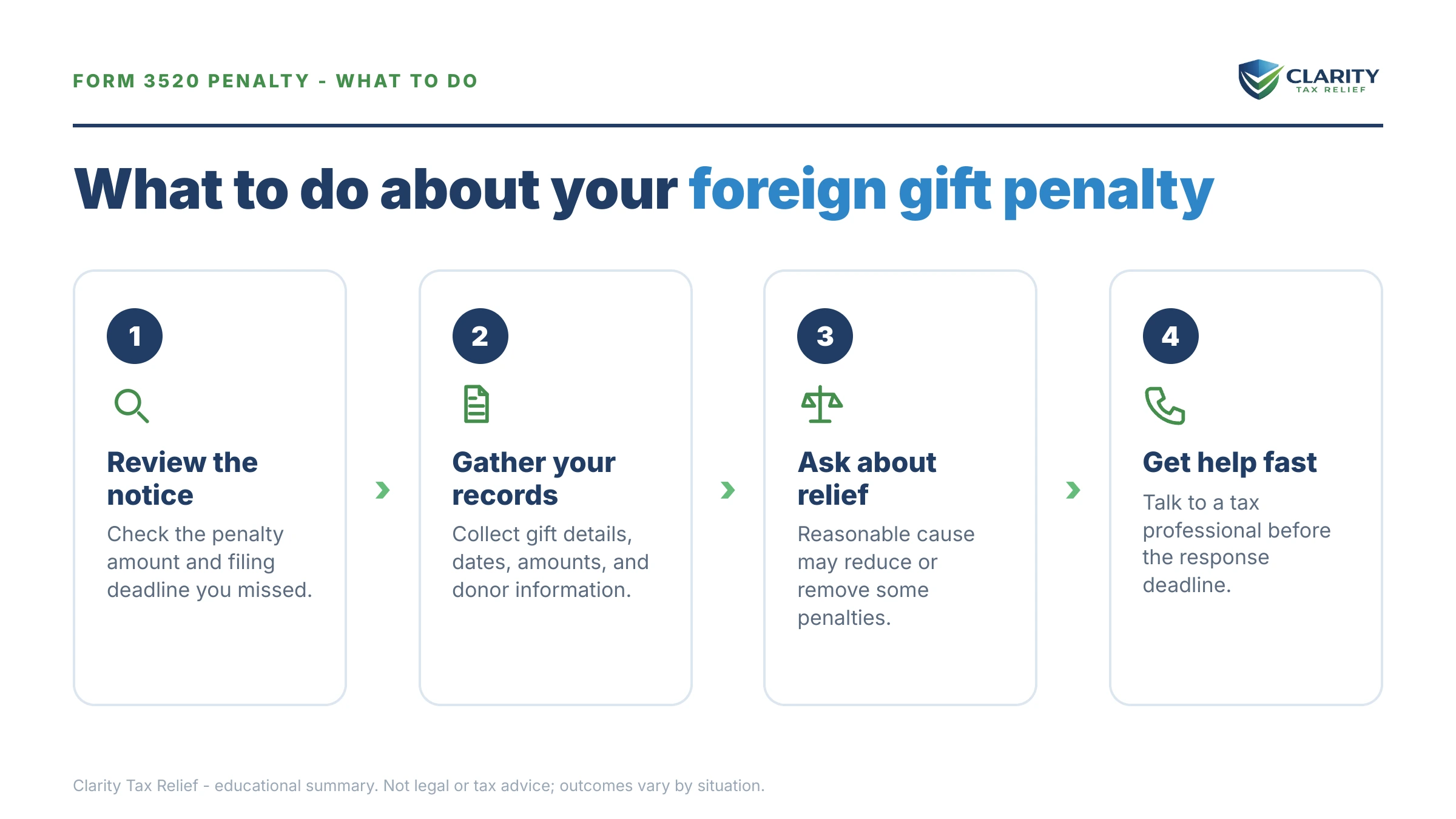
- Confirm the filing requirement — check whether your gifts topped $100,000 from a foreign individual or estate (aggregating related givers), crossed the lower foreign-corporation threshold, or involved a foreign trust in any amount.
- Gather your proof — wire confirmations, the gift letter or donor statement, your tax return for that year, and the CP15 notice if one has arrived.
- Pick your path — file the late Form 3520 with a reasonable-cause statement attached if no penalty has been assessed yet, or protest the CP15 in writing before the response date printed on it.
- Write the reasonable-cause statement — specific facts and dates showing ordinary care: why you didn't know about the form, when you learned, and how quickly you acted to fix it.
- Sweep your other international reporting — FBAR, Form 8938, Form 5471 — before you submit anything, so fixing one gap doesn't expose another.
That last step matters more than it looks. The same overseas family connection that produced the gift often produced a foreign bank account holding it, and an undisclosed foreign account carries its own penalty regime. If the account was large enough, a Form 8938 penalty may sit alongside the 3520 issue; if a family business abroad is involved, so might a Form 5471 penalty. Fixing them together — through one coordinated submission — is almost always cheaper and safer than fixing them one notice at a time.
When you can handle this yourself
Some Form 3520 problems are genuinely DIY-able. If you're filing the current year's form on time, you don't need help — it's tedious but not complicated. If you're a few months late on a modest gift, no CP15 has arrived, every dollar of your income was reported, and your reasonable-cause story is simple and true, filing the delinquent form with a clear, factual statement yourself is a reasonable move — especially now that the IRS reviews gift-report statements before assessing.
Experienced help changes the outcome in four situations: a CP15 has already assessed a five- or six-figure penalty and the protest window is running; a foreign trust is involved (the 35% rules, 3520-A interplay, and continuation penalties are unforgiving); there's unreported foreign income, because choosing between a reasonable-cause filing and the streamlined procedures is a one-shot decision you can't redo; or multiple years and multiple forms are missing, where the order of submissions determines total exposure. An experienced tax professional has written the protest that Appeals actually reads — and knows which facts sink one.
Terms on your CP15, decoded
- IRC §6039F — the statute behind the foreign-gift penalty: 5% of the gift per month late, capped at 25%.
- IRC §6677 — the foreign-trust penalty statute: the greater of $10,000 or 35% of the unreported distribution or transfer.
- CP15 (Notice of Penalty Charge) — the notice telling you a civil penalty has been assessed, with a short written-protest window printed on it.
- Assessable penalty — a penalty the IRS charges directly, with no notice of deficiency first — which means no prepayment Tax Court petition.
- Reasonable cause — the legal standard for removal: you exercised ordinary business care and prudence but still couldn't comply, and you fixed it promptly.
- Form 3520-A — the annual return a foreign trust with a US owner must file; the owner eats the penalty if it doesn't.
Form 3520 penalty questions, answered
Is a gift from a foreign person taxable in the US?
Generally no — the recipient of a gift owes no US income tax on it, whether the giver is foreign or domestic. What the law requires is reporting: if you receive more than $100,000 in a year from a foreign individual or estate, you must disclose it on Form 3520. The penalty punishes the missed disclosure, not the gift — which is why people end up owing five figures on money that was never taxable.
How much is the Form 3520 late filing penalty?
For an unreported foreign gift, the penalty is 5% of the gift for each month the form is late, capped at 25% of the gift's value. For foreign trust distributions or transfers, it is the greater of $10,000 or 35% of the amount involved, and additional penalties can continue if you still don't file after the IRS demands the form. Interest accrues on the penalty once it is assessed.
Does first-time abatement apply to Form 3520 penalties?
No. First-Time Abate covers failure-to-file, failure-to-pay, and deposit penalties on regular tax returns — not international information return penalties like Form 3520's. The same limitation is expected to carry into the Automatic Exemption from Penalty (AEP) rolling out in summer 2026. For Form 3520, the path to removal is a reasonable-cause statement showing you acted with ordinary care and fixed the failure promptly once you learned of it.
What is a CP15 notice?
A CP15 is the IRS's Notice of Penalty Charge — it tells you a civil penalty, such as a Form 3520 penalty, has been assessed against you. Unlike an audit adjustment, there is no proposed-change stage first; the penalty is already on your account. The notice gives you a short window, typically 30 days from the notice date, to protest in writing before the debt moves into normal IRS collections.
Should I still file Form 3520 if I missed the deadline years ago?
Yes — and sooner is genuinely better. Under IRC §6501(c)(8), the statute of limitations on your entire tax return for that year does not start running until the missing Form 3520 is filed, so the exposure never ages out on its own. Filing the delinquent form with a strong reasonable-cause statement attached both starts the clock and gives the IRS a documented basis not to assess the penalty.
My parents wired me $60,000 from overseas — do I have to file Form 3520?
Not for that gift alone — gifts from a foreign individual or estate only trigger Form 3520 when they exceed $100,000 in total for the year. Watch two traps: gifts from related foreign persons are aggregated, so $60,000 from your mother and $50,000 from your father in the same year crosses the line together; and gifts from foreign corporations or partnerships have a much lower inflation-adjusted threshold, roughly $20,000.
Can I fight a Form 3520 penalty in Tax Court before paying it?
Not through the usual deficiency route — Form 3520 penalties are "assessable" penalties, meaning the IRS charges them without issuing a notice of deficiency you could petition. Your realistic forums are a written protest of the CP15, IRS Appeals, a Collection Due Process hearing if the case reaches a final levy notice, or paying the penalty and suing for a refund after a Form 843 claim is denied.
Can a Form 3520 penalty affect my passport?
It can. Assessed Form 3520 penalties plus interest count toward the "seriously delinquent tax debt" threshold — $66,000 in 2026 — that lets the IRS certify your debt to the State Department for passport denial or revocation. A single large gift penalty, or penalties stacked across multiple years, can cross that line on its own, which matters enormously if your family and finances span two countries.
Your next 24 hours
- Find your controlling date. If you have a CP15, locate the notice date and the response deadline printed on it — that date, not a general rule, is your clock. No notice yet? Pull the wire dates from your bank records so you know how many 5% months have accrued.
- Gather three things: the wire confirmations or transfer records for the gift, a signed statement or letter from the giver identifying it as a gift, and your filed tax return for that year.
- Get the free case review. Send us the CP15 (or just the gift details) at the 2-minute form or call (888) 825-7779. If a protest window is open, we'll tell you exactly what a reasonable-cause case looks like on your facts before it closes — and if no penalty has been assessed yet, how to file so one never is.
Primary sources: the IRS's official About Form 3520 page hosts the current form, instructions, and thresholds; payment options for an assessed penalty are at IRS.gov/payments; and if collection action is causing hardship while your abatement request sits unworked, the Taxpayer Advocate Service can intervene.
This guide is general information, not tax or legal advice for your specific situation. Eligibility for IRS programs depends on individual facts and circumstances; no outcome is guaranteed.