
IRS Penalties
Form 8938 Penalty: What FATCA Fines Really Cost and How to Fix Them in 2026
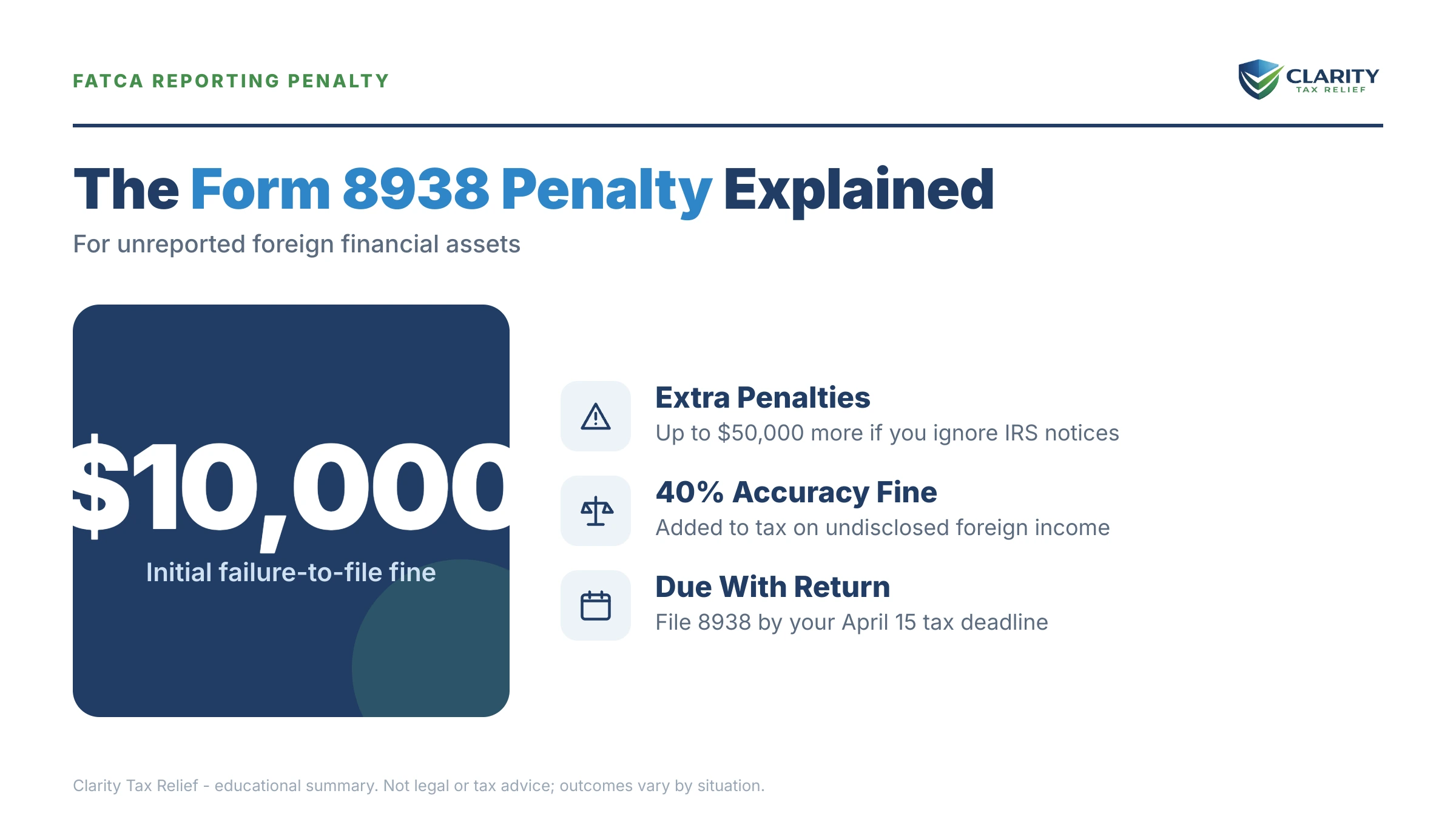
The short answer: the Form 8938 penalty is $10,000 per year for failing to report specified foreign financial assets under FATCA. After an IRS notice, an extra $10,000 accrues every 30 days (starting 90 days after the notice), up to $50,000 more — and related unpaid tax can carry a 40% accuracy penalty.
Three years of unfiled returns felt manageable — until you found out the account you left overseas has its own form and its own five-figure fine. Take a breath: the IRS built specific disclosure paths for exactly this discovery, and people who use them before the IRS writes first usually pay a fraction of the headline numbers.
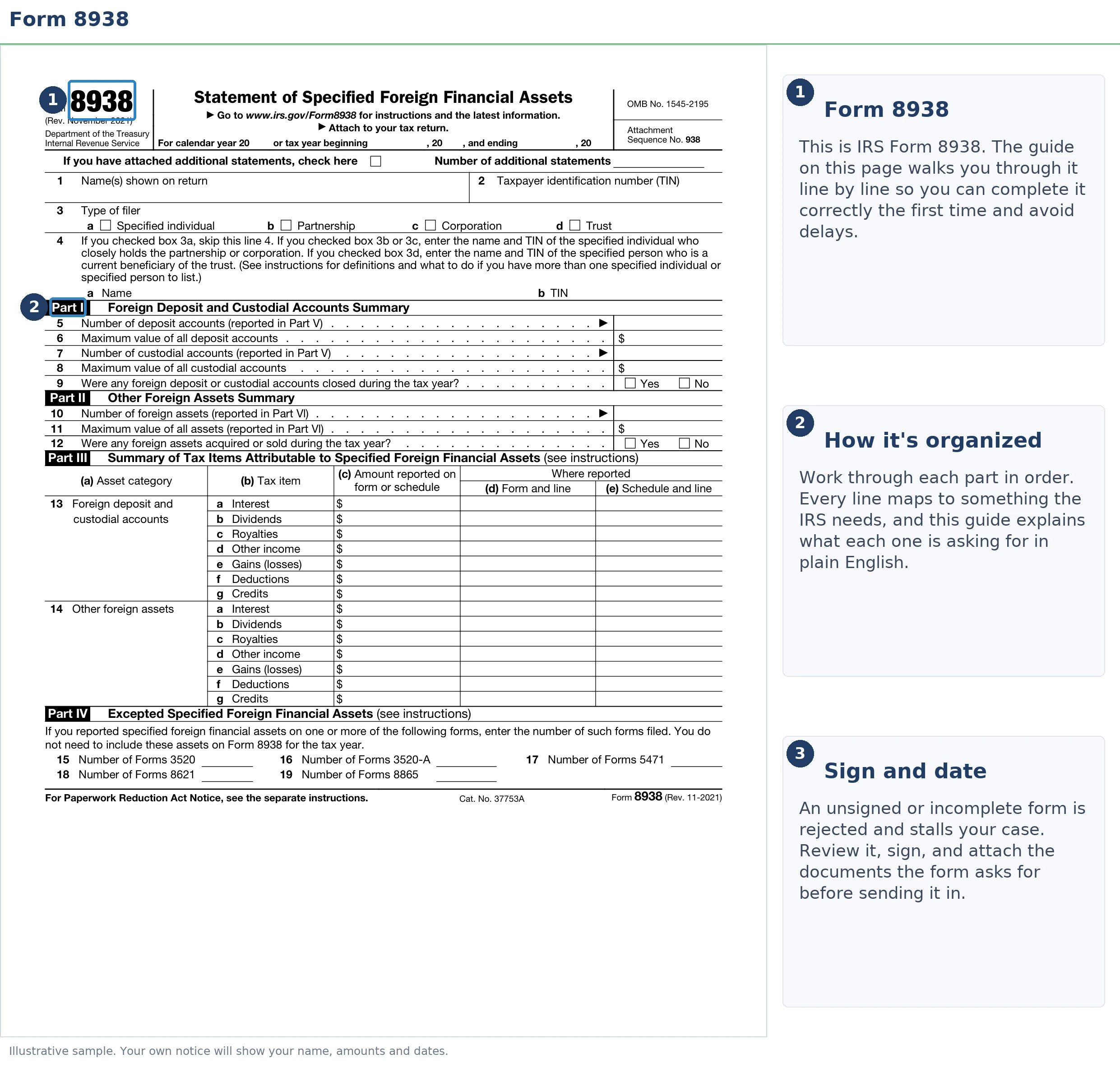
Here's what makes this penalty different from an ordinary late-filing charge: it applies even if you owed zero tax on the foreign accounts, and until the form is filed, your entire tax return stays open to audit with no expiration date, unless you can show the failure was due to reasonable cause — in that case only the items tied to the unreported foreign asset stay open, not your entire return (IRC 6501(c)(8)(B)). The image below shows exactly what Form 8938 looks like and where the account values and thresholds appear — worth a look before you decide whether you even had to file.
⏱ The clock that matters: if the IRS has already mailed you a letter about a missing Form 8938, you have 90 days from that notice before continuation penalties begin — another $10,000 for every 30 days the form stays unfiled, up to $50,000 on top of the first $10,000. No letter yet? The window to fix it voluntarily is still open, but interest on any related tax accrues every month.
Why the IRS says you owe a Form 8938 penalty
Form 8938 is the FATCA report attached to your tax return once your foreign financial assets cross a threshold — and skipping it costs $10,000 per year under IRC §6038D, even when the accounts produced no taxable income. The IRS doesn't need you to volunteer the information: under FATCA, foreign banks and brokerages report U.S. account holders' names, taxpayer ID numbers, and balances directly to the IRS every year.
That reporting is why this penalty finds people who never got audited. If a foreign institution reports an account tied to your Social Security number and the IRS sees no Form 8938 — or, in your case, no return at all — the mismatch is machine-detectable. It's the same automated matching that catches missing 1099s, aimed offshore.
Form 8938 belongs to a family of $10,000 international information penalties that all work on this "flat fine, no tax required" logic — the Form 5471 penalty for foreign corporations and the Form 3520 penalty for foreign gifts and trusts follow the same escalation pattern. What's unique to 8938 is that it rides on your income tax return itself, which is what freezes your audit clock (more on that below).
Did you even have to file? The Form 8938 thresholds
You only owe a Form 8938 penalty if you were actually required to file — and the thresholds are higher than most people fear. Unlike the FBAR's $10,000 trigger, Form 8938 doesn't start until $50,000 for a single U.S. resident, and it climbs sharply if you're married or live abroad.
| Your situation | Value on Dec. 31 | Value at any time in the year |
|---|---|---|
| Single or married filing separately, living in the U.S. | Over $50,000 | Over $75,000 |
| Married filing jointly, living in the U.S. | Over $100,000 | Over $150,000 |
| Single or married filing separately, living abroad | Over $200,000 | Over $300,000 |
| Married filing jointly, living abroad | Over $400,000 | Over $600,000 |
"Specified foreign financial assets" is broader than bank accounts: foreign brokerage accounts, foreign stock and partnership interests held outside an account, foreign pensions, and certain foreign contracts all count toward the total. As the image on this page shows, the form asks for each asset's maximum value during the year — that's the number the thresholds test, so pull the year's high-water mark, not just the December statement.
Two edge cases trip people constantly. Married filing separately keeps you at the low $50,000 threshold even if your spouse holds most of the assets jointly with you — each joint owner counts the full account value. And self-employed or gig income doesn't change the thresholds, but it does mean an unfiled return: if you were required to file a return and didn't, the Form 8938 obligation (and its penalty) attaches the moment you file late.
What happens if you ignore a Form 8938 penalty
Ignoring a Form 8938 problem can turn a $10,000 fine into $60,000 per form, per year — and it keeps your entire tax return open to examination indefinitely. The sequence runs on FATCA data-matching, so it doesn't need a human examiner to start:
- FATCA reporting. Your foreign bank sends your name, taxpayer ID, and balances to the IRS. This has already happened for every year the account existed.
- Matching. The IRS compares that data against your filed return — or flags that no return exists for a Social Security number with reported foreign accounts.
- Contact. A foreign-account compliance letter such as Letter 6291, or an exam notice, asks about the unreported assets. This is your last cheap exit.
- Assessment. A $10,000 penalty posts for each missing year, and the penalty notice starts the 90-day continuation clock.
- Continuation penalties. Ninety days after the notice, $10,000 more accrues every 30 days the form stays unfiled, capped at an additional $50,000 per form.
- Tax-side penalties. If the foreign assets produced unreported income, the underpayment can carry a 40% accuracy penalty — double the standard 20% accuracy-related penalty — plus interest.
- Collection. Once assessed, the penalties are collectible like any tax debt: liens, levies, and refund offsets, in the standard notice sequence.
The quietest consequence is the worst one: under IRC §6501(c)(8), the statute of limitations on your whole return never starts until the missing Form 8938 is filed. A return you filed six years ago without it is still fully open today, unless you can show the failure was due to reasonable cause — in that case only the items tied to the unreported foreign asset stay open, not your entire return (IRC 6501(c)(8)(B)). Willful concealment can also cross into criminal territory — rare, but real, and the reason the fix paths below distinguish honest mistakes from deliberate hiding.
Foreign account and years of missing Forms 8938?
Your bank is already reporting your balances to the IRS under FATCA — the question is whether you disclose first or the IRS writes first. Get your foreign-account years reviewed free before a notice starts the 90-day continuation clock: (888) 825-7779 or the 2-minute form.
Your options to fix a missing Form 8938
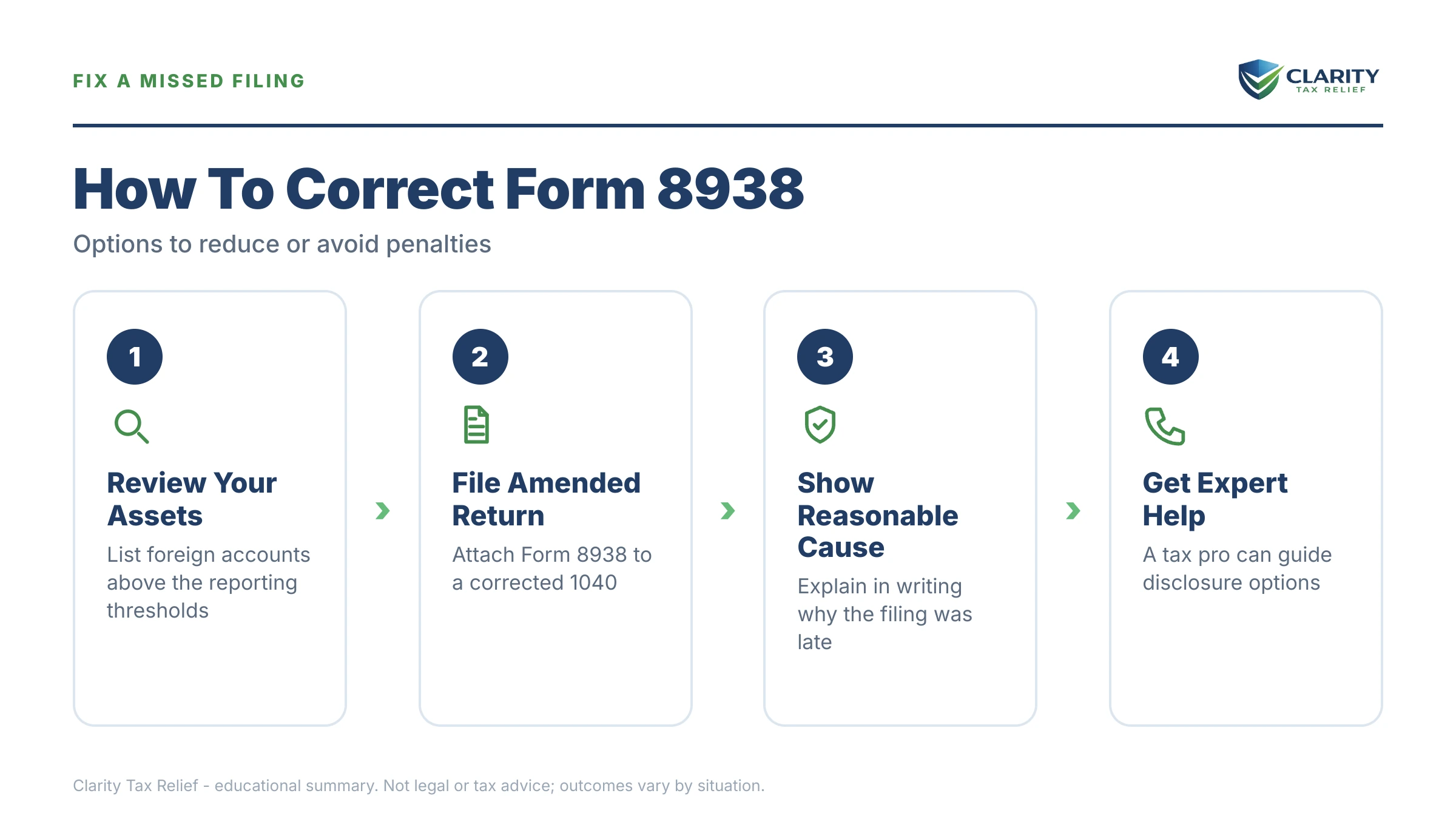
Non-willful taxpayers have real IRS-sanctioned paths back to compliance — and two of them can avoid the $10,000 penalties entirely. Which one fits depends on three questions: was your conduct willful, do you live abroad, and did you file the underlying returns at all?
| Path | Who it fits | What it costs | Timeline |
|---|---|---|---|
| Streamlined offshore procedures (foreign) | Non-willful, meets the non-residency test | $0 offshore penalty; pay tax + interest on 3 years of returns | Compliant the day you file; IRS review can take months |
| Streamlined domestic offshore (SDOP) | Non-willful U.S. residents who already filed returns | 5% of the highest year-end foreign balance + tax and interest | Same — filing itself restores compliance |
| Delinquent filing with reasonable cause | Non-filers and no-tax-due cases with a genuine excuse | $0 if reasonable cause is accepted; penalties possible if not | Processed with the returns; penalty decision follows |
| IRS voluntary disclosure (VDP) | Willful conduct | Substantial civil penalties — but a path away from prosecution | Longest process; typically covers 6 years |
| Quiet disclosure | No one — amending old returns silently invites exam | Full penalties if caught, plus a willfulness inference | Not a program; no protection at all |
Two eligibility traps matter here. First, SDOP only accepts amended returns — if you live in the U.S. and never filed the returns at all, the domestic streamlined door is closed, and your path is filing complete, accurate returns with Forms 8938 attached plus a reasonable-cause statement. Second, both streamlined programs require you to certify non-willfulness under penalties of perjury (Form 14653 abroad, Form 14654 domestic) — sign that carelessly and you've created evidence, not protection.
Don't count on the usual penalty-relief shortcuts. First-time abatement and its 2026 successor, the Automatic Exemption from Penalty (AEP), apply to late-filing and late-payment penalties — not to international information-return penalties like this one. Reasonable cause is the only direct abatement route, and the statute expressly rejects "my foreign bank's secrecy laws" as an excuse. For how the ordinary penalty stack works on the tax side of your bill, see how big IRS penalties on back taxes get.
Say you're three years behind with $8,900 of foreign income: the math
Say you're a gig worker who hasn't filed in 3 years, and you also hold a foreign brokerage account that sat around $86,000 each December 31 — above the $50,000 year-end threshold for a single U.S. resident. Across those three years the account paid $8,900 in interest and dividends that never touched a U.S. return.
If the IRS finds it first, the foreign side alone looks like this:
- Three missing Forms 8938: 3 × $10,000 = $30,000, before any continuation penalties.
- Tax on the $8,900 at a 22% rate: about $1,958.
- 40% accuracy penalty on that underpayment (the undisclosed-foreign-asset rate): about $783 — versus roughly $392 at the standard 20%.
- Failure-to-file and failure-to-pay penalties plus interest on the $1,958, growing monthly — your gig income owes its own tax and self-employment tax on top.
Rough exposure just on the foreign account: $33,000+ against $8,900 of income. Now flip it: come forward first by filing all three returns with Forms 8938 attached and a reasonable-cause statement. You pay roughly $2,000 of tax plus the late additions on that tax — and the $30,000 of information penalties may never be assessed at all. If you lived abroad and qualified for the streamlined foreign procedures, the offshore penalty would be exactly zero. You can estimate the late-filing and late-payment side of your own bill with our IRS Penalty & Interest Calculator; the flat $10,000 information penalties sit on top of whatever it shows.
How to respond to a Form 8938 penalty, step by step
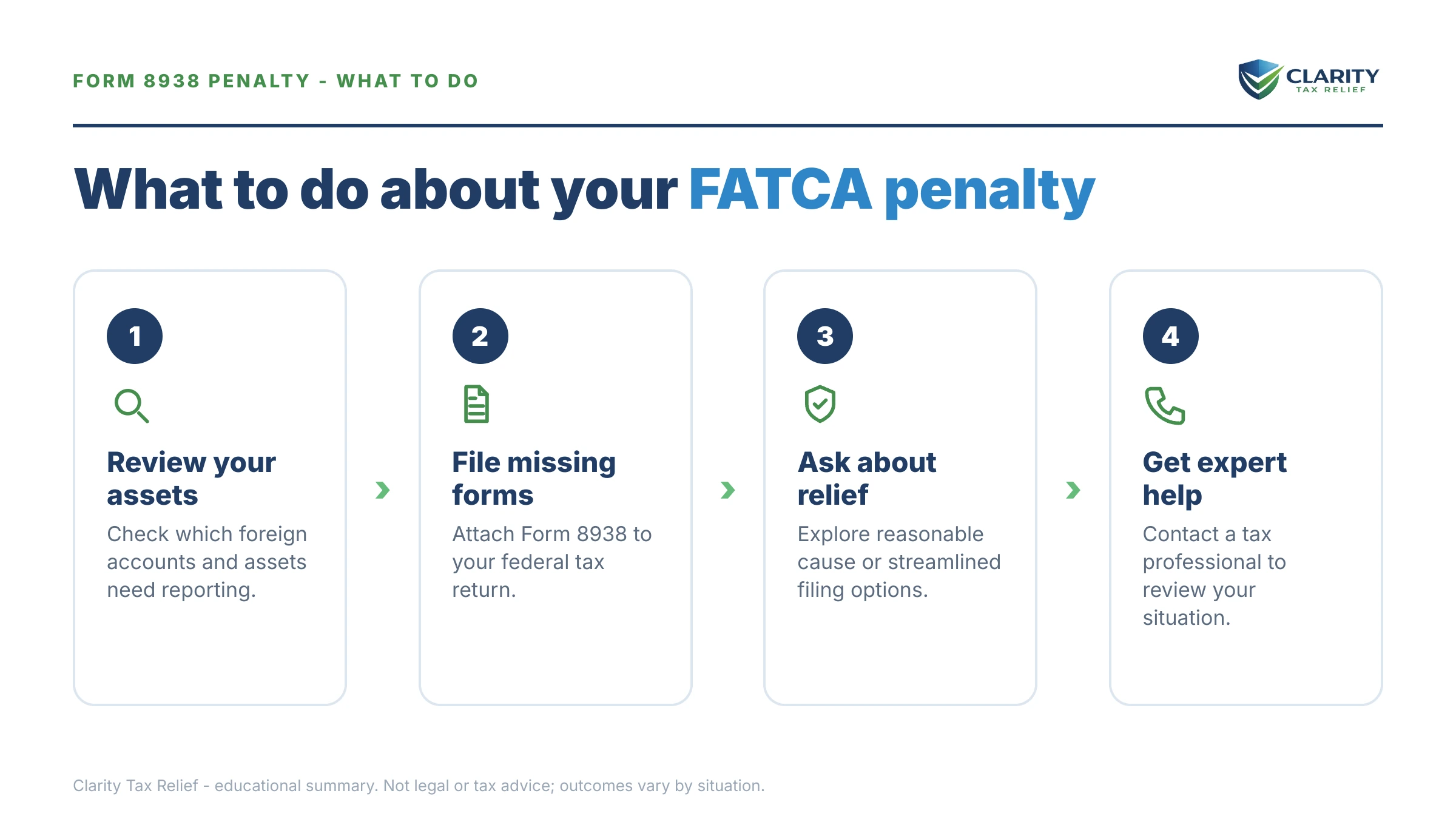
- Confirm you had to file. Pull each year's December 31 balance and highest balance for every foreign account and compare them to the thresholds in the table above.
- Check what the IRS already knows. Request your wage and income transcripts and look for any foreign-account letter or penalty notice before you choose a path.
- Pick your disclosure path. Streamlined procedures for non-willful conduct, a delinquent filing with a reasonable-cause statement, or the Voluntary Disclosure Practice if your conduct was willful.
- File everything together. Submit the missing returns with Forms 8938 attached, the six years of FBARs your path requires, and the certification or reasonable-cause statement — one complete package, not pieces.
- Answer any penalty notice within 90 days. Filing the form and disputing the penalty inside that window stops continuation penalties from stacking $10,000 every 30 days.
Step four matters because Form 8938 rarely travels alone. The same account that triggers it almost always triggers the FBAR too — a separate FinCEN filing with a much lower $10,000 threshold and its own FBAR penalty regime. A disclosure that fixes one and ignores the other fixes nothing.
Form 8938 penalty codes on your IRS transcript
The Form 8938 penalty usually posts to your IRS account transcript as Transaction Code 240, a miscellaneous civil penalty. If you're watching your transcript after a disclosure or a notice, here's how to read what you see:
| Code | What it means | What to do |
|---|---|---|
| 240 | Miscellaneous civil penalty assessed — how the flat $10,000 Form 8938 penalty typically posts | Match the amount and date to your notice; this starts the collection and appeal clocks |
| 971 | Notice issued on your account | Find the letter — a penalty-charge notice is what opens the 90-day continuation window |
| 196 | Interest charged on the assessed balance | Expect this to repeat; interest runs from assessment until the penalty is paid or abated |
| 290 | Additional tax assessed — e.g., tax on the unreported foreign income after review | Check whether a companion accuracy penalty posted at the 40% foreign-asset rate |
When you can handle this yourself — and when help changes the outcome
You can handle a late Form 8938 yourself when there's no unreported income and no IRS contact yet. If you filed your returns on time, the foreign accounts generated little or no taxable income, and you simply didn't know the form existed, attaching the delinquent forms with a clear reasonable-cause statement is a manageable DIY project. Same if you check the thresholds and discover you were never required to file — document the balances and keep the proof.
Experienced help changes outcomes in four situations. Multiple unfiled years combined with unreported foreign income — your exact spot — because the order of operations (returns, FBARs, 8938s, certification) determines which penalties ever get assessed. A non-willfulness certification you're not sure you can honestly sign, because that judgment call is the whole ballgame. A Letter 6291 or penalty notice already in hand, because the 90-day continuation clock punishes slow responses. And any fact pattern with deliberate concealment in it, where the voluntary disclosure route needs to be evaluated before anything is filed. If a penalty was already assessed and the IRS won't engage, the Taxpayer Advocate Service is a free escalation channel.
Terms on your notice, decoded
- FATCA — the Foreign Account Tax Compliance Act, the 2010 law that makes foreign banks report U.S. account holders to the IRS and created Form 8938.
- Specified foreign financial asset — what Form 8938 covers: foreign bank and brokerage accounts, plus foreign stock, partnership interests, pensions, and certain contracts held outside any account.
- Non-willful — conduct due to negligence, mistake, or a good-faith misunderstanding of the law; the gate that decides streamlined eligibility.
- Reasonable cause — the defense that removes the penalty when you exercised ordinary care and still failed to file; foreign secrecy laws are expressly excluded.
- Continuation penalty — the extra $10,000 per 30 days (up to $50,000) that stacks when the form stays unfiled 90 days after an IRS notice.
- §6501(c)(8) — the rule that keeps your entire tax return open to audit until the missing Form 8938 is filed, unless you can show the failure was due to reasonable cause — in that case only the items tied to the unreported foreign asset stay open, not your entire return (IRC 6501(c)(8)(B)).
The official form and instructions live at About Form 8938 on IRS.gov, and the IRS's side-by-side comparison of Form 8938 and FBAR requirements settles which of the two filings you owed for each account.
Form 8938 penalty questions, answered
How much is the penalty for not filing Form 8938?
The base penalty is $10,000 for each year you were required to file Form 8938 and didn't. If the IRS mails you a notice and the form still isn't filed 90 days later, another $10,000 is added for every 30 days, capped at $50,000 more — a $60,000 maximum per form. Any tax you underpaid on the unreported assets can also carry a 40% accuracy-related penalty instead of the usual 20%.
Can the Form 8938 penalty be waived or abated?
Yes — if you can show reasonable cause, meaning you exercised ordinary care and still failed to file; the law specifically says fear of violating foreign bank-secrecy rules does not count. First-time abatement and the new Automatic Exemption from Penalty do not cover this penalty, because it is an information-return penalty, not a late-filing or late-payment penalty. The stronger play is usually a streamlined disclosure, which keeps the penalty from being assessed at all for non-willful taxpayers.
Do I still have to file Form 8938 if I already file an FBAR?
Yes — they are separate requirements filed with separate agencies, and filing one does not satisfy the other. The FBAR (FinCEN Form 114) goes to the Treasury's FinCEN with a $10,000 aggregate threshold; Form 8938 goes to the IRS with your tax return and thresholds starting at $50,000. Missing both means two independent penalty exposures on the same account.
Does a missing Form 8938 keep my tax return open forever?
Yes, in most cases. Under IRC §6501(c)(8), the statute of limitations on your entire tax return does not start running until the missing Form 8938 is filed — so a year you'd normally consider closed after three years stays open indefinitely. If you can show reasonable cause, the open period is limited to the items related to the unreported foreign assets rather than the whole return.
Can I just quietly attach a late Form 8938 to an amended return?
You can, but it's the riskiest path. A quiet disclosure — amending old returns without using an IRS disclosure program — leaves every penalty on the table and, if the return is pulled for exam, can make your conduct look willful. The streamlined procedures exist precisely so non-willful taxpayers can fix the same problem with reduced or zero offshore penalties and a certification that protects them.
Does crypto held on a foreign exchange count for Form 8938?
The IRS has not issued definitive guidance saying virtual currency itself is a specified foreign financial asset, but an account you hold at a foreign exchange looks a lot like a foreign financial account. Many experienced tax professionals treat foreign-exchange crypto accounts as reportable once you cross the thresholds, because the cost of over-disclosing is zero and the cost of under-disclosing starts at $10,000.
Is failing to file Form 8938 a crime?
Not by itself in most cases — the penalty is civil, and the vast majority of missing 8938s are resolved with money, not prosecution. Willful concealment is different: deliberately hiding foreign assets can support criminal tax charges, which is why the Voluntary Disclosure Practice exists for taxpayers whose conduct was intentional. If your failure was an honest miss, the civil disclosure paths are built for you.
Your next 24 hours
- Pull the balances. Log into each foreign account and record the December 31 value and the year's highest value for every year in question — those two numbers decide whether you were required to file and what any offshore penalty would be calculated on.
- Gather the paper. Any returns you did file, any IRS letters (especially anything mentioning foreign accounts or a penalty), and your gig-income records — 1099-Ks, 1099-NECs, and app statements — for the unfiled years.
- Get the free case review. Call (888) 825-7779 or use the 2-minute form. Your bank's FATCA reports are already sitting in IRS systems, and interest on any unpaid tax compounds monthly — the disclosure paths above are only fully available while the IRS hasn't contacted you first.
This guide is general information, not tax or legal advice for your specific situation. Eligibility for IRS programs depends on individual facts and circumstances; no outcome is guaranteed.