
IRS Penalties
FBAR Penalty in 2026: Willful vs. Non-Willful Amounts and How to Fix Unfiled FBARs
The short answer: the FBAR penalty for a non-willful violation is up to $10,000 — inflation-adjusted to over $16,000 — per unfiled report, not per account. A willful violation runs the greater of roughly $160,000 (adjusted) or 50% of the account balance, per year. Formal disclosure programs can cut that to 5% or even $0.
Maybe you were pulling statements together for a refinance, or your overseas bank suddenly asked you to certify your U.S. status — and somewhere in that paperwork you learned that a foreign account was supposed to be reported to the Treasury every single year. Now every search result is quoting five- and six-figure fines. Take a breath: most people in your position resolve this for a small fraction of those headline numbers, and some resolve it for nothing. The map is below.
The form at the center of all this is FinCEN Form 114 — the FBAR itself. The image below shows you exactly what this filing looks like and where the account-balance figures that drive the penalty math come from.
⏱ Your clock: the IRS has 6 years from each FBAR's due date to assess a penalty — and that clock runs whether or not you ever filed the form. If you've already received an FBAR penalty letter, the controlling deadline is the response date printed on it; pre-assessment appeal windows are short, typically around 30 days.
Why you're facing an FBAR penalty
An FBAR penalty applies when a U.S. person fails to report foreign financial accounts whose combined value topped $10,000 at any point during the year. The report is FinCEN Form 114, filed separately from your tax return through the Treasury's BSA E-Filing system — due April 15, with an automatic extension to October 15 that you don't have to request.
This is a pure reporting penalty. You can owe it even if you paid every dollar of tax on the account's income, because the violation is the missing form, not missing money. That's also why the usual triggers are so ordinary: an account you kept after working abroad, an inheritance sitting in a parent's home country, a foreign pension from an old employer, or signature authority over a relative's account you help manage.
One more structural fact that shapes everything below: the FBAR lives in Title 31 of the U.S. Code — the Bank Secrecy Act — not the tax code. That's why the familiar IRS penalty-relief tools work differently here, and why collection, appeal, and abatement all follow their own rules.
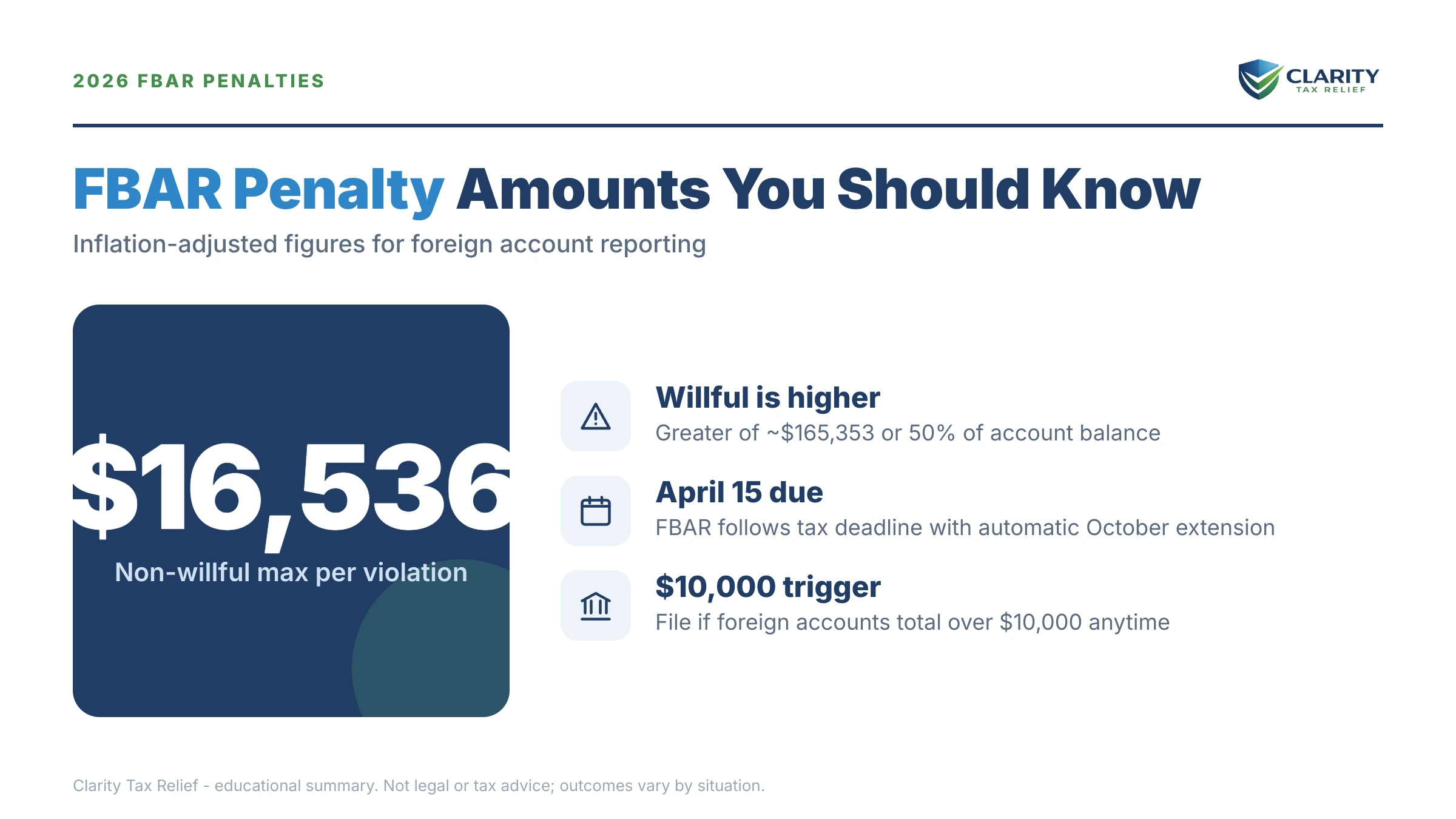
How much is the FBAR penalty in 2026?
A non-willful FBAR penalty is capped at $10,000 per violation by statute, inflation-adjusted to more than $16,000 for recent violations — and it applies once per unfiled report, not once per account. The Supreme Court settled that in Bittner v. United States (2023): five accounts on one missed FBAR is one violation, not five.
Willful violations are a different universe. The civil penalty is the greater of roughly $100,000 by statute (over $160,000 inflation-adjusted) or 50% of the account balance at the time of the violation — per year. Because each unfiled year is its own violation, courts have upheld willful penalties that exceed what the account ever held.
| Violation type | 2026 civil exposure | How it's counted |
|---|---|---|
| Non-willful | Up to $10,000 by statute, inflation-adjusted to over $16,000 | Per unfiled report (one per year), not per account — Bittner v. United States (2023) |
| Willful (civil) | Greater of ~$160,000 (adjusted) or 50% of the account balance | Per year, with per-account stacking possible — totals can exceed the account's value |
| Willful (criminal) | Fine up to $250,000 and up to 5 years in prison | Reserved for deliberate concealment; can be charged alongside civil penalties |
Two softening facts the scary tables never mention. First, examiners have discretion — IRS internal mitigation guidelines often result in one non-willful penalty per year, or even a single penalty covering multiple years, when the facts are sympathetic. Second, the statute has a reasonable-cause exception: if you can show your failure happened despite ordinary care, a non-willful penalty can be eliminated entirely. For context on how FBAR fines compare to ordinary tax penalties, see how much are IRS penalties on back taxes.
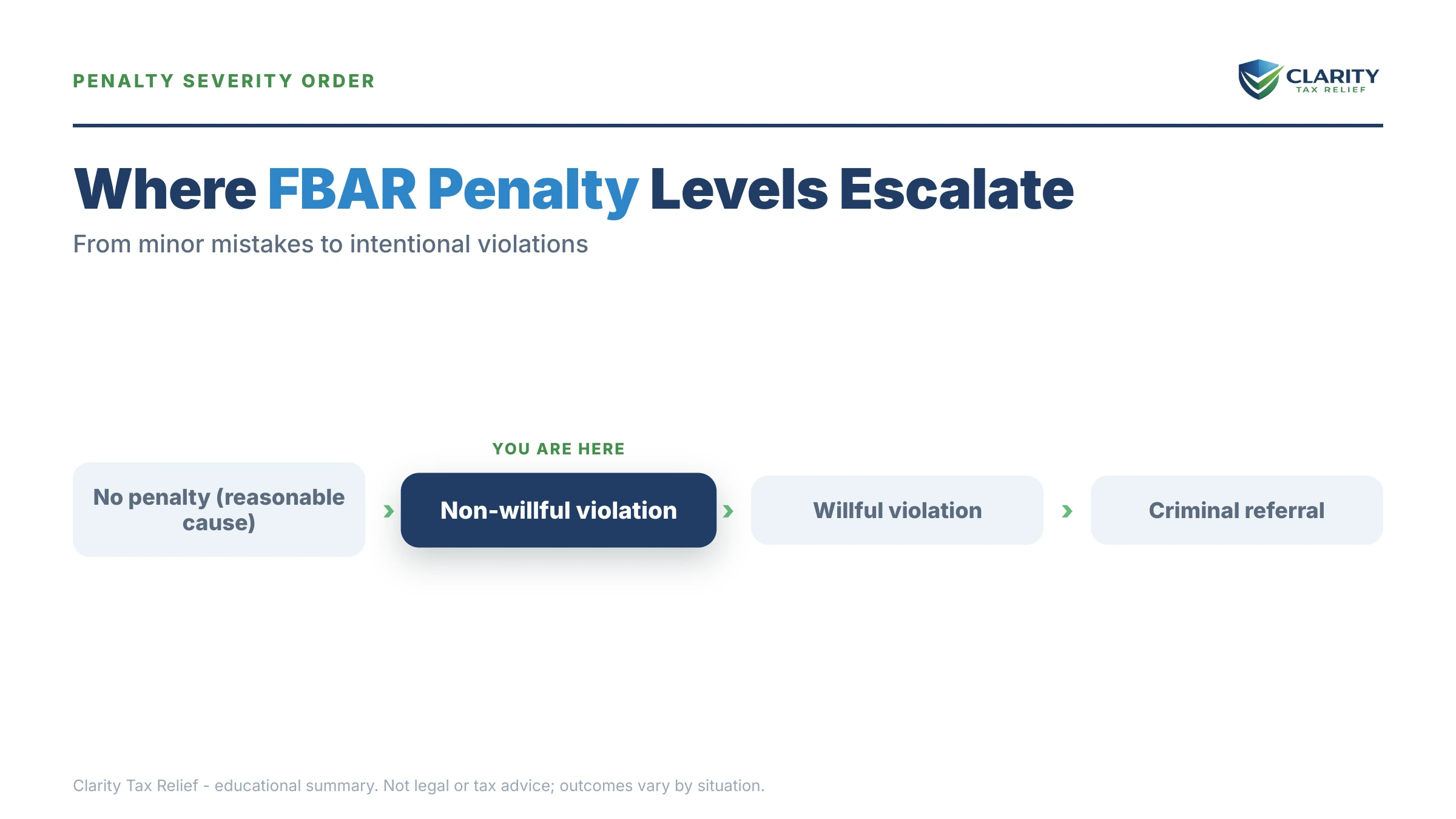
Willful vs. non-willful: how the IRS decides
Willfulness for FBAR purposes doesn't require intent to cheat — courts include reckless disregard and "willful blindness" in the definition. You don't need to have hidden money; you need only to have consciously avoided learning about or acting on an obligation you had reason to know existed.
The most common evidence of willfulness is your own tax return. Schedule B asks directly whether you had a foreign account; checking "No" while holding one is the fact pattern the government cites in nearly every willful case. Using a foreign address on the account, moving funds between countries, or telling a banker not to send mail to the U.S. all push the same direction.
Here's the part that matters for you today: willfulness is judged by what you knew and when. Before you found this page, your failure was plausibly non-willful. Now that you know the requirement exists, every month you sit on it makes "I didn't know" harder to argue. That — not a fabricated deadline — is the honest reason to move.
How the IRS finds unreported foreign accounts
Under FATCA, banks in more than 100 countries report their U.S.-person account holders directly to the U.S. government. That data — names, account numbers, balances — is matched against your Schedule B answers and your Form 8938 penalty exposure on the tax side. If your foreign bank ever asked you for a W-9 or a U.S.-status certification, your account is almost certainly in that pipeline already. Foreign crypto platforms raise their own overlapping issues, covered in our guide to offshore crypto reporting.
What happens if you ignore an unfiled FBAR
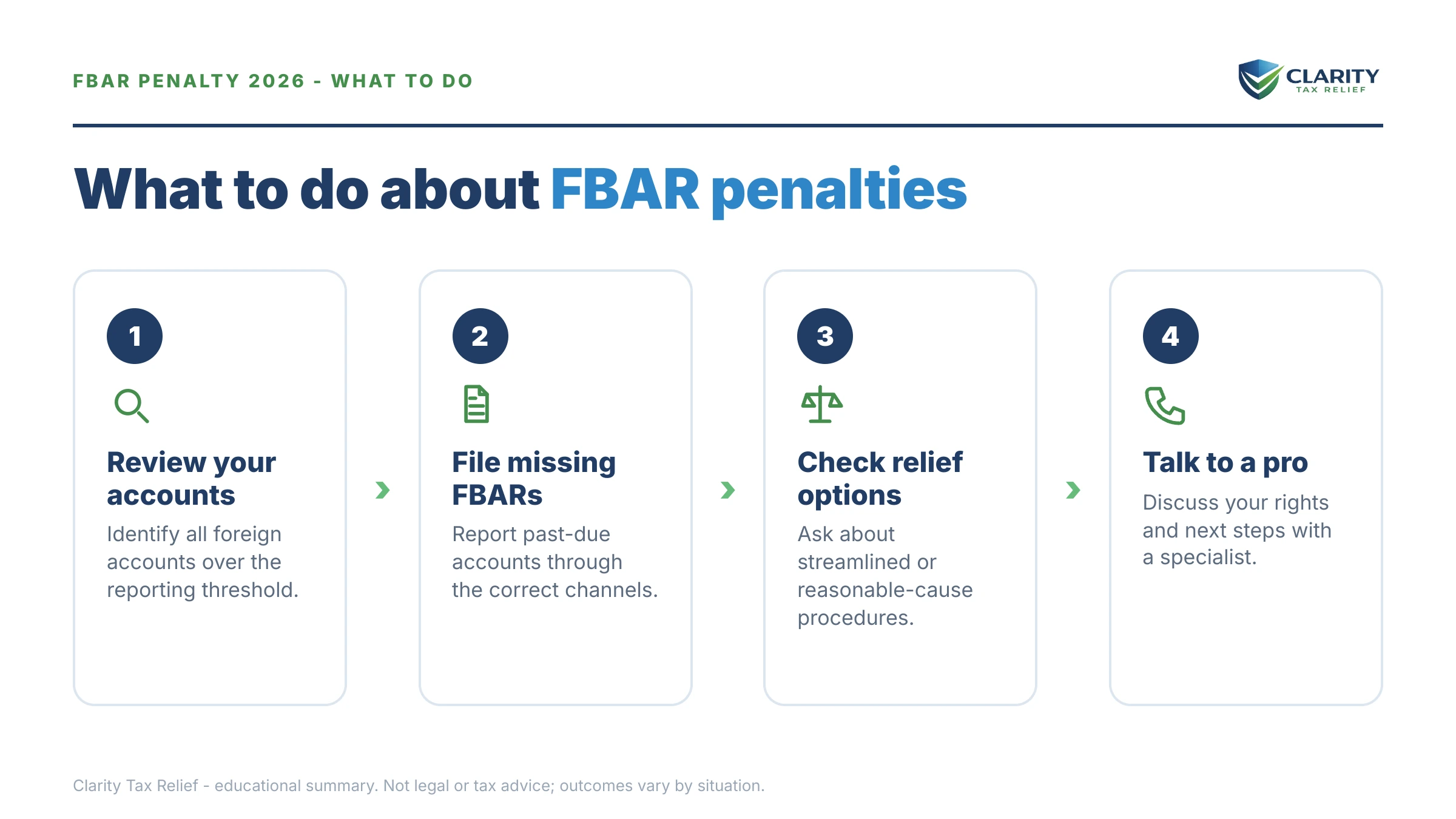
FBAR enforcement moves in stages, and each stage closes doors that were open at the one before it:
- FATCA data lands. Your bank's report sits in Treasury systems, waiting to be matched against your returns. Nothing has happened yet — every fix is still available.
- A soft letter arrives. A Letter 6291 tells you the IRS sees a foreign-account discrepancy and invites you to correct it. The voluntary paths are still open, but you are now on a list.
- An examination opens. This is the door-slam moment: late FBAR e-filing and both streamlined programs require that you are not under exam. Once an audit starts, penalty outcomes are in the examiner's hands.
- A proposed penalty letter issues. Before assessment, you get a short window — typically around 30 days, per the date printed on the letter — to protest to IRS Appeals.
- The penalty is assessed. A demand for payment follows, with interest and late-payment additions accruing under Title 31.
- Collection begins. The government can offset federal payments and, generally within 2 years of assessment, sue in federal district court. A judgment there can attach to your assets — including your home — as a recorded judgment lien.
That last stage is exactly what a refinancing homeowner cannot afford: a federal judgment on the title search stops most underwriting cold. Resolving the FBAR issue while it's still voluntary keeps the whole matter off the public record.
Unfiled FBARs hanging over you?
Which fix you qualify for — $0, 5%, or a negotiated penalty — depends on facts you can't un-choose once you file. Get your foreign-account situation reviewed free, before an exam or a Letter 6291 takes the best options off the table.
Your options: four ways to fix unfiled FBARs
There are four formal paths back into compliance, and the right one is determined almost entirely by two questions: was your conduct non-willful, and was the account's income reported on your returns?
| Path | Who it fits | Penalty cost | Typical timeline |
|---|---|---|---|
| Late FBAR e-filing with explanation (DFSP ended June 30, 2026) | All foreign income was reported and tax paid; not under exam | No automatic penalty, but no longer a guaranteed penalty-free program | Weeks — file the late FBARs through FinCEN with an explanation |
| Streamlined Foreign Offshore (SFOP) | Non-willful conduct + you meet the non-residency test | 0% offshore penalty; pay tax and interest on 3 amended years | Several months |
| Streamlined Domestic Offshore (SDOP) | Non-willful conduct, U.S. resident, some unreported foreign income | 5% of the highest year-end offshore balance, plus tax and interest | Several months |
| Voluntary Disclosure Practice (VDP) | Willful conduct; protection from criminal referral is the priority | Generally one willful FBAR penalty — 50% of the highest aggregate balance | A year or more |
| Quiet / forward-only disclosure | No one — it forfeits every protection above | Unlimited exposure if examined | Not a program; not recommended |
If your income was reported — the account earned little or you declared the interest — you can still e-file the late reports through FinCEN with a brief explanation. When the account income was reported and taxed, penalties are not automatic, but the IRS removed the guaranteed penalty-free delinquent FBAR procedures on June 30, 2026, so there is no longer a program that promises no penalty at all.
If income went unreported and you were non-willful, the streamlined programs apply: the streamlined offshore procedures for people who meet the non-residency test (no offshore penalty), and the streamlined domestic offshore program for U.S. residents (a one-time 5% penalty). Both require three amended returns, six years of FBARs, and a signed non-willfulness certification — Form 14653 abroad, Form 14654 at home. If the amended returns show a tax understatement, the accuracy related penalty IRS rules can apply to that tax side separately, which is one more reason the certification and numbers need to be right the first time.
If your facts are willful — false Schedule B answers over many years, deliberate structuring — the IRS voluntary disclosure practice trades a large but defined civil penalty for protection against criminal referral. Expensive, but bounded.
What not to do: amend quietly or just start filing from this year forward. Our guide to quiet disclosure IRS risk explains why forward-only filing flags the very years you skipped while giving up every penalty cap above. And note what's missing from this list: First-Time Abate and the new automatic exemption from penalty AEP 2026 rolling out this summer apply to tax-code penalties — Title 31 FBAR penalties aren't covered by either.
A worked example: $61,200 abroad, three missed FBARs
Say you're a homeowner planning to refinance, and while gathering documents you realize the account you inherited overseas — which peaked at $61,200 — needed FBARs for the last three years. The interest, about $900 a year, never made it onto your returns. Here's the honest math, clearly hypothetical:
- Worst-case non-willful assessment: one inflation-adjusted penalty per unfiled report — roughly $16,000 × 3 years ≈ $48,000, before any examiner mitigation.
- Worst-case willful assessment: 50% × $61,200 = $30,600 per year; × 3 years = $91,800 — half again more than the account holds.
- SDOP instead: 5% × $61,200 = $3,060, one time, plus the tax and interest on three years of $900 in unreported interest — likely a few hundred dollars more, depending on your bracket.
- If the interest had been reported: late FBARs e-filed through FinCEN with an explanation would carry no automatic penalty across all three years, though the IRS's guaranteed penalty-free program ended June 30, 2026.
Same account, same three missed forms — outcomes ranging from $0 to $91,800 depending entirely on which door you walk through and when. And for the refinance: $3,060 paid through a formal program leaves nothing on your title search; a $48,000 assessed penalty headed to a federal judgment does the opposite.
How to respond, step by step
- Confirm you had a filing requirement. Add up the highest balances of every foreign account you owned or could sign on for each year. If the combined total ever topped $10,000, an FBAR was due for that year.
- Check whether the account income made it onto your tax returns. Pull your last 3 years of returns and look for the foreign interest, dividends, or gains. Reported income points to late FBAR e-filing with no automatic penalty; unreported income points to the streamlined procedures.
- Choose your disclosure path before the IRS contacts you. Every formal fix — delinquent procedures, streamlined, voluntary disclosure — closes the moment an exam opens on those years. Pick the path that matches your facts while all of them are still available.
- File the late FBARs electronically through FinCEN's BSA E-Filing system. Late FBARs are filed online, each with a late-filing reason selected or a certification attached, depending on the path you chose. Paper filings are not accepted.
- Respond to any FBAR letter by the date printed on it. If you already have a Letter 6291 or a proposed-penalty letter, the deadline printed on it controls your appeal rights. Missing it moves the case from negotiation to assessment and collection.
When you can handle this yourself
If every dollar of foreign income was already on your tax returns, you can genuinely do this without help: late FBARs are a set of electronic filings through FinCEN with a short explanation, and when the income was reported and taxed a penalty is not automatic — though the IRS ended its guaranteed penalty-free program on June 30, 2026. One account, reported income, no IRS contact yet — file and move on.
Experienced help changes the outcome in four situations. First, when income went unreported and you must sign a non-willfulness certification under penalty of perjury — a wrongly framed Form 14654 can convert a 5% case into a willful one. Second, when any willful fact exists (a "No" on Schedule B, a foreign address on the account), because the streamlined-vs-VDP choice is one-way. Third, when a Letter 6291 or exam notice has already arrived and appeal windows are running. Fourth, when the FBAR problem sits on top of unfiled returns or other foreign forms — our broader guide to an undisclosed foreign account IRS problem maps how the pieces interact.
Terms on an FBAR case, decoded
- FBAR / FinCEN Form 114 — the annual Report of Foreign Bank and Financial Accounts, filed with the Treasury's FinCEN bureau, separate from your tax return.
- Aggregate balance — the combined high-water marks of all your foreign accounts; crossing $10,000 in total triggers the filing duty.
- Willful blindness — deliberately avoiding knowledge of a duty you had reason to suspect; courts treat it as willfulness.
- Title 31 — the Bank Secrecy Act section of federal law where FBAR penalties live, outside the tax code and its usual relief programs.
- Quiet disclosure — fixing old years by amending or filing forward without using a formal program; it surrenders every penalty protection.
- Reasonable cause — the statutory exception that can eliminate a non-willful penalty when you show the failure happened despite ordinary care.
FBAR penalty questions, answered
Is the FBAR penalty per account or per year?
For non-willful violations, the penalty is per unfiled report — one FBAR covers all of your accounts for a year, so one missed year means one penalty no matter how many accounts you had. The Supreme Court settled this in Bittner v. United States (2023). Willful penalties are different: they can be asserted per account, per year, at up to 50% of each account's balance.
Can an FBAR penalty be waived or abated?
Yes — through the reasonable cause exception, not through First-Time Abate. FBAR penalties live in Title 31 of the U.S. Code, so IRS penalty-relief tools like first-time abatement and the new automatic exemption from penalty (AEP) don't reach them. To win reasonable cause you must show you exercised ordinary care — for example, you relied on a preparer who knew about the accounts and never mentioned the FBAR.
How does the IRS know about my foreign bank account?
Mostly through FATCA. Banks in more than 100 countries report accounts held by U.S. persons — name, account number, and balance — and that data is matched against your Form 8938 and the foreign-account question on Schedule B. If a foreign bank has ever asked you to complete a W-9 or certify your U.S. status, your account information is likely already in the pipeline.
What is the statute of limitations on FBAR penalties?
The IRS has 6 years from each FBAR's due date to assess a penalty, and unlike an unfiled tax return, that clock runs even if you never filed the form. Once a penalty is assessed, the government generally has 2 years to sue in federal court to collect it. Filing late FBARs now starts putting old years permanently behind you.
Do I have to file an FBAR if no single account is over $10,000?
Possibly — the $10,000 threshold is an aggregate test across all of your foreign accounts combined, measured at their highest points during the year. Three accounts that each peaked at $4,000 put you over the line. The test also counts accounts you don't own but can sign on, like an elderly parent's account you help manage.
Can you go to jail for not filing an FBAR?
Willful failure to file an FBAR is a crime that can carry up to a $250,000 fine and 5 years in prison, but criminal prosecution is rare and reserved for deliberate concealment — hidden entities, moved money, false statements. The overwhelming majority of FBAR cases are handled civilly. If your facts involve deliberate hiding, speak with a tax attorney before contacting the IRS.
Can I just file FBARs going forward and skip the old years?
That forward-only approach — a form of quiet disclosure — is risky. Your new filings show FinCEN the accounts existed in earlier years, the 6-year assessment window on those years is still open, and you give up the formal programs that cap or eliminate penalties. Compare that to e-filing the late FBARs through FinCEN with an explanation, which carries no automatic penalty when your income was reported and taxed.
Do foreign crypto accounts trigger the FBAR penalty?
An overseas account that holds only cryptocurrency is not currently on FinCEN's list of reportable accounts, though FinCEN has signaled it intends to change that. But a foreign exchange account that also holds cash, or a foreign account you used to buy crypto, can cross into reportable territory. When in doubt, disclose — the penalty risk runs one direction.
Your next 24 hours
- Find your high-water marks. Log into each foreign account and note the highest balance for every year you didn't file — those figures decide which years needed an FBAR and what any 5% penalty would be computed on.
- Gather the paper. Pull your last three tax returns (check Schedule B and whether the foreign interest appears) and six years of foreign account statements — that's the exact package every disclosure path is built from.
- Get the path chosen before anyone chooses it for you. A free, confidential case review at the 2-minute form or (888) 825-7779 will tell you whether your facts point to the $0 route, the 5% route, or something that needs an attorney — while all three doors are still open and nothing is on your title search.
Primary sources: the IRS's official FBAR overview page, its streamlined filing compliance procedures page, and FinCEN's BSA E-Filing system, where all FBARs — current and late — are filed.
This guide is general information, not tax or legal advice for your specific situation. Eligibility for IRS programs depends on individual facts and circumstances; no outcome is guaranteed.