
International Tax Problems
Undisclosed Foreign Account IRS Penalties: How to Fix It Before the IRS Finds You (2026)
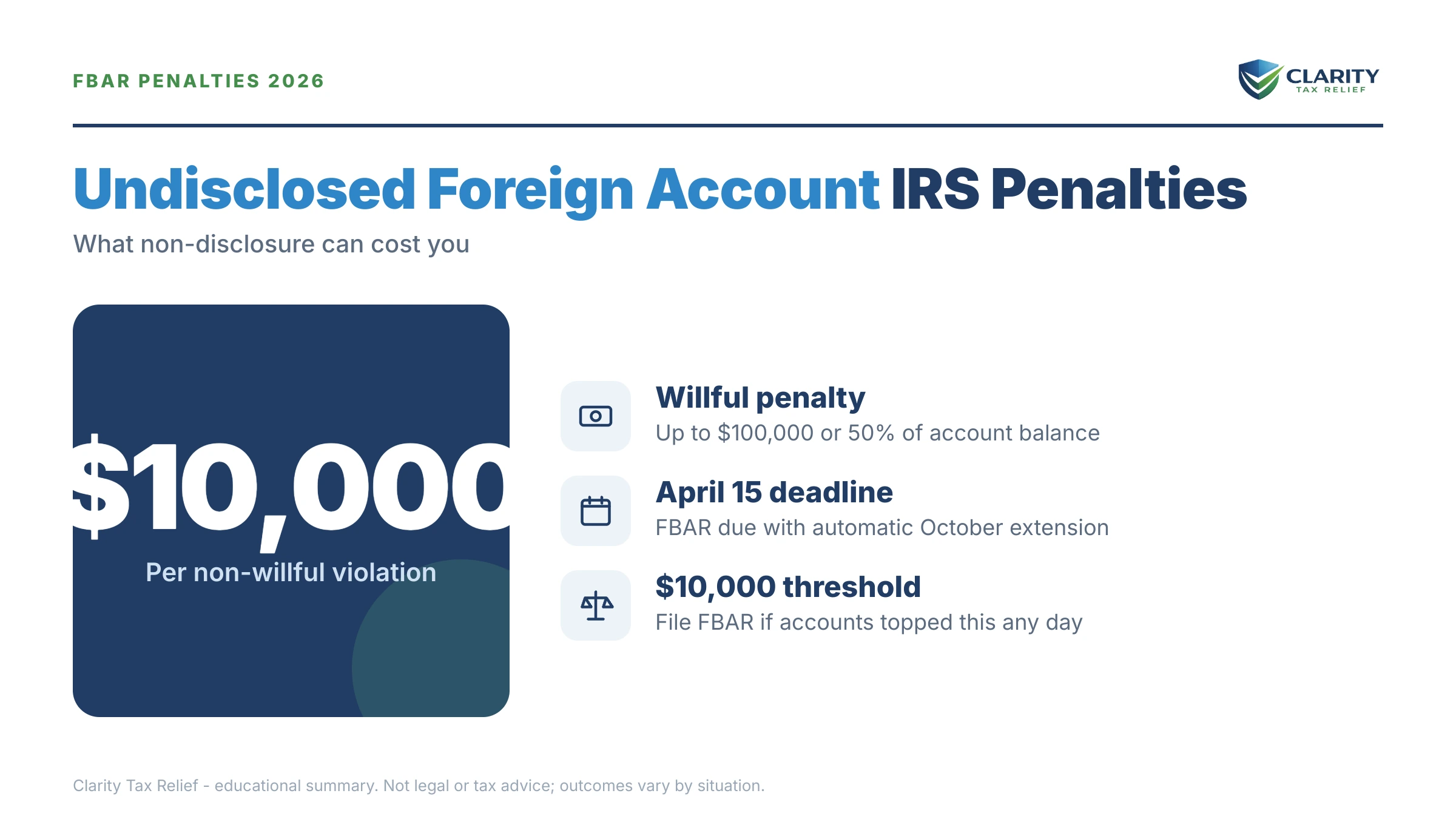
The short answer: an undisclosed foreign account exposes you to IRS-enforced FBAR penalties starting at $10,000 per unfiled report (adjusted annually for inflation) — and up to 50% of the balance per year if the failure was willful. Several disclosure programs can cut that to little or nothing, but only if you come forward before the IRS contacts you.
Maybe your bank back home just emailed asking you to certify your U.S. status on a W-9. Maybe you learned the word "FBAR" an hour ago and realized the account you've had since before you moved here was supposed to be reported every year. Either way, you're not facing a bill yet — you're facing a choice about who moves first, and right now you still hold the better position.
Most people in this spot have never seen the filing they missed — the image below shows you exactly what it looks like and where your account information goes, so you know what you're actually catching up on.
⏱ Your real deadline: there is no date printed on a letter — yet. Every fix described below (late FBAR filings, streamlined procedures, voluntary disclosure) is only available before the IRS contacts you about the account or opens an exam. FATCA data arrives on the IRS's schedule, not yours, and interest on any unpaid tax accrues daily until you act.
Why your undisclosed foreign account isn't hidden from the IRS
Under FATCA, foreign banks in more than 100 jurisdictions report their U.S. account holders — names, taxpayer IDs, and balances — to the IRS. "Undisclosed" describes what you haven't told the IRS, not what the IRS doesn't know. In most cases the data is already sitting in an IRS database waiting to be matched against your returns.
The reporting duty catches far more people than the word "offshore" suggests. It applies to U.S. citizens, green card holders, and tax residents — including a gig worker who kept the savings account from home, a dual citizen whose parent added them to a family account, and anyone with mere signature authority over someone else's foreign account. It doesn't matter that the account is legal, that you paid tax on it abroad, or that it earns almost nothing. The duty is to report its existence.
What makes this different from ordinary back taxes: the penalties attach to the missed paperwork, not the unpaid tax. An account that produced $40 of interest can generate five-figure penalties per year — which is also why the fixes are paperwork-driven, and why the right program matters more than the size of the debt. For how ordinary balance-due penalties compound by comparison, see how much IRS penalties on back taxes really grow.
What you were supposed to file — and what each miss costs
The FBAR is required once all your foreign accounts together exceed $10,000 at any point in the year — even for a single day. It's FinCEN Form 114, filed electronically and separately from your tax return, due April 15 with an automatic extension to October 15. Larger holdings can also trigger Form 8938, which attaches to your 1040 and starts at $50,000 in foreign financial assets for a single U.S. resident (higher thresholds apply for married couples and Americans abroad). The image below shows where the account name, number, and maximum balance appear on the filing — those maximum-balance boxes are what drive the penalty math.
| Missed filing | When it's required | Penalty exposure if the IRS assesses it |
|---|---|---|
| FBAR (FinCEN 114) — non-willful | Foreign accounts exceed $10,000 combined at any point in the year | $10,000 statutory penalty per unfiled report, inflation-adjusted upward each year; after Bittner v. United States (2023), per report — not per account |
| FBAR — willful | Same threshold, but the IRS proves you knew or recklessly ignored the duty | The greater of roughly $100,000 (inflation-adjusted) or 50% of the account balance, per year; criminal referral possible in egregious cases |
| Form 8938 (FATCA) | Foreign financial assets exceed $50,000 (single, U.S. resident; higher for married/abroad) | $10,000, plus up to $50,000 more for continued failure after IRS notice |
| Form 3520 / Form 5471 | Foreign gifts or trusts / ownership in a foreign corporation | Up to 25% of an unreported foreign gift; $10,000-and-up per missed information return — see the Form 3520 penalty guide |
Two more facts frame your exposure. The government has six years to assess FBAR penalties after each missed deadline — so "old" years are still live. And the willful/non-willful line isn't about intent to cheat; checking "No" on Schedule B's foreign-account question, or moving money after learning the rules, is the kind of evidence the IRS uses to argue willfulness. Willful facts can also open the door to the IRS civil fraud penalty on any unreported income.
What happens if the IRS finds the account first
The moment the IRS contacts you about a foreign account, every voluntary-disclosure and streamlined door closes. That single rule is what makes this problem different from a CP14 or a payment plan: the sequence below isn't about growing balances, it's about vanishing options.
- FATCA data lands. Your bank (or its government) reports your name, ID, and balances. Nothing happens visibly — the record simply exists.
- A soft letter or Letter 6291 arrives. The IRS tells you it has foreign-account information that doesn't match your filings and invites you to fix it. Streamlined eligibility is now in serious doubt.
- An examination opens. Once you're under exam for any year, every disclosure program is off the table by its own terms. The examiner — not you — now decides whether your conduct was willful.
- Penalties are assessed. Non-willful penalties can stack per unfiled report across up to six years; a willful finding applies the 50%-of-balance formula per year, which can exceed the account itself.
- Collection begins — and willful cases can go further. Assessed FBAR penalties are enforced like other federal debts, and the most aggressive fact patterns are referred for criminal investigation.
In 2026 this runs largely on autopilot. IRS staffing is down roughly 27% since 2025, but FATCA matching and letter generation are automated — the data doesn't wait for a human to be assigned to your file.
Have a foreign account you never reported?
Get your exposure reviewed free before the IRS makes first contact — the streamlined and voluntary-disclosure doors close the day a letter or exam arrives. An experienced tax professional will map which program fits your facts, confidentially and with no pressure.
Your options in 2026: every disclosure path, its cost, and its timeline
There are four legitimate ways to fix an undisclosed foreign account — and one trap that looks like a fifth. Which one fits depends on three questions: was your failure non-willful, do you meet the non-residency test, and did you file your original tax returns?
| Path | Who it's for | What it costs | Typical timeline |
|---|---|---|---|
| Late FBAR filing through FinCEN (the formal Delinquent FBAR Submission Procedures were removed by the IRS in late June 2026) | You reported and paid tax on all the account's income — you only missed the FBAR itself | Penalties are not automatic when all the account income was reported and taxed, but the IRS no longer guarantees a $0-penalty outcome; you e-file the late FBARs with a statement explaining the delay | Weeks — still the fastest fix available |
| Streamlined Foreign Offshore (SFOP) | Non-willful taxpayers who meet the non-residency test — original delinquent returns accepted | $0 offshore penalty; pay tax + interest on 3 years of returns, file 6 years of FBARs, certify on Form 14653 | Months to prepare and process |
| Streamlined Domestic Offshore (SDOP) | Non-willful U.S. residents who filed original returns for the covered years | 5% of the highest year-end balance of the undisclosed assets, plus tax + interest on 3 amended returns; certify on Form 14654 | Months to prepare and process |
| Voluntary Disclosure Practice (VDP) | Willful conduct — you need protection from criminal referral | Substantial civil penalties (typically a willful-tier FBAR penalty) in exchange for that protection; starts with Form 14457 preclearance | A year or more, working directly with the IRS |
| Quiet disclosure | No one — filing old forms without a program preserves full penalty exposure and flags the account | Every penalty above remains assessable, with your own filings as the evidence | Not a real option |
A few notes the table can't hold. The streamlined offshore procedures (foreign version) are the closest thing to true amnesty in the tax code — zero offshore penalty — but the non-residency test is strict. The streamlined domestic offshore path costs 5% and, critically, requires that you filed original returns for the three covered years, because it runs on amended returns; those amendments should be prepared carefully, since sloppy ones invite the accuracy related penalty IRS examiners apply to understatements. Non-filers living in the U.S. fall between the two streamlined programs — a common gap covered in the worked example below.
And about the trap: a quiet disclosure — mailing in amended returns and late FBARs without entering a program — hands the IRS a signed confession with none of a program's protections. If your facts are genuinely willful, the only safe route is the IRS voluntary disclosure practice, and that's a decision to make with representation, not alone.
A worked example: three unfiled years and an $11,300 account
Say you've been driving for delivery apps for three years without filing, and you still have the savings account from your home country — it peaked at $11,300, just over the $10,000 FBAR line, earning about $40 of interest a year. This is hypothetical, but it's the most common shape of this problem: the foreign account is small; the paperwork exposure isn't.
If the IRS finds you first, the FBAR side alone is three missed reports. At the $10,000 statutory non-willful penalty per report (before inflation adjustments push it higher), that's 3 × $10,000 = $30,000 of exposure — nearly three times the account itself, and separate from anything owed on the gig income.
If you move first, the math flips. Suppose each unfiled year's return shows about $3,000 due on the gig income (including the $40 of foreign interest). The failure-to-file penalty runs 5% per month and caps at 25% — $750 per year, $2,250 across three years — plus failure-to-pay at 0.5% per month and interest. Call it roughly $12,000–$13,000 total, and the balance fits a payment plan — though this is an illustrative estimate for the hypothetical only; eligibility for penalty-free relief depends on your complete facts (all income reported, no prior IRS contact), and no outcome is guaranteed. You can run your own year-by-year numbers with our Penalty & Interest Calculator — it estimates, it doesn't promise.
The wrinkle: as a U.S. resident who never filed originals, you don't fit SDOP, and living stateside rules out SFOP. The usual path is filing the three back returns — the same process covered in haven't filed in 3 years — reporting every dollar including the foreign interest, and submitting the late FBARs with a reasonable-cause explanation. On facts this clean (small account, trivial income, no concealment), FBAR penalties are often avoidable entirely — but "often" is doing real work in that sentence, which is why the sequencing deserves professional eyes before anything is mailed.
How to respond, step by step
- Inventory every foreign account. Pull six years of statements for every foreign bank account, pension, brokerage, and e-wallet — and note the highest balance in each account for each year.
- Identify every missed filing. For each year, list what should have been filed — FBAR, Form 8938, Form 3520, Form 5471 — and whether the U.S. return for that year was filed and reported the account's income.
- Assess willfulness honestly. Write down what you knew and when — checking "No" on Schedule B, moving money after learning the rules, or using another name on the account changes which program is safe to use.
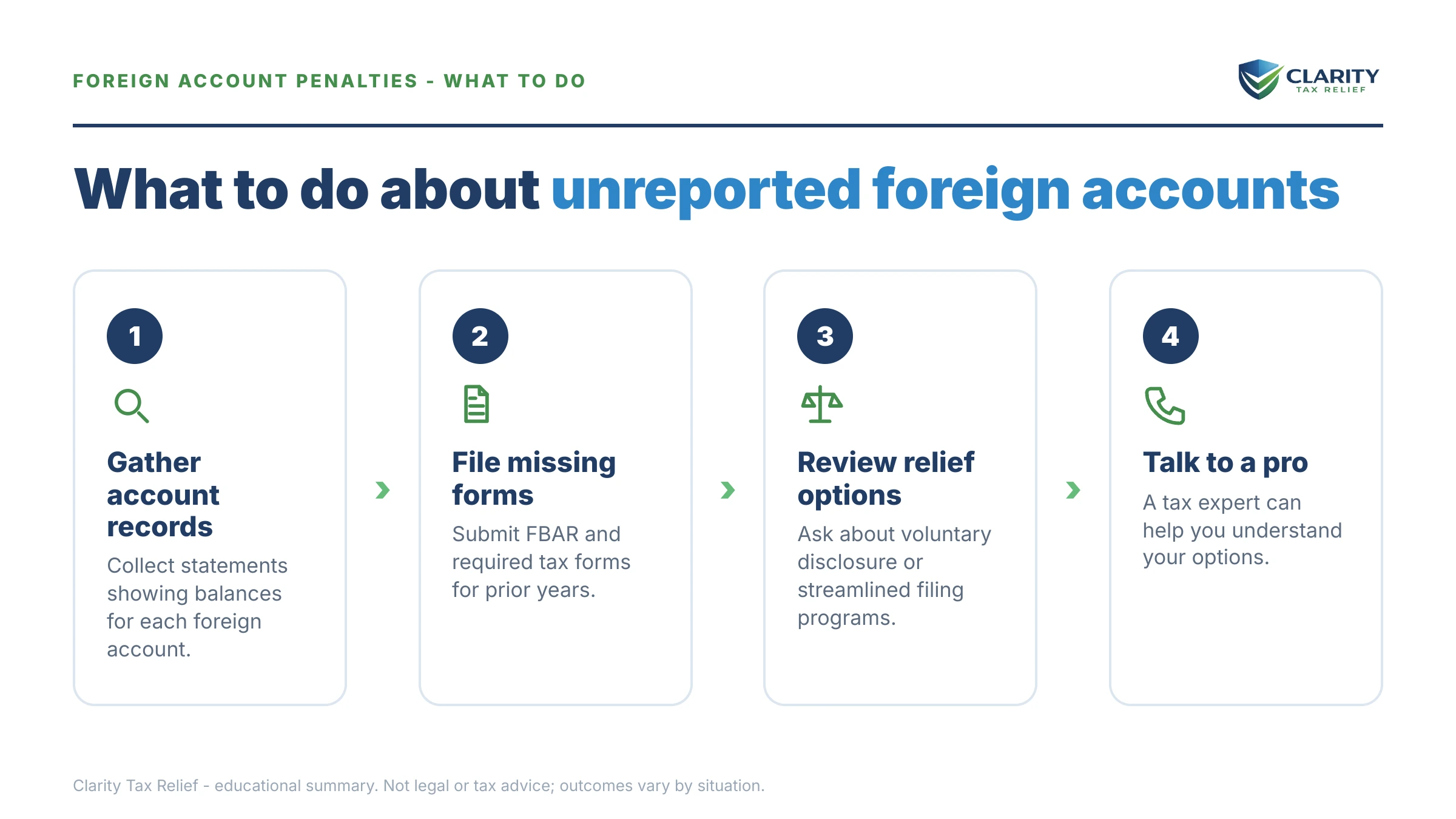
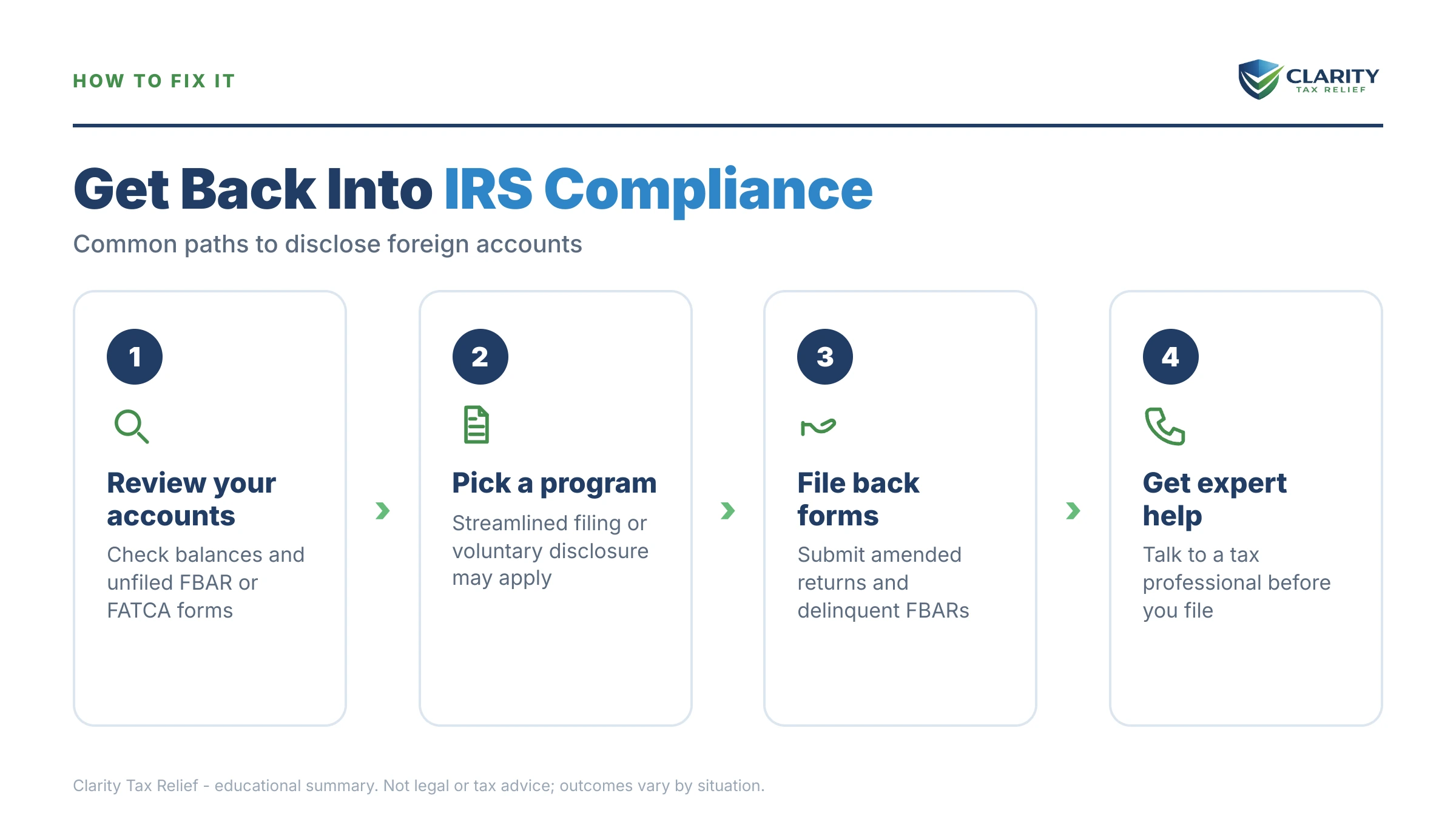
- Choose one disclosure path. Match your facts to a late FBAR filing through FinCEN with an explanation, the streamlined procedures, or the Voluntary Disclosure Practice — and never file the old forms quietly without a program.
- File the complete package and settle the tax. Submit every required year together with the certification the program requires, pay the tax and interest or set up a payment arrangement, and keep proof of everything.
When you can handle this yourself — and when you shouldn't
If your returns already reported all the account's income and you only missed the FBAR form, your fix may still be simple — but the rules changed in June 2026. The IRS removed its formal Delinquent FBAR Submission Procedures in late June 2026 — you can still e-file late FBARs through FinCEN's system with a statement explaining the delay, and penalties are not automatic when all the account income was reported and taxed, but the IRS no longer guarantees a $0-penalty outcome, so talk to a tax professional before filing. Likewise, if your accounts never crossed $10,000 combined and the income was reported, you may have no FBAR problem at all — verify the yearly maximums before assuming the worst.
Get experienced help before filing anything if any of these are true: you checked "No" to the foreign-account question on a return you signed; the account held six figures or received unexplained deposits; you have unfiled returns alongside the unfiled FBARs (the between-programs gap above); the account holds crypto on a foreign exchange; or you've already received a soft letter. In those situations, which program you enter and what the certification says determines whether you pay hundreds or tens of thousands — and a willfulness misjudgment can't be walked back. Where penalties do get assessed, reasonable-cause relief is argued in writing; our IRS penalty abatement letter guide shows what a persuasive request looks like.
Terms on the forms, decoded
- FBAR — the Report of Foreign Bank and Financial Accounts (FinCEN Form 114), filed with the Treasury's FinCEN, not with your tax return.
- FATCA — the 2010 law forcing foreign banks to report U.S. account holders to the IRS; it's why the account is already visible.
- Willful — the IRS's label for knowing or reckless failure to report; it's proven with your own paperwork (like Schedule B) and multiplies penalties roughly tenfold.
- Quiet disclosure — filing late or amended forms without entering a program; it preserves full penalty exposure while flagging the account.
- Miscellaneous offshore penalty — the one-time 5% charge on the highest year-end balance that buys peace under the domestic streamlined program.
- Reasonable cause — the facts-and-circumstances defense that can eliminate penalties when you exercised ordinary care and still missed the filing.
Undisclosed foreign account questions, answered
How does the IRS find out about foreign bank accounts?
Mostly through FATCA: foreign banks in over 100 jurisdictions report their U.S. account holders — name, taxpayer ID, and balances — directly or through their governments to the IRS. The IRS matches that data against filed returns and FBARs. Whistleblower tips and information from other investigations fill the gaps, and the government has six years to assess FBAR penalties once a filing deadline passes.
What is the penalty for an undisclosed foreign account?
For a non-willful failure, the statutory penalty starts at $10,000 per unfiled FBAR, adjusted upward each year for inflation — and after the Supreme Court's Bittner decision, it applies per report, not per account. If the IRS decides your failure was willful, the penalty jumps to the greater of roughly $100,000 (inflation-adjusted) or 50% of the account balance, for each year. Disclosure programs can reduce that exposure to little or nothing if you use them before the IRS contacts you.
Do I have to report a foreign account under $10,000?
Not on an FBAR — the filing requirement triggers only when all your foreign accounts combined exceed $10,000 at any point in the year, even for one day. Two accounts holding $6,000 each cross the line together. Any interest or investment income the account earns is taxable on your U.S. return regardless of the balance, so a small account can still create a filing problem on the tax side.
Can I just close the foreign account instead of reporting it?
No — closing the account does not erase the reporting duty for the years it was open, and the government has six years to assess FBAR penalties for each missed filing. Worse, closing or moving an account after learning about the rules is exactly the kind of conduct the IRS points to as evidence of willfulness, which multiplies the penalty. The account's closing records will still exist in FATCA data.
Is not filing an FBAR a crime?
Usually not — most missed FBARs are civil matters, and non-willful failures are routinely fixed through the streamlined procedures or late FBAR filings with modest or zero penalties. Willful violations are different: deliberately hiding an account, using nominee names, or lying on Schedule B can support criminal prosecution. That is what the IRS Voluntary Disclosure Practice exists for — trading a significant civil penalty for protection from criminal referral.
What is the difference between the FBAR and Form 8938?
The FBAR (FinCEN Form 114) goes to the Treasury's FinCEN, triggers at a $10,000 aggregate balance, and is filed separately from your tax return. Form 8938 is a FATCA form attached to your Form 1040, with higher thresholds — starting at $50,000 in foreign financial assets for a single U.S. resident. Many people must file both for the same account, and each carries its own separate penalty, so fixing one without the other leaves you exposed.
Can I use the streamlined program if I never filed tax returns at all?
It depends on where you live. The Streamlined Foreign Offshore Procedures accept original delinquent returns from taxpayers who meet the non-residency test, with no offshore penalty at all. The domestic version (SDOP) requires that you filed original returns for the covered years, because it works through amended returns — a U.S.-resident non-filer falls between the programs and needs a tailored plan, usually filing the back returns with FBARs and a reasonable-cause statement.
Primary sources worth bookmarking: the IRS's own FBAR overview, its Streamlined Filing Compliance Procedures page, and IRS.gov/payments for settling any tax the catch-up returns show.
Your next 24 hours
- Find your highest balances. Log into the foreign account (or email the bank) and pull the maximum balance for each of the last six years — those numbers determine whether you had a filing duty and what any penalty formula uses.
- Gather your filing history. Collect your last filed U.S. return (check Schedule B's foreign-account question), a list of any unfiled years, and any letter you've received mentioning foreign accounts.
- Get the free case review. Send us what you found through the 2-minute form or call (888) 825-7779 — the disclosure programs only work before the IRS contacts you, and interest on any unpaid tax is accruing daily either way.
This guide is general information, not tax or legal advice for your specific situation. Eligibility for IRS programs depends on individual facts and circumstances; no outcome is guaranteed.