
IRS Penalties & Interest
How Much Are IRS Penalties on Back Taxes? The Real Math for 2026
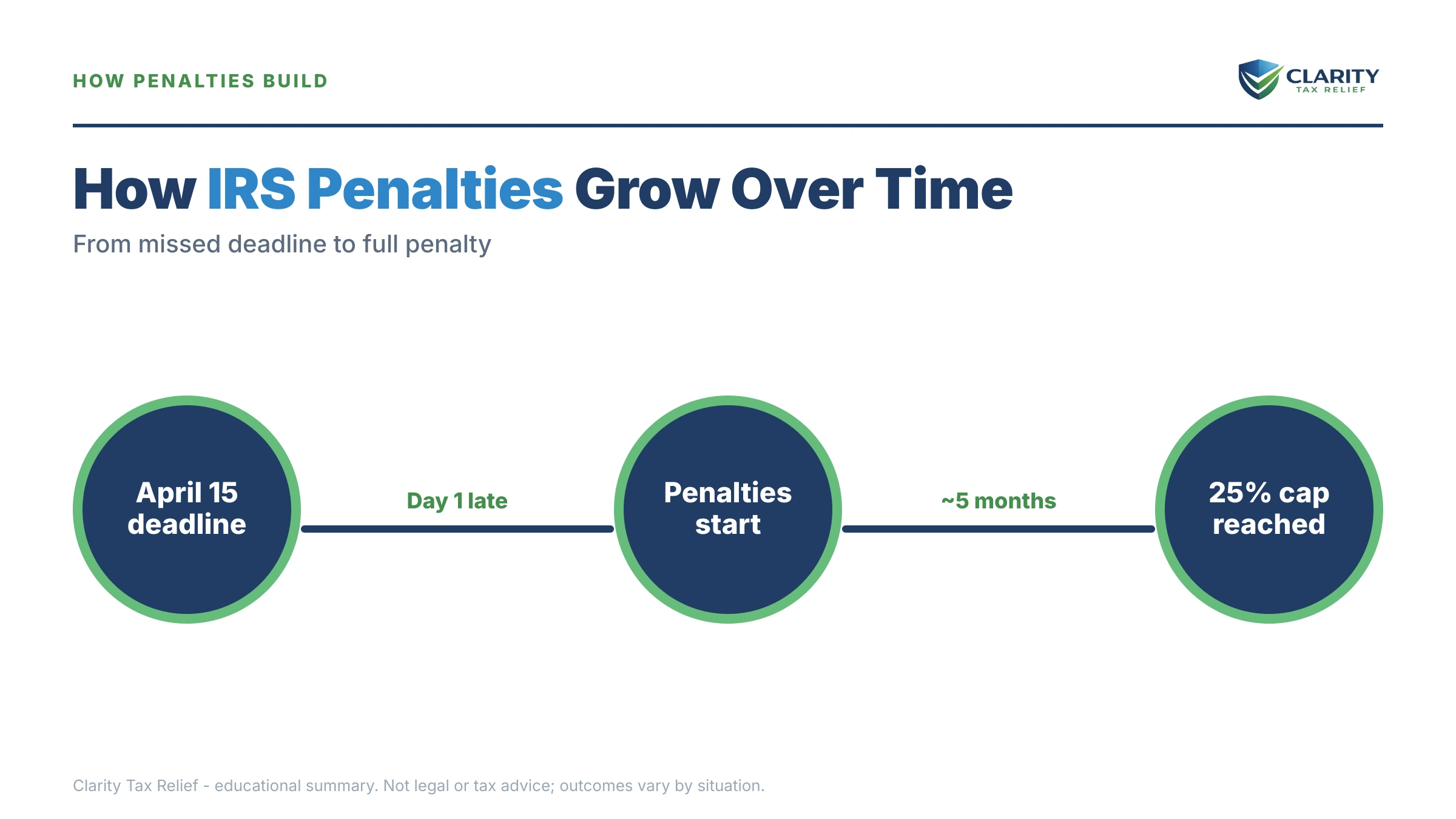
The short answer: IRS penalties on back taxes run 0.5% of the unpaid tax per month if you filed but didn't pay, and 5% per month if you never filed — each capped at 25%. Interest compounds daily on top. Combined, penalties alone can add up to 47.5% to the tax you owe.
If you're asking how much are IRS penalties on back taxes, you've probably just compared two notices and realized the balance grew even though you didn't owe anything new. That growth isn't a mistake — it's three separate charges stacking by formula, every single month. The good news: the formula runs both ways. Once you know which charges are on your account, you know exactly which ones can be cut, capped, or removed entirely.
⏱ The real clock: there's no single deadline on penalties — they accrue automatically. Every month a back-tax balance sits unpaid adds another 0.5% in failure-to-pay penalty, and interest compounds every single day. On a $13,600 balance, that's roughly $68 in new penalty each month before interest. The clock only stops when you act.
The three charges that stack on every back-tax balance
Every unpaid federal tax balance carries up to three separate charges: the failure-to-file penalty, the failure-to-pay penalty, and daily-compounding interest. Understanding which of the three you're being charged is the first step, because each has a different rate, a different cap, and a different fix.
Failure-to-file (FTF): 5% of the unpaid tax for each month or part of a month a required return is late, capped at 25%. If the return is more than 60 days late, a minimum penalty kicks in — the lesser of an inflation-adjusted flat amount or 100% of the tax due. This is the expensive one, and it's entirely avoidable: file even if you can't pay, and it never starts.
Failure-to-pay (FTP): 0.5% of the unpaid tax per month, also capped at 25%. The rate isn't fixed — it moves with your collection status. It drops to 0.25% per month while an approved installment agreement is in effect, and it doubles to 1% per month after the IRS issues a final notice of intent to levy. The full breakdown of how these two penalties interact is in our guide to failure-to-file vs. failure-to-pay penalties.
When both penalties run in the same month, the failure-to-file penalty is reduced by the failure-to-pay amount — so the combined hit is 5% per month (4.5% + 0.5%), not 5.5%. Over time, the two together can reach 47.5% of the tax: 22.5% FTF plus 25% FTP.
Interest: charged at the federal short-term rate plus 3 percentage points, reset quarterly and compounded daily — on the tax and on the penalties once assessed. Unlike the penalties, interest has no cap. Current quarterly figures and how the compounding actually works are covered in how IRS interest actually compounds in 2026.
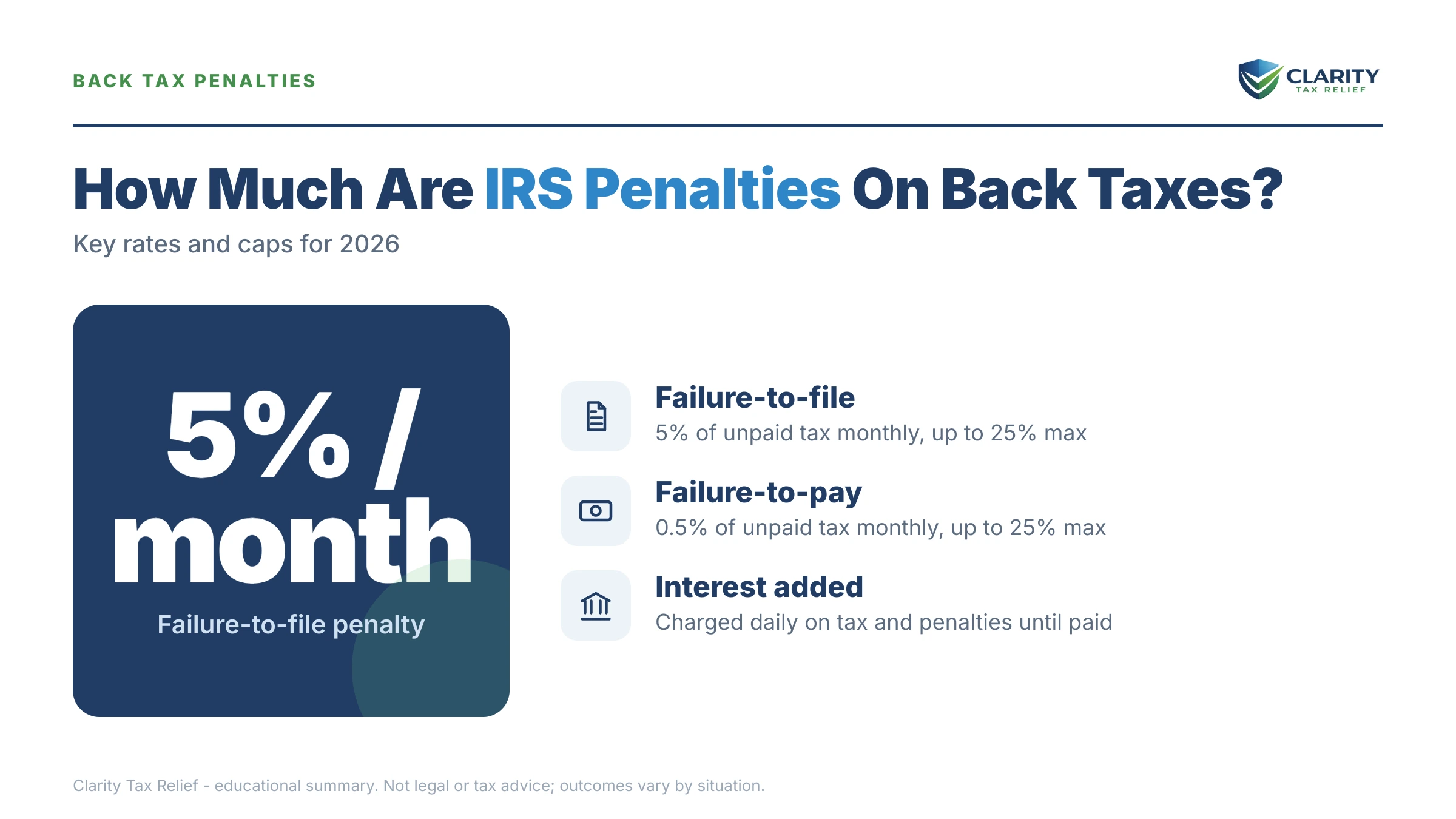
How much are IRS penalties on back taxes? The 2026 rates
In 2026, the failure-to-pay penalty is 0.5% of the unpaid tax per month and the failure-to-file penalty is 5% per month — each capped at 25% of the tax. Here is every rate that can appear on a back-tax account, side by side:
| Charge | Rate | Maximum | When it applies |
|---|---|---|---|
| Failure-to-file | 5% of unpaid tax per month | 25% of the tax | Return filed late with a balance due |
| Failure-to-pay | 0.5%/month (0.25% on a payment plan; 1% after a final levy notice) | 25% of the tax | Tax unpaid after the due date |
| Both in the same month | 5% combined (4.5% FTF + 0.5% FTP) | 47.5% combined lifetime | Return both unfiled and unpaid |
| Accuracy-related | 20%, one-time | 20% of the understatement | Negligence or substantial understatement |
| Civil fraud | 75%, one-time | 75% of the underpayment | Intentional fraud, proven by the IRS |
| Estimated-tax penalty | Interest-rate based, per quarter missed | Runs until each shortfall is paid | Underpaid quarterly estimates |
| Interest | Federal short-term rate + 3%, compounded daily | No cap | Any unpaid tax or penalty |
A few clarifications that trip people up. The accuracy related penalty irs examiners assess is a one-time 20% on the portion of tax you understated — it doesn't grow monthly, but interest runs on it from the return's original due date. The 75% civil fraud penalty is rare and requires the IRS to prove intent. And the estimated-tax penalty isn't a flat percentage at all — it's computed like interest on each quarterly shortfall, which is why the math surprises people who didn't pay estimated taxes. For a tour of every penalty the IRS assesses in volume, see the IRS most common penalties guide.
One more distinction worth naming: the answer changes depending on whether you filed. The failure-to-file penalty is ten times the failure-to-pay penalty — 5% versus 0.5% per month. Two people who each owe $13,600 for the same year can be in wildly different positions purely based on whether a return went in on time.
What penalties add to $13,600 in back taxes: a worked example
On a $13,600 back-tax balance, penalties and interest add roughly $1,800 in the first year alone — and the pace never slows on its own. Here's the arithmetic.
Say you're retired, living mostly on Social Security, and a large IRA withdrawal in 2024 — maybe to help a family member or cover a roof — left $13,600 due on the return. You filed on time in April 2025 but couldn't pay. This is hypothetical, but the math is exact:
- Failure-to-pay penalty: 0.5% × $13,600 = $68 per month. After 15 months, that's $1,020.
- Interest: at an illustrative 7% annual rate (the real rate resets quarterly), roughly $80–$90 per month at first, compounding daily on the tax plus accrued penalties — call it about $1,250 over the same 15 months.
- Balance today: roughly $15,870 — nearly $2,300 added without owing a dollar of new tax.
Now the alternate universe: same retiree, same $13,600, but the return never got filed. The combined failure-to-file and failure-to-pay penalty would run 5% per month — $680 a month — for the first five months, adding $3,400 in penalties before interest. Filing on time saved this retiree over $3,000 in the first five months alone. Here's how the filed-but-unpaid balance keeps moving over time:
| Time unpaid | Failure-to-pay penalty | Interest (7% illustration) | Approximate balance |
|---|---|---|---|
| 6 months | $408 | ~$490 | ~$14,500 |
| 12 months | $816 | ~$1,010 | ~$15,430 |
| 24 months | $1,632 | ~$2,150 | ~$17,380 |
| 50 months (penalty caps) | $3,400 (25% max) | ~$4,600 and still growing | ~$21,600 |
Figures are rounded and the interest column is an illustration at 7% annual; the actual rate is the federal short-term rate plus 3%, reset each quarter. Notice the pattern in the last row: the penalty caps at month 50, but interest never does — which is why decade-old balances often carry more in additions than in original tax. You can run your own figures with our IRS Penalty & Interest Calculator, which estimates penalty and interest accrual for your balance and dates.
What happens if you ignore the penalties
Penalties don't just make the balance bigger — the unpaid balance behind them moves through a fixed, automated enforcement sequence. Each stage arrives with more interest attached and fewer good options available:
- CP14 — the first bill. Tax, penalty, and interest broken out, with roughly 21 days to pay or arrange payment. The cheapest moment in the entire sequence.
- CP501 / CP503 — reminders. Still just bills, but each cycle adds another month of failure-to-pay penalty and another month of daily compounding.
- CP504 — intent to levy your state refund. Under IRC §6331(d), the IRS can now take your state tax refund, and a federal tax lien becomes a realistic next step.
- LT11 / Letter 1058 — final notice of intent to levy. A 30-day clock starts, along with your Collection Due Process appeal rights (requested on Form 12153). This is also where the penalty math turns against you: after the final levy notice, the failure-to-pay rate doubles to 1% per month.
- Levy. Bank accounts (with a 21-day hold before funds leave), wages (continuous until released), and — critical for retirees — up to 15% of Social Security through the Federal Payment Levy Program.
For the retiree in our example, that last stage isn't abstract: the IRS is one of the few creditors that can reach a Social Security check, as we explain in the 15% Social Security levy. And while IRS staffing fell roughly 27% in 2025 — making a human hard to reach — the notice-and-levy machine is automated and never paused. The sequence advances whether or not anyone at the IRS reads your file.
Watching penalties pile onto your back taxes?
Every month adds another 0.5% plus daily interest — and abatement can often claw back what's already been charged. Send us your notice and an experienced tax professional will break down your tax vs. penalty vs. interest and map the cheapest way out. Free, confidential, no pressure.
Your options to stop or reduce IRS penalties in 2026
Penalty abatement removes qualifying IRS penalties in full — and the interest charged on those penalties disappears with them. That's the single most misunderstood fact on this topic: you usually can't get interest waived directly, but killing the penalty kills its interest automatically. Here's the full menu, with what each costs and who qualifies:
| Option | Who qualifies | Upfront cost | Effect on penalties & interest |
|---|---|---|---|
| Pay in full | Anyone | $0 | All accrual stops on the payoff date |
| Short-term payment plan | Can pay in full within 180 days | $0 setup | Enforcement stops; 0.5%/month and interest continue until paid |
| Long-term installment agreement | Up to $50,000 can apply online, up to 72 months | Setup fee (reduced or waived for lower incomes) | Failure-to-pay drops to 0.25%/month; interest continues |
| First-time abatement / AEP | Clean compliance in the prior 3 years | $0 | Removes FTF/FTP penalties for one year, plus their interest |
| Reasonable-cause abatement | Illness, disaster, or circumstances beyond your control | $0 (Form 843 or written request) | Removes penalties where cause is documented, plus their interest |
| Currently Not Collectible | Paying would leave you unable to cover basic living costs | $0 (financial disclosure required) | Collection pauses; penalties and interest keep accruing |
| Offer in Compromise | Assets and income genuinely can't cover the debt | $205 fee + 20% down (both waived with low-income certification) | Settles tax, penalties, and interest together for the accepted amount |
First-time abatement is the highest-value move for most people with one bad year: if your prior three years show no penalties, the IRS removes the failure-to-file and failure-to-pay penalties for that year on request. The full eligibility rules, the phone script, and what to do when it's denied live in our complete guide to first time penalty abatement. For our hypothetical retiree, FTA would erase the $1,020 in accrued failure-to-pay penalty and the interest that piled onto it — likely $1,100 or more back with one request.
Two 2026-specific notes. First, FTA is transitioning: starting in summer 2026, the IRS's new Automatic Exemption from Penalty (AEP) begins applying qualifying first-time relief automatically — no request needed. If your penalty posted before the changeover, you still request relief the traditional way. Second, if your clean-history year is used up, reasonable-cause penalty abatement remains available for events like serious illness, a death in the family, or a natural disaster — the request usually goes in on Form 843.
Interest itself is a different animal. It's set by statute, so the IRS can't waive it out of kindness — the narrow exception is IRS interest abatement under §6404, available when an IRS error or unreasonable delay caused extra interest to accrue. For everyone else, the interest strategy is indirect: abate the penalties, get on a plan to halve the ongoing penalty rate, and pay principal as fast as the budget allows.
On payment plans specifically: balances of $10,000 or less generally qualify for a guaranteed installment agreement, and balances up to $50,000 can be set up online in minutes — the walkthrough is in IRS payment plan online, step by step. The plan doesn't erase what's already accrued, but it cuts the go-forward penalty rate in half and takes levies off the table while you pay.
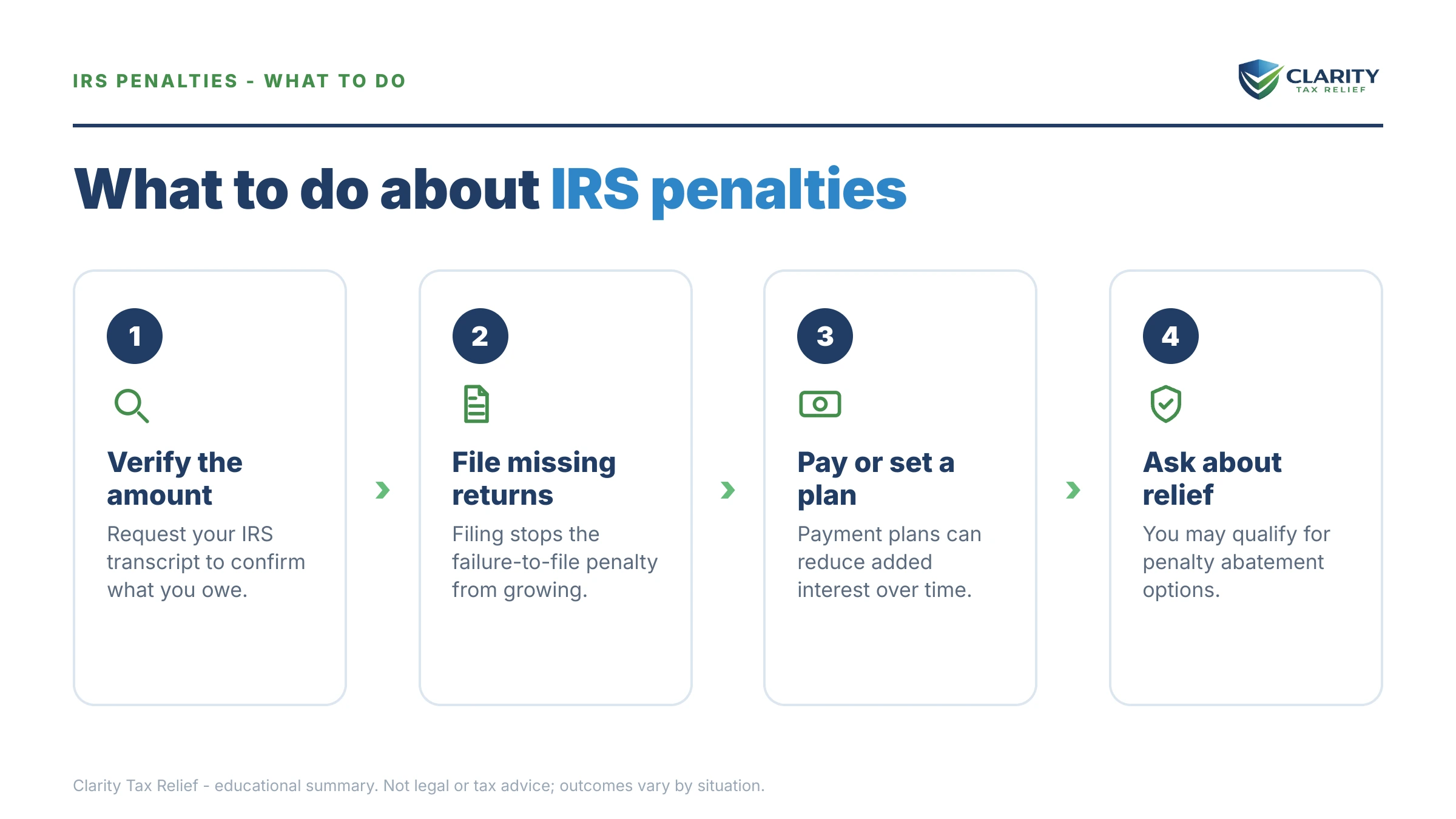
How to respond to growing IRS penalties, step by step
- Pull your exact balance — log into your IRS online account or request an account transcript so you can see tax, penalty, and interest broken out by year, not just the total on the notice.
- File any unfiled returns immediately — filing stops the 5%-per-month failure-to-file penalty, which is ten times the cost of not paying.
- Set up a payment arrangement — a short-term plan (up to 180 days, no setup fee) or an installment agreement, which cuts the failure-to-pay rate in half to 0.25% per month and stops the notice escalation.
- Request penalty abatement — check first-time abatement eligibility (clean prior three years) or file Form 843 with a reasonable-cause explanation; removing a penalty also removes the interest charged on it.
- Get a professional review for complex cases — multiple years, a levy already in motion, or income the IRS can reach (like Social Security) change the right order of moves, and sequencing mistakes cost real money.
The order matters more than people expect. Abating penalties before negotiating a payment plan means the plan is built on a smaller balance — lower monthly payment, less interest over the life of the plan. Filing before anything else stops the most expensive penalty from running another month.
When you can handle this yourself — and when help changes the outcome
You can resolve a straightforward penalty balance yourself if you agree with the tax, can pay within 180 days, and have a clean three-year history. In that case: verify the balance in your online account, set up the free short-term plan, and call the IRS to request first-time abatement — no professional needed, no fee owed to anyone. The IRS's own penalty overview at IRS.gov/payments/penalties and payment options at IRS.gov/payments cover the mechanics.
Experienced help tends to change the outcome in a handful of specific situations:
- Multiple years of penalties. FTA covers only one year; stacking it with reasonable-cause requests across other years is a sequencing exercise that's easy to get wrong and hard to redo.
- A levy is in motion. Once an LT11 clock is running — or Social Security is already being reduced — the priority flips from penalty math to stopping enforcement, and the 30-day appeal window is unforgiving.
- Fixed-income hardship. Retirees whose budget genuinely can't absorb a payment may qualify for Currently Not Collectible status instead of a plan they'll default on — the analysis is covered in retired and owe back taxes.
- Disputed penalties. Accuracy-related and fraud penalties are conduct penalties with their own defense procedures — arguing them is fundamentally different from requesting abatement.
- An abatement was denied. Denials are appealable, and appeals succeed regularly — but only when the reasonable-cause narrative is documented properly the second time.
If the balance keeps growing and the IRS phone lines keep disconnecting, the Taxpayer Advocate Service at taxpayeradvocate.irs.gov is a free, independent option for cases stuck in the system.
Terms on your notice, decoded
- Statutory additions — the IRS's umbrella term for penalties and interest added on top of the tax itself; it's why your notice total exceeds what your return showed.
- Failure-to-pay penalty — the 0.5%-per-month charge for unpaid tax after the due date; on notices it may appear simply as "penalty for late payment."
- Abatement — the formal removal of an assessed penalty; when a penalty is abated, the interest that accrued on it is removed too.
- Underpayment rate — the interest rate on unpaid balances: the federal short-term rate plus 3 percentage points, reset every quarter.
- Accrual — the ongoing monthly (penalty) and daily (interest) addition of charges; a notice shows accruals only through its print date, so the payoff figure is always slightly higher.
- CSED — the Collection Statute Expiration Date: the IRS generally has 10 years from assessment to collect, though certain events pause that clock.
Not sure whether the penalties on your notice are the abatable kind? An experienced tax professional can tell you in one free call whether first-time abatement, reasonable cause, or neither applies to your years — request a free case review or call (888) 825-7779 before another month of accrual posts.
IRS penalty questions, answered
How much is the IRS penalty for not paying back taxes?
The failure-to-pay penalty is 0.5% of the unpaid tax for each month or part of a month the balance goes unpaid, capped at 25% of the tax. The rate drops to 0.25% per month while an approved installment agreement is in place, and it doubles to 1% per month after the IRS issues a final notice of intent to levy. Interest accrues on top at the federal short-term rate plus 3%, compounded daily.
How much is the penalty for not filing a tax return?
The failure-to-file penalty is 5% of the unpaid tax per month, capped at 25% — ten times the failure-to-pay rate. If your return is more than 60 days late, a minimum penalty applies: the lesser of an inflation-adjusted flat amount or 100% of the tax due. That is why filing on time, even when you can't pay a dime, is always the right move.
Do IRS penalties on back taxes ever stop growing?
The penalties cap, but the interest never does. Failure-to-file maxes out at 25% (22.5% in months when the failure-to-pay penalty runs alongside it), and failure-to-pay maxes out at 25% — together up to 47.5% of the tax. Interest keeps compounding daily on the tax and on the penalties until the balance is paid or the collection statute expires.
Can the IRS remove penalties on back taxes?
Yes — penalty abatement is real and heavily used. First-time abatement removes failure-to-file and failure-to-pay penalties if your prior three years were clean, and reasonable cause relief covers serious illness, disaster, and other circumstances beyond your control. Starting in summer 2026, the IRS's Automatic Exemption from Penalty (AEP) begins applying qualifying first-time relief automatically, with no request needed.
Can IRS interest be waived?
Almost never for ordinary balances — interest is set by statute, not IRS discretion. The main exception is Section 6404 abatement when an IRS error or unreasonable delay caused extra interest to accrue. The practical way to cut interest is indirect: get penalties abated, because the interest charged on those penalties falls away with them, and pay the principal down faster.
Does the IRS charge interest on penalties?
Yes. Interest compounds daily on the unpaid tax, on the failure-to-file penalty, and on the failure-to-pay penalty once assessed. That stacking is why a balance can grow faster than the listed rates suggest — you're paying interest on the penalties, not just the tax. Removing a penalty through abatement also removes the interest that accrued on it.
Am I still charged a penalty while on an IRS payment plan?
Yes, but at half the rate. While an approved installment agreement is in effect, the failure-to-pay penalty drops from 0.5% to 0.25% per month, and interest continues at the full rate. A payment plan doesn't erase what accrued before you set it up — pair the plan with a penalty abatement request to attack the existing charges.
Can the IRS take my Social Security for back taxes and penalties?
Yes — through the Federal Payment Levy Program, the IRS can take up to 15% of a Social Security benefit continuously until the debt is resolved. It can't happen out of nowhere: you'll receive a final notice, usually a CP91 or LT11, with 30 days to respond first. Retirees on fixed incomes often qualify for hardship status or payment terms that prevent the levy entirely.
What is the maximum total penalty the IRS can charge on back taxes?
For a filed-late, paid-late return, combined failure-to-file and failure-to-pay penalties max out at 47.5% of the unpaid tax. Separate conduct penalties can go higher: 20% for accuracy-related understatements and 75% for civil fraud. Interest has no cap at all, so on old balances the total added can exceed the original tax itself.
Your next 24 hours
- Find the breakdown on your most recent notice — the box that splits your balance into tax, penalty, and interest. That split tells you exactly how much of what you "owe" is potentially removable.
- Gather three things: the notice, your last filed return, and a rough monthly income-and-expense picture. That's everything needed to test abatement eligibility and payment options.
- Get the free penalty review — use the 2-minute form or call (888) 825-7779. Penalties post monthly and interest compounds daily, so the analysis is worth doing this week, not next quarter.
This guide is general information, not tax or legal advice for your specific situation. Eligibility for IRS programs depends on individual facts and circumstances; no outcome is guaranteed.