
IRS Business Notices
IRS CP215 Notice: The Business Civil Penalty, Your Deadline, and How to Fight It (2026)
The short answer: a CP215 notice means the IRS has assessed a civil penalty against your business — most often for late, incorrect, or unfiled information returns like W-2s and 1099s, or international forms. It is a penalty, not extra tax. You can pay it, request abatement for reasonable cause, or appeal — by the due date printed on the notice.
You're standing at the shop counter with an envelope addressed to your company's EIN, and the number inside isn't tax you underpaid — it's a penalty for paperwork, assessed without an audit, a hearing, or a phone call. That's exactly what a CP215 is, and it lands hardest on small businesses with payroll, because W-2 and 1099 penalties stack per form. Here's the part the notice doesn't say: civil penalties like these are among the most abatable balances the IRS assesses, and there's a defined path to challenge one.
The image below shows you exactly what a CP215 looks like and where to find the three things that control your response: the code section the penalty was charged under, the tax period, and the due date. If you're not sure why any IRS mail shows up in the first place, our decoder on why did I get a letter from the IRS covers the whole system in one place — this page stays focused on the CP215 itself.
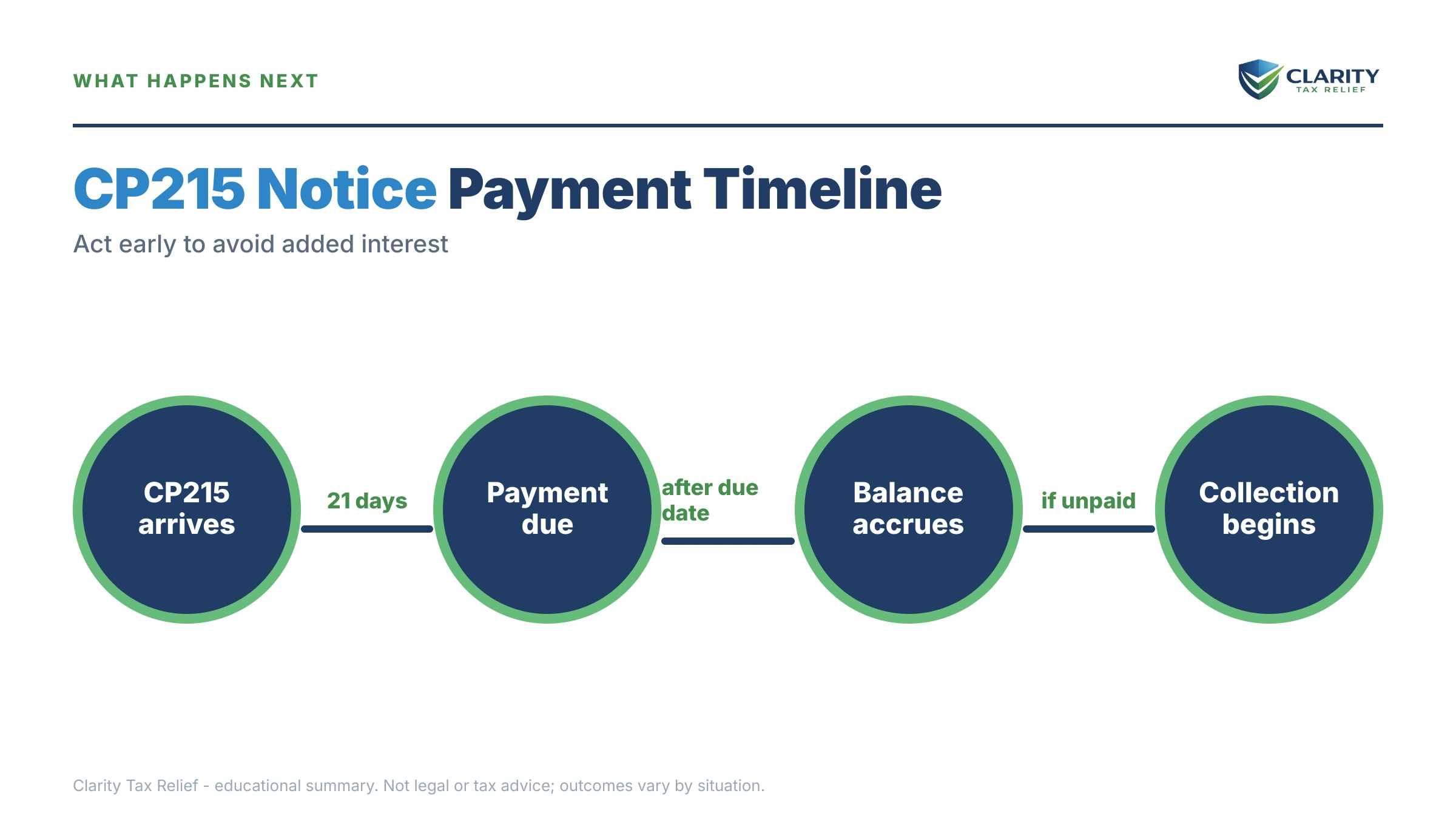
⏱ Your deadline: the due date printed on your CP215 — pay, or send your abatement request, by that date. Interest runs from the date the penalty was assessed, and a late-payment addition of 0.5% per month can begin once the due date passes. The longer the balance sits, the more you pay to make the same problem go away.
Why your business got a CP215 notice
A CP215 assesses a civil penalty against a business account — a standalone penalty charged under a specific Internal Revenue Code section, separate from any tax return balance. That distinction matters for two reasons. First, these are "assessable" penalties: the IRS can charge them without sending you a proposed adjustment or a 90-day letter first, which is why the CP215 often feels like it came out of nowhere. Second, because there was no exam, the IRS assessed the penalty without hearing your side — which is exactly what the abatement process exists to fix.
For a small employer, the most common trigger by far is information returns: W-2s or 1099s that were filed late, filed on paper when e-filing was required, filed with wrong TINs, or never transmitted at all — often because a payroll provider or bookkeeper dropped the handoff. Because the penalty is charged per form, a single missed batch of W-2s for a 15-person crew can produce a five-figure CP215.
| Penalty type | Code section | Typical trigger |
|---|---|---|
| Late, incorrect, or unfiled information returns | IRC §6721 | W-2s, 1099-NECs, 1099-MISCs, or ACA forms filed late, with errors, or not at all — charged per form |
| Missing or incorrect payee statements | IRC §6722 | Copies to employees or contractors never furnished or furnished with wrong data — stacks on top of §6721 |
| Foreign corporation reporting failure | IRC §6038 (Form 5471) | $10,000 per form, per year, for an unfiled or late Form 5471 |
| Foreign-owned U.S. company reporting failure | IRC §6038A (Form 5472) | $25,000 per form for an unfiled or late Form 5472 |
| Intentional disregard | IRC §6721(e) | The IRS believes the filing failure was deliberate — much higher per-form amounts with no annual cap |
The §6721 per-form dollar amounts are tiered — smallest if you correct within 30 days of the deadline, higher by August 1, highest after that — and they're inflation-adjusted each year, so check the exact figures printed on your notice rather than a chart. Roughly speaking, the intentional-disregard tier runs about double the top standard tier, per form, with the annual cap removed.
Don't confuse the CP215 with its business-notice siblings. A CP161 notice bills your business for unpaid tax on a return. A CP162 notice charges the per-partner, per-month penalty for a late 1065 or 1120-S. A CP215 is neither — it's a standalone civil penalty, and its main relief path (reasonable cause under §6724 for information returns) is different from both. Its individual twin is the CP15, which charges the same kinds of penalties against a personal SSN instead of a business EIN.
What happens if you ignore a CP215 notice
An unpaid CP215 puts your business into the same automated collection stream as unpaid tax — a stream that ends at levies on business bank accounts and accounts receivable. The sequence runs on autopilot: with the IRS workforce down roughly 27% since 2025, a human may never look at your file, but the notice system escalates on schedule regardless.
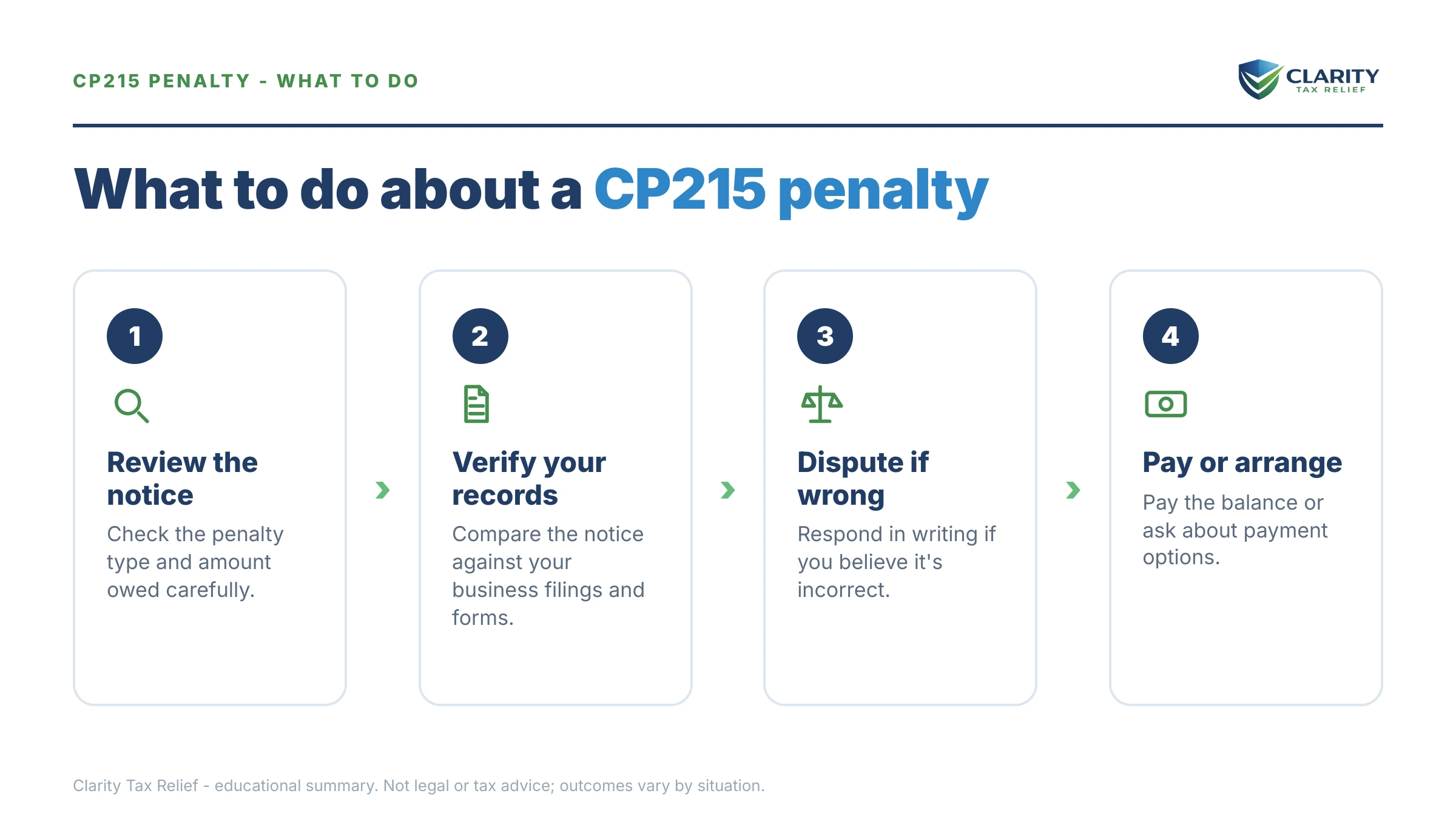
- CP215 — the penalty is assessed and the IRS formally demands payment. You are here. No enforcement yet, but interest is already running.
- Reminder notices — the business account shows a growing balance; each mailing adds accrued interest and the late-payment addition.
- CP504B notice — the business version of the intent-to-levy notice. The IRS can now take the company's state refund, and a federal tax lien against business assets becomes a live possibility.
- CP297A notice (final notice of intent to levy) — this one starts a 30-day clock and your Collection Due Process rights (requested on Form 12153). Miss it, and the IRS can levy without further warning.
- Levy — business bank accounts, and — more dangerous for an operating company — accounts receivable, where the IRS collects directly from your customers.
| Notice | What the IRS can do at this stage | The window or right at stake |
|---|---|---|
| CP215 | Demand payment; interest and late-payment additions accrue | Cheapest moment to pay or request abatement — due date printed on the notice |
| Reminder notices | Balance grows; account queues toward enforcement | You can still resolve by mail or online without enforcement pressure |
| CP504B | Seize the business's state tax refund; signal lien filing | Last stage before formal levy rights attach |
| CP297A (final notice) | Levy after 30 days from the notice date | 30 days to request a Collection Due Process hearing (Form 12153) — miss it and you lose the pre-levy hearing |
| Levy | Take business bank funds and accounts receivable | Release is possible but far harder than prevention |
One more cost of waiting: an abatement request filed while the balance is small and current gets decided on its merits. The same request filed after a levy is in motion has to fight the collection machinery at the same time.
Holding a CP215 for your business right now?
Send us a photo of it before the due date on the notice passes. An experienced tax professional will identify exactly which penalty was assessed, whether it's abatable, and the fastest way to keep it off the collection track — free, confidential, no pressure.
Your options: pay, abate, or fight — costs and timelines
Every CP215 has three basic response paths — pay it, get it removed, or contest it — and they can be combined. Which one fits depends on whether the penalty is factually correct and whether your business has a documented reason for the failure.
| Option | What it costs | Typical timeline |
|---|---|---|
| Pay in full | The penalty plus accrued interest; no fees | Immediate — stops interest and the late-payment addition, and ends the notice sequence |
| Reasonable-cause abatement (written statement or Form 843) | Free to request; the balance keeps accruing while pending unless you pay it | Several weeks to a few months for a decision — longer in 2026 with reduced IRS staffing |
| Pay first, then claim a refund of the penalty | Full payment up front; the abatement request rides on Form 843 | Months — but accruals stop on day one, and you preserve the argument |
| Business payment plan | A setup fee (varies by method); interest and the 0.5%/month addition continue | Smaller balances can often be arranged online quickly; larger ones require financial disclosure |
| Appeal a denied abatement | Free; balance continues accruing unless paid | Months — the Independent Office of Appeals reviews the case fresh |
For information-return penalties, the abatement standard lives in IRC §6724: reasonable cause. You have to show two things — that there were significant mitigating factors or events beyond the business's control, and that the business acted in a responsible manner both before and after the failure (for example, you corrected the filings as soon as you discovered the problem). The general playbook for entity-level penalty relief is in our business penalty abatement guide, and the standards themselves are unpacked in reasonable cause penalty abatement. When the request rides on a form, it's the Form 843 penalty abatement request — and if you want a starting draft, we publish a free business penalty abatement letter template.
Two honest caveats. First-time abatement generally does not cover the penalties CP215s carry — it applies to failure-to-file, failure-to-pay, and deposit penalties, not per-form information-return penalties (see first time penalty abatement for what it does cover). Second, the new automatic exemption from penalty (AEP) arriving in summer 2026 targets those same common penalties automatically — helpful for other balances your business may carry, but not a fix for a §6721 assessment. For a CP215, reasonable cause is usually the whole game.
A worked example: a $36,900 CP215 on a payroll business
Say you run a landscaping company with a dozen employees, and your CP215 assesses $36,900 in information-return penalties because your former payroll provider never transmitted last year's W-2s to the government — you found out from this notice. Here's the math on each path:
- Do nothing for a year: the late-payment addition alone runs 0.5% × $36,900 = $184.50 per month, roughly $2,214 over twelve months — plus interest compounding on top, plus the escalation sequence above. You can estimate how fast the pile grows with our IRS penalty & interest calculator.
- Payment plan: spread over 24 months, that's about $36,900 ÷ 24 = $1,537.50 per month before interest and additions — survivable, but real money out of operating cash flow every month.
- Reasonable-cause abatement: you gave the provider complete, accurate data before the deadline, you have the engagement contract and the data-submission confirmations, and you filed corrected W-2s within weeks of discovering the failure. If the IRS agrees you acted responsibly, the abatement removes some or all of the $36,900 — the difference between a payment plan and a letter.
This is hypothetical, and abatement is never automatic — but it shows why the order of operations matters. On a CP215, you evaluate abatement before you resign yourself to paying.
How to respond to a CP215, step by step
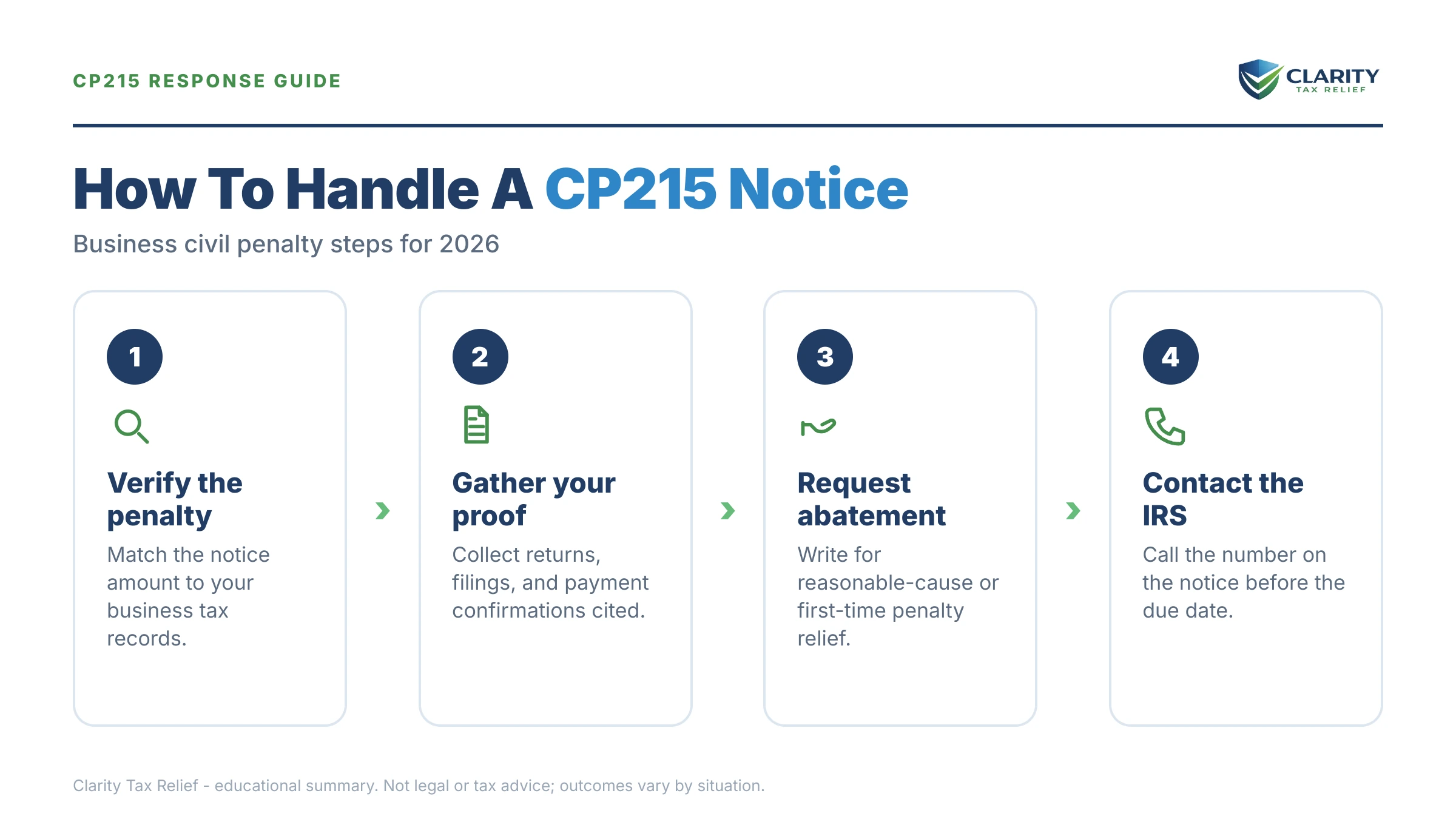
- Identify the penalty. Find the Internal Revenue Code section, the tax period, the penalty amount, and the due date on page one of your CP215.
- Pull your proof. Gather e-file confirmations, mailing receipts, payroll provider records, and any prior IRS correspondence for that period.
- Choose your path. Pay in full to stop the accruals, request reasonable-cause abatement, or do both and claim a refund of the abated amount later.
- Send your response by the due date. Mail your payment, written statement, or Form 843 to the address on the notice, and keep copies of everything.
- Arrange payments if you can't pay. Set up a payment arrangement so collection doesn't escalate while your abatement request is pending.
- Appeal a denial. Request a conference with the IRS Independent Office of Appeals if your abatement request is rejected.
When you can handle a CP215 yourself — and when help changes the outcome
Plenty of CP215s don't need professional help. If the penalty is small, factually correct — you know the 1099s went out late and there's no story behind it — and the business can pay it without strain, paying by the due date at IRS.gov/payments is the clean, cheap answer. Likewise, if you have one clear, well-documented reasonable-cause story (a hospitalization, a disaster, a provable vendor failure), a self-written statement with exhibits attached is a legitimate DIY project.
Experienced help earns its cost in four situations: when the assessment is five figures and stacked across many forms or multiple years, so the abatement argument has to be built form-by-form; when the notice charges intentional disregard, which roughly doubles the per-form amount and signals the IRS thinks the failure was deliberate; when international forms like the 5471 or 5472 are involved, where the penalties repeat every year the form stays unfiled; and when a CP504B or final notice has already arrived, because now the abatement fight and the levy defense have to run at the same time. The IRS's own overview of this notice is at Understanding your CP215 notice, and if the collection process itself is causing hardship the Taxpayer Advocate Service is a free, independent resource.
Terms on your CP215, decoded
- Assessable penalty — a penalty the IRS can charge directly, without a proposed adjustment or Tax Court letter first; that's why the CP215 arrives already final.
- Notice and demand — the formal request for payment your CP215 represents; it's what starts interest additions and the collection sequence.
- Reasonable cause (§6724) — the legal standard for removing information-return penalties: events beyond your control plus proof the business acted responsibly.
- Abatement — the IRS reducing or removing an assessed penalty, either on written request or on appeal.
- Intentional disregard — the IRS's finding that a filing failure was deliberate; it raises the per-form penalty sharply and removes the annual cap.
- Collection Due Process (CDP) rights — your right to a pre-levy hearing, triggered by the final notice and requested on Form 12153 within 30 days.
CP215 questions, answered
What is a CP215 notice from the IRS?
A CP215 is the IRS's formal notice that it has assessed a civil penalty against your business — it is a penalty, not additional tax. The most common triggers are late, incorrect, or unfiled information returns such as W-2s and 1099s, and international reporting forms like Form 5471 or 5472. The notice shows the penalty amount, the law it was charged under, and the due date.
Is a CP215 the same as a CP15?
No — they are the same type of notice aimed at different taxpayers. A CP15 assesses a civil penalty against an individual account, while a CP215 assesses one against a business account under its EIN. The response paths are similar — pay, request reasonable-cause abatement, or appeal — but a CP215 can lead to collection against business bank accounts and receivables.
Can I get a CP215 penalty removed?
Yes, if you can show reasonable cause — that your business acted responsibly and the failure was due to events beyond its control, such as a fire, serious illness of the person responsible for filing, or an unavoidable loss of records. Send a written statement or Form 843 with documentation to the address on the notice. If the IRS denies the request, you can take the case to the Independent Office of Appeals.
Does first-time penalty abatement apply to a CP215?
Usually not. First-time abatement covers failure-to-file, failure-to-pay, and failure-to-deposit penalties — most CP215 penalties, like information-return penalties, fall outside it, so reasonable cause is the main relief path. The Automatic Exemption from Penalty (AEP) rolling out in summer 2026 targets those same common penalties, so don't count on it to erase an information-return assessment either.
What happens if my business ignores a CP215?
The balance grows and collection escalates. Interest accrues from the assessment date, a late-payment addition of 0.5% per month can apply once the due date passes, and the IRS moves through its business collection sequence — reminder notices, a CP504B intent-to-levy, then a final notice that starts a 30-day levy clock. After that, the IRS can levy business bank accounts and accounts receivable.
Am I personally liable for a CP215 penalty?
It depends on your entity. If you operate as a sole proprietor or a single-member LLC taxed as one, the penalty is effectively yours, because you and the business are the same taxpayer. If you run a corporation or partnership, the penalty belongs to the entity — but the IRS can still levy the business's bank accounts, and a levy on receivables can hurt you just as fast.
My payroll company filed our W-2s late — is that reasonable cause?
It can be, but it isn't automatic. The IRS expects the business to show it acted responsibly — you hired a competent provider, gave them accurate data on time, and had no reason to know the filings were missed. Document the provider's failure in writing and include it with your abatement request; blaming the vendor without showing your own diligence usually fails.
Your next 24 hours
- Find three things on the notice: the code section the penalty was charged under, the tax period it covers, and the due date — those three facts determine your entire strategy.
- Gather your proof: the CP215 itself, e-file or mailing confirmations for the forms in question, your payroll or filing provider's records, and any related IRS letters for that period.
- Get a free case review before the due date on your notice passes: call (888) 825-7779 or use the 2-minute form — an experienced tax professional will tell you whether your CP215 is abatable before another month of interest and additions posts.
This guide is general information, not tax or legal advice for your specific situation. Eligibility for IRS programs depends on individual facts and circumstances; no outcome is guaranteed.