
Business Tax Debt
LLC Back Taxes Personal Liability: Who Actually Owes the IRS in 2026
The short answer: LLC back taxes personal liability depends on the tax type and how your LLC is taxed. Income tax from a single-member or partnership LLC is always your personal debt. Withheld payroll taxes become personal through the Trust Fund Recovery Penalty. Only entity-level tax on an LLC taxed as a C corporation stays with the LLC.
You're partway through a refinance application, the loan officer just asked about tax liens, and you're suddenly doing math on the balance your LLC has been carrying with the IRS — wondering whether a business debt can reach your house. That's an unsettling question to face mid-underwriting, and the honest answer is that some of that debt was probably yours all along. The good news: once you know which balances are legally yours, every one of them has a resolution path — and most can be handled before they touch your loan file.
⏱ Two clocks are already running. There's no single deadline printed on "LLC back taxes," but penalties and interest accrue monthly on every unpaid balance — and if you receive Letter 1153 proposing the Trust Fund Recovery Penalty, you have 60 days to protest before it's assessed against you personally.
Why your LLC's tax classification decides who owes the back taxes
An LLC has no tax classification of its own — the IRS taxes it as a sole proprietorship, a partnership, an S corporation, or a C corporation, and that choice determines whose name goes on the debt. The liability shield you formed the LLC for protects you from lawsuits and business creditors. It does not decide who owes federal tax, because most LLC taxes were never assessed against the LLC in the first place.
Here's the piece most owners miss: if your LLC is a single-member disregarded entity, its profit landed on Schedule C of your own Form 1040. The "business" tax debt is a personal 1040 balance sitting on your Social Security number. There's nothing to pierce — the shield was never between you and that debt. Our guide to single member LLC tax debt covers that structure in depth.
Multi-member LLCs taxed as partnerships work the same way one step removed: the LLC files Form 1065, but the tax flows to each member on Schedule K-1 and gets assessed on each member's personal return. An LLC that elected S-corporation status passes income through on K-1s too. In all three cases, unpaid income tax is your debt, collectible from your wages, your bank accounts, and — through a federal tax lien — your home.
The one classification that genuinely holds entity-level income tax at the entity is the C-corporation election: the LLC files Form 1120 and pays its own tax. Payroll taxes are the wild card that cuts across all four classifications — more on that next.
| Type of back tax | LLC classification | Who the IRS collects from |
|---|---|---|
| Income & self-employment tax | Single-member (disregarded) | You personally — it's a 1040 balance on your SSN |
| Income tax | Multi-member (partnership) | Each member personally, via Schedule K-1 |
| Income tax | S-corporation election | Owners personally, via Schedule K-1 |
| Income tax | C-corporation election | The LLC only (Form 1120), absent alter-ego or transferee issues |
| Payroll: withheld income tax + employee FICA | Any classification | Responsible individuals personally, via the Trust Fund Recovery Penalty |
| Payroll: employer FICA match, FUTA, penalties | Any classification | The LLC only |
| State sales tax (most states) | Any classification | Owners/officers personally under state trust-fund statutes |
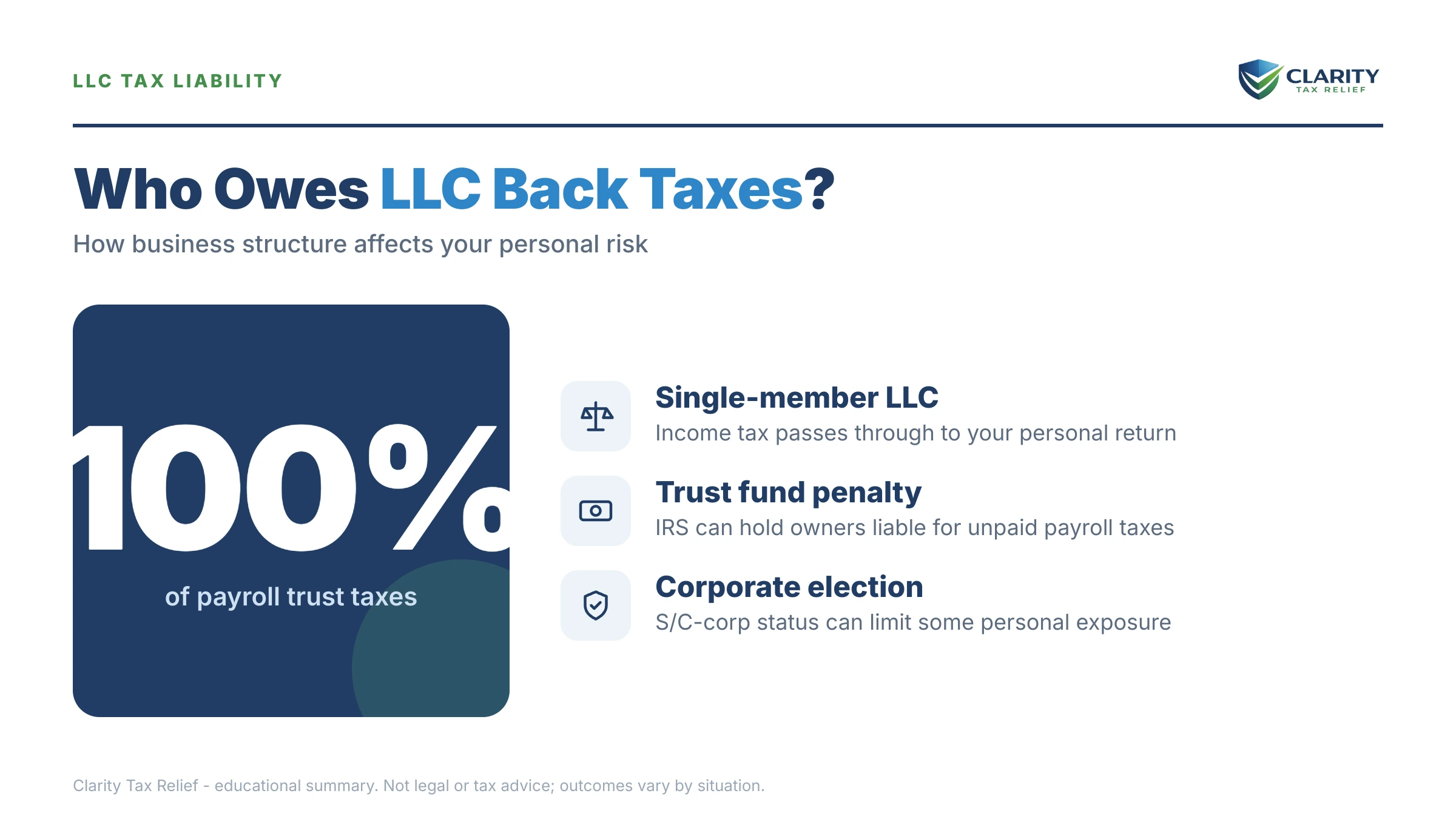
LLC back taxes personal liability: the two doors the IRS walks through
The IRS reaches LLC owners personally through two distinct legal doors — pass-through assessment and the Trust Fund Recovery Penalty — and each has its own paperwork, timeline, and defense.
Door one: pass-through assessment. For income tax, the IRS doesn't need any special procedure to come after you, because the debt was assessed on your personal account from the start. If your 1040 shows a balance from LLC profit, the collection machine treats it exactly like any other personal debt: notices, then a lien, then levies. There's no veil to argue about. If the debt sits on the LLC's own EIN instead — a Form 1065 or 1120-S late-filing penalty, for example — see our companion guide on what happens when an LLC owes IRS back taxes at the entity level.
Door two: the Trust Fund Recovery Penalty (TFRP). If your LLC ran payroll and fell behind on Form 941 deposits, the money withheld from employees' paychecks — their income tax withholding plus their share of Social Security and Medicare — is "trust fund" money the LLC held for the government. Under IRC §6672, the IRS can assess 100% of that trust-fund portion against any "responsible person" who "willfully" failed to pay it over. No lawsuit, no veil-piercing trial — an administrative assessment that converts business payroll debt into your personal debt. The full mechanics are in our trust fund recovery penalty guide.
Responsible doesn't mean "owner on paper." It means anyone with the authority to decide which bills got paid: members, managers, officers, and sometimes a check-signing bookkeeper. Willful doesn't mean malicious — paying rent, suppliers, or yourself while the 941 balance sat unpaid is enough. The IRS builds its case through the Form 4180 interview, then proposes the assessment on Letter 1153, which starts your 60-day window to protest.
Two more payroll details worth knowing. First, only 941 back taxes carry trust-fund exposure — Form 940 FUTA tax is entirely employer-side money and stays with the entity (the distinction is mapped in 941 vs 940 back taxes). Second, since 2009 the IRS treats even a disregarded single-member LLC as the employer for employment taxes — so the 941 debt starts on the LLC's EIN, but the TFRP brings the trust-fund slice back to you anyway.
When the LLC actually shields you — and the exceptions that break it
The LLC genuinely protects you from three categories of federal tax debt: entity-level income tax under a C-corporation election, the employer-side portions of payroll tax, and penalties assessed against the entity itself. If your LLC elected C-corp status and owes on its Form 1120, the IRS's default collection target is the LLC's assets — its bank accounts, receivables, and equipment — not your home.
That shield holds only as long as you respect it. The IRS breaks it with three theories, each requiring the government to prove facts rather than just send a notice:
- Alter ego / nominee liability — if the LLC was your personal pocketbook (commingled accounts, personal expenses run through the business, no real separateness), the IRS can treat its assets as yours and vice versa.
- Transferee liability — if you pulled money or assets out of the LLC while it owed tax, the IRS can follow those assets to you, up to the value transferred.
- Fraudulent transfer claims — moving property to a spouse, a new entity, or a trust to keep it away from the tax debt invites both collection action and, in bad cases, worse.
Dissolving the LLC doesn't reset any of this. Pass-through debt was always yours, trust-fund debt follows the responsible people for 10 years from the TFRP assessment under the collection statute, and distributed assets carry transferee exposure. If the business is already closed, our guide to payroll tax debt after a business closes walks through what survives.
One state-level caution: states run their own playbooks. California's FTB, for example, collects for up to 20 years and will suspend a delinquent LLC outright — a suspended LLC can't legally contract or defend itself in court. Most states also impose personal liability on owners for collected-but-unremitted sales tax. Never assume an IRS rule or threshold applies to your state agency.
Say you owe $41,800: what personal liability looks like in dollars
A worked example shows how the same $41,800 splits very differently depending on which tax created it. Say you're the sole member of a consulting LLC, you're planning to refinance your home this fall, and the total IRS balance across 2023 and 2024 is $41,800. (Hypothetical numbers throughout.)
Scenario A — it's pass-through income tax. All $41,800 is on your 1040s, on your Social Security number. Because the balance is under $50,000, you can set up a streamlined installment agreement online with no financial disclosure: $41,800 ÷ 72 months ≈ $581/month minimum. Interest and the failure-to-pay penalty keep accruing inside the plan, so paying $800–$900/month instead shortens the payoff by years and cuts the total accrual meaningfully — you can estimate your own penalty and interest with our calculator. For your refinance: at $41,800 unresolved, a Notice of Federal Tax Lien is a live risk, and a filed lien is exactly what underwriters search county records for. Getting into an agreement before a lien is filed usually keeps the loan viable; lenders typically want to see the agreement and a payment history. If a lien has already been filed, you're in refinancing with an IRS lien territory and will likely need tax lien subordination on Form 14134 before closing — a process measured in weeks, so start early. One quiet bright spot: $41,800 is below the $66,000 threshold (2026) for passport certification, though continued accrual across more years can close that gap.
Scenario B — it's a 941 payroll balance on the LLC's EIN. Now the $41,800 splits. Suppose roughly $26,500 of it is trust-fund money (withheld income tax plus employee FICA) and the remaining $15,300 is employer FICA match, FUTA, penalties, and interest. Your worst-case personal exposure through the TFRP is the $26,500 — the other $15,300 legally stays with the LLC. That split changes strategy: if the business is still operating, an in-business business payroll tax payment plan that pays the trust-fund portion down first can shrink or avoid the personal assessment entirely, keeping your SSN — and your refinance file — clean.
The image below shows how these liability paths branch from a single LLC balance, and where each one can reach your personal assets.
What happens if you ignore LLC back taxes
Ignored LLC back taxes escalate along parallel tracks — one against the entity, one against you personally — and both run on automation that never takes a month off. In 2026, with IRS staffing down roughly 27% from the 2025 cuts, humans are harder to reach, but the notice-and-levy systems are fully automated. Here's the sequence:
- Silent accrual. The failure-to-pay penalty adds 0.5% per month and interest compounds on top, on every balance — personal and entity — before a single scary letter arrives.
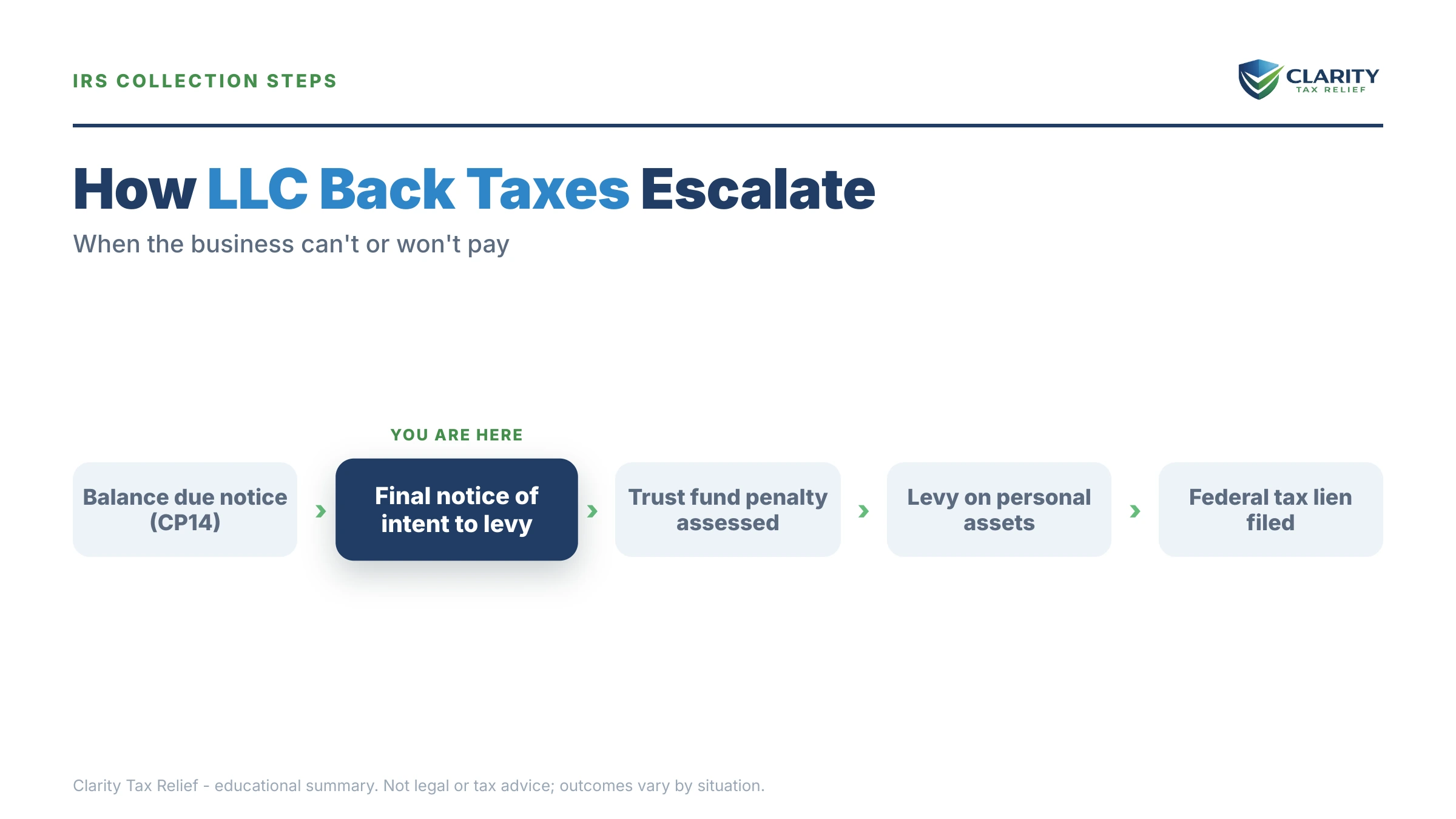
- The notice ladders. Personal balances run CP14 → CP501/CP503 → CP504 → LT11. Business balances run their own track: CP161 → CP504B → LT11. Each rung carries more enforcement power than the last.
- The lien. A Notice of Federal Tax Lien can be filed against you (for personal-side debt) or the LLC (for entity debt). A personal lien attaches to everything you own, including your home — and it's the single event most likely to stall or kill a refinance.
- The TFRP track (payroll debt). A revenue officer opens an investigation (Letter 3164), conducts Form 4180 interviews, then issues Letter 1153 proposing the penalty. Miss the 60-day protest window and the trust-fund portion is assessed against you personally, starting its own 10-year collection clock.
- Levies. After LT11 and its 30-day window, the IRS can levy: bank accounts (funds held 21 days before they're sent), wages (continuous until released), and — for businesses — accounts receivable, which can end a company's cash flow in one mailing.
Every stage on that list is cheaper to fix than the one after it. The window where you choose your resolution — instead of reacting to the IRS's — is right now.
Own an LLC with back taxes hanging over your name?
Before a lien hits the county records or a Letter 1153 starts your 60-day clock, get a free case review. An experienced tax professional will pull both transcripts, split what's truly yours from what's the LLC's, and map the fix — free and confidential.
Your options for resolving LLC-related back taxes
Every LLC-related tax debt has a resolution program — the right one depends on whose name the debt is in, how big it is, and what your finances can support. The step-by-step mechanics of setting these up on your own are in our hub on how to settle tax debt yourself; here's how each option maps to the LLC situation specifically:
| Option | Who it fits | Key thresholds & cost |
|---|---|---|
| Short-term payment plan | Personal-side debt you can clear fast | Pay in full within 180 days; $0 setup; accrual continues |
| Guaranteed installment agreement | Personal balance ≤ $10,000 | Must be approved if basic conditions met; up to 3 years |
| Streamlined installment agreement | Personal balance ≤ $50,000 | Up to 72 months online, no financial statement; ≤ $25,000 (or ≤ $50k with direct debit) for the simplest setup |
| In-business installment agreement | Operating LLC with 941 or entity debt | Requires current deposits and filings; trust-fund debt has its own express rules |
| Currently Not Collectible | Genuine hardship — paying would prevent basic living expenses | Financial disclosure required; collection pauses, debt and accrual remain |
| Offer in Compromise | Assets + future income genuinely can't cover the personal debt | $205 fee; 20% down on lump-sum offers (both waived with low-income certification, AGI ≤ 250% of poverty); roughly 1 in 5 offers accepted in FY2024 |
| Penalty relief (FTA / AEP / reasonable cause) | Clean 3-year compliance history, or circumstances beyond your control | First-Time Abate is being replaced by the Automatic Exemption from Penalty (AEP) starting summer 2026 — automatic, no request needed |
Because most LLC back taxes end up on the personal side, the size of the balance on your SSN is what determines your realistic path:
| Balance on your SSN | Realistic path | What changes at this level |
|---|---|---|
| Under $10,000 | Guaranteed installment agreement or short-term plan | Simplest tier; lien filing unlikely if you act promptly |
| $10,000 – $25,000 | Streamlined agreement online | No financial disclosure; direct debit keeps lien risk low |
| $25,000 – $50,000 | Streamlined agreement — direct debit typically required at the top of the band | Our $41,800 example lives here; lien risk is real if you stall |
| $50,000 – $66,000 | Financial-disclosure agreement, OIC, or CNC | Form 433-series financials enter the picture; approaching passport territory |
| Over $66,000 | Negotiated resolution, often with professional representation | Passport certification threshold ($66,000 in 2026); revenue-officer assignment more likely |
Two LLC-specific notes on this menu. First, an installment agreement or OIC on your personal debt does nothing for a balance still on the LLC's EIN, and vice versa — parallel debts need parallel resolutions. Second, for payroll debt, which balance you pay first matters: designated voluntary payments applied to the trust-fund portion reduce your personal TFRP exposure, while undesignated payments get applied however the IRS chooses.
How to respond to LLC back taxes, step by step
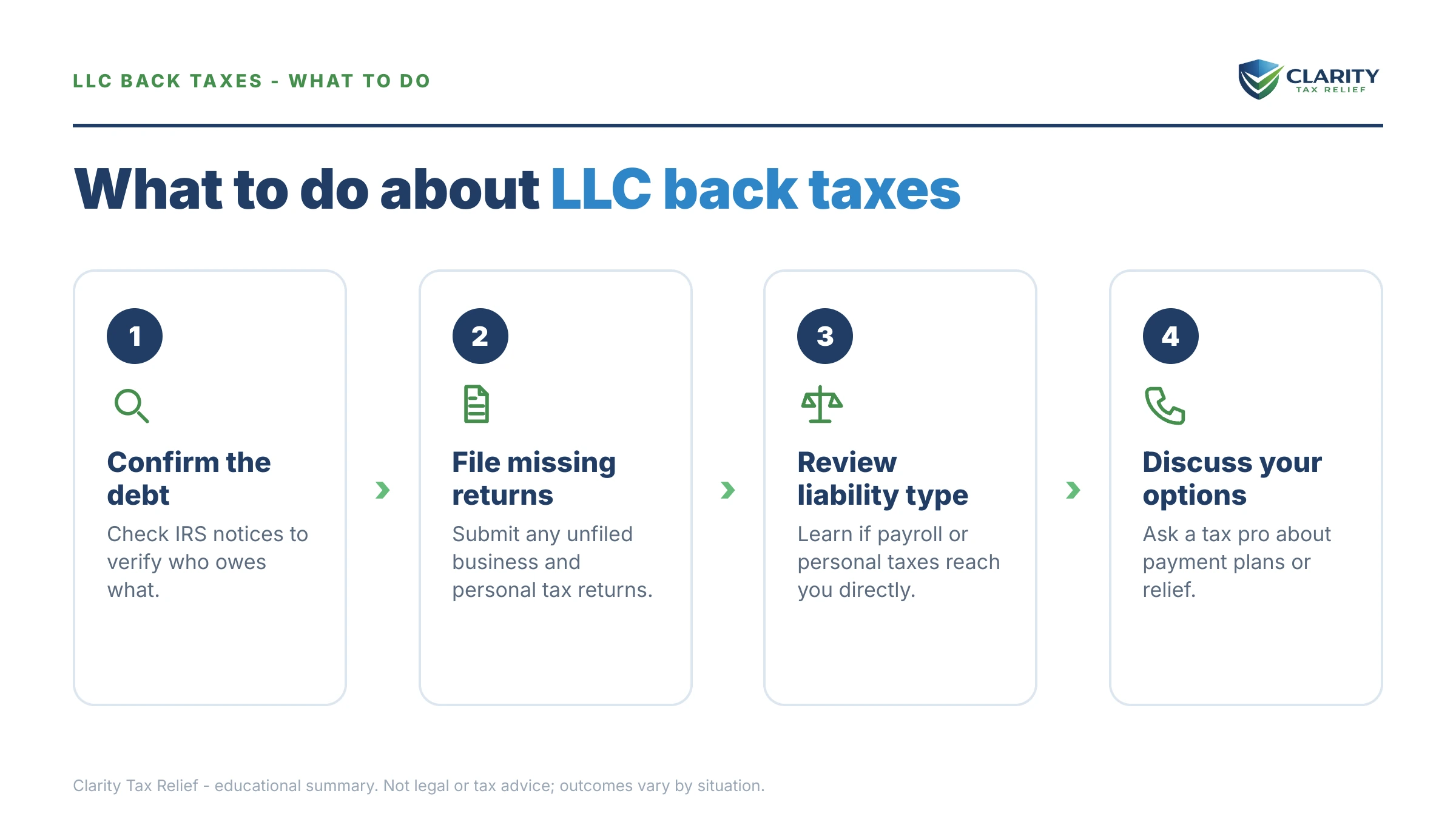
- Pull the transcripts for both taxpayer IDs. Get IRS account transcripts for your Social Security number and the LLC's EIN so you can see exactly which balances are already yours and which sit with the entity.
- Split any payroll debt into trust-fund and non-trust-fund portions. Only the withheld income tax and the employee share of FICA can be assessed against you personally through the Trust Fund Recovery Penalty — knowing the split tells you your true personal exposure.
- File every missing return, personal and entity. Unfiled 1040s, 941s, or 1065/1120-S returns block every resolution program and let the IRS assess estimated amounts that are usually worse than reality.
- Resolve the personal-side balance before a lien is filed. Set up a payment plan, hardship status, or an Offer in Compromise on the debt assessed against your SSN — acting before a Notice of Federal Tax Lien hits the county records protects your credit transactions, including a refinance.
- Answer any TFRP contact on the clock. If you receive Letter 3164, a Form 4180 interview request, or Letter 1153, respond within the stated window — you have 60 days to protest a Letter 1153 before the penalty is assessed against you personally.
When you can handle this yourself — and when help changes the outcome
Plenty of LLC back-tax situations don't need professional help, and it's worth knowing which yours is. You can confidently handle it yourself when:
- The debt is pass-through income tax on your 1040, you agree with the amount, and it's under $50,000 — the streamlined agreement takes minutes to set up online;
- You can pay in full within 180 days — the short-term plan costs nothing to set up;
- All returns are filed, no revenue officer is assigned, and no TFRP letters have arrived.
Experienced help genuinely changes outcomes in a different set of situations: any TFRP investigation (the Form 4180 interview is where personal liability is won or lost, and answers can't be un-given), a revenue officer already assigned to the LLC, multiple unfiled entity years, an operating business trying to keep 941 debt off the owners, disputed responsible-person allegations against a minority member or non-owner, and any case where a lien is about to collide with a home sale or refinance. In those cases the sequencing — which returns to file first, which balance to pay first, which form to file before which deadline — is the whole game.
If your refinance clock is tighter than the IRS's, a free review with an experienced tax professional at the 2-minute form or (888) 825-7779 can map which balances must be resolved before underwriting — ideally before a lien makes it a Form 14134 project.
Terms on your IRS mail, decoded
- Disregarded entity — a single-member LLC the IRS ignores for income tax, taxing its profit directly on your personal return.
- Trust-fund taxes — money withheld from employee paychecks (income tax and the employee share of FICA) that the business holds in trust for the government.
- Responsible person — anyone with the status, duty, and authority to see that withheld taxes get paid; the IRS can name several people for the same debt.
- Willfulness — for TFRP purposes, knowingly paying other creditors while withheld taxes went unpaid; intent to cheat isn't required.
- Notice of Federal Tax Lien (NFTL) — the public filing that attaches the government's claim to everything you own, and the document mortgage underwriters search for.
- Transferee liability — the IRS's ability to collect entity tax from people who received the entity's assets while the debt was unpaid.
LLC back taxes personal liability questions, answered
Am I personally liable for my LLC's back taxes?
Usually yes for income tax, and often yes for part of payroll tax. Income tax from a single-member or partnership-taxed LLC passes through to your personal return, so that debt was never the LLC's to begin with. Withheld payroll taxes can be assessed against you personally through the Trust Fund Recovery Penalty. The main exception is entity-level income tax on an LLC taxed as a C corporation.
Does a single-member LLC protect me from IRS tax debt?
No — not for income or self-employment tax. The IRS treats a single-member LLC as a disregarded entity, so business profit lands on your Schedule C and any unpaid tax is assessed against your Social Security number, not the LLC's EIN. The LLC's liability shield matters for lawsuits and business creditors; it was never designed to stand between you and your own 1040.
Can the IRS take my house or personal bank account for LLC taxes?
It can when the debt is legally yours — pass-through income tax or an assessed Trust Fund Recovery Penalty. Once a balance sits on your Social Security number, the IRS can file a Notice of Federal Tax Lien against your home and levy personal bank accounts after issuing a final notice (LT11) and waiting 30 days. Bank levies come with a 21-day hold before funds are sent; home seizures are rare and require extra approvals.
Who can be hit with the Trust Fund Recovery Penalty?
Anyone who was responsible for collecting or paying withheld taxes and willfully failed to do so — owners, officers, and sometimes bookkeepers or check-signers. The penalty equals 100% of the trust-fund portion: withheld income tax plus the employee share of Social Security and Medicare. The IRS decides responsibility largely through the Form 4180 interview, and it can assess multiple people for the same debt.
Does an LLC taxed as an S corporation protect me from back taxes?
Not for income tax — an S corporation is a pass-through, so profit flows to your personal return on Schedule K-1 and any unpaid tax is your personal debt. The S election also doesn't block the Trust Fund Recovery Penalty on withheld payroll taxes. What it can shield you from is entity-only items, like the late-filing penalty assessed against the S corporation itself.
If I dissolve my LLC, does the tax debt go away?
No. Pass-through income tax was already your personal debt, and dissolving the entity doesn't touch it. Trust-fund payroll taxes survive dissolution too — the IRS simply assesses the Trust Fund Recovery Penalty against the responsible people and collects from them for up to 10 years from that assessment. Only genuinely entity-level debt can die with a truly assetless entity, and even then transferee liability can follow assets you moved out.
Can I refinance my home if my LLC's back taxes became my personal debt?
Often, yes — but timing is everything. If no federal tax lien has been filed, most lenders want the balance either resolved or in a payment agreement with a documented payment history. If a Notice of Federal Tax Lien has already hit the county records, you'll generally need lien subordination on Form 14134 before the new loan can close, which adds weeks to the process.
What part of payroll tax debt am I NOT personally liable for?
The employer-side portions: the company's matching share of Social Security and Medicare, federal unemployment (FUTA) tax, and the penalties and interest assessed against the business. Those stay with the LLC. The Trust Fund Recovery Penalty reaches only the trust-fund portion — taxes withheld from employee paychecks — which is typically a bit more than half of a total 941 balance.
Can the IRS pierce the veil of an LLC taxed as a C corporation?
Yes, in limited situations. If you treated the LLC as a personal pocketbook, moved assets out while taxes went unpaid, or the entity was a sham, the IRS can use alter-ego, nominee, or transferee liability theories to collect entity debt from you or from transferred assets. These require the government to build a case — they're the exception, not the default — but they're why treating the debt as only the LLC's problem isn't a strategy.
Your next 24 hours
- Sort your IRS mail by taxpayer ID. Check the top of each notice for whose number it's addressed to — your SSN or the LLC's EIN. That single detail tells you which debts are already personal.
- Gather the file: your last two personal returns, the LLC's most recent 1065/1120-S or Schedule C, any 941s, and every IRS notice — especially anything mentioning Letter 1153, Form 4180, or a lien.
- Get the free case review. Call (888) 825-7779 or use the 2-minute form. Penalties and interest accrue monthly on every unpaid balance, and if you're refinancing, resolving the personal side before a lien is filed is the difference between a routine loan file and a subordination project.
Primary sources for further reading: the IRS's overview of employment taxes and the Trust Fund Recovery Penalty, the official IRS payment plans page, and the independent Taxpayer Advocate Service if the IRS's own process is causing you harm.
This guide is general information, not tax or legal advice for your specific situation. Eligibility for IRS programs depends on individual facts and circumstances; no outcome is guaranteed.