
Business Tax Debt
Single Member LLC Tax Debt: Who Really Owes the IRS (2026)
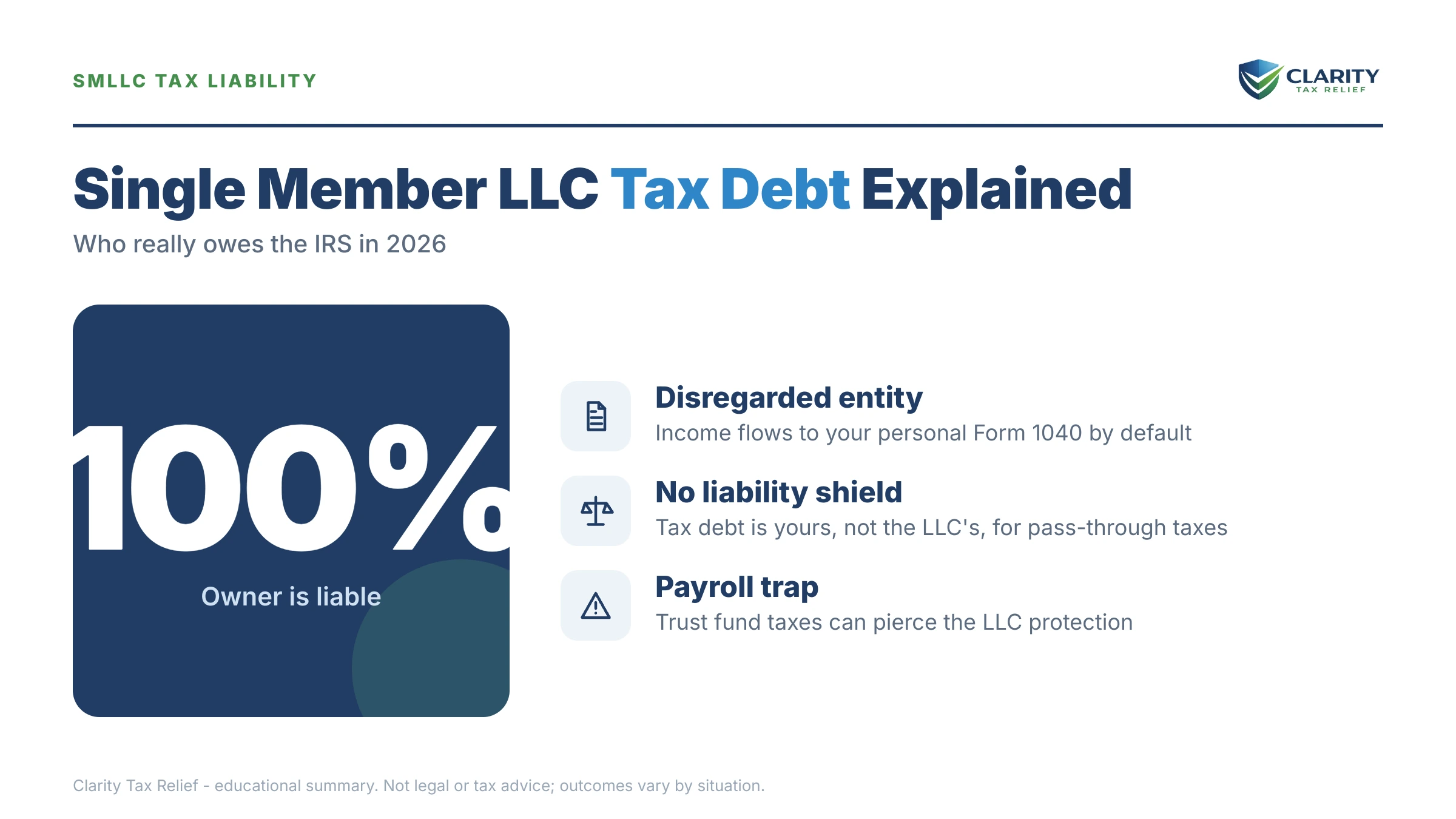
The short answer: single member LLC tax debt is almost always your personal debt. The IRS treats a single-member LLC as a disregarded entity for income tax, so the balance sits under your Social Security number — the LLC shields nothing. Only employment and excise taxes belong to the LLC, and even those can reach you through the Trust Fund Recovery Penalty.
The notice sitting in front of you is addressed to you — your name, your Social Security number — not to the LLC you formed to keep business problems away from your personal life. That's not a clerical error. For income tax purposes, the IRS never saw your LLC at all, and the debt was assessed against you from day one. The map for fixing it — including who legally owes which tax, and what the IRS can actually reach — is below.
⏱ The ongoing clock: the failure-to-pay penalty adds 0.5% of the unpaid balance every month, and interest compounds daily on top. On a $27,500 balance, that's roughly $137 in penalty alone each month — before interest — until you put a resolution in place.
Why single member LLC tax debt is personal debt
A single-member LLC is a disregarded entity for federal income tax, which means the tax on every dollar of business profit was assessed against you personally, not the company. Your profit flows onto Schedule C of your Form 1040, and both income tax and the 15.3% self-employment tax are computed under your Social Security number. When they go unpaid, there is no corporate veil for the IRS to pierce — the debt never belonged to the LLC in the first place.
This surprises owners because the LLC's liability protection is real — for lawsuits and business creditors under state law. It just doesn't apply here. The IRS isn't suing your business; it's collecting your own 1040 balance.
The trap runs both directions. Because a disregarded entity has no withholding, quarterly estimated payments are the only thing standing between you and a April surprise, and skipping them stacks an underpayment penalty on top of the balance. Compare that with a C corporation tax debt, where the 1120 balance genuinely belongs to the corporation — the entity choice changes who the IRS chases, which is exactly why this article's answer differs from the corporate one.
Which taxes the IRS collects from you — and which from your LLC
Only employment taxes and federal excise taxes are treated as the single-member LLC's own liability; everything else is yours. Since January 1, 2009, an SMLLC with employees files Forms 941 and 940 under the LLC's own EIN, so that payroll debt starts out as entity debt — but the trust-fund share (the tax withheld from employee paychecks) can still be assessed against you personally through the Trust Fund Recovery Penalty if you controlled the money.
| Tax | Who legally owes it | What the IRS can reach |
|---|---|---|
| Income + self-employment tax (Schedule C) | You personally, under your SSN | Your wages, personal accounts, state refund — and the LLC's bank account and receivables, since the entity is disregarded |
| Employment taxes on wages paid since 2009 (Forms 941/940) | The LLC, under its own EIN | LLC assets; the withheld trust-fund share can be assessed against you personally (TFRP) |
| Federal excise taxes | The LLC, under its own EIN | LLC assets |
| State taxes (income, sales/use) | Varies by state | Many states hold owners personally liable for sales tax collected from customers but not remitted — check your state agency's rules |
Two practical consequences follow from that table. First, resolving your case means running two tracks if payroll is involved — your 1040 debt under your SSN, the 941 debt under the LLC's EIN — and the IRS won't merge them. Trades with crews learn this the hard way; the construction payroll tax debt pattern is the classic version. Second, dissolving the LLC solves nothing: the personal debt was always yours, and TFRP exposure survives the entity. For a fuller entity-by-entity comparison, see LLC back taxes personal liability.
What happens if you ignore the debt
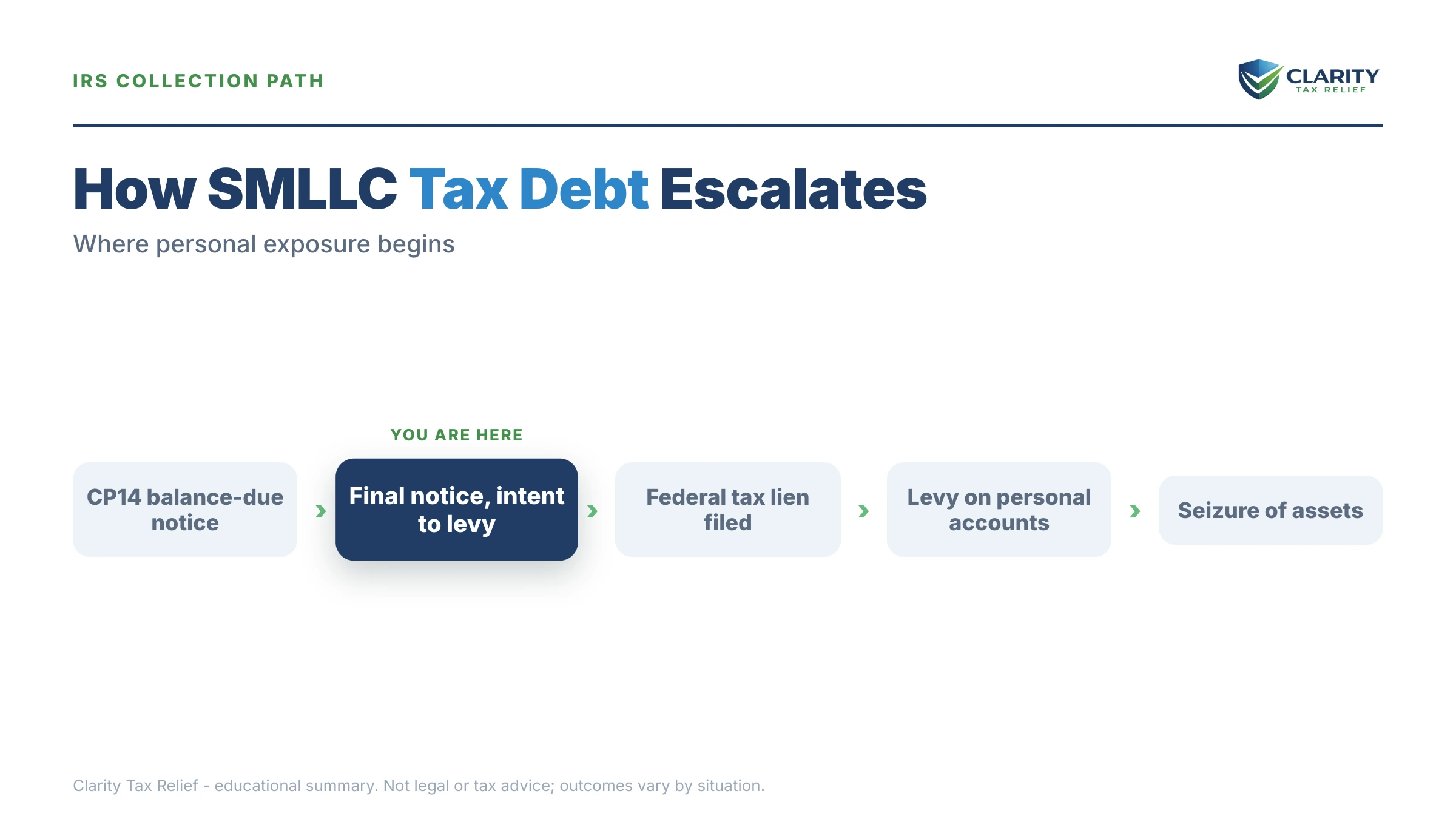
Unpaid Schedule C tax debt moves through the same automated collection sequence as any personal 1040 balance — and because it's personal, every stage can touch your non-business life. The order is fixed:
- CP14 — the first bill under your SSN, typically giving about 21 days to pay or arrange something. No enforcement yet.
- CP501 / CP503 — reminder notices. Still just bills, but the failure-to-pay penalty and daily interest are compounding.
- CP504 — Notice of Intent to Levy under IRC §6331(d). The IRS can now seize your state tax refund, and a federal tax lien — which attaches to your home, your vehicles, and your LLC membership interest — becomes a live possibility.
- LT11 / Letter 1058 — Final Notice of Intent to Levy. This starts a 30-day clock and your Collection Due Process rights (requested on Form 12153). Once it passes, the IRS can levy.
- Levy — a bank levy freezes funds with a 21-day hold before the bank sends them; a wage levy on any W-2 income is continuous until released; and payments your clients owe the business can be intercepted, because the disregarded LLC's receivables and bank account are treated as yours.
That last point is what makes this different from most personal tax debt: a levy can hit the business's operating account and your personal checking account for the same balance. And if debt stacks across multiple years past $66,000, the IRS can certify it to the State Department, which can deny or revoke your passport. IRS staffing fell roughly 27% in 2025, but these notices are generated by automated systems that never stopped running — a human being harder to reach doesn't slow the machine down.
Facing tax debt on your single-member LLC?
Penalties and interest are compounding on that Schedule C balance every month, and levies can reach both your personal and business accounts. An experienced tax professional will map exactly which taxes sit under your SSN vs. your EIN and what your options are — free, confidential, no pressure.
Your options for resolving single-member LLC back taxes
Because the debt is personal, every individual IRS resolution program is available to a single-member LLC owner — payment plans, hardship status, penalty relief, and settlement. Which one fits is a math question, not a marketing one. (The full DIY playbook for each program lives in our guide on how to settle tax debt yourself; here's how each applies to a Schedule C balance.)
| Option | Typical eligibility | Cost to apply | What to watch |
|---|---|---|---|
| Short-term payment plan | Can pay in full within 180 days | $0 setup | Interest and penalties keep accruing until paid |
| Guaranteed installment agreement | Balance of $10,000 or less, all returns filed | Setup fee applies | Official program name — approval still requires staying current |
| Streamlined installment agreement | Up to $25,000 with any payment method; $25,001–$50,000 with direct debit; up to 72 months | Setup fee applies (reduced online) | No financial disclosure required, but current-year estimates must stay paid |
| Offer in Compromise (self-employed) | Assets plus future income genuinely below the balance | $205 fee + 20% down on lump-sum offers (both waived with low-income certification) | Roughly 1 in 5 offers accepted in FY2024; business equipment equity counts |
| Currently Not Collectible (self-employed) | Paying anything would prevent basic living expenses | $0 | Debt remains, interest accrues, a lien may still be filed |
| First-time penalty abatement | Clean compliance history for the prior 3 years | $0 | Removes penalties, not tax or interest; the automatic AEP begins replacing it summer 2026 |
One option most owners overlook: fix the return before negotiating the debt. Self-prepared Schedule Cs routinely overstate profit — missed mileage, missed home office, gross 1099-K figures reported without expenses. If the numbers were wrong, amending the return to lower the tax debt shrinks the balance before any payment plan or offer is built on it.
Say you owe $27,500: the math on each option
A hypothetical makes the trade-offs concrete. Say you're a self-employed sole proprietor operating through a single-member LLC, and two years of unpaid quarterlies left you owing $27,500 under your SSN.
- Streamlined installment agreement. $27,500 sits above the $25,000 line, so the streamlined plan requires direct debit. Spread over the maximum 72 months, the base payment is about $382/month ($27,500 ÷ 72 ≈ $382) — but interest and the 0.5% monthly failure-to-pay penalty keep accruing during the plan, so paying more than the minimum meaningfully cuts the total cost. You can estimate how fast your own balance is growing with our penalty and interest calculator.
- Offer in Compromise. Suppose your work vehicle and equipment carry $6,000 in equity after loans, and after the IRS's allowable-expense standards your monthly disposable income is $400. A lump-sum offer generally values future income at 12 months: $400 × 12 = $4,800, plus $6,000 in equity = $10,800 in reasonable collection potential. Because $10,800 is less than $27,500, the numbers could support an offer — but every figure must be documented on Form 433-A (OIC), and the IRS accepted only about 1 in 5 offers in FY2024.
- Currently Not Collectible. If the same worksheet shows $0 left after allowable expenses, CNC pauses levies while each year's balance ages toward its 10-year CSED. Interest still accrues, and the IRS reviews your income periodically.
- Penalty relief. If these are your first delinquent years after three clean ones, first-time abatement can strip the failure-to-file and failure-to-pay penalties from a year — and beginning summer 2026, the IRS's Automatic Exemption from Penalty (AEP) applies similar relief automatically, with no request needed.
| Balance under your SSN | Realistic path | Key requirement |
|---|---|---|
| Under $10,000 | Guaranteed installment agreement or 180-day full pay | All returns filed; stay current on estimates |
| $10,000–$25,000 | Streamlined plan, any payment method, up to 72 months | Set up online; no financial disclosure |
| $25,001–$50,000 (a $27,500 balance lands here) | Streamlined plan with direct debit — or OIC/CNC if the finances fall short | Direct debit required for streamlined treatment |
| $50,001–$100,000 | Non-streamlined agreement with financial disclosure (Form 433 series) | Passport certification possible once total debt passes $66,000 |
| Over $100,000 | Often assigned to a revenue officer; asset review likely | Professional representation typically changes outcomes here |
How to respond to single-member LLC tax debt, step by step
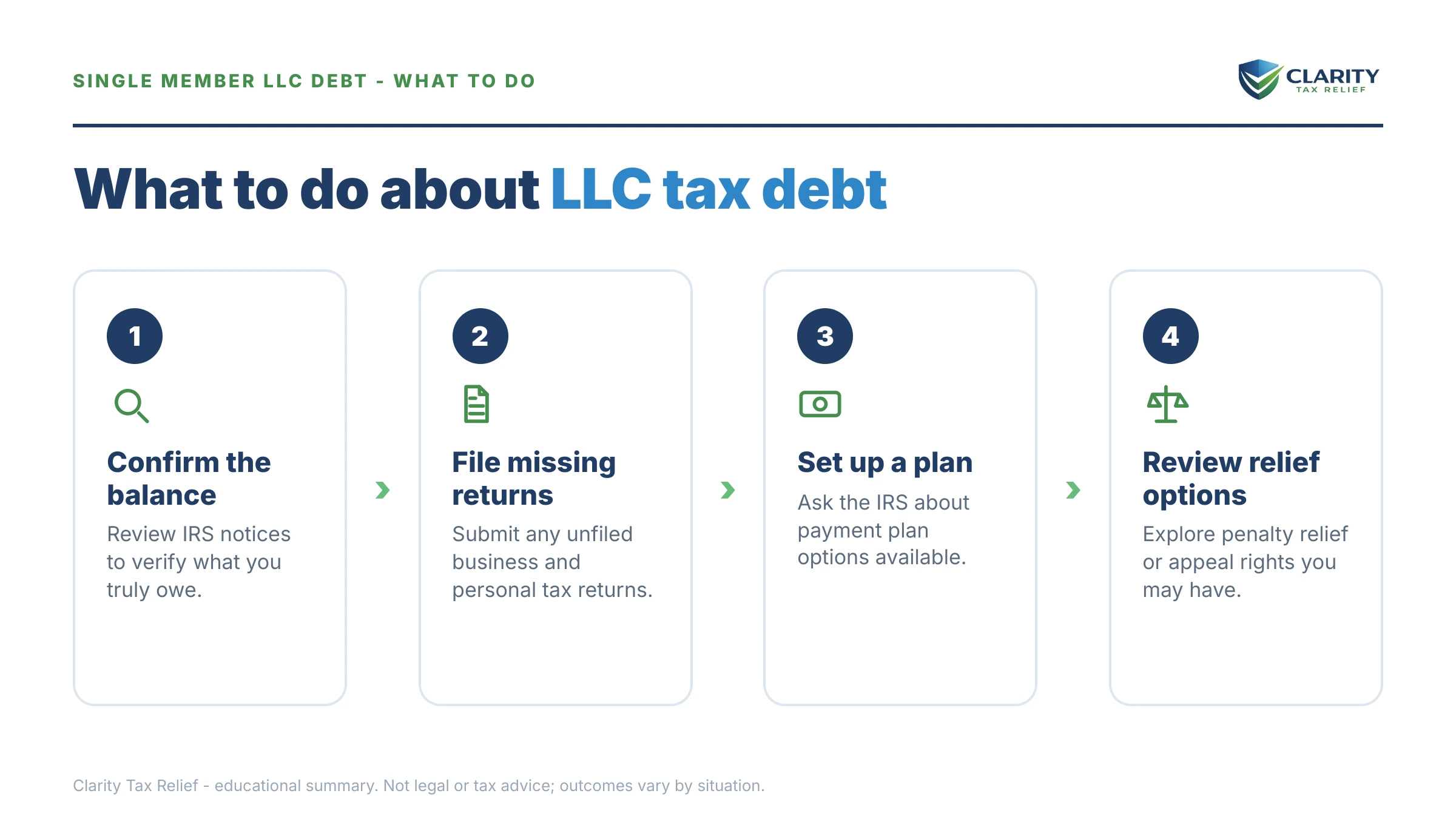
- Pull your IRS transcripts. Get account transcripts for every open year under your SSN — and under the LLC's EIN if it ever had employees — so you know exactly which taxes, years, and penalties make up the balance.
- Verify the returns behind the debt. Check the Schedule C numbers. If income was overstated or real deductions were missed, amending the return can shrink the debt before you negotiate on it.
- Separate personal debt from payroll debt. Income and self-employment tax resolves under your name; 941 employment tax resolves under the LLC's EIN. Mixing them up stalls both cases.
- Set up the resolution that fits your numbers. For most balances between $25,001 and $50,000, that means a direct-debit streamlined installment agreement at IRS.gov — or a hardship review or Offer in Compromise if your equity and income genuinely fall short of the balance.
- Stop the next debt from forming. Set aside a fixed share of every draw for quarterly estimated taxes going forward — an installment agreement can default if you fall behind on the current year.
When you can handle this yourself — and when to get help
Most single-member LLC owners with one year of debt and a balance under $50,000 can resolve it directly with the IRS online. If your returns are filed, you agree with the numbers, and a direct-debit plan fits your cash flow, set it up yourself at IRS.gov/payments — no firm needed, ours included.
Experienced help changes outcomes in specific situations: a levy already hitting your business receivables or bank account, multiple unfiled years that need reconstructing before anything can be negotiated, payroll debt with Trust Fund Recovery Penalty exposure layered on top of your 1040 balance, or OIC math where documenting business income and equipment equity determines whether an offer survives review. In those cases, the sequencing — returns first, penalties second, balance last — often matters more than the program you pick.
Terms on your notices, decoded
- Disregarded entity — the IRS ignores your LLC for income tax, so business profit and its tax land directly on your Form 1040 (the IRS's own explainer is at single-member limited liability companies).
- Self-employment (SE) tax — the 15.3% Social Security and Medicare tax on net business profit, owed on top of income tax.
- Trust fund taxes — money withheld from employee paychecks that the business holds in trust for the government.
- Trust Fund Recovery Penalty (TFRP) — a personal assessment of unpaid trust-fund taxes against whoever controlled the money and chose not to pay it over.
- CSED — the Collection Statute Expiration Date: 10 years from assessment, per year, pausable by offers, appeals, and bankruptcy.
- CDP rights — your 30-day right to a Collection Due Process hearing (Form 12153) after a final notice of intent to levy.
Single-member LLC tax debt questions, answered
Does a single-member LLC protect me from IRS tax debt?
No — not for income or self-employment tax. Because the IRS disregards the entity, the tax on your business profit was assessed against you personally from the start, so there is no corporate veil to pierce. The LLC's liability protection applies to lawsuits and business creditors under state law, not to your own federal income tax.
Can the IRS levy my LLC's business bank account for my personal tax debt?
Generally yes. Because a single-member LLC is disregarded for federal tax purposes, the IRS takes the position that the LLC's bank account and accounts receivable are reachable for the owner's personal income tax debt. A bank levy comes with a 21-day hold before the bank sends the money, which is your window to negotiate a release.
Who owes payroll taxes — me or my single-member LLC?
For wages paid since 2009, employment taxes are the LLC's own liability under its EIN, not automatically yours. But the trust-fund portion — the income tax and FICA withheld from employee paychecks — can be assessed against you personally through the Trust Fund Recovery Penalty if you controlled the money and didn't pay it over.
Can I settle single-member LLC tax debt with an Offer in Compromise?
Yes, if the math works — the IRS accepted roughly 1 in 5 offers in FY2024, and self-employed applicants must document business income and equipment equity on Form 433-A (OIC). The application costs $205 with 20% down on a lump-sum offer, though low-income certification (AGI at or below 250% of the poverty level) waives both.
Does electing S-corp status fix single-member LLC tax debt?
No — an S-corp election only changes how future profit is taxed; it does nothing to debt already assessed under your Social Security number. It can reduce self-employment tax going forward, but it also creates payroll obligations, and a missed 941 deposit creates a new, harsher category of debt.
Can the IRS garnish my wages or take my house for my LLC's tax debt?
For Schedule C income tax debt, yes — it is personal debt, so your wages from any job, your personal bank accounts, and your state refund are within reach after the IRS issues a final notice of intent to levy and the 30-day window passes. A federal tax lien attaches to everything you own, including your home and your LLC membership interest, though actual home seizures are rare and require court approval.
Does dissolving my single-member LLC erase the tax debt?
No. Income and self-employment tax debt was never the LLC's, so closing the entity changes nothing — the IRS keeps collecting from you for the full 10-year collection statute. Trust-fund payroll debt also survives dissolution because the Trust Fund Recovery Penalty attaches to responsible people, not the business.
How long can the IRS collect single-member LLC tax debt?
Ten years from the date each year's tax was assessed, under the Collection Statute Expiration Date (CSED). The clock pauses while an Offer in Compromise, bankruptcy, or collection appeal is pending, so waiting it out usually takes longer than people expect. Each unpaid year has its own separate 10-year clock.
Your next 24 hours
- Check the taxpayer ID on your notice. Look at the top of the letter: is the debt under your SSN (Form 1040 — your personal debt) or the LLC's EIN (Form 941 — entity debt with possible TFRP exposure)? That single line determines which playbook applies.
- Gather your last two returns, every IRS notice you've received, and a rough monthly income-and-expense picture for the business. Those three things are all any resolution — DIY or professional — is built on.
- Get a free case review. Interest and the monthly failure-to-pay penalty are compounding on the balance right now, and they don't pause while you decide. Call (888) 825-7779 or use the 2-minute form and an experienced tax professional will map your options — under your SSN and your EIN — before the next notice lands.
This guide is general information, not tax or legal advice for your specific situation. Eligibility for IRS programs depends on individual facts and circumstances; no outcome is guaranteed.