
IRS Hardship Programs
Currently Not Collectible Self-Employed: How to Qualify With Business Income (2026)
The short answer: yes — self-employed taxpayers can get IRS currently not collectible (CNC) status. The IRS tests your net business income (gross receipts minus expenses it accepts) against its allowable living expense standards on a Form 433 financial statement, and requires current filings plus quarterly estimated payments. If nothing is left over, collection pauses — the debt itself remains.
You invoiced enough this year to look fine on paper, but after the slow months, the software, and the subcontractors, there's nothing left — and the IRS is billing you for taxes you can't pay. That sinking feeling is real, but so is this: the IRS has a formal status built for exactly this situation. Your job is proving you belong in it when there's no paystub to hand over.
One document decides the whole case — the collection information statement — and the image below shows you exactly what that form looks like and where the business-income sections sit.
⏱ The real clock: there is no filing deadline to request CNC — but your balance grows every month you wait. The failure-to-pay penalty adds 0.5% of the unpaid tax per month (about $156 monthly on a $31,200 balance), interest compounds daily on top, and once a final levy notice is more than 30 days old, the IRS can levy your business bank account without further warning.
Currently not collectible self-employed: what the IRS actually tests
Currently not collectible status pauses IRS collection when your income can't cover IRS-allowed living expenses — and for self-employed taxpayers, the IRS verifies that income from bank deposits, not paystubs. The general hardship test is covered in our guide to how to qualify for CNC; this page covers what changes when your income comes from a business.
Three things change, and each one makes the case harder to prove but far from impossible.
First, income verification. A W-2 employee hands over two paystubs and is done. You'll be asked for three to six months of business bank statements and a profit-and-loss summary, because the IRS assumes self-reported business income is understated until the deposits prove otherwise.
Second, the expense re-do. The IRS does not accept your Schedule C at face value. It recalculates your income, allowing only expenses it considers necessary to produce that income — and it starts from your bank deposits, not your Schedule C profit. Paper deductions like depreciation get added back, which often makes your "IRS income" higher than the profit on your return.
Third, the compliance condition. CNC is collection relief for old debt, and the IRS won't grant it while you're actively creating new debt. For a self-employed applicant that means current-year quarterly estimated payments — the single most common reason self-employed CNC requests stall.
The IRS also looks past your income to what the business itself holds: equipment with resale value, vehicles with equity, and invoices your clients haven't paid yet. Meaningful collectible assets can push the IRS toward "pay us from those" instead of hardship status.
How the IRS calculates self-employed income on the Form 433
For a self-employed CNC request, the IRS computes monthly income as your average gross receipts minus only the business expenses it considers necessary for producing income. That average usually comes from three to six months of records; if your work is seasonal — landscaping, tax prep, tourism — push for a twelve-month average so a strong quarter doesn't misrepresent your year.
Which form you file depends on who has your case. The IRS's automated collection line typically works from the shorter Form 433-F; a revenue officer will demand the full Form 433-A, which contains dedicated business income, expense, and asset sections. Prepare to the 433-A standard either way — it's the math that gets applied.
On the personal side, your living expenses are capped by the IRS's allowable living expense standards: national standards for food, clothing, and miscellaneous costs; local standards for housing, utilities, and vehicles. Actual health insurance premiums, out-of-pocket medical costs, and — critically for you — current-year estimated tax payments are allowed on top of the standards. The full arithmetic, including where the caps bite, is in our guide to CNC income limits.
One edge case worth flagging: if you're married, the IRS evaluates household income and shared expenses, even when your spouse owes nothing. A non-liable spouse's W-2 income can sink a CNC request that your business numbers alone would have supported — the spouse isn't liable for the debt, but their income changes what you can afford.
Here's what the IRS will actually ask you to produce, and why:
| Document | Why the IRS wants it | What to watch for |
|---|---|---|
| 3–6 months of business bank statements | Verifies gross receipts against what you claim | Every deposit will be questioned — note transfers and loan proceeds so they aren't counted as income |
| Profit-and-loss summary | Shows how receipts become net income | Depreciation and home-office paper deductions get added back |
| Most recent filed return with Schedule C | Baseline for income and the CNC income threshold | All required years must be filed before CNC is granted |
| Proof of current estimated tax payments | Confirms you've stopped accruing new debt | Missing quarterlies is the top reason self-employed requests stall |
| Accounts receivable list | Unpaid invoices are a levyable asset | Large receivables can be treated as money the IRS could collect |
| Business asset list (equipment, vehicles) | Tests whether the business holds collectible equity | Tools of the trade get some protection; excess equity does not |
What happens if you do nothing
An unpaid IRS balance moves through an automated notice sequence that ends in levies — and for the self-employed, those levies reach business bank accounts and client payments, not just wages. The sequence runs on its own; in 2026, with the IRS workforce down roughly 27% from the 2025 cuts, per TIGTA reports, humans are harder to reach, but the automated system never stopped issuing notices or levies.
- CP14 — the first bill. No enforcement yet; the cheapest moment to act.
- CP501 / CP503 — reminder notices. The balance compounds monthly while these arrive.
- CP504 — Notice of Intent to Levy under IRC §6331(d). The IRS can seize your state tax refund, and a federal tax lien becomes a live possibility.
- LT11 / Letter 1058 — final notice of intent to levy. This starts a 30-day clock and your Collection Due Process rights (requested on Form 12153). After 30 days, enforcement is authorized.
- Enforcement — a bank levy freezes funds for 21 days before they're sent to the IRS; a levy on your accounts receivable orders your clients to redirect what they owe you to the IRS. That letter landing on a client's desk announces your tax problem to the people who pay you — damage a W-2 employee never faces.
If unpaid balances stack across multiple years and grow past $66,000 (the 2026 threshold), passport certification enters the picture too. None of this requires a human at the IRS to decide anything — which is exactly why "they haven't contacted me in months" is not safety.
Self-employed and can't pay the IRS?
Get your CNC eligibility reviewed free before the next notice escalates. An experienced tax professional will run your business numbers through the IRS's own hardship math — every month you wait adds another 0.5% penalty plus daily interest.
Your options when you owe $31,200 on self-employment income
CNC is one of five realistic paths for a self-employed taxpayer with a five-figure balance, and the right one depends entirely on what's left after IRS-allowed expenses. If the math shows you can pay something, the IRS will steer you toward a plan — see payment plan vs. currently not collectible for where the line falls. If the math shows you can't, CNC or an offer becomes the honest conversation; CNC vs. offer in compromise breaks down which fits which situation, and self-employed offer math has its own quirks covered in OIC self-employed.
| Option | Who it fits | What it requires |
|---|---|---|
| Currently not collectible | Nothing left after IRS-allowed expenses | Form 433 financials, all returns filed, current estimated payments |
| Short-term plan (up to 180 days) | A temporary cash crunch — a big receivable is coming | Ability to pay in full within 180 days |
| Streamlined installment agreement | Balance ≤ $50,000 and room in the budget | Up to 72 monthly payments; usually no financial statement |
| Partial-payment installment agreement | Some ability to pay, but not enough to clear the debt | Form 433 financials; periodic re-review |
| Offer in compromise | Assets plus future income can't cover the debt | Full financial disclosure; per IRS data, the IRS accepted roughly 1 in 5 offers in FY2024 |
| Penalty relief (FTA / AEP) | Clean compliance history in the prior 3 years | Shrinks the balance under any of the options above; starting summer 2026, Automatic Exemption from Penalty applies without a request |
Cost and speed differ as much as eligibility does:
| Option | Upfront cost | Monthly cost | Typical time to in place |
|---|---|---|---|
| Currently not collectible | $0 — no application fee | $0, but penalties and interest still accrue | Weeks by phone with the automated line; longer with a revenue officer |
| Short-term plan (180 days) | $0 setup | Whatever pays it off in 180 days (~$5,200/mo here) | Same day online |
| Streamlined installment agreement | Setup fee applies (lower online with direct debit; reduced or waived for low income) | ~$434 at 72 months, plus accruing interest and penalty | Same day to a few weeks |
| Partial-payment installment agreement | Setup fee applies | Whatever the Form 433 math supports | Weeks to months — financials are reviewed |
| Offer in compromise | $205 fee + 20% down on lump-sum offers (both waived with low-income certification, AGI ≤ 250% of poverty) | Offer payments per your terms | Months; auto-accepted if the IRS doesn't decide within 2 years, with narrow exceptions — a returned or rejected offer stops the clock, and time during court disputes does not count |
One honest note on CNC's place in that lineup: it's the only option that costs nothing and demands no payment, which is exactly why it demands the most proof. The IRS grants CNC based on its math, not your stress level — which makes getting the Form 433 numbers right the entire game.
A worked example: $31,200 owed, single, self-employed
Say you owe $31,200 across two years of Schedule C balances, you file single, and your freelance receipts have slipped. Here's the math the IRS would run — all figures hypothetical.
Income side. Your six-month bank-statement average shows $6,400/month in gross receipts. Your Schedule C claims $3,300/month in expenses, but $600 of that is depreciation on your work van — a paper deduction the IRS adds back. Allowed business expenses: $2,700. Net business income for CNC purposes: $6,400 − $2,700 = $3,700/month.
Expense side. Say your county's local standards and your documented bills allow: housing and utilities $1,825, vehicle ownership and operating $780, national standard for food/clothing/miscellaneous $800, health insurance $265, and current-quarter estimated tax payments of $330. Total allowed: $4,000/month.
The verdict. $3,700 income minus $4,000 allowed expenses leaves −$300. There is nothing for the IRS to take without creating hardship — a genuine CNC candidate. Compare the alternative: a streamlined 72-month plan runs $31,200 ÷ 72 ≈ $434/month, which these numbers simply cannot support.
Now flip one variable. If your allowed expenses totaled $3,400 instead, leaving $300/month on the table, the IRS would likely push a $300/month partial-payment agreement rather than CNC. That's the knife's edge these cases turn on — a single disallowed expense category can be the difference between paying $0 and paying $300 every month.
And understand what CNC doesn't stop: at 0.5% per month, the failure-to-pay penalty alone adds roughly $156/month to this balance at the start, plus interest. The debt grows while collection sleeps — which is why the 10-year statute (next section) matters so much.
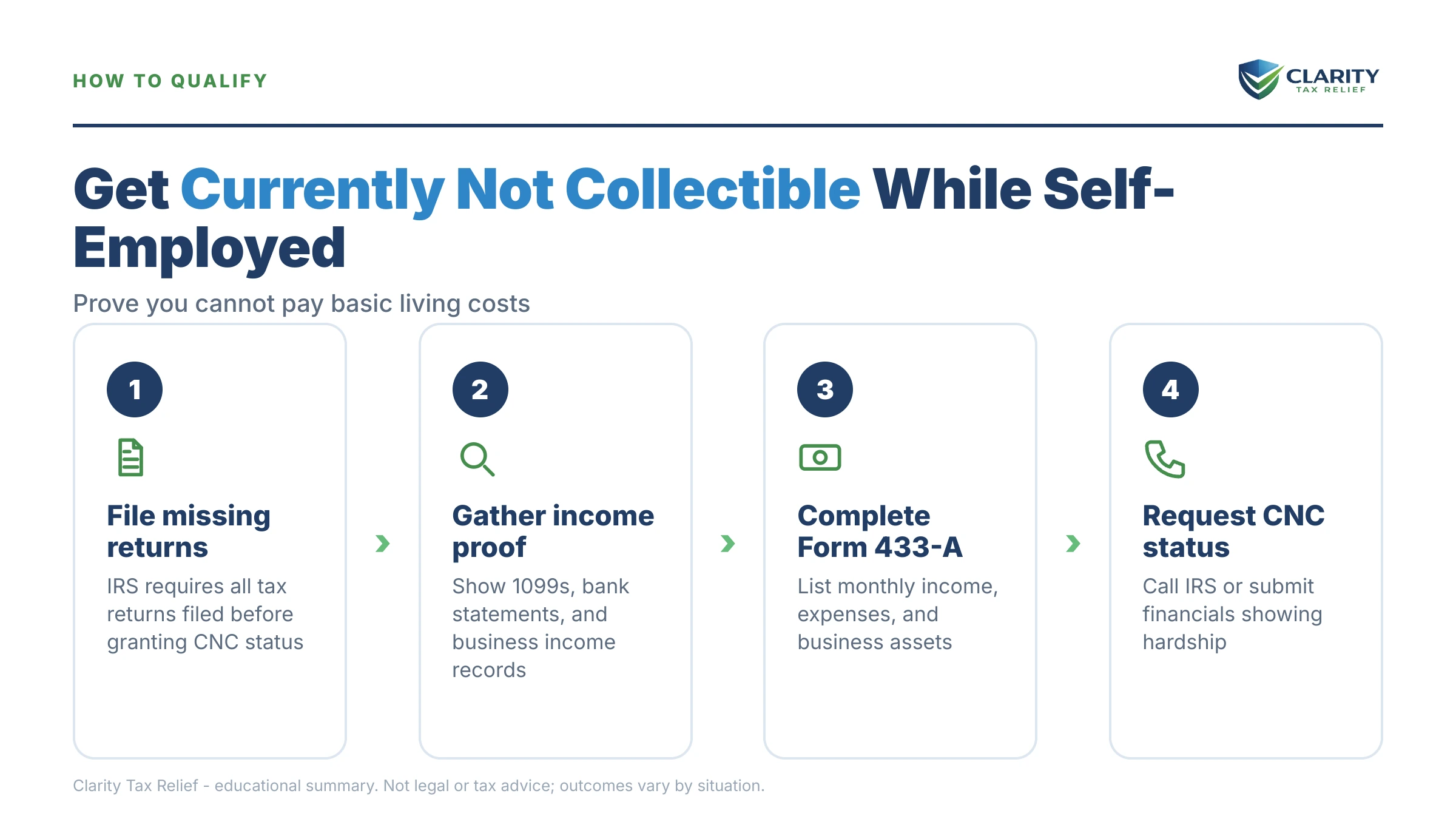
How to apply for currently not collectible when you're self-employed, step by step
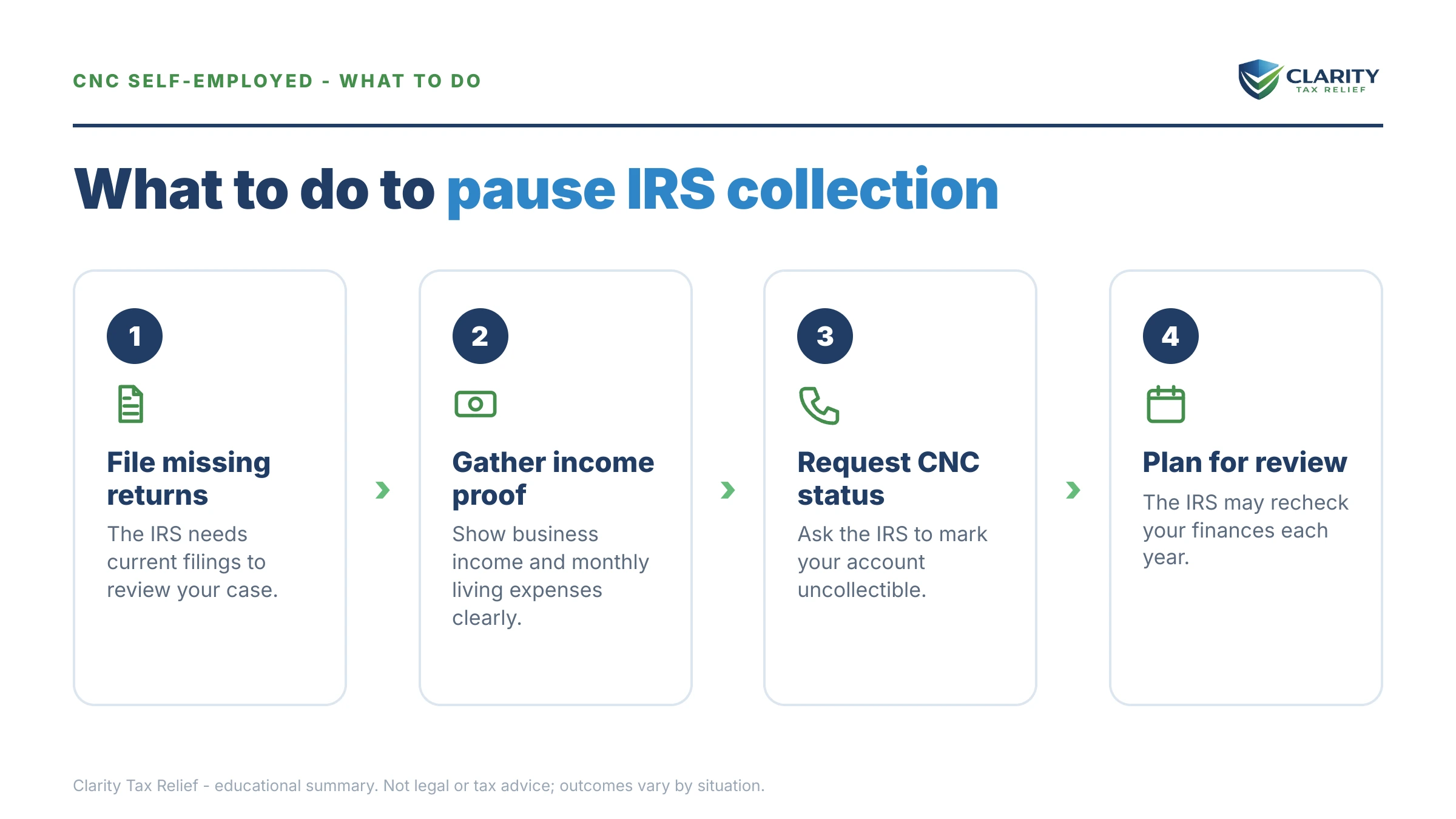
- File every required return — the IRS will not grant CNC with unfiled years on your account, including old Schedule C years.
- Stop the new debt — start making quarterly estimated tax payments for the current year so you stop accruing a new balance; the IRS treats current-year compliance as a condition of hardship status. (New to quarterlies? Start with how quarterly estimated taxes work.)
- Assemble your proof — gather three to six months of business bank statements, a simple profit-and-loss summary, and documentation for your personal living expenses.
- Complete the financial statement — fill out Form 433-F if you're working with the IRS's automated collection line, or Form 433-A if a revenue officer has your case, and build the numbers from your bank records, not memory.
- Request CNC by name — call the number on your most recent notice, say you are requesting currently-not-collectible status, and submit the financial statement with your backup documents.
- Confirm the coding — check your IRS account transcript a few weeks later for transaction code 530, which confirms the account was placed in CNC.
What CNC costs you: the lien, the clock, and the annual check-in
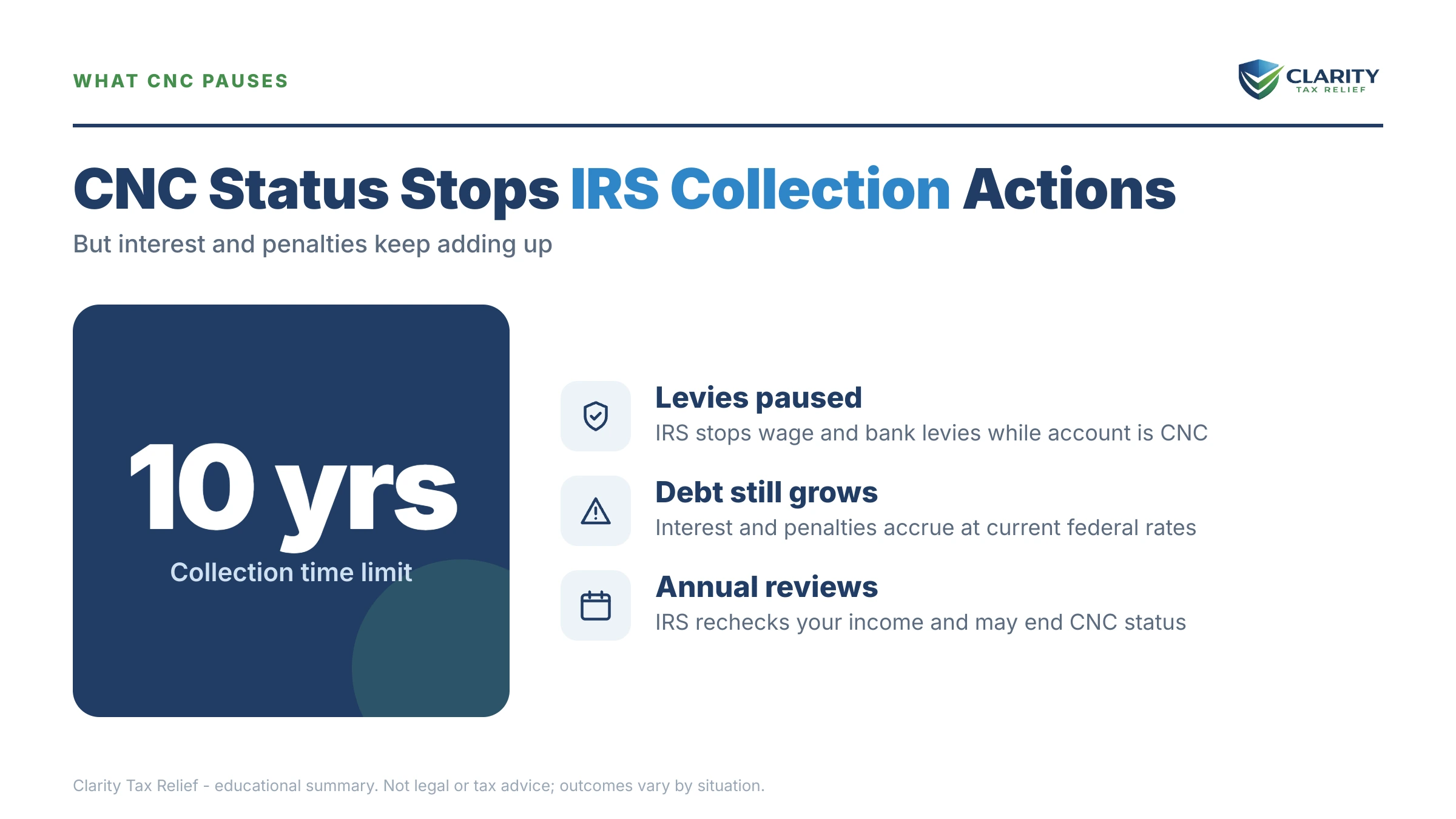
CNC pauses collection, but it is not free relief — four consequences follow it, and every self-employed applicant should weigh them before calling.
The lien. The IRS generally files a Notice of Federal Tax Lien when it places balances over $10,000 into CNC — at $31,200, expect one. It takes nothing by itself, but it's a public record that can complicate financing and some business credit lines. Details in does CNC stop a tax lien.
The clock keeps running — in your favor. Unlike an offer in compromise or bankruptcy, CNC does not pause the 10-year collection statute, though events like a pending OIC or bankruptcy do toll it. Every year in CNC is a year off the IRS's window to collect; you can estimate your own collection deadline with our CSED Calculator.
Refund offsets. Any refund you're due — including from over-withholding at a side W-2 job — gets applied to the balance each year, automatically.
The income check. The IRS sets an income threshold when it grants CNC and compares it against every return you file afterward. A strong Schedule C year can flip the account back to active collection — how long currently not collectible lasts covers the review cycle, and CNC status removed covers what to do when it happens. Because self-employed income swings, self-employed accounts get reactivated more often than fixed-income ones — a banner year followed by a slow one may mean re-proving the hardship.
Two boundary notes. CNC is per-taxpayer, not per-year: once granted, it generally covers your assessed personal balances, but new balances you create by skipping estimates can break it. And CNC is IRS-only — if you also owe your state, that's a separate fight under separate rules. California's Franchise Tax Board, for example, runs its own hardship program on its own forms, with a 20-year collection statute instead of 10; see FTB currently not collectible. The IRS's own description of the status lives at temporarily delaying the collection process.
When you can handle this yourself — and when help changes the outcome
Plenty of self-employed taxpayers can request CNC without hiring anyone. You're a good DIY candidate if this is a single tax year, all your returns are filed, your books are clean enough to produce a P&L in an afternoon, and you're comfortable walking an IRS agent through a Form 433-F by phone. If the math shows you can actually afford a modest payment, you may not need CNC at all — a streamlined plan takes minutes to set up on the IRS payment plans page.
Experienced help earns its cost in a different set of situations: a levy already hitting your bank account or your clients' inboxes; a revenue officer demanding a full Form 433-A on a deadline; multiple unfiled Schedule C years that have to be reconstructed before CNC is even possible; meaningful business assets or receivables the IRS wants to count against you; or any payroll tax in the mix, which follows far harsher rules. In those cases, how the business income and expenses get presented on the 433 is the difference between hardship status and a payment demand — and presentations can't be un-made.
If money is the obstacle to getting advice at all, the Taxpayer Advocate Service and Low Income Taxpayer Clinics exist for exactly that.
Not sure which side of that line you're on? A free review of your business numbers against the IRS hardship standards will tell you in one call — request it here or dial (888) 825-7779.
Terms on your financial statement, decoded
- Currently not collectible (status 53 / code 530): the IRS's internal coding for an account where collection is paused because of financial hardship.
- Collection information statement: the Form 433 series — the sworn financial snapshot the entire CNC decision rides on.
- Allowable living expenses: the national and local caps the IRS substitutes for many of your actual bills when measuring what you can afford.
- CSED: the Collection Statute Expiration Date — 10 years after each assessment, the IRS legally loses the right to collect that balance, though certain events pause the clock.
- Notice of Federal Tax Lien: a public filing securing the IRS's claim against your property; it takes nothing by itself.
- Accounts receivable levy: an IRS order telling your clients to send money they owe you to the IRS instead — the self-employed equivalent of a wage levy.
Currently not collectible questions self-employed people actually ask
Can I get currently not collectible status if I'm self-employed?
Yes. Self-employment doesn't disqualify you — but the IRS requires more proof, because there's no W-2 or paystub to verify your income. Expect to document gross receipts and business expenses with bank statements and a profit-and-loss summary, usually on Form 433-A, and to be current on required filings and estimated taxes before CNC is granted.
Do I have to close my business to qualify for CNC?
No. CNC is available to operating self-employed taxpayers when net business income doesn't cover IRS-allowed living expenses. The IRS will, however, look at whether the business itself holds collectible value — equipment you could sell, or receivables it could levy. Significant business equity can lead the IRS to demand payment from those assets instead of granting hardship status.
Does the IRS use my gross receipts or my net income?
Net — but the IRS decides what counts as a business expense, not your tax return. It starts from gross receipts and subtracts only expenses it considers necessary for producing income. Depreciation, for example, is a paper deduction the IRS adds back, so your income for CNC purposes is often higher than your Schedule C profit.
Do I need to make estimated tax payments to get CNC?
Generally yes. The IRS treats current-year compliance as a condition of collection relief, and for self-employed taxpayers that means quarterly estimated payments — or at minimum, not accruing a new balance. If you're behind on the current year, expect the IRS to require you to start paying estimates before it will code your account as currently not collectible.
Will the IRS file a tax lien if it grants me CNC?
Likely, yes. The IRS generally files a Notice of Federal Tax Lien when it places balances over $10,000 into CNC status. The lien doesn't take anything by itself — it secures the government's claim against what you own — but it becomes public record and can complicate financing, selling property, or qualifying for some business credit.
Does the 10-year collection statute keep running during CNC?
Yes — and that's one of CNC's quiet advantages. Unlike an offer in compromise or bankruptcy, CNC does not pause the 10-year collection statute (the CSED), though the clock does pause for events like a pending OIC or bankruptcy. If your hardship lasts and the IRS never reactivates collection, whatever remains when the statute expires becomes legally uncollectible.
What happens if my business income goes up?
The IRS can pull you out of CNC. When it grants hardship status, it sets an income threshold; if a later filed tax return shows income above it, the account returns to active collection and the notice sequence restarts. There's no penalty for improving — you'd simply move to a payment plan or another resolution at that point.
Can the IRS levy my business bank account or 1099 pay while I'm applying?
Yes, if you've already received a final notice of intent to levy and the 30-day window has passed. A pending CNC request doesn't automatically bar levy the way a pending offer in compromise does, though in practice the IRS usually holds enforcement while it reviews financials you've submitted. If a levy is already in motion, request a hardship release at the same time.
Which form do I need — Form 433-F or Form 433-A?
It depends on who's handling your case. The IRS's automated collection phone line generally uses the shorter Form 433-F; a revenue officer assigned to your case will require the full Form 433-A, which has dedicated business income and asset sections. Self-employed taxpayers should prepare 433-A-level detail either way, because that's the math the IRS applies.
Does CNC ever forgive the debt?
Not directly. CNC pauses collection; the balance remains, penalties and interest keep accruing, and your refunds are offset each year. Forgiveness only happens indirectly — if the 10-year collection statute expires while you're still in hardship, the remaining balance becomes uncollectible. If you want the debt formally settled sooner, compare an offer in compromise.
Your next 24 hours
- Pin down the real balance. Log into your IRS online account or pull your latest notice and find the total across every year — CNC has to cover all of it, and unfiled years block the whole request.
- Pull three months of business bank statements and your last filed return. Those two things are 80% of the Form 433 — and they'll tell you tonight whether your numbers look like a CNC case or a payment-plan case.
- Get the numbers checked before you present them. An experienced tax professional will run your receipts, expenses, and assets through the IRS's own hardship math free — start the 2-minute form or call (888) 825-7779. Every month unresolved adds roughly 0.5% in penalty plus daily interest to what you owe.
This guide is general information, not tax or legal advice for your specific situation. Eligibility for IRS programs depends on individual facts and circumstances; no outcome is guaranteed.