
Offer in Compromise
OIC for the Self-Employed: How an Offer in Compromise Really Works With 1099 Income (2026)
The short answer: yes — an OIC for a self-employed worker is real, but the IRS builds your offer from averaged business income (typically months of bank deposits minus necessary expenses), not your Schedule C profit. And it will return your offer unprocessed unless every required return is filed and your current-year estimated taxes are paid.
For three tax seasons the 1099s went into a drawer, the apps kept paying, and every April became "next year." Now the balance is real, you've heard the IRS will accept less than the full amount in some cases, and you want to know if that's true for someone with gig income and no employer. It is — but the math and the order of operations are different for you, and getting the order wrong means your offer never even gets opened.
Your entire self-employed offer lives or dies on one document — Form 433-A(OIC), the financial statement that travels with your offer. The image below shows you exactly what this form looks like and where the self-employment sections sit, so you know what the IRS will make you prove.
⏱ The real clock: an OIC has no application deadline — but on unfiled years, the failure-to-file penalty grows at 5% per month, up to 25%, and interest compounds daily on everything. The IRS also returns offers unprocessed when returns are missing or estimated taxes aren't current, so the compliance work starts now, not when you mail Form 656.
Why a self-employed OIC is different
A self-employed OIC is decided on Form 433-A(OIC), which requires you to document business income and expenses that a W-2 applicant never has to prove. A wage earner hands over pay stubs. You hand over 6 to 12 months of bank statements plus a profit-and-loss summary — and the offer examiner cross-checks your figures against the 1099-K and 1099-NEC forms platforms already filed under your Social Security number.
The basics of the program — doubt as to collectibility, Form 656, the review process — are covered in our hub on how an offer in compromise actually works. What follows is only what changes when the income is yours to prove.
Four things trip up self-employed applicants specifically:
- Schedule C deductions ≠ allowable expenses. Depreciation, the home-office deduction, and the standard mileage rate are tax-return concepts. The offer examiner allows only expenses actually paid and necessary to produce income — so your offer income can be higher than your taxable income, sometimes by a lot.
- The compliance gate. All required returns filed, all current-year quarterly estimates paid. Miss either and the offer comes back unprocessed. If you're behind on quarterlies, start with how quarterly estimated taxes work.
- New debt forms every quarter. Self-employment tax accrues as you earn. An offer that takes months to review can be sunk by a fresh unpaid balance created while you waited.
- Entity matters. A sole proprietor or single-member LLC files Form 433-A(OIC) as an individual. If the debt belongs to a partnership or corporation, that's a different application on Form 433-B(OIC) — see our guide to a business offer in compromise.
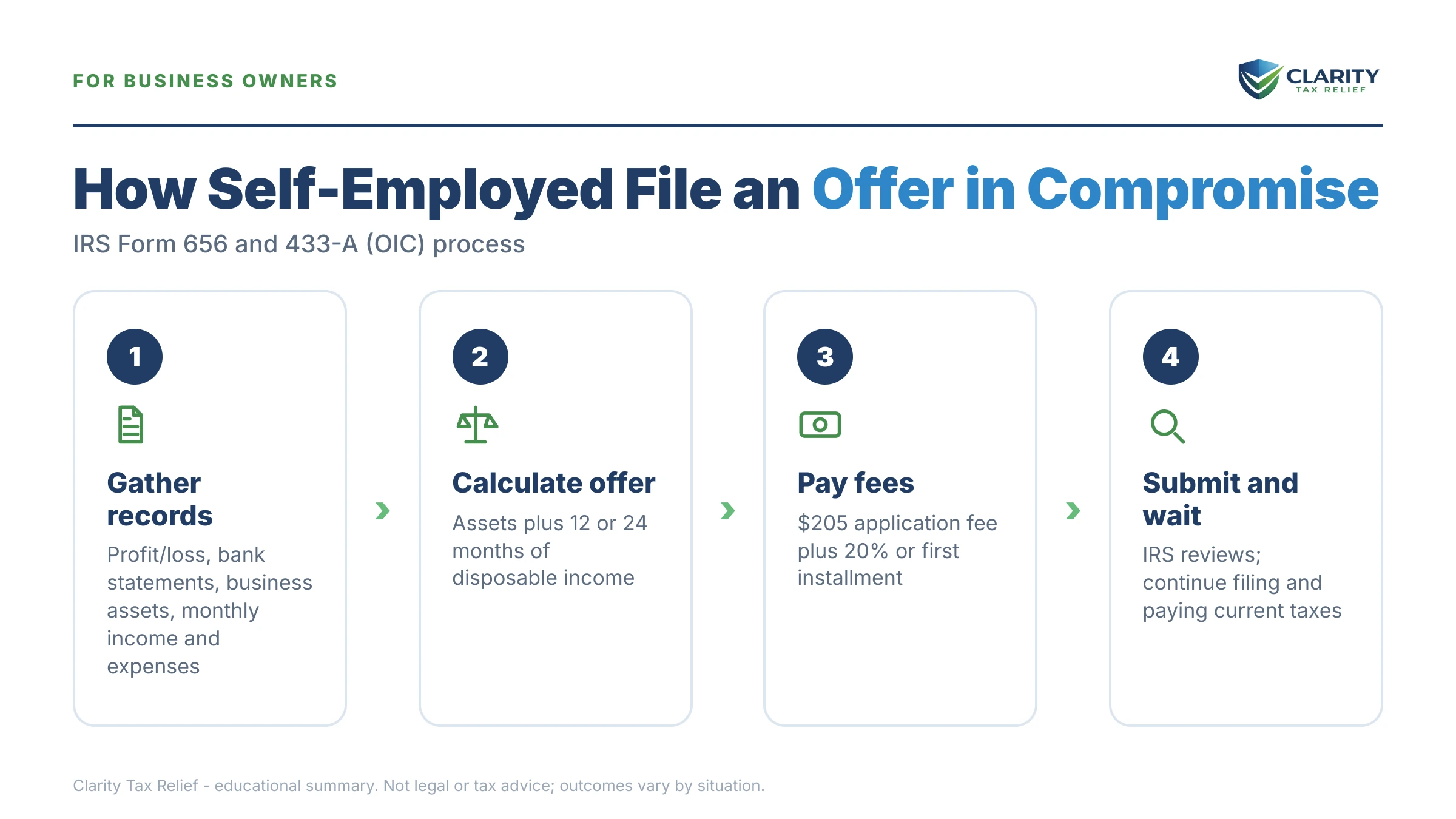
How the IRS calculates a self-employed OIC
The IRS won't accept an offer below your Reasonable Collection Potential — your net asset equity plus 12 or 24 months of your remaining monthly income. Everything on Form 433-A(OIC) feeds that one number, which we break down line by line in Reasonable Collection Potential. For irregular 1099 income, three rules control the outcome:
1. Your income gets averaged. The examiner typically averages your recent bank deposits — often 6 to 12 months — subtracts documented, necessary business expenses, and projects that average forward. If your last stretch was unusually good (a busy season, a one-time contract), it can inflate your offer unless you document why it won't repeat. If income recently dropped — a deactivated app account, a lost client — prove it in writing.
2. Living expenses are capped by IRS standards. After business expenses, the IRS subtracts allowable living expenses using national and local standards, not your actual lifestyle. Whatever survives is your "remaining monthly income," multiplied by 12 for a lump-sum offer or 24 for a periodic offer.
3. Assets count at quick-sale value. Vehicles, equipment, and accounts go in at roughly 80% of market value, minus loans. A financed work vehicle often adds nothing. Tools that generate the very income the IRS is counting can sometimes be excluded — the IRS generally shouldn't double-count an asset's value and the income it produces. That argument is one of the most valuable, and most overlooked, in self-employed offers.
Want a ballpark before you touch the forms? You can estimate your own offer with our Offer in Compromise Calculator.
A worked example: $6,200 owed, three years unfiled
Say you deliver for gig apps, haven't filed for three years, and after preparing all three returns with real mileage and expenses, the total balance lands at $6,200. This is hypothetical — your numbers will differ — but the arithmetic is exactly what the IRS runs:
| Line on Form 433-A(OIC) | Amount | How it's counted |
|---|---|---|
| Average monthly gross deposits | $3,900 | Averaged from your last 6 months of bank statements |
| Necessary business expenses | −$1,150 | Gas, phone, insurance, supplies — actual and documented |
| Allowable living expenses | −$2,570 | Capped at IRS national/local standards, not your actual spending |
| Remaining monthly income | $180 | What the IRS says you could pay each month |
| Future income component (× 12) | $2,160 | Lump-sum multiplier; a periodic offer uses × 24 |
| Asset equity | $0 | Car loan exceeds 80% quick-sale value; bank balance under the form's $1,000 exclusion |
| Reasonable Collection Potential | $2,160 | The minimum offer the IRS could accept |
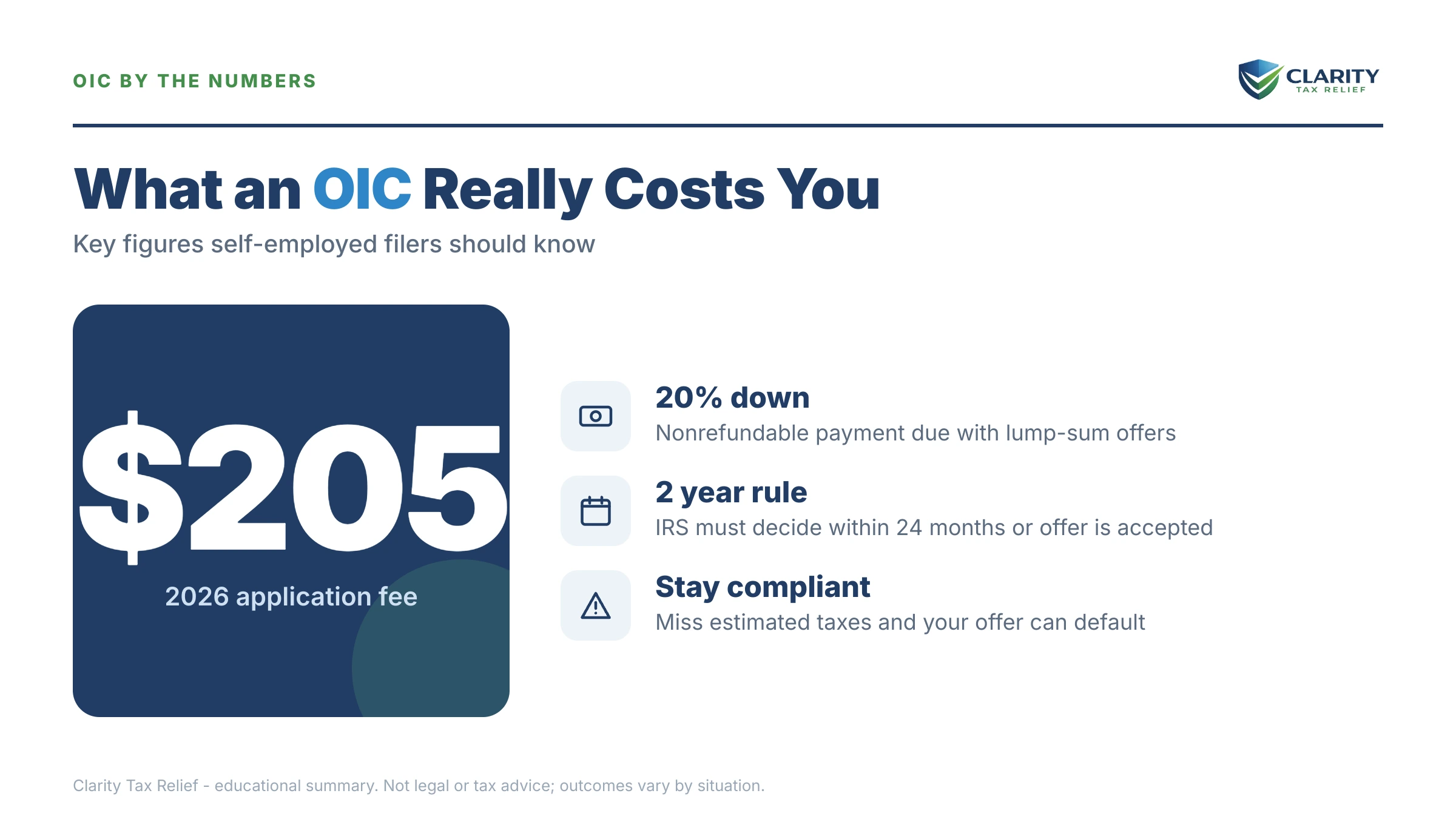
An accepted $2,160 offer resolves a $6,200 debt — roughly $4,000 less than full payment, before counting the interest a payment plan would add. The cost to apply: a $205 fee plus a $432 down payment (20% of $2,160) — unless your AGI is at or below 250% of the federal poverty level, in which case the low-income certification waives the fee, the down payment, and payments during review. Many solo gig workers clear that threshold.
Now the honest counterweight: at $6,200, a guaranteed installment agreement would run under $90 a month over 72 months (plus accruing interest and penalties) with no financial disclosure at all. The offer only wins because RCP came out well below the balance — change the deposits to $4,400 a month and the math flips. That's why you run both numbers before committing to either path.
What happens if you keep waiting
Unfiled years don't sit still — the IRS eventually files for you, and its version of your return has no business expenses in it. The sequence runs in this order:
- Non-filer notices (CP59 → CP516 → CP518) — the IRS's records show 1099 income with no return attached, and it starts demanding one.
- Substitute for Return (SFR) — the IRS prepares a return from your gross 1099s: no mileage, no expenses, single filing status. For a gig worker, the assessed tax can be several times what a real return would show.
- CP3219N, the deficiency notice — a 90-day window to petition Tax Court before the SFR amount becomes a legal assessment.
- Collection notices (CP14 → CP504) — the assessed balance, now grown by penalties and daily interest, enters the automated collection stream.
- LT11 final notice — a 30-day clock and your Collection Due Process rights, then the IRS can levy: a bank levy freezes funds for 21 days before they leave, and payments owed to you by platforms or clients can be intercepted.
Two quieter costs of waiting: any refund from a withholding or credit year is forfeited three years after its due date, and the 10-year collection statute doesn't even start running until a return is assessed — unfiled debt never ages. In 2026, with IRS staffing down roughly 27%, humans are harder to reach, but every step above is automated and never stopped.
Three years unfiled and thinking about an offer?
The filing order, the expense documentation, and the offer math all change what you end up paying. Have an experienced tax professional run your self-employed OIC numbers free — before another month of interest and failure-to-file penalties posts.
If the offer math doesn't work: your other options
An OIC is one door, not the only one — and for many self-employed balances it's not the cheapest. Match your situation to the eligibility test first:
| Option | Core eligibility test | Best fit when |
|---|---|---|
| Offer in Compromise | RCP below the balance; all returns filed; estimates current | Income barely covers IRS allowable expenses and assets are thin |
| Guaranteed installment agreement | Balance of $10,000 or less; returns filed and paid on time going forward | Small balance, steady enough income to pay monthly |
| Streamlined installment agreement | Up to $25,000 (up to $50,000 with direct debit); up to 72 months online | You can pay in full over time and want no financial disclosure |
| Short-term payment plan | Can pay in full within 180 days | A slow season caused the shortfall, not the business model |
| Currently Not Collectible | Allowable expenses meet or exceed income | The business genuinely can't fund any payment — see currently not collectible self employed |
| Penalty relief | Clean prior compliance or reasonable cause; the new Automatic Exemption from Penalty (AEP) begins rolling out summer 2026 | Failure-to-file/pay penalties are a big slice of the balance |
Costs and timelines differ just as much as eligibility:
| Option | Upfront cost | Typical timeline |
|---|---|---|
| Lump-sum OIC | $205 fee + 20% of the offer (both waived with low-income certification) | Review often takes months; auto-accepted if the IRS makes no decision within 2 years, with narrow exceptions — a returned or rejected offer stops the clock, and time during court disputes does not count |
| Periodic OIC | $205 fee + first monthly payment; payments continue during review | Offer paid over up to 24 months after acceptance |
| Short-term plan | $0 setup | Paid in full within 180 days |
| Long-term installment agreement | Setup fee varies (lowest with direct debit); interest and penalties keep accruing | Up to 72 months |
| Currently Not Collectible | $0 | Reviewed periodically; the debt keeps aging toward the 10-year collection statute |
Two edge cases worth knowing: if you're already making monthly payments, submitting an offer changes what happens to that agreement — see can I apply for an OIC while on a payment plan. And whatever you send with a lump-sum offer isn't a deposit you can pull back — here's exactly what happens to your 20% down payment if the offer fails.
How to apply for a self-employed OIC, step by step
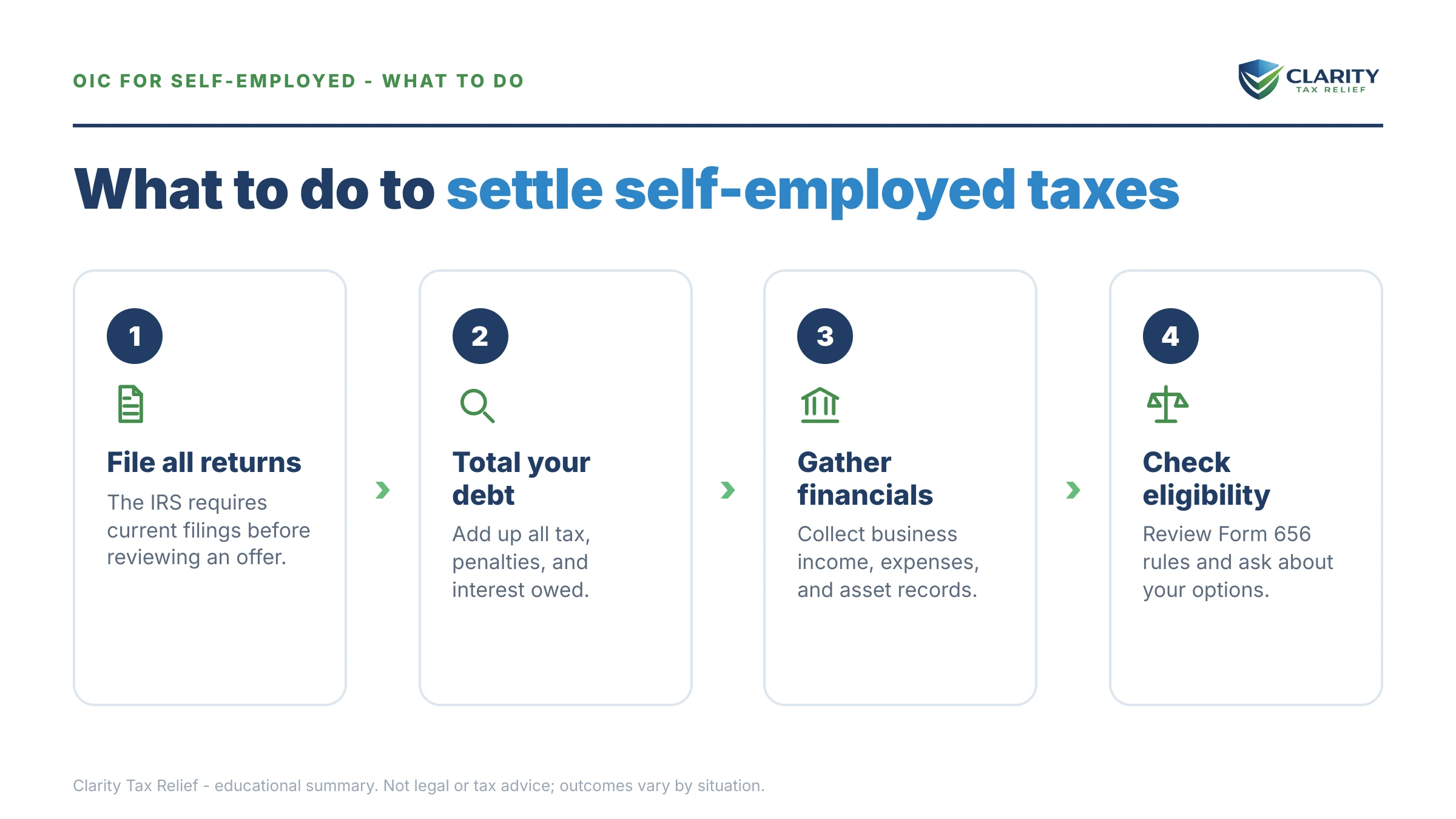
- File every missing return. Claim your real business expenses on each unfiled year — actual returns are usually far lower than what the IRS assesses without them, and no offer is processable until all required returns are in.
- Get current on this year's estimated taxes. Start quarterly payments now; the IRS returns offers from self-employed applicants who aren't current on estimates.
- Assemble your financial proof. Pull 6–12 months of bank statements, a profit-and-loss summary, and documentation for every business and living expense you'll claim on Form 433-A(OIC).
- Calculate your Reasonable Collection Potential. Average your net business income, subtract IRS allowable living expenses, multiply the remainder by 12 (lump sum) or 24 (periodic), then add net asset equity.
- Submit Form 656 with the fee and down payment — or the low-income certification. Send $205 plus 20% of a lump-sum offer, or check the low-income box if your AGI is at or below 250% of the federal poverty level, which waives both.
- Stay compliant while the IRS reviews. Keep making estimated payments and file on time — a new unpaid balance during review can sink the offer, and if the IRS makes no decision within 2 years, your offer is automatically accepted, with narrow exceptions — a returned or rejected offer stops the clock, and time during court disputes does not count.
When you can handle this yourself — and when help changes the outcome
You don't need professional help for every self-employed tax debt, and anyone who says otherwise is selling something. Handle it yourself when the balance is small enough to pay within 180 days, when only one recent year is unfiled and you have the records, or when a streamlined payment plan clearly fits — the IRS's own Offer in Compromise page and IRS.gov/payments walk you through both. If money is tight, a Taxpayer Advocate Service low-income clinic may represent you for free.
Experienced help earns its cost in specific situations: reversing an SFR that taxed your gross 1099s, reconstructing three years of expenses without complete records, defending business expenses an examiner wants to disallow, and the income-averaging fight when your best six months are being projected across your future. And an honest note on small balances: at $6,200, a firm quoting thousands in fees can erase the OIC's entire savings — a legitimate review will tell you when a payment plan you set up yourself is the better deal. The IRS accepted roughly 1 in 5 offers in FY2024; the offers that make it through are the ones where the documentation was right the first time.
Terms on your offer paperwork, decoded
- Reasonable Collection Potential (RCP): the IRS's calculation of the most it could ever collect from you — asset equity plus projected future income — and the floor for any acceptable offer.
- Doubt as to collectibility: the legal basis for most offers — you owe the tax, but your finances show the IRS can't collect it in full.
- Quick-sale value: the discounted value (typically 80% of market) the IRS assigns your assets, reflecting a forced-sale price rather than what you paid.
- Allowable living expenses: the IRS's standardized caps on housing, food, transportation, and health costs used in the offer math — regardless of what you actually spend.
- Low-income certification: the checkbox on Form 656 that waives the $205 fee, the 20% down payment, and review-period payments when your AGI is at or below 250% of the federal poverty level.
- Returned vs. rejected: a returned offer was never considered (usually a compliance failure) and can't be appealed; a rejected offer was reviewed and denied — and that decision you can appeal.
Self-employed OIC questions, answered
Can a self-employed person get an offer in compromise?
Yes — self-employment doesn't disqualify you, but it changes the proof. Instead of pay stubs, the IRS wants months of bank statements and a profit-and-loss summary, and it cross-checks your numbers against the 1099-K and 1099-NEC forms already on file. The IRS accepted roughly 1 in 5 offers in FY2024, and self-employed offers succeed or fail on how well the income and expense documentation holds up.
Do I have to file all my back tax returns before applying for an OIC?
Yes. The IRS returns an offer unprocessed if any required return is missing. Filing first usually works in your favor anyway: if the IRS filed substitute returns for you, it taxed your gross 1099 income with no business expenses, and replacing them with real returns often shrinks the balance before you ever make an offer.
How does the IRS calculate my income for an OIC when 1099 income changes every month?
It averages. The offer examiner typically looks at your last 6 to 12 months of bank deposits, backs out necessary business expenses, and treats the average as your monthly income going forward. If your income is seasonal or recently dropped, document why — a written explanation with proof, such as a lost contract or a deactivated app account, can keep an unusually good stretch from being projected across your whole future.
Do I have to be current on quarterly estimated taxes to apply?
Yes. The IRS requires self-employed applicants to be current on the current year's estimated tax payments before it will process an offer, because it won't settle old debt while new debt is forming. Start quarterly payments before you submit Form 656 — and keep making them during review, since a new unpaid balance while your offer is pending can end it.
Will the IRS count my work vehicle or tools in my offer?
It counts equity, not the asset itself. Each asset goes in at quick-sale value — typically 80% of what it would fetch — minus any loan against it, so a financed work vehicle often contributes nothing. Equipment you genuinely need to produce the income the IRS is already counting can sometimes be excluded, because the IRS generally shouldn't count both the tool's value and the income it generates.
How much does it cost to apply for an OIC when you're self-employed?
A lump-sum offer costs a $205 application fee plus 20% of your offer amount up front. If your adjusted gross income is at or below 250% of the federal poverty level, the low-income certification waives the fee, the 20% down payment, and monthly payments during review. Watch out for firms quoting thousands of dollars to file a small offer — on a small balance, fees can erase the savings.
Is an offer in compromise worth it if I only owe about $6,000?
Sometimes — but check the alternatives first. Any balance of $10,000 or less qualifies for a guaranteed installment agreement, which is faster and needs no financial disclosure. An OIC only wins when your Reasonable Collection Potential is clearly below the balance and you can stay compliant for the months the review takes. Run both numbers before you commit; the cheaper path depends entirely on your income and assets.
What happens if my self-employed OIC is rejected?
You have 30 days from the rejection letter to appeal using Form 13711, and appeals officers do reverse rejections when the expense documentation supports it. Your 20% down payment and any monthly payments made during review are applied to the tax debt, not refunded. Many self-employed offers fail on disputed business expenses — exactly the kind of issue an appeal can fix with better records.
Your next 24 hours
- Log into your IRS online account and write down which years show no return filed and what's already been assessed — that's your real starting number, not a guess.
- Gather your paper trail: your last six months of bank statements, the 1099s (or wage-and-income transcripts) for the missing years, and a rough list of your business expenses — if the years are a blur, start with our guide to haven't filed in 3 years.
- Get your offer math checked free — call (888) 825-7779 or use the 2-minute form. An experienced tax professional can tell you whether a self-employed OIC or a simple payment plan is the cheaper path before another month of interest compounds.
This guide is general information, not tax or legal advice for your specific situation. Eligibility for IRS programs depends on individual facts and circumstances; no outcome is guaranteed.