
IRS Transcript Codes
IRS Code 530 Transcript Meaning: Currently Not Collectible Status (2026)
The short answer: code 530 on an IRS transcript means the IRS placed your balance in currently not collectible (CNC) status — active collection is suspended because the IRS determined it can't collect from you right now. The debt isn't forgiven: interest and penalties keep accruing, but levies stop and the 10-year collection clock keeps running.
You pulled your transcript to see where you stand after the divorce — a balance that's still half your ex's doing — and near the bottom of the transaction list sits a line: 530, with $0.00 beside it. No letter arrived to explain it. Here's what a code 530 transcript entry actually changed on your account, and the one mistake that can undo it.
If you're not sure you're even looking at the right document, start with our guide to how to read an IRS account transcript. The image below shows you exactly what a 530 line looks like on a real transcript and where to find it among the other transaction codes.
⏱ Two clocks are running: there is no response deadline attached to code 530, but interest and the 0.5% monthly failure-to-pay penalty keep accruing on your full balance — while the 10-year collection statute keeps counting down in your favor. What you do (and don't do) during CNC decides which clock wins.
Code 530 transcript meaning: why it posted to your account
Transaction code 530 posts when the IRS closes a balance-due account as currently not collectible — its formal decision that forcing collection would leave you unable to cover basic living expenses, or that it has no way to collect at all.
Three routes lead to a 530 on your transcript:
- Hardship closing. You (or someone representing you) gave the IRS a financial snapshot — usually Form 433-F over the phone or by mail — showing that your income barely covers, or doesn't cover, the IRS's allowable living expense standards. This is the most common route, and the one most people searching this code are in. The full qualification math lives in our guide to how to qualify for CNC.
- Unable to locate or contact. If IRS mail bounces and no levy source turns up, the account gets shelved with a 530 without any financial review. These closings are fragile — they reverse the moment a W-2, 1099, or bank match gives the IRS a target.
- Defunct entity. Business accounts get 530 closings when the entity has dissolved and there's nothing left to collect from.
Each 530 posts with a two-digit closing code. For hardship closings, that code generally maps to an income level — and here's the part almost nobody explains: the IRS compares the income on every return you file against that threshold. Stay under it and the status holds. Cross it and the system flags your account for reactivation. No human has to decide anything.
The 530 line itself typically shows a $0.00 amount. That's normal — it's a status change, not a charge or a credit. If you recently went from two incomes to one, a hardship 530 is often the IRS acknowledging what your budget already knows. For the full background on what CNC is and how it works, see our pillar guide to IRS Currently Not Collectible status — this page stays focused on what the transcript entry itself tells you.
The codes around 530 on your transcript
A 530 rarely sits alone. Read the lines around it to understand your account's full story:
| Code | What it means | What to do |
|---|---|---|
| 150 | Original return assessed — this date starts the 10-year collection clock | Note the date for each year; it anchors your CSED math |
| 196 | Interest charged to the account | Expect these to keep posting during CNC — the pause doesn't stop accrual |
| 276 | Failure-to-pay penalty posted | Keeps posting at 0.5% per month until it caps at 25% of the unpaid tax |
| 530 | Account placed in currently not collectible status | Note the date and closing code; confirm one posted for every year you owe |
| 531 | CNC reversed — account back in active collection | Act before the restarted notice stream reaches a final levy notice |
| 582 | Federal tax lien indicator | A lien can post even during CNC — see how CNC and tax liens interact |
| 971 | Notice issued | During CNC this is often just the annual reminder notice, not a new problem |
What code 530 stops — and what keeps running
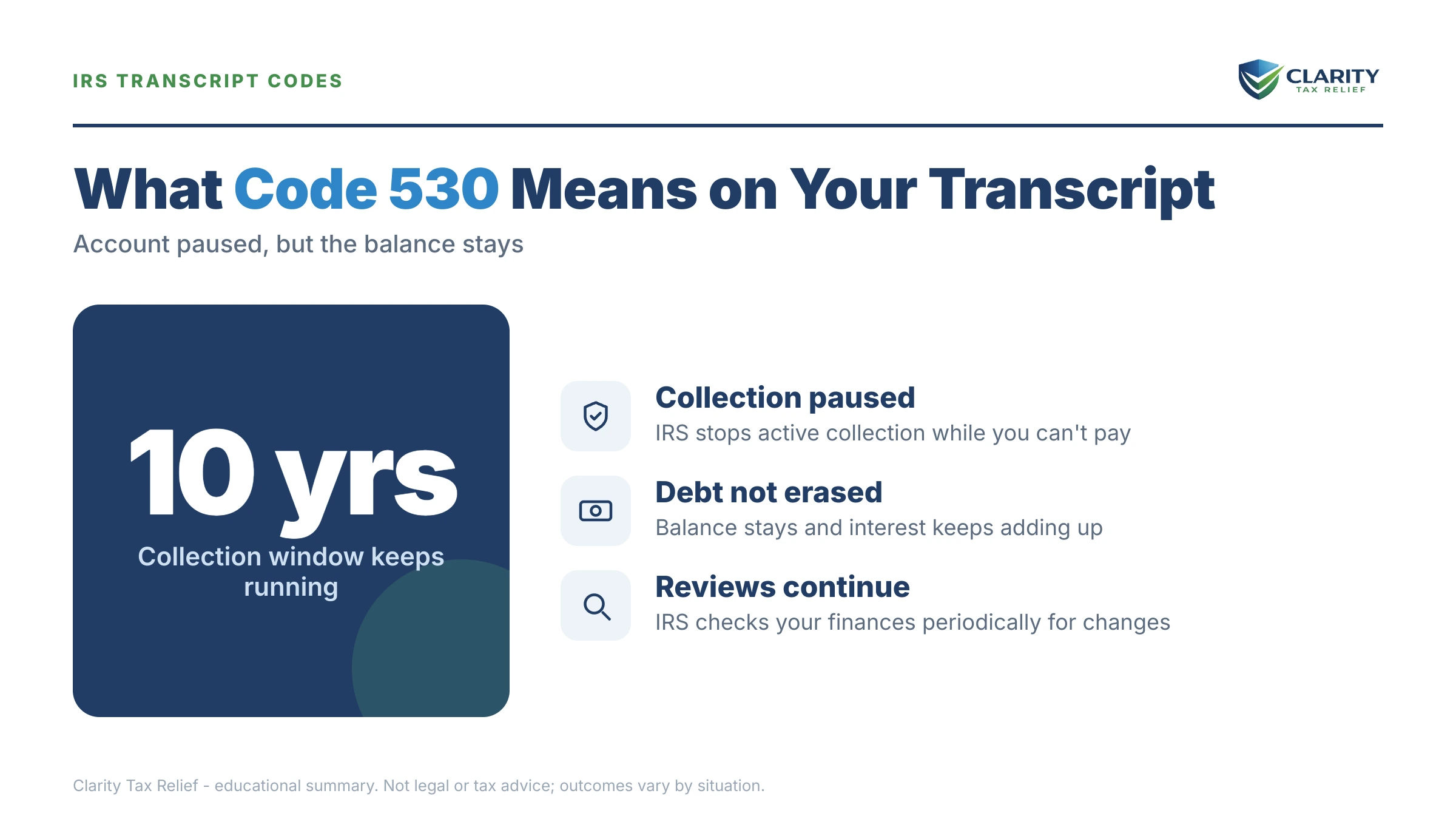
Code 530 suspends IRS levies and wage garnishments, but it does not stop interest, penalties, refund offsets, annual notices, or the possibility of a federal tax lien.
This is the trap in treating a 530 as "case closed." The enforcement machinery goes quiet, but the balance itself keeps compounding — each year adds new code 196 interest lines and code 276 penalty lines beneath your 530.
| Collection activity | Status while code 530 is active |
|---|---|
| Wage garnishments and bank levies | Stop — existing levies are released, new ones suspended |
| Interest (code 196 lines) | Continues, compounding daily on the full balance |
| Failure-to-pay penalty (code 276 lines) | Continues at 0.5% per month until it caps at 25% of the tax |
| Federal refund offsets | Continue — every refund is taken and applied to the debt |
| Notice of Federal Tax Lien | Can still be filed, especially on balances over $10,000 |
| Annual CP71 reminder notices | Continue — required by law, not a sign of reactivation |
| 10-year collection countdown (CSED) | Keeps running — in your favor |
Two of those rows deserve emphasis. First, the refund offset: if you're due a refund next spring, it's gone before it reaches you — so if you're in CNC, fixing your withholding to break even matters more than usual. Second, the lien: code 530 stops levies, not liens. On a balance like $92,700, IRS procedure generally supports filing a Notice of Federal Tax Lien even while your account sits in hardship status. Our guide to whether CNC stops a tax lien covers when that fight is winnable.
What happens after code 530 posts if you do nothing
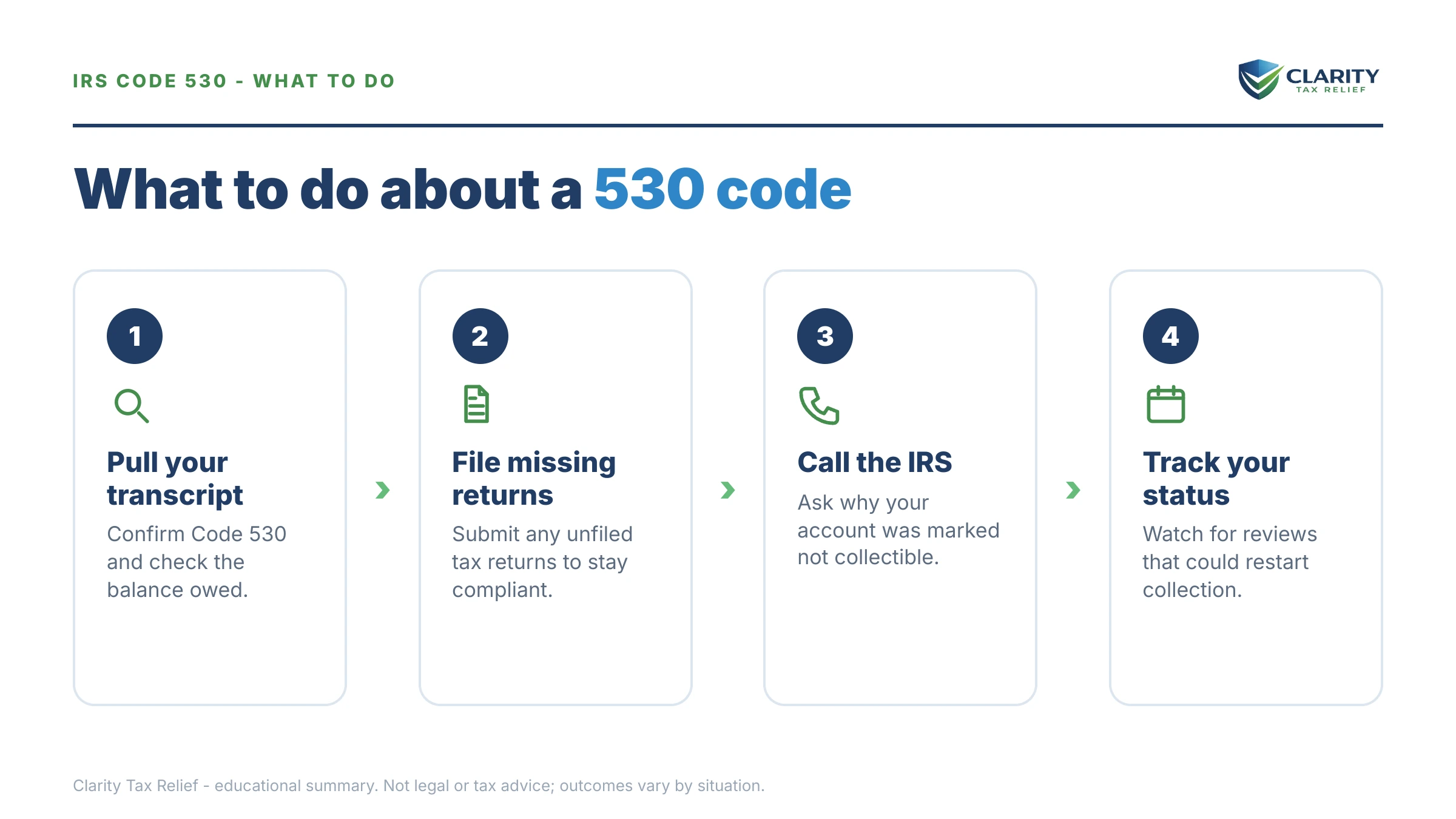
The IRS doesn't forget a CNC account — it monitors it automatically and can pull it back into collection the moment your reported income improves. The lifecycle runs as a sequence:
- Code 530 posts with a closing code. Active collection stops; any existing levy should be released. You are here.
- Annual maintenance mode. Each year you receive a CP71 reminder notice restating the balance, any refund you claim is offset, and fresh interest and penalty lines stack under the 530.
- Systemic income monitoring. Every return you file is compared against the income threshold tied to your closing code. This review is automated — nobody has to reopen your file by hand.
- Code 531 posts if you cross the line. The CNC closing is reversed and your account returns to active inventory. The collection notice stream restarts and, if unanswered, runs all the way to a final notice of intent to levy with a 30-day clock. What that reactivation looks like — and how to respond — is covered in CNC status removed: back to collections.
- Or the statute expires. If the 530 holds until each year's Collection Statute Expiration Date passes, the remaining balance for that year is written off. This is the quiet endgame of long-term CNC.
One 2026 reality check: the IRS workforce shrank roughly 27% in 2025, which makes humans harder to reach — but the income-monitoring and notice systems that manage CNC accounts are automated and never stopped. Your 530 will be reviewed by a computer whether or not you can get one on the phone.
Found a 530 — or worried a 531 is coming?
Send us your transcript. An experienced tax professional will confirm every year you owe is actually covered, map each year's expiration date, and tell you whether CNC is your best move or just a pause — free and confidential, no pressure. Penalties and interest are accruing either way.
Your options while your account sits in code 530
CNC is one of four realistic paths for a balance you can't full-pay, and the right one depends on your income trajectory and how much time is left on each year's collection statute.
| Option | Upfront cost | Ongoing cost and timeline | Effect on the 10-year clock |
|---|---|---|---|
| Stay in CNC | $0 | Interest plus 0.5% monthly penalty accrue; refunds offset each year; status holds until income rises or statute expires | Keeps running — in your favor |
| Installment agreement | Setup fee varies by method ($0 for short-term plans up to 180 days); low-income waivers exist | Monthly payments until paid; balances over $50,000 require financial disclosure | Keeps running while you pay |
| Partial-pay installment agreement | Setup fee plus Form 433 financials | An affordable monthly amount, not a full-pay schedule; IRS re-reviews your finances periodically | Keeps running — balance can expire mid-plan |
| Offer in Compromise (Form 656) | $205 fee plus 20% down on lump-sum offers — both waived with low-income certification | Typically many months to a decision; the IRS accepted roughly 1 in 5 offers in FY2024 | Paused while the offer is pending |
| Penalty abatement (FTA / AEP) | $0 | Removes qualifying penalties, not the tax itself; starting summer 2026, Automatic Exemption from Penalty applies without a request | No effect |
Two comparisons matter most for someone already in CNC. If your income is genuinely low and stable, the head-to-head in CNC vs. Offer in Compromise is the decision that shapes everything — an accepted offer ends the debt for good, but the process pauses your statute clock, and only about 1 in 5 offers were accepted in FY2024. If your income is recovering, payment plan vs. currently not collectible explains when volunteering an affordable plan beats waiting for the IRS to reverse your 530 on its own terms.
Don't skip the penalty angle. If the years behind your 530 carry failure-to-file or failure-to-pay penalties and your prior three years were clean, first-time abatement can strip those penalties — and beginning summer 2026, the IRS's new Automatic Exemption from Penalty (AEP) grants that relief automatically for qualifying accounts, no request needed. Shrinking the penalty load shrinks what the interest compounds on.
Code 530 after a divorce: whose hardship counts
A joint tax debt survives divorce intact — the IRS can collect 100% of it from either ex-spouse, no matter what the decree says. Your divorce decree binds your ex to you; it does not bind the IRS, a distinction we unpack in divorce and IRS debt: who pays.
That has a direct consequence for code 530: CNC is granted per person, not per debt. Your hardship closing protects you. It does nothing for your ex — the IRS can keep levying them for the same joint balance, and every dollar collected from them still reduces the debt on your transcript. The reverse is also true: if your ex got a 530 and you didn't, you're the one still exposed.
If the debt traces to income your ex hid or understated, innocent-spouse relief may remove your liability entirely rather than just pausing collection — a different tool worth evaluating before you settle into CNC as a long-term plan.
A worked example: $92,700 after a divorce
Say you owe $92,700 across three joint years — $38,400 for 2019, $31,200 for 2021, and $23,100 for 2022 — and the divorce finalized last year, dropping you to one income. Your take-home pay is $3,480 a month. Under the IRS's allowable expense standards, your countable expenses come to $3,510: housing and utilities $1,700, vehicle $850, food/clothing/misc $780, health costs $180. Disposable income: negative $30. That's a CNC account, and the 530 posts.
Now run the clocks. Roughly $71,000 of the $92,700 is underlying tax, so the failure-to-pay penalty adds about $355 a month (0.5% × $71,000) until it caps at 25% of the tax. Interest compounds daily at the federal short-term rate plus 3 points — for illustration, at 7% the balance grows about $6,500 in the first year. The debt is getting bigger.
But the statute is running too. If the 2019 balance was assessed in July 2020, its CSED lands in July 2030 — about four years away. Hold CNC through that date and the $38,400 plus everything that accrued on it simply expires. The 2021 and 2022 assessments run roughly two and three years longer.
Compare the alternatives. A full-pay plan on $92,700 over 72 months would run about $1,288 a month before accruals — arithmetic your budget can't survive, which is exactly what CNC exists for. An Offer in Compromise looks tempting with $0 disposable income and no equity, and if your AGI is at or below 250% of the poverty line, low-income certification waives the $205 fee and the 20% down payment. But an offer pauses every year's statute clock while it's reviewed — with the oldest $38,400 that close to expiring, offering could genuinely cost more than waiting. This is the exact fork where professional math earns its fee.
The quiet advantage: the 10-year clock keeps running under code 530
Currently not collectible status does not pause the Collection Statute Expiration Date — the IRS generally has 10 years from each assessment to collect, and every month in CNC burns that time off.
This makes code 530 structurally different from almost every other resolution. An Offer in Compromise pauses the clock while pending. Bankruptcy pauses it. A Collection Due Process hearing pauses it. CNC doesn't. For low-income taxpayers with old assessments, staying quietly in 530 status until the statute expires is often the mathematically best outcome available — the mechanics are in our guide to how long the IRS can collect back taxes, and you can estimate each of your own expiration dates with our CSED Calculator.
Three cautions before you build a strategy on the clock. First, the countdown runs per assessment, per year — your newest year expires last. Second, tolling events you triggered in the past (a prior offer, a bankruptcy, certain appeals) push dates later than the simple assessed-date-plus-ten math suggests. Third, don't hand the IRS a tolling event by accident: filing an offer with two years left on your biggest year can be a strategic mistake, not a solution.
One more benefit worth knowing at your balance level: owing more than $66,000 (the 2026 threshold) normally exposes you to passport certification as a seriously delinquent taxpayer — but the IRS's published exclusions include debt in currently-not-collectible hardship status. A hardship 530 is one of the things that keeps your passport out of the crossfire.
How to respond to code 530, step by step
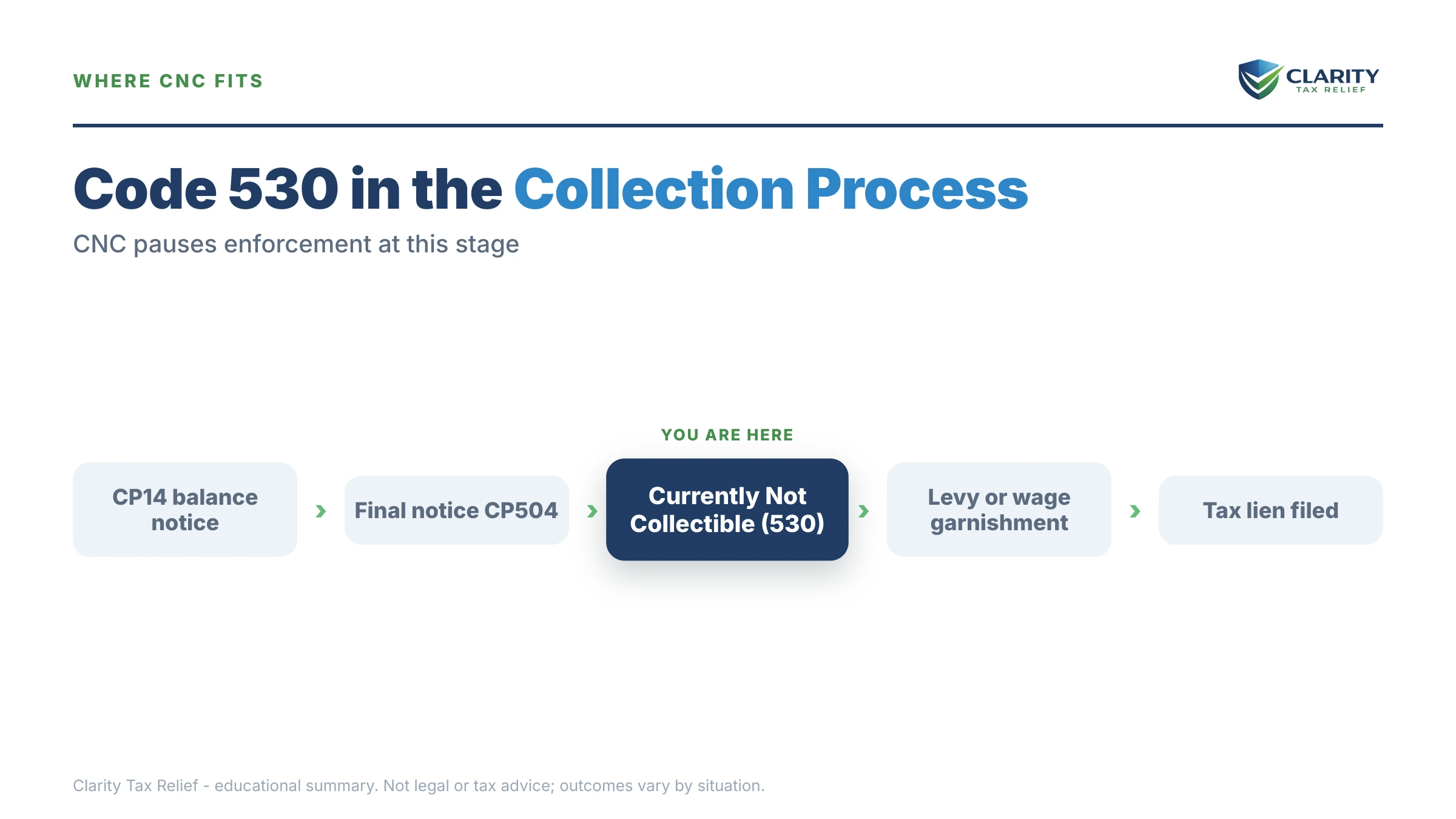
- Pull your account transcript for every year you owe. Confirm a code 530 posted to each balance year — CNC that skips a year leaves that year open to levy. Transcripts are free through your IRS online account.
- Find each year's assessment date and calculate the CSED. Locate the code 150 or 290 assessment date, add 10 years, and adjust for any tolling events like a prior Offer in Compromise or bankruptcy.
- Stay filing-compliant and fix your withholding. File every return on time — a new balance due invites review, and any refund you claim will be offset against the old debt automatically.
- Track your income against the closing-code threshold. A raise, a 1099 side job, or a taxable retirement withdrawal can push your reported income high enough to trigger a code 531 reversal.
- Re-run the strategy math once a year. Compare staying in CNC against an Offer in Compromise or partial-pay plan as each CSED gets closer — the right answer changes over time.
You can pull transcripts yourself anytime through the IRS's Get Transcript tool — checking once a year, ideally after you file, is enough to catch a 531 before the notice stream gets serious.
When you can handle code 530 yourself
If the 530 covers every year you owe, your income is stable and under your closing-code threshold, and you have no lien complicating a home sale or refinance — you may not need anyone. Keep filing on time, keep your withholding accurate, check your transcript annually, and let the statute run. The IRS's own overview of the program is on its temporarily delay the collection process page, and if a reactivation ever causes hardship you can't resolve through normal channels, the Taxpayer Advocate Service exists for exactly that.
Experienced help changes outcomes in specific situations: a year that's missing its 530 and still collectible; CSED math complicated by old tolling events, where being wrong by a year changes the whole strategy; a lien about to be filed before you need to sell or refinance; income rising toward your threshold, where preempting the 531 with a partial-pay plan or a well-timed offer beats reacting to it; joint-year debt where innocent-spouse relief could erase your share instead of pausing it; and self-employment income, where the IRS applies the hardship test differently. In those cases, the fee usually buys a materially different result, not just convenience.
Not sure which side of that line you're on? A free transcript review by an experienced tax professional will tell you in one call — request it here or dial (888) 825-7779.
Terms on your transcript, decoded
- TC 530: the transaction code marking your account closed as currently not collectible — a status change, which is why it posts with $0.00.
- TC 531: the reversal code that takes your account out of CNC and back into active collection.
- Closing code: the two-digit code attached to a 530 that records why the account was closed; hardship closings carry the income threshold that governs reactivation.
- CNC (currently not collectible): the IRS status that suspends levies and garnishments because collection would prevent you from meeting basic living expenses.
- CSED (Collection Statute Expiration Date): the date, generally 10 years after assessment, when the IRS's legal right to collect a given year's balance ends.
- CP71: the annual reminder notice the IRS must send while a balance exists — routine during CNC, not a sign your status changed.
- Refund offset: the automatic application of any federal refund to your old balance — the one collection tool CNC never turns off.
Code 530 questions, answered
What does code 530 mean on an IRS transcript?
Code 530 means the IRS has closed your balance-due account as currently not collectible — it has suspended active collection because its records show you cannot pay right now. The line usually posts with a $0.00 amount because it changes your account's status, not its balance. Your debt still exists, still grows with interest and penalties, and can be reactivated if your income improves.
Is code 530 good news or bad news?
Mostly good news if you were facing levies: code 530 means wage garnishments and bank levies stop while the status holds. The trade-offs are that interest and the 0.5% monthly failure-to-pay penalty keep accruing, your refunds will be offset each year, and the IRS can still file a federal tax lien. The quiet upside is that the 10-year collection statute keeps running the entire time.
Does code 530 mean the IRS forgave my tax debt?
No. Currently not collectible status is a pause, not forgiveness — the full balance remains on your account and keeps growing. Forgiveness only happens two ways: the IRS accepts an Offer in Compromise, or the 10-year collection statute expires with a balance still unpaid. Code 530 can eventually lead to the second outcome, but only if the status holds until each year's CSED passes.
How long does code 530 status last?
There is no fixed term — CNC lasts until the IRS decides you can pay again or the collection statute expires. The IRS monitors the income on each return you file; if it rises above the threshold tied to your 530's closing code, the account is flagged for reactivation. Many accounts stay in CNC for years; others come out after a single good income year.
Does the 10-year collection statute keep running during code 530?
Yes — this is the most important feature of CNC status. Unlike an Offer in Compromise, a bankruptcy, or a Collection Due Process hearing, currently not collectible status does not pause the Collection Statute Expiration Date. Every month you spend in code 530 status is a month closer to the balance expiring, as long as no tolling event intervenes.
Will the IRS take my tax refund while code 530 is active?
Yes. Refund offset is one collection tool that CNC does not stop — any federal refund you're due will be applied to the old balance automatically until it's paid or expires. If you're in CNC, adjust your withholding so you break roughly even at filing time instead of handing the IRS an interest-free extra payment every spring. A hardship offset bypass exists but is rare and must be requested before the refund is applied.
What is code 531 on an IRS transcript?
Code 531 reverses code 530 — it means the IRS has taken your account out of currently not collectible status and returned it to active collection. It usually follows a filed return showing income above your closing-code threshold, or a new balance due. After a 531 posts, expect the collection notice sequence to restart, ending in a final notice of intent to levy if the balance goes unaddressed.
Can the IRS file a tax lien while I'm in CNC status?
Yes. Code 530 stops levies, not liens — and IRS procedure generally calls for filing a Notice of Federal Tax Lien on unpaid balances over $10,000, including accounts in hardship status. A lien doesn't take money; it stakes a public claim against your property that complicates selling or refinancing. If a lien would cause specific harm, that argument has to be raised — it doesn't happen automatically.
Why is code 530 on my transcript when I never asked for hardship status?
Not every 530 is a hardship closing. The IRS also uses code 530 when it cannot locate or contact a taxpayer, or when a business entity is defunct — those closings happen without any financial review. If you moved and stopped receiving IRS mail, your account may have been shelved this way. Update your address and pull your transcript for every year, because these accounts reactivate the moment the IRS finds a levy source.
Your next 24 hours
- Find the 530 line on each year's transcript. Note its date and closing code, and confirm every year you owe has one — a year without a 530 is still fully collectible.
- Gather three things: your last filed return, your current income figures, and any IRS letters you've received — especially the most recent CP71 reminder.
- Get the free case review. Use the 2-minute form or call (888) 825-7779 and an experienced tax professional will map each year's expiration date and tell you whether your CNC status is a holding pattern or your endgame — because interest and penalties are compounding on that balance every month it goes unexamined.
This guide is general information, not tax or legal advice for your specific situation. Eligibility for IRS programs depends on individual facts and circumstances; no outcome is guaranteed.