
IRS Collections
CNC Status Removed: Why the IRS Reactivated Collection and What to Do Now (2026)
The short answer: CNC status removed means the IRS has pulled your account out of hardship protection and back into active collection — usually because a filed return showed income above the threshold set when your CNC was approved. The debt never went away; the notice sequence that leads to levies now restarts.
For two or three years, the only mail you got about this debt was one quiet annual reminder. Now — right when you were rebuilding after the divorce — a real collection notice landed, and the protection you thought you had is gone. Here's the part that matters: reactivation is a status change, not a levy, and you have a window to choose your next arrangement before enforcement resumes.
Most people never get a letter that says "your CNC was removed." The evidence lives on your account transcript, in the hardship transaction the IRS posted when it approved your CNC and what changes when it reverses — the image below shows you exactly where that status appears and what to look for.
⏱ Your real clock: CNC removal itself has no fixed deadline — but the notice that follows does. Each collection notice carries a printed response date that controls, and if an LT11 or Letter 1058 arrives, you have 30 days from its date to request a Collection Due Process hearing before the IRS can levy. Meanwhile, penalties and interest have been accruing the entire time you were in CNC.
Why your CNC status was removed
The number one reason CNC status is removed is a tax return showing income above the dollar threshold the IRS recorded when it approved your hardship. When the IRS closes an account as currently not collectible, it doesn't just file your case away — it attaches a closing code tied to an income level. Every year, its computers match your newly filed return against that number. Cross it, and the system reactivates your account automatically. No human decides; no one calls you first.
For a recently divorced filer, this trigger is almost predictable. Your CNC was likely approved when your household income cratered — one income where there used to be two, new rent, legal bills. A new job, a raise, or your first full year of post-divorce income can push your reported total over the recorded line even if your budget still feels stretched. The threshold is based on CNC income limits and the allowable-expense math from when you applied — not on how tight things feel today.
Other triggers pull accounts out of CNC too:
- A periodic review. CNC is never permanent — the IRS revisits hardship accounts on a cycle, and a review can end the status even without an income spike. Our guide to how long currently not collectible lasts covers the review rhythm in detail.
- A new balance due. Owing again for a later year — common in the first year after a divorce changes your filing status and withholding — signals the IRS that your compliance broke, and it can fold the old debt back into active collection alongside the new one.
- An unfiled required return. The IRS conditions hardship status on staying current. A missing return can end the protection and blocks every replacement option until it's filed.
- New asset or income information. A 1099 the IRS wasn't expecting, a property record, or a levy source report can prompt a manual reversal.
If you're not sure which trigger hit you, your transcript will say. The hardship closure posts as code 530 on your transcript; a reversal transaction and a resumed notice stream mean the account is active again. (Background on how the status works in the first place lives in our guide to how to qualify for CNC — this page is about what happens when it ends.)
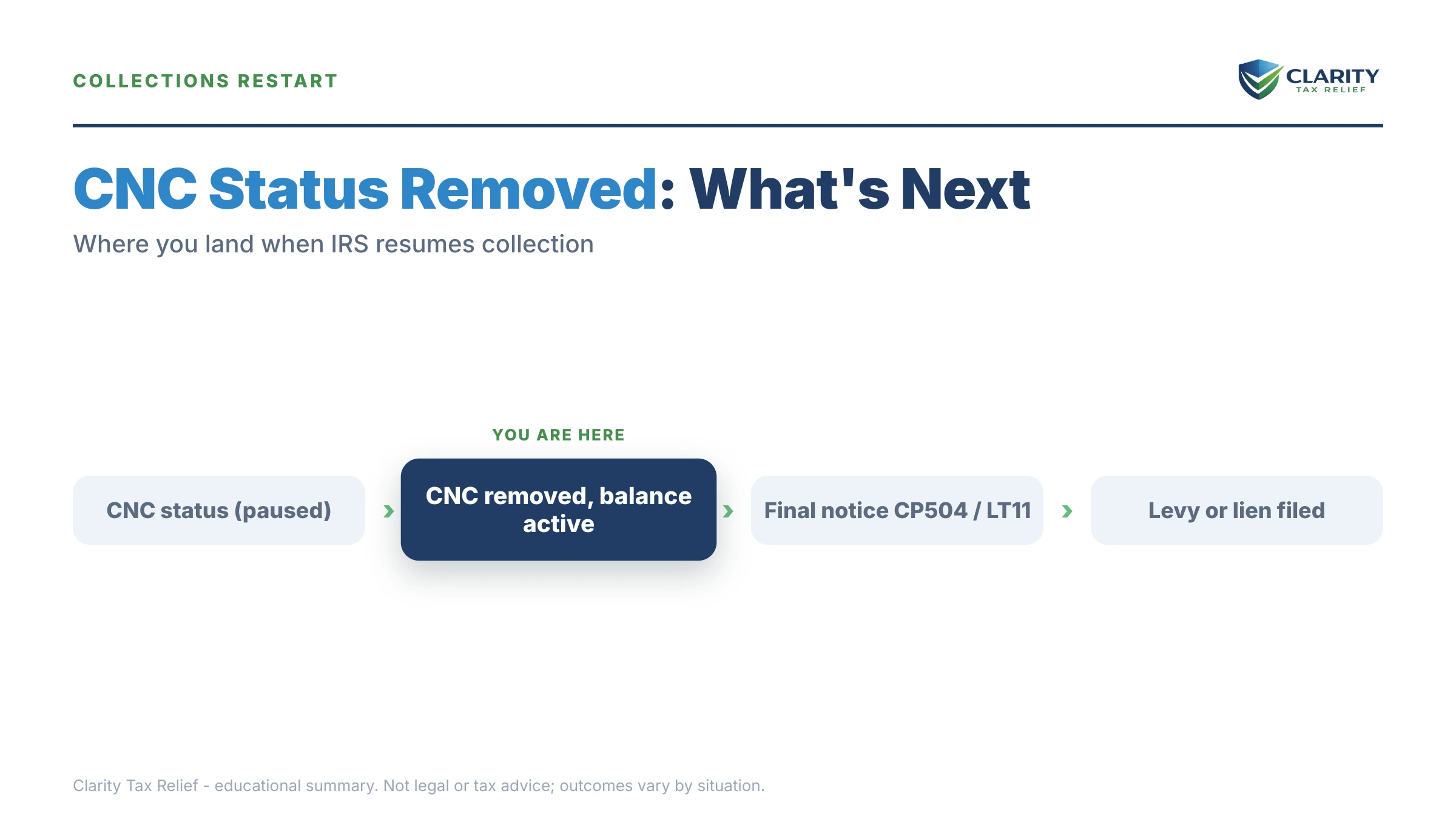
What "CNC status removed" actually means — and what it doesn't
CNC removal changes your account's collection status, not the amount you owe — the debt existed and grew the entire time. Three things were true all along, and they shape your options now:
First, the balance kept growing. CNC pauses enforcement, not accrual. Interest compounded daily at the federal short-term rate plus 3%, and the failure-to-pay penalty kept adding 0.5% per month until it caps at 25% of the tax. A debt that entered CNC at $70,000 can easily come out the other side above $83,000.
Second, the 10-year collection statute never stopped. Unlike an Offer in Compromise or bankruptcy, CNC does not pause the CSED — every year you spent in hardship status was a year of collection window the IRS lost forever. If your debt was assessed in 2021, the IRS has until roughly 2031, and that shrinking runway is real leverage in choosing what comes next. You can estimate your remaining collection window with our CSED Calculator, and our guide to the 10-year collection statute explains what does and doesn't pause it.
Third, some collection never stopped at all. The IRS kept every refund you were owed while in CNC, and if your balance was large enough, a federal tax lien may already be on file. Removal doesn't create those — it adds the active-enforcement tools back on top of them.
What happens if you ignore the reactivation
Once CNC is removed, your account re-enters the same automated notice pipeline that leads to wage and bank levies. The stages arrive in order, each with more enforcement power than the last:
- Annual reminders end, balance-due notices resume. The yearly CP71 notice you got during CNC gives way to active demands for payment — the first visible sign most people get that hardship status ended.
- Reminder notices (CP501/CP503 or LT-series). Still bills, not enforcement — but the balance grows monthly and the system is queuing the next stage.
- CP504 — Notice of Intent to Levy. The IRS can now seize your state tax refund under IRC §6331(d). This is not the final notice, but it's the last cheap exit.
- LT11 / Letter 1058 — Final Notice. A 30-day clock starts, along with your Collection Due Process rights (requested on Form 12153). After 30 days, wage garnishment and bank levies are on the table. One caution: if the IRS issued a final notice before your CNC was approved, it may not need to send a new one — enforcement can move faster on reactivated accounts.
- Levy. A bank levy freezes funds with a 21-day hold before the money leaves; a wage levy is continuous until released; Social Security can be levied up to 15% through the Federal Payment Levy Program.
One more consequence is unique to coming out of CNC with a large balance: passport exposure. Accounts in hardship status are generally excluded from certification — but once your account reactivates, a debt above $66,000 (the 2026 threshold) can be certified to the State Department as seriously delinquent, blocking passport issuance or renewal until you're back in an approved arrangement.
And a 2026 reality check: per TIGTA reports, the IRS workforce shrank roughly 27% in 2025, which makes reaching a human harder than ever — but the reactivation, notice, and levy systems are automated and never stopped. Waiting for someone to call you is not a strategy.
| Stage / notice | Your response window | What's at stake if it passes |
|---|---|---|
| CNC reversal (transcript / first new notice) | No fixed deadline — act before notices escalate | Your chance to choose the next arrangement calmly, before enforcement pressure |
| Balance-due / reminder notices | The pay-by date printed on each notice | Cheapest window to set up a plan; balance grows monthly |
| CP504 — Intent to Levy | The date printed on the notice | State tax refund can be seized; lien filing becomes likely |
| LT11 / Letter 1058 — Final Notice | 30 days from the notice date | Collection Due Process hearing rights (Form 12153); after 30 days, levies can begin |
| Bank levy issued | 21-day hold before funds leave | Last chance to get the levy released before the money is gone |
Just found out your CNC status was removed?
The window between reactivation and the first enforcement notice is when your options are widest. Get your transcript and notices reviewed free — an experienced tax professional will confirm what triggered the removal and which arrangement protects you now.
Your options after CNC removal
Coming out of CNC, you have five realistic paths, and which one fits depends on what your current Form 433-F math shows. The honest starting point: if the IRS was right that your income rose, re-applying for hardship may fail — and a payment arrangement chosen by you beats a levy chosen by the machine.
| Option | Who it fits at $83,100 | What the IRS requires |
|---|---|---|
| Re-qualify for CNC | Income rose on paper but allowable expenses still consume it (new support obligations, medical costs) | Fresh Form 433-F, all returns filed, expenses within IRS standards |
| Streamlined installment agreement | Only if you can pay the balance below $50,000 first — otherwise unavailable at this size | Balance ≤ $50,000; up to 72 months; can be set up online |
| Non-streamlined installment agreement | Income genuinely recovered; you can full-pay within the remaining collection statute | Financial disclosure (Form 433-F); payment sized to income and CSED |
| Partial-pay installment agreement (PPIA) | You can pay something monthly, but not enough to full-pay before the CSED | Full financial disclosure; periodic reviews; IRS collects only what the statute allows |
| Offer in Compromise | Assets and future income together genuinely can't cover the debt | Forms 656 + 433-A(OIC), $205 fee (waived if AGI ≤ 250% of poverty); IRS accepted roughly 1 in 5 offers in FY2024, per IRS data |
Re-qualifying for CNC is the first thing to test, because the trigger is often cruder than your reality. The computer saw gross income cross a line; it didn't see that your divorce decree added child support, that you now carry the health insurance, or that your housing cost doubled. If a fresh Form 433-F shows allowable expenses still meet or exceed income, you can be placed back in hardship status. One warning for the divorced reader: the IRS follows its own allowable-expense standards, not your decree — and it collects joint liabilities from either ex-spouse regardless of who the decree assigned them to. Our guide to divorce and IRS debt: who pays covers that trap.
An installment agreement is the path if your income really did recover. At $83,100 you're above the $50,000 online-streamlined line, so expect to submit financials — the payment gets sized to what the 433-F shows, not a fixed formula. Interest and a reduced failure-to-pay penalty continue while you pay.
A partial-pay installment agreement is the option most people coming out of CNC have never heard of, and it's often the best fit. You pay what your financials support each month; when the collection statute expires, whatever remains uncollected is gone. Because your CSED ran all through your CNC years, the remaining window may be short enough that a PPIA collects far less than the full balance — legally.
An Offer in Compromise settles the debt for the most the IRS could realistically collect from your assets and future income. It's real but means-tested and slow, and the same income increase that ended your CNC raises your offer amount. See CNC vs. offer in compromise for the head-to-head — and note that a pending OIC pauses the CSED, which is exactly the clock working in your favor right now.
A worked example: $83,100 after a divorce, CNC removed
Say you owe $83,100 from two joint tax years, assessed in 2021. The IRS approved CNC in 2023 when your post-divorce income dropped to $34,000. In early 2026 you filed your 2025 return showing $78,000 from a new job — above your recorded closing threshold — and the system reactivated your account. Here's the math on each path:
- The clock: assessed in 2021, the CSED lands around 2031 — roughly 5 years (about 60 months) of collection window remain, and your three CNC years already burned three of the ten.
- Full-pay installment agreement: $83,100 ÷ 60 months ≈ $1,385/month before ongoing interest — realistic only if your budget after rent, childcare, and support obligations can absorb it.
- Partial-pay agreement: suppose your Form 433-F shows $450/month of genuine ability to pay after IRS-standard expenses. $450 × ~60 remaining months ≈ $27,000 collected — the rest expires with the statute in 2031, assuming nothing pauses the clock.
- Cost of doing nothing: at 0.5% per month, the failure-to-pay penalty alone adds about $415 a month until it caps at 25% of the tax, interest compounds daily on top, and the notice ladder above marches toward a levy on your $78,000 salary.
This is hypothetical, and your numbers will differ — but it shows why the same removal can end three very different ways depending on which arrangement you request first.
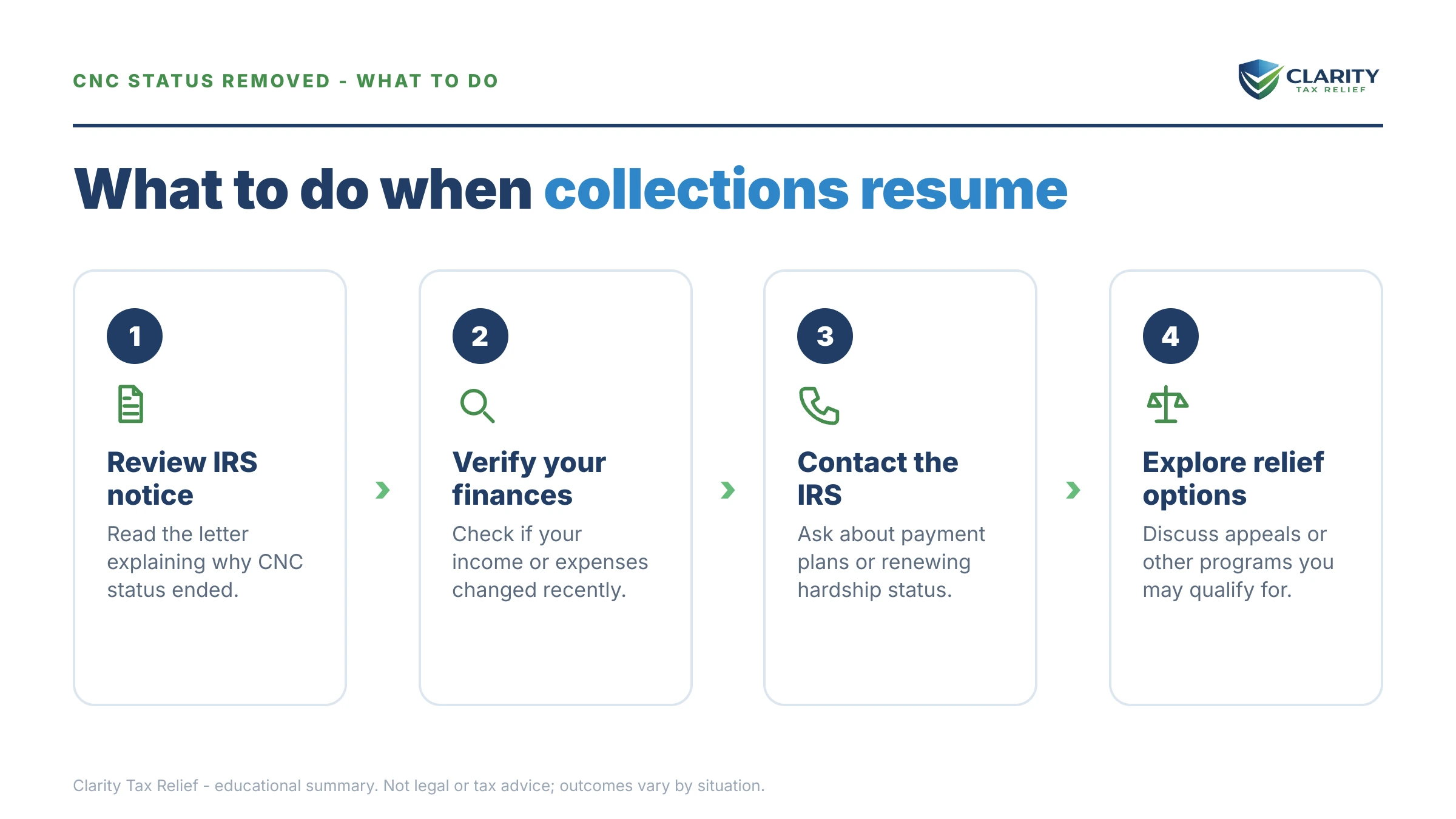
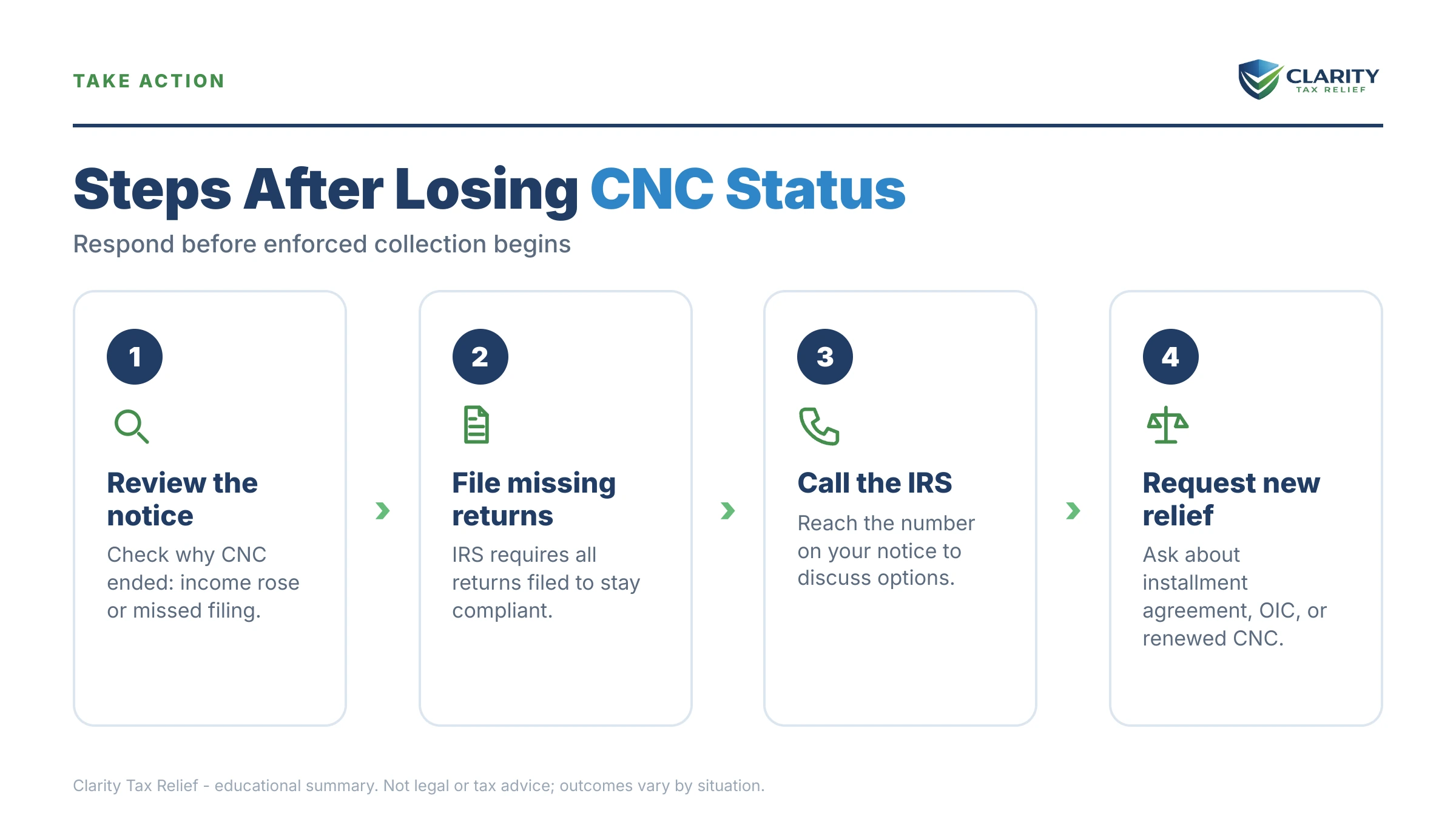
How to respond after CNC status removal, step by step
- Confirm why collection restarted. Pull your account transcript or log into your IRS online account and read the newest notice — the reason (income trigger, new balance, unfiled return) determines your next move.
- Get filing-compliant first. File any missing return and fix your withholding or estimated payments — the IRS will not approve CNC, a payment plan, or an offer while a required return is outstanding.
- Rebuild your financial picture. Complete a fresh Form 433-F with your current income and allowable expenses — this one document tells you whether re-qualifying for hardship is realistic or a payment option fits better.
- Choose and submit your resolution. Based on the 433-F math, request renewed CNC, a full-pay installment agreement, a partial-pay agreement, or an Offer in Compromise — before enforcement notices arrive, not after.
- Answer every notice by its printed date. Respond to each collection notice by the deadline printed on it, and if an LT11 or Letter 1058 arrives, file Form 12153 within 30 days to preserve your appeal rights and pause levy action.
When you can handle this yourself — and when help changes the outcome
You can likely handle CNC removal on your own if your income genuinely recovered, you have no unfiled years, and a straightforward monthly payment fits your budget — setting up an installment agreement is a form and a phone call, and the IRS's own payment plans page walks through it. If your balance is modest and you can full-pay within 180 days, a short-term plan costs nothing to set up.
Experienced help changes the outcome in four situations. When the removal was wrong — your gross income crossed the line but your allowable-expense math still supports hardship — presenting the 433-F correctly the first time matters. When a partial-pay agreement or OIC is on the table, because the CSED math and expense standards decide whether you pay $27,000 or $83,100 over the same five years. When multiple years are unfiled, since the fix must happen in the right order. And when a final notice has already been issued or a levy is in motion, because the 30-day CDP window and hardship-release rules are unforgiving of missed steps. If your CNC came out of a business or 1099 situation, the financials get harder still — see currently not collectible when self-employed.
If any of those describe you, a free review of your transcript before you call the IRS yourself can save you from locking in the wrong arrangement — request one here or call (888) 825-7779.
Terms on your transcript and notices, decoded
- CNC / hardship status: a collection pause the IRS grants when paying anything would leave you unable to cover necessary living expenses — the debt remains and grows.
- TC 530: the transcript transaction code showing your account was closed as currently not collectible; a reversal of it means collection is active again.
- Closing code / income threshold: the income level the IRS recorded when approving your CNC; filed returns are matched against it every year, and crossing it triggers reactivation.
- CSED: the Collection Statute Expiration Date — 10 years from assessment, after which the IRS can no longer collect; it kept running during your CNC.
- CDP rights: your right to a Collection Due Process hearing (Form 12153) within 30 days of a final notice of intent to levy — it pauses levy action while the appeal is heard.
- Levy vs. lien: a lien is a legal claim securing the debt against your property; a levy is the actual seizure of wages, bank funds, or other assets.
CNC removal questions, answered
Why was my CNC status removed?
The most common trigger is a filed tax return showing income above the threshold the IRS recorded when it approved your hardship. Other triggers include a periodic account review, a new balance due for a later year, an unfiled required return, or updated financial information suggesting you can now pay. Your account transcript and the first new collection notice usually reveal which one applies to you.
Does the IRS tell you when CNC status ends?
Not always with a dedicated letter — many people learn their CNC ended only when a regular collection notice arrives. During CNC you receive an annual CP71 reminder; when the stream shifts from annual reminders to escalating balance-due notices, your account has reactivated. You can confirm it anytime by pulling your account transcript or checking your IRS online account.
How do I get back into currently not collectible status?
You re-apply the same way you qualified the first time: file any missing returns, then submit a current Form 433-F showing that your necessary living expenses under IRS standards equal or exceed your income. If your income genuinely rose since the original approval, the math may no longer work — in that case a partial-pay installment agreement or an Offer in Compromise may fit better than re-applying for CNC.
Does time spent in CNC count toward the 10-year collection statute?
Yes — the 10-year collection clock (CSED) keeps running the entire time your account sits in CNC. Unlike an Offer in Compromise or bankruptcy, hardship status does not pause the statute. That means every year in CNC is a year of collection window the IRS lost, which changes the math on what it can realistically collect from you now.
Can the IRS levy me immediately after removing CNC status?
Usually the IRS resumes its notice sequence first, and it must issue a final notice of intent to levy — with 30 days to request a Collection Due Process hearing — before seizing wages or bank accounts. The exception: if a final notice was already issued before your CNC was approved, the IRS may not need to send a new one, so enforcement can move faster. Either way, a levy that causes genuine hardship can be released.
Will filing my tax return kick me out of CNC?
Filing itself doesn't end CNC — but a return showing income above the threshold set when your hardship was approved will trigger a systemic reactivation. Do not skip filing to avoid this: an unfiled return is its own removal trigger, blocks every resolution option, and the failure-to-file penalty is ten times the failure-to-pay penalty (though in months where both apply, the failure-to-file portion drops to 4.5 percent, for 5 percent combined). File, then be ready to re-prove hardship or negotiate.
Does CNC removal affect my passport?
It can if your balance is large enough. Accounts in CNC hardship status are generally excluded from passport certification, but once your account reactivates, a debt above $66,000 (the 2026 threshold) can be certified to the State Department as seriously delinquent, which can block passport renewal or issuance. Getting into an installment agreement or approved hardship status again removes that exposure.
Your next 24 hours
- Pull your transcript and find the trigger. Log into your IRS online account, locate the hardship closure and its reversal, and note the date and response deadline printed on the newest collection notice.
- Gather three things: your most recent tax return, every IRS notice from the past year (including the annual CP71s), and a rough monthly budget — income, rent or mortgage, childcare, support payments, insurance.
- Get a free case review before you call the IRS. Bring those documents to the 2-minute form at claritytaxrelief.com/#consult or call (888) 825-7779 — the arrangement you request first is the one that sticks, and penalties and interest are accruing on the full balance while the account sits active.
For the IRS's own overview of hardship status and your rights during collection, see the Taxpayer Advocate Service, and if you're ready to pay or set up a plan directly, start at IRS.gov/payments.
This guide is general information, not tax or legal advice for your specific situation. Eligibility for IRS programs depends on individual facts and circumstances; no outcome is guaranteed.