
IRS Hardship Programs
CNC Income Limits: How the IRS Really Decides Who Qualifies in 2026
The short answer: there is no fixed income limit for Currently Not Collectible (CNC) status. The IRS grants CNC when your monthly income, minus allowable living expenses under its Collection Financial Standards, leaves nothing left to pay. If your necessary expenses equal or exceed your income, you can qualify — at almost any salary on paper.
If you searched CNC income limits hoping for a chart of dollar cutoffs, here's the truth up front: no such chart exists. The IRS doesn't approve or deny hardship status by salary. It runs one calculation — income minus allowable expenses — and the "limit" changes with your county, your household size, and your documented bills.
Maybe you're a renter who just got a levy notice, rent is due, and every payment-plan estimate you've run comes out to money that isn't there. That gap between what the IRS wants and what your budget holds is exactly the thing CNC was built to measure — and you can measure it yourself before you ever call.
The whole determination lives on one form, the 433-F. The image below shows exactly what that form looks like and where the income and expense sections that decide your case actually sit — worth studying before you fill in a single line.
⏱ If a levy is in motion, real clocks are running. You have 30 days from the date on an LT11 or Letter 1058 to request a Collection Due Process hearing with Form 12153. If your bank account was already levied, the bank holds the funds for 21 days before sending them to the IRS — a hardship release during that window can still get the money back.
CNC income limits: why there's no fixed number
The IRS approves Currently Not Collectible status based on an expense calculation, not an income cutoff. A single renter earning $3,600 a month in a high-rent county can qualify while someone earning $2,800 in a cheap one gets denied — because the test is what's left over, not what comes in. (For the full hardship-test overview, see how to qualify for CNC; this page covers the income and expense math specifically.)
There is one real income number in the process, and it comes after approval. When the IRS closes your account as CNC, it records the income level from your financial statement. Your future tax returns are then monitored against that figure — if reported income rises meaningfully above it, the account reactivates. That mechanism is covered in CNC status removed; the point here is that the number is set by your case, not published as a universal limit.
So the practical question isn't "what's the limit?" It's "what will the IRS allow me to spend?" — and that's governed by four expense categories with very specific rules.
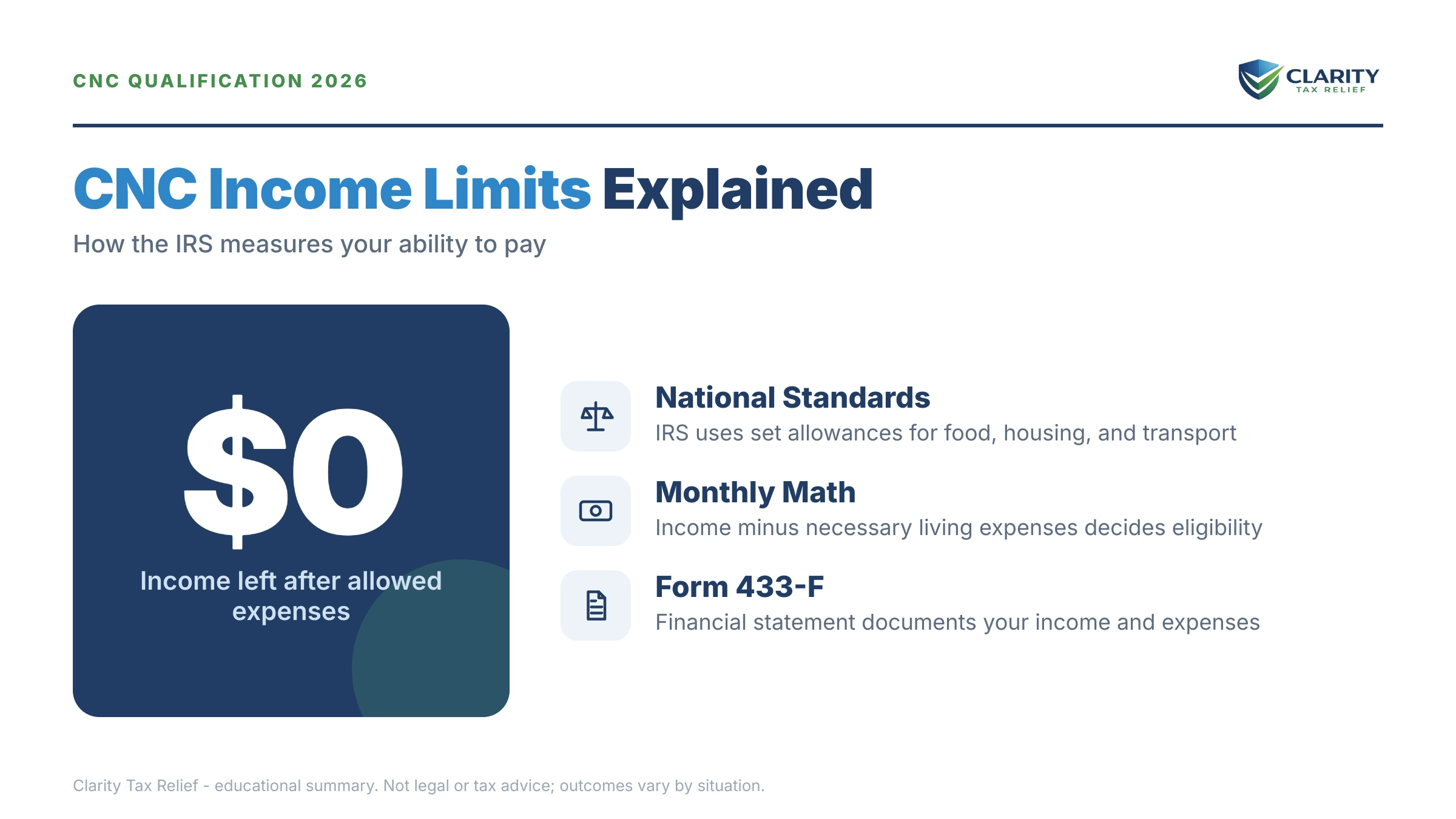
The allowable-expense math the IRS actually runs
The IRS measures your ability to pay against its Collection Financial Standards — published allowances for food, housing, transportation, and health care — not against your actual lifestyle. That distinction cuts both ways. Some allowances you get without receipts, even if you spend less. Others are capped, even if you genuinely spend more.
Here's how each category is treated when a caseworker (or the automated system) scores your Form 433-F. Our IRS allowable living expenses standards guide covers the current published figures; this table shows the rules of the game:
| Expense category | How the IRS caps it | Proof to gather |
|---|---|---|
| Food, clothing, housekeeping, personal care, misc. | National standard by household size — allowed in full, no receipts required | None (claim the full standard) |
| Housing & utilities (rent, electric, water, phone, internet) | Local standard by county and household size — generally the lesser of your actual cost or the standard | Lease, utility bills, 3 months of statements |
| Vehicle ownership (loan or lease payment) | National cap per vehicle; no allowance if you own the car outright | Loan/lease statement |
| Vehicle operating costs (gas, insurance, maintenance) or public transit | Regional standard by metro area | Insurance declaration page |
| Health insurance premiums | Actual amount paid | Pay stub deduction or premium bill |
| Out-of-pocket medical costs | National standard per person, or actual if higher with documentation | Pharmacy/provider receipts if above standard |
| Current-year taxes (withholding or estimates) | Actual, if consistent with your income | Recent pay stubs |
| Court-ordered payments (child support, restitution) | Actual, if actually being paid | Court order plus payment proof |
| Child or dependent care needed to work | Reasonable actual cost | Provider statements |
Two traps catch renters most often. First, your actual rent counts only up to your county's housing standard — if you pay above it, the IRS can disallow the excess unless you document why the higher cost is necessary (a disability accommodation, a lease you can't yet exit, no cheaper options in your work area). Second, credit-card minimums, streaming services, and payments on other unsecured debts generally don't count at all. The IRS's position is blunt: it comes before your other creditors.
Everything above goes on Form 433-F (or the longer 433-A if a revenue officer is assigned). Our Form 433-F walkthrough covers the form line by line — and the image on this page shows where each expense section sits, so you can match your paperwork to the right boxes before you call.
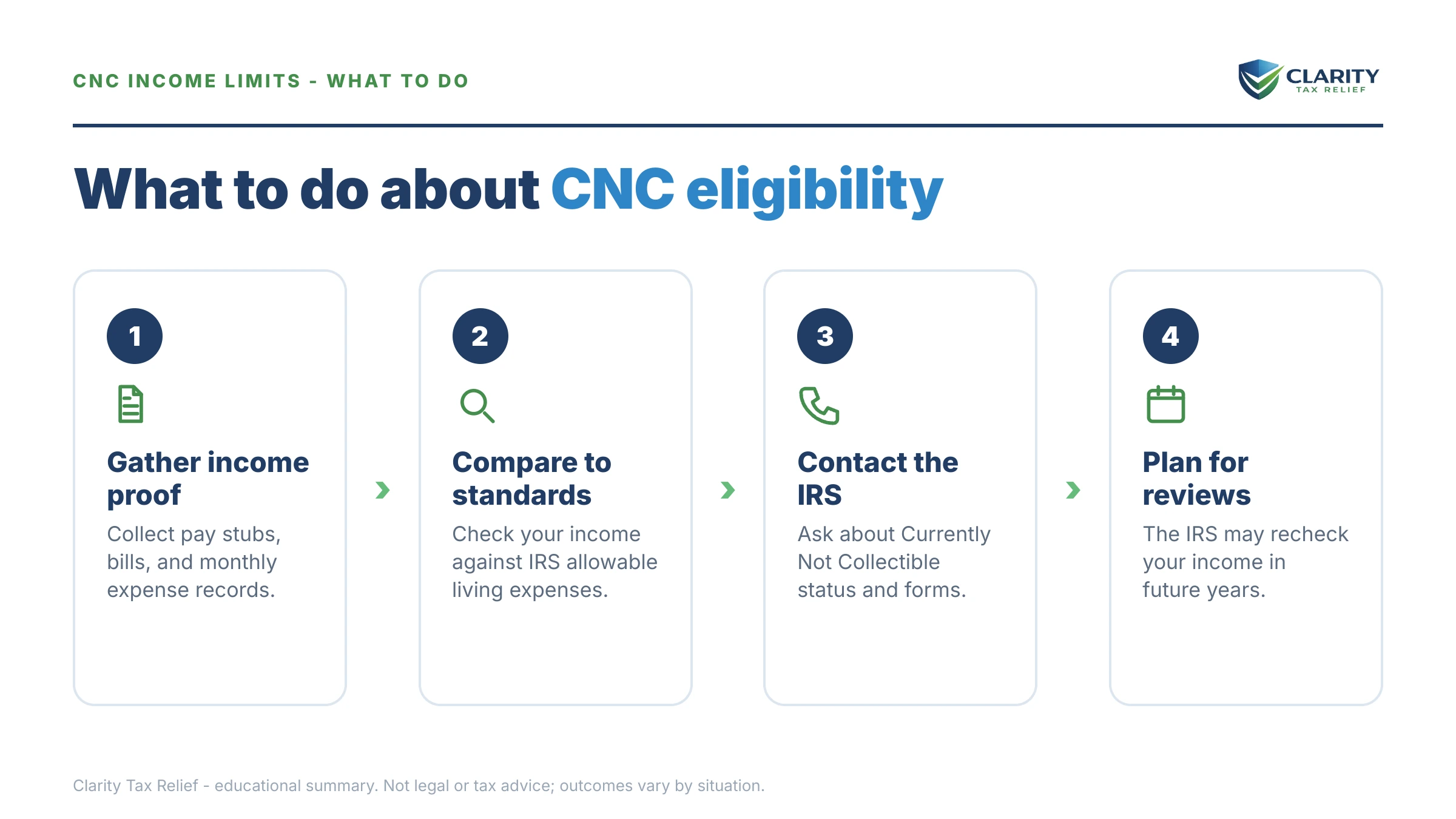
What income counts toward the CNC test
The IRS counts essentially every dollar that arrives in your household each month — not just your W-2 wages. Before you run your own math, know what goes in the income column:
- Wages: the IRS starts from gross pay, then allows your actual current-year withholding as an expense — which nets out close to your take-home amount.
- Both spouses' income counts toward household finances even if only one of you owes. If your spouse isn't liable, the IRS allocates shared expenses between you in proportion to income — so a well-paid non-liable spouse can shrink the expense share credited to you and sink the request. This is one of the most common surprise denials.
- Self-employment and gig income: gross receipts minus documented, necessary business expenses, usually averaged over recent months. Variable income makes the math genuinely harder — see currently not collectible self employed for that version of the test.
- Benefits: Social Security, SSDI, unemployment, pensions, and child support received all count as income.
- What doesn't count: loans from family, one-time gifts, and money that isn't recurring. Don't let a one-off deposit inflate your monthly figure.
The result of income minus allowable expenses is your monthly remainder. A remainder at or below zero is the entire "income limit" for CNC. A small positive remainder usually means the IRS pushes you toward a payment plan at that amount instead.
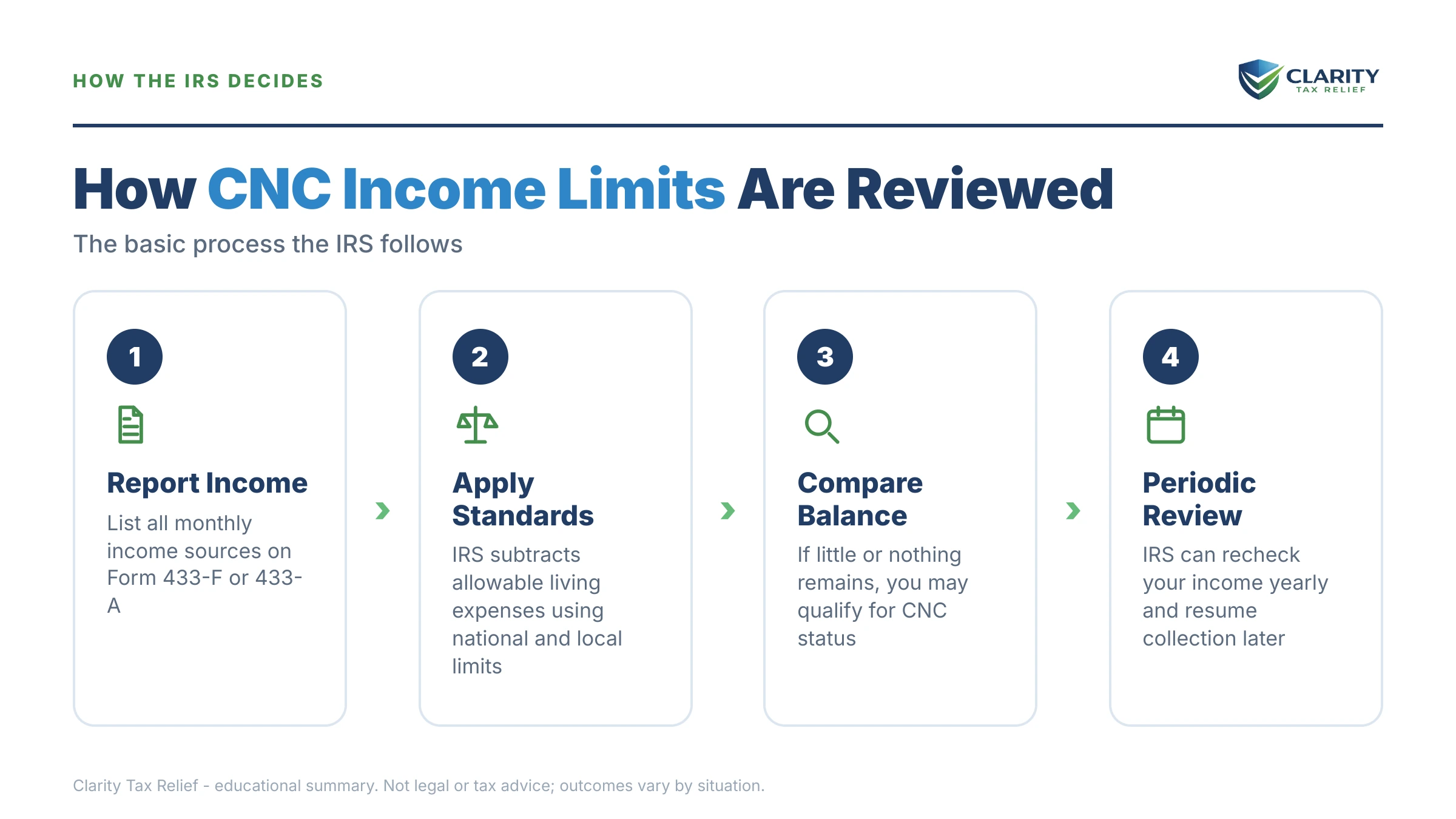
Worked example: $11,300 owed, a renter, and a levy notice
Say you owe the IRS $11,300, you rent a one-bedroom, and an LT11 just arrived. Here's the math the IRS would run — all figures hypothetical, for illustration:
- Income: $3,600 gross per month; $450 of current tax withholding is allowed as an expense, leaving $3,150 to measure.
- Rent + utilities: $1,650 actual. Suppose your county's housing standard for one person is $1,720 — you're under it, so the full $1,650 is allowed.
- Food/clothing/misc national standard for one person: suppose $850, allowed with no receipts.
- Car: a $520 loan payment within the ownership cap plus $260 of allowed operating costs — $780 total.
- Health insurance: $210 actual premium. Out-of-pocket medical standard: $80.
Allowable expenses total $1,650 + $850 + $780 + $210 + $80 = $3,570 against $3,150 of post-tax income — a remainder of −$420. You are a textbook CNC candidate. Compare the alternative: a 72-month streamlined plan on $11,300 runs roughly $157/month minimum ($11,300 ÷ 72), before the interest that keeps accruing. The IRS would rather have the $157 — but your documented budget says it doesn't exist, and that's precisely what the 433-F is designed to prove.
One more wrinkle at this balance: a guaranteed installment agreement requires a balance of $10,000 or less, so at $11,300 you miss that automatic path by $1,300. Your realistic routes are streamlined-plan-you-can't-afford, CNC, or an offer — compared below.
What happens if you do nothing while a levy is in motion
An LT11 or Letter 1058 means the IRS can begin seizing wages and bank funds once its 30-day window passes. If you've already received one, you're not at the start of the collection sequence — you're near the end of it, and each stage from here removes an option:
- CP504 — intent to levy your state refund. Under IRC §6331(d), the IRS can take your state tax refund after this notice. It is not yet the final notice.
- LT11 / Letter 1058 — final notice. A 30-day clock starts, along with your Collection Due Process rights. Requesting a hearing on Form 12153 protects you from levy while your case — including a CNC request — is reviewed.
- Bank levy. A one-time grab of whatever is in the account when the levy hits. The bank holds funds for 21 days before remitting — your last window to prove hardship and recover them.
- Wage levy. Continuous: your employer keeps sending most of each paycheck until the IRS releases it. Only a small exempt amount reaches you.
- Federal Payment Levy Program. If you receive Social Security, up to 15% of each payment can be taken automatically.
A note on 2026 specifically: the IRS workforce shrank roughly 27% in 2025, which makes a human hard to reach — but levies are issued by automated systems that never stopped. Silence doesn't slow the machine; a filed CDP request or a documented hardship claim does. One small mercy at $11,300: you're well below the $66,000 passport-certification threshold, so your passport isn't the exposure. Your paycheck and bank account are.
| Notice or event | Your window | The right at stake |
|---|---|---|
| CP504 | Before the next notice issues | Resolve now and the final notice — and levy authority — never arrives; state refund is already at risk |
| LT11 / Letter 1058 | 30 days from the notice date | Collection Due Process hearing (Form 12153); miss it and levy can begin without further warning |
| Bank levy served | 21 days before the bank remits | Hardship release can return held funds; after remittance, recovery is far harder |
| Wage levy in effect | Continuous until released | A CNC/economic-hardship determination under §6343 forces release |
| FPLP Social Security levy | Up to 15% of each payment, ongoing | Hardship documentation can stop the withholding |
Levy notice in hand and the math says you can't pay?
That's the exact situation CNC exists for. Get your notice and your budget reviewed free before the 30-day window on an LT11 closes — an experienced tax professional will run the allowable-expense math with you and tell you honestly whether you clear the hardship test.
How much income is too much for CNC? Your options compared
If your remainder is positive, CNC is usually off the table — but a positive remainder opens the doors CNC closes. Here's the honest map at a balance like $11,300:
| Option | Who qualifies | Cost and catch |
|---|---|---|
| Short-term payment plan | Anyone who can pay in full within 180 days | $0 setup; interest and penalties continue but enforcement stops |
| Streamlined installment agreement | Balance ≤ $50,000; up to 72 months, set up online | Setup fee applies (reduced or waived for low income); at $11,300, roughly $157/month minimum |
| Guaranteed installment agreement | Balance ≤ $10,000 plus filing/payment compliance | Not available at $11,300 — you miss the cap by $1,300 |
| Currently Not Collectible | Monthly remainder at or below zero after allowable expenses | $0 to request; interest accrues, refunds are offset, and the IRS reviews future returns |
| Partial-pay installment agreement | Small positive remainder that can't retire the debt before the CSED | Full financial disclosure; periodic re-reviews |
| Offer in Compromise | Means-tested: assets plus future income can't cover the debt | $205 fee and 20% down on lump-sum offers — both waived with low-income certification (AGI ≤ 250% of the poverty level); roughly 1 in 5 offers accepted in FY2024 |
Notice the overlap between the last three rows: the same negative remainder that qualifies you for CNC also makes an offer mathematically strong, because the future-income component of an offer is built on that remainder. The deciding factor is usually the clock. CNC does not pause the 10-year collection statute — every month in CNC brings the debt closer to expiring, while an OIC pauses that clock during review. If your CSED is only a few years out, riding CNC to expiration can beat settling; if it's eight years out, an offer may end things sooner. You can estimate your own expiration date with our CSED Calculator, and the full trade-off analysis lives in CNC vs offer in compromise. If your remainder is small but positive, payment plan vs currently not collectible walks the borderline cases.
Two more things CNC does not do. It doesn't stop refund offsets — future federal refunds go straight to the balance. And it doesn't prevent a Notice of Federal Tax Lien; on balances above $10,000 the IRS typically makes a lien determination even while pausing active collection. See does CNC stop a tax lien before you assume the file goes fully quiet.
Owe California too? The Franchise Tax Board runs its own hardship program with its own financial forms — and a 20-year collection statute under R&TC §19255, twice the IRS's window. None of the IRS figures on this page apply to the FTB; see FTB currently not collectible for that track.
How to request CNC status, step by step
One prerequisite before any of this: the IRS generally wants your required returns filed before it will grant CNC. If you have unfiled years, they come first.
- Confirm where collection stands. Pull your most recent notice and check the date. An LT11 or Letter 1058 starts a 30-day window to request a Collection Due Process hearing — file Form 12153 if you're inside it, because it protects you from levy while your case is reviewed.
- Gather three months of proof. Collect pay stubs or benefit statements, your lease, utility bills, health-insurance premiums, bank statements, and proof of any court-ordered payments. The IRS approves CNC on documents, not explanations.
- Complete Form 433-F. List every income source and sort your expenses into the allowable categories. Use actual amounts; the IRS will apply its published standards where they're lower, and you'll need documentation for anything above them.
- Call the IRS and request CNC. Use the number on your notice, state that paying would create economic hardship, and ask for a collection hold while your financials are reviewed. If a levy is already active, request a hardship release in the same call.
- Confirm the status in writing. Ask for written confirmation, watch your account transcript for transaction code 530, and calendar your own annual check — CNC continues only while your returns keep showing hardship-level income.
The published expense figures the IRS applies are posted at its Collection Financial Standards page — pull your county's housing standard before the call so nothing in the conversation surprises you. Some cases also benefit from a short written summary of the hardship; see our IRS hardship letter for currently not collectible guide for what to include and what to leave out.
When you can handle the CNC request yourself
Plenty of people get CNC approved with no professional help — and some shouldn't be pursuing CNC at all. Honest triage:
Handle it yourself if: your income is a single W-2 or benefit check, your rent and bills sit at or under the local standards, no levy has been issued yet, and your returns are filed. That's a one-call case with a clean 433-F. Likewise, if you could actually pay $11,300 within 180 days, skip hardship status entirely — a $0-setup short-term plan at IRS.gov/payments costs less in accrued interest than a year of CNC.
Experienced help changes the outcome when: a wage or bank levy is already in motion and the 21-day or 30-day clock is running; you're self-employed with income the IRS will want reconstructed; your rent exceeds the county standard and needs a documented exception; a non-liable spouse's income complicates the allocation; or you have multiple unfiled years standing between you and eligibility. In those cases, how the 433-F is assembled — which expenses are claimed, how income is averaged, what gets substantiated — is frequently the difference between "approved" and "set up a plan you can't afford."
If a levy has already hit and rent is on the line, don't wait for the CNC paperwork to work through the system — a hardship release can move faster: levy causing hardship covers that emergency route, or call (888) 825-7779 and an experienced tax professional will review your levy notice free.
Terms on your 433-F and notices, decoded
- Allowable living expenses (ALE): the IRS's published caps on what counts as necessary spending — the yardstick your budget is measured against.
- Collection Financial Standards: the official name for those published figures: national standards for food and clothing, local standards for housing and transportation.
- Currently Not Collectible / status 53: the account marker that pauses active collection; it appears as transaction code 530 on your account transcript. Background lives in our Currently Not Collectible status hub guide.
- CSED: the Collection Statute Expiration Date — 10 years from assessment, after which the IRS can no longer collect. It keeps running during CNC.
- CDP rights: your Collection Due Process rights — the 30-day window after a final notice to demand a hearing before levy, requested on Form 12153.
- Levy vs. lien: a levy takes property (wages, bank funds); a lien is a legal claim against it. CNC stops levies; it doesn't erase a lien.
CNC income questions, answered
What is the income limit for currently not collectible status?
There is no fixed dollar limit for CNC. The IRS grants it when your monthly income minus allowable living expenses leaves nothing to pay, and the allowable amounts depend on your county's housing standard, your household size, and your documented necessary costs. A renter in a high-cost county can qualify at an income that would disqualify someone in a cheaper area.
Can I get CNC status if I make $50,000 a year?
Possibly — CNC has no salary cutoff. What matters is whether allowable expenses under the Collection Financial Standards consume your whole paycheck: at $50,000 in a high-rent county with health insurance premiums and a court-ordered payment, the remainder can still be zero. Expenses above the published standards need documentation, and the IRS will disallow spending it considers non-essential.
Does CNC stop a levy that's already started?
Yes. When the IRS determines that a levy is creating economic hardship, it must release it under IRC §6343, and a CNC determination is that finding. A continuous wage levy stops once CNC posts, and if your bank account was levied, funds are held for 21 days before they leave — a hardship request during that window can still recover them.
Do penalties and interest stop during CNC?
No. Interest and the 0.5% monthly failure-to-pay penalty keep accruing, so your balance grows while collection is paused. The trade-off works in your favor anyway for many people, because the 10-year collection statute keeps running during CNC — part or all of the debt can expire before the IRS ever collects it.
Will the IRS take my tax refund while I'm in CNC?
Yes. Refund offset is the one collection tool CNC does not stop — any federal refund you're owed will be applied to the old balance automatically. For that reason, adjust your withholding so you're not overpaying during the year; money in your paycheck is protected by CNC, but money in a refund is not.
How long does currently not collectible status last?
CNC lasts until your finances improve — there's no fixed term. The IRS records the income level on your account when it closes the case and monitors your future tax returns; if reported income rises meaningfully above that level, the account returns to active collection. Many accounts stay in CNC for years, and some run out the 10-year collection clock entirely.
Does my spouse's income count for CNC if only I owe the tax?
Yes, indirectly. The IRS looks at total household income and expenses even when only one spouse is liable, then allocates the shared expenses between you. If your spouse's income covers most of the rent and utilities, less of those expenses count against your income — which can push your remainder positive and cost you CNC eligibility.
Does the 10-year collection statute keep running during CNC?
Yes — unlike an offer in compromise, a bankruptcy, or a collection appeal, CNC does not pause the CSED. Every month you spend in CNC is a month closer to the debt expiring. That's why comparing your realistic CNC timeline against your CSED date is often the single most important calculation in choosing between CNC and an offer.
Is currently not collectible the same as the IRS hardship program?
Yes — 'IRS hardship program' is the marketing name; Currently Not Collectible (also called status 53) is what the IRS actually calls it. There is no separate application or enrollment fee. You qualify by submitting financial information, usually Form 433-F, showing your allowable expenses equal or exceed your income.
Your next 24 hours
- Find the date on your most recent notice. If it's an LT11 or Letter 1058, count 30 days forward — that's your Collection Due Process deadline, and everything else schedules around it.
- Gather your proof pile: last year's return, three months of pay stubs or benefit statements, your lease, utility bills, insurance premiums, and bank statements. This is the entire raw material of a CNC case.
- Get the math checked before you call the IRS. Send us your notice and your numbers at the 2-minute form or call (888) 825-7779 — a free review tells you whether your remainder clears the hardship test, and how to protect the CDP window while the request is prepared. If the IRS itself is unreachable and a levy is causing immediate harm, the Taxpayer Advocate Service exists for exactly that.
This guide is general information, not tax or legal advice for your specific situation. Eligibility for IRS programs depends on individual facts and circumstances; no outcome is guaranteed.