
IRS Hardship & CNC
IRS Hardship Letter for Currently Not Collectible Status: What to Write and How CNC Really Works (2026)
The short answer: an IRS hardship letter alone won't get you currently not collectible (CNC) status. The IRS grants CNC based on the numbers in Form 433-F — proof that paying anything would leave you unable to cover basic living expenses. The letter is a one-page cover narrative that explains why, backed by documents.
Here's the fact most template sites bury: there is no official IRS form called a "hardship letter." A search for "IRS hardship letter currently not collectible" turns up hundreds of fill-in-the-blank templates promising that the right emotional wording pauses collection. It doesn't. The IRS decides CNC with a calculator, not a heartstring — your monthly income minus its allowable living expense standards, reported on Form 433-F.
You've probably been staring at a stack of IRS envelopes, doing the same math at the kitchen table every night: after rent, groceries, and the car payment, there is nothing left to send. That situation has a name inside the IRS, a code on your transcript, and a defined path to get there — and this page walks you through all of it.
The letter still has a real job — it organizes your evidence and tells the agent exactly which status to apply. But the case is won or lost on the financial statement behind it; the image below shows you exactly what that document looks like and where the IRS's attention actually goes.
⏱ The real clocks: there is no application deadline for currently not collectible status — but two clocks run while you wait. Your balance grows every month (the failure-to-pay penalty adds 0.5% per month, plus interest), and if you've received an LT11 or Letter 1058, you have 30 days from its date to request a Collection Due Process hearing before levies become legal.
What an IRS hardship letter for currently not collectible actually is
An IRS hardship letter is a supporting narrative, not an application — the actual CNC request runs through Form 433-F and, usually, a phone call. When the IRS agrees you can't pay, it closes your account as "currently not collectible" (internally, hardship closing status 53), which stops levies and garnishments while the debt sits. If the phrase "IRS hardship program" brought you here, know that it's marketing shorthand for this same CNC status — we break down that branding honestly in our guide to the IRS hardship program.
So why write the letter at all? Three reasons:
- It frames the file. An ACS agent or revenue officer skimming your package sees the event (job loss, illness, disability), the date it happened, and the monthly shortfall in one paragraph — before they dig into the form.
- It connects the documents. "Attached: three months of pay stubs, my SSDI award letter, and the hospital billing statement" turns a pile of paper into evidence.
- It creates a record. If your first request is denied or lost — increasingly common with the IRS workforce down roughly 27% since 2025 — a dated written request strengthens the appeal and any Taxpayer Advocate involvement.
What the letter cannot do: replace the financial statement, dispute the tax itself, or make an account with obvious ability to pay look uncollectible. The shared background on the hardship test itself lives in our hub on how to qualify for CNC; this page focuses on the paperwork package that gets you there.
How the IRS decides you're uncollectible: the Form 433-F test
CNC is granted when your monthly income minus IRS-allowed expenses leaves nothing to pay. That calculation happens on Form 433-F, Collection Information Statement — a two-page snapshot of your income, assets, and monthly expenses. Our Form 433-F walkthrough covers it line by line; revenue officers on larger or business cases use the longer Form 433-A instead.
The catch that surprises almost everyone: the IRS doesn't accept your actual expenses at face value. It measures them against its own allowable living expenses standards — national figures for food and clothing, county-level caps for housing and utilities, and set amounts for vehicles and health care. If your rent runs above the cap for your county and household size, the IRS may count only the cap. That single adjustment flips more borderline CNC cases than any other factor. There's no income ceiling for CNC — the whole test is this expense math, and our guide to CNC income limits shows how households at very different income levels land on opposite sides of it.
Assets matter too. Equity you could reasonably reach — a paid-off second vehicle, a brokerage account — weakens a hardship claim even when monthly cash flow is negative. The IRS won't usually force the sale of a modest home or the car you drive to work, but the form asks, and honesty here is non-negotiable: a financial statement is signed under penalty of perjury.
What to write in your IRS hardship letter
A strong hardship letter is one page, factual, and dated — it states the event, the shortfall, and the request in plain language. Skip the life story and the apologies. The agent reading it handles hundreds of these files; what moves yours forward is a clean structure they can verify against your documents in minutes.
| Letter section | What to say | What to attach |
|---|---|---|
| Opening & request | Your name(s) as shown on the notice, the tax years involved, and one sentence: you are requesting that the account be placed in currently not collectible status. | A copy of your most recent IRS notice |
| The hardship event | What changed and when — layoff date, diagnosis, disability onset, business closure. Facts and dates, not adjectives. | Termination letter, medical records or bills, SSDI/SSA award letter |
| The monthly math | Total monthly household income, total necessary living expenses, and the resulting shortfall — matching your Form 433-F exactly. | Completed Form 433-F, signed and dated |
| Proof of the numbers | A one-line inventory of everything enclosed, so nothing gets separated from the file. | 3 months of pay stubs, bank statements, lease/mortgage statement, utility bills |
| Closing | State that you are current on filing (or are enclosing missing returns), a daytime phone number, and your signature. | Any unfiled returns being submitted with the package |
Two cautions. First, never write anything on the letter that contradicts the 433-F — a mismatch between "we have nothing left" and a form showing a $400 monthly surplus sinks the request. Second, don't dispute the underlying tax in a hardship letter. CNC accepts the debt as valid and argues you can't pay it; disputing the amount is a different process with different forms, and mixing the two confuses the file.
What happens if you can't pay and do nothing
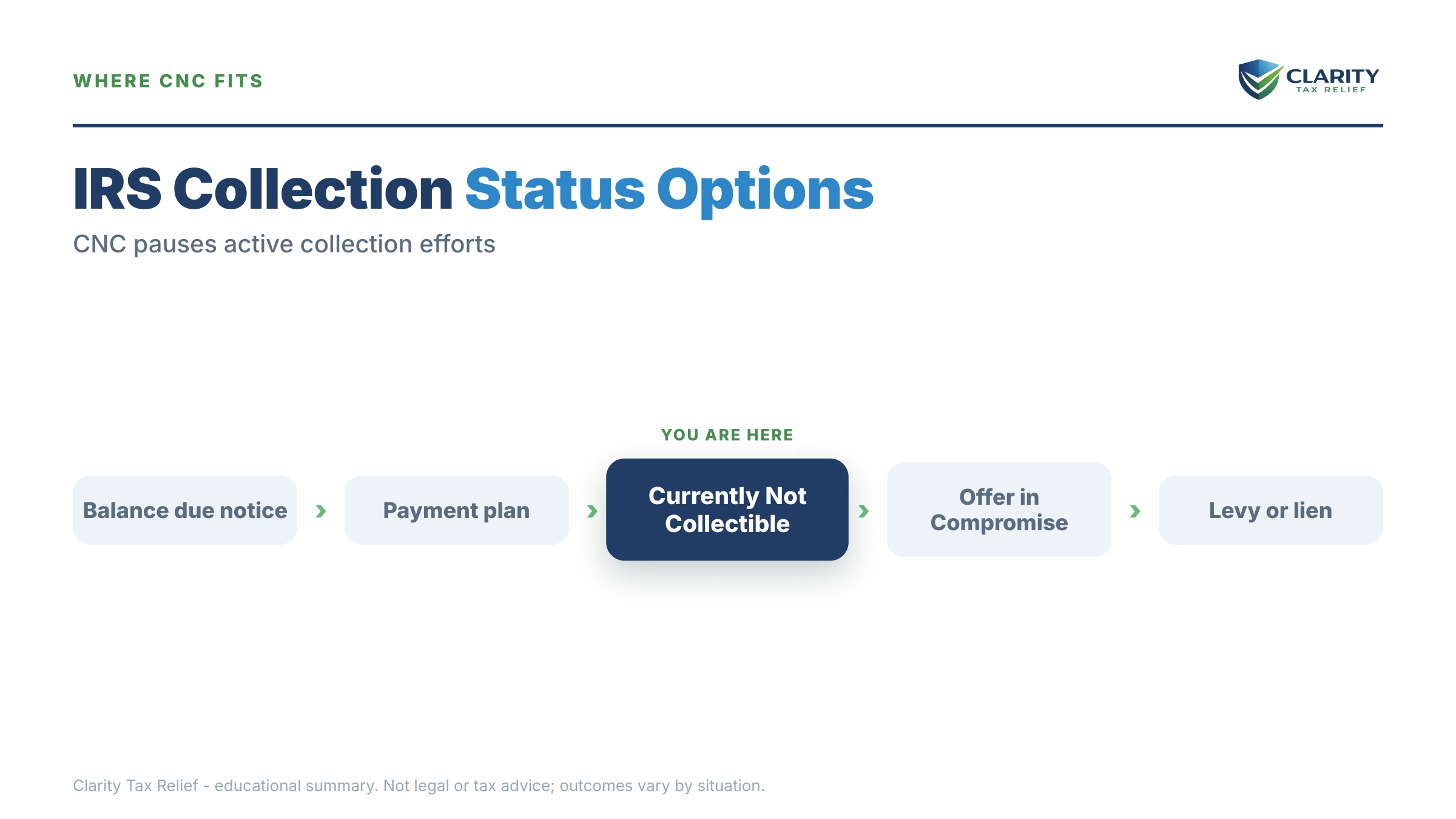
If you can't pay and never ask for CNC, the IRS's automated collection sequence ends in wage and bank levies — hardship or not. The system doesn't know your income dropped; it only knows a balance exists. Here's the stage order for a debt like $83,100:
- Balance-due and reminder notices (CP14, CP501, CP503) — bills with growing interest and penalties, no enforcement power yet.
- CP504 — Notice of Intent to Levy — the IRS can now seize your state tax refund, and a federal tax lien becomes likely.
- Passport certification — once the balance passes $66,000 (the 2026 threshold), the debt can be certified to the State Department. At $83,100, you're already in this zone — see what a passport revoked for tax debt actually means.
- LT11 / Letter 1058 — Final Notice of Intent to Levy — starts a 30-day clock and your Collection Due Process rights. After it expires, levies are legal.
- Levies — a bank levy freezes funds with a 21-day hold before the money leaves; a wage levy is continuous until released; Social Security can be reduced by up to 15% through the Federal Payment Levy Program.
The bitter irony: people who would easily qualify for CNC get levied every week, simply because they never told the IRS what a Form 433-F would have shown. Hardship protection exists — but only for people who ask for it before or after the machine strikes, never automatically.
Can't pay the IRS and the notices keep coming?
Send us your latest notice and your rough monthly numbers. An experienced tax professional will run the same allowable-expense math the IRS uses and tell you whether CNC — or something better — fits your situation. Free, confidential, no pressure, and worth doing before the next notice escalates your account.
Your options when you can't pay the IRS in full
CNC is one of five real paths for a balance you can't pay, and the right one depends on your Form 433-F math, not your preference. Here's how they compare for a debt in the $83,100 range — large enough that the easy online options are off the table:
| Option | Eligibility in 2026 | Monthly payment while active |
|---|---|---|
| Currently not collectible | Form 433-F shows income at or below allowable living expenses — no ability to pay | $0 (refunds are still kept and applied) |
| Short-term payment plan | Can pay the full balance within 180 days; $0 setup fee | Whatever retires the debt in 180 days — roughly $13,850/month at $83,100 |
| Streamlined installment agreement | Balance of $50,000 or less for the online 72-month plan — not available at $83,100 without paying the balance down first | Balance ÷ up to 72 months |
| Financially verified installment agreement | Any balance; above $50,000 the IRS requires a Form 433-F and sets the payment | Your documented ability to pay |
| Partial payment installment agreement | Can pay something, but not everything, before the collection statute expires | Ability-to-pay amount; the unpaid remainder can expire at the CSED |
| Offer in Compromise | Offer must equal or exceed what the IRS could realistically collect; roughly 1 in 5 offers were accepted in FY2024 | Lump sum, or periodic payments during review |
Notice the pattern: the same Form 433-F that proves CNC also prices every other option. A small monthly surplus points to a partial-pay agreement; a genuine zero points to CNC; a zero plus minimal assets may point to settlement — the decision framework between those last two is its own analysis, covered in CNC vs offer in compromise.
Cost and speed differ sharply between these paths too:
| Option | Upfront cost | Typical time to a decision | What happens to the balance |
|---|---|---|---|
| Currently not collectible | $0 — no application fee exists | Same phone call for clear cases; weeks to a few months when a full financial review is required | Keeps growing with interest and penalties; the 10-year collection statute keeps running |
| Installment agreement | Setup fee varies by application method; reduced or waived for low-income taxpayers | Same day online at $50,000 or under; weeks with financial review above that | Paid over up to 72 months while interest and the late-payment penalty continue |
| Partial payment installment agreement | Same setup fees, plus full financial disclosure | Weeks to months; the IRS re-reviews your finances periodically | Partially repaid; whatever remains at the CSED can expire uncollected |
| Offer in Compromise | $205 application fee plus 20% down on lump-sum offers — both waived with low-income certification (AGI at or below 250% of the poverty level) | Commonly six months to a year or more; deemed accepted if the IRS doesn't decide within 2 years | Settled for the accepted amount if you stay filing- and payment-compliant afterward |
CNC hardship math for a married couple owing $83,100: a worked example
Say you and your spouse filed jointly and owe $83,100 across three tax years — a business that failed, then a layoff, with penalties and interest doing the rest. This is a hypothetical, but the arithmetic is exactly what the IRS runs.
Start with what full repayment would demand. $83,100 ÷ 72 months ≈ $1,154 per month before the interest that keeps accruing — and because the balance is over $50,000, you couldn't even set that up online without a financial review. Now the household side:
- Monthly income: $3,900 gross wages (one spouse working) + $1,250 SSDI (the other) = $5,150.
- Allowable expenses (illustrative standards for a two-person household): food/clothing national standard $1,690 + housing/utilities county cap $2,240 + vehicle ownership and operating $1,180 + health insurance and out-of-pocket care $560 = $5,670.
- Ability to pay: $5,150 − $5,670 = −$520 per month.
A negative number means the IRS's own standards say this couple can't fund basic living and pay anything — a textbook CNC profile. The $1,154 installment payment isn't merely painful; it's mathematically impossible.
Now the edge case that decides real files: suppose their actual rent is $2,600, but the county housing cap is $2,240. The IRS may count only $2,240, cutting the shortfall from −$520 to −$160. Still negative — still CNC — but a couple with slightly higher income would have flipped to a small positive number and been steered into a payment plan instead. This is why how expenses are documented and presented matters as much as what they are. One more note for this couple: at $83,100 they're above the $66,000 passport certification threshold, and getting the account into CNC hardship status is generally what keeps — or gets — their passports clear.
How to request currently not collectible status, step by step
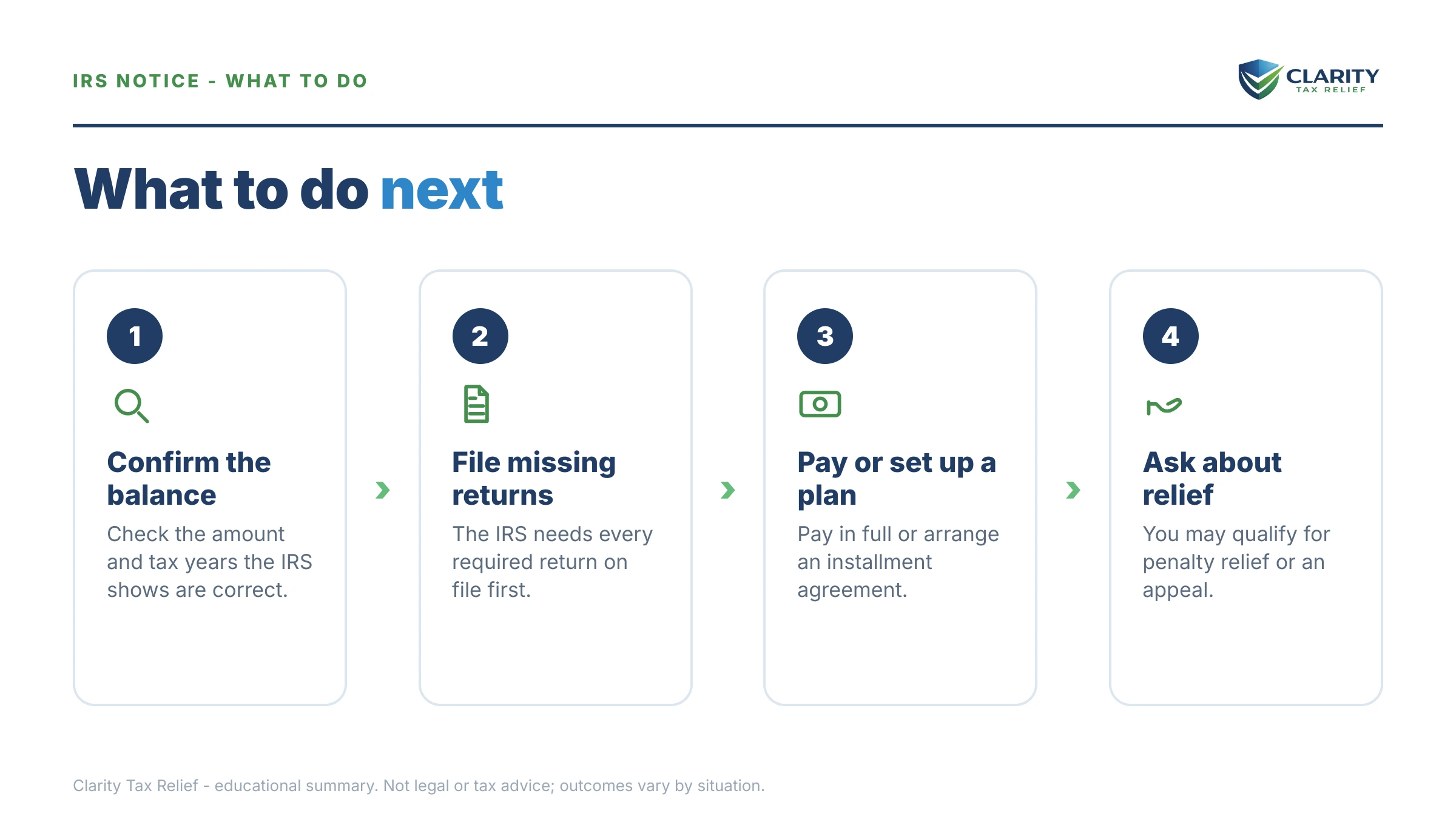
- Gather three months of financial records. Collect pay stubs, benefit award letters, bank statements, rent or mortgage statements, utility bills, and medical bills for the last three months, plus your most recent tax return.
- Complete Form 433-F, Collection Information Statement. List every income source and monthly expense honestly. Use the IRS allowable living expense standards for your household size and county — this form's numbers, not the letter, decide your case.
- Write a one-page hardship letter. State what changed, when it changed, and what your monthly shortfall is. Reference the documents you're attaching and ask that your account be placed in currently not collectible status.
- Call the number on your most recent IRS notice. Request currently not collectible status and be ready to read your 433-F figures to the agent. If a revenue officer is assigned to your case, send the package directly to that officer instead.
- Confirm the status in writing or on your transcript. Ask the agent to confirm the closing action, then verify that transaction code 530 posts to your account transcript. Keep a copy of your full package in case the IRS asks again.
What happens after the IRS marks your account currently not collectible
CNC pauses collection — it does not erase, reduce, or freeze the debt. Once approved, here's what actually changes and what doesn't:
- Your transcript shows code 530. That's the closing transaction — our guide to code 530 on your transcript shows what it looks like and how to confirm the status is active.
- Levies and garnishments stop. Active levies should be released once the account closes; no new enforcement issues while the status holds.
- The balance keeps growing. Interest and the 0.5%-per-month failure-to-pay penalty continue to accrue the entire time.
- Refunds are gone until it's resolved. Every tax refund you'd otherwise receive is kept and applied to the balance, year after year.
- A lien is on the table. The IRS commonly files a Notice of Federal Tax Lien when it closes a balance over $10,000 as uncollectible — the full picture is in does CNC stop a tax lien.
- You'll get a CP71 every year. That annual balance reminder is informational, not a new collection action — here's what a CP71 notice means.
- The 10-year clock keeps running. CNC does not pause the collection statute. If your finances never recover, the debt can expire at the CSED — you can estimate your CSED with our calculator, keeping in mind that appeals, offers, and bankruptcy filings pause the clock.
The status isn't permanent. The IRS sets an income threshold when it closes your account; a future tax return showing income above it triggers a fresh review, and the account can return to active collections. How long the pause realistically holds — and what triggers the end of it — is covered in how long does currently not collectible last. The one behavior that protects the status more than anything else: keep filing every return, on time, every year.
Special situations that change the CNC answer
Married filing jointly. On a joint debt, the IRS evaluates the whole household — both incomes, both sets of expenses, family-size expense standards. One spouse returning to work mid-request changes the math immediately, so run the numbers on current income, not last year's. If only one spouse owes (a debt from before the marriage, for example), the non-liable spouse's income generally enters the calculation only to allocate their share of household expenses — a nuance worth getting right before you submit anything.
Fixed income and Social Security. Retirees and disability recipients are among the strongest CNC candidates, because fixed benefits rarely exceed allowable expenses — and because the alternative is a 15% levy on those same benefits through the Federal Payment Levy Program. The fixed-income playbook is its own article: IRS hardship on Social Security.
Self-employed or 1099 income. Hardship with business income is harder to document — the IRS wants profit-and-loss detail, and variable income invites skepticism. Expect the longer Form 433-A and more scrutiny of business expenses, and expect the IRS to require any missing returns before it will close the account.
Multiple years and unfiled returns. CNC covers the account, not a single year — but the IRS will generally want your filing brought current first. If several unfiled years are in the mix, file them (or submit them with the package) before requesting the status; an SFR assessment the IRS created for you may also be worth correcting first, since it's usually inflated.
State tax debt. Nothing on this page transfers to your state. California's Franchise Tax Board, for example, runs its own hardship status under its own rules — and collects for 20 years, not 10 — so the waiting-it-out strategy works very differently there. Start with FTB currently not collectible if California is part of your problem, and check your own state agency's program directly for anywhere else.
When you can handle this yourself — and when help changes the outcome
Plenty of people get CNC on their own, and you may be one of them. Handle it yourself if: your income is clearly below the expense standards (fixed benefits only, for example), you have one or two tax years involved, all returns are filed, and you're comfortable spending time on hold with ACS reading your 433-F numbers to an agent. There's no fee, no magic language, and the IRS's own phone agents grant clear-cut cases routinely.
Experienced help tends to change outcomes in four situations: a levy is already in motion (release requests have their own urgency and sequence), a revenue officer is assigned (the standards get applied more aggressively and deadlines are real), the math is borderline (whether a $300 surplus becomes CNC, a partial-pay plan, or a $1,000 payment often turns on how expenses are documented and which standards apply), and business or multiple-year debt with unfiled returns (the order you fix things in changes the final number). At $83,100 with a lien and passport certification in play, the borderline-math scenario alone usually justifies a professional look before you submit.
Not sure which side of that line you're on? A free case review takes about 20 minutes and tells you whether your file is a phone-call case or a fight — before interest adds another month to the balance.
Terms on your CNC paperwork, decoded
- Currently not collectible (CNC): the IRS status that pauses active collection because paying would prevent you from meeting basic living expenses — the debt itself remains.
- Form 433-F: the two-page Collection Information Statement listing your income, assets, and monthly expenses; it's the actual evidence a CNC decision rests on.
- Allowable living expense (ALE) standards: the IRS's own tables for what food, housing, transportation, and health care "should" cost — your expenses are measured against these, not your receipts alone.
- Transaction code 530: the transcript entry showing your account was closed as uncollectible; its presence is how you verify CNC actually took effect.
- CSED: the Collection Statute Expiration Date — 10 years from assessment, after which unpaid tax generally expires; it keeps running during CNC but pauses during appeals, offers, and bankruptcy.
- CP71: the annual reminder notice everyone in CNC receives; it restates the growing balance but demands no action.
IRS hardship letter and CNC questions, answered
Do I need to write a hardship letter to get currently not collectible status?
No — the IRS grants CNC based on the financial figures in Form 433-F, and many people are placed in CNC over the phone without any letter at all. A short hardship letter still helps: it organizes your story, ties your documents together, and gives the agent a clear reason to code the account correctly. Think of it as the cover page, not the application.
Is there an official IRS hardship form?
The closest thing is Form 433-F, Collection Information Statement — the form the IRS uses to measure your income against allowable living expenses. Revenue officers on larger cases use the longer Form 433-A instead. There is no IRS form literally called a hardship letter; anything with that name is a supporting narrative you write yourself.
How long does it take the IRS to approve currently not collectible status?
It can happen on a single phone call if your balance is modest and your figures clearly show hardship. Cases that need a full Form 433-F review, or that are assigned to a revenue officer, commonly take several weeks to a few months. With the IRS workforce down roughly 27% since 2025, phone waits are longer — but the automated levy systems never slowed, so start before a final notice arrives.
Does currently not collectible status forgive my tax debt?
No. CNC pauses active collection — no levies, no garnishments — but the balance keeps growing with interest and the failure-to-pay penalty, and the IRS keeps every tax refund you're owed. The 10-year collection statute keeps running during CNC, so debt that stays uncollectible long enough can eventually expire, but nothing is written off the day you're approved.
Will the IRS file a tax lien while I'm in CNC?
It can, and it commonly does when the balance exceeds $10,000 at the time the account is closed as uncollectible. A lien is a public claim against your property, not a seizure — it protects the government's position but takes nothing out of your bank account. The lien is released when the debt is paid, settled, or expires.
Can a married couple qualify for CNC if one spouse still works?
Yes, if the household's total income still doesn't cover IRS-allowed living expenses for the family size. On a jointly owed debt, the IRS looks at both spouses' income and expenses together, so one working spouse doesn't disqualify you — it just raises the income side of the math. If only one spouse owes the tax, the analysis gets more nuanced and the non-liable spouse's income is generally used only to determine their share of household expenses.
Does CNC stop passport certification for tax debt over $66,000?
Generally, yes. Accounts in CNC hardship status are typically excluded from seriously delinquent tax debt certification, which starts at $66,000 in 2026, and an existing certification is generally reversed once CNC is granted. Timing matters: certification can happen before your CNC request is processed, so ask about your passport status when you call.
Is there an income limit for currently not collectible status?
No fixed dollar limit exists. CNC is a math test — monthly income minus IRS allowable living expense standards for your county and household size — so a family with $6,000 of income and $6,300 of allowed expenses can qualify while a single filer earning half that may not. The standards, not your gross income, decide it.
Do I have to reapply for CNC every year?
No. Once granted, CNC stays in place until the IRS's systems flag a change — usually a filed tax return showing income above the threshold set when your account was closed. You'll receive an annual CP71 reminder notice of the balance, which is informational, not a demand. Keep filing every year; an unfiled return is one of the fastest ways to get pulled back into collections.
Your next 24 hours
- Find your latest notice and total the damage. Pull every IRS letter you have, note the notice number and date on the most recent one, and add up the balances across all years — that total decides which options are even on the table.
- Gather the proof. Three months of pay stubs or benefit statements, three months of bank statements, your rent or mortgage statement, utility and medical bills, and your last filed tax return — the entire CNC package comes from this pile.
- Get the math checked before you call the IRS. Fill out the 2-minute form or call (888) 825-7779 for a free case review — an experienced tax professional will run the allowable-expense calculation and tell you whether CNC fits, while interest is still the only thing moving against you.
Primary sources if you want to go deeper: the IRS's official page for Form 433-F, Collection Information Statement, the IRS payments hub for every payment and plan option, and the Taxpayer Advocate Service if a hardship request stalls or a levy is causing immediate harm.
This guide is general information, not tax or legal advice for your specific situation. Eligibility for IRS programs depends on individual facts and circumstances; no outcome is guaranteed.